KEYS 4011: Torture Laws, Solitary Confinement, and Analysis Report
VerifiedAdded on 2022/11/24
|15
|2406
|288
Report
AI Summary
This report provides a comprehensive analysis of international torture laws and the practice of solitary confinement, drawing upon the work of Dewulf and Haney. The report begins by outlining key international legal frameworks, including the Universal Declaration on Human Rights, the International Covenant on Civil and Political Rights, and the UN Convention Against Torture (UNCAT), among others. It then details the specific elements of torture as defined in international jurisprudence, such as the infliction of severe physical or mental pain, the role of acts or omissions, intent, specific purpose, the perpetrator, and the victim. The core of the report analyzes whether solitary confinement rises to the level of torture based on these six elements, examining the health impacts of confinement, including stress, insomnia, and psychological distress. The report concludes that solitary confinement can constitute torture due to its severe physiological and psychological effects, and it calls for exploring alternatives to solitary confinement to protect the well-being of inmates. The analysis includes a discussion of relevant case law and legal definitions, providing a thorough examination of the issue.

Running head: KEYS 4011
Keys 4011
Keys 4011
Paraphrase This Document
Need a fresh take? Get an instant paraphrase of this document with our AI Paraphraser

KEYS 4011 1
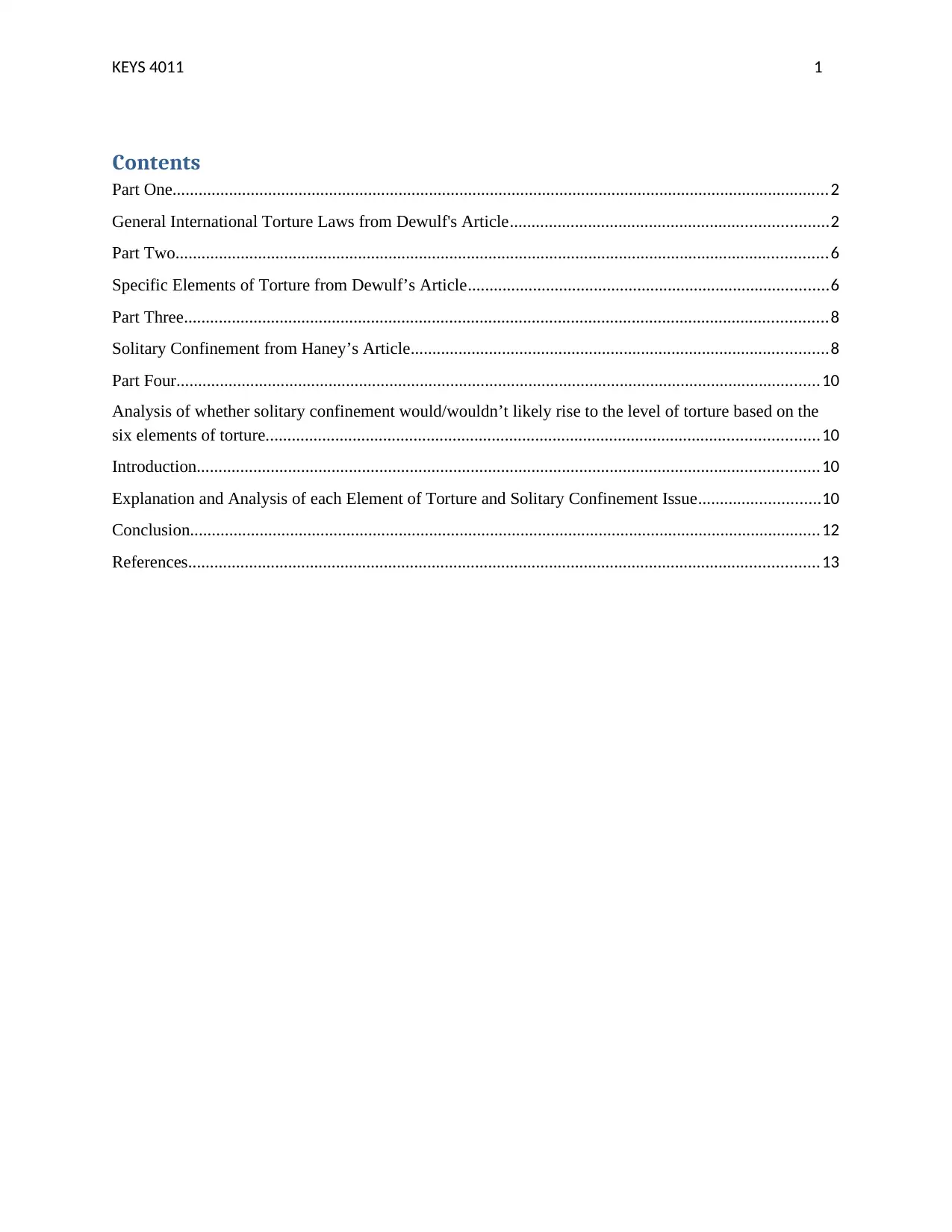
Contents
Part One.......................................................................................................................................................2
General International Torture Laws from Dewulf's Article.........................................................................2
Part Two......................................................................................................................................................6
Specific Elements of Torture from Dewulf’s Article...................................................................................6
Part Three....................................................................................................................................................8
Solitary Confinement from Haney’s Article................................................................................................8
Part Four....................................................................................................................................................10
Analysis of whether solitary confinement would/wouldn’t likely rise to the level of torture based on the
six elements of torture...............................................................................................................................10
Introduction...............................................................................................................................................10
Explanation and Analysis of each Element of Torture and Solitary Confinement Issue............................10
Conclusion.................................................................................................................................................12
References.................................................................................................................................................13
Contents
Part One.......................................................................................................................................................2
General International Torture Laws from Dewulf's Article.........................................................................2
Part Two......................................................................................................................................................6
Specific Elements of Torture from Dewulf’s Article...................................................................................6
Part Three....................................................................................................................................................8
Solitary Confinement from Haney’s Article................................................................................................8
Part Four....................................................................................................................................................10
Analysis of whether solitary confinement would/wouldn’t likely rise to the level of torture based on the
six elements of torture...............................................................................................................................10
Introduction...............................................................................................................................................10
Explanation and Analysis of each Element of Torture and Solitary Confinement Issue............................10
Conclusion.................................................................................................................................................12
References.................................................................................................................................................13

KEYS 4011 2
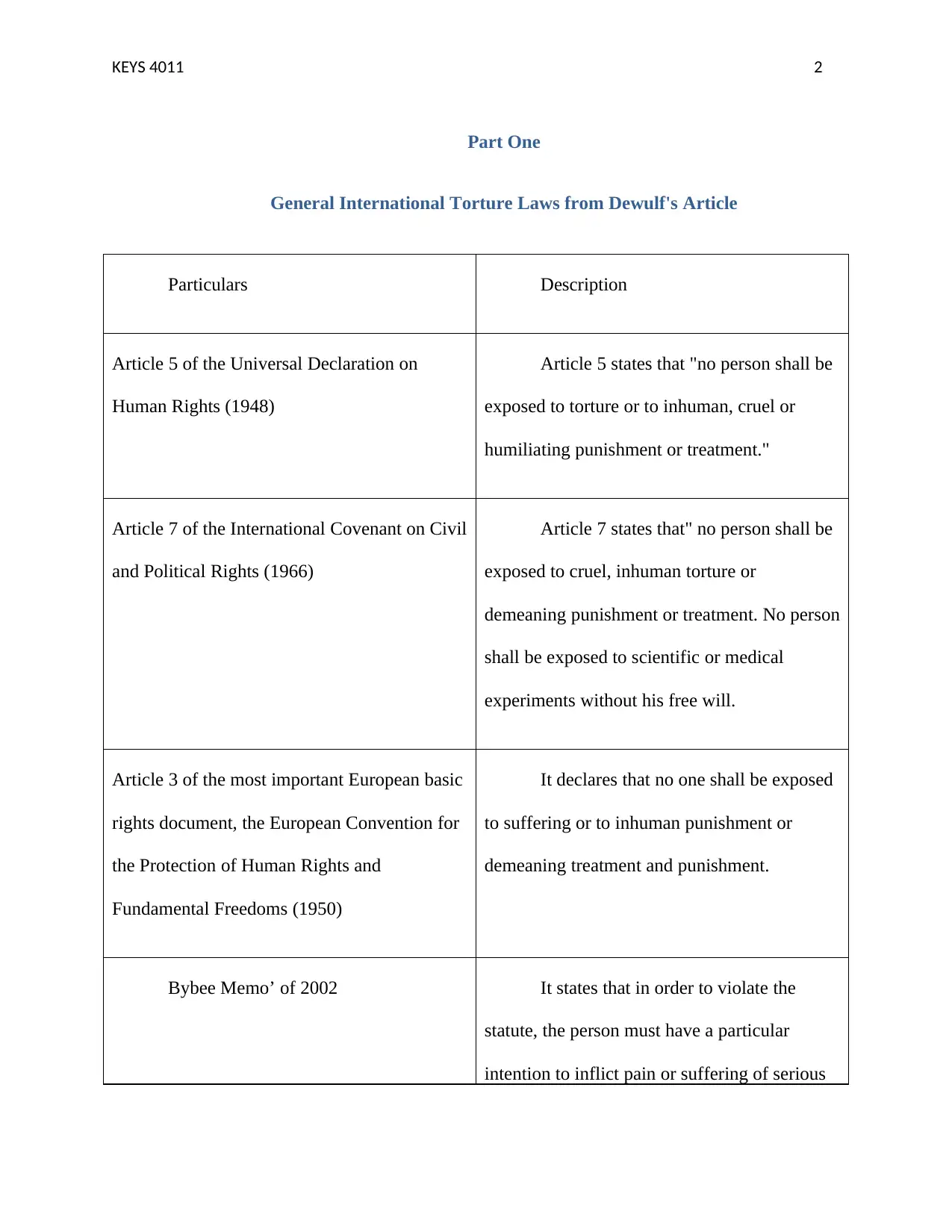
Part One
General International Torture Laws from Dewulf's Article
Particulars Description
Article 5 of the Universal Declaration on
Human Rights (1948)
Article 5 states that "no person shall be
exposed to torture or to inhuman, cruel or
humiliating punishment or treatment."
Article 7 of the International Covenant on Civil
and Political Rights (1966)
Article 7 states that" no person shall be
exposed to cruel, inhuman torture or
demeaning punishment or treatment. No person
shall be exposed to scientific or medical
experiments without his free will.
Article 3 of the most important European basic
rights document, the European Convention for
the Protection of Human Rights and
Fundamental Freedoms (1950)
It declares that no one shall be exposed
to suffering or to inhuman punishment or
demeaning treatment and punishment.
Bybee Memo’ of 2002 It states that in order to violate the
statute, the person must have a particular
intention to inflict pain or suffering of serious
Part One
General International Torture Laws from Dewulf's Article
Particulars Description
Article 5 of the Universal Declaration on
Human Rights (1948)
Article 5 states that "no person shall be
exposed to torture or to inhuman, cruel or
humiliating punishment or treatment."
Article 7 of the International Covenant on Civil
and Political Rights (1966)
Article 7 states that" no person shall be
exposed to cruel, inhuman torture or
demeaning punishment or treatment. No person
shall be exposed to scientific or medical
experiments without his free will.
Article 3 of the most important European basic
rights document, the European Convention for
the Protection of Human Rights and
Fundamental Freedoms (1950)
It declares that no one shall be exposed
to suffering or to inhuman punishment or
demeaning treatment and punishment.
Bybee Memo’ of 2002 It states that in order to violate the
statute, the person must have a particular
intention to inflict pain or suffering of serious
⊘ This is a preview!⊘
Do you want full access?
Subscribe today to unlock all pages.

Trusted by 1+ million students worldwide

KEYS 4011 3
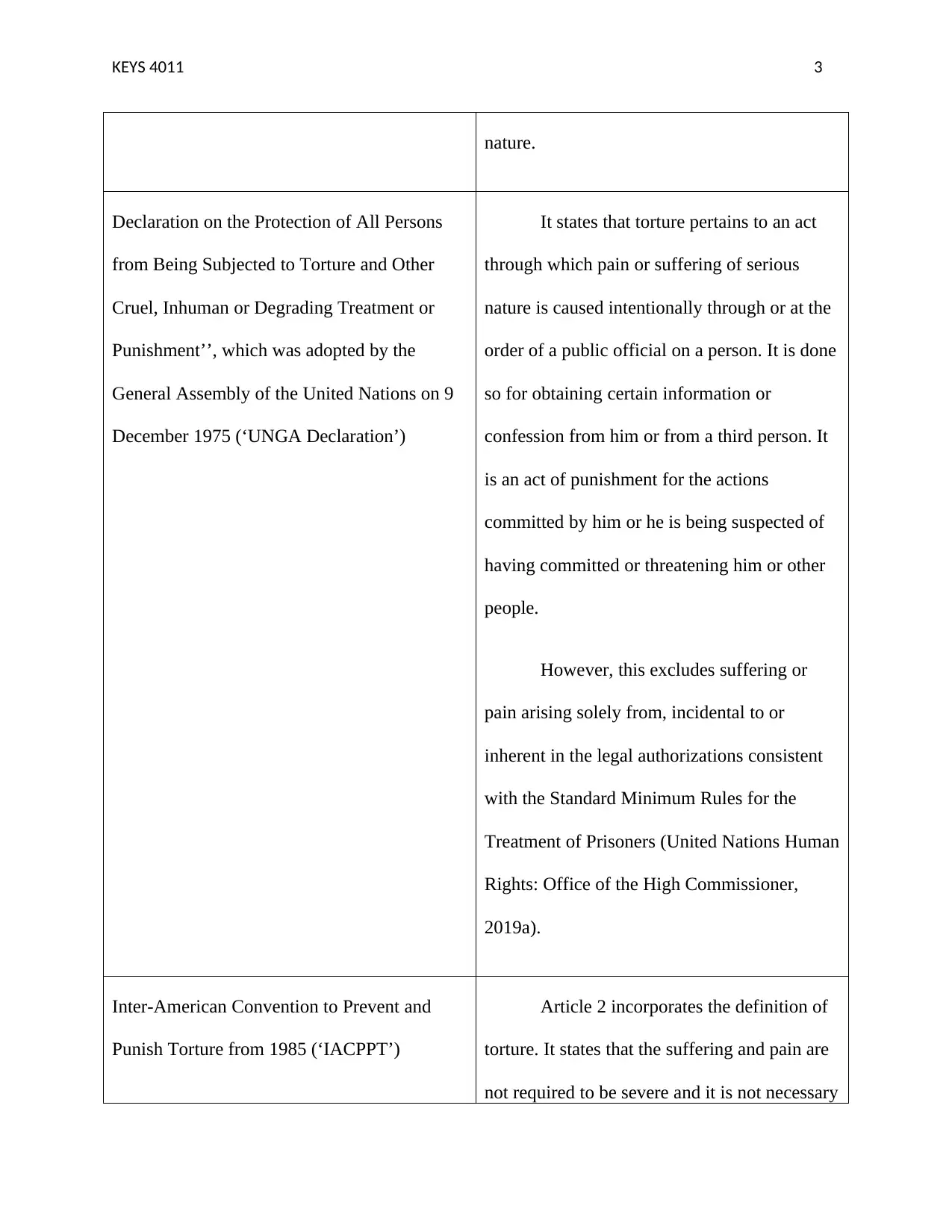
nature.
Declaration on the Protection of All Persons
from Being Subjected to Torture and Other
Cruel, Inhuman or Degrading Treatment or
Punishment’’, which was adopted by the
General Assembly of the United Nations on 9
December 1975 (‘UNGA Declaration’)
It states that torture pertains to an act
through which pain or suffering of serious
nature is caused intentionally through or at the
order of a public official on a person. It is done
so for obtaining certain information or
confession from him or from a third person. It
is an act of punishment for the actions
committed by him or he is being suspected of
having committed or threatening him or other
people.
However, this excludes suffering or
pain arising solely from, incidental to or
inherent in the legal authorizations consistent
with the Standard Minimum Rules for the
Treatment of Prisoners (United Nations Human
Rights: Office of the High Commissioner,
2019a).
Inter-American Convention to Prevent and
Punish Torture from 1985 (‘IACPPT’)
Article 2 incorporates the definition of
torture. It states that the suffering and pain are
not required to be severe and it is not necessary
nature.
Declaration on the Protection of All Persons
from Being Subjected to Torture and Other
Cruel, Inhuman or Degrading Treatment or
Punishment’’, which was adopted by the
General Assembly of the United Nations on 9
December 1975 (‘UNGA Declaration’)
It states that torture pertains to an act
through which pain or suffering of serious
nature is caused intentionally through or at the
order of a public official on a person. It is done
so for obtaining certain information or
confession from him or from a third person. It
is an act of punishment for the actions
committed by him or he is being suspected of
having committed or threatening him or other
people.
However, this excludes suffering or
pain arising solely from, incidental to or
inherent in the legal authorizations consistent
with the Standard Minimum Rules for the
Treatment of Prisoners (United Nations Human
Rights: Office of the High Commissioner,
2019a).
Inter-American Convention to Prevent and
Punish Torture from 1985 (‘IACPPT’)
Article 2 incorporates the definition of
torture. It states that the suffering and pain are
not required to be severe and it is not necessary
Paraphrase This Document
Need a fresh take? Get an instant paraphrase of this document with our AI Paraphraser

KEYS 4011 4
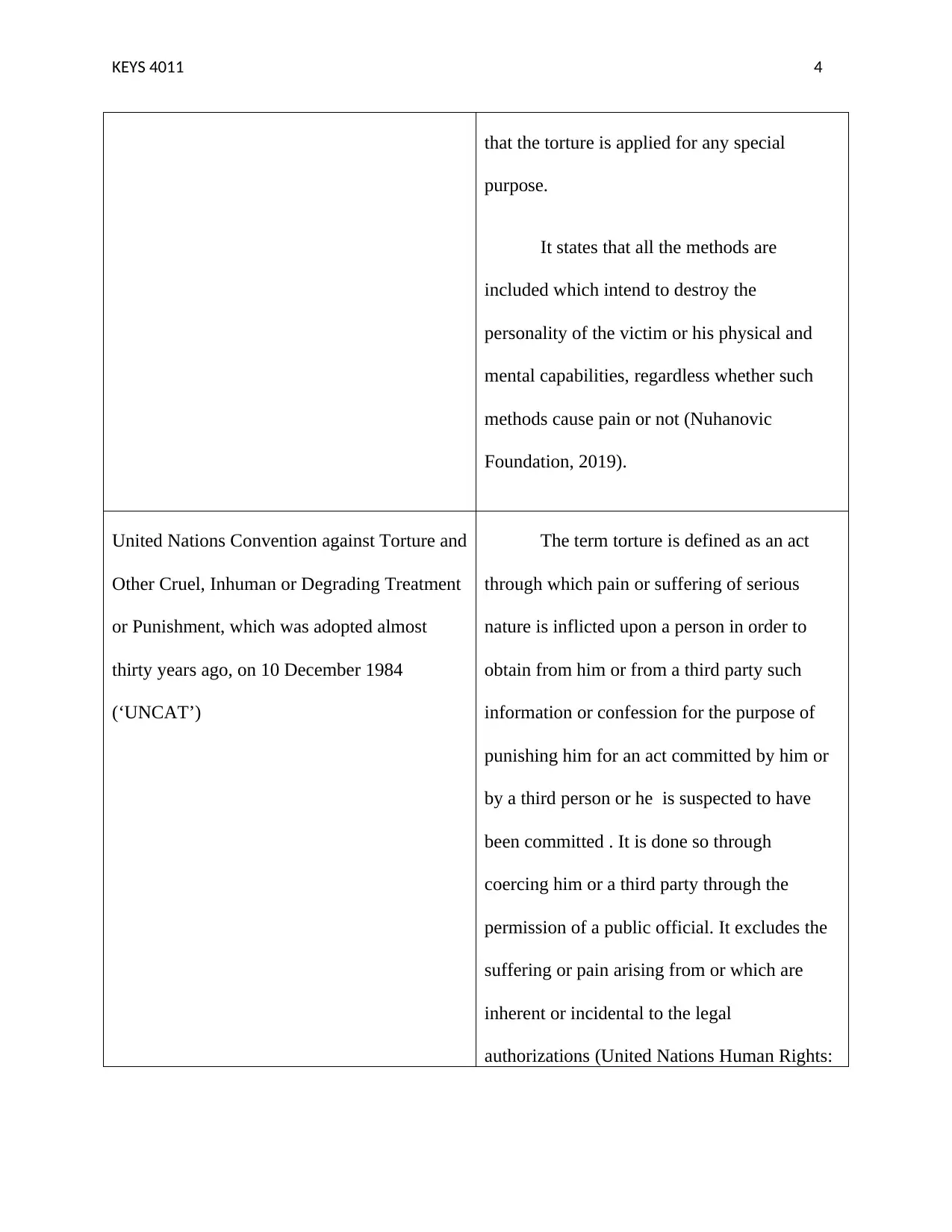
that the torture is applied for any special
purpose.
It states that all the methods are
included which intend to destroy the
personality of the victim or his physical and
mental capabilities, regardless whether such
methods cause pain or not (Nuhanovic
Foundation, 2019).
United Nations Convention against Torture and
Other Cruel, Inhuman or Degrading Treatment
or Punishment, which was adopted almost
thirty years ago, on 10 December 1984
(‘UNCAT’)
The term torture is defined as an act
through which pain or suffering of serious
nature is inflicted upon a person in order to
obtain from him or from a third party such
information or confession for the purpose of
punishing him for an act committed by him or
by a third person or he is suspected to have
been committed . It is done so through
coercing him or a third party through the
permission of a public official. It excludes the
suffering or pain arising from or which are
inherent or incidental to the legal
authorizations (United Nations Human Rights:
that the torture is applied for any special
purpose.
It states that all the methods are
included which intend to destroy the
personality of the victim or his physical and
mental capabilities, regardless whether such
methods cause pain or not (Nuhanovic
Foundation, 2019).
United Nations Convention against Torture and
Other Cruel, Inhuman or Degrading Treatment
or Punishment, which was adopted almost
thirty years ago, on 10 December 1984
(‘UNCAT’)
The term torture is defined as an act
through which pain or suffering of serious
nature is inflicted upon a person in order to
obtain from him or from a third party such
information or confession for the purpose of
punishing him for an act committed by him or
by a third person or he is suspected to have
been committed . It is done so through
coercing him or a third party through the
permission of a public official. It excludes the
suffering or pain arising from or which are
inherent or incidental to the legal
authorizations (United Nations Human Rights:

KEYS 4011 5
Office of the High Commissioner, 2019b).
⊘ This is a preview!⊘
Do you want full access?
Subscribe today to unlock all pages.

Trusted by 1+ million students worldwide

KEYS 4011 6
Part Two
Specific Elements of Torture from Dewulf’s Article
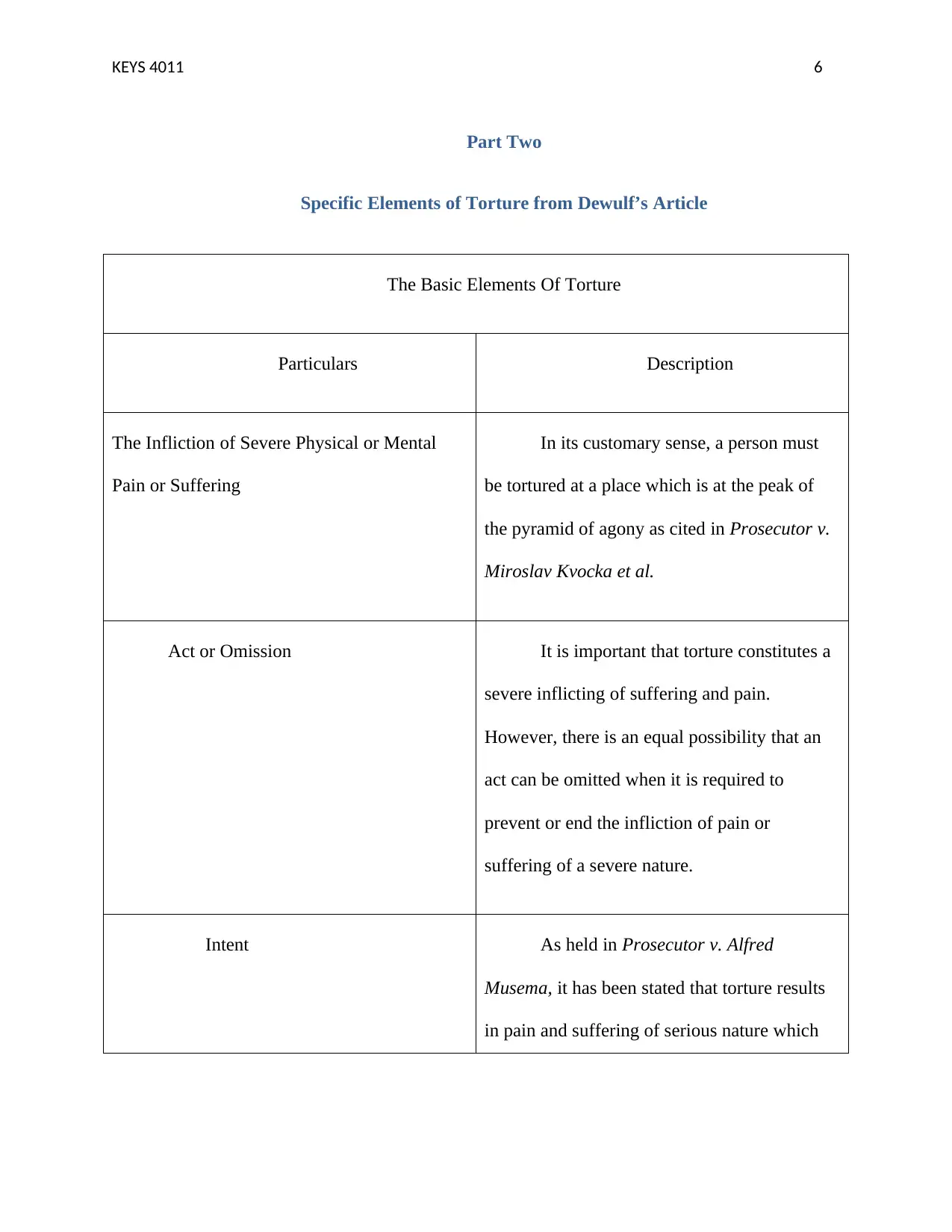
The Basic Elements Of Torture
Particulars Description
The Infliction of Severe Physical or Mental
Pain or Suffering
In its customary sense, a person must
be tortured at a place which is at the peak of
the pyramid of agony as cited in Prosecutor v.
Miroslav Kvocka et al.
Act or Omission It is important that torture constitutes a
severe inflicting of suffering and pain.
However, there is an equal possibility that an
act can be omitted when it is required to
prevent or end the infliction of pain or
suffering of a severe nature.
Intent As held in Prosecutor v. Alfred
Musema, it has been stated that torture results
in pain and suffering of serious nature which
Part Two
Specific Elements of Torture from Dewulf’s Article
The Basic Elements Of Torture
Particulars Description
The Infliction of Severe Physical or Mental
Pain or Suffering
In its customary sense, a person must
be tortured at a place which is at the peak of
the pyramid of agony as cited in Prosecutor v.
Miroslav Kvocka et al.
Act or Omission It is important that torture constitutes a
severe inflicting of suffering and pain.
However, there is an equal possibility that an
act can be omitted when it is required to
prevent or end the infliction of pain or
suffering of a severe nature.
Intent As held in Prosecutor v. Alfred
Musema, it has been stated that torture results
in pain and suffering of serious nature which
Paraphrase This Document
Need a fresh take? Get an instant paraphrase of this document with our AI Paraphraser

KEYS 4011 7
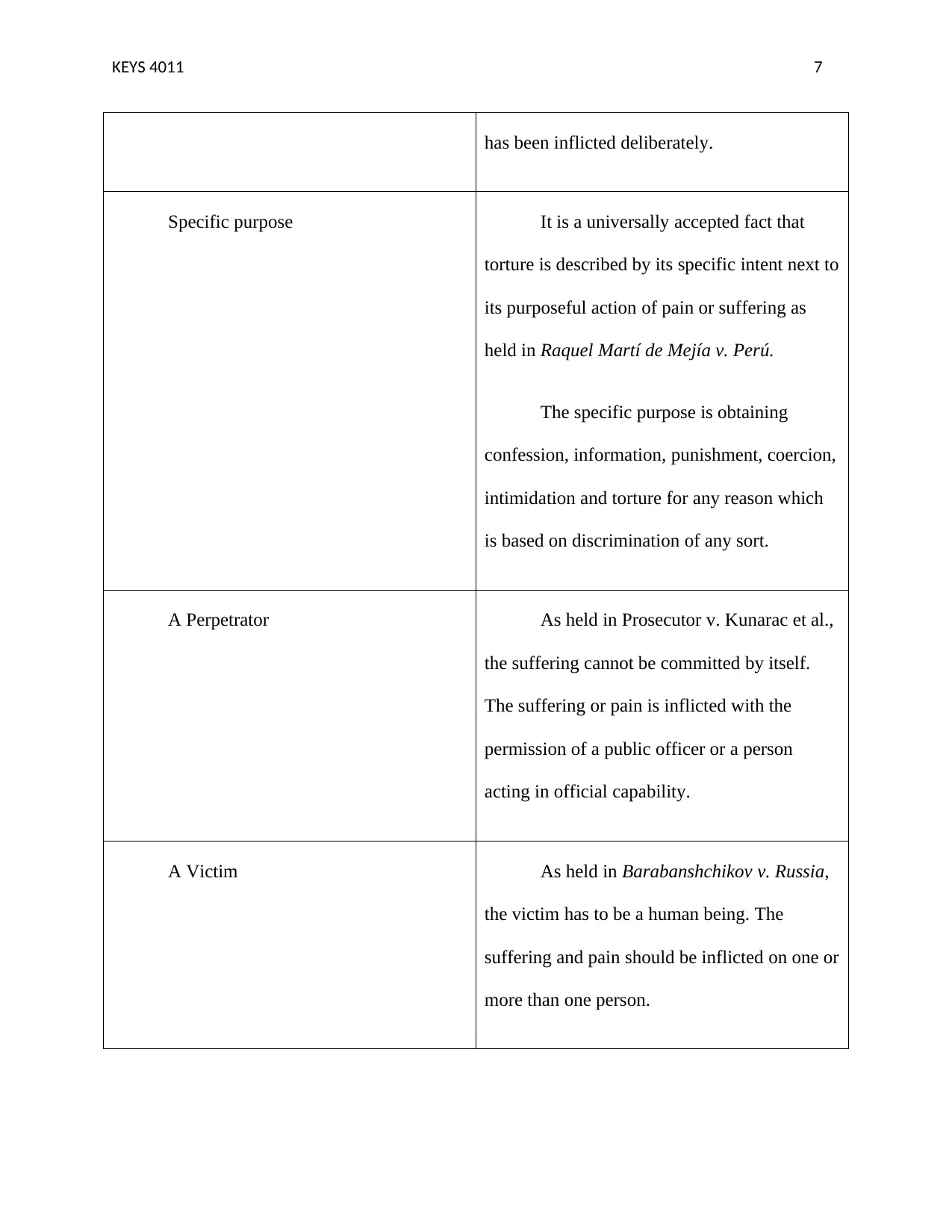
has been inflicted deliberately.
Specific purpose It is a universally accepted fact that
torture is described by its specific intent next to
its purposeful action of pain or suffering as
held in Raquel Martí de Mejía v. Perú.
The specific purpose is obtaining
confession, information, punishment, coercion,
intimidation and torture for any reason which
is based on discrimination of any sort.
A Perpetrator As held in Prosecutor v. Kunarac et al.,
the suffering cannot be committed by itself.
The suffering or pain is inflicted with the
permission of a public officer or a person
acting in official capability.
A Victim As held in Barabanshchikov v. Russia,
the victim has to be a human being. The
suffering and pain should be inflicted on one or
more than one person.
has been inflicted deliberately.
Specific purpose It is a universally accepted fact that
torture is described by its specific intent next to
its purposeful action of pain or suffering as
held in Raquel Martí de Mejía v. Perú.
The specific purpose is obtaining
confession, information, punishment, coercion,
intimidation and torture for any reason which
is based on discrimination of any sort.
A Perpetrator As held in Prosecutor v. Kunarac et al.,
the suffering cannot be committed by itself.
The suffering or pain is inflicted with the
permission of a public officer or a person
acting in official capability.
A Victim As held in Barabanshchikov v. Russia,
the victim has to be a human being. The
suffering and pain should be inflicted on one or
more than one person.

KEYS 4011 8
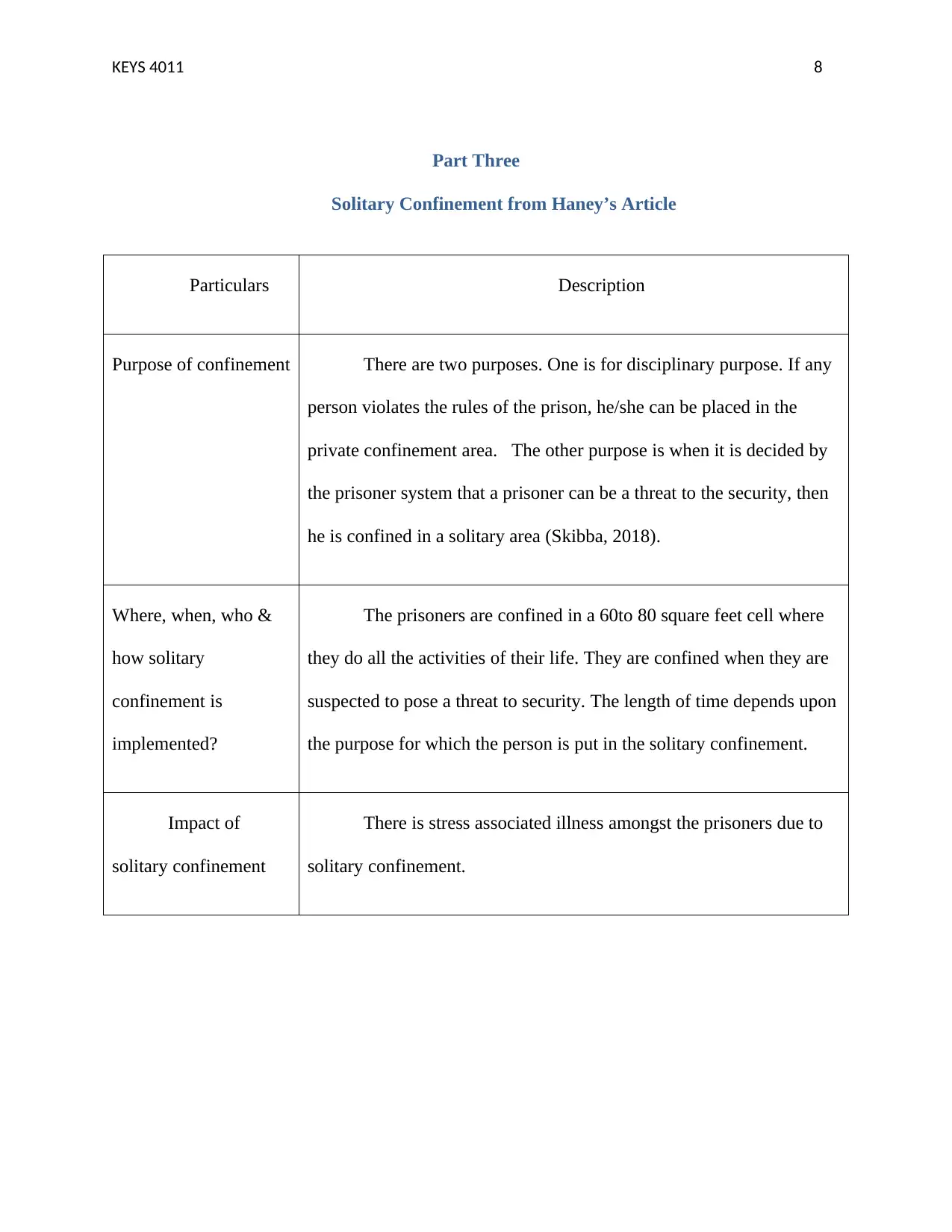
Part Three
Solitary Confinement from Haney’s Article
Particulars Description
Purpose of confinement There are two purposes. One is for disciplinary purpose. If any
person violates the rules of the prison, he/she can be placed in the
private confinement area. The other purpose is when it is decided by
the prisoner system that a prisoner can be a threat to the security, then
he is confined in a solitary area (Skibba, 2018).
Where, when, who &
how solitary
confinement is
implemented?
The prisoners are confined in a 60to 80 square feet cell where
they do all the activities of their life. They are confined when they are
suspected to pose a threat to security. The length of time depends upon
the purpose for which the person is put in the solitary confinement.
Impact of
solitary confinement
There is stress associated illness amongst the prisoners due to
solitary confinement.
Part Three
Solitary Confinement from Haney’s Article
Particulars Description
Purpose of confinement There are two purposes. One is for disciplinary purpose. If any
person violates the rules of the prison, he/she can be placed in the
private confinement area. The other purpose is when it is decided by
the prisoner system that a prisoner can be a threat to the security, then
he is confined in a solitary area (Skibba, 2018).
Where, when, who &
how solitary
confinement is
implemented?
The prisoners are confined in a 60to 80 square feet cell where
they do all the activities of their life. They are confined when they are
suspected to pose a threat to security. The length of time depends upon
the purpose for which the person is put in the solitary confinement.
Impact of
solitary confinement
There is stress associated illness amongst the prisoners due to
solitary confinement.
⊘ This is a preview!⊘
Do you want full access?
Subscribe today to unlock all pages.

Trusted by 1+ million students worldwide

KEYS 4011 9
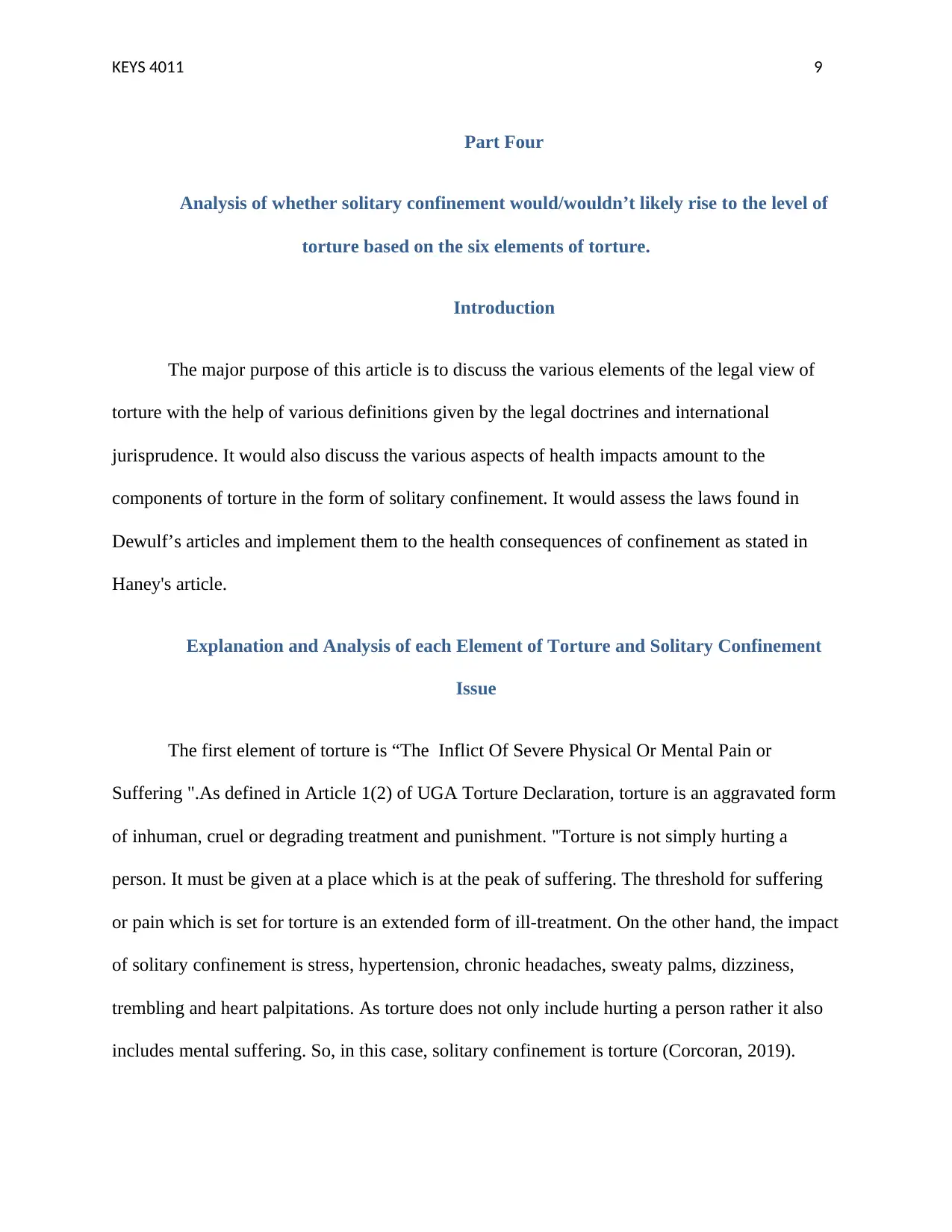
Part Four
Analysis of whether solitary confinement would/wouldn’t likely rise to the level of
torture based on the six elements of torture.
Introduction
The major purpose of this article is to discuss the various elements of the legal view of
torture with the help of various definitions given by the legal doctrines and international
jurisprudence. It would also discuss the various aspects of health impacts amount to the
components of torture in the form of solitary confinement. It would assess the laws found in
Dewulf’s articles and implement them to the health consequences of confinement as stated in
Haney's article.
Explanation and Analysis of each Element of Torture and Solitary Confinement
Issue
The first element of torture is “The Inflict Of Severe Physical Or Mental Pain or
Suffering ".As defined in Article 1(2) of UGA Torture Declaration, torture is an aggravated form
of inhuman, cruel or degrading treatment and punishment. "Torture is not simply hurting a
person. It must be given at a place which is at the peak of suffering. The threshold for suffering
or pain which is set for torture is an extended form of ill-treatment. On the other hand, the impact
of solitary confinement is stress, hypertension, chronic headaches, sweaty palms, dizziness,
trembling and heart palpitations. As torture does not only include hurting a person rather it also
includes mental suffering. So, in this case, solitary confinement is torture (Corcoran, 2019).
Part Four
Analysis of whether solitary confinement would/wouldn’t likely rise to the level of
torture based on the six elements of torture.
Introduction
The major purpose of this article is to discuss the various elements of the legal view of
torture with the help of various definitions given by the legal doctrines and international
jurisprudence. It would also discuss the various aspects of health impacts amount to the
components of torture in the form of solitary confinement. It would assess the laws found in
Dewulf’s articles and implement them to the health consequences of confinement as stated in
Haney's article.
Explanation and Analysis of each Element of Torture and Solitary Confinement
Issue
The first element of torture is “The Inflict Of Severe Physical Or Mental Pain or
Suffering ".As defined in Article 1(2) of UGA Torture Declaration, torture is an aggravated form
of inhuman, cruel or degrading treatment and punishment. "Torture is not simply hurting a
person. It must be given at a place which is at the peak of suffering. The threshold for suffering
or pain which is set for torture is an extended form of ill-treatment. On the other hand, the impact
of solitary confinement is stress, hypertension, chronic headaches, sweaty palms, dizziness,
trembling and heart palpitations. As torture does not only include hurting a person rather it also
includes mental suffering. So, in this case, solitary confinement is torture (Corcoran, 2019).
Paraphrase This Document
Need a fresh take? Get an instant paraphrase of this document with our AI Paraphraser

KEYS 4011 10
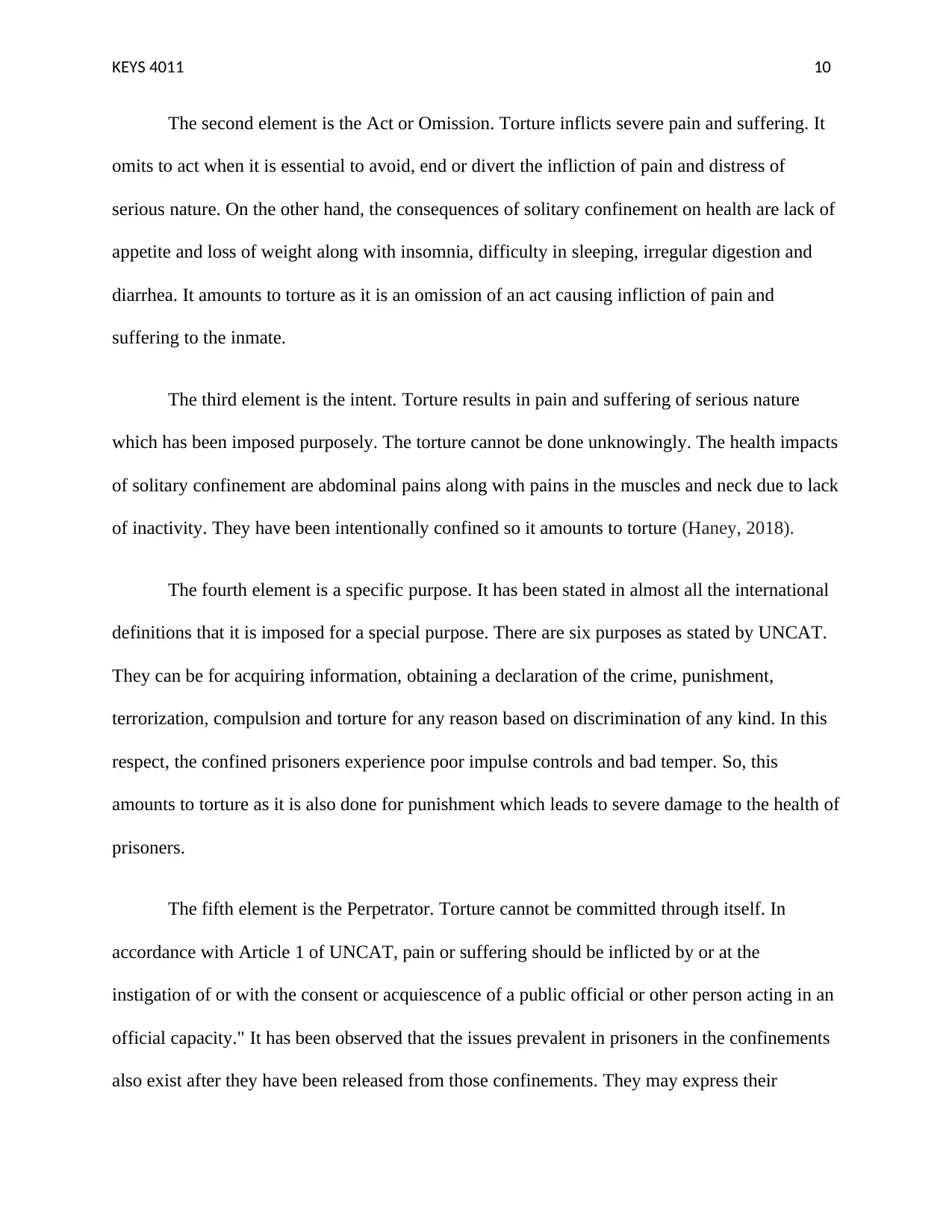
The second element is the Act or Omission. Torture inflicts severe pain and suffering. It
omits to act when it is essential to avoid, end or divert the infliction of pain and distress of
serious nature. On the other hand, the consequences of solitary confinement on health are lack of
appetite and loss of weight along with insomnia, difficulty in sleeping, irregular digestion and
diarrhea. It amounts to torture as it is an omission of an act causing infliction of pain and
suffering to the inmate.
The third element is the intent. Torture results in pain and suffering of serious nature
which has been imposed purposely. The torture cannot be done unknowingly. The health impacts
of solitary confinement are abdominal pains along with pains in the muscles and neck due to lack
of inactivity. They have been intentionally confined so it amounts to torture (Haney, 2018).
The fourth element is a specific purpose. It has been stated in almost all the international
definitions that it is imposed for a special purpose. There are six purposes as stated by UNCAT.
They can be for acquiring information, obtaining a declaration of the crime, punishment,
terrorization, compulsion and torture for any reason based on discrimination of any kind. In this
respect, the confined prisoners experience poor impulse controls and bad temper. So, this
amounts to torture as it is also done for punishment which leads to severe damage to the health of
prisoners.
The fifth element is the Perpetrator. Torture cannot be committed through itself. In
accordance with Article 1 of UNCAT, pain or suffering should be inflicted by or at the
instigation of or with the consent or acquiescence of a public official or other person acting in an
official capacity." It has been observed that the issues prevalent in prisoners in the confinements
also exist after they have been released from those confinements. They may express their
The second element is the Act or Omission. Torture inflicts severe pain and suffering. It
omits to act when it is essential to avoid, end or divert the infliction of pain and distress of
serious nature. On the other hand, the consequences of solitary confinement on health are lack of
appetite and loss of weight along with insomnia, difficulty in sleeping, irregular digestion and
diarrhea. It amounts to torture as it is an omission of an act causing infliction of pain and
suffering to the inmate.
The third element is the intent. Torture results in pain and suffering of serious nature
which has been imposed purposely. The torture cannot be done unknowingly. The health impacts
of solitary confinement are abdominal pains along with pains in the muscles and neck due to lack
of inactivity. They have been intentionally confined so it amounts to torture (Haney, 2018).
The fourth element is a specific purpose. It has been stated in almost all the international
definitions that it is imposed for a special purpose. There are six purposes as stated by UNCAT.
They can be for acquiring information, obtaining a declaration of the crime, punishment,
terrorization, compulsion and torture for any reason based on discrimination of any kind. In this
respect, the confined prisoners experience poor impulse controls and bad temper. So, this
amounts to torture as it is also done for punishment which leads to severe damage to the health of
prisoners.
The fifth element is the Perpetrator. Torture cannot be committed through itself. In
accordance with Article 1 of UNCAT, pain or suffering should be inflicted by or at the
instigation of or with the consent or acquiescence of a public official or other person acting in an
official capacity." It has been observed that the issues prevalent in prisoners in the confinements
also exist after they have been released from those confinements. They may express their

KEYS 4011 11
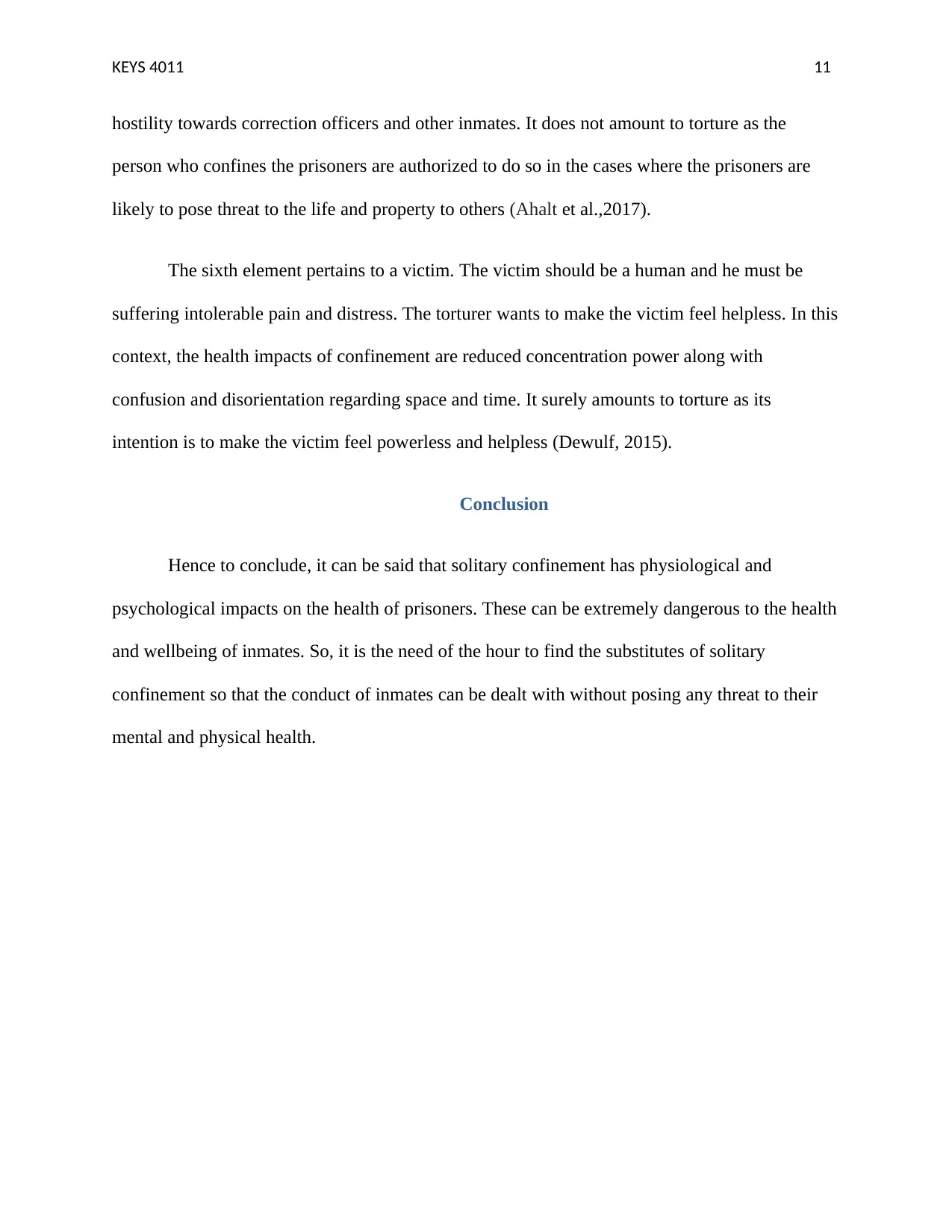
hostility towards correction officers and other inmates. It does not amount to torture as the
person who confines the prisoners are authorized to do so in the cases where the prisoners are
likely to pose threat to the life and property to others (Ahalt et al.,2017).
The sixth element pertains to a victim. The victim should be a human and he must be
suffering intolerable pain and distress. The torturer wants to make the victim feel helpless. In this
context, the health impacts of confinement are reduced concentration power along with
confusion and disorientation regarding space and time. It surely amounts to torture as its
intention is to make the victim feel powerless and helpless (Dewulf, 2015).
Conclusion
Hence to conclude, it can be said that solitary confinement has physiological and
psychological impacts on the health of prisoners. These can be extremely dangerous to the health
and wellbeing of inmates. So, it is the need of the hour to find the substitutes of solitary
confinement so that the conduct of inmates can be dealt with without posing any threat to their
mental and physical health.
hostility towards correction officers and other inmates. It does not amount to torture as the
person who confines the prisoners are authorized to do so in the cases where the prisoners are
likely to pose threat to the life and property to others (Ahalt et al.,2017).
The sixth element pertains to a victim. The victim should be a human and he must be
suffering intolerable pain and distress. The torturer wants to make the victim feel helpless. In this
context, the health impacts of confinement are reduced concentration power along with
confusion and disorientation regarding space and time. It surely amounts to torture as its
intention is to make the victim feel powerless and helpless (Dewulf, 2015).
Conclusion
Hence to conclude, it can be said that solitary confinement has physiological and
psychological impacts on the health of prisoners. These can be extremely dangerous to the health
and wellbeing of inmates. So, it is the need of the hour to find the substitutes of solitary
confinement so that the conduct of inmates can be dealt with without posing any threat to their
mental and physical health.
⊘ This is a preview!⊘
Do you want full access?
Subscribe today to unlock all pages.

Trusted by 1+ million students worldwide
1 out of 15
Related Documents
Your All-in-One AI-Powered Toolkit for Academic Success.
+13062052269
info@desklib.com
Available 24*7 on WhatsApp / Email
Unlock your academic potential
Copyright © 2020–2025 A2Z Services. All Rights Reserved. Developed and managed by ZUCOL.