Strategic and Tactical Decisions in Tour Operation Management
VerifiedAdded on 2024/04/26
|19
|4324
|141
Report
AI Summary
This report provides a comprehensive overview of tour operation management, beginning with an analysis of current trends and developments affecting the tour operator industry, including the impact of technology, demographic changes, and safety concerns. It assesses the stages and timescales involved in developing holiday packages, emphasizing marketing research, itinerary development, negotiation with suppliers, cost evaluation, and financial pricing. The report evaluates different methods of contracting for holiday components and various types of tour operators, along with a calculation of selling prices for a sample holiday tour package. It further examines planning decisions for brochure design and evaluates alternative promotional methods, as well as distribution strategies for selling holiday packages. Finally, the report evaluates strategic and tactical decisions made by different types of tour operators in varying situations. This assignment is available on Desklib, a platform offering study tools and resources for students.

TOUR OPERATION MANAGEMENT

Paraphrase This Document
Need a fresh take? Get an instant paraphrase of this document with our AI Paraphraser
Table of Contents
INTRODUCTION..........................................................................................................................2
TASK 1.........................................................................................................................................3
1.1 ANALYSE THE EFFECTS OF CURRENT AND RECENT TRENDS AND DEVELOPMENT ON
THE TOUR OPERATORS INDUSTRY.........................................................................................3
TASK 2.........................................................................................................................................4
2.1 ASSESS THE STAGES AND TIMESCALES INVOLVED IN DEVELOPING HOLIDAYS...............4
2.2 EVALUATE THE SUITABILITY OF DIFFERENT METHODS OF CONTRACTING FOR
DIFFERENT COMPONENTS OF THE HOLIDAY AND DIFFERENT TYPES OF TOUR OPERATOR. 7
2.3 CALCULATE THE SELLING PRICES OF A HOLIDAY TOUR PACKAGE AND THE PRICE PER
PERSON..................................................................................................................................9
TASK 3.......................................................................................................................................10
3.1 EVALUATE THE PLANNING DECISIONS TAKEN FOR THE DESIGN OF A SELECTED
BROCHURE...........................................................................................................................10
3.2 ASSESS THE SUITABILITY OF ALTERNATIVES TO A TRADITIONAL BROCHURE FOR
DIFFERENT TYPES OF TOUR OPERATORS AND RECOMMEND THE MOST APPROPRIATE FOR
YOUR TOUR PACKAGE..........................................................................................................11
3.3 EVALUATE THE SUITABILITY OF DIFFERENT METHODS OF DISTRIBUTION USED TO SELL
HOLIDAY PACKAGES FOR DIFFERENT TYPES OF TOUR OPERATORS....................................13
TASK 4.......................................................................................................................................14
4.1 EVALUATE THE STRATEGIC DECISIONS MADE BY DIFFERENT TYPES OF TOUR
OPERATOR............................................................................................................................14
4.2 COMPARE THE TACTICAL DECISIONS THAT COULD BE TAKEN BY A SELECTED TOUR
OPERATOR IN DIFFERENT SITUATIONS................................................................................15
CONCLUSION............................................................................................................................16
REFERENCES.............................................................................................................................17
1
INTRODUCTION..........................................................................................................................2
TASK 1.........................................................................................................................................3
1.1 ANALYSE THE EFFECTS OF CURRENT AND RECENT TRENDS AND DEVELOPMENT ON
THE TOUR OPERATORS INDUSTRY.........................................................................................3
TASK 2.........................................................................................................................................4
2.1 ASSESS THE STAGES AND TIMESCALES INVOLVED IN DEVELOPING HOLIDAYS...............4
2.2 EVALUATE THE SUITABILITY OF DIFFERENT METHODS OF CONTRACTING FOR
DIFFERENT COMPONENTS OF THE HOLIDAY AND DIFFERENT TYPES OF TOUR OPERATOR. 7
2.3 CALCULATE THE SELLING PRICES OF A HOLIDAY TOUR PACKAGE AND THE PRICE PER
PERSON..................................................................................................................................9
TASK 3.......................................................................................................................................10
3.1 EVALUATE THE PLANNING DECISIONS TAKEN FOR THE DESIGN OF A SELECTED
BROCHURE...........................................................................................................................10
3.2 ASSESS THE SUITABILITY OF ALTERNATIVES TO A TRADITIONAL BROCHURE FOR
DIFFERENT TYPES OF TOUR OPERATORS AND RECOMMEND THE MOST APPROPRIATE FOR
YOUR TOUR PACKAGE..........................................................................................................11
3.3 EVALUATE THE SUITABILITY OF DIFFERENT METHODS OF DISTRIBUTION USED TO SELL
HOLIDAY PACKAGES FOR DIFFERENT TYPES OF TOUR OPERATORS....................................13
TASK 4.......................................................................................................................................14
4.1 EVALUATE THE STRATEGIC DECISIONS MADE BY DIFFERENT TYPES OF TOUR
OPERATOR............................................................................................................................14
4.2 COMPARE THE TACTICAL DECISIONS THAT COULD BE TAKEN BY A SELECTED TOUR
OPERATOR IN DIFFERENT SITUATIONS................................................................................15
CONCLUSION............................................................................................................................16
REFERENCES.............................................................................................................................17
1
INTRODUCTION
The role of tour operations management is very important in making the travel experience
of an individual a lifetime and memorable experience. Since an individual would never want
to spoil their experience due to mismanagement, therefore it is the duty of tour operators
to manage the components of the tour and travel for a package holiday timely and
efficiently (Frey and George, 2010). Tour operators are the one who plans, organises tours
for various locations by creating a holiday package which is beneficial for the individuals
who love travelling. The management of tours is handled by these tour operators who tailor
make the touring packages according to the interest, budgets and preferences of the clients
by including and excluding various options.
This assignment represents the management of operations of tour operators. It exhibits a
comprehensive understanding by analysing the current trends in the tour operators industry
(Mak, 2011). It also depicts that stages that are involved in developing holiday packages for
its guests including the contracts from suppliers and intermediaries and also evaluate the
finance and pricing for the tours. This assignment portrays the distribution methods to
promote and sell holiday packages. It also describes the strategic decision making to
evaluate tactical decisions taken by the tour operator.
2
The role of tour operations management is very important in making the travel experience
of an individual a lifetime and memorable experience. Since an individual would never want
to spoil their experience due to mismanagement, therefore it is the duty of tour operators
to manage the components of the tour and travel for a package holiday timely and
efficiently (Frey and George, 2010). Tour operators are the one who plans, organises tours
for various locations by creating a holiday package which is beneficial for the individuals
who love travelling. The management of tours is handled by these tour operators who tailor
make the touring packages according to the interest, budgets and preferences of the clients
by including and excluding various options.
This assignment represents the management of operations of tour operators. It exhibits a
comprehensive understanding by analysing the current trends in the tour operators industry
(Mak, 2011). It also depicts that stages that are involved in developing holiday packages for
its guests including the contracts from suppliers and intermediaries and also evaluate the
finance and pricing for the tours. This assignment portrays the distribution methods to
promote and sell holiday packages. It also describes the strategic decision making to
evaluate tactical decisions taken by the tour operator.
2
⊘ This is a preview!⊘
Do you want full access?
Subscribe today to unlock all pages.

Trusted by 1+ million students worldwide
TASK 1
1.1 ANALYSE THE EFFECTS OF CURRENT AND RECENT TRENDS AND
DEVELOPMENT ON THE TOUR OPERATORS INDUSTRY
INTRODUCTION
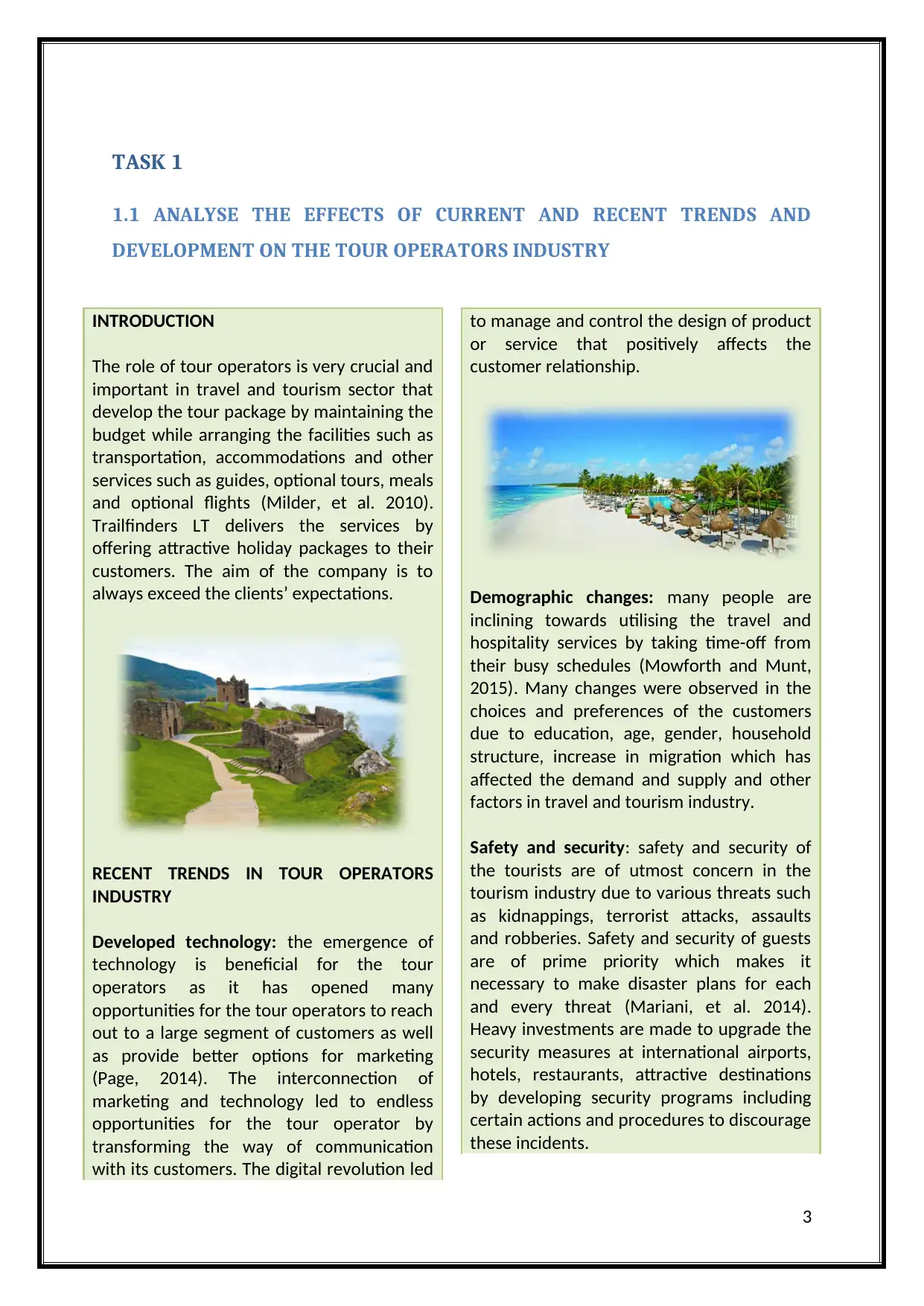
The role of tour operators is very crucial and
important in travel and tourism sector that
develop the tour package by maintaining the
budget while arranging the facilities such as
transportation, accommodations and other
services such as guides, optional tours, meals
and optional flights (Milder, et al. 2010).
Trailfinders LT delivers the services by
offering attractive holiday packages to their
customers. The aim of the company is to
always exceed the clients’ expectations.
RECENT TRENDS IN TOUR OPERATORS
INDUSTRY
Developed technology: the emergence of
technology is beneficial for the tour
operators as it has opened many
opportunities for the tour operators to reach
out to a large segment of customers as well
as provide better options for marketing
(Page, 2014). The interconnection of
marketing and technology led to endless
opportunities for the tour operator by
transforming the way of communication
with its customers. The digital revolution led
to manage and control the design of product
or service that positively affects the
customer relationship.
Demographic changes: many people are
inclining towards utilising the travel and
hospitality services by taking time-off from
their busy schedules (Mowforth and Munt,
2015). Many changes were observed in the
choices and preferences of the customers
due to education, age, gender, household
structure, increase in migration which has
affected the demand and supply and other
factors in travel and tourism industry.
Safety and security: safety and security of
the tourists are of utmost concern in the
tourism industry due to various threats such
as kidnappings, terrorist attacks, assaults
and robberies. Safety and security of guests
are of prime priority which makes it
necessary to make disaster plans for each
and every threat (Mariani, et al. 2014).
Heavy investments are made to upgrade the
security measures at international airports,
hotels, restaurants, attractive destinations
by developing security programs including
certain actions and procedures to discourage
these incidents.
3
1.1 ANALYSE THE EFFECTS OF CURRENT AND RECENT TRENDS AND
DEVELOPMENT ON THE TOUR OPERATORS INDUSTRY
INTRODUCTION
The role of tour operators is very crucial and
important in travel and tourism sector that
develop the tour package by maintaining the
budget while arranging the facilities such as
transportation, accommodations and other
services such as guides, optional tours, meals
and optional flights (Milder, et al. 2010).
Trailfinders LT delivers the services by
offering attractive holiday packages to their
customers. The aim of the company is to
always exceed the clients’ expectations.
RECENT TRENDS IN TOUR OPERATORS
INDUSTRY
Developed technology: the emergence of
technology is beneficial for the tour
operators as it has opened many
opportunities for the tour operators to reach
out to a large segment of customers as well
as provide better options for marketing
(Page, 2014). The interconnection of
marketing and technology led to endless
opportunities for the tour operator by
transforming the way of communication
with its customers. The digital revolution led
to manage and control the design of product
or service that positively affects the
customer relationship.
Demographic changes: many people are
inclining towards utilising the travel and
hospitality services by taking time-off from
their busy schedules (Mowforth and Munt,
2015). Many changes were observed in the
choices and preferences of the customers
due to education, age, gender, household
structure, increase in migration which has
affected the demand and supply and other
factors in travel and tourism industry.
Safety and security: safety and security of
the tourists are of utmost concern in the
tourism industry due to various threats such
as kidnappings, terrorist attacks, assaults
and robberies. Safety and security of guests
are of prime priority which makes it
necessary to make disaster plans for each
and every threat (Mariani, et al. 2014).
Heavy investments are made to upgrade the
security measures at international airports,
hotels, restaurants, attractive destinations
by developing security programs including
certain actions and procedures to discourage
these incidents.
3
Paraphrase This Document
Need a fresh take? Get an instant paraphrase of this document with our AI Paraphraser
TASK 2
2.1 ASSESS THE STAGES AND TIMESCALES INVOLVED IN DEVELOPING
HOLIDAYS
It is essential for the tour operator to consider each and every process in order to create a
holiday package which is generally distributed in 12 steps (Buhalis, et al. 2012). The process
of creating a holiday plan to satisfy the clients and tourists can be conceived through the
following stages:
MARKETING RESEARCH- the first stage in the creating a holiday package is the study of a
tourist destination and tourism market (Paquin, et al. 2016). For developing the educational
tour for adult students, Trailfinders need to search and study for the educational sites and
attraction form London to Brussels and Bruges.
DEVELOPMENT OF TOUR ITINERARY: this is the second stage where the tour is planned and
schedule to be implemented. Proper scheduling by carrying out planned activities will assist
the Trailfinders to successfully complete the educational tour in 5 days.
NEGOTIATION WITH SUPPLIERS/VENDORS: once the education tour program is finalised
then next step for Trailfinders will be to negotiate with the prospective vendors such as
airlines, transport operators, ground operators, lodging companies, car rentals, sightseeing
vendors etc (Paquin, et al. 2016). the main aim of the Trailfinders will be to reach a
competitive price with the satisfactory quality.
COST OF PACKAGE TOUR: tour cost is the term, referred to determine the monetary value
of tour package by preparing cost sheet so as to get an idea to determine the profit margin
(Page, 2014). Various categories of tour package are air travel cost, payroll cost, research
cost, marketing cost etc.
FINANCIAL EVALUATION AND PRICING: after determining the cost of a package tour,
Trailfinders need to determine the exchange rates, estimated selling prices for future to
4
2.1 ASSESS THE STAGES AND TIMESCALES INVOLVED IN DEVELOPING
HOLIDAYS
It is essential for the tour operator to consider each and every process in order to create a
holiday package which is generally distributed in 12 steps (Buhalis, et al. 2012). The process
of creating a holiday plan to satisfy the clients and tourists can be conceived through the
following stages:
MARKETING RESEARCH- the first stage in the creating a holiday package is the study of a
tourist destination and tourism market (Paquin, et al. 2016). For developing the educational
tour for adult students, Trailfinders need to search and study for the educational sites and
attraction form London to Brussels and Bruges.
DEVELOPMENT OF TOUR ITINERARY: this is the second stage where the tour is planned and
schedule to be implemented. Proper scheduling by carrying out planned activities will assist
the Trailfinders to successfully complete the educational tour in 5 days.
NEGOTIATION WITH SUPPLIERS/VENDORS: once the education tour program is finalised
then next step for Trailfinders will be to negotiate with the prospective vendors such as
airlines, transport operators, ground operators, lodging companies, car rentals, sightseeing
vendors etc (Paquin, et al. 2016). the main aim of the Trailfinders will be to reach a
competitive price with the satisfactory quality.
COST OF PACKAGE TOUR: tour cost is the term, referred to determine the monetary value
of tour package by preparing cost sheet so as to get an idea to determine the profit margin
(Page, 2014). Various categories of tour package are air travel cost, payroll cost, research
cost, marketing cost etc.
FINANCIAL EVALUATION AND PRICING: after determining the cost of a package tour,
Trailfinders need to determine the exchange rates, estimated selling prices for future to
4
finalize the tour prices (Novelli and Hellwig, 2011). Tour prices include the evaluation of
financial risks such as foreign exchange and in terms of cost such as rate of return, price
competitiveness, market share etc.
ADMINISTRATIVE STAFF: as tour operation is a seasonal business which may require extra
personnel to meet the needs of the tour operators. Trailfinders need to recruit reservation
staff, guides, resort staff, international agents, and sales representatives and so on.
MARKETING TOUR PACKAGE: the marketing strategies for this educational tour should
focus on the different marketing elements to attract a large number of adult students. A
proper marketing plan is to be adopted by the management of tour operator such as online
marketing through social media (Novelli and Hellwig, 2011).
DEVELOP A TOUR MARKETING PLAN: tour marketing plan can be effectively developed by
Trailfinders by understanding the product and market which is needed to be maintained in
the specific budget which may be limited to 25 per cent of the total projected cost.
MARKETING INBOUND AND OUTBOUND TOURS: it is very difficult and complicated for tour
operators to perform international tour marketing rather than domestic tours marketing
(Paquin, et al. 2016). The Trailfinders need to approach each and every tour members
either directly or through travel agencies.
TOUR OPERATOR’S BROCHURES: one of the vital tools for marketing is tour brochure which
includes all the detailed information to allure the potential customers to purchase the tour
package. Another mode of marketing is through social media such as advertising, direct
mail, telemarketing etc.
5
financial risks such as foreign exchange and in terms of cost such as rate of return, price
competitiveness, market share etc.
ADMINISTRATIVE STAFF: as tour operation is a seasonal business which may require extra
personnel to meet the needs of the tour operators. Trailfinders need to recruit reservation
staff, guides, resort staff, international agents, and sales representatives and so on.
MARKETING TOUR PACKAGE: the marketing strategies for this educational tour should
focus on the different marketing elements to attract a large number of adult students. A
proper marketing plan is to be adopted by the management of tour operator such as online
marketing through social media (Novelli and Hellwig, 2011).
DEVELOP A TOUR MARKETING PLAN: tour marketing plan can be effectively developed by
Trailfinders by understanding the product and market which is needed to be maintained in
the specific budget which may be limited to 25 per cent of the total projected cost.
MARKETING INBOUND AND OUTBOUND TOURS: it is very difficult and complicated for tour
operators to perform international tour marketing rather than domestic tours marketing
(Paquin, et al. 2016). The Trailfinders need to approach each and every tour members
either directly or through travel agencies.
TOUR OPERATOR’S BROCHURES: one of the vital tools for marketing is tour brochure which
includes all the detailed information to allure the potential customers to purchase the tour
package. Another mode of marketing is through social media such as advertising, direct
mail, telemarketing etc.
5
⊘ This is a preview!⊘
Do you want full access?
Subscribe today to unlock all pages.
Trusted by 1+ million students worldwide
OPERATION AND EXECUTION OF TOUR: the success of the Trailfinders depends on the
efficient operations of the tour which is very crucial to converting the promises into realities
by managing all the tasks and responsibilities in an effective manner (Brunt, et al. 2017).
POST TOUR OPERATION MANAGEMENT: this is the last stage which includes preparation of
various reports so as to analyse and evaluate the success of the tour and identify the
shortcomings to overcome in future.
6
efficient operations of the tour which is very crucial to converting the promises into realities
by managing all the tasks and responsibilities in an effective manner (Brunt, et al. 2017).
POST TOUR OPERATION MANAGEMENT: this is the last stage which includes preparation of
various reports so as to analyse and evaluate the success of the tour and identify the
shortcomings to overcome in future.
6
Paraphrase This Document
Need a fresh take? Get an instant paraphrase of this document with our AI Paraphraser
2.2 EVALUATE THE SUITABILITY OF DIFFERENT METHODS OF
CONTRACTING FOR DIFFERENT COMPONENTS OF THE HOLIDAY AND
DIFFERENT TYPES OF TOUR OPERATOR
The tour operators need to evaluate the appropriateness of contracting methods for the
different components such as transports; hotels and attractions are given as follows:
TRANSPORT: tourism and transport are inseparable as the existence of the tourism depends
on the transport (Horner and Swarbrooke, 2016). Fixed contracts should be made by
Trailfinders with the airline company and other travel agencies. Trailfinders will be liable
which will make it’s a high-risk factor with ample scope of discounts.
HOTELS: it is imperative for the Trailfinders to provide proper accommodation facilities by
considering the budgets of tours package and also the clients or customers of different
financial background (Brunt, et al. 2017). Again fixed contract is to be maintained by
Trailfinders with hotels and restaurants by having the advantage of cost-effectiveness
through huge discounts and high risk of unused service. For example, high class travellers
require the facilities from five-star hotels while for middle-class travellers, small, medium
hotels or lodges are arranged.
ATTRACTIONS: the essential element of the holiday package is the tourist attractions.
Tourists are attracted to visit these locations so as to generate revenues for the
government, provide employment facilities, investing in infrastructural development and
also contributing in the economy by providing earnings with foreign exchange (KhairatP0F
and Maher, 2012). Seasonal contracts can be made with the attractions for example
educational sites for this particular educational tour for adult students.
DIFFERENT TYPES OF TOUR OPERATORS
There are basically three types of tour operators:
7
CONTRACTING FOR DIFFERENT COMPONENTS OF THE HOLIDAY AND
DIFFERENT TYPES OF TOUR OPERATOR
The tour operators need to evaluate the appropriateness of contracting methods for the
different components such as transports; hotels and attractions are given as follows:
TRANSPORT: tourism and transport are inseparable as the existence of the tourism depends
on the transport (Horner and Swarbrooke, 2016). Fixed contracts should be made by
Trailfinders with the airline company and other travel agencies. Trailfinders will be liable
which will make it’s a high-risk factor with ample scope of discounts.
HOTELS: it is imperative for the Trailfinders to provide proper accommodation facilities by
considering the budgets of tours package and also the clients or customers of different
financial background (Brunt, et al. 2017). Again fixed contract is to be maintained by
Trailfinders with hotels and restaurants by having the advantage of cost-effectiveness
through huge discounts and high risk of unused service. For example, high class travellers
require the facilities from five-star hotels while for middle-class travellers, small, medium
hotels or lodges are arranged.
ATTRACTIONS: the essential element of the holiday package is the tourist attractions.
Tourists are attracted to visit these locations so as to generate revenues for the
government, provide employment facilities, investing in infrastructural development and
also contributing in the economy by providing earnings with foreign exchange (KhairatP0F
and Maher, 2012). Seasonal contracts can be made with the attractions for example
educational sites for this particular educational tour for adult students.
DIFFERENT TYPES OF TOUR OPERATORS
There are basically three types of tour operators:
7
DOMESTIC TOUR OPERATORS: these are the tour operators who work within the limited
boundaries of the country by selling holiday packages to the individuals or a group of people
who prefer to travel within the country. Holiday packages are offered to promote the
national integrity by building domestic tourism for example leisure breaks.
INBOUND TOUR OPERATORS: these tour operators work to fulfil the needs of the foreign
travellers in the domestic country by delivering the required services to the foreign
travellers since their arrival to their departure (Page, 2014). The role of inbound tour
operators is very crucial as they commercialise the domestic resources of the country to an
international level to increase the revenues and brand image of the country.
OUTBOUND TOUR OPERATORS: these are the operators who work for the citizens of their
own country by selling them holiday package to visit foreign countries (Page, 2014). The
outbound tour operators serve the clients by collaborating with the inbound tour operators
for all the tourism services.
8
boundaries of the country by selling holiday packages to the individuals or a group of people
who prefer to travel within the country. Holiday packages are offered to promote the
national integrity by building domestic tourism for example leisure breaks.
INBOUND TOUR OPERATORS: these tour operators work to fulfil the needs of the foreign
travellers in the domestic country by delivering the required services to the foreign
travellers since their arrival to their departure (Page, 2014). The role of inbound tour
operators is very crucial as they commercialise the domestic resources of the country to an
international level to increase the revenues and brand image of the country.
OUTBOUND TOUR OPERATORS: these are the operators who work for the citizens of their
own country by selling them holiday package to visit foreign countries (Page, 2014). The
outbound tour operators serve the clients by collaborating with the inbound tour operators
for all the tourism services.
8
⊘ This is a preview!⊘
Do you want full access?
Subscribe today to unlock all pages.
Trusted by 1+ million students worldwide
2.3 CALCULATE THE SELLING PRICES OF A HOLIDAY TOUR PACKAGE AND
THE PRICE PER PERSON
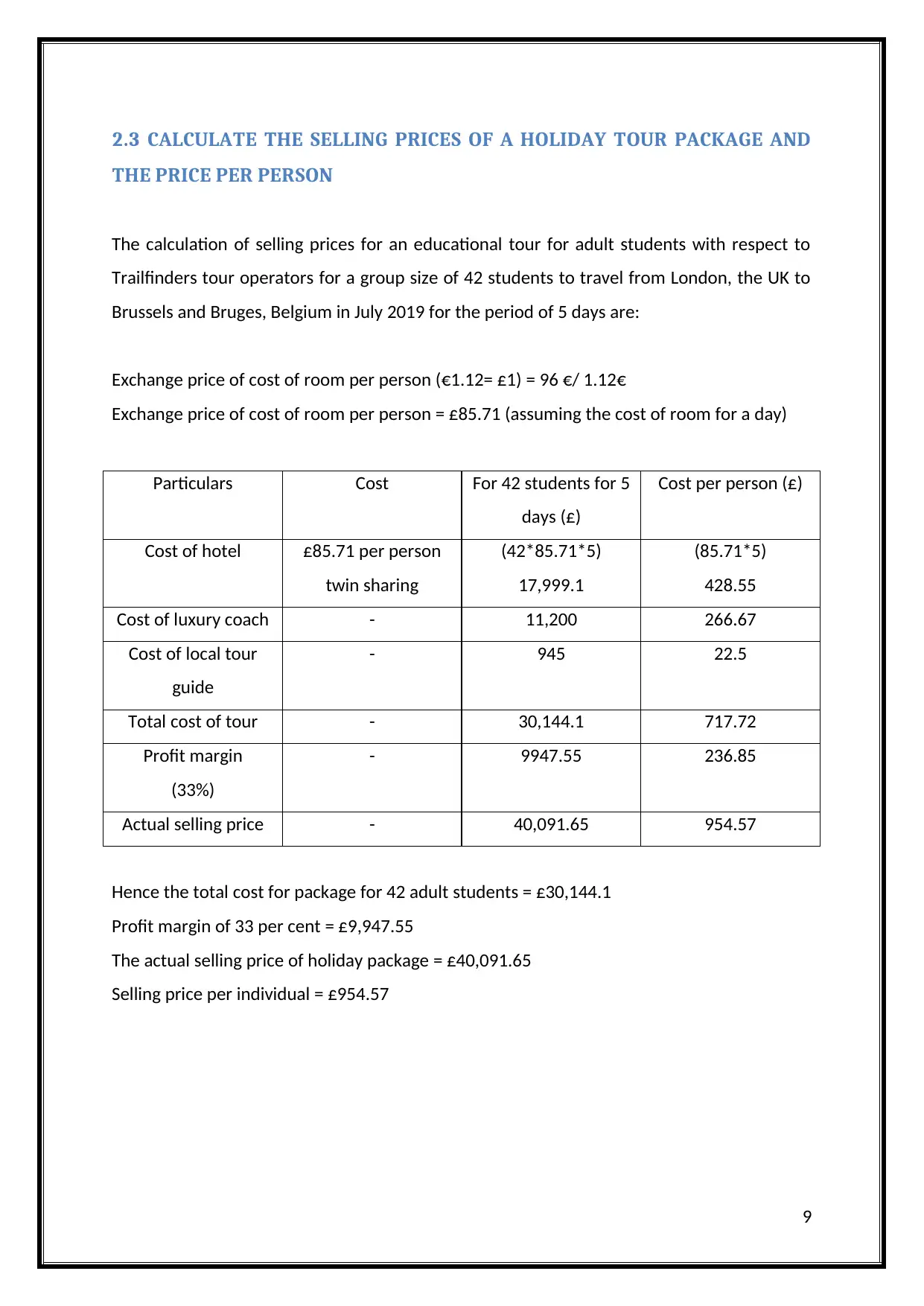
The calculation of selling prices for an educational tour for adult students with respect to
Trailfinders tour operators for a group size of 42 students to travel from London, the UK to
Brussels and Bruges, Belgium in July 2019 for the period of 5 days are:
Exchange price of cost of room per person (€1.12= £1) = 96 €/ 1.12€
Exchange price of cost of room per person = £85.71 (assuming the cost of room for a day)
Particulars Cost For 42 students for 5
days (£)
Cost per person (£)
Cost of hotel £85.71 per person
twin sharing
(42*85.71*5)
17,999.1
(85.71*5)
428.55
Cost of luxury coach - 11,200 266.67
Cost of local tour
guide
- 945 22.5
Total cost of tour - 30,144.1 717.72
Profit margin
(33%)
- 9947.55 236.85
Actual selling price - 40,091.65 954.57
Hence the total cost for package for 42 adult students = £30,144.1
Profit margin of 33 per cent = £9,947.55
The actual selling price of holiday package = £40,091.65
Selling price per individual = £954.57
9
THE PRICE PER PERSON
The calculation of selling prices for an educational tour for adult students with respect to
Trailfinders tour operators for a group size of 42 students to travel from London, the UK to
Brussels and Bruges, Belgium in July 2019 for the period of 5 days are:
Exchange price of cost of room per person (€1.12= £1) = 96 €/ 1.12€
Exchange price of cost of room per person = £85.71 (assuming the cost of room for a day)
Particulars Cost For 42 students for 5
days (£)
Cost per person (£)
Cost of hotel £85.71 per person
twin sharing
(42*85.71*5)
17,999.1
(85.71*5)
428.55
Cost of luxury coach - 11,200 266.67
Cost of local tour
guide
- 945 22.5
Total cost of tour - 30,144.1 717.72
Profit margin
(33%)
- 9947.55 236.85
Actual selling price - 40,091.65 954.57
Hence the total cost for package for 42 adult students = £30,144.1
Profit margin of 33 per cent = £9,947.55
The actual selling price of holiday package = £40,091.65
Selling price per individual = £954.57
9
Paraphrase This Document
Need a fresh take? Get an instant paraphrase of this document with our AI Paraphraser
TASK 3
3.1 EVALUATE THE PLANNING DECISIONS TAKEN FOR THE DESIGN OF A
SELECTED BROCHURE
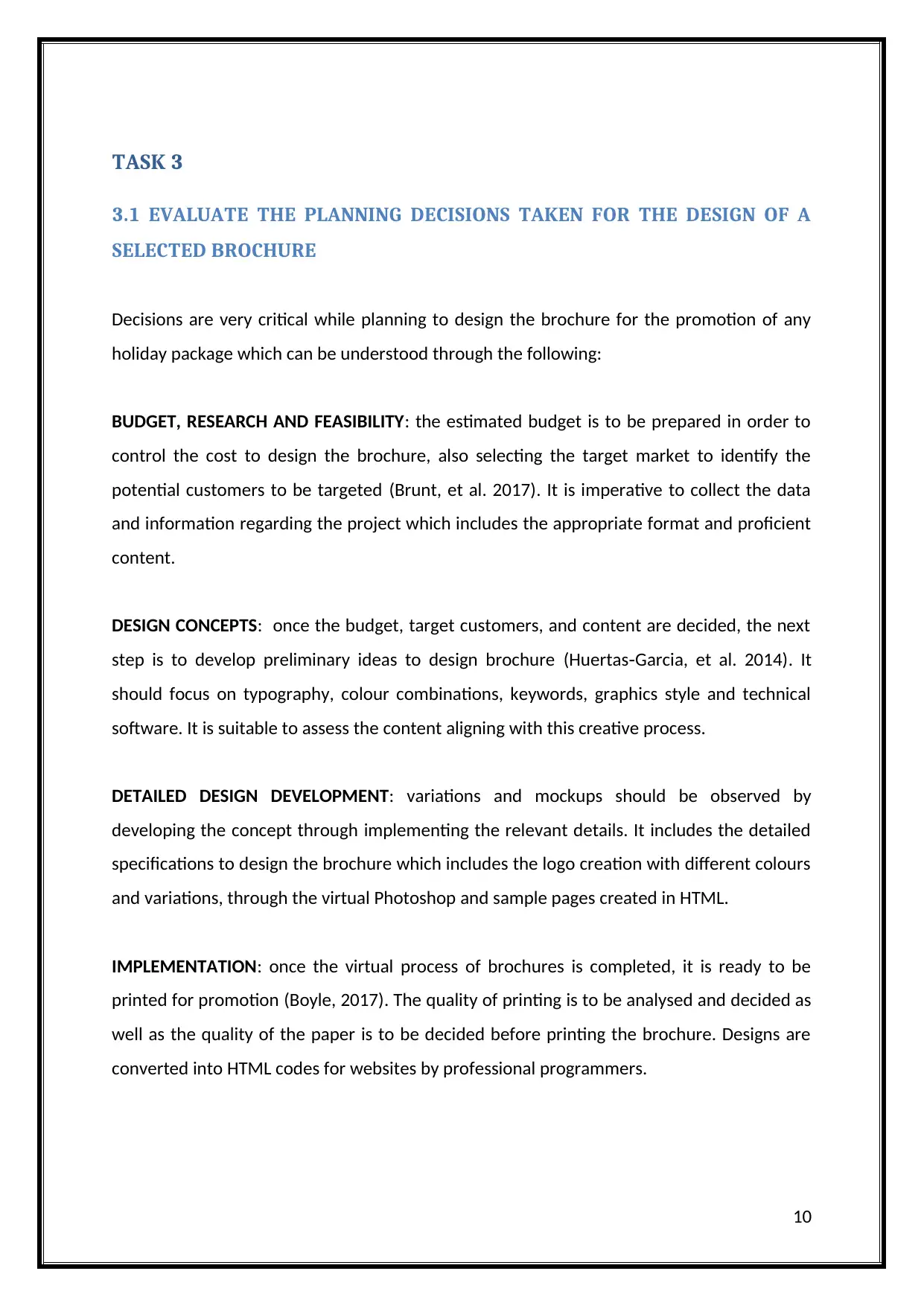
Decisions are very critical while planning to design the brochure for the promotion of any
holiday package which can be understood through the following:
BUDGET, RESEARCH AND FEASIBILITY: the estimated budget is to be prepared in order to
control the cost to design the brochure, also selecting the target market to identify the
potential customers to be targeted (Brunt, et al. 2017). It is imperative to collect the data
and information regarding the project which includes the appropriate format and proficient
content.
DESIGN CONCEPTS: once the budget, target customers, and content are decided, the next
step is to develop preliminary ideas to design brochure (Huertas Garcia, et al. 2014)‐ . It
should focus on typography, colour combinations, keywords, graphics style and technical
software. It is suitable to assess the content aligning with this creative process.
DETAILED DESIGN DEVELOPMENT: variations and mockups should be observed by
developing the concept through implementing the relevant details. It includes the detailed
specifications to design the brochure which includes the logo creation with different colours
and variations, through the virtual Photoshop and sample pages created in HTML.
IMPLEMENTATION: once the virtual process of brochures is completed, it is ready to be
printed for promotion (Boyle, 2017). The quality of printing is to be analysed and decided as
well as the quality of the paper is to be decided before printing the brochure. Designs are
converted into HTML codes for websites by professional programmers.
10
3.1 EVALUATE THE PLANNING DECISIONS TAKEN FOR THE DESIGN OF A
SELECTED BROCHURE
Decisions are very critical while planning to design the brochure for the promotion of any
holiday package which can be understood through the following:
BUDGET, RESEARCH AND FEASIBILITY: the estimated budget is to be prepared in order to
control the cost to design the brochure, also selecting the target market to identify the
potential customers to be targeted (Brunt, et al. 2017). It is imperative to collect the data
and information regarding the project which includes the appropriate format and proficient
content.
DESIGN CONCEPTS: once the budget, target customers, and content are decided, the next
step is to develop preliminary ideas to design brochure (Huertas Garcia, et al. 2014)‐ . It
should focus on typography, colour combinations, keywords, graphics style and technical
software. It is suitable to assess the content aligning with this creative process.
DETAILED DESIGN DEVELOPMENT: variations and mockups should be observed by
developing the concept through implementing the relevant details. It includes the detailed
specifications to design the brochure which includes the logo creation with different colours
and variations, through the virtual Photoshop and sample pages created in HTML.
IMPLEMENTATION: once the virtual process of brochures is completed, it is ready to be
printed for promotion (Boyle, 2017). The quality of printing is to be analysed and decided as
well as the quality of the paper is to be decided before printing the brochure. Designs are
converted into HTML codes for websites by professional programmers.
10
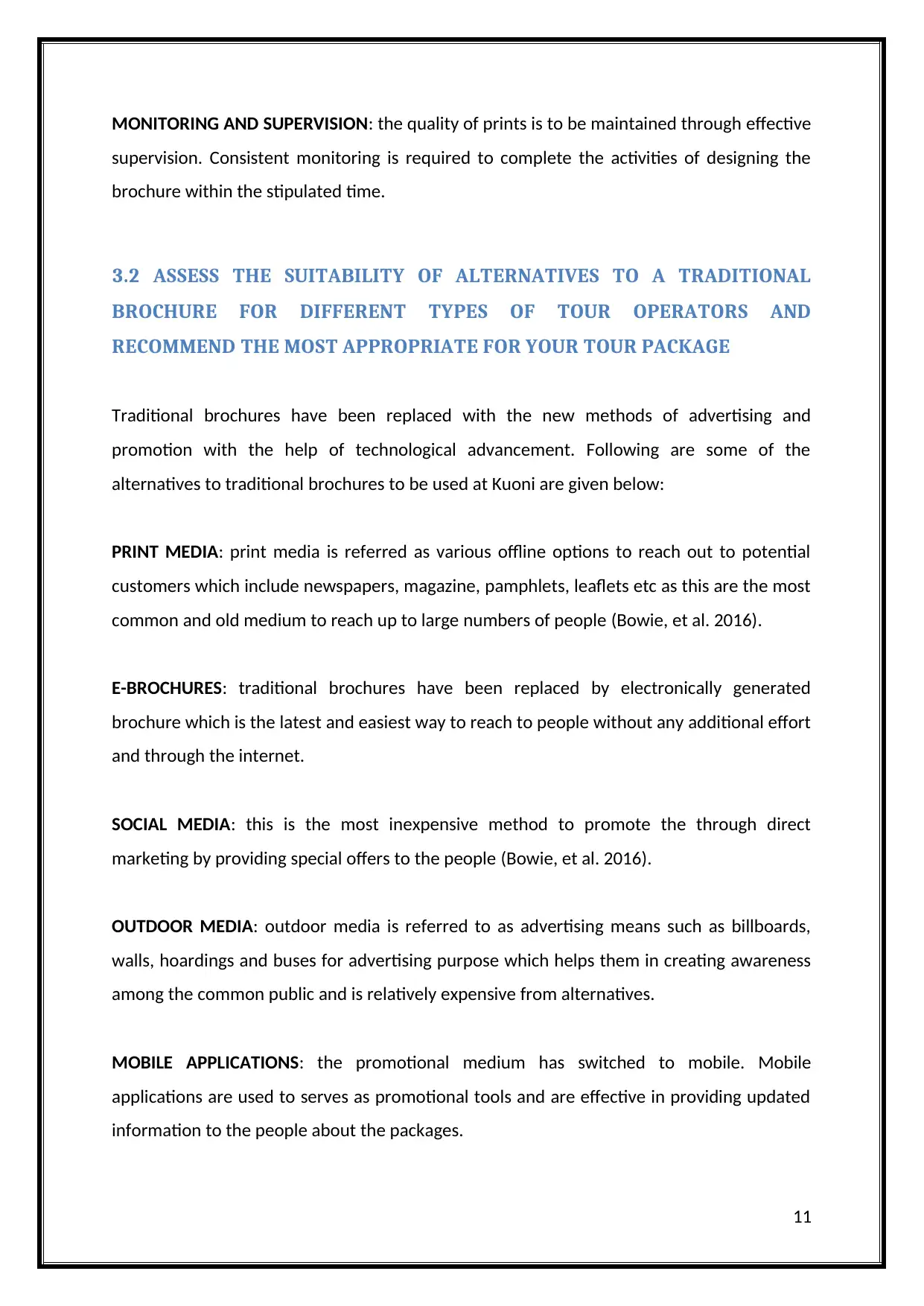
MONITORING AND SUPERVISION: the quality of prints is to be maintained through effective
supervision. Consistent monitoring is required to complete the activities of designing the
brochure within the stipulated time.
3.2 ASSESS THE SUITABILITY OF ALTERNATIVES TO A TRADITIONAL
BROCHURE FOR DIFFERENT TYPES OF TOUR OPERATORS AND
RECOMMEND THE MOST APPROPRIATE FOR YOUR TOUR PACKAGE
Traditional brochures have been replaced with the new methods of advertising and
promotion with the help of technological advancement. Following are some of the
alternatives to traditional brochures to be used at Kuoni are given below:
PRINT MEDIA: print media is referred as various offline options to reach out to potential
customers which include newspapers, magazine, pamphlets, leaflets etc as this are the most
common and old medium to reach up to large numbers of people (Bowie, et al. 2016).
E-BROCHURES: traditional brochures have been replaced by electronically generated
brochure which is the latest and easiest way to reach to people without any additional effort
and through the internet.
SOCIAL MEDIA: this is the most inexpensive method to promote the through direct
marketing by providing special offers to the people (Bowie, et al. 2016).
OUTDOOR MEDIA: outdoor media is referred to as advertising means such as billboards,
walls, hoardings and buses for advertising purpose which helps them in creating awareness
among the common public and is relatively expensive from alternatives.
MOBILE APPLICATIONS: the promotional medium has switched to mobile. Mobile
applications are used to serves as promotional tools and are effective in providing updated
information to the people about the packages.
11
supervision. Consistent monitoring is required to complete the activities of designing the
brochure within the stipulated time.
3.2 ASSESS THE SUITABILITY OF ALTERNATIVES TO A TRADITIONAL
BROCHURE FOR DIFFERENT TYPES OF TOUR OPERATORS AND
RECOMMEND THE MOST APPROPRIATE FOR YOUR TOUR PACKAGE
Traditional brochures have been replaced with the new methods of advertising and
promotion with the help of technological advancement. Following are some of the
alternatives to traditional brochures to be used at Kuoni are given below:
PRINT MEDIA: print media is referred as various offline options to reach out to potential
customers which include newspapers, magazine, pamphlets, leaflets etc as this are the most
common and old medium to reach up to large numbers of people (Bowie, et al. 2016).
E-BROCHURES: traditional brochures have been replaced by electronically generated
brochure which is the latest and easiest way to reach to people without any additional effort
and through the internet.
SOCIAL MEDIA: this is the most inexpensive method to promote the through direct
marketing by providing special offers to the people (Bowie, et al. 2016).
OUTDOOR MEDIA: outdoor media is referred to as advertising means such as billboards,
walls, hoardings and buses for advertising purpose which helps them in creating awareness
among the common public and is relatively expensive from alternatives.
MOBILE APPLICATIONS: the promotional medium has switched to mobile. Mobile
applications are used to serves as promotional tools and are effective in providing updated
information to the people about the packages.
11
⊘ This is a preview!⊘
Do you want full access?
Subscribe today to unlock all pages.
Trusted by 1+ million students worldwide

1 out of 19


Related Documents


Your All-in-One AI-Powered Toolkit for Academic Success.
+13062052269
info@desklib.com
Available 24*7 on WhatsApp / Email
![[object Object]](/_next/static/media/star-bottom.7253800d.svg)
Unlock your academic potential
Copyright © 2020–2026 A2Z Services. All Rights Reserved. Developed and managed by ZUCOL.