HND Hospitality Unit 40: Tour Operations Management Stages
VerifiedAdded on 2023/02/03
|11
|879
|76
Presentation
AI Summary
This presentation provides a comprehensive overview of tour operations management, focusing on the stages involved in holiday creation. It begins with market research and planning, detailing the time scales for each stage, including contracting with third parties, costing, brochure creation, and advertising. The presentation evaluates the suitability of different methods, such as fixed contracts, allocation contracts, and ad hoc tour operations, highlighting their advantages. Furthermore, it delves into the financial aspects, calculating the selling price of a holiday by considering fixed and variable costs, direct and indirect costs, and profit margins. The conclusion emphasizes the importance of currency exchange, special offers, seasonal flexing, and competitive pricing in the tour operating industry. The presentation is based on a student assignment for the HND in Hospitality Management.
Tour Operations Management
Stages that tour operators have to perform while creating holidays
Paraphrase This Document
Need a fresh take? Get an instant paraphrase of this document with our AI Paraphraser

INTRODUCTION
Tour operations management is a part of tourism industry in which operators create
packages and offers for holidays.
This attracts many customers that want to travel and enjoy different destinations, without
having to spend much money.
This presentation will assess stages and time scales for development of holidays
It will evaluate suitability of different methods that tour operators use for creating holidays
It will also calculate selling prices of a holiday.
Tour operations management is a part of tourism industry in which operators create
packages and offers for holidays.
This attracts many customers that want to travel and enjoy different destinations, without
having to spend much money.
This presentation will assess stages and time scales for development of holidays
It will evaluate suitability of different methods that tour operators use for creating holidays
It will also calculate selling prices of a holiday.

STAGES AND TIME SCALES WHILE DEVELOPING HOLIDAYS
Market research is an important part of planning and developing holidays and it usually
takes tour operators 4 to 6 months to thoroughly research their market, so that proper
packages can be made.
Planning and scheduling includes ascertaining destinations, hotels, duration of stay and
number of travellers. This is the second stage and takes approximately 6 to 8 months to
finalise.
Contracting with third parties is not a difficult task and tour operators manage to make
deals with them in 2 months.
Costing the holiday is the forth stage of developing holidays and is done within 3 months.
Market research is an important part of planning and developing holidays and it usually
takes tour operators 4 to 6 months to thoroughly research their market, so that proper
packages can be made.
Planning and scheduling includes ascertaining destinations, hotels, duration of stay and
number of travellers. This is the second stage and takes approximately 6 to 8 months to
finalise.
Contracting with third parties is not a difficult task and tour operators manage to make
deals with them in 2 months.
Costing the holiday is the forth stage of developing holidays and is done within 3 months.
⊘ This is a preview!⊘
Do you want full access?
Subscribe today to unlock all pages.

Trusted by 1+ million students worldwide

CONT..
Tour operators conduct financial evaluation and pricing within 3 to 5 months as they have
to ascertain costs, so that development of holidays can begin
Brochure is created after all the plans have been finalised. It takes approximately 6 months
to design and distribute brochures.
Advertising is done by marketing managers of tour operators and this is done once holiday
packages have been developed.
Operations and execution is the final stage of developing holidays. Travellers are able to
choose packages and make their purchases.
Post tour management is the after sale services that is provided by tour operators, so that
they are able to determine the success of packages that have been created.
Tour operators conduct financial evaluation and pricing within 3 to 5 months as they have
to ascertain costs, so that development of holidays can begin
Brochure is created after all the plans have been finalised. It takes approximately 6 months
to design and distribute brochures.
Advertising is done by marketing managers of tour operators and this is done once holiday
packages have been developed.
Operations and execution is the final stage of developing holidays. Travellers are able to
choose packages and make their purchases.
Post tour management is the after sale services that is provided by tour operators, so that
they are able to determine the success of packages that have been created.
Paraphrase This Document
Need a fresh take? Get an instant paraphrase of this document with our AI Paraphraser


EVALUATION OF SUITABILITY OF DIFFERENT METHODS
Fixed contract is a type of agreement made between a tour operator and third parties when
holidays are being developed.
This is suitable for most tour operators as they can create a contract with hotels, transport
services and other organisations for attracting large travellers.
There are certain rules and regulations that have to be followed in this type of method.
Allocation contract is a method of agreement through which tour operators make
arrangements of blocking a fixed amount of rooms or seats for their travellers.
This is done for a certain amount of time or during a particular season.
Tour operators get discounts through this method, making is suitable for some of them.
Fixed contract is a type of agreement made between a tour operator and third parties when
holidays are being developed.
This is suitable for most tour operators as they can create a contract with hotels, transport
services and other organisations for attracting large travellers.
There are certain rules and regulations that have to be followed in this type of method.
Allocation contract is a method of agreement through which tour operators make
arrangements of blocking a fixed amount of rooms or seats for their travellers.
This is done for a certain amount of time or during a particular season.
Tour operators get discounts through this method, making is suitable for some of them.
⊘ This is a preview!⊘
Do you want full access?
Subscribe today to unlock all pages.

Trusted by 1+ million students worldwide

CONT…
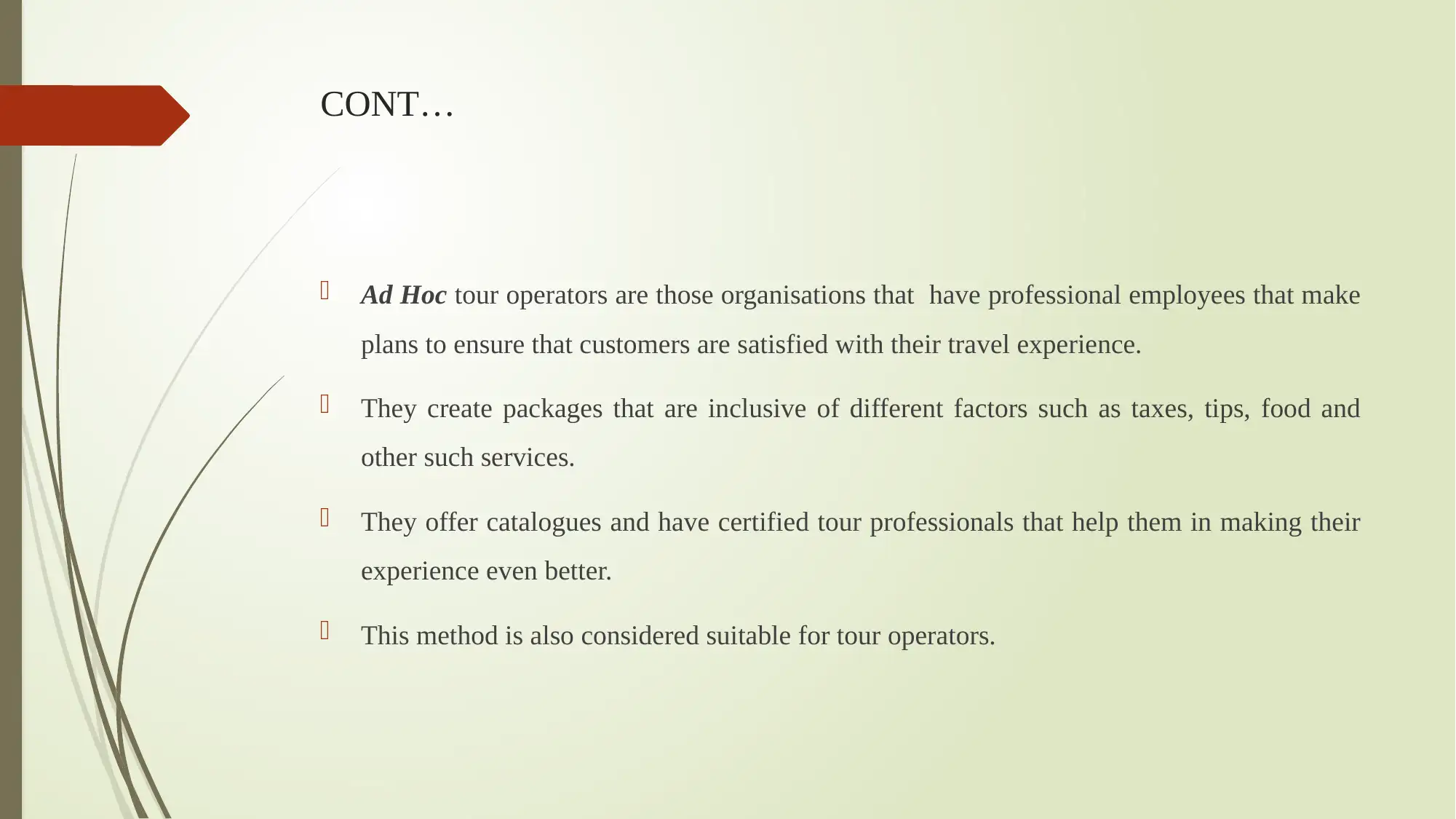
Ad Hoc tour operators are those organisations that have professional employees that make
plans to ensure that customers are satisfied with their travel experience.
They create packages that are inclusive of different factors such as taxes, tips, food and
other such services.
They offer catalogues and have certified tour professionals that help them in making their
experience even better.
This method is also considered suitable for tour operators.
Ad Hoc tour operators are those organisations that have professional employees that make
plans to ensure that customers are satisfied with their travel experience.
They create packages that are inclusive of different factors such as taxes, tips, food and
other such services.
They offer catalogues and have certified tour professionals that help them in making their
experience even better.
This method is also considered suitable for tour operators.
Paraphrase This Document
Need a fresh take? Get an instant paraphrase of this document with our AI Paraphraser

SELLING PRICE OF HOLIDAY
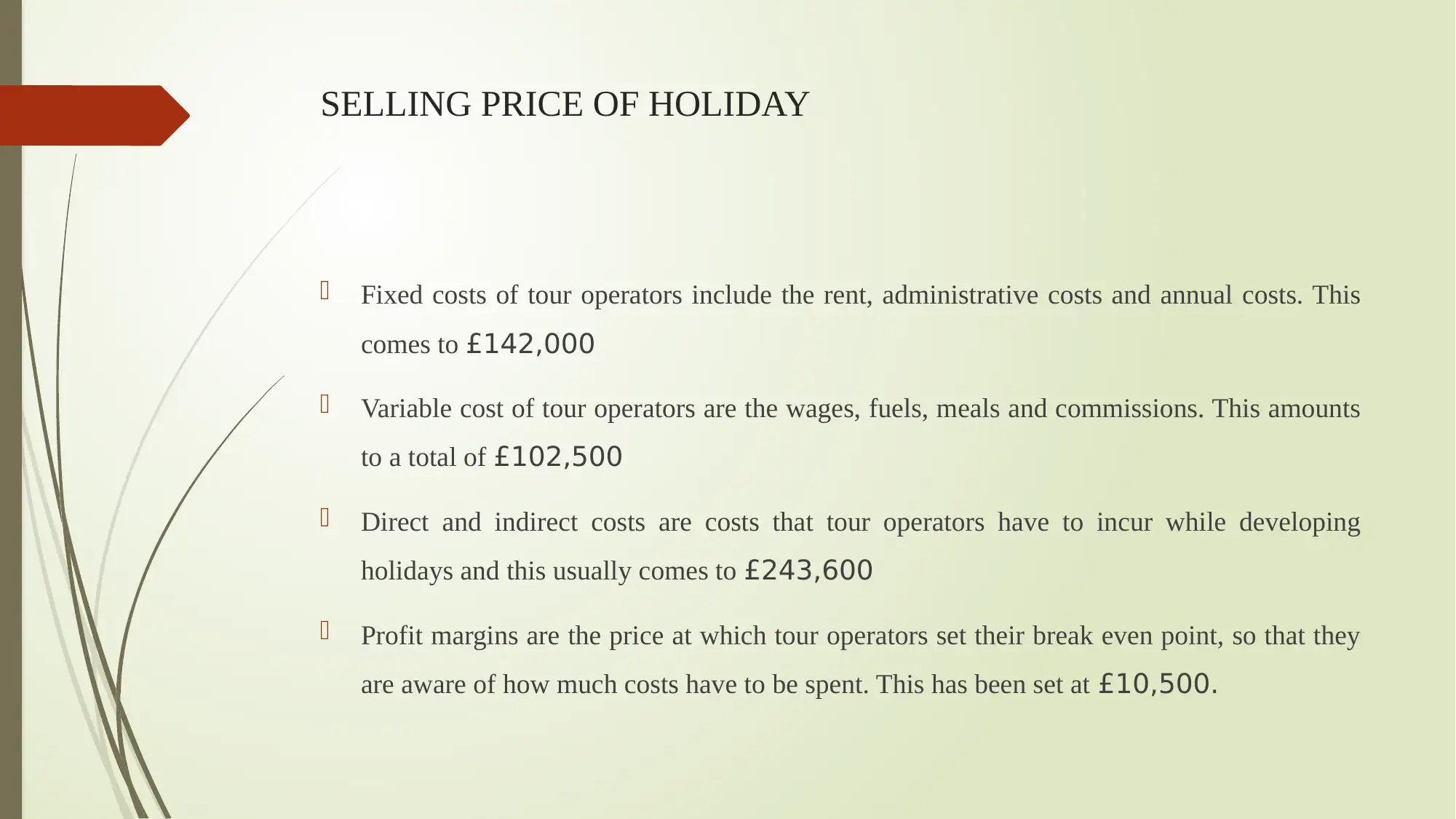
Fixed costs of tour operators include the rent, administrative costs and annual costs. This
comes to £142,000
Variable cost of tour operators are the wages, fuels, meals and commissions. This amounts
to a total of £102,500
Direct and indirect costs are costs that tour operators have to incur while developing
holidays and this usually comes to £243,600
Profit margins are the price at which tour operators set their break even point, so that they
are aware of how much costs have to be spent. This has been set at £10,500.
Fixed costs of tour operators include the rent, administrative costs and annual costs. This
comes to £142,000
Variable cost of tour operators are the wages, fuels, meals and commissions. This amounts
to a total of £102,500
Direct and indirect costs are costs that tour operators have to incur while developing
holidays and this usually comes to £243,600
Profit margins are the price at which tour operators set their break even point, so that they
are aware of how much costs have to be spent. This has been set at £10,500.

CONCLUSION
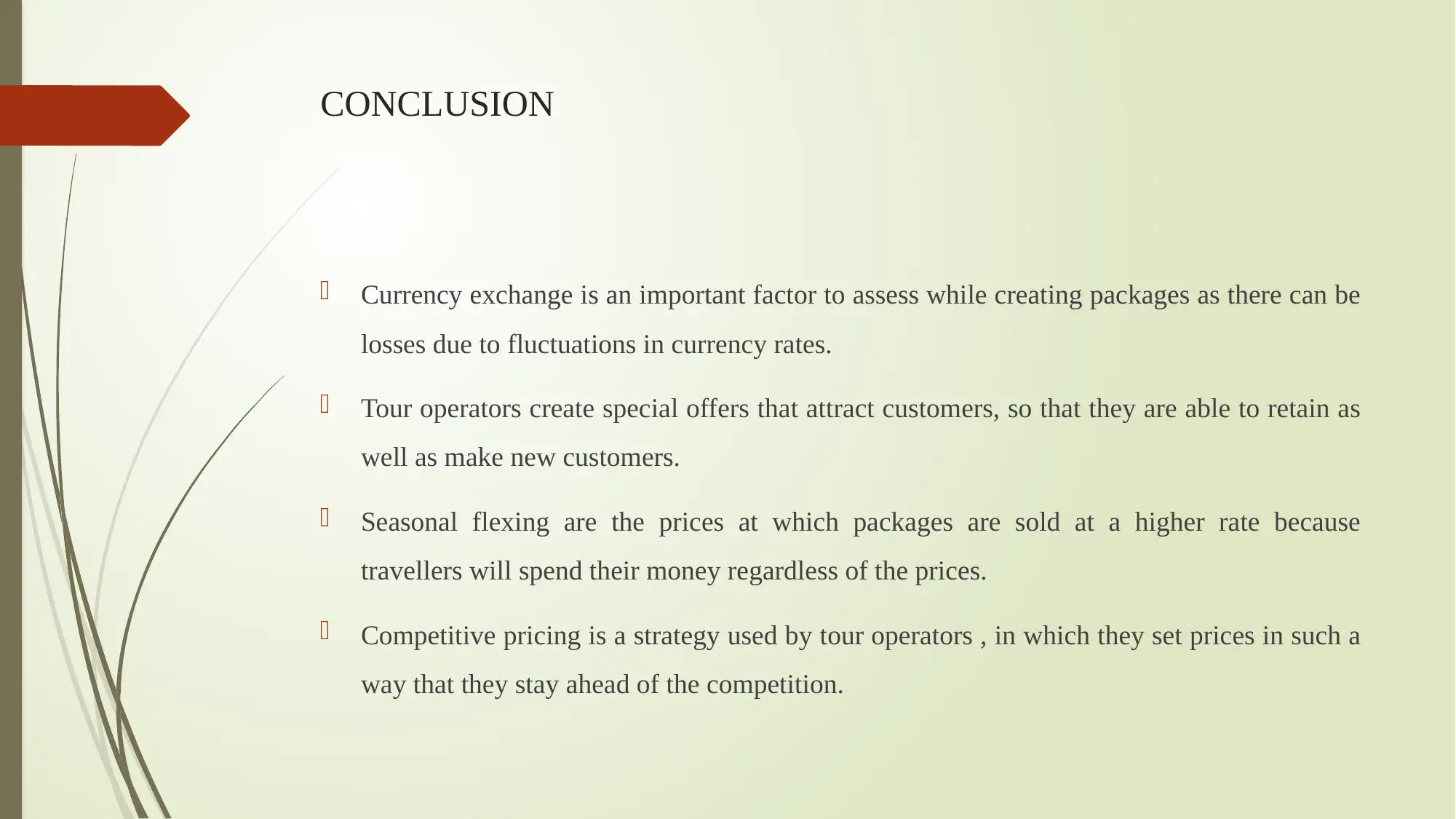
Currency exchange is an important factor to assess while creating packages as there can be
losses due to fluctuations in currency rates.
Tour operators create special offers that attract customers, so that they are able to retain as
well as make new customers.
Seasonal flexing are the prices at which packages are sold at a higher rate because
travellers will spend their money regardless of the prices.
Competitive pricing is a strategy used by tour operators , in which they set prices in such a
way that they stay ahead of the competition.
Currency exchange is an important factor to assess while creating packages as there can be
losses due to fluctuations in currency rates.
Tour operators create special offers that attract customers, so that they are able to retain as
well as make new customers.
Seasonal flexing are the prices at which packages are sold at a higher rate because
travellers will spend their money regardless of the prices.
Competitive pricing is a strategy used by tour operators , in which they set prices in such a
way that they stay ahead of the competition.
⊘ This is a preview!⊘
Do you want full access?
Subscribe today to unlock all pages.

Trusted by 1+ million students worldwide

REFERENCES
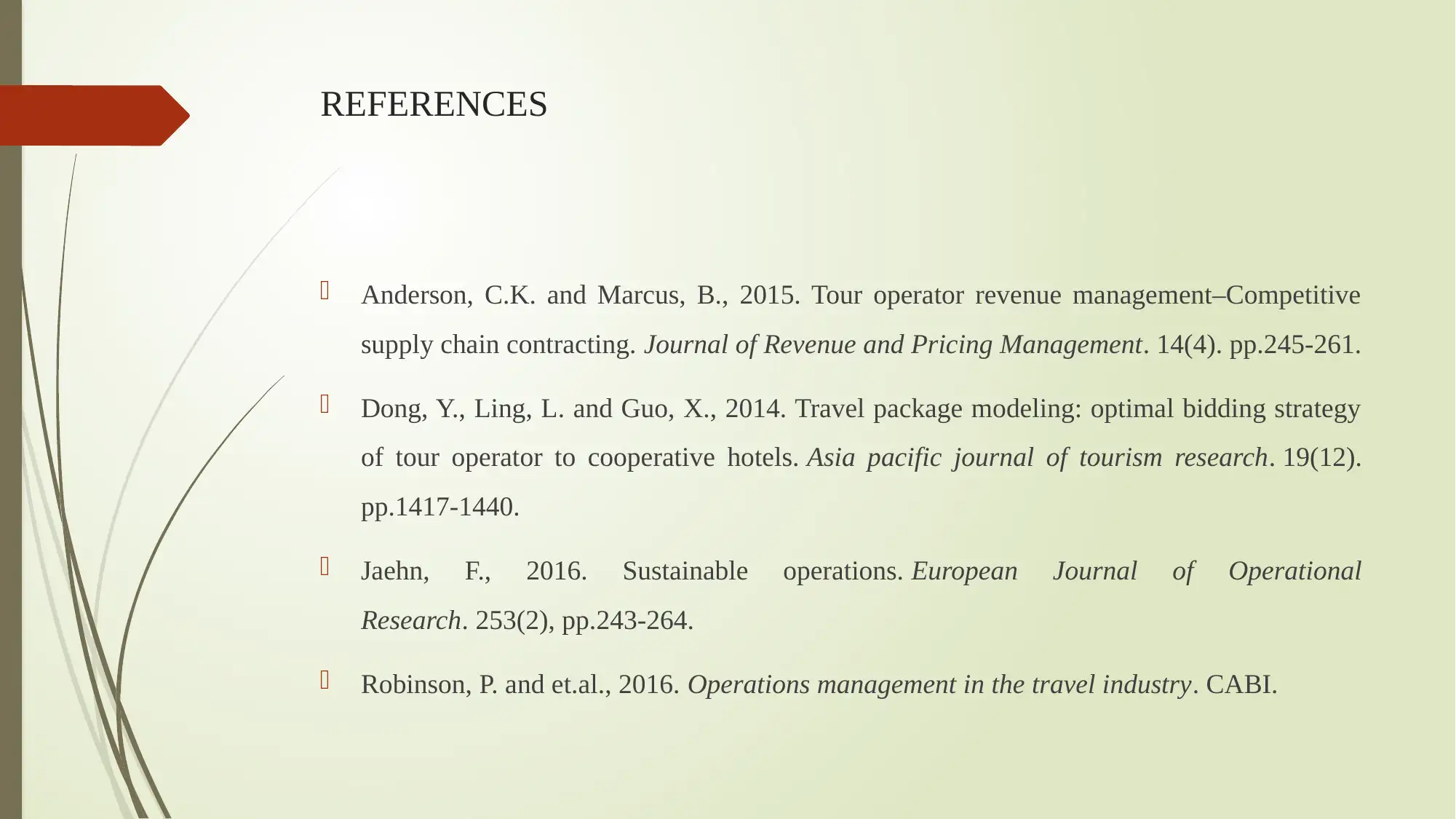
Anderson, C.K. and Marcus, B., 2015. Tour operator revenue management–Competitive
supply chain contracting. Journal of Revenue and Pricing Management. 14(4). pp.245-261.
Dong, Y., Ling, L. and Guo, X., 2014. Travel package modeling: optimal bidding strategy
of tour operator to cooperative hotels. Asia pacific journal of tourism research. 19(12).
pp.1417-1440.
Jaehn, F., 2016. Sustainable operations. European Journal of Operational
Research. 253(2), pp.243-264.
Robinson, P. and et.al., 2016. Operations management in the travel industry. CABI.
Anderson, C.K. and Marcus, B., 2015. Tour operator revenue management–Competitive
supply chain contracting. Journal of Revenue and Pricing Management. 14(4). pp.245-261.
Dong, Y., Ling, L. and Guo, X., 2014. Travel package modeling: optimal bidding strategy
of tour operator to cooperative hotels. Asia pacific journal of tourism research. 19(12).
pp.1417-1440.
Jaehn, F., 2016. Sustainable operations. European Journal of Operational
Research. 253(2), pp.243-264.
Robinson, P. and et.al., 2016. Operations management in the travel industry. CABI.
Paraphrase This Document
Need a fresh take? Get an instant paraphrase of this document with our AI Paraphraser

1 out of 11
Related Documents
Your All-in-One AI-Powered Toolkit for Academic Success.
+13062052269
info@desklib.com
Available 24*7 on WhatsApp / Email
Unlock your academic potential
Copyright © 2020–2026 A2Z Services. All Rights Reserved. Developed and managed by ZUCOL.