Tour Operations Management Report: Holiday Package Analysis
VerifiedAdded on 2020/06/03
|13
|2911
|57
Report
AI Summary
This report comprehensively examines tour operations management, focusing on the development of holiday packages, including the stages and timescales involved. It details various methods of contracting for holiday components and provides costing calculations for different packages. The report further explores marketing strategies, including direct sales, hiring agents, partnerships, and online sales. Strategic decisions made by different types of tour operators are analyzed, along with various tactical decisions required under different situations. The report uses a case study approach, with examples of packages to South Africa, and discusses topics like market research, cost analysis, legal formalities and promotional strategies.
Tour Operations Management

Paraphrase This Document
Need a fresh take? Get an instant paraphrase of this document with our AI Paraphraser
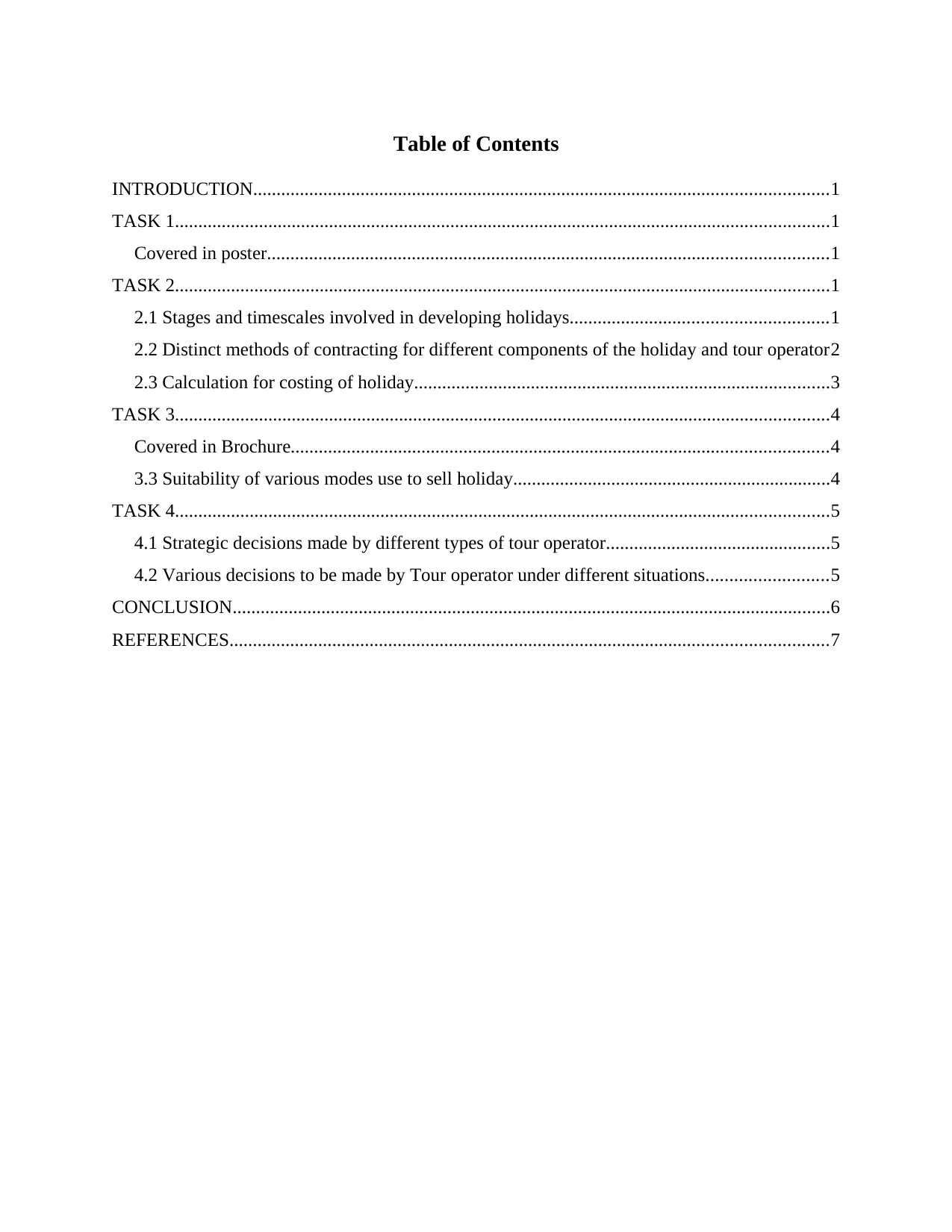
Table of Contents
INTRODUCTION...........................................................................................................................1
TASK 1............................................................................................................................................1
Covered in poster........................................................................................................................1
TASK 2............................................................................................................................................1
2.1 Stages and timescales involved in developing holidays.......................................................1
2.2 Distinct methods of contracting for different components of the holiday and tour operator2
2.3 Calculation for costing of holiday.........................................................................................3
TASK 3............................................................................................................................................4
Covered in Brochure...................................................................................................................4
3.3 Suitability of various modes use to sell holiday....................................................................4
TASK 4............................................................................................................................................5
4.1 Strategic decisions made by different types of tour operator................................................5
4.2 Various decisions to be made by Tour operator under different situations..........................5
CONCLUSION................................................................................................................................6
REFERENCES................................................................................................................................7
INTRODUCTION...........................................................................................................................1
TASK 1............................................................................................................................................1
Covered in poster........................................................................................................................1
TASK 2............................................................................................................................................1
2.1 Stages and timescales involved in developing holidays.......................................................1
2.2 Distinct methods of contracting for different components of the holiday and tour operator2
2.3 Calculation for costing of holiday.........................................................................................3
TASK 3............................................................................................................................................4
Covered in Brochure...................................................................................................................4
3.3 Suitability of various modes use to sell holiday....................................................................4
TASK 4............................................................................................................................................5
4.1 Strategic decisions made by different types of tour operator................................................5
4.2 Various decisions to be made by Tour operator under different situations..........................5
CONCLUSION................................................................................................................................6
REFERENCES................................................................................................................................7
INTRODUCTION
In the tourism industry, tour operation management plays a crucial role. There are various
tour operators who assist in catering services to the global as well as domestic travellers. This
way the overall business of tour operations is refereed as an integrated activity which develops a
link between the tourists and all other people which are dealing in the same business (Brown,
Bessant and Lamming, 2013). In 21st century, the most effective business which has started in
tourism sector is of arranging packages for travellers in which facilities like lodging, convince
food, accommodation and like are included. In the given report, factors that have their direct
impact on tourism industry will be discussed in detail which will assist those who are dealing in
this business. Way in which holiday packages are developed will be highlighted in the report.
Thereafter, distinct modern and traditional marketing techniques will be elaborated which will
help in understanding each concept with more clarity.
TASK 1
Covered in poster
TASK 2
2.1 Stages and timescales involved in developing holidays
In order to prepare a perfect tour combination, it is important that proper steps are being
followed so that an effective package can be offered to the customers (Chand and Katou, 2012).
To design a package to South Africa, Thomson Holidays Ltd will have to evaluate all the costs
so that it can make the estimation of value which will be given to the potential customers. There
are various options which are available with the tourists to visit at this destination as it is known
for its rich heritage and culture and other beautiful spots like Kruger national park, Table
Mountain, etc. various stages involved in the process of package formulations are given below:
Market research – In order to start the planning for designing of package, it is important
for the tour operator to first collect the relevant information from market. This helps in
construction of package which is beneficial for both customers as well for the operating
organisation. In this, the collection of accommodation services information and other tour
1
In the tourism industry, tour operation management plays a crucial role. There are various
tour operators who assist in catering services to the global as well as domestic travellers. This
way the overall business of tour operations is refereed as an integrated activity which develops a
link between the tourists and all other people which are dealing in the same business (Brown,
Bessant and Lamming, 2013). In 21st century, the most effective business which has started in
tourism sector is of arranging packages for travellers in which facilities like lodging, convince
food, accommodation and like are included. In the given report, factors that have their direct
impact on tourism industry will be discussed in detail which will assist those who are dealing in
this business. Way in which holiday packages are developed will be highlighted in the report.
Thereafter, distinct modern and traditional marketing techniques will be elaborated which will
help in understanding each concept with more clarity.
TASK 1
Covered in poster
TASK 2
2.1 Stages and timescales involved in developing holidays
In order to prepare a perfect tour combination, it is important that proper steps are being
followed so that an effective package can be offered to the customers (Chand and Katou, 2012).
To design a package to South Africa, Thomson Holidays Ltd will have to evaluate all the costs
so that it can make the estimation of value which will be given to the potential customers. There
are various options which are available with the tourists to visit at this destination as it is known
for its rich heritage and culture and other beautiful spots like Kruger national park, Table
Mountain, etc. various stages involved in the process of package formulations are given below:
Market research – In order to start the planning for designing of package, it is important
for the tour operator to first collect the relevant information from market. This helps in
construction of package which is beneficial for both customers as well for the operating
organisation. In this, the collection of accommodation services information and other tour
1
⊘ This is a preview!⊘
Do you want full access?
Subscribe today to unlock all pages.

Trusted by 1+ million students worldwide
related facilities are done so that the best offer is made to the customers (Chon and Yu,
2012).
Packaging Cost analysis – Main factor while designing the final package is to reach at
the effective price which will be offered to the ultimate customer. It is the most complex
stage as it has to be ensured that the right package is being offered so that more
customers can be attracted and also it should provide maximum benefits to company.
These packages are flexible and modified as per the need of clients. Depending upon the
requirement of customers, changes are done which further lead to fluctuations in price.
Apart from this, information about the price market also helps in deciding what price will
be offered to which customer (Dodds and Kuehnel, 2010).
Negotiation with the different service providers – When a group or an individual is on
trip, they use variety of facilitates like accommodation, food, travelling etc. Therefore, in
order to give clients maximum satisfaction, tour operators have to negotiate with these
service providers of South Africa in which they decide price of each facility which will
be charged from the service user.
Accomplishment of all legal formalities – Every nation has their own rules and
regulations depending on the level of security and safety measures which are followed
their. Therefore it is the duty of the tour operators to see that the documentation work is
done properly so that tourists do not face any issue when they travel globally (Evans,
Stonehouse and Campbell, 2012).
Promotion strategy – If an effective package is being designed but not communicated to
users than the constructed plan is of no use. Therefore, it is vital that whatever package is
made is well communicated to all so that they get to know the benefits offered to them
and accordingly can take the required decision.
2.2 Distinct methods of contracting for different components of the holiday and tour operator
There are several element which are needed to be balanced while doing preparation of a
holiday. Booking of flights, hotels assistant to guide and various other associated services. It is
important to have a legal document which act as an evidence in the entire trip which includes all
the promises which the tour operator company promises to offer to its customers. On the basis of
flexibility these contracts can be divided into two different parts as given below:
2
2012).
Packaging Cost analysis – Main factor while designing the final package is to reach at
the effective price which will be offered to the ultimate customer. It is the most complex
stage as it has to be ensured that the right package is being offered so that more
customers can be attracted and also it should provide maximum benefits to company.
These packages are flexible and modified as per the need of clients. Depending upon the
requirement of customers, changes are done which further lead to fluctuations in price.
Apart from this, information about the price market also helps in deciding what price will
be offered to which customer (Dodds and Kuehnel, 2010).
Negotiation with the different service providers – When a group or an individual is on
trip, they use variety of facilitates like accommodation, food, travelling etc. Therefore, in
order to give clients maximum satisfaction, tour operators have to negotiate with these
service providers of South Africa in which they decide price of each facility which will
be charged from the service user.
Accomplishment of all legal formalities – Every nation has their own rules and
regulations depending on the level of security and safety measures which are followed
their. Therefore it is the duty of the tour operators to see that the documentation work is
done properly so that tourists do not face any issue when they travel globally (Evans,
Stonehouse and Campbell, 2012).
Promotion strategy – If an effective package is being designed but not communicated to
users than the constructed plan is of no use. Therefore, it is vital that whatever package is
made is well communicated to all so that they get to know the benefits offered to them
and accordingly can take the required decision.
2.2 Distinct methods of contracting for different components of the holiday and tour operator
There are several element which are needed to be balanced while doing preparation of a
holiday. Booking of flights, hotels assistant to guide and various other associated services. It is
important to have a legal document which act as an evidence in the entire trip which includes all
the promises which the tour operator company promises to offer to its customers. On the basis of
flexibility these contracts can be divided into two different parts as given below:
2
Paraphrase This Document
Need a fresh take? Get an instant paraphrase of this document with our AI Paraphraser
Fixed contract – It is that type of agreement where no negotiation take place between the
supplier and and service receiver (Filby, Stockin and Scarpaci, 2015). Tour operators in this
contract concentrates on maximising their profits by bringing more and more packages during
the peak seasons. They have limited customers as they do not make change in the price which
they offer.
Only sale agreement – this type of contract is formulated for a selected type population which is
high income group. They provide offers in throughout the year and are comparatively expensive
from that of others (Gass and Harris, 2012).
Each of the discussed contracts has their own advantages and disadvantages to the
company and are selected after analysing the positives and negatives of these. Revenue is
generated through them and also positioning in the market of tour companies is maintained
through them. After taking all the relevant steps examination of same is done and than the same
is implemented.
2.3 Calculation for costing of holiday
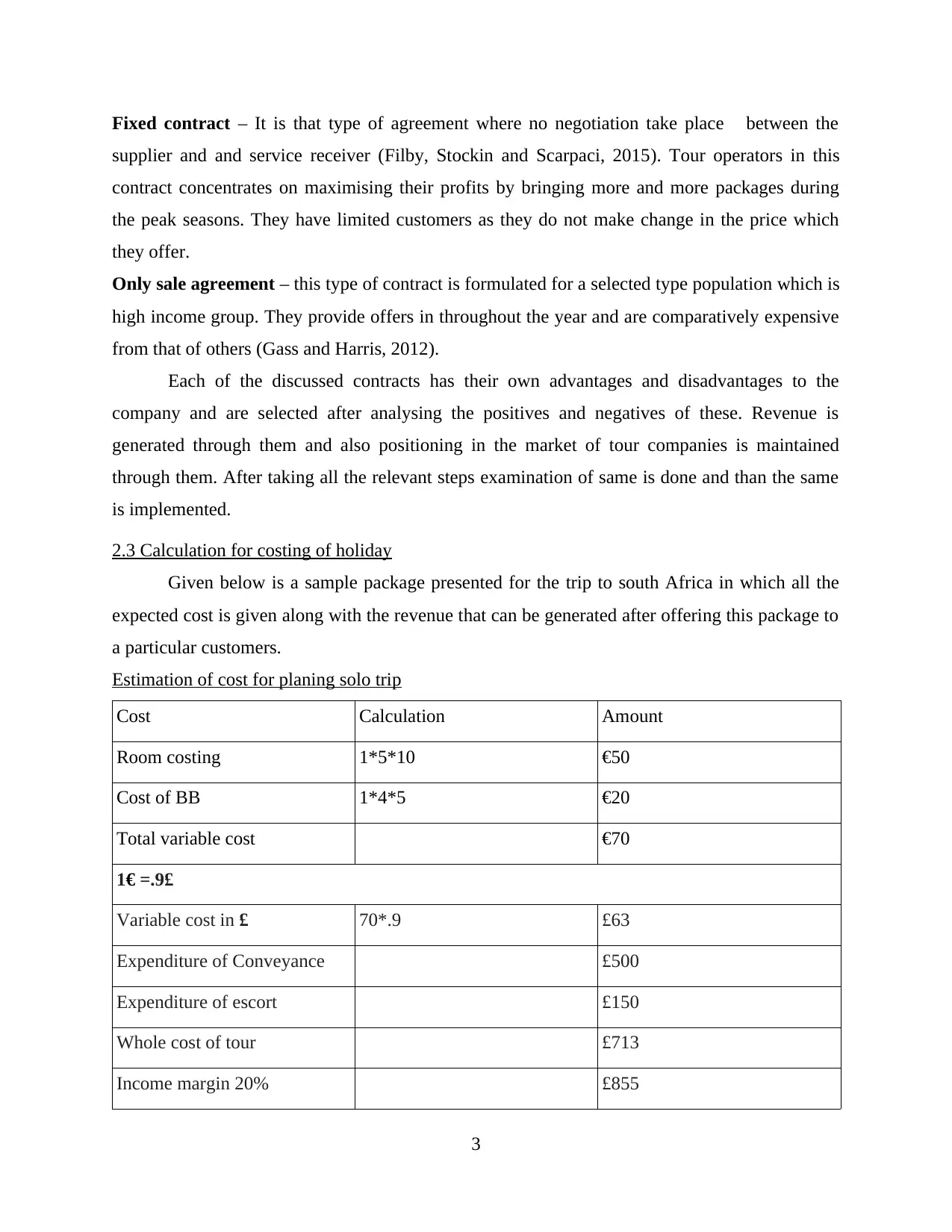
Given below is a sample package presented for the trip to south Africa in which all the
expected cost is given along with the revenue that can be generated after offering this package to
a particular customers.
Estimation of cost for planing solo trip
Cost Calculation Amount
Room costing 1*5*10 €50
Cost of BB 1*4*5 €20
Total variable cost €70
1€ =.9£
Variable cost in £ 70*.9 £63
Expenditure of Conveyance £500
Expenditure of escort £150
Whole cost of tour £713
Income margin 20% £855
3
supplier and and service receiver (Filby, Stockin and Scarpaci, 2015). Tour operators in this
contract concentrates on maximising their profits by bringing more and more packages during
the peak seasons. They have limited customers as they do not make change in the price which
they offer.
Only sale agreement – this type of contract is formulated for a selected type population which is
high income group. They provide offers in throughout the year and are comparatively expensive
from that of others (Gass and Harris, 2012).
Each of the discussed contracts has their own advantages and disadvantages to the
company and are selected after analysing the positives and negatives of these. Revenue is
generated through them and also positioning in the market of tour companies is maintained
through them. After taking all the relevant steps examination of same is done and than the same
is implemented.
2.3 Calculation for costing of holiday
Given below is a sample package presented for the trip to south Africa in which all the
expected cost is given along with the revenue that can be generated after offering this package to
a particular customers.
Estimation of cost for planing solo trip
Cost Calculation Amount
Room costing 1*5*10 €50
Cost of BB 1*4*5 €20
Total variable cost €70
1€ =.9£
Variable cost in £ 70*.9 £63
Expenditure of Conveyance £500
Expenditure of escort £150
Whole cost of tour £713
Income margin 20% £855
3
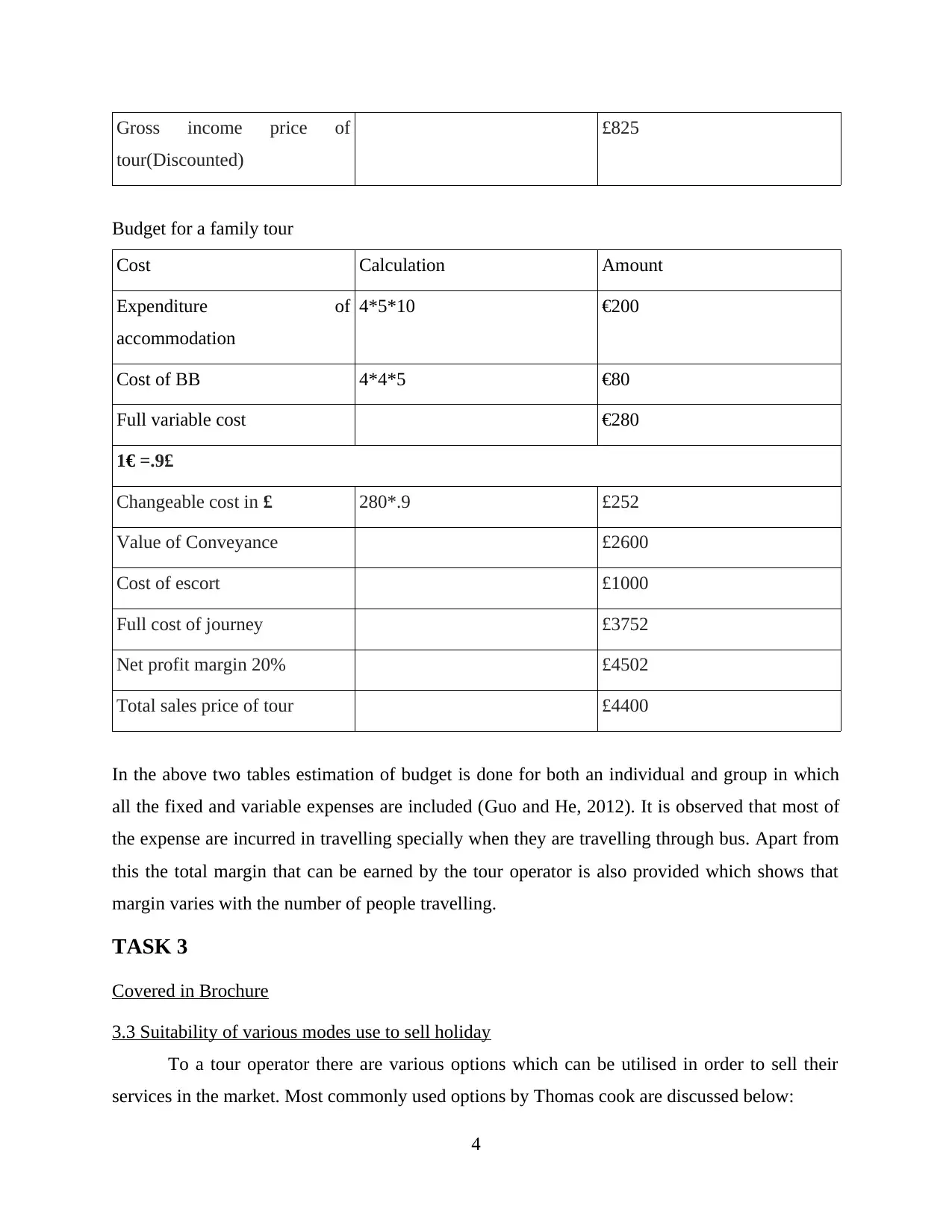
Gross income price of
tour(Discounted)
£825
Budget for a family tour
Cost Calculation Amount
Expenditure of
accommodation
4*5*10 €200
Cost of BB 4*4*5 €80
Full variable cost €280
1€ =.9£
Changeable cost in £ 280*.9 £252
Value of Conveyance £2600
Cost of escort £1000
Full cost of journey £3752
Net profit margin 20% £4502
Total sales price of tour £4400
In the above two tables estimation of budget is done for both an individual and group in which
all the fixed and variable expenses are included (Guo and He, 2012). It is observed that most of
the expense are incurred in travelling specially when they are travelling through bus. Apart from
this the total margin that can be earned by the tour operator is also provided which shows that
margin varies with the number of people travelling.
TASK 3
Covered in Brochure
3.3 Suitability of various modes use to sell holiday
To a tour operator there are various options which can be utilised in order to sell their
services in the market. Most commonly used options by Thomas cook are discussed below:
4
tour(Discounted)
£825
Budget for a family tour
Cost Calculation Amount
Expenditure of
accommodation
4*5*10 €200
Cost of BB 4*4*5 €80
Full variable cost €280
1€ =.9£
Changeable cost in £ 280*.9 £252
Value of Conveyance £2600
Cost of escort £1000
Full cost of journey £3752
Net profit margin 20% £4502
Total sales price of tour £4400
In the above two tables estimation of budget is done for both an individual and group in which
all the fixed and variable expenses are included (Guo and He, 2012). It is observed that most of
the expense are incurred in travelling specially when they are travelling through bus. Apart from
this the total margin that can be earned by the tour operator is also provided which shows that
margin varies with the number of people travelling.
TASK 3
Covered in Brochure
3.3 Suitability of various modes use to sell holiday
To a tour operator there are various options which can be utilised in order to sell their
services in the market. Most commonly used options by Thomas cook are discussed below:
4
⊘ This is a preview!⊘
Do you want full access?
Subscribe today to unlock all pages.
Trusted by 1+ million students worldwide
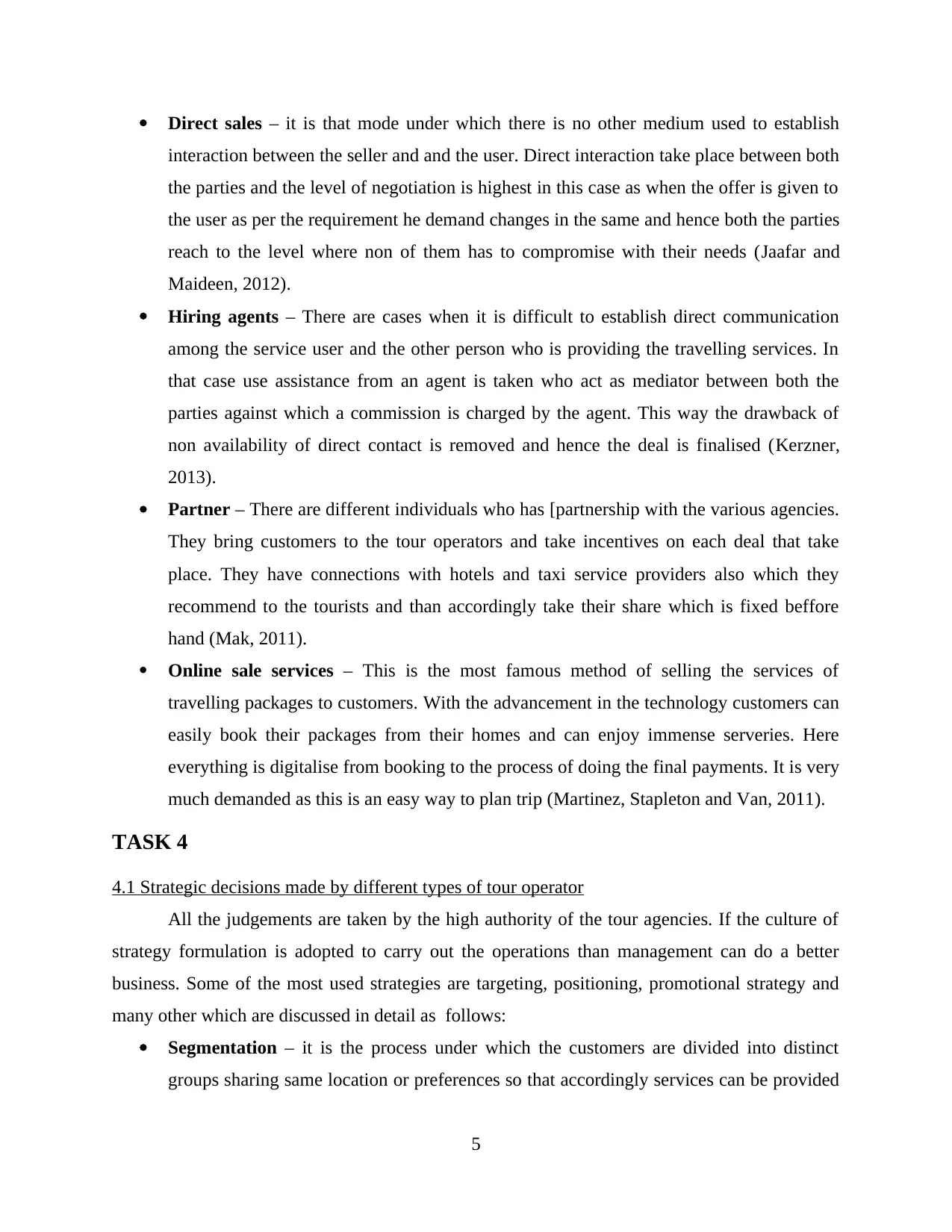
Direct sales – it is that mode under which there is no other medium used to establish
interaction between the seller and and the user. Direct interaction take place between both
the parties and the level of negotiation is highest in this case as when the offer is given to
the user as per the requirement he demand changes in the same and hence both the parties
reach to the level where non of them has to compromise with their needs (Jaafar and
Maideen, 2012).
Hiring agents – There are cases when it is difficult to establish direct communication
among the service user and the other person who is providing the travelling services. In
that case use assistance from an agent is taken who act as mediator between both the
parties against which a commission is charged by the agent. This way the drawback of
non availability of direct contact is removed and hence the deal is finalised (Kerzner,
2013).
Partner – There are different individuals who has [partnership with the various agencies.
They bring customers to the tour operators and take incentives on each deal that take
place. They have connections with hotels and taxi service providers also which they
recommend to the tourists and than accordingly take their share which is fixed beffore
hand (Mak, 2011).
Online sale services – This is the most famous method of selling the services of
travelling packages to customers. With the advancement in the technology customers can
easily book their packages from their homes and can enjoy immense serveries. Here
everything is digitalise from booking to the process of doing the final payments. It is very
much demanded as this is an easy way to plan trip (Martinez, Stapleton and Van, 2011).
TASK 4
4.1 Strategic decisions made by different types of tour operator
All the judgements are taken by the high authority of the tour agencies. If the culture of
strategy formulation is adopted to carry out the operations than management can do a better
business. Some of the most used strategies are targeting, positioning, promotional strategy and
many other which are discussed in detail as follows:
Segmentation – it is the process under which the customers are divided into distinct
groups sharing same location or preferences so that accordingly services can be provided
5
interaction between the seller and and the user. Direct interaction take place between both
the parties and the level of negotiation is highest in this case as when the offer is given to
the user as per the requirement he demand changes in the same and hence both the parties
reach to the level where non of them has to compromise with their needs (Jaafar and
Maideen, 2012).
Hiring agents – There are cases when it is difficult to establish direct communication
among the service user and the other person who is providing the travelling services. In
that case use assistance from an agent is taken who act as mediator between both the
parties against which a commission is charged by the agent. This way the drawback of
non availability of direct contact is removed and hence the deal is finalised (Kerzner,
2013).
Partner – There are different individuals who has [partnership with the various agencies.
They bring customers to the tour operators and take incentives on each deal that take
place. They have connections with hotels and taxi service providers also which they
recommend to the tourists and than accordingly take their share which is fixed beffore
hand (Mak, 2011).
Online sale services – This is the most famous method of selling the services of
travelling packages to customers. With the advancement in the technology customers can
easily book their packages from their homes and can enjoy immense serveries. Here
everything is digitalise from booking to the process of doing the final payments. It is very
much demanded as this is an easy way to plan trip (Martinez, Stapleton and Van, 2011).
TASK 4
4.1 Strategic decisions made by different types of tour operator
All the judgements are taken by the high authority of the tour agencies. If the culture of
strategy formulation is adopted to carry out the operations than management can do a better
business. Some of the most used strategies are targeting, positioning, promotional strategy and
many other which are discussed in detail as follows:
Segmentation – it is the process under which the customers are divided into distinct
groups sharing same location or preferences so that accordingly services can be provided
5
Paraphrase This Document
Need a fresh take? Get an instant paraphrase of this document with our AI Paraphraser
to them. It helps more in understanding the demand of potential customers (Medlik,
2016).
Pricing Strategy – it is another technique which can be utilised in order to increase the
total sales. As per the current situation of the economy and demand fluctuations in the
cost of packages is done buy offering discounts and other attractive reduce price to the
customers which increases total sales.
4.2 Various decisions to be made by Tour operator under different situations.
In order to achieve the long term benefits and increase profitability it is required that
proper decisions shall be taken in this respect and they are defined as tactical decisions
(Moutinho, 2011). This will help the tour operator to perform the day to day activities of
business in appropriate manner. Some of the decisions which are to be taken by them involve
certain factors to be considered which are:
For the development of product and services, it is needed that proper decisions shall be
made in this regards. For this various policies are to be made in short term by the tour
operator. All the customers have different taste and so their preferences are also variation
in terms of prices, locations and other factors. To deal with this various policies are
offered by Thomas Cook to all of them according to their needs and requirements. This is
an additional feature provided by it as other give only one option and all have to adopt
the same (Nakayama and Bucks, 2012).
There are many such services which are provided additionally by organisations in order
to attract more number of visitors and they include parking, car hiring, currency exchange
and hotel facilities.
There are such services which are sold on direct basis and for that tour operator is
required to communicate with the customers directly. Some of them involve call centres,
telephones, after sales services and mailings. By the help of this customers are satisfied
and this increase their loyalty towards company and overall rise in profitability will be
achieved with the use of this (Nolz, Doerner and Hartl, 2010).
In the changing environment people want to gain all the information in relation to the
place they are visiting. To meet this need guide service is provided by companies to their
customers.
6
2016).
Pricing Strategy – it is another technique which can be utilised in order to increase the
total sales. As per the current situation of the economy and demand fluctuations in the
cost of packages is done buy offering discounts and other attractive reduce price to the
customers which increases total sales.
4.2 Various decisions to be made by Tour operator under different situations.
In order to achieve the long term benefits and increase profitability it is required that
proper decisions shall be taken in this respect and they are defined as tactical decisions
(Moutinho, 2011). This will help the tour operator to perform the day to day activities of
business in appropriate manner. Some of the decisions which are to be taken by them involve
certain factors to be considered which are:
For the development of product and services, it is needed that proper decisions shall be
made in this regards. For this various policies are to be made in short term by the tour
operator. All the customers have different taste and so their preferences are also variation
in terms of prices, locations and other factors. To deal with this various policies are
offered by Thomas Cook to all of them according to their needs and requirements. This is
an additional feature provided by it as other give only one option and all have to adopt
the same (Nakayama and Bucks, 2012).
There are many such services which are provided additionally by organisations in order
to attract more number of visitors and they include parking, car hiring, currency exchange
and hotel facilities.
There are such services which are sold on direct basis and for that tour operator is
required to communicate with the customers directly. Some of them involve call centres,
telephones, after sales services and mailings. By the help of this customers are satisfied
and this increase their loyalty towards company and overall rise in profitability will be
achieved with the use of this (Nolz, Doerner and Hartl, 2010).
In the changing environment people want to gain all the information in relation to the
place they are visiting. To meet this need guide service is provided by companies to their
customers.
6
More advertisements are given so that visitors are aware of all options from which they
can choose the best as per their needs (Page, 2014).
CONCLUSION
From above report this has been summarised that tour operators is playing a crucial role
in bringing out the business of tourism industry. There are various functions which are
performed by them which helps tourists to enjoy their trip and get maximum satisfaction.
Various forms are described in the above text through which the packages are sold in the market.
Different types of contracts are also explained which shows how a deal is fixed between the
customers and the service provider.
7
can choose the best as per their needs (Page, 2014).
CONCLUSION
From above report this has been summarised that tour operators is playing a crucial role
in bringing out the business of tourism industry. There are various functions which are
performed by them which helps tourists to enjoy their trip and get maximum satisfaction.
Various forms are described in the above text through which the packages are sold in the market.
Different types of contracts are also explained which shows how a deal is fixed between the
customers and the service provider.
7
⊘ This is a preview!⊘
Do you want full access?
Subscribe today to unlock all pages.
Trusted by 1+ million students worldwide
REFERENCES
Book and Journals
Brown, S., Bessant, J.R. and Lamming, R., 2013. Strategic operations management. Routledge.
Chand, M. and Katou, A.A., 2012. Strategic determinants for the selection of partner alliances in
the Indian tour operator industry: A cross-national study. Journal of World Business.
47(2). pp.167-177.
Chon, K.S. and Yu, L., 2012. The international hospitality business: Management and
operations. Routledge.
Dodds, R. and Kuehnel, J., 2010. CSR among Canadian mass tour operators: good awareness but
little action. International Journal of Contemporary Hospitality Management. 22(2).
pp.221-244.
Evans, N., Stonehouse, G. and Campbell, D., 2012. Strategic management for travel and tourism.
Taylor & Francis.
Filby, N.E., Stockin, K.A. and Scarpaci, C., 2015. Social science as a vehicle to improve
dolphin-swim tour operation compliance?. Marine Policy. 51. pp.40-47.
Gass, S.I. and Harris, C.M. eds., 2012. Encyclopedia of operations research and management
science. Springer Science & Business Media.
Guo, X. and He, L., 2012. Tourism supply-chain coordination: The cooperation between tourism
hotel and tour operator. Tourism Economics. 18(6). pp.1361-1376.
Jaafar, M. and Maideen, S.A., 2012. Ecotourism-related products and activities, and the
economic sustainability of small and medium island chalets. Tourism Management.
33(3). pp.683-691.
Kerzner, H., 2013. Project management: a systems approach to planning, scheduling, and
controlling. John Wiley & Sons.
Mak, B.L., 2011. ISO certification in the tour operator sector. International Journal of
Contemporary Hospitality Management. 23(1). pp.115-130.
Martinez, A.J.P., Stapleton, O. and Van Wassenhove, L.N., 2011. Field vehicle fleet
management in humanitarian operations: a case-based approach. Journal of Operations
Management. 29(5). pp.404-421.
Medlik, S. ed., 2016. Managing tourism. Elsevier.
Moutinho, L. ed., 2011. Strategic management in tourism. Cabi.
Nakayama, F.S. and Bucks, D.A. eds., 2012. Trickle irrigation for crop production: design,
operation and management (Vol. 9). Elsevier.
Nolz, P.C., Doerner, K.F. and Hartl, R.F., 2010. Water distribution in disaster relief.
International Journal of Physical Distribution & Logistics Management. 40(8/9).
pp.693-708.
Book and Journals
Brown, S., Bessant, J.R. and Lamming, R., 2013. Strategic operations management. Routledge.
Chand, M. and Katou, A.A., 2012. Strategic determinants for the selection of partner alliances in
the Indian tour operator industry: A cross-national study. Journal of World Business.
47(2). pp.167-177.
Chon, K.S. and Yu, L., 2012. The international hospitality business: Management and
operations. Routledge.
Dodds, R. and Kuehnel, J., 2010. CSR among Canadian mass tour operators: good awareness but
little action. International Journal of Contemporary Hospitality Management. 22(2).
pp.221-244.
Evans, N., Stonehouse, G. and Campbell, D., 2012. Strategic management for travel and tourism.
Taylor & Francis.
Filby, N.E., Stockin, K.A. and Scarpaci, C., 2015. Social science as a vehicle to improve
dolphin-swim tour operation compliance?. Marine Policy. 51. pp.40-47.
Gass, S.I. and Harris, C.M. eds., 2012. Encyclopedia of operations research and management
science. Springer Science & Business Media.
Guo, X. and He, L., 2012. Tourism supply-chain coordination: The cooperation between tourism
hotel and tour operator. Tourism Economics. 18(6). pp.1361-1376.
Jaafar, M. and Maideen, S.A., 2012. Ecotourism-related products and activities, and the
economic sustainability of small and medium island chalets. Tourism Management.
33(3). pp.683-691.
Kerzner, H., 2013. Project management: a systems approach to planning, scheduling, and
controlling. John Wiley & Sons.
Mak, B.L., 2011. ISO certification in the tour operator sector. International Journal of
Contemporary Hospitality Management. 23(1). pp.115-130.
Martinez, A.J.P., Stapleton, O. and Van Wassenhove, L.N., 2011. Field vehicle fleet
management in humanitarian operations: a case-based approach. Journal of Operations
Management. 29(5). pp.404-421.
Medlik, S. ed., 2016. Managing tourism. Elsevier.
Moutinho, L. ed., 2011. Strategic management in tourism. Cabi.
Nakayama, F.S. and Bucks, D.A. eds., 2012. Trickle irrigation for crop production: design,
operation and management (Vol. 9). Elsevier.
Nolz, P.C., Doerner, K.F. and Hartl, R.F., 2010. Water distribution in disaster relief.
International Journal of Physical Distribution & Logistics Management. 40(8/9).
pp.693-708.
Paraphrase This Document
Need a fresh take? Get an instant paraphrase of this document with our AI Paraphraser
Page, S.J., 2014. Tourism management. Routledge.
Online
Tour Operations Management. 2016. [Online]. Available Through: <http://somo.co.ke/bachelor-
of-travel-and-tour-operations-management-at-moi-university-sm2-493.html> .
[Accesses on 24th October 2017].
Characteristics Of Tour Operator. 2015. [Online]. Available Through:
<http://www.iibmindialms.com/library/operation-management/supply-chain-
management/tour-operator-characteristics/> . [Accesses on 24th October 2017].
9
Online
Tour Operations Management. 2016. [Online]. Available Through: <http://somo.co.ke/bachelor-
of-travel-and-tour-operations-management-at-moi-university-sm2-493.html> .
[Accesses on 24th October 2017].
Characteristics Of Tour Operator. 2015. [Online]. Available Through:
<http://www.iibmindialms.com/library/operation-management/supply-chain-
management/tour-operator-characteristics/> . [Accesses on 24th October 2017].
9

10
⊘ This is a preview!⊘
Do you want full access?
Subscribe today to unlock all pages.
Trusted by 1+ million students worldwide

1 out of 13


Related Documents


Your All-in-One AI-Powered Toolkit for Academic Success.
+13062052269
info@desklib.com
Available 24*7 on WhatsApp / Email
![[object Object]](/_next/static/media/star-bottom.7253800d.svg)
Unlock your academic potential
Copyright © 2020–2025 A2Z Services. All Rights Reserved. Developed and managed by ZUCOL.