Comprehensive Analysis of Tourism System for CTC Travel in Singapore
VerifiedAdded on 2020/05/11
|11
|4486
|239
Report
AI Summary
This report presents a thorough analysis of the tourism system, using CTC Travel of Singapore as a case study. It encompasses a literature review, research methodology (qualitative and quantitative), and content analysis. The research focuses on innovating CTC Travel's website beyond marketing and sales to ensure long-term sustainability, considering ethical considerations and research limitations. The report delves into the advantages and disadvantages of tourism, economic impacts, and key features of tourism websites. The methodology includes a discussion of qualitative and quantitative research approaches used in tourism analysis. The report aims to provide insights into tourism websites' design, functionality, and their role in promoting destinations, with a focus on how CTC Travel can improve its online presence and overall tourism strategy. The report also covers the economic gains and challenges associated with tourism.

Running head: TOURISM SYSTEM ANALYSIS
Tourism System Analysis
Name of the student:
Name of the university:
Author note
Tourism System Analysis
Name of the student:
Name of the university:
Author note

Paraphrase This Document
Need a fresh take? Get an instant paraphrase of this document with our AI Paraphraser
1TOURISM SYSTEM ANALYSIS
Abstract
This report is the combination of a literature review and research methodology along with a
content analysis for a tourism system. CTC travels of Singapore have been used as the example
for the research topic. The researcher has worked on the innovation of tourism website beyond
marketing and selling for the long- term sustenance of the particular company. The survey has
been conducted by the researcher by keeping in mind the ethical considerations as well as the
research limitations. The broad topic has been narrowed down to a specific part for the ease of
the study. The content and designing of the website has to be considered for modification while
making the innovation in the tourism website. The in- depth analysis has been given in the
assignment for successful completion of the research work.
Abstract
This report is the combination of a literature review and research methodology along with a
content analysis for a tourism system. CTC travels of Singapore have been used as the example
for the research topic. The researcher has worked on the innovation of tourism website beyond
marketing and selling for the long- term sustenance of the particular company. The survey has
been conducted by the researcher by keeping in mind the ethical considerations as well as the
research limitations. The broad topic has been narrowed down to a specific part for the ease of
the study. The content and designing of the website has to be considered for modification while
making the innovation in the tourism website. The in- depth analysis has been given in the
assignment for successful completion of the research work.
2TOURISM SYSTEM ANALYSIS
Table of Contents
1. Introduction..............................................................................................................................3
2. Literature Review.....................................................................................................................3
Introduction..................................................................................................................................3
Conceptual Framework................................................................................................................4
About Tourism Websites.............................................................................................................4
Advantages and Disadvantages...................................................................................................5
Economic Impact.........................................................................................................................5
Research Questions......................................................................................................................6
3. Methodology............................................................................................................................6
Qualitative Research....................................................................................................................6
Quantitative Research..................................................................................................................6
Research Limitations...................................................................................................................7
Ethical Considerations.................................................................................................................7
4. Content Analysis......................................................................................................................8
5. Conclusion................................................................................................................................8
Reference.........................................................................................................................................9
Table of Contents
1. Introduction..............................................................................................................................3
2. Literature Review.....................................................................................................................3
Introduction..................................................................................................................................3
Conceptual Framework................................................................................................................4
About Tourism Websites.............................................................................................................4
Advantages and Disadvantages...................................................................................................5
Economic Impact.........................................................................................................................5
Research Questions......................................................................................................................6
3. Methodology............................................................................................................................6
Qualitative Research....................................................................................................................6
Quantitative Research..................................................................................................................6
Research Limitations...................................................................................................................7
Ethical Considerations.................................................................................................................7
4. Content Analysis......................................................................................................................8
5. Conclusion................................................................................................................................8
Reference.........................................................................................................................................9
⊘ This is a preview!⊘
Do you want full access?
Subscribe today to unlock all pages.

Trusted by 1+ million students worldwide
3TOURISM SYSTEM ANALYSIS
1. Introduction
Tourism refers to the travel for the purpose of business, recreation or leisure. It can be
defined as the system of traveling and staying in a place outside the known environment of an
individual for various purposes and for not more than a consecutive year. Tourism is beneficial
for a country or place because it is responsible for bringing in huge income in exchange of goods
and services which accounts for the 30% of the global export of services and 6% of the total
export of goods and services. There are three factors, namely, internal, external and national
factors associated with the tourism system. The external factors include those that recognize the
destination competitiveness, influence of the competitors, security, image, distance and the
international barriers and economy. The national factors include the structure of government,
GDP, economy, culture and society of the two countries in which the tourism business take
place. The individual factors include those that affect the individual’s preference of a destination,
for instance, time taken to travel, income, regulations, images and personal choice. The
upcoming and innovative products in tourism include golf tourism, medical tourism, education
tourism, sports tourism, domestic tourism, tea tourism, luxury trains, eco tourism and wedding.
The challenges that can pose a threat for tourism include regulatory issues, lack of proper
infrastructure, security, human resources, taxation, service levels and lack of sufficient marketing
and promotion (Carlisle et al., 2013). The managers in the supervision of tourism industry use
strategies like product development in the form of customized services, specific location oriented
packages and low cost of packages. Use of web and e- commerce is also popular with the
increasing users of internet. The managers create, draw and ease sporting, entertaining, cultural
activities and other major events for the sake of tourists.
2. Literature Review
Introduction
In this report the researcher will look into the overview of the tourism system in
Singapore with special focus on the company CTC Travel. According to Lin et al., 2014 the
analysis of the tourism company in Singapore will be supported with relevant concepts of the
system. They are efficient in operating specialized China tours. CTC is the ideal choice for
tourists who are planning to travel in China. Since its establishment in the year 1990, it has
always been focused to improve their services and provide the beautiful tours to various places in
China which include Beijing, Tulou, Chengde, Tianjin, Chaoshan, Jiangxi, Zhangzhou,
Huanglong, Jiuzhaigou, Guangdong and so on. They are also able to offer a broad range of
customized tours that involves the MICE tours, golden age tours, corporate tours, Muslim tours,
self drive tours, student tours, language tours, educational tours and cultural tours. Their
knowledgeable and friendly tour guides are so helpful and companionable that the customers
never failed to mention their services in their feedback (Carson, Carson & Hodge, 2014). This
full service agency has interesting tour packages, reasonable tour prices and an excellent
professional service which is appealing to the customers. Their tour destinations vary from
America, Australia, Bhutan, Cambodia and Canada to China, Egypt, Europe, Greece, Hong
Kong, India and many more.
1. Introduction
Tourism refers to the travel for the purpose of business, recreation or leisure. It can be
defined as the system of traveling and staying in a place outside the known environment of an
individual for various purposes and for not more than a consecutive year. Tourism is beneficial
for a country or place because it is responsible for bringing in huge income in exchange of goods
and services which accounts for the 30% of the global export of services and 6% of the total
export of goods and services. There are three factors, namely, internal, external and national
factors associated with the tourism system. The external factors include those that recognize the
destination competitiveness, influence of the competitors, security, image, distance and the
international barriers and economy. The national factors include the structure of government,
GDP, economy, culture and society of the two countries in which the tourism business take
place. The individual factors include those that affect the individual’s preference of a destination,
for instance, time taken to travel, income, regulations, images and personal choice. The
upcoming and innovative products in tourism include golf tourism, medical tourism, education
tourism, sports tourism, domestic tourism, tea tourism, luxury trains, eco tourism and wedding.
The challenges that can pose a threat for tourism include regulatory issues, lack of proper
infrastructure, security, human resources, taxation, service levels and lack of sufficient marketing
and promotion (Carlisle et al., 2013). The managers in the supervision of tourism industry use
strategies like product development in the form of customized services, specific location oriented
packages and low cost of packages. Use of web and e- commerce is also popular with the
increasing users of internet. The managers create, draw and ease sporting, entertaining, cultural
activities and other major events for the sake of tourists.
2. Literature Review
Introduction
In this report the researcher will look into the overview of the tourism system in
Singapore with special focus on the company CTC Travel. According to Lin et al., 2014 the
analysis of the tourism company in Singapore will be supported with relevant concepts of the
system. They are efficient in operating specialized China tours. CTC is the ideal choice for
tourists who are planning to travel in China. Since its establishment in the year 1990, it has
always been focused to improve their services and provide the beautiful tours to various places in
China which include Beijing, Tulou, Chengde, Tianjin, Chaoshan, Jiangxi, Zhangzhou,
Huanglong, Jiuzhaigou, Guangdong and so on. They are also able to offer a broad range of
customized tours that involves the MICE tours, golden age tours, corporate tours, Muslim tours,
self drive tours, student tours, language tours, educational tours and cultural tours. Their
knowledgeable and friendly tour guides are so helpful and companionable that the customers
never failed to mention their services in their feedback (Carson, Carson & Hodge, 2014). This
full service agency has interesting tour packages, reasonable tour prices and an excellent
professional service which is appealing to the customers. Their tour destinations vary from
America, Australia, Bhutan, Cambodia and Canada to China, Egypt, Europe, Greece, Hong
Kong, India and many more.
Paraphrase This Document
Need a fresh take? Get an instant paraphrase of this document with our AI Paraphraser
4TOURISM SYSTEM ANALYSIS
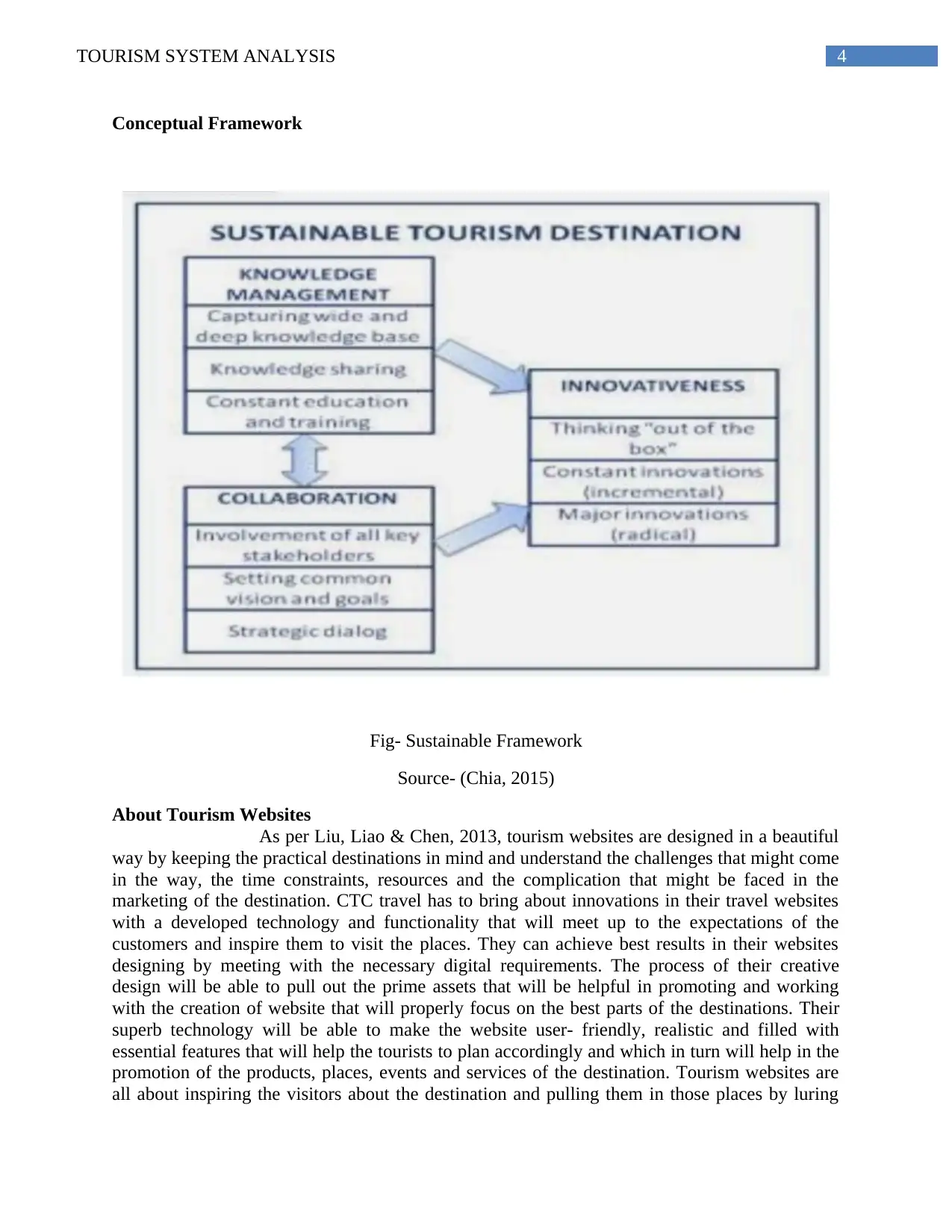
Conceptual Framework
Fig- Sustainable Framework
Source- (Chia, 2015)
About Tourism Websites
As per Liu, Liao & Chen, 2013, tourism websites are designed in a beautiful
way by keeping the practical destinations in mind and understand the challenges that might come
in the way, the time constraints, resources and the complication that might be faced in the
marketing of the destination. CTC travel has to bring about innovations in their travel websites
with a developed technology and functionality that will meet up to the expectations of the
customers and inspire them to visit the places. They can achieve best results in their websites
designing by meeting with the necessary digital requirements. The process of their creative
design will be able to pull out the prime assets that will be helpful in promoting and working
with the creation of website that will properly focus on the best parts of the destinations. Their
superb technology will be able to make the website user- friendly, realistic and filled with
essential features that will help the tourists to plan accordingly and which in turn will help in the
promotion of the products, places, events and services of the destination. Tourism websites are
all about inspiring the visitors about the destination and pulling them in those places by luring
Conceptual Framework
Fig- Sustainable Framework
Source- (Chia, 2015)
About Tourism Websites
As per Liu, Liao & Chen, 2013, tourism websites are designed in a beautiful
way by keeping the practical destinations in mind and understand the challenges that might come
in the way, the time constraints, resources and the complication that might be faced in the
marketing of the destination. CTC travel has to bring about innovations in their travel websites
with a developed technology and functionality that will meet up to the expectations of the
customers and inspire them to visit the places. They can achieve best results in their websites
designing by meeting with the necessary digital requirements. The process of their creative
design will be able to pull out the prime assets that will be helpful in promoting and working
with the creation of website that will properly focus on the best parts of the destinations. Their
superb technology will be able to make the website user- friendly, realistic and filled with
essential features that will help the tourists to plan accordingly and which in turn will help in the
promotion of the products, places, events and services of the destination. Tourism websites are
all about inspiring the visitors about the destination and pulling them in those places by luring
5TOURISM SYSTEM ANALYSIS
them with attractive offers (Cornelissen, 2017). The key features of a tourism website include
responsive design, product display and searches, featured products, itinerary planner, integrated
dynamic mapping, nearest landmarks, events calendar and social media integration. According
tpo Mariani et al., 2014, all these facilities provided with the travel and tourism websites are
beneficial for providing the best experience to the users who will turn into visitors. The featured
products and advanced searches help in planning an easy and hassle free tour for the tourists. The
social media integration in the websites provides the ability to drive awareness and traffic by
implanting social media feeds and interaction buttons.
Advantages and Disadvantages
McKercher & Koh, 2017 argued that the advantages in this industry include earning of
foreign exchanges which contributes to government revenues. Tourism helps in creating business
opportunities which should be clarified in the tourism website because it serves as a catalyst for
the country’s development. Tourism also holds a higher rank compared to other businesses
which are spread worldwide therefore it is an absolute necessary for the travel website
innovation of the company CTC travel. When the huge amount of income is generated from the
field of tourism it facilitates the quality of life in the rural parts of the country. With the
experience of foreign culture the international relations between the countries can also be
enhanced. The local residents get the scope for employment in the tourism sector which helps in
poverty reduction (Couture et al., 2015).
According to Peng, Song & Crouch, 2014, along with the advantages, disadvantages also
exist. Lack of infrastructure and sufficient planning makes it unbearable for the local
communities. The difference between the cultures and principles of the native population and
that of the tourists coincide to give rise to a conflict in the destination area. The governments
become aware of the tourist presence in the area and start to give more importance to them than
the local people. The increasing pollution due to the tourist activities takes a toll on the
environment of the place. Although tourism provides employment to the local people of the area
but it is only meant for a specific time period and for the rest of the year the local people are
almost neglected.
Thus, according to Smith, 2014, it can be mentioned that in the travel website of the
company the advantages and disadvantages of the tourism industry should be explained in a
subtle way. It should be explained in such a way that the tourists can understand the value of the
destination they are going to visit and respect the local culture and environment. The do’s and
don’ts of the specific places should be stated in a bold and clear way so that it does not refrain
the tourists from visiting the place (Espiner & Becken, 2014).
Economic Impact
As per Pereira, de Fátima Salgueiro & Rita, 2016, the idea of a travel website is to
provide a portfolio of the specific destinations so that any visitor who intends to visit the country
can have a look in the website and book rooms or search for the nearby places and other
available facilities. The website needs to be real and authentic about the deal that is offered by
the company CTC travel and thus money can be gained from the website. It is a common trend to
earn revenue by means of an online enterprise. Without earning an income it is not easy for the
maintenance of a large company tourism website. Therefore the essential part is to make an
aggressive marketing through diversified channels for easy monetization (Shen et al., 2015).
them with attractive offers (Cornelissen, 2017). The key features of a tourism website include
responsive design, product display and searches, featured products, itinerary planner, integrated
dynamic mapping, nearest landmarks, events calendar and social media integration. According
tpo Mariani et al., 2014, all these facilities provided with the travel and tourism websites are
beneficial for providing the best experience to the users who will turn into visitors. The featured
products and advanced searches help in planning an easy and hassle free tour for the tourists. The
social media integration in the websites provides the ability to drive awareness and traffic by
implanting social media feeds and interaction buttons.
Advantages and Disadvantages
McKercher & Koh, 2017 argued that the advantages in this industry include earning of
foreign exchanges which contributes to government revenues. Tourism helps in creating business
opportunities which should be clarified in the tourism website because it serves as a catalyst for
the country’s development. Tourism also holds a higher rank compared to other businesses
which are spread worldwide therefore it is an absolute necessary for the travel website
innovation of the company CTC travel. When the huge amount of income is generated from the
field of tourism it facilitates the quality of life in the rural parts of the country. With the
experience of foreign culture the international relations between the countries can also be
enhanced. The local residents get the scope for employment in the tourism sector which helps in
poverty reduction (Couture et al., 2015).
According to Peng, Song & Crouch, 2014, along with the advantages, disadvantages also
exist. Lack of infrastructure and sufficient planning makes it unbearable for the local
communities. The difference between the cultures and principles of the native population and
that of the tourists coincide to give rise to a conflict in the destination area. The governments
become aware of the tourist presence in the area and start to give more importance to them than
the local people. The increasing pollution due to the tourist activities takes a toll on the
environment of the place. Although tourism provides employment to the local people of the area
but it is only meant for a specific time period and for the rest of the year the local people are
almost neglected.
Thus, according to Smith, 2014, it can be mentioned that in the travel website of the
company the advantages and disadvantages of the tourism industry should be explained in a
subtle way. It should be explained in such a way that the tourists can understand the value of the
destination they are going to visit and respect the local culture and environment. The do’s and
don’ts of the specific places should be stated in a bold and clear way so that it does not refrain
the tourists from visiting the place (Espiner & Becken, 2014).
Economic Impact
As per Pereira, de Fátima Salgueiro & Rita, 2016, the idea of a travel website is to
provide a portfolio of the specific destinations so that any visitor who intends to visit the country
can have a look in the website and book rooms or search for the nearby places and other
available facilities. The website needs to be real and authentic about the deal that is offered by
the company CTC travel and thus money can be gained from the website. It is a common trend to
earn revenue by means of an online enterprise. Without earning an income it is not easy for the
maintenance of a large company tourism website. Therefore the essential part is to make an
aggressive marketing through diversified channels for easy monetization (Shen et al., 2015).
⊘ This is a preview!⊘
Do you want full access?
Subscribe today to unlock all pages.
Trusted by 1+ million students worldwide
6TOURISM SYSTEM ANALYSIS
Research Questions
a) What is a tourism website? Why is it important?
b) What are the advantages and disadvantages of tourism websites?
c) What is the economic gain from a tourism website?
3. Methodology
In the past few years, the qualitative and quantitative approaches of research in the
tourism analysis have become popular. The reason behind this can involve many factors. The
most significant reason being the dependence on the tourism destinations has expanded on a
global scale and emergence of more resources have been contributing to the data collection
procedure. The approaches that are used by the tourism researchers are largely informed by the
improvement in the statistical analysis in all disciplines (Gibbs & Gretzel, 2015).
Qualitative Research
Qualitative research refers to the enquiries which are applied in a set of qualitative
methods to explore in detail, interpret and understand the particular subject of study. Qualitative
research in the field of tourism is influenced from the cultural and social perspective. The main
aim of this research is to find out and seek for the meaning and to grow an understanding of
collecting information and generating new descriptions (Chia, 2015). Qualitative research is
associated to a high level of reflectivity and sensitivity to power affairs and uncertainty.
Qualitative research is a well- established approach for the researching phenomenon. Its
application in the field of tourism and travel is taking place in the recent years. The popularity of
qualitative research in the field of travel and tourism is gaining momentum gradually. This is
because qualitative research has the ability to provide rich and in- depth knowledge from
different points of view along with a stress on the understanding as to how the tourism related
phenomenon and experiences can be beneficial. In the subject of research, the qualitative type
refers to the use of unstructured and unreliable data sources and the methods used for collecting
data. The methods that are used for data collection include observation, research interviews,
surveys, documents and more such similar kind of things (Gong, 2017). It is the theoretical form
of a research topic and includes the research procedure in detail. It helps in understanding the
research questions. The different steps that are involved while conducting a qualitative research
are- preparation of the research subject; selecting a particular question and focusing on it for the
ease of the study; making a literature review; evaluation of the processes that are needed for the
qualitative research; taking into consideration the sample size; research methodology; data
analysis.
Quantitative Research
The most significant fact is that the destinations related to tourism has grown and
developed on a global scale and therefore more resources have been utilized for the collection of
quantitative data and the maintenance of tourism data sets. This has motivated those researchers
who were interested in the quantitative analysis of data to keep the tourism industry in their
agenda of preferred research subject. Also, the stakeholders of the tourism industry which
include the destination managers, governments look out for better decisions by implementing
developed policies and assessing the existing ones in order to be attentive towards the outcome
of the quantitative research. This type of research puts stress on the objective measurements and
the different kinds of statistical, mathematical and numerical analysis of the information that is
Research Questions
a) What is a tourism website? Why is it important?
b) What are the advantages and disadvantages of tourism websites?
c) What is the economic gain from a tourism website?
3. Methodology
In the past few years, the qualitative and quantitative approaches of research in the
tourism analysis have become popular. The reason behind this can involve many factors. The
most significant reason being the dependence on the tourism destinations has expanded on a
global scale and emergence of more resources have been contributing to the data collection
procedure. The approaches that are used by the tourism researchers are largely informed by the
improvement in the statistical analysis in all disciplines (Gibbs & Gretzel, 2015).
Qualitative Research
Qualitative research refers to the enquiries which are applied in a set of qualitative
methods to explore in detail, interpret and understand the particular subject of study. Qualitative
research in the field of tourism is influenced from the cultural and social perspective. The main
aim of this research is to find out and seek for the meaning and to grow an understanding of
collecting information and generating new descriptions (Chia, 2015). Qualitative research is
associated to a high level of reflectivity and sensitivity to power affairs and uncertainty.
Qualitative research is a well- established approach for the researching phenomenon. Its
application in the field of tourism and travel is taking place in the recent years. The popularity of
qualitative research in the field of travel and tourism is gaining momentum gradually. This is
because qualitative research has the ability to provide rich and in- depth knowledge from
different points of view along with a stress on the understanding as to how the tourism related
phenomenon and experiences can be beneficial. In the subject of research, the qualitative type
refers to the use of unstructured and unreliable data sources and the methods used for collecting
data. The methods that are used for data collection include observation, research interviews,
surveys, documents and more such similar kind of things (Gong, 2017). It is the theoretical form
of a research topic and includes the research procedure in detail. It helps in understanding the
research questions. The different steps that are involved while conducting a qualitative research
are- preparation of the research subject; selecting a particular question and focusing on it for the
ease of the study; making a literature review; evaluation of the processes that are needed for the
qualitative research; taking into consideration the sample size; research methodology; data
analysis.
Quantitative Research
The most significant fact is that the destinations related to tourism has grown and
developed on a global scale and therefore more resources have been utilized for the collection of
quantitative data and the maintenance of tourism data sets. This has motivated those researchers
who were interested in the quantitative analysis of data to keep the tourism industry in their
agenda of preferred research subject. Also, the stakeholders of the tourism industry which
include the destination managers, governments look out for better decisions by implementing
developed policies and assessing the existing ones in order to be attentive towards the outcome
of the quantitative research. This type of research puts stress on the objective measurements and
the different kinds of statistical, mathematical and numerical analysis of the information that is
Paraphrase This Document
Need a fresh take? Get an instant paraphrase of this document with our AI Paraphraser
7TOURISM SYSTEM ANALYSIS
gathered through the polls created or the survey or research questionnaire (Halkier, Kozak &
Svensson, 2014). The different steps involved in the process of quantitative research include-
identification of the research problem; reviewing the literature of the research; analyzing the
theoretical framework, methodology; discussion of the results; conclusion. There is a need in the
tourism research procedure to facilitate and implement methods of knowing and researching not
only on the western point of view of the world but also getting associated with the cross- cultural
research teams which have a focused view and are situated temporarily. The quantitative
research particularly highlights the evaluation and application of the different methods which
have developed a control over the formalization controllability, value freedom and repeatability.
These characteristics are the common traits for the research approaches which add to the
direction of numerical determination or the measurement of the process. The type of numerical
determination or quantitative analysis is limited to certain fundamental concept (Heerschap et al.,
2014).
Research Limitations
While conducting a research on the innovation of tourism websites for CTC travels it is a
normal fact that there will be certain limitations (Phua & Miller, 2014). For the researcher it is
extremely important to put effort for reducing the risk of limitations throughout the whole
process of research and acknowledge the limitations at the end in the conclusion chapter. The
limitations that were involved in this particular research include- formulation of research aims
and objectives. The broad aim for the research goal should be specified so that the focus can be
put on a particular subject. In this particular subject the innovation in travel websites the focus
can be put on the most important element such as the new content which will be introduced in
the innovated website. There has to be a choice in the data collection methods and along with
those an added method of data collection will increase the opportunity for detailed analysis on
the subject. For instance, in this study if the website designing is included in the research subject
along with the website content then there would be a better scope for the researcher to develop
the website which will be beneficial for the company CTC travels (Kim & Canina, 2015).
Implementation of the data collection method and scope of discussions are also considered as the
limitations in the process of research. This is because a new researcher will not have much
experience of data collection previously which will be posed as a limitation in his research work.
Ethical Considerations
Ethics have the power to change the previous considerations of preferences and actions.
This branch of philosophy is associated with the potential of decision making and addressing the
right and the wrong. It is very important to take into considerations the major ethical issues
which can come up while conducting a research. Informed consent is one such way which has
the right of the respondents is protected. This means that the answers that are given by the
respondents should be kept confidential and cannot be disclosed without the individual’s
consent. Another ethical issue is voluntary participation which refers to the fact that the people
are not forced to take part in the survey but they come in their own will. The people also have the
right to withdraw their participation at any moment they feel. This withdrawal of participation
should not harm them or their career in the future or have any negative impact on them. It should
be strictly maintained that no harm either physically or mentally should come upon the
participants in any way (Kiráľová & Pavlíčeka, 2015). Anonymity and confidentiality are the
other two factors which are also part of ethical issues that are of major significance.
gathered through the polls created or the survey or research questionnaire (Halkier, Kozak &
Svensson, 2014). The different steps involved in the process of quantitative research include-
identification of the research problem; reviewing the literature of the research; analyzing the
theoretical framework, methodology; discussion of the results; conclusion. There is a need in the
tourism research procedure to facilitate and implement methods of knowing and researching not
only on the western point of view of the world but also getting associated with the cross- cultural
research teams which have a focused view and are situated temporarily. The quantitative
research particularly highlights the evaluation and application of the different methods which
have developed a control over the formalization controllability, value freedom and repeatability.
These characteristics are the common traits for the research approaches which add to the
direction of numerical determination or the measurement of the process. The type of numerical
determination or quantitative analysis is limited to certain fundamental concept (Heerschap et al.,
2014).
Research Limitations
While conducting a research on the innovation of tourism websites for CTC travels it is a
normal fact that there will be certain limitations (Phua & Miller, 2014). For the researcher it is
extremely important to put effort for reducing the risk of limitations throughout the whole
process of research and acknowledge the limitations at the end in the conclusion chapter. The
limitations that were involved in this particular research include- formulation of research aims
and objectives. The broad aim for the research goal should be specified so that the focus can be
put on a particular subject. In this particular subject the innovation in travel websites the focus
can be put on the most important element such as the new content which will be introduced in
the innovated website. There has to be a choice in the data collection methods and along with
those an added method of data collection will increase the opportunity for detailed analysis on
the subject. For instance, in this study if the website designing is included in the research subject
along with the website content then there would be a better scope for the researcher to develop
the website which will be beneficial for the company CTC travels (Kim & Canina, 2015).
Implementation of the data collection method and scope of discussions are also considered as the
limitations in the process of research. This is because a new researcher will not have much
experience of data collection previously which will be posed as a limitation in his research work.
Ethical Considerations
Ethics have the power to change the previous considerations of preferences and actions.
This branch of philosophy is associated with the potential of decision making and addressing the
right and the wrong. It is very important to take into considerations the major ethical issues
which can come up while conducting a research. Informed consent is one such way which has
the right of the respondents is protected. This means that the answers that are given by the
respondents should be kept confidential and cannot be disclosed without the individual’s
consent. Another ethical issue is voluntary participation which refers to the fact that the people
are not forced to take part in the survey but they come in their own will. The people also have the
right to withdraw their participation at any moment they feel. This withdrawal of participation
should not harm them or their career in the future or have any negative impact on them. It should
be strictly maintained that no harm either physically or mentally should come upon the
participants in any way (Kiráľová & Pavlíčeka, 2015). Anonymity and confidentiality are the
other two factors which are also part of ethical issues that are of major significance.
8TOURISM SYSTEM ANALYSIS
4. Content Analysis
Content analysis in a research refers to the methods used for making replicable and
authentic inferences by identifying the elements given in the information. The successful
evaluation of the elements helps in providing qualitative data which are further convertible to
quantitative data. For the given subject of research on the innovation of travel website, the
researcher will look for the specific elements in the provided answers of the respondents
(Lai, Li & Harrill, 2013). The elements can be the demands of the customers that they look
for while searching for any destination. It might be the price chart of all the nearby Chinese
restaurants. These are the specific characteristics which will be useful for the long term
sustenance of the services provided. Another factor that the tourists mostly look out for are
the local popular objects which are famous as well as can be kept as a memoir. The tourism
website of CTC travels can be developed in such a way that they list out the popular handy
elements of the destination area so that it becomes easy for the visitors to get an idea about
what to shop for and from where (Wuthipunuangchai, 2015).
This widely used qualitative research technique applies three distinguished approaches of
conventional, directed and summative. These three approaches are essential to extract data
from the gathered information and then analyze them accordingly. Thus, by using the three
approaches the researcher will be able to gain insight about the in- depth components which
will benefit in the innovation of the travel websites. If the researcher is successful in attaining
success then the company CTC travel will have an innovated tourism website beyond the
marketing and selling of their product and services for the long- term sustenance (Lew &
Cheer, 2017).
5. Conclusion
So it can be concluded from the assignment that for the innovation in the tourism website,
CTC travel has to take into account a lot of elements essential for their long term sustenance.
The researcher has to conduct a survey which will answer the specific research questions.
The solutions of the questions can be found out by conducting a survey in the form of
questionnaire which will be sent through mail to the target group of respondents. The
responses will help the researcher to get an idea about the market demand of the people from
the CTC travels company. There should be no discrepancy with the questionnaire on the part
of the research and he should do the research in an ethical way. There might be research
limitations but he should mention that. It is essential for the company to keep an account of
the fact that the innovation in their products and services will keep them at a competitive
advantageous position as compared to the rivalries. If they can provide the required elements
in their websites then that will help the visitors to prefer them over other travel and tourism
companies. This is more necessary than providing premium services because it is the
attraction in the website which will pull the tourists to visit the destination area.
4. Content Analysis
Content analysis in a research refers to the methods used for making replicable and
authentic inferences by identifying the elements given in the information. The successful
evaluation of the elements helps in providing qualitative data which are further convertible to
quantitative data. For the given subject of research on the innovation of travel website, the
researcher will look for the specific elements in the provided answers of the respondents
(Lai, Li & Harrill, 2013). The elements can be the demands of the customers that they look
for while searching for any destination. It might be the price chart of all the nearby Chinese
restaurants. These are the specific characteristics which will be useful for the long term
sustenance of the services provided. Another factor that the tourists mostly look out for are
the local popular objects which are famous as well as can be kept as a memoir. The tourism
website of CTC travels can be developed in such a way that they list out the popular handy
elements of the destination area so that it becomes easy for the visitors to get an idea about
what to shop for and from where (Wuthipunuangchai, 2015).
This widely used qualitative research technique applies three distinguished approaches of
conventional, directed and summative. These three approaches are essential to extract data
from the gathered information and then analyze them accordingly. Thus, by using the three
approaches the researcher will be able to gain insight about the in- depth components which
will benefit in the innovation of the travel websites. If the researcher is successful in attaining
success then the company CTC travel will have an innovated tourism website beyond the
marketing and selling of their product and services for the long- term sustenance (Lew &
Cheer, 2017).
5. Conclusion
So it can be concluded from the assignment that for the innovation in the tourism website,
CTC travel has to take into account a lot of elements essential for their long term sustenance.
The researcher has to conduct a survey which will answer the specific research questions.
The solutions of the questions can be found out by conducting a survey in the form of
questionnaire which will be sent through mail to the target group of respondents. The
responses will help the researcher to get an idea about the market demand of the people from
the CTC travels company. There should be no discrepancy with the questionnaire on the part
of the research and he should do the research in an ethical way. There might be research
limitations but he should mention that. It is essential for the company to keep an account of
the fact that the innovation in their products and services will keep them at a competitive
advantageous position as compared to the rivalries. If they can provide the required elements
in their websites then that will help the visitors to prefer them over other travel and tourism
companies. This is more necessary than providing premium services because it is the
attraction in the website which will pull the tourists to visit the destination area.
⊘ This is a preview!⊘
Do you want full access?
Subscribe today to unlock all pages.
Trusted by 1+ million students worldwide
9TOURISM SYSTEM ANALYSIS
Reference
Carlisle, S., Kunc, M., Jones, E., & Tiffin, S. (2013). Supporting innovation for tourism
development through multi-stakeholder approaches: Experiences from Africa. Tourism
Management, 35, 59-69.
Carson, D. A., Carson, D. B., & Hodge, H. (2014). Understanding local innovation systems
in peripheral tourism destinations. Tourism Geographies, 16(3), 457-473.
Chia, S. Y. (2015). Globalization And Regionalization: Singapore'S Trade And Fdi. The
Singapore Economic Review, 60(03), 1550034.
Cornelissen, S. (2017). The global tourism system: Governance, development and lessons
from South Africa. Routledge.
Couture, A., Arcand, M., Sénécal, S., & Ouellet, J. F. (2015). The influence of tourism
innovativeness on online consumer behavior. Journal of Travel Research, 54(1), 66-79.
Espiner, S., & Becken, S. (2014). Tourist towns on the edge: Conceptualising vulnerability
and resilience in a protected area tourism system. Journal of Sustainable Tourism, 22(4),
646-665.
Gibbs, C., & Gretzel, U. (2015). Drivers of responsive website design innovation by
destination marketing organizations. In Information and Communication Technologies in
Tourism 2015(pp. 581-592). Springer, Cham.
Gong, S. (2017). The Trend of Tourism Service Integration and Promotion from the
Perspective of Multiculturalism. DEStech Transactions on Social Science, Education and
Human Science, (ssme).
Halkier, H., Kozak, M., & Svensson, B. (2014). Innovation and tourism destination
development.
Heerschap, N., Ortega, S., Priem, A., & Offermans, M. (2014, May). Innovation of tourism
statistics through the use of new big data sources. In 12th Global Forum on Tourism
Statistics, Prague, CZ.
Kim, J. Y., & Canina, L. (2015). An analysis of smart tourism system satisfaction scores: The
role of priced versus average quality. Computers in Human Behavior, 50, 610-617.
Kiráľová, A., & Pavlíčeka, A. (2015). Development of social media strategies in tourism
destination. Procedia-Social and Behavioral Sciences, 175, 358-366.
Lai, C., Li, X. R., & Harrill, R. (2013). Chinese outbound tourists' perceived constraints to
visiting the United States. Tourism Management, 37, 136-146.
Lew, A. A., & Cheer, J. M. (Eds.). (2017). Tourism Resilience and Adaptation to
Environmental Change: Definitions and Frameworks. Routledge.
Reference
Carlisle, S., Kunc, M., Jones, E., & Tiffin, S. (2013). Supporting innovation for tourism
development through multi-stakeholder approaches: Experiences from Africa. Tourism
Management, 35, 59-69.
Carson, D. A., Carson, D. B., & Hodge, H. (2014). Understanding local innovation systems
in peripheral tourism destinations. Tourism Geographies, 16(3), 457-473.
Chia, S. Y. (2015). Globalization And Regionalization: Singapore'S Trade And Fdi. The
Singapore Economic Review, 60(03), 1550034.
Cornelissen, S. (2017). The global tourism system: Governance, development and lessons
from South Africa. Routledge.
Couture, A., Arcand, M., Sénécal, S., & Ouellet, J. F. (2015). The influence of tourism
innovativeness on online consumer behavior. Journal of Travel Research, 54(1), 66-79.
Espiner, S., & Becken, S. (2014). Tourist towns on the edge: Conceptualising vulnerability
and resilience in a protected area tourism system. Journal of Sustainable Tourism, 22(4),
646-665.
Gibbs, C., & Gretzel, U. (2015). Drivers of responsive website design innovation by
destination marketing organizations. In Information and Communication Technologies in
Tourism 2015(pp. 581-592). Springer, Cham.
Gong, S. (2017). The Trend of Tourism Service Integration and Promotion from the
Perspective of Multiculturalism. DEStech Transactions on Social Science, Education and
Human Science, (ssme).
Halkier, H., Kozak, M., & Svensson, B. (2014). Innovation and tourism destination
development.
Heerschap, N., Ortega, S., Priem, A., & Offermans, M. (2014, May). Innovation of tourism
statistics through the use of new big data sources. In 12th Global Forum on Tourism
Statistics, Prague, CZ.
Kim, J. Y., & Canina, L. (2015). An analysis of smart tourism system satisfaction scores: The
role of priced versus average quality. Computers in Human Behavior, 50, 610-617.
Kiráľová, A., & Pavlíčeka, A. (2015). Development of social media strategies in tourism
destination. Procedia-Social and Behavioral Sciences, 175, 358-366.
Lai, C., Li, X. R., & Harrill, R. (2013). Chinese outbound tourists' perceived constraints to
visiting the United States. Tourism Management, 37, 136-146.
Lew, A. A., & Cheer, J. M. (Eds.). (2017). Tourism Resilience and Adaptation to
Environmental Change: Definitions and Frameworks. Routledge.
Paraphrase This Document
Need a fresh take? Get an instant paraphrase of this document with our AI Paraphraser
10TOURISM SYSTEM ANALYSIS
Lin, P. J., Kao, C. C., Lam, K. H., & Tsai, I. C. (2014). Design and implementation of a
tourism system using mobile augmented reality and GIS technologies. In Proceedings of
the 2nd International Conference on Intelligent Technologies and Engineering Systems
(ICITES2013) (pp. 1093-1099). Springer, Cham.
Liu, S. H., Liao, H. L., & Chen, C. H. (2013). Marketing for remote area using an
experience-based tourism website destination. International Journal of Services
Technology and Management, 19(4-6), 294-303.
Mariani, M., Baggio, R., Buhalis, D., & Longhi, C. (Eds.). (2014). Tourism Management,
Marketing, and Development: Volume I: The Importance of Networks and ICTs (Vol. 1).
Springer.
McKercher, B., & Koh, E. (2017). Do attractions “attract” tourists? The case of
Singapore. International Journal of Tourism Research.
Peng, B., Song, H., & Crouch, G. I. (2014). A meta-analysis of international tourism demand
forecasting and implications for practice. Tourism Management, 45, 181-193.
Pereira, H. G., de Fátima Salgueiro, M., & Rita, P. (2016). Online purchase determinants of
loyalty: The mediating effect of satisfaction in tourism. Journal of Retailing and
Consumer Services, 30, 279-291.
Phua, V., & Miller, J. W. (2014). Gazing at Haw Par villa: Cultural Tourism in
Singapore. Shima: The International Journal of Research into Island Cultures, 8(2).
Rodríguez, I., Williams, A. M., & Hall, C. M. (2014). Tourism innovation policy:
Implementation and outcomes. Annals of Tourism Research, 49, 76-93.
Shen, H., Song, C., Li, M., & Jiang, Q. (2015). Shaping destination images through social
networking sites: A case study of Singapore. In Advances in Hospitality and Leisure (pp.
89-107). Emerald Group Publishing Limited.
Smith, S. L. (2014). Tourism analysis: A handbook. Routledge.
Wuthipunuangchai, C. (2015). The application of management process and marketing mix
for successful outbound travel agencies.
Lin, P. J., Kao, C. C., Lam, K. H., & Tsai, I. C. (2014). Design and implementation of a
tourism system using mobile augmented reality and GIS technologies. In Proceedings of
the 2nd International Conference on Intelligent Technologies and Engineering Systems
(ICITES2013) (pp. 1093-1099). Springer, Cham.
Liu, S. H., Liao, H. L., & Chen, C. H. (2013). Marketing for remote area using an
experience-based tourism website destination. International Journal of Services
Technology and Management, 19(4-6), 294-303.
Mariani, M., Baggio, R., Buhalis, D., & Longhi, C. (Eds.). (2014). Tourism Management,
Marketing, and Development: Volume I: The Importance of Networks and ICTs (Vol. 1).
Springer.
McKercher, B., & Koh, E. (2017). Do attractions “attract” tourists? The case of
Singapore. International Journal of Tourism Research.
Peng, B., Song, H., & Crouch, G. I. (2014). A meta-analysis of international tourism demand
forecasting and implications for practice. Tourism Management, 45, 181-193.
Pereira, H. G., de Fátima Salgueiro, M., & Rita, P. (2016). Online purchase determinants of
loyalty: The mediating effect of satisfaction in tourism. Journal of Retailing and
Consumer Services, 30, 279-291.
Phua, V., & Miller, J. W. (2014). Gazing at Haw Par villa: Cultural Tourism in
Singapore. Shima: The International Journal of Research into Island Cultures, 8(2).
Rodríguez, I., Williams, A. M., & Hall, C. M. (2014). Tourism innovation policy:
Implementation and outcomes. Annals of Tourism Research, 49, 76-93.
Shen, H., Song, C., Li, M., & Jiang, Q. (2015). Shaping destination images through social
networking sites: A case study of Singapore. In Advances in Hospitality and Leisure (pp.
89-107). Emerald Group Publishing Limited.
Smith, S. L. (2014). Tourism analysis: A handbook. Routledge.
Wuthipunuangchai, C. (2015). The application of management process and marketing mix
for successful outbound travel agencies.

1 out of 11


Related Documents


Your All-in-One AI-Powered Toolkit for Academic Success.
+13062052269
info@desklib.com
Available 24*7 on WhatsApp / Email
![[object Object]](/_next/static/media/star-bottom.7253800d.svg)
Unlock your academic potential
Copyright © 2020–2026 A2Z Services. All Rights Reserved. Developed and managed by ZUCOL.