Marketing Research Report: Evaluating Secondary Data in Australia
VerifiedAdded on  2021/04/17
|5
|691
|33
Report
AI Summary
This marketing research report evaluates secondary data sources, discussing the criteria for their assessment, including authenticity and relevance. The report then analyzes the current state of the Australian tourism market using data from the Australian Bureau of Statistics (ABS), highlighting the increasing number of international visitors and the growth in tourism-related GDP, consumption, and employment. The report references the sources using APA formatting, providing a comprehensive overview of secondary data evaluation and its application in understanding the Australian tourism industry's performance and trends. The assignment fulfills the requirements of the assignment brief, demonstrating analytical skills and engagement with the subject matter.
Running head: MARKETING RESEARCH
Marketing Research
Name of the Student
Name of the University
Author’s note
Marketing Research
Name of the Student
Name of the University
Author’s note
Paraphrase This Document
Need a fresh take? Get an instant paraphrase of this document with our AI Paraphraser

1MARKETING RESEARCH
Evaluate Secondary Data Sources
Secondary data is the information that is already available in the topic and the variables
of the research that is chosen by a researcher. It helps the researcher understand the foundation of
the subject better and also provides insightful observations regarding the dynamics of the subject
and the variables associated with the subject. Sometimes researchers only use secondary data to
prove a theory or reach a conclusion. While selecting the source of secondary data there are
some points that has to be considered, the source should be authentic in nature, the information
that is being collected should be authorized by some institution or some organisation. Researcher
should not use information that is available in the open forum, as the information can be changed
or edited by anyone without permission (Johnston, 2017). Articles publish in journals, official
documents that are released by the company like final accounts details or sustainability reports
etc, government issued information or information form news articles of famous publications
around the world can be used as source material. Data available in Wikipedia or any other blog
websites should not be used at the information is not authenticated. Another important aspect of
selecting secondary source is the relevance of the information, depending upon the topic the year
of publication of the source of information should be analyzed, for example if the research is
regarding the downfall of cocoa production in the international market, statistics of 1999 is
irrelevant as this issue did not occur at that point of time (Cheng & Phillips, 2014).
Current Tourism market in Australia
In order to learn about the prospects of the business in the tourism industry of Australia,
companies may undertake market research. According to a recent study released by the
Australian Bureau of Statistics, the numbers of international visitors are constantly increasing.
Evaluate Secondary Data Sources
Secondary data is the information that is already available in the topic and the variables
of the research that is chosen by a researcher. It helps the researcher understand the foundation of
the subject better and also provides insightful observations regarding the dynamics of the subject
and the variables associated with the subject. Sometimes researchers only use secondary data to
prove a theory or reach a conclusion. While selecting the source of secondary data there are
some points that has to be considered, the source should be authentic in nature, the information
that is being collected should be authorized by some institution or some organisation. Researcher
should not use information that is available in the open forum, as the information can be changed
or edited by anyone without permission (Johnston, 2017). Articles publish in journals, official
documents that are released by the company like final accounts details or sustainability reports
etc, government issued information or information form news articles of famous publications
around the world can be used as source material. Data available in Wikipedia or any other blog
websites should not be used at the information is not authenticated. Another important aspect of
selecting secondary source is the relevance of the information, depending upon the topic the year
of publication of the source of information should be analyzed, for example if the research is
regarding the downfall of cocoa production in the international market, statistics of 1999 is
irrelevant as this issue did not occur at that point of time (Cheng & Phillips, 2014).
Current Tourism market in Australia
In order to learn about the prospects of the business in the tourism industry of Australia,
companies may undertake market research. According to a recent study released by the
Australian Bureau of Statistics, the numbers of international visitors are constantly increasing.

2MARKETING RESEARCH
There is not only increase in the international tourist market by an increase of 6.5% per
cent relative to 2016 (Thomsen, 2016). Businesses in this industry are booming and new and
innovative ideas are brought forwards by travel management companies and hotels to attract the
customers. Here are some of the highlights of the change that has been observed in the past
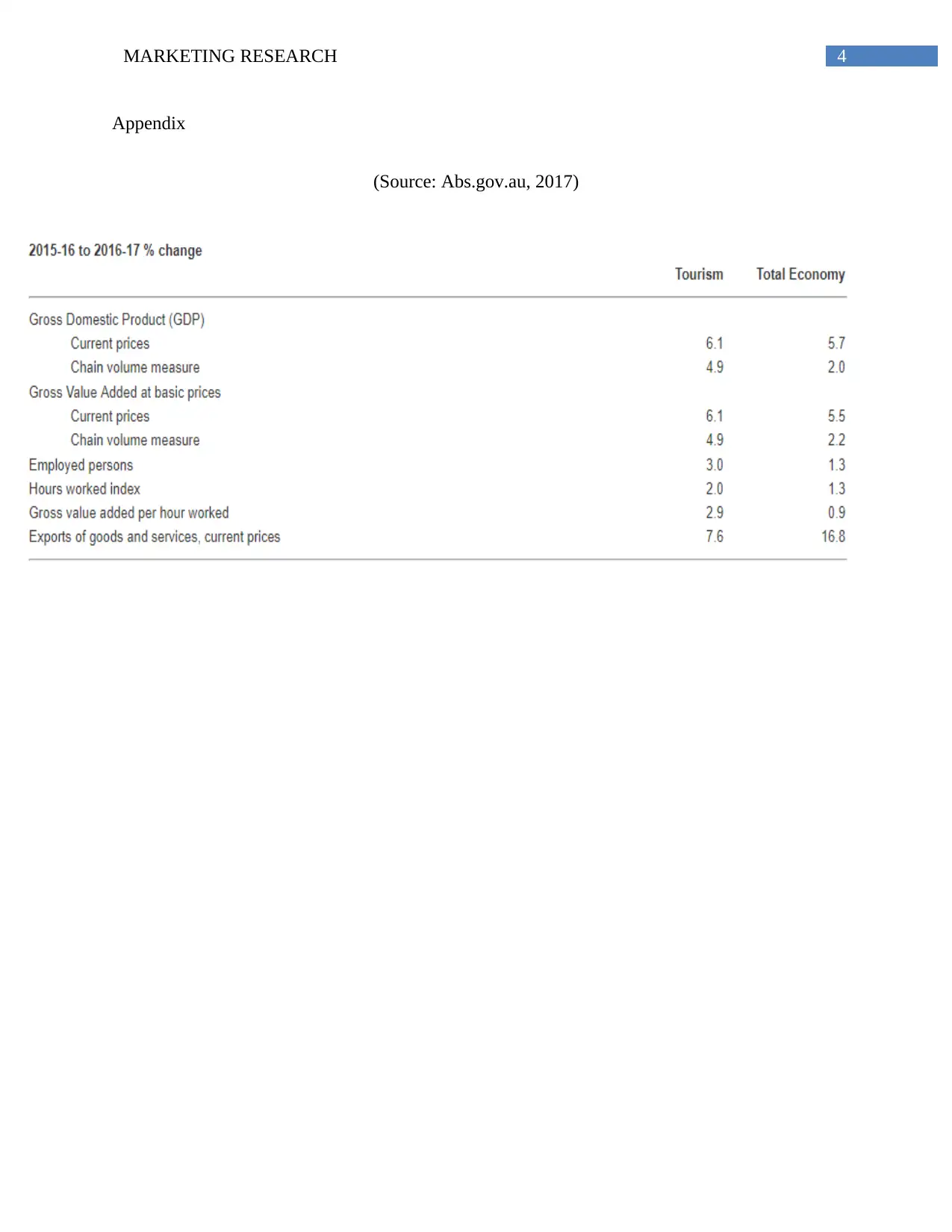
financial year. Gross Domestic Product (GDP) from direct tourism in terms of volume, increased
by 4.9%, compared with the real GDP growth of 2.0% in 2016-17 (Abs.gov.au, 2017).
Form the statistics shown by the ABS (refer appendix) it is evident that there is a growth
in the industry and this growth is also forecasted to continue. Following are some of the
highlights of the year 2016-17 in terms of consumption and employment.
Consumption due to tourism
Internal tourism consumption increased by 5.3% and domestic tourism consumption increased by
4.5%.
International tourism consumption in Australia increased by 7.6%
Employment due to tourism
Tourism employed persons increased by approximately 17,500 employees to 598,200 employed
persons (Abs.gov.au, 2017).
There is not only increase in the international tourist market by an increase of 6.5% per
cent relative to 2016 (Thomsen, 2016). Businesses in this industry are booming and new and
innovative ideas are brought forwards by travel management companies and hotels to attract the
customers. Here are some of the highlights of the change that has been observed in the past
financial year. Gross Domestic Product (GDP) from direct tourism in terms of volume, increased
by 4.9%, compared with the real GDP growth of 2.0% in 2016-17 (Abs.gov.au, 2017).
Form the statistics shown by the ABS (refer appendix) it is evident that there is a growth
in the industry and this growth is also forecasted to continue. Following are some of the
highlights of the year 2016-17 in terms of consumption and employment.
Consumption due to tourism
Internal tourism consumption increased by 5.3% and domestic tourism consumption increased by
4.5%.
International tourism consumption in Australia increased by 7.6%
Employment due to tourism
Tourism employed persons increased by approximately 17,500 employees to 598,200 employed
persons (Abs.gov.au, 2017).
⊘ This is a preview!⊘
Do you want full access?
Subscribe today to unlock all pages.

Trusted by 1+ million students worldwide

3MARKETING RESEARCH
Reference list:
Abs.gov.au. (2017). Tourism Satellite Account, 2016-17. abs.gov.au. Retrieved 11 March 2018,
from http://www.abs.gov.au/ausstats/abs@.nsf/0/7639A207753F8A78CA25697A007D60A9?
Opendocument
Cheng, H. G., & Phillips, M. R. (2014). Secondary analysis of existing data: opportunities and
implementation. Shanghai archives of psychiatry, 26(6), 371.
Johnston, M. P. (2017). Secondary data analysis: A method of which the time has
come. Qualitative and quantitative methods in libraries, 3(3), 619-626.
Thomsen, S. (2016). Tourism in Australia is booming. Businessinsider.com.au. Retrieved 11
March 2018, from https://www.businessinsider.com.au/tourism-in-australia-is-booming-
2016-2
Reference list:
Abs.gov.au. (2017). Tourism Satellite Account, 2016-17. abs.gov.au. Retrieved 11 March 2018,
from http://www.abs.gov.au/ausstats/abs@.nsf/0/7639A207753F8A78CA25697A007D60A9?
Opendocument
Cheng, H. G., & Phillips, M. R. (2014). Secondary analysis of existing data: opportunities and
implementation. Shanghai archives of psychiatry, 26(6), 371.
Johnston, M. P. (2017). Secondary data analysis: A method of which the time has
come. Qualitative and quantitative methods in libraries, 3(3), 619-626.
Thomsen, S. (2016). Tourism in Australia is booming. Businessinsider.com.au. Retrieved 11
March 2018, from https://www.businessinsider.com.au/tourism-in-australia-is-booming-
2016-2
Paraphrase This Document
Need a fresh take? Get an instant paraphrase of this document with our AI Paraphraser

4MARKETING RESEARCH
Appendix
(Source: Abs.gov.au, 2017)
Appendix
(Source: Abs.gov.au, 2017)
1 out of 5
Related Documents
Your All-in-One AI-Powered Toolkit for Academic Success.
 +13062052269
info@desklib.com
Available 24*7 on WhatsApp / Email
Unlock your academic potential
Copyright © 2020–2025 A2Z Services. All Rights Reserved. Developed and managed by ZUCOL.