Crisis Management Strategies in Tourism & Aviation - LCC 2018/19
VerifiedAdded on 2023/04/20
|17
|4213
|165
Report
AI Summary
This report provides an overview of crisis management within the tourism and aviation industries, emphasizing the importance of strategic planning to cope with crisis situations. It examines key components of crisis management, including scenario planning, action plans, control delegation, communication protocols, resource allocation, and regular practice and review of crisis redressal. The report highlights the challenges faced during crises, such as information clutter, inadequacy, lack of communication, and unpredictability, using the terror attack on the Taj Hotel in Mumbai as a case study. The significance of a crisis management plan is discussed, emphasizing its role in maintaining business sustainability, stakeholder communication, and mitigating the impact of crises. The report also touches upon the three stages of crisis communication: pre-crisis, crisis, and post-crisis, along with the importance of media liaison.
Running head: CRISIS MANAGEMENT
Crisis Management
Name of the Student
Name of the University
Author Notes:
Crisis Management
Name of the Student
Name of the University
Author Notes:

Paraphrase This Document
Need a fresh take? Get an instant paraphrase of this document with our AI Paraphraser
1CRISIS MANAGEMENT
Executive Summary
The importance of a proper crisis management program should not be undermined. The
efficiency of a proper crisis management plan determines the nature and success of the plan.
It was found that information defiency, lack of it, improper communication and
unpredictability can determine the efficiency of the plan. Communication that takes place
within the crisis situation, determines the ability to solve and mitigate the problem. The terror
attack in the Taj hotel, Mumbai was unanticipated and thus resulted in unsuccessful crisis
management. However communication was established in the later stages. Along with
establishment of communication, the media played a crucial role in spreading awareness
regarding the crisis which collaborated the efforts of the government and the people thus
contributing to the mitigation of the crisis.
Executive Summary
The importance of a proper crisis management program should not be undermined. The
efficiency of a proper crisis management plan determines the nature and success of the plan.
It was found that information defiency, lack of it, improper communication and
unpredictability can determine the efficiency of the plan. Communication that takes place
within the crisis situation, determines the ability to solve and mitigate the problem. The terror
attack in the Taj hotel, Mumbai was unanticipated and thus resulted in unsuccessful crisis
management. However communication was established in the later stages. Along with
establishment of communication, the media played a crucial role in spreading awareness
regarding the crisis which collaborated the efforts of the government and the people thus
contributing to the mitigation of the crisis.
2CRISIS MANAGEMENT
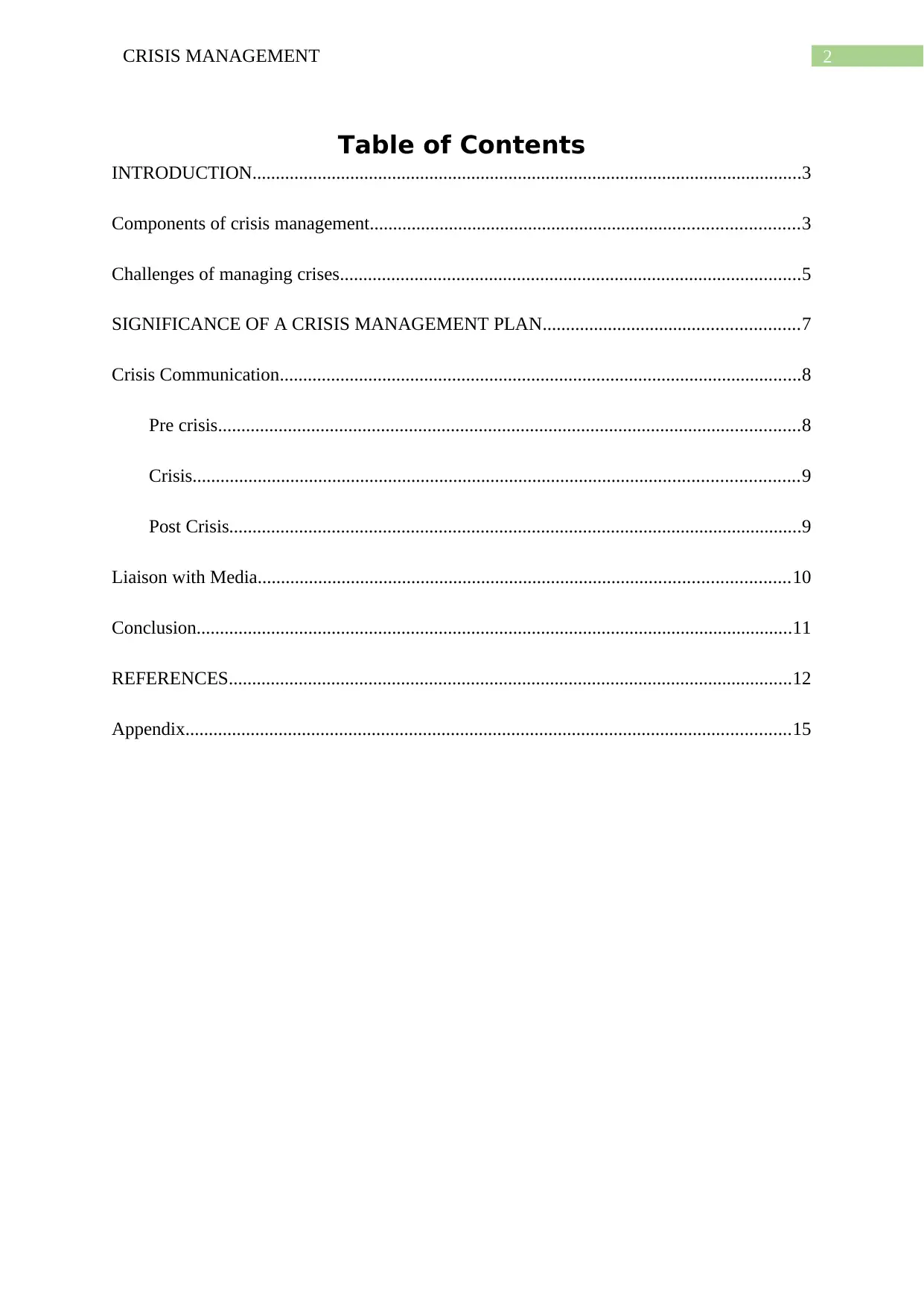
Table of Contents
INTRODUCTION......................................................................................................................3
Components of crisis management............................................................................................3
Challenges of managing crises...................................................................................................5
SIGNIFICANCE OF A CRISIS MANAGEMENT PLAN.......................................................7
Crisis Communication................................................................................................................8
Pre crisis.............................................................................................................................8
Crisis..................................................................................................................................9
Post Crisis...........................................................................................................................9
Liaison with Media..................................................................................................................10
Conclusion................................................................................................................................11
REFERENCES.........................................................................................................................12
Appendix..................................................................................................................................15
Table of Contents
INTRODUCTION......................................................................................................................3
Components of crisis management............................................................................................3
Challenges of managing crises...................................................................................................5
SIGNIFICANCE OF A CRISIS MANAGEMENT PLAN.......................................................7
Crisis Communication................................................................................................................8
Pre crisis.............................................................................................................................8
Crisis..................................................................................................................................9
Post Crisis...........................................................................................................................9
Liaison with Media..................................................................................................................10
Conclusion................................................................................................................................11
REFERENCES.........................................................................................................................12
Appendix..................................................................................................................................15
⊘ This is a preview!⊘
Do you want full access?
Subscribe today to unlock all pages.

Trusted by 1+ million students worldwide
3CRISIS MANAGEMENT
INTRODUCTION
Crisis management can be termed as the process that involves strategic planning to
cope with outbreak of a crisis situation. A crisis can be defined as a situation that is
characterised by intense difficulty or danger. Crises have been defined by various authors on
various occasions. Crises have been compared to snakes by various authors on several
occasions (Seymour and Moore 2000) have compared crises with a cobra because just as a
cobra a crisis can strike at any time. The same has also been compared to a python as crises
are said to grow as time passes (Wang and Ritchie 2010). The main goal of a crisis
management program is to remove any sort of risk or uncertainty that can lead to loss of
property or human capital (Booth 2015). This paper will help in mitigating the gap that exists
between theoretical and practical implications of crisis management. There could be an array
of problems that could hinder the proper functioning of the tourism industry. Crisis in the
tourism industry can range from natural disasters such as hurricanes, to economic crisis such
as famines, political outbreaks such as terrorist attacks and crisis can be related to technical
failure such as shipwreck or plane crash (Paraskevas et al. 2013). Such situations have taken
place on various occasions in the past and thus the need for an effective crisis management
plan is evident. The crisis outbreaks can be short lived or can even last for months and the
unpredictable ones are the reasons for which one should invest in a crisis management plan
(Laws and Prideaux 2013). The following paper will critically evaluate the components of an
effective crisis management plan, the challenges that are faced while managing a crisis, the
significance and the stages of a crisis management plan along with the role of media during
the event of a crisis. The paper will critically evaluate the crisis that was faced during the
terror attacks on the Taj Hotel, India in 2008.
INTRODUCTION
Crisis management can be termed as the process that involves strategic planning to
cope with outbreak of a crisis situation. A crisis can be defined as a situation that is
characterised by intense difficulty or danger. Crises have been defined by various authors on
various occasions. Crises have been compared to snakes by various authors on several
occasions (Seymour and Moore 2000) have compared crises with a cobra because just as a
cobra a crisis can strike at any time. The same has also been compared to a python as crises
are said to grow as time passes (Wang and Ritchie 2010). The main goal of a crisis
management program is to remove any sort of risk or uncertainty that can lead to loss of
property or human capital (Booth 2015). This paper will help in mitigating the gap that exists
between theoretical and practical implications of crisis management. There could be an array
of problems that could hinder the proper functioning of the tourism industry. Crisis in the
tourism industry can range from natural disasters such as hurricanes, to economic crisis such
as famines, political outbreaks such as terrorist attacks and crisis can be related to technical
failure such as shipwreck or plane crash (Paraskevas et al. 2013). Such situations have taken
place on various occasions in the past and thus the need for an effective crisis management
plan is evident. The crisis outbreaks can be short lived or can even last for months and the
unpredictable ones are the reasons for which one should invest in a crisis management plan
(Laws and Prideaux 2013). The following paper will critically evaluate the components of an
effective crisis management plan, the challenges that are faced while managing a crisis, the
significance and the stages of a crisis management plan along with the role of media during
the event of a crisis. The paper will critically evaluate the crisis that was faced during the
terror attacks on the Taj Hotel, India in 2008.
Paraphrase This Document
Need a fresh take? Get an instant paraphrase of this document with our AI Paraphraser
4CRISIS MANAGEMENT
Components of crisis management
A crisis can be termed as a scenario that is characterised by extreme difficulty or
involvement of a high degree of danger. The nature of the crisis is what determines the
degree of difficulty that is associated with the same (Job and Paesler 2013). Crises can range
from natural disaster, to technical fault and political outbreaks. Furthermore the crises can
arise suddenly (Chew and Jahari 2014). The sudden nature of the same is responsible for the
disasters that are associated and faced by the aviation and the tourism industry. The damage
caused to property and human capital becomes unrecoverable in certain instances. This can
be avoided by employing a proper crisis management body. The following are the
components of a proper crisis management plan:
1. Proper planning of scenarios: Planning should revolve around simulation of
scenarios of crisis (Booth 2015). This will ensure that the crises are well
prepared for and thus can be dealt with ease on occurrence of such crises.
2. Action plan for every possible scenario: As discussed earlier, a crisis can
strike suddenly (Laclau and Mouffe 2014). That is why it important to prepare
oneself for a crisis by planning measures to each possible crisis. An action
plan will ensure that the crisis redressal team is able to effectively mitigate a
crisis.
3. Establishment of control and delegation: The efforts to cope with a crisis
should be well coordinated. A centralised line of command will ensure that the
member of the crisis redressal teams are aligned to single goal. Furthermore
proper delegation of the suitable individual to deals with a particular crisis will
ensure efficacy in management of the same.
4. Proper protocols: The suitable scenario for delegating a proper crisis
management plan should be based on protocols within an organisation or a
Components of crisis management
A crisis can be termed as a scenario that is characterised by extreme difficulty or
involvement of a high degree of danger. The nature of the crisis is what determines the
degree of difficulty that is associated with the same (Job and Paesler 2013). Crises can range
from natural disaster, to technical fault and political outbreaks. Furthermore the crises can
arise suddenly (Chew and Jahari 2014). The sudden nature of the same is responsible for the
disasters that are associated and faced by the aviation and the tourism industry. The damage
caused to property and human capital becomes unrecoverable in certain instances. This can
be avoided by employing a proper crisis management body. The following are the
components of a proper crisis management plan:
1. Proper planning of scenarios: Planning should revolve around simulation of
scenarios of crisis (Booth 2015). This will ensure that the crises are well
prepared for and thus can be dealt with ease on occurrence of such crises.
2. Action plan for every possible scenario: As discussed earlier, a crisis can
strike suddenly (Laclau and Mouffe 2014). That is why it important to prepare
oneself for a crisis by planning measures to each possible crisis. An action
plan will ensure that the crisis redressal team is able to effectively mitigate a
crisis.
3. Establishment of control and delegation: The efforts to cope with a crisis
should be well coordinated. A centralised line of command will ensure that the
member of the crisis redressal teams are aligned to single goal. Furthermore
proper delegation of the suitable individual to deals with a particular crisis will
ensure efficacy in management of the same.
4. Proper protocols: The suitable scenario for delegating a proper crisis
management plan should be based on protocols within an organisation or a
5CRISIS MANAGEMENT
system. The protocols enable the crisis management team to differentiate a
normal scenario form a scenario of crisis.
5. Resistance free communication channel: A smooth communication channel
ensure that information flows smoothly from a desired location to the other
(Han, Bicen and Akyildiz 2015). Establishment of proper communication
through media and communication mediums such as speakers and telephones
can help communicate the urgency of the situation to the desired people.
6. Resources to compensate: The advent of crisis often leads to loss of property,
resources and even human capital. The loss of the same could sometimes
make the problem in had even worse. In such instances reserve resources such
as emergency food, electricity and medical supplies can be the criterion which
can difference can be made (Kudo et al. 2013).
7. Practice of crisis redressal and review: The practice of addressing crisis
should be practiced at regular intervals. This would ensure that the crisis
redressal program is effective. Practice related to different scenarios should be
carried out which would help develop the efficacy of the crisis management
team. Furthermore proper review of actual crisis redressal should be carried
out to review the same ad to develop ideas to deal with similar scenarios more
effectively.
Challenges of managing crises
The Taj Mahal palace is one of the most reputed luxury hotels of India (Iqbal 2015). It
is a popular place for foreign tourist lodging. It is a trademarked hotel and has received
acclaims of several grounds of excellence (Iqbal 2015). The luxury hotel was on the receiving
end of a terrorist invasion on 29th November 2008 (Javaid and Kamal 2013). The attack was
followed by several other attacks across the port city of Mumbai. A suspected militant group
system. The protocols enable the crisis management team to differentiate a
normal scenario form a scenario of crisis.
5. Resistance free communication channel: A smooth communication channel
ensure that information flows smoothly from a desired location to the other
(Han, Bicen and Akyildiz 2015). Establishment of proper communication
through media and communication mediums such as speakers and telephones
can help communicate the urgency of the situation to the desired people.
6. Resources to compensate: The advent of crisis often leads to loss of property,
resources and even human capital. The loss of the same could sometimes
make the problem in had even worse. In such instances reserve resources such
as emergency food, electricity and medical supplies can be the criterion which
can difference can be made (Kudo et al. 2013).
7. Practice of crisis redressal and review: The practice of addressing crisis
should be practiced at regular intervals. This would ensure that the crisis
redressal program is effective. Practice related to different scenarios should be
carried out which would help develop the efficacy of the crisis management
team. Furthermore proper review of actual crisis redressal should be carried
out to review the same ad to develop ideas to deal with similar scenarios more
effectively.
Challenges of managing crises
The Taj Mahal palace is one of the most reputed luxury hotels of India (Iqbal 2015). It
is a popular place for foreign tourist lodging. It is a trademarked hotel and has received
acclaims of several grounds of excellence (Iqbal 2015). The luxury hotel was on the receiving
end of a terrorist invasion on 29th November 2008 (Javaid and Kamal 2013). The attack was
followed by several other attacks across the port city of Mumbai. A suspected militant group
⊘ This is a preview!⊘
Do you want full access?
Subscribe today to unlock all pages.
Trusted by 1+ million students worldwide
6CRISIS MANAGEMENT
entered Mumbai from the harbour and were behind several bombings and shoot outs that took
place in various crowded places of the city. The Taj hotel was taken over by the militant
group who used various explosives and firearms to cause mayhem in the luxury hotel. It was
an unprecedented event which left the whole country of India in shock. The event took place
due to lack of security and a lack of being prepared. A Lack of proper crisis management can
be deemed to be responsible for the outbreak of the incident. There were various challenges
that were associated with crisis management and they are as follows:
1. Information clutter: On the advent of the first bombing the city was already in
turmoil. Further bombings and shootouts caught the officials and the anti-militant
forces by surprise. The attack that then took place inside the Taj was anticipated to an
extent. The scenario that was taking place in other locations of the city triggered the
troops to be delegated to those locations and left the Taj completely unguarded. Thus
too much information was a challenge.
2. Information inadequacy: In addition to information flowing from other direction,
the staff and the security had little idea that they were next on the radar of the
militant group. The hotel was carrying out business as usual when the attack broke
out. Even if there was a crisis management team, they could not be alerted along with
the fact that they were preoccupied with managing the scenarios in other locations.
3. Lack of proper communication: On the event of the scenario, a smooth flow of
communication of any form ceased to exist. The staff were murdered mercilessly
along with multiple guests and many were held hostage. Due to the pre-scenario that
took place in the city, there was an evident communication breakdown between the
hotel and the protection forces. Furthermore the situation triggered loss of cellular
and internet network across the hotel.
entered Mumbai from the harbour and were behind several bombings and shoot outs that took
place in various crowded places of the city. The Taj hotel was taken over by the militant
group who used various explosives and firearms to cause mayhem in the luxury hotel. It was
an unprecedented event which left the whole country of India in shock. The event took place
due to lack of security and a lack of being prepared. A Lack of proper crisis management can
be deemed to be responsible for the outbreak of the incident. There were various challenges
that were associated with crisis management and they are as follows:
1. Information clutter: On the advent of the first bombing the city was already in
turmoil. Further bombings and shootouts caught the officials and the anti-militant
forces by surprise. The attack that then took place inside the Taj was anticipated to an
extent. The scenario that was taking place in other locations of the city triggered the
troops to be delegated to those locations and left the Taj completely unguarded. Thus
too much information was a challenge.
2. Information inadequacy: In addition to information flowing from other direction,
the staff and the security had little idea that they were next on the radar of the
militant group. The hotel was carrying out business as usual when the attack broke
out. Even if there was a crisis management team, they could not be alerted along with
the fact that they were preoccupied with managing the scenarios in other locations.
3. Lack of proper communication: On the event of the scenario, a smooth flow of
communication of any form ceased to exist. The staff were murdered mercilessly
along with multiple guests and many were held hostage. Due to the pre-scenario that
took place in the city, there was an evident communication breakdown between the
hotel and the protection forces. Furthermore the situation triggered loss of cellular
and internet network across the hotel.
Paraphrase This Document
Need a fresh take? Get an instant paraphrase of this document with our AI Paraphraser
7CRISIS MANAGEMENT
4. Unpredictability: The incidence of the event was completely unpredictable and thus
the management of the crisis became a challenging task. Situations such as terrorist
attacks are unpredictable and for the same reason proper training should be imparted
in the crisis management teams (Jin, Liu and Austin 2014). The events that took
place before the attack left the staff and security unprepared and that is one of the
reasons why the plan of the militants became a success (refer to appendix).
SIGNIFICANCE OF A CRISIS MANAGEMENT PLAN
An effective crisis management plan forms the base of dealing or coping with crises
that exists within a company or an industry. Be it the aviation industry, tourism industry or
any other industry, crisis management goes a long way in maintaining the sustainability of
the business or the industry. A proper crisis management plan helps the business or industry
to deal with a crisis and even if the scenario turns out to be unavoidable, it at least ensures
that the crisis is dealt with in a better way. A proper crisis management procedure ensures
that the crisis management staff are prepared and able to cope with any form of crisis that
might arise at any point. In order to make the crisis management plan a success, the crisis
management team should have good outlook regarding the business or the industry they
operate in. In addition to a proper outlook to the possibility of the crises, the crisis redressal
team should be trained to cope with every possible crisis (Jin, Liu and Austin 2014). Proper
training should be imparted to the personnel who are delegated to the duty of crisis
management. The possibility of every crisis scenario should be preconceived and practice in
order to improve the efficacy of the team to deal with the situation that might arise without
any notice.
It can be said that the outbreak of the terror attack resulted due to political dispute
within India and their neighbouring rivals Pakistan. Outbreaks of such scenarios can
4. Unpredictability: The incidence of the event was completely unpredictable and thus
the management of the crisis became a challenging task. Situations such as terrorist
attacks are unpredictable and for the same reason proper training should be imparted
in the crisis management teams (Jin, Liu and Austin 2014). The events that took
place before the attack left the staff and security unprepared and that is one of the
reasons why the plan of the militants became a success (refer to appendix).
SIGNIFICANCE OF A CRISIS MANAGEMENT PLAN
An effective crisis management plan forms the base of dealing or coping with crises
that exists within a company or an industry. Be it the aviation industry, tourism industry or
any other industry, crisis management goes a long way in maintaining the sustainability of
the business or the industry. A proper crisis management plan helps the business or industry
to deal with a crisis and even if the scenario turns out to be unavoidable, it at least ensures
that the crisis is dealt with in a better way. A proper crisis management procedure ensures
that the crisis management staff are prepared and able to cope with any form of crisis that
might arise at any point. In order to make the crisis management plan a success, the crisis
management team should have good outlook regarding the business or the industry they
operate in. In addition to a proper outlook to the possibility of the crises, the crisis redressal
team should be trained to cope with every possible crisis (Jin, Liu and Austin 2014). Proper
training should be imparted to the personnel who are delegated to the duty of crisis
management. The possibility of every crisis scenario should be preconceived and practice in
order to improve the efficacy of the team to deal with the situation that might arise without
any notice.
It can be said that the outbreak of the terror attack resulted due to political dispute
within India and their neighbouring rivals Pakistan. Outbreaks of such scenarios can
8CRISIS MANAGEMENT
deteriorate the relations between the countries and can also result in a loss of stakeholders for
the particular business or industry. India is a major tourist attraction for its diverse cultural
offerings. Crisis such as the above can pose threats to the wellbeing and sustainability of the
industry. Thus a proper crisis management plan helps in making amends to manage, mitigate
and try to prevent incidences of such situations. A good crisis management plan involves
establishment of proper communication. This implies to communication within the
organization, industry and communication with the stakeholders of the company. It is
important to keep the stakeholders informed about the scenario that exists within the industry
after a crisis has ceased. Inability to do the same might result in permanent loss of the
customers which might turn out to be catastrophic for the long-term prosperity of the
business. A crisis management plan is of great significance and the role of the same should
not be undermined.
Crisis Communication
Pre crisis
There are various models associated with crisis management. The most popular being
the three stage mode (Banks 2014). The three stages model comprises of the pre-crisis
scenario, scenario of communication during the crisis and the post crisis communication
scenario (Bland 2016). The efficiency and inter connectivity of the all the components result
in a proper functioning crisis management program. The pre-crisis scenario can be defined as
a scenario under which the first signs of advent of the crisis has been witnessed. For the
chosen scenario, the pre-crisis scenario was not directly applicable since the attack was
completely unpredictable. However, the incident that triggered the pre-crisis scenario can be
linked to be when the first terrorist attack took place in Mumbai. After the first explosion, the
city and the country overall was in turmoil. The pre-crisis scenario of the crisis at the Taj was
characterised by allocation of security forces across various parts of the city. However this
deteriorate the relations between the countries and can also result in a loss of stakeholders for
the particular business or industry. India is a major tourist attraction for its diverse cultural
offerings. Crisis such as the above can pose threats to the wellbeing and sustainability of the
industry. Thus a proper crisis management plan helps in making amends to manage, mitigate
and try to prevent incidences of such situations. A good crisis management plan involves
establishment of proper communication. This implies to communication within the
organization, industry and communication with the stakeholders of the company. It is
important to keep the stakeholders informed about the scenario that exists within the industry
after a crisis has ceased. Inability to do the same might result in permanent loss of the
customers which might turn out to be catastrophic for the long-term prosperity of the
business. A crisis management plan is of great significance and the role of the same should
not be undermined.
Crisis Communication
Pre crisis
There are various models associated with crisis management. The most popular being
the three stage mode (Banks 2014). The three stages model comprises of the pre-crisis
scenario, scenario of communication during the crisis and the post crisis communication
scenario (Bland 2016). The efficiency and inter connectivity of the all the components result
in a proper functioning crisis management program. The pre-crisis scenario can be defined as
a scenario under which the first signs of advent of the crisis has been witnessed. For the
chosen scenario, the pre-crisis scenario was not directly applicable since the attack was
completely unpredictable. However, the incident that triggered the pre-crisis scenario can be
linked to be when the first terrorist attack took place in Mumbai. After the first explosion, the
city and the country overall was in turmoil. The pre-crisis scenario of the crisis at the Taj was
characterised by allocation of security forces across various parts of the city. However this
⊘ This is a preview!⊘
Do you want full access?
Subscribe today to unlock all pages.
Trusted by 1+ million students worldwide
9CRISIS MANAGEMENT
failed as the cover of the militant groups where still protected and as they latter could not be
detected until several other mishaps had already taken place. Communication in the pre-crisis
scenario is of great importance as it serves as an indicator of the overall crisis (Choudhary
and Singh 2016). Catering to the urgency and delegating personnel to investigate and mitigate
the same could be helpful in avoiding the crisis. Even though anti-militant groups were
delegated throughout the city, the security personnel could not anticipate the location of the
oncoming attacks and thus became vulnerable to the latter.
Crisis
Crisis communication is one of the most challenging and crucial phases of crisis
management (Coombs and Holladay 2013). The crisis phase can be defined as a point in the
crisis when the crisis is at full effect (Pearson and Clair 1998). At the point of the terrorist
attack in the Taj, the security personnel were already delegated to location throughout the city
along with sites where the terror had already struck. The security in the premises should have
been alerted. However, that was not the case since the whole city was in state of panic. As a
result the hotel was left completely vulnerable to the attack. It is necessary to communicate a
crisis on the advent of the same as it helps in providing support and assists in redressal of the
crisis. The terrorists were inside the Taj hotel, firing at will and threatening to shoot at the
hostages. The media was informed and the received full coverage after which the whole
world was informed about the scenario that existed within the hotel. Questions such as
security and safety of the tourists were raised. After being informed about the scenario, the
police and defence team arrived hours later and tried to negotiate terms with the militants
within the premises of the Taj. Proper communication is crucial during the crisis. Failing to
establish proper communication during the advent of a crisis situation results in loss of
property and human capital. Even though communication was established during the terror
failed as the cover of the militant groups where still protected and as they latter could not be
detected until several other mishaps had already taken place. Communication in the pre-crisis
scenario is of great importance as it serves as an indicator of the overall crisis (Choudhary
and Singh 2016). Catering to the urgency and delegating personnel to investigate and mitigate
the same could be helpful in avoiding the crisis. Even though anti-militant groups were
delegated throughout the city, the security personnel could not anticipate the location of the
oncoming attacks and thus became vulnerable to the latter.
Crisis
Crisis communication is one of the most challenging and crucial phases of crisis
management (Coombs and Holladay 2013). The crisis phase can be defined as a point in the
crisis when the crisis is at full effect (Pearson and Clair 1998). At the point of the terrorist
attack in the Taj, the security personnel were already delegated to location throughout the city
along with sites where the terror had already struck. The security in the premises should have
been alerted. However, that was not the case since the whole city was in state of panic. As a
result the hotel was left completely vulnerable to the attack. It is necessary to communicate a
crisis on the advent of the same as it helps in providing support and assists in redressal of the
crisis. The terrorists were inside the Taj hotel, firing at will and threatening to shoot at the
hostages. The media was informed and the received full coverage after which the whole
world was informed about the scenario that existed within the hotel. Questions such as
security and safety of the tourists were raised. After being informed about the scenario, the
police and defence team arrived hours later and tried to negotiate terms with the militants
within the premises of the Taj. Proper communication is crucial during the crisis. Failing to
establish proper communication during the advent of a crisis situation results in loss of
property and human capital. Even though communication was established during the terror
Paraphrase This Document
Need a fresh take? Get an instant paraphrase of this document with our AI Paraphraser
10CRISIS MANAGEMENT
attack in Taj, however it can be said that it was established after the damage had already been
done and lives were taken by the Jihadi terrorist.
Post Crisis
Post crisis communication phase involves communication of the outcomes of the
crisis to the right personnel (Heide and Simonsson 2014). Depending on the nature of the
crisis, the outcomes and after effects of the same are determined. The crisis that had
transpired in Taj had serious outcomes such as a massive death toll, numerous people were
injured, and property within the hotel was damaged from fires and explosions that were
created by the militant groups. Serious implications as such left the country in a state of
unrest. Proper communication was finally established and the people who were injured were
admitted into hospital, medical personnel were rushed into the scene and fire brigades helped
control the fire. However, it was too late, the death toll had already reached more than 170
(Javaid and Kamal 2013). The management of the hotel issued an apology to the consumer
community as a whole, especially to the guests who were threatened, injured and to the
family members of the deceased. The establishment of communication was responsible for
saving the lives of many and redressal of public grievances. On a contradictory note it can be
argued that communication took place when it was already too late as many people had
already lost their lives.
Liaison with Media
Ever since the early 1990s the role of media during crisis situations has been
amplified. The emergence of the CNN effect is an approach that helped in dealing with the
crisis by informing and cooperating their efforts with the government and the public (Gilboa
et al. 2014). The media acts as informer who inform the general public about the emergence
of the crisis. The help in spreading awareness through which the governments of countries
attack in Taj, however it can be said that it was established after the damage had already been
done and lives were taken by the Jihadi terrorist.
Post Crisis
Post crisis communication phase involves communication of the outcomes of the
crisis to the right personnel (Heide and Simonsson 2014). Depending on the nature of the
crisis, the outcomes and after effects of the same are determined. The crisis that had
transpired in Taj had serious outcomes such as a massive death toll, numerous people were
injured, and property within the hotel was damaged from fires and explosions that were
created by the militant groups. Serious implications as such left the country in a state of
unrest. Proper communication was finally established and the people who were injured were
admitted into hospital, medical personnel were rushed into the scene and fire brigades helped
control the fire. However, it was too late, the death toll had already reached more than 170
(Javaid and Kamal 2013). The management of the hotel issued an apology to the consumer
community as a whole, especially to the guests who were threatened, injured and to the
family members of the deceased. The establishment of communication was responsible for
saving the lives of many and redressal of public grievances. On a contradictory note it can be
argued that communication took place when it was already too late as many people had
already lost their lives.
Liaison with Media
Ever since the early 1990s the role of media during crisis situations has been
amplified. The emergence of the CNN effect is an approach that helped in dealing with the
crisis by informing and cooperating their efforts with the government and the public (Gilboa
et al. 2014). The media acts as informer who inform the general public about the emergence
of the crisis. The help in spreading awareness through which the governments of countries
11CRISIS MANAGEMENT
and its people gain awareness and formulate collaborative organizations to deal with
situations. For the scenario in hand, the media acted as anchors who covered the whole event
and who helped in formulating alliances to help the people in distress. The support of the
media helped in coping with the after effect of the terror attack. It helped in spreading
awareness to the whole nation and thus acted as a platform through which donations came
from all over the country. In the modern times social media is a platform through which
people can share information about crises and get the required help. At the time of the Taj
terror attack, India was new to social media. Even though people took the topic to social
media, it was not effective as it is in the present time.
Conclusion
On a concluding note it can be said that the importance of a proper crisis management
plan is evident in every industry, although, it can be said that a crisis plan is vital in the
tourism industry. The importance of the same should not be undermined as it helps in dealing
with the unpredictable crises. Clutter of information, inadequacy of the same, lack of proper
communication and unpredictability were identified as the challenges that hindered the
performance of a proper crisis management plan. The Terror attack in Taj Mahal hotel was
unanticipated. This nature of the crisis leaded to improper management of the situation when
it took place. However communication was established later on which helped in coping with
the aftermath of the situation. It should have been established faster in order to control the
death toll. The media played and crucial role in spreading awareness and their efforts along
with the involvement of the government and the public helped in communicating and
collaborating their efforts to mitigate the crisis that was in hand. India’s social media
presence was not as strong it is in the modern time. Had it been same as now the crisis could
have been communicated more effectively. In order to improve in the future, organisations
and its people gain awareness and formulate collaborative organizations to deal with
situations. For the scenario in hand, the media acted as anchors who covered the whole event
and who helped in formulating alliances to help the people in distress. The support of the
media helped in coping with the after effect of the terror attack. It helped in spreading
awareness to the whole nation and thus acted as a platform through which donations came
from all over the country. In the modern times social media is a platform through which
people can share information about crises and get the required help. At the time of the Taj
terror attack, India was new to social media. Even though people took the topic to social
media, it was not effective as it is in the present time.
Conclusion
On a concluding note it can be said that the importance of a proper crisis management
plan is evident in every industry, although, it can be said that a crisis plan is vital in the
tourism industry. The importance of the same should not be undermined as it helps in dealing
with the unpredictable crises. Clutter of information, inadequacy of the same, lack of proper
communication and unpredictability were identified as the challenges that hindered the
performance of a proper crisis management plan. The Terror attack in Taj Mahal hotel was
unanticipated. This nature of the crisis leaded to improper management of the situation when
it took place. However communication was established later on which helped in coping with
the aftermath of the situation. It should have been established faster in order to control the
death toll. The media played and crucial role in spreading awareness and their efforts along
with the involvement of the government and the public helped in communicating and
collaborating their efforts to mitigate the crisis that was in hand. India’s social media
presence was not as strong it is in the modern time. Had it been same as now the crisis could
have been communicated more effectively. In order to improve in the future, organisations
⊘ This is a preview!⊘
Do you want full access?
Subscribe today to unlock all pages.
Trusted by 1+ million students worldwide

1 out of 17


Related Documents


Your All-in-One AI-Powered Toolkit for Academic Success.
+13062052269
info@desklib.com
Available 24*7 on WhatsApp / Email
![[object Object]](/_next/static/media/star-bottom.7253800d.svg)
Unlock your academic potential
Copyright © 2020–2026 A2Z Services. All Rights Reserved. Developed and managed by ZUCOL.