Tourism Destinations Management: Banwa Private Island Hotel Evaluation
VerifiedAdded on 2022/08/21
|11
|2972
|32
Report
AI Summary
This report provides a detailed analysis of the tourism management aspects of Banwa Private Island Hotel in the Philippines. It evaluates the economic impacts, considering direct, fiscal, and indirect effects, highlighting the high costs associated with the luxury resort. The environmental impact is assessed, focusing on the hotel's efforts to reduce waste, save energy, and promote sustainability, given its location in a marine-protected area. The socio-cultural impact is also examined, emphasizing the importance of digital marketing and stakeholder analysis, including customers and employees. The report concludes with recommendations, such as considering price competition and improving digital marketing strategies to enhance business performance. The analysis is supported by academic sources and aims to provide a comprehensive understanding of the hotel's operations within the context of tourism management.
Running head: TOURISM DESTINATIONS MANAGEMENT
Tourism Destinations Management: Banwa Private Island Hotel
Name of the Student
Name of the University
Author’s Note:
Tourism Destinations Management: Banwa Private Island Hotel
Name of the Student
Name of the University
Author’s Note:

Paraphrase This Document
Need a fresh take? Get an instant paraphrase of this document with our AI Paraphraser
1
TOURISM DESTINATIONS MANAGEMENT
Table of Contents
1. Introduction...............................................................................................................2
2. Discussion................................................................................................................2
2.1 Brief Description of Banwa Private Island Hotel.................................................2
2.2 Proper Evaluation of the Economic Impacts of the Operations of Banwa
Private Island Hotel in the Philippines......................................................................2
2.3 Proper Evaluation of the Environmental Impact of the Operations of Banwa
Private Island Hotel in the Philippines......................................................................3
2.4 Proper Evaluation of the Socio Cultural Impact of the Operations of Banwa
Private Island Hotel in the Philippines......................................................................4
3. Conclusion................................................................................................................7
4. Recommendations....................................................................................................7
References...................................................................................................................9
TOURISM DESTINATIONS MANAGEMENT
Table of Contents
1. Introduction...............................................................................................................2
2. Discussion................................................................................................................2
2.1 Brief Description of Banwa Private Island Hotel.................................................2
2.2 Proper Evaluation of the Economic Impacts of the Operations of Banwa
Private Island Hotel in the Philippines......................................................................2
2.3 Proper Evaluation of the Environmental Impact of the Operations of Banwa
Private Island Hotel in the Philippines......................................................................3
2.4 Proper Evaluation of the Socio Cultural Impact of the Operations of Banwa
Private Island Hotel in the Philippines......................................................................4
3. Conclusion................................................................................................................7
4. Recommendations....................................................................................................7
References...................................................................................................................9
2
TOURISM DESTINATIONS MANAGEMENT
1. Introduction
Tourism management refers to each and every activity, associated to the
industries of tourism and hospitality (Page 2014). This type of tourism management
even involves the respective public authorities, associations and enterprises, which
the market tourism could eventually service to their potential travellers. There are
three business related components of the tourism industry, which involve attractions,
accommodations and accessibility (Medlik 2016). The following report will be
outlining a detailed analysis of the tourism aspects for a popular and significant
hotels in Philippines, Banwa Private Island Hotel with evaluation of the economic,
environmental and socio cultural impacts within the entire country of Philippines.
Moreover, suitable recommendations would also be provided in this report.
2. Discussion
2.1 Brief Description of Banwa Private Island Hotel
Banwa Private Island Hotel is a popular and significant hotel in the
Philippines. It is a private island sanctuary within a marine protected and secured
area. It is situated in Palawan, Philippines (Banwa Private Island. 2020). This
Palawan is one of the most widely acknowledged places in the world and the
organizational management have made this hotel since they want the customer to
experience the natural world at the untouched best. They allow several activities,
such as water sports, dive trips, golf, tennis, hiking and many more. Since, it is an
ultra-luxury hotel, it is considered as one of the most expensive hotels in the entire
world. They charge around 100000 dollars per night and they have six villas and can
only accommodate maximum of 48 people at the highest occupancy (Banwa Private
Island. 2020). One of the major characteristics of this particular resort is that it can
only be reached by private sea plane or helicopter.
2.2 Proper Evaluation of the Economic Impacts of the Operations of Banwa
Private Island Hotel in the Philippines
This particular hotel is the most expensive resorts in the entire world and as a
result, the cost is the highest as compared to other similar hotels. The organizational
management or the shareholders of this particular resort are responsible for making
the costs extremely high (Inkson and Minnaert 2018). As a result, it is nearly
impossible to afford for common people around the world and only the rich people
TOURISM DESTINATIONS MANAGEMENT
1. Introduction
Tourism management refers to each and every activity, associated to the
industries of tourism and hospitality (Page 2014). This type of tourism management
even involves the respective public authorities, associations and enterprises, which
the market tourism could eventually service to their potential travellers. There are
three business related components of the tourism industry, which involve attractions,
accommodations and accessibility (Medlik 2016). The following report will be
outlining a detailed analysis of the tourism aspects for a popular and significant
hotels in Philippines, Banwa Private Island Hotel with evaluation of the economic,
environmental and socio cultural impacts within the entire country of Philippines.
Moreover, suitable recommendations would also be provided in this report.
2. Discussion
2.1 Brief Description of Banwa Private Island Hotel
Banwa Private Island Hotel is a popular and significant hotel in the
Philippines. It is a private island sanctuary within a marine protected and secured
area. It is situated in Palawan, Philippines (Banwa Private Island. 2020). This
Palawan is one of the most widely acknowledged places in the world and the
organizational management have made this hotel since they want the customer to
experience the natural world at the untouched best. They allow several activities,
such as water sports, dive trips, golf, tennis, hiking and many more. Since, it is an
ultra-luxury hotel, it is considered as one of the most expensive hotels in the entire
world. They charge around 100000 dollars per night and they have six villas and can
only accommodate maximum of 48 people at the highest occupancy (Banwa Private
Island. 2020). One of the major characteristics of this particular resort is that it can
only be reached by private sea plane or helicopter.
2.2 Proper Evaluation of the Economic Impacts of the Operations of Banwa
Private Island Hotel in the Philippines
This particular hotel is the most expensive resorts in the entire world and as a
result, the cost is the highest as compared to other similar hotels. The organizational
management or the shareholders of this particular resort are responsible for making
the costs extremely high (Inkson and Minnaert 2018). As a result, it is nearly
impossible to afford for common people around the world and only the rich people
⊘ This is a preview!⊘
Do you want full access?
Subscribe today to unlock all pages.

Trusted by 1+ million students worldwide
3
TOURISM DESTINATIONS MANAGEMENT
can afford this particular resort. Hence, the economic impact of this resort is negative
on their business.
i) Direct Impact: The direct impact of economy involves all types of projected
revenue, which would be generated from the customers at the new hotel. It even
involves the revenues of the room as well as food or beverage (Gretzel et al. 2015).
Since it is a private hotel and could not be reached without private helicopter or sea
plane, the convenience costs are also included in the hotel expenses. This type of
direct impact involves the total payroll to be paid out to the employees, working in
that particular hotel. Due to the excessive costs, the direct impact is negative for all
customers.
ii) Fiscal Impact: The second significant economic impact is the fiscal impact
that refers to every local, state and federal tax, which would be collected from the
operations and development of their hotel (Prebensen, Chen and Uysal 2018).
These taxes involve sales tax that is being collected in association with the hotel
after generation of revenue. Due to the high cost, the hotel management has to pay
high taxes to the government of the Philippines. As a result, the fiscal impact is
negative for the business.
iii) Indirect Impact: Another vital and important economic impact is the
indirect impact. Apart from the owners or employees in Banwa Private Island, the
suppliers and contractors are also impacted to a high level (Zeng and Gerritsen
2014). The indirect impact eventually involves all types of jobs and income that is
generated by the businesses for supplying goods and services.
2.3 Proper Evaluation of the Environmental Impact of the Operations of Banwa
Private Island Hotel in the Philippines
Tourism is the travel for business or pleasure as well as the theory or practice
for touring. It is the subsequent business of attracting, accommodating and even
entertaining tourists related to the business of operating tours (Bunakov et al. 2015).
The common perception of tourism is being maintained under every possible aspect
and activity to ensure that the customers are getting maximum advantages without
any complexity. Banwa Private Island Hotel is a private island that is away from all
types of pollution and environmental negative effects (Armenski, Dwyer and
Pavluković 2018). Since the hotel only allows 48 people at a time, they are always
TOURISM DESTINATIONS MANAGEMENT
can afford this particular resort. Hence, the economic impact of this resort is negative
on their business.
i) Direct Impact: The direct impact of economy involves all types of projected
revenue, which would be generated from the customers at the new hotel. It even
involves the revenues of the room as well as food or beverage (Gretzel et al. 2015).
Since it is a private hotel and could not be reached without private helicopter or sea
plane, the convenience costs are also included in the hotel expenses. This type of
direct impact involves the total payroll to be paid out to the employees, working in
that particular hotel. Due to the excessive costs, the direct impact is negative for all
customers.
ii) Fiscal Impact: The second significant economic impact is the fiscal impact
that refers to every local, state and federal tax, which would be collected from the
operations and development of their hotel (Prebensen, Chen and Uysal 2018).
These taxes involve sales tax that is being collected in association with the hotel
after generation of revenue. Due to the high cost, the hotel management has to pay
high taxes to the government of the Philippines. As a result, the fiscal impact is
negative for the business.
iii) Indirect Impact: Another vital and important economic impact is the
indirect impact. Apart from the owners or employees in Banwa Private Island, the
suppliers and contractors are also impacted to a high level (Zeng and Gerritsen
2014). The indirect impact eventually involves all types of jobs and income that is
generated by the businesses for supplying goods and services.
2.3 Proper Evaluation of the Environmental Impact of the Operations of Banwa
Private Island Hotel in the Philippines
Tourism is the travel for business or pleasure as well as the theory or practice
for touring. It is the subsequent business of attracting, accommodating and even
entertaining tourists related to the business of operating tours (Bunakov et al. 2015).
The common perception of tourism is being maintained under every possible aspect
and activity to ensure that the customers are getting maximum advantages without
any complexity. Banwa Private Island Hotel is a private island that is away from all
types of pollution and environmental negative effects (Armenski, Dwyer and
Pavluković 2018). Since the hotel only allows 48 people at a time, they are always
Paraphrase This Document
Need a fresh take? Get an instant paraphrase of this document with our AI Paraphraser
4
TOURISM DESTINATIONS MANAGEMENT
concerned for the positive impacts of environment on both the customers and their
hotel. They are reducing waste for ensuring that the environmental impact is lowered
majorly. The organizational management has incorporated energy saving
technologies for saving energy and costs to a greater level. There are several
appliances, such as lighting, cooling or heating systems, which are responsible for
consuming a huge amount of energy and huge consumption of energy directly
impacts the environment in a negative manner (Chen and Law 2016). As a result,
the organizational management has induced environment friendly appliances, so that
they are able to save energy subsequently to save money and also provide
advantages to the environment.
They have also implemented recycling of wastes to decrease impact of plastic
materials into the environment (Ateljevic and Page 2017). Since the hotel is situated
amidst the sea; it is extremely important and significant to reduce usage of plastic
materials to a high level for maintaining a positive balance in the environment. To
reduce waste, the organizational management has also appointed specific
employees, who can check and ensure such issues are resolved successfully easily
and promptly (Higgins-Desbiolles 2018). Apart from waste, the management is also
involved in the planning of saving water. They have banned excess and unnecessary
utilization of water in the organization. Moreover, they have maintained greenery in
the island, so that the customers get access to fresh air and vegetation, without
much issue. As a result, the environmental impact is high for the operations of
Banwa Private Island Hotel (Mason 2015).
2.4 Proper Evaluation of the Socio Cultural Impact of the Operations of Banwa
Private Island Hotel in the Philippines
There are three vital areas of tourism management that are required to be
considered on top priority, which include business administration functionalities like
human resources, marketing and finance, management principles and theories and
finally tourism industry topics like tourism organizations, environmental factors as
well as travel motivation (Schuckert, Liu and Law 2015). Different opportunities are
being gained on top priority to ensure that better development, economic and growth
potential is gained without much complexity. As the entire hotel is made for the
customers, they have focused on socio cultural factors majorly and these distinct
factors have huge impact on the business operations (Weaver 2014). The travellers
TOURISM DESTINATIONS MANAGEMENT
concerned for the positive impacts of environment on both the customers and their
hotel. They are reducing waste for ensuring that the environmental impact is lowered
majorly. The organizational management has incorporated energy saving
technologies for saving energy and costs to a greater level. There are several
appliances, such as lighting, cooling or heating systems, which are responsible for
consuming a huge amount of energy and huge consumption of energy directly
impacts the environment in a negative manner (Chen and Law 2016). As a result,
the organizational management has induced environment friendly appliances, so that
they are able to save energy subsequently to save money and also provide
advantages to the environment.
They have also implemented recycling of wastes to decrease impact of plastic
materials into the environment (Ateljevic and Page 2017). Since the hotel is situated
amidst the sea; it is extremely important and significant to reduce usage of plastic
materials to a high level for maintaining a positive balance in the environment. To
reduce waste, the organizational management has also appointed specific
employees, who can check and ensure such issues are resolved successfully easily
and promptly (Higgins-Desbiolles 2018). Apart from waste, the management is also
involved in the planning of saving water. They have banned excess and unnecessary
utilization of water in the organization. Moreover, they have maintained greenery in
the island, so that the customers get access to fresh air and vegetation, without
much issue. As a result, the environmental impact is high for the operations of
Banwa Private Island Hotel (Mason 2015).
2.4 Proper Evaluation of the Socio Cultural Impact of the Operations of Banwa
Private Island Hotel in the Philippines
There are three vital areas of tourism management that are required to be
considered on top priority, which include business administration functionalities like
human resources, marketing and finance, management principles and theories and
finally tourism industry topics like tourism organizations, environmental factors as
well as travel motivation (Schuckert, Liu and Law 2015). Different opportunities are
being gained on top priority to ensure that better development, economic and growth
potential is gained without much complexity. As the entire hotel is made for the
customers, they have focused on socio cultural factors majorly and these distinct
factors have huge impact on the business operations (Weaver 2014). The travellers
5
TOURISM DESTINATIONS MANAGEMENT
desire to get connected with their acquaintances within the most effective method.
This particular strategy of digital connection enables the people in securing
accommodation conveniently and easily without depending on the third parties. The
subsequent requirement of connecting with others have increased the chance of
business growth to a high level. However, in spite of maintaining a proper balance
within their business operations and social networking sites like Facebook ad Twitter,
the management of Banwa Private Island Hotel requires to improve their digital
marketing campaigns (Shaw 2014).
This type of marketing is advertising delivered via several digitalized
channels. The main channels include mobile applications, electronic mails, search
engines, web applications and social media platforms (Armenski, Dwyer and
Pavluković 2018). Since it is an ultra-luxury hotel, it is evident that all customers
would not be able to afford the services majorly; as a result, proper digital marketing
campaign would be effective for the business in the entire world. The organization
should make an application of their company, so that the customers are able to gain
maximum knowledge about the services easily and promptly (Schuckert, Liu and
Law 2015). Moreover, in addition to their website, the organization could even utilize
display advertisements and PPC for the core purpose of attracting as well as
engaging the target customers.
It is being observed that there are few positive and negative impacts of luxury
hospitality operations within sensitive destinations. The positive impacts include high
customer satisfaction and maximum profit in the business due to the remote
locations. On the contrary, the overall expense to maintain these operations and
services is quite high and could not be managed effectively. Moreover, the raw
materials in the sensitive destinations are quite difficult to be brought.
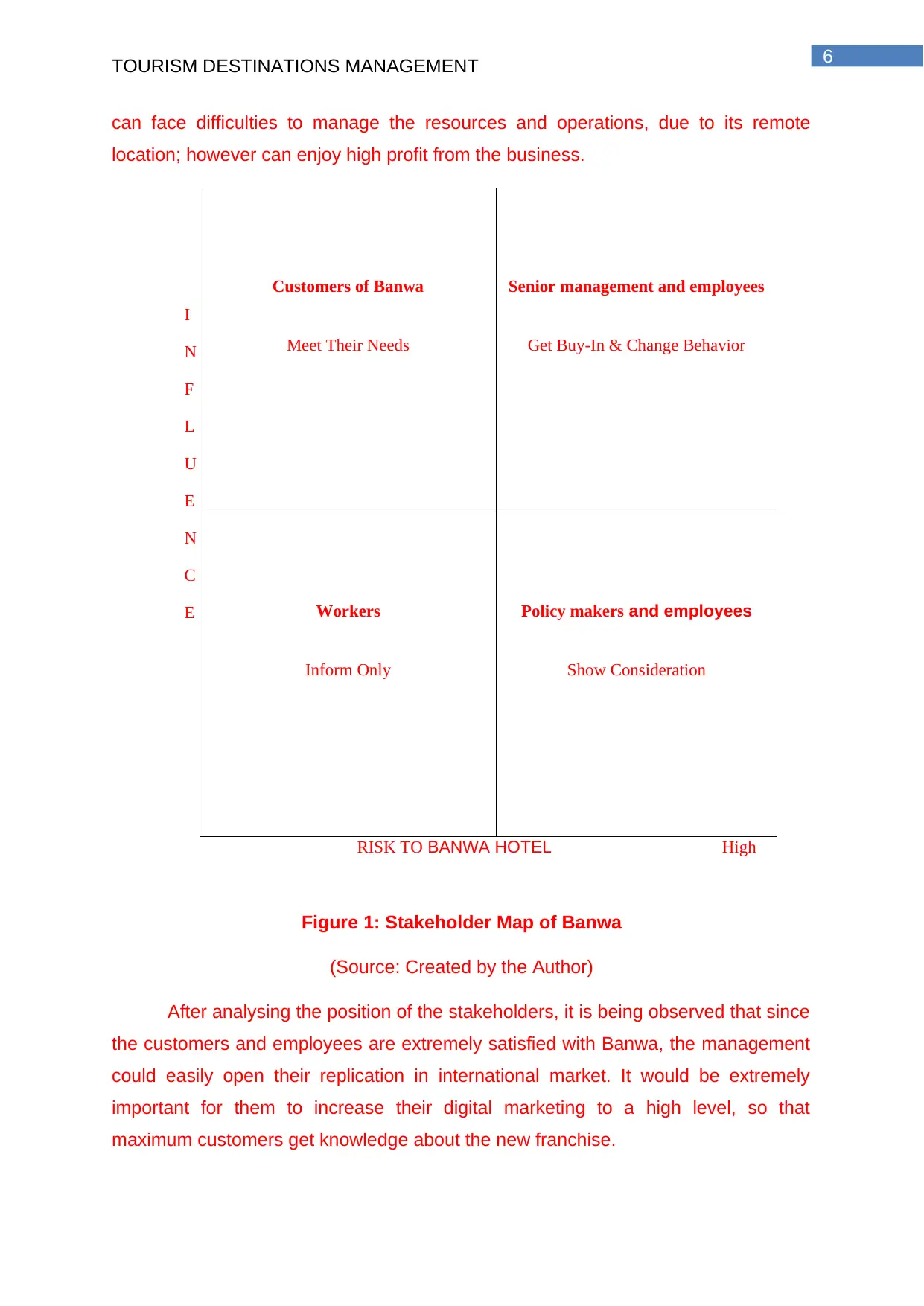
Since the stakeholders are eventually impacts with these above mentioned
aspects, a proper stakeholder analysis is effective for understanding the entire
situation. These stakeholders are highly affected by the positive and negative
impacts. The customers have both positive and negative impacts, as although they
have to pay high costs, they would be getting ultra-luxurious services, as compared
to any other resort in the world. On the other hand, the organizational management
TOURISM DESTINATIONS MANAGEMENT
desire to get connected with their acquaintances within the most effective method.
This particular strategy of digital connection enables the people in securing
accommodation conveniently and easily without depending on the third parties. The
subsequent requirement of connecting with others have increased the chance of
business growth to a high level. However, in spite of maintaining a proper balance
within their business operations and social networking sites like Facebook ad Twitter,
the management of Banwa Private Island Hotel requires to improve their digital
marketing campaigns (Shaw 2014).
This type of marketing is advertising delivered via several digitalized
channels. The main channels include mobile applications, electronic mails, search
engines, web applications and social media platforms (Armenski, Dwyer and
Pavluković 2018). Since it is an ultra-luxury hotel, it is evident that all customers
would not be able to afford the services majorly; as a result, proper digital marketing
campaign would be effective for the business in the entire world. The organization
should make an application of their company, so that the customers are able to gain
maximum knowledge about the services easily and promptly (Schuckert, Liu and
Law 2015). Moreover, in addition to their website, the organization could even utilize
display advertisements and PPC for the core purpose of attracting as well as
engaging the target customers.
It is being observed that there are few positive and negative impacts of luxury
hospitality operations within sensitive destinations. The positive impacts include high
customer satisfaction and maximum profit in the business due to the remote
locations. On the contrary, the overall expense to maintain these operations and
services is quite high and could not be managed effectively. Moreover, the raw
materials in the sensitive destinations are quite difficult to be brought.
Since the stakeholders are eventually impacts with these above mentioned
aspects, a proper stakeholder analysis is effective for understanding the entire
situation. These stakeholders are highly affected by the positive and negative
impacts. The customers have both positive and negative impacts, as although they
have to pay high costs, they would be getting ultra-luxurious services, as compared
to any other resort in the world. On the other hand, the organizational management
⊘ This is a preview!⊘
Do you want full access?
Subscribe today to unlock all pages.
Trusted by 1+ million students worldwide
6
TOURISM DESTINATIONS MANAGEMENT
can face difficulties to manage the resources and operations, due to its remote
location; however can enjoy high profit from the business.
I
N
F
L
U
E
N
C
E
Customers of Banwa
Meet Their Needs
Senior management and employees
Get Buy-In & Change Behavior
Workers
Inform Only
Policy makers and employees
Show Consideration
RISK TO BANWA HOTEL High
Figure 1: Stakeholder Map of Banwa
(Source: Created by the Author)
After analysing the position of the stakeholders, it is being observed that since
the customers and employees are extremely satisfied with Banwa, the management
could easily open their replication in international market. It would be extremely
important for them to increase their digital marketing to a high level, so that
maximum customers get knowledge about the new franchise.
TOURISM DESTINATIONS MANAGEMENT
can face difficulties to manage the resources and operations, due to its remote
location; however can enjoy high profit from the business.
I
N
F
L
U
E
N
C
E
Customers of Banwa
Meet Their Needs
Senior management and employees
Get Buy-In & Change Behavior
Workers
Inform Only
Policy makers and employees
Show Consideration
RISK TO BANWA HOTEL High
Figure 1: Stakeholder Map of Banwa
(Source: Created by the Author)
After analysing the position of the stakeholders, it is being observed that since
the customers and employees are extremely satisfied with Banwa, the management
could easily open their replication in international market. It would be extremely
important for them to increase their digital marketing to a high level, so that
maximum customers get knowledge about the new franchise.
Paraphrase This Document
Need a fresh take? Get an instant paraphrase of this document with our AI Paraphraser
7
TOURISM DESTINATIONS MANAGEMENT
However, they would require to consider about price competition. Since,
Banwa is the most costly resort in the world, there could be issues related to
customer retention. Hence, it can be termed as that Banwa is not doing its best
practice for the business and should lower the prices. Improvement of this particular
aspect would be effective for their business. Moreover, amongst all the stakeholders,
the customers would be influencing majorly on the business for high success.
3. Conclusion
Therefore, from the above discussion, a conclusion can be drawn that tourism
management undertakes the inter-disciplinary approach for consideration of different
aspects and features of the regional, national and international tourism effectively
and efficiently. The country of Philippines has made sure that the tourism aspects
are fulfilled completely and there is a high chance of economic growth in the field.
The above provided report has clearly outlined a detailed analysis of the tourism
management for a popular and significant hotels in Philippines, called Banwa Private
Island Hotel with relevant details and recommendations.
4. Recommendations
The organization of Banwa Private Island Hotel should involve some of the
most significant and important changes in their business for ensuring that major
effectiveness and efficiency is gained under every circumstance. Suitable
recommendations for the respective organization for their better results in their
respective business are as follows:
i) Consideration of Price Competition: The first suitable recommendation
for Banwa Private Island Hotel for improving their business for the international
guests is to consider the price competition. This type of competition is one of the
major ways, by which any specific product or service could easily compete within the
respective international market place. Since, Banwa Private Island is an ultra-luxury
hotel, they would have to consider the costs of other similar hotels, so that it
becomes easier for them to bring out better efficiency without much complexity.
When the costs of their services and products would be less than the costs of all
other hotels and resorts, it is evident that the respective hotel would gain maximum
profit and success. Moreover, the prospective customers would be able to
TOURISM DESTINATIONS MANAGEMENT
However, they would require to consider about price competition. Since,
Banwa is the most costly resort in the world, there could be issues related to
customer retention. Hence, it can be termed as that Banwa is not doing its best
practice for the business and should lower the prices. Improvement of this particular
aspect would be effective for their business. Moreover, amongst all the stakeholders,
the customers would be influencing majorly on the business for high success.
3. Conclusion
Therefore, from the above discussion, a conclusion can be drawn that tourism
management undertakes the inter-disciplinary approach for consideration of different
aspects and features of the regional, national and international tourism effectively
and efficiently. The country of Philippines has made sure that the tourism aspects
are fulfilled completely and there is a high chance of economic growth in the field.
The above provided report has clearly outlined a detailed analysis of the tourism
management for a popular and significant hotels in Philippines, called Banwa Private
Island Hotel with relevant details and recommendations.
4. Recommendations
The organization of Banwa Private Island Hotel should involve some of the
most significant and important changes in their business for ensuring that major
effectiveness and efficiency is gained under every circumstance. Suitable
recommendations for the respective organization for their better results in their
respective business are as follows:
i) Consideration of Price Competition: The first suitable recommendation
for Banwa Private Island Hotel for improving their business for the international
guests is to consider the price competition. This type of competition is one of the
major ways, by which any specific product or service could easily compete within the
respective international market place. Since, Banwa Private Island is an ultra-luxury
hotel, they would have to consider the costs of other similar hotels, so that it
becomes easier for them to bring out better efficiency without much complexity.
When the costs of their services and products would be less than the costs of all
other hotels and resorts, it is evident that the respective hotel would gain maximum
profit and success. Moreover, the prospective customers would be able to
8
TOURISM DESTINATIONS MANAGEMENT
understand about the pricing strategies and would reduce the complexities related to
customer dissatisfaction to a high level.
ii) Focusing on Digital Marketing: The second recommendation would be
focusing on digital marketing. It is quite vital for a business to focus on their digital
marketing, so that each and every customer from the international market is able to
gain knowledge about the distinct products and services, provided by this particular
hotel. Moreover, there would be a proper and fair competition amongst several
similar hotel organizations in the entire world. It would also increase chance of
business growth majorly.
iii) Creation of a Culture for Perpetual Revenue Management: Another
significant recommendation would be creation of a proper culture for the perpetual
revenue management. This specific culture would be responsible for creating focus
and negation of the threat of complacency. When the focus on hotel revenue
management is highly pervasive in the entire company, it would lead to subsequent
awareness within every staff of its significance. It also leads to better thoughtful
business related decisions as well as behaviour for helping to drive revenue in the
organization of Banwa Private Island.
TOURISM DESTINATIONS MANAGEMENT
understand about the pricing strategies and would reduce the complexities related to
customer dissatisfaction to a high level.
ii) Focusing on Digital Marketing: The second recommendation would be
focusing on digital marketing. It is quite vital for a business to focus on their digital
marketing, so that each and every customer from the international market is able to
gain knowledge about the distinct products and services, provided by this particular
hotel. Moreover, there would be a proper and fair competition amongst several
similar hotel organizations in the entire world. It would also increase chance of
business growth majorly.
iii) Creation of a Culture for Perpetual Revenue Management: Another
significant recommendation would be creation of a proper culture for the perpetual
revenue management. This specific culture would be responsible for creating focus
and negation of the threat of complacency. When the focus on hotel revenue
management is highly pervasive in the entire company, it would lead to subsequent
awareness within every staff of its significance. It also leads to better thoughtful
business related decisions as well as behaviour for helping to drive revenue in the
organization of Banwa Private Island.
⊘ This is a preview!⊘
Do you want full access?
Subscribe today to unlock all pages.
Trusted by 1+ million students worldwide
9
TOURISM DESTINATIONS MANAGEMENT
References
Armenski, T., Dwyer, L. and Pavluković, V., 2018. Destination competitiveness:
Public and private sector tourism management in Serbia. Journal of travel
research, 57(3), pp.384-398.
Ateljevic, J. and Page, S.J. eds., 2017. Tourism and entrepreneurship. Routledge.
Banwa Private Island. 2020. Accessed from https://www.banwaprivateisland.com/
[Accessed on 30 January 2020].
Bunakov, O.A., Zaitseva, N.A., Larionova, A.A., Chudnovskiy, A.D., Zhukova, M.A.
and Zhukov, V.A., 2015. Research on the evolution of management concepts of
sustainable tourism and hospitality development in the regions. Journal of
Sustainable Development, 8(6), p.39.
Chen, Y.F. and Law, R., 2016. A review of research on electronic word-of-mouth in
hospitality and tourism management. International Journal of Hospitality & Tourism
Administration, 17(4), pp.347-372.
Gretzel, U., Sigala, M., Xiang, Z. and Koo, C., 2015. Smart tourism: foundations and
developments. Electronic Markets, 25(3), pp.179-188.
Higgins-Desbiolles, F., 2018. Sustainable tourism: Sustaining tourism or something
more?. Tourism management perspectives, 25, pp.157-160.
Inkson, C. and Minnaert, L., 2018. Tourism management: An introduction. Sage.
Mason, P., 2015. Tourism impacts, planning and management. Routledge.
Medlik, S. ed., 2016. Managing tourism. Elsevier.
Page, S.J., 2014. Tourism management. Routledge.
Prebensen, N.K., Chen, J.S. and Uysal, M. eds., 2018. Creating experience value in
tourism. Cabi.
Schuckert, M., Liu, X. and Law, R., 2015. Hospitality and tourism online reviews:
Recent trends and future directions. Journal of Travel & Tourism Marketing, 32(5),
pp.608-621.
TOURISM DESTINATIONS MANAGEMENT
References
Armenski, T., Dwyer, L. and Pavluković, V., 2018. Destination competitiveness:
Public and private sector tourism management in Serbia. Journal of travel
research, 57(3), pp.384-398.
Ateljevic, J. and Page, S.J. eds., 2017. Tourism and entrepreneurship. Routledge.
Banwa Private Island. 2020. Accessed from https://www.banwaprivateisland.com/
[Accessed on 30 January 2020].
Bunakov, O.A., Zaitseva, N.A., Larionova, A.A., Chudnovskiy, A.D., Zhukova, M.A.
and Zhukov, V.A., 2015. Research on the evolution of management concepts of
sustainable tourism and hospitality development in the regions. Journal of
Sustainable Development, 8(6), p.39.
Chen, Y.F. and Law, R., 2016. A review of research on electronic word-of-mouth in
hospitality and tourism management. International Journal of Hospitality & Tourism
Administration, 17(4), pp.347-372.
Gretzel, U., Sigala, M., Xiang, Z. and Koo, C., 2015. Smart tourism: foundations and
developments. Electronic Markets, 25(3), pp.179-188.
Higgins-Desbiolles, F., 2018. Sustainable tourism: Sustaining tourism or something
more?. Tourism management perspectives, 25, pp.157-160.
Inkson, C. and Minnaert, L., 2018. Tourism management: An introduction. Sage.
Mason, P., 2015. Tourism impacts, planning and management. Routledge.
Medlik, S. ed., 2016. Managing tourism. Elsevier.
Page, S.J., 2014. Tourism management. Routledge.
Prebensen, N.K., Chen, J.S. and Uysal, M. eds., 2018. Creating experience value in
tourism. Cabi.
Schuckert, M., Liu, X. and Law, R., 2015. Hospitality and tourism online reviews:
Recent trends and future directions. Journal of Travel & Tourism Marketing, 32(5),
pp.608-621.
Paraphrase This Document
Need a fresh take? Get an instant paraphrase of this document with our AI Paraphraser
10
TOURISM DESTINATIONS MANAGEMENT
Shaw, G., 2014. Entrepreneurial cultures and small business enterprises in
tourism. The Wiley Blackwell companion to tourism, pp.120-131.
Weaver, D.B., 2014. Asymmetrical dialectics of sustainable tourism: Toward
enlightened mass tourism. Journal of Travel Research, 53(2), pp.131-140.
Zeng, B. and Gerritsen, R., 2014. What do we know about social media in tourism?
A review. Tourism management perspectives, 10, pp.27-36.
TOURISM DESTINATIONS MANAGEMENT
Shaw, G., 2014. Entrepreneurial cultures and small business enterprises in
tourism. The Wiley Blackwell companion to tourism, pp.120-131.
Weaver, D.B., 2014. Asymmetrical dialectics of sustainable tourism: Toward
enlightened mass tourism. Journal of Travel Research, 53(2), pp.131-140.
Zeng, B. and Gerritsen, R., 2014. What do we know about social media in tourism?
A review. Tourism management perspectives, 10, pp.27-36.

1 out of 11


Related Documents


Your All-in-One AI-Powered Toolkit for Academic Success.
+13062052269
info@desklib.com
Available 24*7 on WhatsApp / Email
![[object Object]](/_next/static/media/star-bottom.7253800d.svg)
Unlock your academic potential
Copyright © 2020–2026 A2Z Services. All Rights Reserved. Developed and managed by ZUCOL.