Tourism Impacts and Planning: London Olympiad and Goa, India Report
VerifiedAdded on 2020/01/28
|17
|5437
|51
Report
AI Summary
This report delves into various aspects of tourism development, using the London Olympiad as a central case study. It explores the rationale for planning, stakeholder benefits, and the advantages and disadvantages of public/private partnerships in tourism. The report analyzes tourism development at different levels, including interactive planning systems and methods for measuring tourist impact. It further examines sustainable tourism concepts, factors hindering sustainable development, and stages in planning for sustainability. The report also investigates conflicts in Casa de Campo, analyzing conflict resolution methods and the implications of balancing supply and demand, as well as ethical issues. Finally, it assesses the socio-cultural, environmental, and economic impacts of tourism in Goa, India, comparing issues in developing and emerging destinations and offering recommendations for future tourism development.
Contents
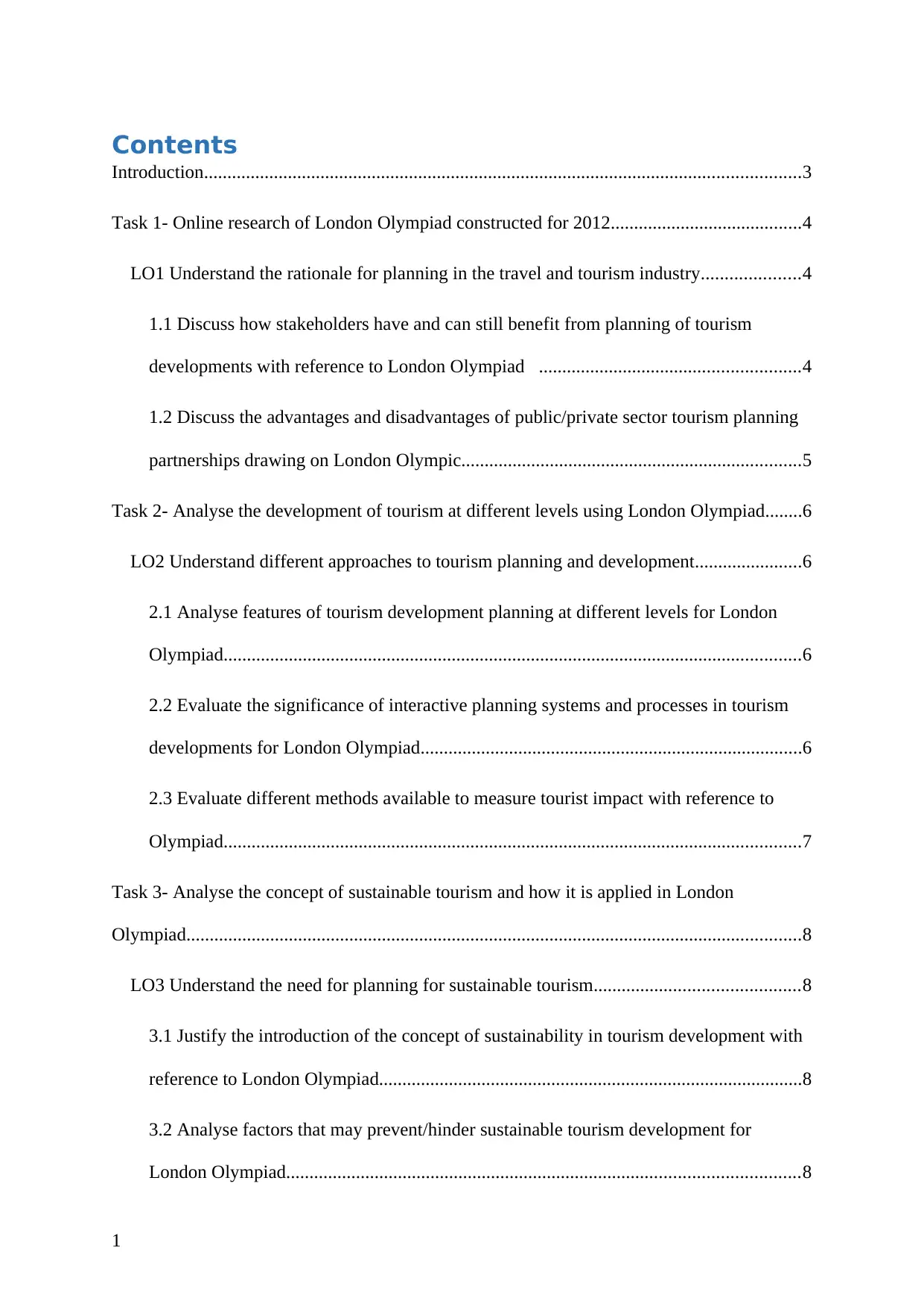
Introduction................................................................................................................................3
Task 1- Online research of London Olympiad constructed for 2012.........................................4
LO1 Understand the rationale for planning in the travel and tourism industry.....................4
1.1 Discuss how stakeholders have and can still benefit from planning of tourism
developments with reference to London Olympiad ........................................................4
1.2 Discuss the advantages and disadvantages of public/private sector tourism planning
partnerships drawing on London Olympic.........................................................................5
Task 2- Analyse the development of tourism at different levels using London Olympiad........6
LO2 Understand different approaches to tourism planning and development.......................6
2.1 Analyse features of tourism development planning at different levels for London
Olympiad............................................................................................................................6
2.2 Evaluate the significance of interactive planning systems and processes in tourism
developments for London Olympiad..................................................................................6
2.3 Evaluate different methods available to measure tourist impact with reference to
Olympiad............................................................................................................................7
Task 3- Analyse the concept of sustainable tourism and how it is applied in London
Olympiad....................................................................................................................................8
LO3 Understand the need for planning for sustainable tourism............................................8
3.1 Justify the introduction of the concept of sustainability in tourism development with
reference to London Olympiad...........................................................................................8
3.2 Analyse factors that may prevent/hinder sustainable tourism development for
London Olympiad..............................................................................................................8
1
Introduction................................................................................................................................3
Task 1- Online research of London Olympiad constructed for 2012.........................................4
LO1 Understand the rationale for planning in the travel and tourism industry.....................4
1.1 Discuss how stakeholders have and can still benefit from planning of tourism
developments with reference to London Olympiad ........................................................4
1.2 Discuss the advantages and disadvantages of public/private sector tourism planning
partnerships drawing on London Olympic.........................................................................5
Task 2- Analyse the development of tourism at different levels using London Olympiad........6
LO2 Understand different approaches to tourism planning and development.......................6
2.1 Analyse features of tourism development planning at different levels for London
Olympiad............................................................................................................................6
2.2 Evaluate the significance of interactive planning systems and processes in tourism
developments for London Olympiad..................................................................................6
2.3 Evaluate different methods available to measure tourist impact with reference to
Olympiad............................................................................................................................7
Task 3- Analyse the concept of sustainable tourism and how it is applied in London
Olympiad....................................................................................................................................8
LO3 Understand the need for planning for sustainable tourism............................................8
3.1 Justify the introduction of the concept of sustainability in tourism development with
reference to London Olympiad...........................................................................................8
3.2 Analyse factors that may prevent/hinder sustainable tourism development for
London Olympiad..............................................................................................................8
1

Paraphrase This Document
Need a fresh take? Get an instant paraphrase of this document with our AI Paraphraser
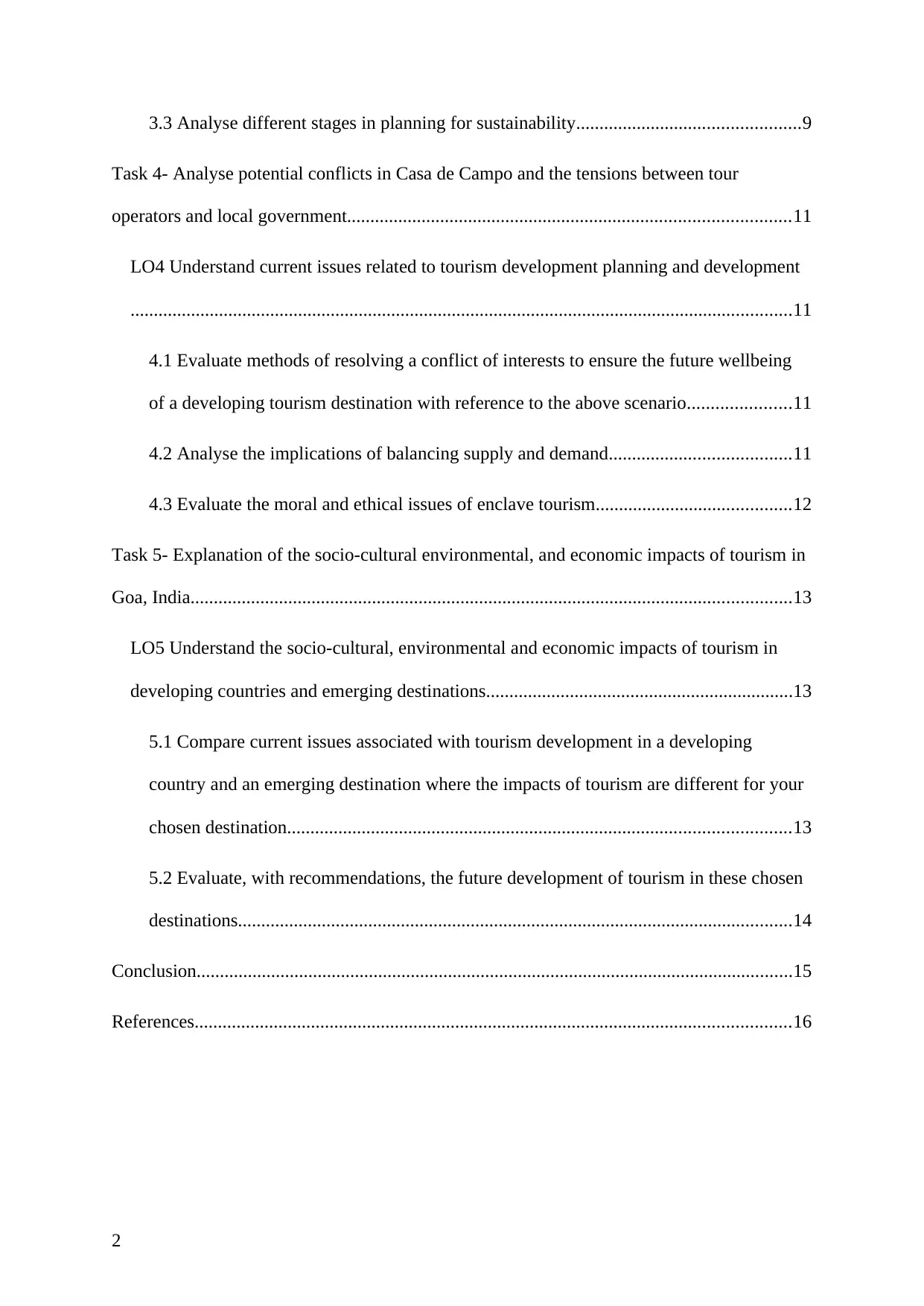
3.3 Analyse different stages in planning for sustainability................................................9
Task 4- Analyse potential conflicts in Casa de Campo and the tensions between tour
operators and local government...............................................................................................11
LO4 Understand current issues related to tourism development planning and development
..............................................................................................................................................11
4.1 Evaluate methods of resolving a conflict of interests to ensure the future wellbeing
of a developing tourism destination with reference to the above scenario......................11
4.2 Analyse the implications of balancing supply and demand.......................................11
4.3 Evaluate the moral and ethical issues of enclave tourism..........................................12
Task 5- Explanation of the socio-cultural environmental, and economic impacts of tourism in
Goa, India.................................................................................................................................13
LO5 Understand the socio-cultural, environmental and economic impacts of tourism in
developing countries and emerging destinations..................................................................13
5.1 Compare current issues associated with tourism development in a developing
country and an emerging destination where the impacts of tourism are different for your
chosen destination............................................................................................................13
5.2 Evaluate, with recommendations, the future development of tourism in these chosen
destinations.......................................................................................................................14
Conclusion................................................................................................................................15
References................................................................................................................................16
2
Task 4- Analyse potential conflicts in Casa de Campo and the tensions between tour
operators and local government...............................................................................................11
LO4 Understand current issues related to tourism development planning and development
..............................................................................................................................................11
4.1 Evaluate methods of resolving a conflict of interests to ensure the future wellbeing
of a developing tourism destination with reference to the above scenario......................11
4.2 Analyse the implications of balancing supply and demand.......................................11
4.3 Evaluate the moral and ethical issues of enclave tourism..........................................12
Task 5- Explanation of the socio-cultural environmental, and economic impacts of tourism in
Goa, India.................................................................................................................................13
LO5 Understand the socio-cultural, environmental and economic impacts of tourism in
developing countries and emerging destinations..................................................................13
5.1 Compare current issues associated with tourism development in a developing
country and an emerging destination where the impacts of tourism are different for your
chosen destination............................................................................................................13
5.2 Evaluate, with recommendations, the future development of tourism in these chosen
destinations.......................................................................................................................14
Conclusion................................................................................................................................15
References................................................................................................................................16
2
Introduction
Sustainable tourism is a new buzz word in the travel industry and is gaining grounds in most
tourist countries, especially where the awareness is more and willingness to include the
environment into its effects are visible. The concept is also becoming popular in small and
emerging destinations which requires to attract environmentally friendly customers who only
prefer to select accommodations and destinations which are doing something for the
environment. This paper looks into the London Olympiad development and will study the
concept of sustainable tourism in the case and how it is maintained and grown. The paper will
also investigate into the conflicts of Casa de Campo between tour operators and local
government and what are the options. And lastly, it will also focus on an emerging
destination like Goa in India and study the socio-cultural, environment, and economic
impacts of tourism in the region and how the future development in tourism will look like.
3
Sustainable tourism is a new buzz word in the travel industry and is gaining grounds in most
tourist countries, especially where the awareness is more and willingness to include the
environment into its effects are visible. The concept is also becoming popular in small and
emerging destinations which requires to attract environmentally friendly customers who only
prefer to select accommodations and destinations which are doing something for the
environment. This paper looks into the London Olympiad development and will study the
concept of sustainable tourism in the case and how it is maintained and grown. The paper will
also investigate into the conflicts of Casa de Campo between tour operators and local
government and what are the options. And lastly, it will also focus on an emerging
destination like Goa in India and study the socio-cultural, environment, and economic
impacts of tourism in the region and how the future development in tourism will look like.
3
⊘ This is a preview!⊘
Do you want full access?
Subscribe today to unlock all pages.

Trusted by 1+ million students worldwide
Task 1- Online research of London Olympiad
constructed for 2012
LO1 Understand the rationale for planning in the travel and tourism
industry
1.1 Discuss how stakeholders have and can still benefit from planning of
tourism developments with reference to London Olympiad
Tourism developments have a lot of stakeholders which includes the investors, hotel owners,
tour operators, transportation providers, government, common citizens, environmentalists,
employees working in tourism industry, etc. The London Olympiad was constructed in 2012
to host the Olympic Games in East London and the site is a major one capable of hosting
millions of people. The location of East London has been a deprived region for long and now
with the plan of converting the Olympic site into Queen Elizabeth Olympic Park (Gov.uk,
2013). The several stakeholders especially the local citizens can benefit tremendously from
the Olympic site development, because with the development of new retail, sports arena, and
creating a legacy for Olympic Games hosting, the location will attract billions of dollars of
investments from public and private enterprises. This can benefit them in creating new
housing stock, entertainment areas and improve the quality of life of local citizens. The
investors and the government can benefit still after increased permanent revenues will start
coming in from the site development for commercial usage. The environmentalist will also
benefit in identifying the regions which needs to be taken care of and since it is a new
development, the planning can be more environment friendly. Several hotels can come up in
the region because the site is ready to host many other international level games which will
attract millions of tourists from the world. The government will achieve its goodwill in
maintaining the site and generating substantial revenues from it. The site will be attract the
local people to explore the opportunities available in the sports arena and can also take part in
local competitions. The development will benefit tremendously by attracting huge
infrastructure investments like railways, metros, better highways, parking lots, parks, and
other facilities to be provided at the site. Thus, the site can help the local citizens, the
government, investors, environmentalists, sports enthusiasts, and a global audience for many
international games to be hosted at the site.
4
constructed for 2012
LO1 Understand the rationale for planning in the travel and tourism
industry
1.1 Discuss how stakeholders have and can still benefit from planning of
tourism developments with reference to London Olympiad
Tourism developments have a lot of stakeholders which includes the investors, hotel owners,
tour operators, transportation providers, government, common citizens, environmentalists,
employees working in tourism industry, etc. The London Olympiad was constructed in 2012
to host the Olympic Games in East London and the site is a major one capable of hosting
millions of people. The location of East London has been a deprived region for long and now
with the plan of converting the Olympic site into Queen Elizabeth Olympic Park (Gov.uk,
2013). The several stakeholders especially the local citizens can benefit tremendously from
the Olympic site development, because with the development of new retail, sports arena, and
creating a legacy for Olympic Games hosting, the location will attract billions of dollars of
investments from public and private enterprises. This can benefit them in creating new
housing stock, entertainment areas and improve the quality of life of local citizens. The
investors and the government can benefit still after increased permanent revenues will start
coming in from the site development for commercial usage. The environmentalist will also
benefit in identifying the regions which needs to be taken care of and since it is a new
development, the planning can be more environment friendly. Several hotels can come up in
the region because the site is ready to host many other international level games which will
attract millions of tourists from the world. The government will achieve its goodwill in
maintaining the site and generating substantial revenues from it. The site will be attract the
local people to explore the opportunities available in the sports arena and can also take part in
local competitions. The development will benefit tremendously by attracting huge
infrastructure investments like railways, metros, better highways, parking lots, parks, and
other facilities to be provided at the site. Thus, the site can help the local citizens, the
government, investors, environmentalists, sports enthusiasts, and a global audience for many
international games to be hosted at the site.
4
Paraphrase This Document
Need a fresh take? Get an instant paraphrase of this document with our AI Paraphraser
1.2 Discuss the advantages and disadvantages of public/private sector
tourism planning partnerships drawing on London Olympic
Public sector tourism planning comes with the government’s involvement into the operations
side and they are also responsible for investments and making the travel laws. The
development of the site to turn into a recreational hub is an idea of the government which is
worth performing it because with this kind of public sector involvement is an advantage for
the local community and the overall development and positive sentiments among the citizens.
They feel that the government is playing its part by providing and building special
infrastructure which will keep the local community happy and with multiple options. The
involvement of public participation in taking important decisions is beneficial to the end
development and does not create any hurdle for anyone. Taking their suggestions can avoid
many pitfalls when developing tourism sites and spots so that the local community also co-
exist with the tourist spot and are not at the mercy of private developers (Scsoft.de, 2015).
However, sometimes the public involvement can create a lot of tensions between the
government and the commissioning of projects because some citizens raise unnecessary
issues which require no thought and are motivated to halt or stop progressive activities.
Private sector is a boost for tourism investment because as an industry it requires mega
investments and this cannot be only met by the government alone. That is why, the
involvement of private sector in investments and operations of tourism sites is a saviour for
the site. The site at the London Olympiad is testimony of significant private investments that
will shape the entire economic development of East London. The private sector can bring in
huge investments and can stay invested and forge a public private partnership with the
government for building and operating important sites like the London Olympiad which will
create massive recreational location for all local citizens. Sometimes, the private sector can
act for personal gains and can overlook the public concerns and may not give priority to them
and meet with stiff opposition from local public and halt the entire project.
5
tourism planning partnerships drawing on London Olympic
Public sector tourism planning comes with the government’s involvement into the operations
side and they are also responsible for investments and making the travel laws. The
development of the site to turn into a recreational hub is an idea of the government which is
worth performing it because with this kind of public sector involvement is an advantage for
the local community and the overall development and positive sentiments among the citizens.
They feel that the government is playing its part by providing and building special
infrastructure which will keep the local community happy and with multiple options. The
involvement of public participation in taking important decisions is beneficial to the end
development and does not create any hurdle for anyone. Taking their suggestions can avoid
many pitfalls when developing tourism sites and spots so that the local community also co-
exist with the tourist spot and are not at the mercy of private developers (Scsoft.de, 2015).
However, sometimes the public involvement can create a lot of tensions between the
government and the commissioning of projects because some citizens raise unnecessary
issues which require no thought and are motivated to halt or stop progressive activities.
Private sector is a boost for tourism investment because as an industry it requires mega
investments and this cannot be only met by the government alone. That is why, the
involvement of private sector in investments and operations of tourism sites is a saviour for
the site. The site at the London Olympiad is testimony of significant private investments that
will shape the entire economic development of East London. The private sector can bring in
huge investments and can stay invested and forge a public private partnership with the
government for building and operating important sites like the London Olympiad which will
create massive recreational location for all local citizens. Sometimes, the private sector can
act for personal gains and can overlook the public concerns and may not give priority to them
and meet with stiff opposition from local public and halt the entire project.
5
Task 2- Analyse the development of tourism at different
levels using London Olympiad
LO2 Understand different approaches to tourism planning and
development
2.1 Analyse features of tourism development planning at different levels
for London Olympiad
Tourism development is a complex process which needs to be simplified to the core for
converting actions into realistic results. The planning of the entire site starts with the board
team which overlooks the entire development. They decide the master plan for the site and
take suggestions from the public for any changes. The amount of hotels, the amount of
people, expected at maximum capacity, the amount of car parking, the amount of walkways,
the details of all the recreational activities and instruments required at the site, the financing
of the project, the financial closure, the back up plans in case of failure in each area, etc. are
planned by the top management team. Then the contractor, the architect and the local
supervisors work together in coordination to study the planning for the site. At this level, the
planning is more on the intricate details about the amount of investments, the requirement of
raw materials, the sequence of working and starting the work, etc. Then the site engineers and
the contractor works together in coordination to execute the planning provided by the
architects and designers. The planning of tourism is being considered from all possibilities
which may also include the maximum and minimum response from people and what is to be
done in case of the project not becoming a success (Suriyamongkol, 2001).
2.2 Evaluate the significance of interactive planning systems and
processes in tourism developments for London Olympiad
The interactive planning system is a wonderful method of keeping all stakeholders involved
during the development of a project, and in case of the London Olympiad which is of national
importance, involving all stakeholders from scratch to commissioning will reduce the level of
opponents and unexpected halts out of the way paving the way for a quick completion of the
project. The interactive planning system can involve the use of electronic medium like
6
levels using London Olympiad
LO2 Understand different approaches to tourism planning and
development
2.1 Analyse features of tourism development planning at different levels
for London Olympiad
Tourism development is a complex process which needs to be simplified to the core for
converting actions into realistic results. The planning of the entire site starts with the board
team which overlooks the entire development. They decide the master plan for the site and
take suggestions from the public for any changes. The amount of hotels, the amount of
people, expected at maximum capacity, the amount of car parking, the amount of walkways,
the details of all the recreational activities and instruments required at the site, the financing
of the project, the financial closure, the back up plans in case of failure in each area, etc. are
planned by the top management team. Then the contractor, the architect and the local
supervisors work together in coordination to study the planning for the site. At this level, the
planning is more on the intricate details about the amount of investments, the requirement of
raw materials, the sequence of working and starting the work, etc. Then the site engineers and
the contractor works together in coordination to execute the planning provided by the
architects and designers. The planning of tourism is being considered from all possibilities
which may also include the maximum and minimum response from people and what is to be
done in case of the project not becoming a success (Suriyamongkol, 2001).
2.2 Evaluate the significance of interactive planning systems and
processes in tourism developments for London Olympiad
The interactive planning system is a wonderful method of keeping all stakeholders involved
during the development of a project, and in case of the London Olympiad which is of national
importance, involving all stakeholders from scratch to commissioning will reduce the level of
opponents and unexpected halts out of the way paving the way for a quick completion of the
project. The interactive planning system can involve the use of electronic medium like
6
⊘ This is a preview!⊘
Do you want full access?
Subscribe today to unlock all pages.
Trusted by 1+ million students worldwide
emails, and using multimedia as a planning tool which will have inputs from all those
involved in the project including the local citizens. By involving the local citizens, the
government of UK would know what to include and what not to include in the development
thereby saving cost and time. The process of decision making is crucial in such a large
development and when all stakeholders give a nod on a single platform or forum, it becomes
very easier to complete the development and enjoy the success of the project. With an
interactive planning system, the stakeholders can raise their concerns and issues which can be
include in the designing stage and avid future retribution (Chapman and Lennie, 1997). The
medium also involves a lot of interaction at initial level and also throughout the development
process of the site so that everyone is being kept informed about the latest development and
no one is being left out. This makes every stakeholder belong to the development and feel an
important part in the development, and the stakeholders also feel to have played their part of
representing their community.
2.3 Evaluate different methods available to measure tourist impact with
reference to Olympiad
Tourism sites are being developed to expect tourist flow and staying for a long time and
spending as much as they can. The strength of a tourist site remains in the natural beauty, its
ease of access from the city or town, its infrastructure provision, availability of facilities
which ae too common to be expected, and the social and cultural influence that it is
spreading. The measurement of the success of a site can be carried out by the after event
evaluation of the number of tourist coming to the event and how much foreign exchange has
come in from them. This may give a broader picture of the impact that tourist have had when
visiting the Olympiad. Another method for checking tourist impact is the positive energy that
is created at the site or at an event and this can be seen by various media channels. This will
be an intuitive and an emotional measurement that can be measured by the positive
sentiments that the tourist have left behind. The arrivals from a specific country can tell the
impact of the marketing of the function in that particular country (Sofield, 2003). The arrivals
being recorded at all transportation stations can also tell the impact of the tourist. One more
method of measuring is the survey being taken from all tourists visiting the place and how do
they like the function and how deep the impact it has made to their life. These are several
ways of measuring tourist impact with reference to the Olympiad built in East London.
7
involved in the project including the local citizens. By involving the local citizens, the
government of UK would know what to include and what not to include in the development
thereby saving cost and time. The process of decision making is crucial in such a large
development and when all stakeholders give a nod on a single platform or forum, it becomes
very easier to complete the development and enjoy the success of the project. With an
interactive planning system, the stakeholders can raise their concerns and issues which can be
include in the designing stage and avid future retribution (Chapman and Lennie, 1997). The
medium also involves a lot of interaction at initial level and also throughout the development
process of the site so that everyone is being kept informed about the latest development and
no one is being left out. This makes every stakeholder belong to the development and feel an
important part in the development, and the stakeholders also feel to have played their part of
representing their community.
2.3 Evaluate different methods available to measure tourist impact with
reference to Olympiad
Tourism sites are being developed to expect tourist flow and staying for a long time and
spending as much as they can. The strength of a tourist site remains in the natural beauty, its
ease of access from the city or town, its infrastructure provision, availability of facilities
which ae too common to be expected, and the social and cultural influence that it is
spreading. The measurement of the success of a site can be carried out by the after event
evaluation of the number of tourist coming to the event and how much foreign exchange has
come in from them. This may give a broader picture of the impact that tourist have had when
visiting the Olympiad. Another method for checking tourist impact is the positive energy that
is created at the site or at an event and this can be seen by various media channels. This will
be an intuitive and an emotional measurement that can be measured by the positive
sentiments that the tourist have left behind. The arrivals from a specific country can tell the
impact of the marketing of the function in that particular country (Sofield, 2003). The arrivals
being recorded at all transportation stations can also tell the impact of the tourist. One more
method of measuring is the survey being taken from all tourists visiting the place and how do
they like the function and how deep the impact it has made to their life. These are several
ways of measuring tourist impact with reference to the Olympiad built in East London.
7
Paraphrase This Document
Need a fresh take? Get an instant paraphrase of this document with our AI Paraphraser
Task 3- Analyse the concept of sustainable tourism and
how it is applied in London Olympiad
LO3 Understand the need for planning for sustainable tourism
3.1 Justify the introduction of the concept of sustainability in tourism
development with reference to London Olympiad
Sustainability is a concept which means that anything which is built shall last for the future
generations to use them without any hurdle. Tourism is a sector which requires sustainability
today than ever before. Sustainable tourism can be defined as:
"Tourism that takes full account of its current and future economic, social and environmental
impacts, addressing the needs of visitors, the industry, the environment and host
communities" (sdt.unwto.org, 2015). This is a whole definition of the idea of sustainable
tourism which takes into account all possible effects of the current period and also of the
future. The site of the Olympiad can be developed in such a way that after the games for
which it was particularly built, it can also be converted into a different purpose. And this is
the same thing that the site is experiencing currently, being built into a recreational area for
East London citizens and will also host events and have entertainment centres (Magnay,
2013). The cost of building the Olympiad is so much that it is wiser not be used only for a
single function but after the event, it must be used in such a way that it can generate revenues.
This will be a wise use of the taxpayers’ money and the citizens will get a world class
recreational centre.
3.2 Analyse factors that may prevent/hinder sustainable tourism
development for London Olympiad
Sustainable tourism can be executed in a simple manner if all stakeholders are together and
take collective positive action. There are a number of factors which can prevent sustainable
tourism development in the Olympiad site. If the hotels around and the main site arena is not
capable of using environmental prevention techniques like saving water, recycling water,
8
how it is applied in London Olympiad
LO3 Understand the need for planning for sustainable tourism
3.1 Justify the introduction of the concept of sustainability in tourism
development with reference to London Olympiad
Sustainability is a concept which means that anything which is built shall last for the future
generations to use them without any hurdle. Tourism is a sector which requires sustainability
today than ever before. Sustainable tourism can be defined as:
"Tourism that takes full account of its current and future economic, social and environmental
impacts, addressing the needs of visitors, the industry, the environment and host
communities" (sdt.unwto.org, 2015). This is a whole definition of the idea of sustainable
tourism which takes into account all possible effects of the current period and also of the
future. The site of the Olympiad can be developed in such a way that after the games for
which it was particularly built, it can also be converted into a different purpose. And this is
the same thing that the site is experiencing currently, being built into a recreational area for
East London citizens and will also host events and have entertainment centres (Magnay,
2013). The cost of building the Olympiad is so much that it is wiser not be used only for a
single function but after the event, it must be used in such a way that it can generate revenues.
This will be a wise use of the taxpayers’ money and the citizens will get a world class
recreational centre.
3.2 Analyse factors that may prevent/hinder sustainable tourism
development for London Olympiad
Sustainable tourism can be executed in a simple manner if all stakeholders are together and
take collective positive action. There are a number of factors which can prevent sustainable
tourism development in the Olympiad site. If the hotels around and the main site arena is not
capable of using environmental prevention techniques like saving water, recycling water,
8
using solar light, and banning use of certain harmful materials like plastic, etc., the
development can be called as a failure and may not sustain for a long time. If the
environmental impacts are not being factored in while making the development, it is
inevitable that it will not remain as a sustainable development for long (McKercher, 2003).
The hindrance of local citizens for their lack of responsibility of waste disposal can harm the
site and may not sustain to operate for a long time. If the development is going to create more
problems for the local climate and produce more heat, it will have to be reduced to a
minimum and the operation mays also not sustain because climate change will produce
innumerable diseases and it may spread like a pandemic. Not paying attention to social
impacts that the development will create can also create a lot of hurdle for the project,
because this will create a development which might not be affordable to the common citizen
and the entire revenue expectations will fall down making the project a failure
(Sustainabletourism.net, 2015). If the economic impact of the development is such that the
money spent on this development is unnecessary instead of something which is more
important like healthcare and education, the development may not gain much reputation and
may fail its sustainability.
3.3 Analyse different stages in planning for sustainability
Sustainability is a concept which needs to be started when the conceptual design is being
prepared for a site. The first stage is to identify the social, economic, environmental, and
cultural impact of the development, so that the minimization of negative impacts can be
reduced or mitigated completely. The second stage is to involve all stakeholders and take
their suggestions, especially for the negative outcomes of the development and perceived
outlook of the entire development over a long term (Bramwell, 2004). The broader issues like
gender equality, poverty alleviation, social justice, studying the future trends and adopting
measures meeting those needs, and using renewable materials at the site are some of the
issues that must be studied in the case of Olympiad site. The chance to reduce poverty by
offering employment to the needy must be studied which will design the job works for those
people. The use of natural resources and its availability and deficit will have to be studied,
because when the event will attract millions of people the decision to use a specific type of
resources will decide the scarcity or abundance of that resource which may also be required
in the future. The impact on the local culture, international culture will have to be studied so
that the site promotes inter-cultural progress and fusion. The site must identify all the use of
9
development can be called as a failure and may not sustain for a long time. If the
environmental impacts are not being factored in while making the development, it is
inevitable that it will not remain as a sustainable development for long (McKercher, 2003).
The hindrance of local citizens for their lack of responsibility of waste disposal can harm the
site and may not sustain to operate for a long time. If the development is going to create more
problems for the local climate and produce more heat, it will have to be reduced to a
minimum and the operation mays also not sustain because climate change will produce
innumerable diseases and it may spread like a pandemic. Not paying attention to social
impacts that the development will create can also create a lot of hurdle for the project,
because this will create a development which might not be affordable to the common citizen
and the entire revenue expectations will fall down making the project a failure
(Sustainabletourism.net, 2015). If the economic impact of the development is such that the
money spent on this development is unnecessary instead of something which is more
important like healthcare and education, the development may not gain much reputation and
may fail its sustainability.
3.3 Analyse different stages in planning for sustainability
Sustainability is a concept which needs to be started when the conceptual design is being
prepared for a site. The first stage is to identify the social, economic, environmental, and
cultural impact of the development, so that the minimization of negative impacts can be
reduced or mitigated completely. The second stage is to involve all stakeholders and take
their suggestions, especially for the negative outcomes of the development and perceived
outlook of the entire development over a long term (Bramwell, 2004). The broader issues like
gender equality, poverty alleviation, social justice, studying the future trends and adopting
measures meeting those needs, and using renewable materials at the site are some of the
issues that must be studied in the case of Olympiad site. The chance to reduce poverty by
offering employment to the needy must be studied which will design the job works for those
people. The use of natural resources and its availability and deficit will have to be studied,
because when the event will attract millions of people the decision to use a specific type of
resources will decide the scarcity or abundance of that resource which may also be required
in the future. The impact on the local culture, international culture will have to be studied so
that the site promotes inter-cultural progress and fusion. The site must identify all the use of
9
⊘ This is a preview!⊘
Do you want full access?
Subscribe today to unlock all pages.
Trusted by 1+ million students worldwide

resources and materials to be used in the development and accordingly select them after
checking the availability, so that the materials sustain future demand just in case it may arise.
10
checking the availability, so that the materials sustain future demand just in case it may arise.
10
Paraphrase This Document
Need a fresh take? Get an instant paraphrase of this document with our AI Paraphraser
Task 4- Analyse potential conflicts in Casa de Campo
and the tensions between tour operators and local
government
LO4 Understand current issues related to tourism development
planning and development
4.1 Evaluate methods of resolving a conflict of interests to ensure the
future wellbeing of a developing tourism destination with reference
to the above scenario
The resort of Casa de Campo is a large one and is bigger than any other resort in the region.
The conflict of the tour operators could arise when the resort would have a strict policy of
room rates and not being flexible about it by being adamant on it because of the size of the
resort and not accommodating the tour operator request. The tour operators may have a
conflict with the government which require to pay higher taxes on doing business in the
Dominican Republic. This can cause tensions between the tour operator’s operating styles
and may even halt any tours coming from the Unites States and the United Kingdom. This
can really put the resort in a fix because to maintain such a large development, the fixed costs
are very high and to meet them, it needs to be lenient in room rates and holiday packages.
This can assure sustainability of such a large development for a long time and will remain in
business. The government could come forward and establish a uniform tax system which will
be followed by everyone and this will ensure regular traffic from US and UK. The resort also
can strike a deal with the tour operators over their fees and understand that for staying in
business it needs a lot of customers which will mostly come through these tour operators and
no other, and so they need to come to c conclusion about the fees and decide the package
pricing depending on the season and peak periods (Tirado de Alonso, 1992).
4.2 Analyse the implications of balancing supply and demand
Supply and demand are two important factors in the travel industry. Demand increases when
the economic conditions are conducive to spending and are looking bright. This will ensure
11
and the tensions between tour operators and local
government
LO4 Understand current issues related to tourism development
planning and development
4.1 Evaluate methods of resolving a conflict of interests to ensure the
future wellbeing of a developing tourism destination with reference
to the above scenario
The resort of Casa de Campo is a large one and is bigger than any other resort in the region.
The conflict of the tour operators could arise when the resort would have a strict policy of
room rates and not being flexible about it by being adamant on it because of the size of the
resort and not accommodating the tour operator request. The tour operators may have a
conflict with the government which require to pay higher taxes on doing business in the
Dominican Republic. This can cause tensions between the tour operator’s operating styles
and may even halt any tours coming from the Unites States and the United Kingdom. This
can really put the resort in a fix because to maintain such a large development, the fixed costs
are very high and to meet them, it needs to be lenient in room rates and holiday packages.
This can assure sustainability of such a large development for a long time and will remain in
business. The government could come forward and establish a uniform tax system which will
be followed by everyone and this will ensure regular traffic from US and UK. The resort also
can strike a deal with the tour operators over their fees and understand that for staying in
business it needs a lot of customers which will mostly come through these tour operators and
no other, and so they need to come to c conclusion about the fees and decide the package
pricing depending on the season and peak periods (Tirado de Alonso, 1992).
4.2 Analyse the implications of balancing supply and demand
Supply and demand are two important factors in the travel industry. Demand increases when
the economic conditions are conducive to spending and are looking bright. This will ensure
11
regular traffic to the resort and the region. It is important to understand demand and then
adjust the room rates and package rates according to it. This will ensure proper supply and
also a substantial profit margins. The demand may increase in certain periods such as school
vacations when families will tend to travel to the Dominican Republic, so the resort will have
to adjust the rates in such a way that it will have maximum occupancy with reasonable
package rates so that the demand generated is being absorbed and supplied (Sambrook et.al,
1994). The demand needs to be supplied with in tourism otherwise it will pave way for the
price rise of the product which are the room rates, transportation, event tickets, and other
associated services. The increase in price will eventually reduce the demand and thus, the
hotel may enter into a loss making period with very less occupancy and no profit for the
season, and when the peak period is gone and not taken advantage of, they will have to wait
for another one.
4.3 Evaluate the moral and ethical issues of enclave tourism
Enclave tourism may evolve when there are minimum number of local entrepreneurs and the
tourism level is of a highly concentrated type focusing on a segmented customer base. This is
immoral as the number of tourists that are looking for affordable destinations are more than
the ones which are looking for a secluded luxury holiday. These types of resorts and
development also has a tendency of hiring selected people and very few from the local
community which is unethical in its approach and not justified as they do business in a
country and not provide any benefits to the workforce as appreciation. The development is
also of a unique kind as of Casa de Campo which is intimidating for the average traveller and
they may not feel and belong to the average customer type in the resort. This is immoral as it
leads to inequality rise and not balancing equality issues. The lifestyle is projected very
different than the surrounding and thus it reinforces price exclusivity which again creates a
market for foreign tourist segment or the one which are able to afford the holiday
(home.cc.umanitoba.ca, 2015). These activities are unethical and immoral as they are
responsible for elevating the inequality thinking as it is visibly being differentiated. The site
is entirely enclosed socially, physically, and economically which makes it a secluded region
even though the immediate surrounding may be poor or average in its physical appearance.
This is unethical and the development should have been incorporative and accommodative
and must compliment the surrounding.
12
adjust the room rates and package rates according to it. This will ensure proper supply and
also a substantial profit margins. The demand may increase in certain periods such as school
vacations when families will tend to travel to the Dominican Republic, so the resort will have
to adjust the rates in such a way that it will have maximum occupancy with reasonable
package rates so that the demand generated is being absorbed and supplied (Sambrook et.al,
1994). The demand needs to be supplied with in tourism otherwise it will pave way for the
price rise of the product which are the room rates, transportation, event tickets, and other
associated services. The increase in price will eventually reduce the demand and thus, the
hotel may enter into a loss making period with very less occupancy and no profit for the
season, and when the peak period is gone and not taken advantage of, they will have to wait
for another one.
4.3 Evaluate the moral and ethical issues of enclave tourism
Enclave tourism may evolve when there are minimum number of local entrepreneurs and the
tourism level is of a highly concentrated type focusing on a segmented customer base. This is
immoral as the number of tourists that are looking for affordable destinations are more than
the ones which are looking for a secluded luxury holiday. These types of resorts and
development also has a tendency of hiring selected people and very few from the local
community which is unethical in its approach and not justified as they do business in a
country and not provide any benefits to the workforce as appreciation. The development is
also of a unique kind as of Casa de Campo which is intimidating for the average traveller and
they may not feel and belong to the average customer type in the resort. This is immoral as it
leads to inequality rise and not balancing equality issues. The lifestyle is projected very
different than the surrounding and thus it reinforces price exclusivity which again creates a
market for foreign tourist segment or the one which are able to afford the holiday
(home.cc.umanitoba.ca, 2015). These activities are unethical and immoral as they are
responsible for elevating the inequality thinking as it is visibly being differentiated. The site
is entirely enclosed socially, physically, and economically which makes it a secluded region
even though the immediate surrounding may be poor or average in its physical appearance.
This is unethical and the development should have been incorporative and accommodative
and must compliment the surrounding.
12
⊘ This is a preview!⊘
Do you want full access?
Subscribe today to unlock all pages.
Trusted by 1+ million students worldwide

1 out of 17


Related Documents


Your All-in-One AI-Powered Toolkit for Academic Success.
+13062052269
info@desklib.com
Available 24*7 on WhatsApp / Email
![[object Object]](/_next/static/media/star-bottom.7253800d.svg)
Unlock your academic potential
Copyright © 2020–2026 A2Z Services. All Rights Reserved. Developed and managed by ZUCOL.