NABU 335 Informal Report on Labor Issues in Tourism and Hospitality

Verified

Added on  2022/12/20

|5
|1058
|21
Report
AI Summary
This NABU 335 informal report examines the labor problems plaguing the Canadian tourism and hospitality industry, using the Fairmont Chateau, Lake Louise as a case study. The report identifies a significant shortfall in labor, analyzing its root causes, which include low salaries, inflexible working hours, and a lack of skilled labor. The author provides data on worker attrition and customer complaints, highlighting the negative impacts of these issues. The report concludes with recommendations for addressing these problems, such as salary revisions, flexible working hours, and skills training programs. The report aims to provide insights into the challenges faced by the tourism sector, contributing to a deeper understanding of the issues and potential solutions for improving the industry's sustainability and workforce stability.
Document Page
Running Head: NABU 335
Informal Report: Labor Problems in Tourism and Hospitality Industry
Name of the Student
Name of the University
tabler-icon-diamond-filled.svg

Paraphrase This Document

Need a fresh take? Get an instant paraphrase of this document with our AI Paraphraser
Document Page
1NABU 335
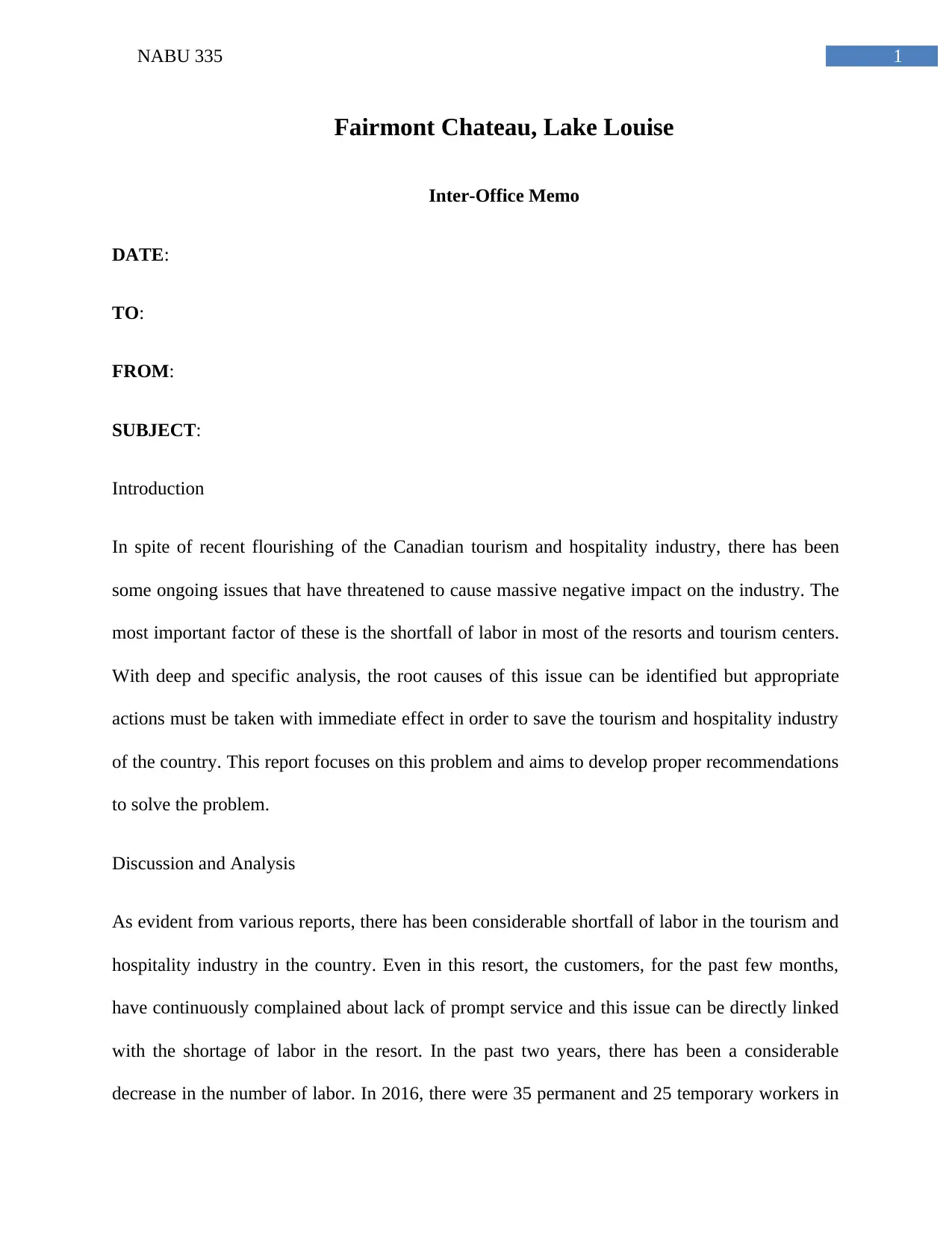
Fairmont Chateau, Lake Louise
Inter-Office Memo
DATE:
TO:
FROM:
SUBJECT:
Introduction
In spite of recent flourishing of the Canadian tourism and hospitality industry, there has been
some ongoing issues that have threatened to cause massive negative impact on the industry. The
most important factor of these is the shortfall of labor in most of the resorts and tourism centers.
With deep and specific analysis, the root causes of this issue can be identified but appropriate
actions must be taken with immediate effect in order to save the tourism and hospitality industry
of the country. This report focuses on this problem and aims to develop proper recommendations
to solve the problem.
Discussion and Analysis
As evident from various reports, there has been considerable shortfall of labor in the tourism and
hospitality industry in the country. Even in this resort, the customers, for the past few months,
have continuously complained about lack of prompt service and this issue can be directly linked
with the shortage of labor in the resort. In the past two years, there has been a considerable
decrease in the number of labor. In 2016, there were 35 permanent and 25 temporary workers in
Document Page
2NABU 335
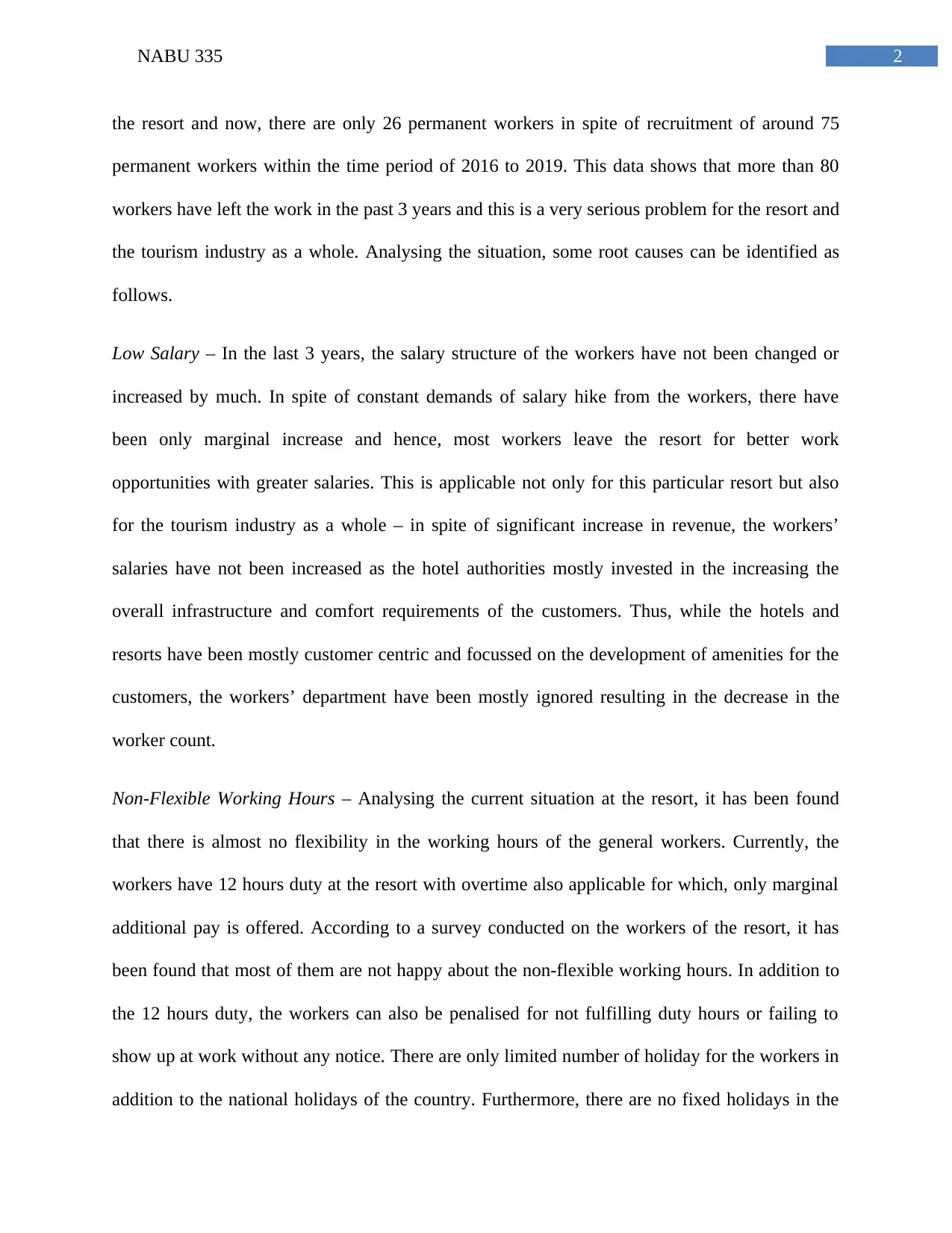
the resort and now, there are only 26 permanent workers in spite of recruitment of around 75
permanent workers within the time period of 2016 to 2019. This data shows that more than 80
workers have left the work in the past 3 years and this is a very serious problem for the resort and
the tourism industry as a whole. Analysing the situation, some root causes can be identified as
follows.
Low Salary – In the last 3 years, the salary structure of the workers have not been changed or
increased by much. In spite of constant demands of salary hike from the workers, there have
been only marginal increase and hence, most workers leave the resort for better work
opportunities with greater salaries. This is applicable not only for this particular resort but also
for the tourism industry as a whole – in spite of significant increase in revenue, the workers’
salaries have not been increased as the hotel authorities mostly invested in the increasing the
overall infrastructure and comfort requirements of the customers. Thus, while the hotels and
resorts have been mostly customer centric and focussed on the development of amenities for the
customers, the workers’ department have been mostly ignored resulting in the decrease in the
worker count.
Non-Flexible Working Hours – Analysing the current situation at the resort, it has been found
that there is almost no flexibility in the working hours of the general workers. Currently, the
workers have 12 hours duty at the resort with overtime also applicable for which, only marginal
additional pay is offered. According to a survey conducted on the workers of the resort, it has
been found that most of them are not happy about the non-flexible working hours. In addition to
the 12 hours duty, the workers can also be penalised for not fulfilling duty hours or failing to
show up at work without any notice. There are only limited number of holiday for the workers in
addition to the national holidays of the country. Furthermore, there are no fixed holidays in the
Document Page
3NABU 335
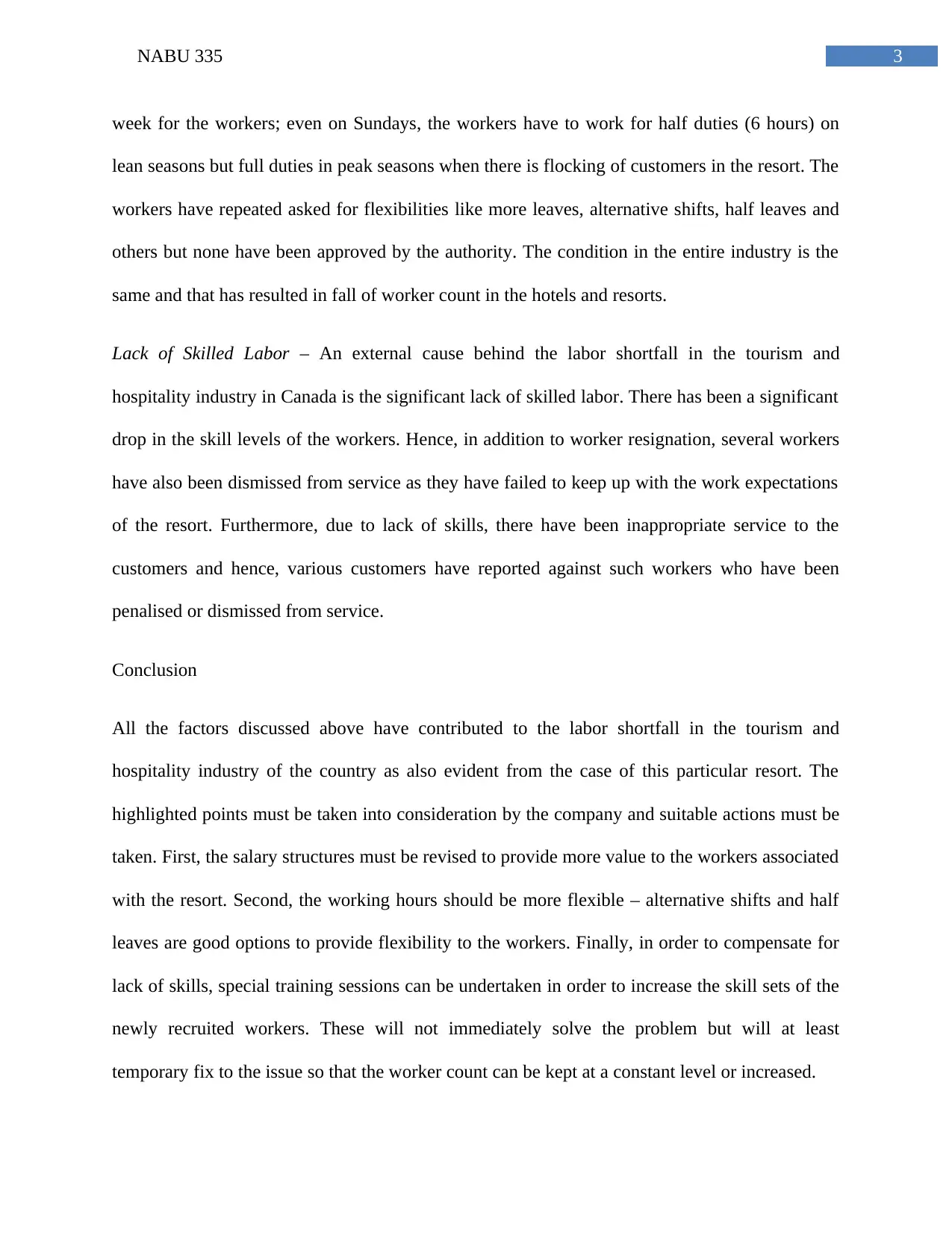
week for the workers; even on Sundays, the workers have to work for half duties (6 hours) on
lean seasons but full duties in peak seasons when there is flocking of customers in the resort. The
workers have repeated asked for flexibilities like more leaves, alternative shifts, half leaves and
others but none have been approved by the authority. The condition in the entire industry is the
same and that has resulted in fall of worker count in the hotels and resorts.
Lack of Skilled Labor – An external cause behind the labor shortfall in the tourism and
hospitality industry in Canada is the significant lack of skilled labor. There has been a significant
drop in the skill levels of the workers. Hence, in addition to worker resignation, several workers
have also been dismissed from service as they have failed to keep up with the work expectations
of the resort. Furthermore, due to lack of skills, there have been inappropriate service to the
customers and hence, various customers have reported against such workers who have been
penalised or dismissed from service.
Conclusion
All the factors discussed above have contributed to the labor shortfall in the tourism and
hospitality industry of the country as also evident from the case of this particular resort. The
highlighted points must be taken into consideration by the company and suitable actions must be
taken. First, the salary structures must be revised to provide more value to the workers associated
with the resort. Second, the working hours should be more flexible – alternative shifts and half
leaves are good options to provide flexibility to the workers. Finally, in order to compensate for
lack of skills, special training sessions can be undertaken in order to increase the skill sets of the
newly recruited workers. These will not immediately solve the problem but will at least
temporary fix to the issue so that the worker count can be kept at a constant level or increased.
tabler-icon-diamond-filled.svg

Paraphrase This Document

Need a fresh take? Get an instant paraphrase of this document with our AI Paraphraser
Document Page
4NABU 335
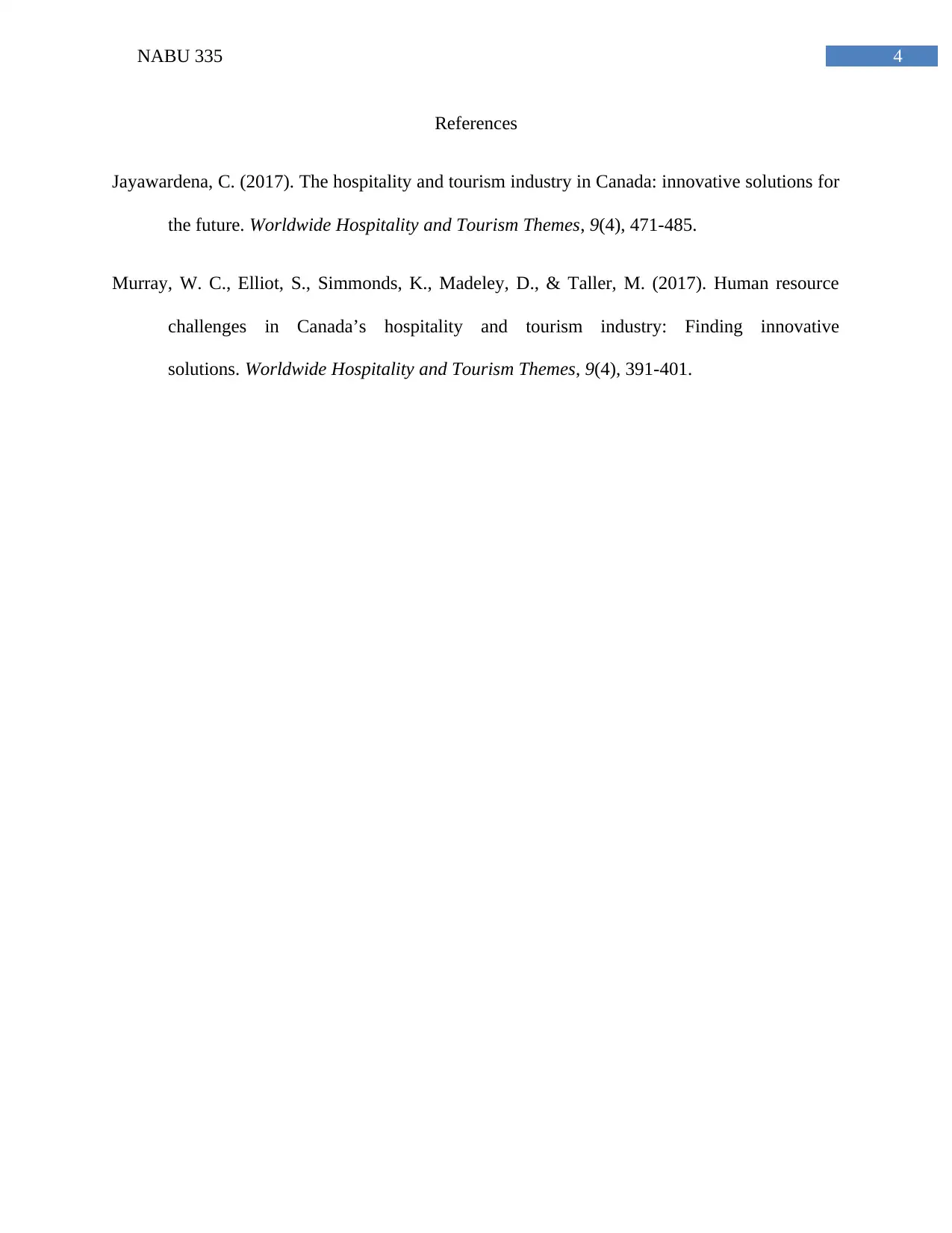
References
Jayawardena, C. (2017). The hospitality and tourism industry in Canada: innovative solutions for
the future. Worldwide Hospitality and Tourism Themes, 9(4), 471-485.
Murray, W. C., Elliot, S., Simmonds, K., Madeley, D., & Taller, M. (2017). Human resource
challenges in Canada’s hospitality and tourism industry: Finding innovative
solutions. Worldwide Hospitality and Tourism Themes, 9(4), 391-401.
chevron_up_icon
1 out of 5
circle_padding
hide_on_mobile
zoom_out_icon
[object Object]