Legislation and Ethics in Travel and Tourism Sector - Report
VerifiedAdded on 2020/02/17
|14
|4002
|71
Report
AI Summary
This report provides a comprehensive overview of the legal and ethical considerations within the travel and tourism sector. It begins by outlining the legal and regulatory frameworks, including acts and regulations related to tourism development, transportation (surface, sea, and air), and package travel. The report then delves into the impact of health, safety, and security legislation, analyzing specific examples like HF Holidays and the legislation related to equality. Further, it explains contract and consumer protection legislation relevant to travel and tourism customers, detailing the roles of contracts and agreements. Finally, the report addresses ethical dilemmas faced by the sector, including a focus on Corporate Social Responsibility (CSR) policies of a specified travel and tourism business, culminating in a conclusion that summarizes the key findings and references relevant sources.
LEGISLATION AND
ETHICS IN TRAVEL AND
TOURISM SECTOR
ETHICS IN TRAVEL AND
TOURISM SECTOR

Paraphrase This Document
Need a fresh take? Get an instant paraphrase of this document with our AI Paraphraser
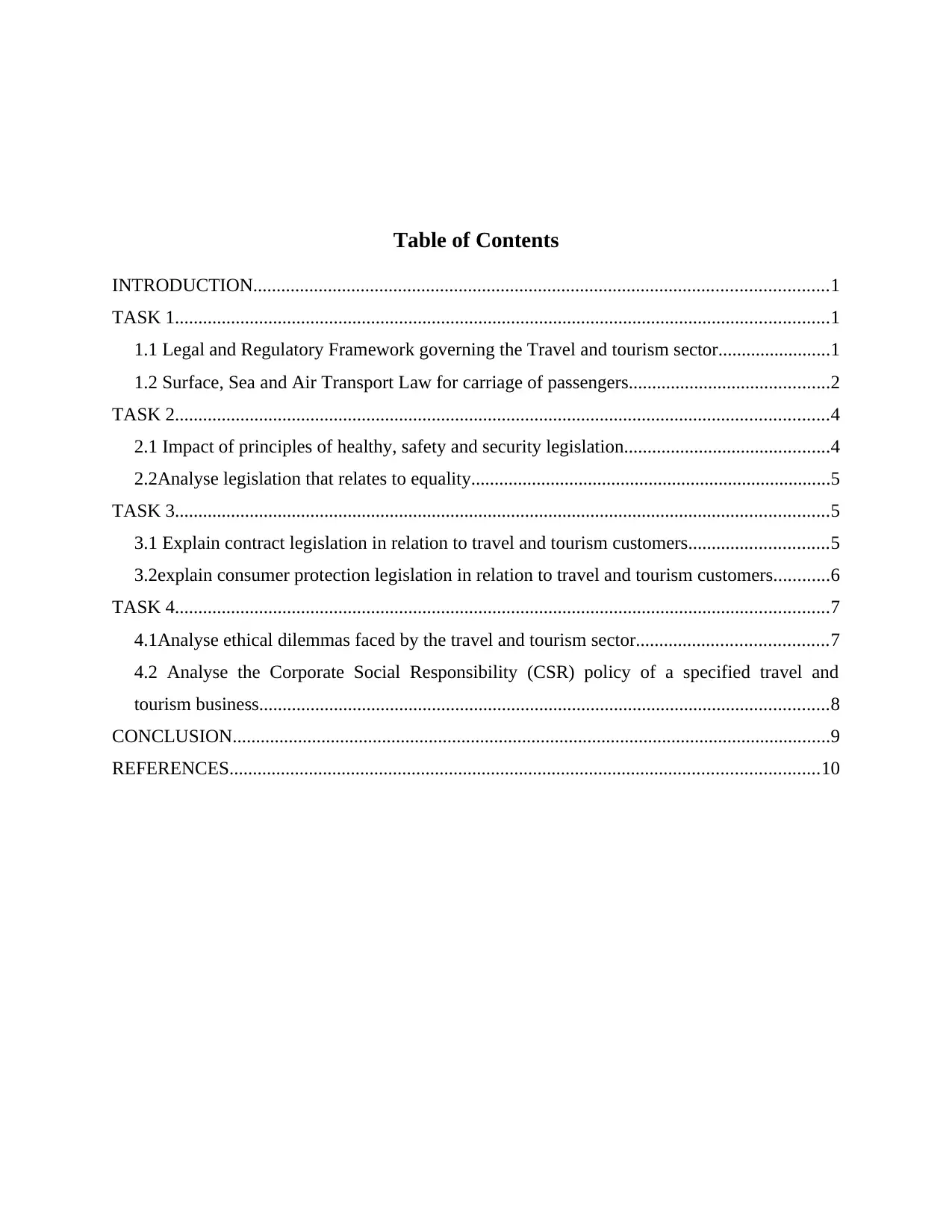
Table of Contents
INTRODUCTION...........................................................................................................................1
TASK 1............................................................................................................................................1
1.1 Legal and Regulatory Framework governing the Travel and tourism sector........................1
1.2 Surface, Sea and Air Transport Law for carriage of passengers...........................................2
TASK 2............................................................................................................................................4
2.1 Impact of principles of healthy, safety and security legislation............................................4
2.2Analyse legislation that relates to equality.............................................................................5
TASK 3............................................................................................................................................5
3.1 Explain contract legislation in relation to travel and tourism customers..............................5
3.2explain consumer protection legislation in relation to travel and tourism customers............6
TASK 4............................................................................................................................................7
4.1Analyse ethical dilemmas faced by the travel and tourism sector.........................................7
4.2 Analyse the Corporate Social Responsibility (CSR) policy of a specified travel and
tourism business..........................................................................................................................8
CONCLUSION................................................................................................................................9
REFERENCES..............................................................................................................................10
INTRODUCTION...........................................................................................................................1
TASK 1............................................................................................................................................1
1.1 Legal and Regulatory Framework governing the Travel and tourism sector........................1
1.2 Surface, Sea and Air Transport Law for carriage of passengers...........................................2
TASK 2............................................................................................................................................4
2.1 Impact of principles of healthy, safety and security legislation............................................4
2.2Analyse legislation that relates to equality.............................................................................5
TASK 3............................................................................................................................................5
3.1 Explain contract legislation in relation to travel and tourism customers..............................5
3.2explain consumer protection legislation in relation to travel and tourism customers............6
TASK 4............................................................................................................................................7
4.1Analyse ethical dilemmas faced by the travel and tourism sector.........................................7
4.2 Analyse the Corporate Social Responsibility (CSR) policy of a specified travel and
tourism business..........................................................................................................................8
CONCLUSION................................................................................................................................9
REFERENCES..............................................................................................................................10

⊘ This is a preview!⊘
Do you want full access?
Subscribe today to unlock all pages.

Trusted by 1+ million students worldwide
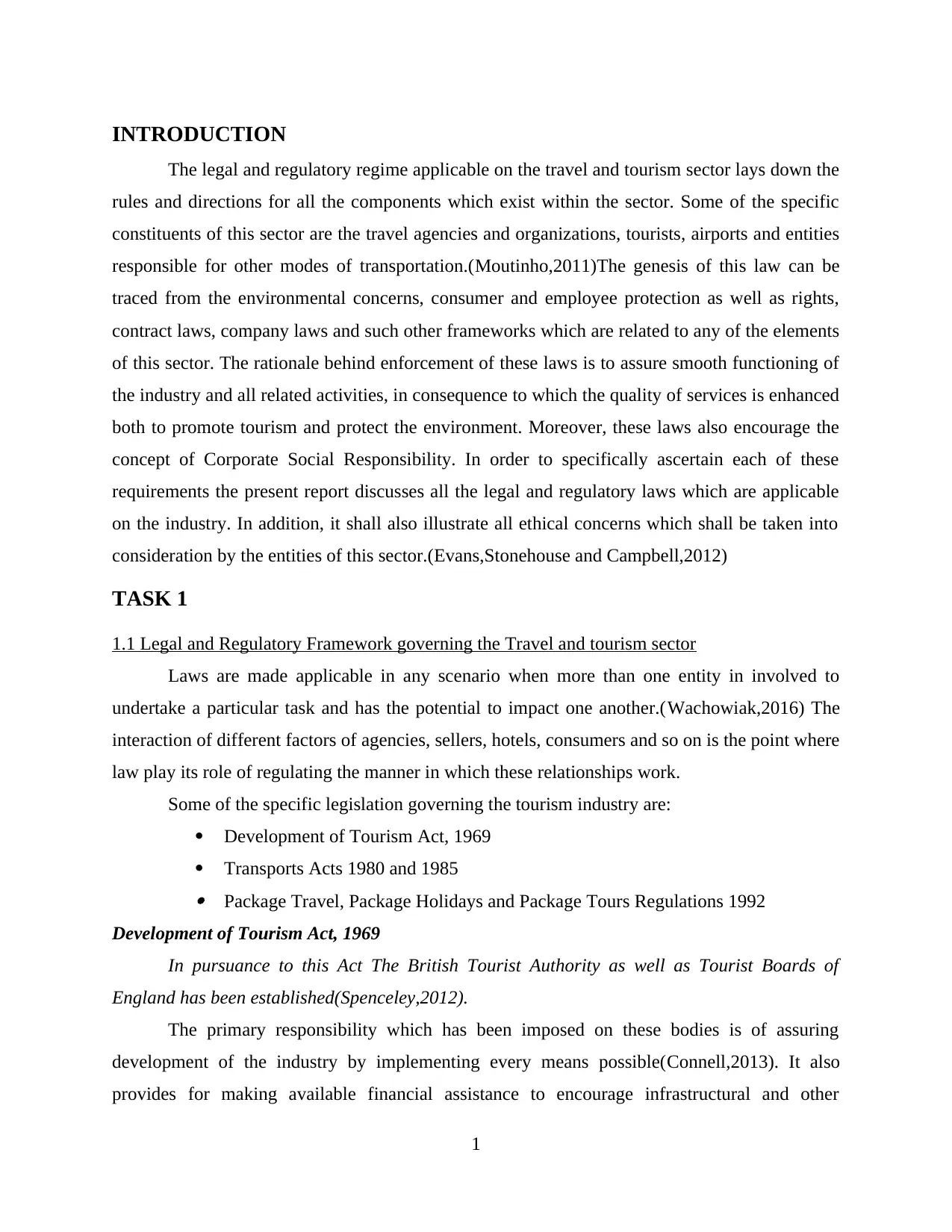
INTRODUCTION
The legal and regulatory regime applicable on the travel and tourism sector lays down the
rules and directions for all the components which exist within the sector. Some of the specific
constituents of this sector are the travel agencies and organizations, tourists, airports and entities
responsible for other modes of transportation.(Moutinho,2011)The genesis of this law can be
traced from the environmental concerns, consumer and employee protection as well as rights,
contract laws, company laws and such other frameworks which are related to any of the elements
of this sector. The rationale behind enforcement of these laws is to assure smooth functioning of
the industry and all related activities, in consequence to which the quality of services is enhanced
both to promote tourism and protect the environment. Moreover, these laws also encourage the
concept of Corporate Social Responsibility. In order to specifically ascertain each of these
requirements the present report discusses all the legal and regulatory laws which are applicable
on the industry. In addition, it shall also illustrate all ethical concerns which shall be taken into
consideration by the entities of this sector.(Evans,Stonehouse and Campbell,2012)
TASK 1
1.1 Legal and Regulatory Framework governing the Travel and tourism sector
Laws are made applicable in any scenario when more than one entity in involved to
undertake a particular task and has the potential to impact one another.(Wachowiak,2016) The
interaction of different factors of agencies, sellers, hotels, consumers and so on is the point where
law play its role of regulating the manner in which these relationships work.
Some of the specific legislation governing the tourism industry are:
Development of Tourism Act, 1969
Transports Acts 1980 and 1985
Package Travel, Package Holidays and Package Tours Regulations 1992
Development of Tourism Act, 1969
In pursuance to this Act The British Tourist Authority as well as Tourist Boards of
England has been established(Spenceley,2012).
The primary responsibility which has been imposed on these bodies is of assuring
development of the industry by implementing every means possible(Connell,2013). It also
provides for making available financial assistance to encourage infrastructural and other
1
The legal and regulatory regime applicable on the travel and tourism sector lays down the
rules and directions for all the components which exist within the sector. Some of the specific
constituents of this sector are the travel agencies and organizations, tourists, airports and entities
responsible for other modes of transportation.(Moutinho,2011)The genesis of this law can be
traced from the environmental concerns, consumer and employee protection as well as rights,
contract laws, company laws and such other frameworks which are related to any of the elements
of this sector. The rationale behind enforcement of these laws is to assure smooth functioning of
the industry and all related activities, in consequence to which the quality of services is enhanced
both to promote tourism and protect the environment. Moreover, these laws also encourage the
concept of Corporate Social Responsibility. In order to specifically ascertain each of these
requirements the present report discusses all the legal and regulatory laws which are applicable
on the industry. In addition, it shall also illustrate all ethical concerns which shall be taken into
consideration by the entities of this sector.(Evans,Stonehouse and Campbell,2012)
TASK 1
1.1 Legal and Regulatory Framework governing the Travel and tourism sector
Laws are made applicable in any scenario when more than one entity in involved to
undertake a particular task and has the potential to impact one another.(Wachowiak,2016) The
interaction of different factors of agencies, sellers, hotels, consumers and so on is the point where
law play its role of regulating the manner in which these relationships work.
Some of the specific legislation governing the tourism industry are:
Development of Tourism Act, 1969
Transports Acts 1980 and 1985
Package Travel, Package Holidays and Package Tours Regulations 1992
Development of Tourism Act, 1969
In pursuance to this Act The British Tourist Authority as well as Tourist Boards of
England has been established(Spenceley,2012).
The primary responsibility which has been imposed on these bodies is of assuring
development of the industry by implementing every means possible(Connell,2013). It also
provides for making available financial assistance to encourage infrastructural and other
1
Paraphrase This Document
Need a fresh take? Get an instant paraphrase of this document with our AI Paraphraser
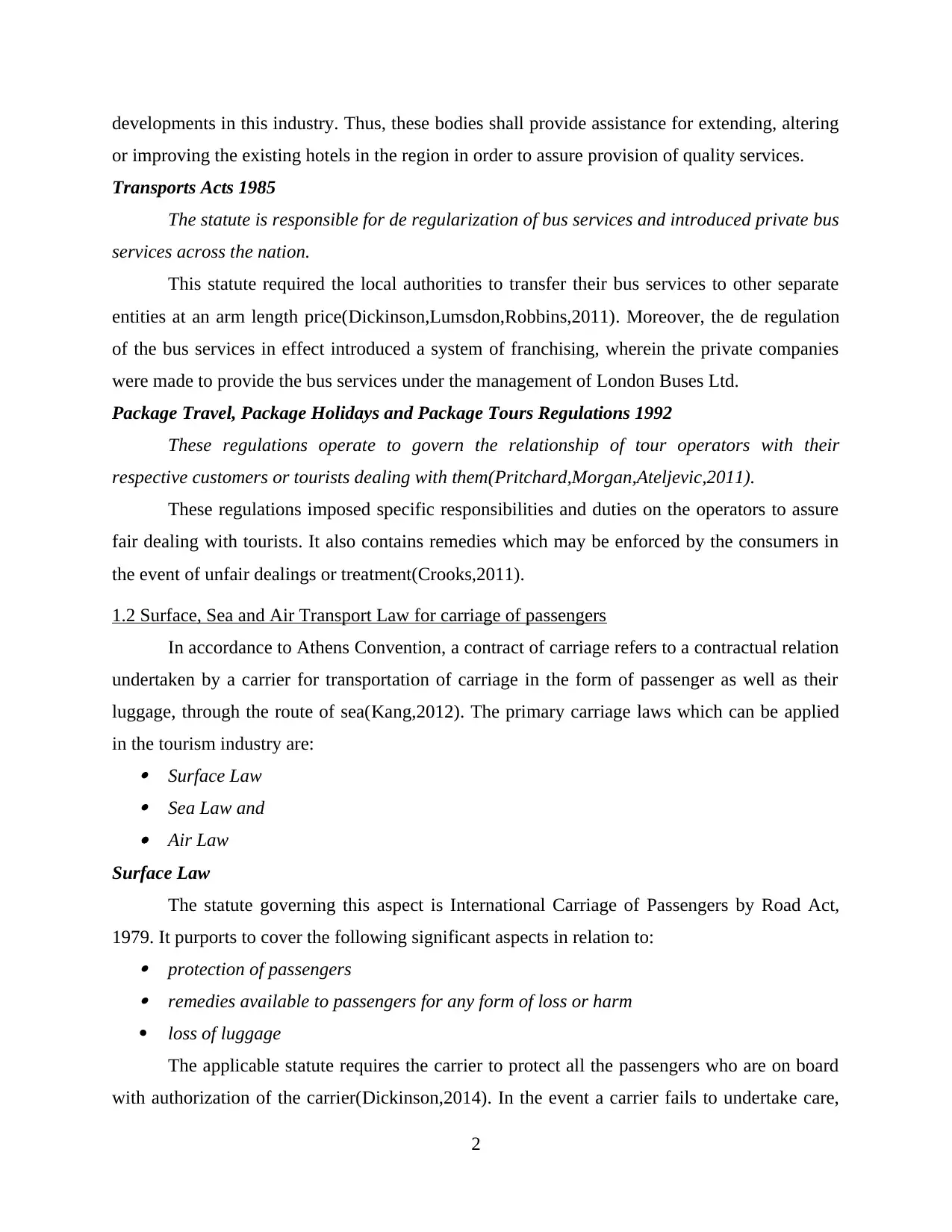
developments in this industry. Thus, these bodies shall provide assistance for extending, altering
or improving the existing hotels in the region in order to assure provision of quality services.
Transports Acts 1985
The statute is responsible for de regularization of bus services and introduced private bus
services across the nation.
This statute required the local authorities to transfer their bus services to other separate
entities at an arm length price(Dickinson,Lumsdon,Robbins,2011). Moreover, the de regulation
of the bus services in effect introduced a system of franchising, wherein the private companies
were made to provide the bus services under the management of London Buses Ltd.
Package Travel, Package Holidays and Package Tours Regulations 1992
These regulations operate to govern the relationship of tour operators with their
respective customers or tourists dealing with them(Pritchard,Morgan,Ateljevic,2011).
These regulations imposed specific responsibilities and duties on the operators to assure
fair dealing with tourists. It also contains remedies which may be enforced by the consumers in
the event of unfair dealings or treatment(Crooks,2011).
1.2 Surface, Sea and Air Transport Law for carriage of passengers
In accordance to Athens Convention, a contract of carriage refers to a contractual relation
undertaken by a carrier for transportation of carriage in the form of passenger as well as their
luggage, through the route of sea(Kang,2012). The primary carriage laws which can be applied
in the tourism industry are: Surface Law Sea Law and Air Law
Surface Law
The statute governing this aspect is International Carriage of Passengers by Road Act,
1979. It purports to cover the following significant aspects in relation to: protection of passengers remedies available to passengers for any form of loss or harm
loss of luggage
The applicable statute requires the carrier to protect all the passengers who are on board
with authorization of the carrier(Dickinson,2014). In the event a carrier fails to undertake care,
2
or improving the existing hotels in the region in order to assure provision of quality services.
Transports Acts 1985
The statute is responsible for de regularization of bus services and introduced private bus
services across the nation.
This statute required the local authorities to transfer their bus services to other separate
entities at an arm length price(Dickinson,Lumsdon,Robbins,2011). Moreover, the de regulation
of the bus services in effect introduced a system of franchising, wherein the private companies
were made to provide the bus services under the management of London Buses Ltd.
Package Travel, Package Holidays and Package Tours Regulations 1992
These regulations operate to govern the relationship of tour operators with their
respective customers or tourists dealing with them(Pritchard,Morgan,Ateljevic,2011).
These regulations imposed specific responsibilities and duties on the operators to assure
fair dealing with tourists. It also contains remedies which may be enforced by the consumers in
the event of unfair dealings or treatment(Crooks,2011).
1.2 Surface, Sea and Air Transport Law for carriage of passengers
In accordance to Athens Convention, a contract of carriage refers to a contractual relation
undertaken by a carrier for transportation of carriage in the form of passenger as well as their
luggage, through the route of sea(Kang,2012). The primary carriage laws which can be applied
in the tourism industry are: Surface Law Sea Law and Air Law
Surface Law
The statute governing this aspect is International Carriage of Passengers by Road Act,
1979. It purports to cover the following significant aspects in relation to: protection of passengers remedies available to passengers for any form of loss or harm
loss of luggage
The applicable statute requires the carrier to protect all the passengers who are on board
with authorization of the carrier(Dickinson,2014). In the event a carrier fails to undertake care,
2
the Act also provides for specific remedies which may be available to the passengers for
suffering any form of loss or harm, whether physical or mental in nature. Moreover, Carriage by
Railway Act 1972 also provides for provision of damages in the case of loss of luggage.
Sea Law
The sea law is governed by the following regulation or bodies: International Maritime Organization (IMO) International Convention for Safety of Life at Sea (SOLAS) Athens Convention, 1974
Protocol of 2002
The safety and security of shipping is ensured by IMO, which has been formulated by the
United Nations(Hartmann,2014). It also envisages protection of surrounding environment while
the ships function to carry the passengers. Further, SOLAS requires the various protection
measures which shall be used in a ship, carrying 12 passengers or more. The Athens Convention
in furtherance to this provide specific damages which the passengers are entitled to claim for
sustaining any form of damages for fault of the carrier(Ooi,Laing,2010). Lastly, the 2002
Protocol necessarily requires attainment of travel insurance for at least a certain time duration.
Air Law
This aspect of law is formulated on the basis of various legislations which govern the
transportation of passengers through the route of air: Warsaw Convention 1929 Montreal Conference 1999 Five Freedoms Agreement 1944
Denied Boarding Compensation Scheme (EU) 1997
The Warsaw Convention requires the to adhere by rules in respect to documents of
carriage. Moreover, it also necessitates checking of luggage before the commencement of
journey. The passengers have also been entitled to claim compensation in relation to occurrence
of death and personal injury. All these rules under the convention were then incorporated in the
Montreal Conference to replace the earlier convention. The Five Freedom Agreement regulates
the flying of vessel beyond the national borders(Ashworth,Page,2011). Lastly, the compensation
Scheme requires harmonized operation of the vessel and provide standard protections to all the
air passengers.
3
suffering any form of loss or harm, whether physical or mental in nature. Moreover, Carriage by
Railway Act 1972 also provides for provision of damages in the case of loss of luggage.
Sea Law
The sea law is governed by the following regulation or bodies: International Maritime Organization (IMO) International Convention for Safety of Life at Sea (SOLAS) Athens Convention, 1974
Protocol of 2002
The safety and security of shipping is ensured by IMO, which has been formulated by the
United Nations(Hartmann,2014). It also envisages protection of surrounding environment while
the ships function to carry the passengers. Further, SOLAS requires the various protection
measures which shall be used in a ship, carrying 12 passengers or more. The Athens Convention
in furtherance to this provide specific damages which the passengers are entitled to claim for
sustaining any form of damages for fault of the carrier(Ooi,Laing,2010). Lastly, the 2002
Protocol necessarily requires attainment of travel insurance for at least a certain time duration.
Air Law
This aspect of law is formulated on the basis of various legislations which govern the
transportation of passengers through the route of air: Warsaw Convention 1929 Montreal Conference 1999 Five Freedoms Agreement 1944
Denied Boarding Compensation Scheme (EU) 1997
The Warsaw Convention requires the to adhere by rules in respect to documents of
carriage. Moreover, it also necessitates checking of luggage before the commencement of
journey. The passengers have also been entitled to claim compensation in relation to occurrence
of death and personal injury. All these rules under the convention were then incorporated in the
Montreal Conference to replace the earlier convention. The Five Freedom Agreement regulates
the flying of vessel beyond the national borders(Ashworth,Page,2011). Lastly, the compensation
Scheme requires harmonized operation of the vessel and provide standard protections to all the
air passengers.
3
⊘ This is a preview!⊘
Do you want full access?
Subscribe today to unlock all pages.
Trusted by 1+ million students worldwide
TASK 2
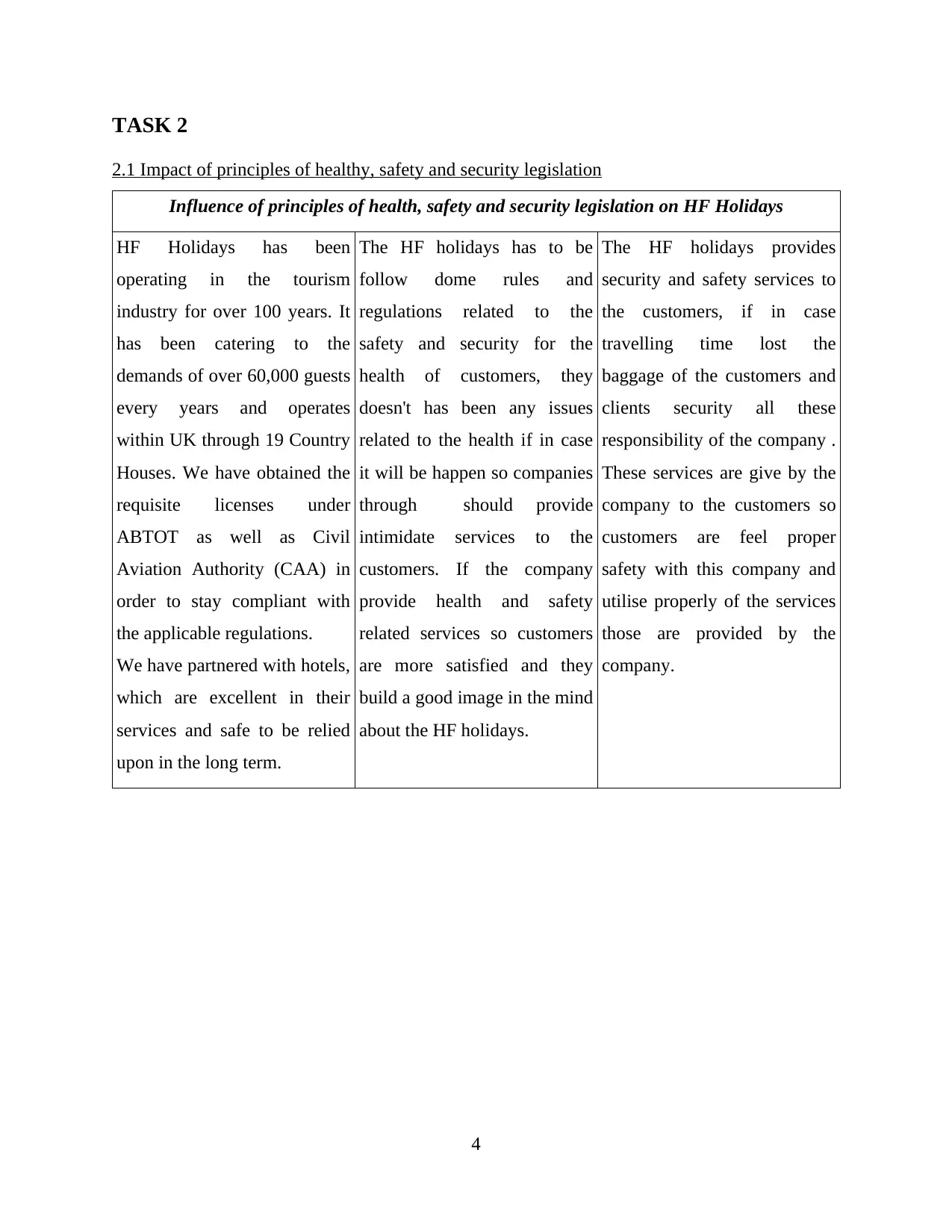
2.1 Impact of principles of healthy, safety and security legislation
Influence of principles of health, safety and security legislation on HF Holidays
HF Holidays has been
operating in the tourism
industry for over 100 years. It
has been catering to the
demands of over 60,000 guests
every years and operates
within UK through 19 Country
Houses. We have obtained the
requisite licenses under
ABTOT as well as Civil
Aviation Authority (CAA) in
order to stay compliant with
the applicable regulations.
We have partnered with hotels,
which are excellent in their
services and safe to be relied
upon in the long term.
The HF holidays has to be
follow dome rules and
regulations related to the
safety and security for the
health of customers, they
doesn't has been any issues
related to the health if in case
it will be happen so companies
through should provide
intimidate services to the
customers. If the company
provide health and safety
related services so customers
are more satisfied and they
build a good image in the mind
about the HF holidays.
The HF holidays provides
security and safety services to
the customers, if in case
travelling time lost the
baggage of the customers and
clients security all these
responsibility of the company .
These services are give by the
company to the customers so
customers are feel proper
safety with this company and
utilise properly of the services
those are provided by the
company.
4
2.1 Impact of principles of healthy, safety and security legislation
Influence of principles of health, safety and security legislation on HF Holidays
HF Holidays has been
operating in the tourism
industry for over 100 years. It
has been catering to the
demands of over 60,000 guests
every years and operates
within UK through 19 Country
Houses. We have obtained the
requisite licenses under
ABTOT as well as Civil
Aviation Authority (CAA) in
order to stay compliant with
the applicable regulations.
We have partnered with hotels,
which are excellent in their
services and safe to be relied
upon in the long term.
The HF holidays has to be
follow dome rules and
regulations related to the
safety and security for the
health of customers, they
doesn't has been any issues
related to the health if in case
it will be happen so companies
through should provide
intimidate services to the
customers. If the company
provide health and safety
related services so customers
are more satisfied and they
build a good image in the mind
about the HF holidays.
The HF holidays provides
security and safety services to
the customers, if in case
travelling time lost the
baggage of the customers and
clients security all these
responsibility of the company .
These services are give by the
company to the customers so
customers are feel proper
safety with this company and
utilise properly of the services
those are provided by the
company.
4
Paraphrase This Document
Need a fresh take? Get an instant paraphrase of this document with our AI Paraphraser
2.2Analyse legislation that relates to equality.
Legislation means is law and rule is legislature by the government that has to be follow by the all
department and sectors, if in case these law , rules and regulation are not follow after that
government through give punishments and charges by the sectors, departments, persons and the
company(Pomering, Noble and Johnson, 2011). Legislation become law it can be known as bill
of the services and has some written paper and data. Legislation is made by the countries
government because they have right to take charges related to the services by the public if they
are not follow the rules and regulation which are important to follow and rules are help to
manage all departments and maintain the climate of company.
HF Holidays is the tour and travelling company, that company has to follow tour and travelling
rules an d regulations which are set and regulated by the government, rules and legislation are
many more those are providing safety and security to the public and they have right to face any
type of situation and take benefits related to these sector(Smith, Costello and Muenchen, 2010).
In tour and travelling sector has many rule are like, licence of the company, licence of all the cars
and taxies, seller of travel laws, another state specific legislation, airline passengers bills of
rights, lost and damaged baggage, full fair advertising etc. legal and regulatory data for the
development and management tourism, protection by the natural and cultural resources.
Legislation is the important part to mange this sectors because in this sectors has many activities
those are sometimes create some issues and problems for the clients so for the security
government had decided some rules and law, before starting the company has to give all
information related to person and objective of the person and the company also that is important
to do record the data in case become any problems so easy to collect data and information
related to person and that particular company.
TASK 3
3.1 Explain contract legislation in relation to travel and tourism customers.
Contract and agreement is playing and important role in the business activities. The
contract is kind of the bond and agreement between two or more parties there has some rule
those are follow by the all parties their has some responsibilities and obligations for the parties.
A contact is the legal binding agreement, it can be also classified as promise or promises which
5
Legislation means is law and rule is legislature by the government that has to be follow by the all
department and sectors, if in case these law , rules and regulation are not follow after that
government through give punishments and charges by the sectors, departments, persons and the
company(Pomering, Noble and Johnson, 2011). Legislation become law it can be known as bill
of the services and has some written paper and data. Legislation is made by the countries
government because they have right to take charges related to the services by the public if they
are not follow the rules and regulation which are important to follow and rules are help to
manage all departments and maintain the climate of company.
HF Holidays is the tour and travelling company, that company has to follow tour and travelling
rules an d regulations which are set and regulated by the government, rules and legislation are
many more those are providing safety and security to the public and they have right to face any
type of situation and take benefits related to these sector(Smith, Costello and Muenchen, 2010).
In tour and travelling sector has many rule are like, licence of the company, licence of all the cars
and taxies, seller of travel laws, another state specific legislation, airline passengers bills of
rights, lost and damaged baggage, full fair advertising etc. legal and regulatory data for the
development and management tourism, protection by the natural and cultural resources.
Legislation is the important part to mange this sectors because in this sectors has many activities
those are sometimes create some issues and problems for the clients so for the security
government had decided some rules and law, before starting the company has to give all
information related to person and objective of the person and the company also that is important
to do record the data in case become any problems so easy to collect data and information
related to person and that particular company.
TASK 3
3.1 Explain contract legislation in relation to travel and tourism customers.
Contract and agreement is playing and important role in the business activities. The
contract is kind of the bond and agreement between two or more parties there has some rule
those are follow by the all parties their has some responsibilities and obligations for the parties.
A contact is the legal binding agreement, it can be also classified as promise or promises which
5
law became as a force to follow by the public. A contract is only made by the two parties agreed
to the all terms and conditions those are follow by the both parties. If in case they are not follow
so they have to get some charges and punishments by the government and also by the other
parties members.
The contact in tour and tourism sector on package holidays if made by the customers their
demand and the tour operator always try to full fill their demand of the customers. Once the
demand of the customers have been meet and both parties agreed with the conditions of holidays
package. Tour and tourism law generally a farm work that are made by governs to travelling
agency, travailing organization, airport(Hall, Page, 2010). In this farm work involved from
environmental protection , health and security, employees rights and rules, customer protection.
Tourism industry involve seller, customers, partners, business organization, customer contacts
and hospitality services for the customers. The legal farm work is the systematic rules and laws
governing by the decision making whereas the regulated by the company members and
customers. The tourism legislation include following:
▪ Development of tourism Act
▪ Transports Act
▪ Packages travel, packages holidays and packages tour regulations and rules.
These three rules and Acts has to be mainly follow by the customers and members of the
company, these three rules are the important for the tourism industry which can be provide
security in uncertain future.
3.2explain consumer protection legislation in relation to travel and tourism customers.
Customer protection is provide security and safety to the customers is a group of law
and organization design by the company and the government to ensure the rights of the
customers as well as fair trade, competitions,and also accrue information to market place and
market related news. The HF holidays provide security in the tour and travelling industry in this
companies through provide health security, theft security, accidental security so these type of
legislation has provide full safety services to the customers. The amount of tourism and holidays
taken increasing time , it has been require to produce regulations and rules which aim to protect
customers if the HF holidays provide their travel goes out of the limit and sometimes goes in the
wrong side. Schemes of bonding , licensing and package regulations are the first hand protection
6
to the all terms and conditions those are follow by the both parties. If in case they are not follow
so they have to get some charges and punishments by the government and also by the other
parties members.
The contact in tour and tourism sector on package holidays if made by the customers their
demand and the tour operator always try to full fill their demand of the customers. Once the
demand of the customers have been meet and both parties agreed with the conditions of holidays
package. Tour and tourism law generally a farm work that are made by governs to travelling
agency, travailing organization, airport(Hall, Page, 2010). In this farm work involved from
environmental protection , health and security, employees rights and rules, customer protection.
Tourism industry involve seller, customers, partners, business organization, customer contacts
and hospitality services for the customers. The legal farm work is the systematic rules and laws
governing by the decision making whereas the regulated by the company members and
customers. The tourism legislation include following:
▪ Development of tourism Act
▪ Transports Act
▪ Packages travel, packages holidays and packages tour regulations and rules.
These three rules and Acts has to be mainly follow by the customers and members of the
company, these three rules are the important for the tourism industry which can be provide
security in uncertain future.
3.2explain consumer protection legislation in relation to travel and tourism customers.
Customer protection is provide security and safety to the customers is a group of law
and organization design by the company and the government to ensure the rights of the
customers as well as fair trade, competitions,and also accrue information to market place and
market related news. The HF holidays provide security in the tour and travelling industry in this
companies through provide health security, theft security, accidental security so these type of
legislation has provide full safety services to the customers. The amount of tourism and holidays
taken increasing time , it has been require to produce regulations and rules which aim to protect
customers if the HF holidays provide their travel goes out of the limit and sometimes goes in the
wrong side. Schemes of bonding , licensing and package regulations are the first hand protection
6
⊘ This is a preview!⊘
Do you want full access?
Subscribe today to unlock all pages.
Trusted by 1+ million students worldwide
to the customers which has been customers paid money for travailing for the holidays. These
schemes still confuse in the customers mind these schemes are not properly clear in customers
mind so that's why customers are not take proper benefits by this company in this sector. HF
holidays can do three things when selling travelling products and services to the customers those
are follow:
Travel can stop to sell packages behalf on the tour operators.
Travel can stop to sell individual items to the customers like flights on the behalf of an
airlines.
Travel can stop create and sell packages related to flights and other items to the
customers.
Packages are the pre planed arrangement and services to the customers these are provides by the
HF holidays in this package include pricing covering of the services and also including overnight
stay of the customers. The information below the legal relationship between customers and the
company, travelling agents, tour operators etc. its important to provide packages in between tour
operators and the customers. This company provide outlet for the operators agents. The agent
will not enter in the contact with the customers, but will be arrange for the customers enter in the
contact of this tour and travelling with the tour operator.
TASK 4
4.1Analyse ethical dilemmas faced by the travel and tourism sector.
Ethics in the travel has received higher attention from the travellers and the travelling company.
Ethical of travelling involved in broad range of issues and challenges,those are affecting on
company image and customers mind also. There are dilemmas are little bit difficult to summarize
and recorded in the mind, primarily focused on the experiences about the particular company
those are got by the customers what they are feel about that related company and services.
There has some travel ethical dilemma those are follow:
Child beggars: At the travelling time there has been some dilemma suddenly create front of
customers in this situation they are confuse to decide what we should do. So one is child beggars
dilemma in this situation child beggars stay front of customer they are confuse to understand
should we give money to him or not.
7
schemes still confuse in the customers mind these schemes are not properly clear in customers
mind so that's why customers are not take proper benefits by this company in this sector. HF
holidays can do three things when selling travelling products and services to the customers those
are follow:
Travel can stop to sell packages behalf on the tour operators.
Travel can stop to sell individual items to the customers like flights on the behalf of an
airlines.
Travel can stop create and sell packages related to flights and other items to the
customers.
Packages are the pre planed arrangement and services to the customers these are provides by the
HF holidays in this package include pricing covering of the services and also including overnight
stay of the customers. The information below the legal relationship between customers and the
company, travelling agents, tour operators etc. its important to provide packages in between tour
operators and the customers. This company provide outlet for the operators agents. The agent
will not enter in the contact with the customers, but will be arrange for the customers enter in the
contact of this tour and travelling with the tour operator.
TASK 4
4.1Analyse ethical dilemmas faced by the travel and tourism sector.
Ethics in the travel has received higher attention from the travellers and the travelling company.
Ethical of travelling involved in broad range of issues and challenges,those are affecting on
company image and customers mind also. There are dilemmas are little bit difficult to summarize
and recorded in the mind, primarily focused on the experiences about the particular company
those are got by the customers what they are feel about that related company and services.
There has some travel ethical dilemma those are follow:
Child beggars: At the travelling time there has been some dilemma suddenly create front of
customers in this situation they are confuse to decide what we should do. So one is child beggars
dilemma in this situation child beggars stay front of customer they are confuse to understand
should we give money to him or not.
7
Paraphrase This Document
Need a fresh take? Get an instant paraphrase of this document with our AI Paraphraser
Paying for photos: Travailing time normally click some pictures at different places in different
dress also so in this case would pay money for those photos which clicked on the particular place
of the country for remembering the memories in the mind.
Foreign owned places: In some countries and cities those are passing by you there has been
some good places to travelling, goods places for food court and also meeting places with other
travellers so this is also a travelling dilemma under the travelling services provided by the HR
holidays.
Animal treatment: Animal treatment mean provide some special services by the company in the
zoo area of that particular country. Just like camel ride, elephant ride and tiger petting as so on
more so these type of animal treatments are also a dilemma for the customers and the clients.
These can be enjoy much more from these services.
Ethics are some incredible to understand by the customers and also for the tourist because all
countries and areas has many types of ethics and rules or norms those has to follow by the tour
departments and also should know and follow. Ethics are representing the countries cultures
which one trends are the follow by the travellers and the tour operators.
4.2 Analyse the Corporate Social Responsibility (CSR) policy of a specified travel and tourism
business.
Corporate social responsibility means to take some responsibility for the society and for the
environment. Company should not be affecting on the society norms and ethics, always think
about the society and try to increase standard of living of the society . Corporate social
responsibility relates to the tour and travelling industry, by HF holidays has to know rules and
regulations those are understand and follow just because company not affecting on the society,
give fully protection the environment and public so for this protection not give any harmful
issues to the society.
There are three main responsibility under the travel and tourism business those are follow:
Social dimension: Social dimension include society rules and regulations those are affecting on
the society ethics and systems. In society lives many different types of persons those are
sometimes not accepting things and some persons are easy to accepting by the tour and travelling
company has to clarify all things related to the services then they can use the use the services and
8
dress also so in this case would pay money for those photos which clicked on the particular place
of the country for remembering the memories in the mind.
Foreign owned places: In some countries and cities those are passing by you there has been
some good places to travelling, goods places for food court and also meeting places with other
travellers so this is also a travelling dilemma under the travelling services provided by the HR
holidays.
Animal treatment: Animal treatment mean provide some special services by the company in the
zoo area of that particular country. Just like camel ride, elephant ride and tiger petting as so on
more so these type of animal treatments are also a dilemma for the customers and the clients.
These can be enjoy much more from these services.
Ethics are some incredible to understand by the customers and also for the tourist because all
countries and areas has many types of ethics and rules or norms those has to follow by the tour
departments and also should know and follow. Ethics are representing the countries cultures
which one trends are the follow by the travellers and the tour operators.
4.2 Analyse the Corporate Social Responsibility (CSR) policy of a specified travel and tourism
business.
Corporate social responsibility means to take some responsibility for the society and for the
environment. Company should not be affecting on the society norms and ethics, always think
about the society and try to increase standard of living of the society . Corporate social
responsibility relates to the tour and travelling industry, by HF holidays has to know rules and
regulations those are understand and follow just because company not affecting on the society,
give fully protection the environment and public so for this protection not give any harmful
issues to the society.
There are three main responsibility under the travel and tourism business those are follow:
Social dimension: Social dimension include society rules and regulations those are affecting on
the society ethics and systems. In society lives many different types of persons those are
sometimes not accepting things and some persons are easy to accepting by the tour and travelling
company has to clarify all things related to the services then they can use the use the services and
8
utilise proper benefits but company has to focus on the ethics and culture of the society those are
should not be break and harm by the company.
Environmental dimension: Environmental dimension relates to the environmental issues and
problems so travelling company has to focus on the environment , that campaniles services are
should not be affecting on the environment because in the environment has many persons living,
animal, natural activities, cultural activities etc. so it can also affecting on the environment.
CONCLUSION
In this research project of concision is proving tourism and travelling services to
customers and clients with the full security and safety. By the company has to provide full
clarification to the customers whose are utilise the services and want to use services, if customer
mind has not been any clarification related to services so they are not satisfied and in the future
they are not receive HF holidays related services , so it is require to give proper clarification and
to know every rules and regulation related to tour and tourism related rules and regulations those
are made by the government of the particular country. Rules and regulations of this industry has
to follow by the HF holidays as like licensing , bills etc. these are require and also written or
recorded data. In this research project has three dimensions are should be affecting by the
company those are like social, environmental and economic dimension . Company through has to
follow ethics and norms of the society.
9
should not be break and harm by the company.
Environmental dimension: Environmental dimension relates to the environmental issues and
problems so travelling company has to focus on the environment , that campaniles services are
should not be affecting on the environment because in the environment has many persons living,
animal, natural activities, cultural activities etc. so it can also affecting on the environment.
CONCLUSION
In this research project of concision is proving tourism and travelling services to
customers and clients with the full security and safety. By the company has to provide full
clarification to the customers whose are utilise the services and want to use services, if customer
mind has not been any clarification related to services so they are not satisfied and in the future
they are not receive HF holidays related services , so it is require to give proper clarification and
to know every rules and regulation related to tour and tourism related rules and regulations those
are made by the government of the particular country. Rules and regulations of this industry has
to follow by the HF holidays as like licensing , bills etc. these are require and also written or
recorded data. In this research project has three dimensions are should be affecting by the
company those are like social, environmental and economic dimension . Company through has to
follow ethics and norms of the society.
9
⊘ This is a preview!⊘
Do you want full access?
Subscribe today to unlock all pages.
Trusted by 1+ million students worldwide

1 out of 14


Related Documents


Your All-in-One AI-Powered Toolkit for Academic Success.
+13062052269
info@desklib.com
Available 24*7 on WhatsApp / Email
![[object Object]](/_next/static/media/star-bottom.7253800d.svg)
Unlock your academic potential
Copyright © 2020–2026 A2Z Services. All Rights Reserved. Developed and managed by ZUCOL.