Legislation, Ethics, and CSR in the Travel and Tourism Industry
VerifiedAdded on 2020/12/10
|13
|3830
|491
Report
AI Summary
This report provides a comprehensive overview of the legal and ethical landscape of the travel and tourism sector. It begins with an introduction to the industry and its regulatory framework, including key legislations like the Development of Tourism Act, Transport Act, and Licensing Act, as well as regulatory bodies such as ABTA, CAA, and IATA. The report then delves into surface, sea, and air transport laws, including the Carriage of Passengers by Road Act, the EU Regulation No. 1177/2010, and various international conventions. It further examines the impacts of health, safety, and security legislations, emphasizing the importance of duty of care and vicarious liability, and the application of the Data Protection Act. The report also addresses legislations relating to equality, such as the Sexual Discrimination Act and the Race Discrimination Act. Furthermore, it explores contract and consumer protection legislations, and concludes by discussing ethical dilemmas faced by the sector and the role of corporate social responsibility, using Bonaire Construction as a case study.
Legislations and Ethics in Travel
and Tourism Sector
and Tourism Sector

Paraphrase This Document
Need a fresh take? Get an instant paraphrase of this document with our AI Paraphraser
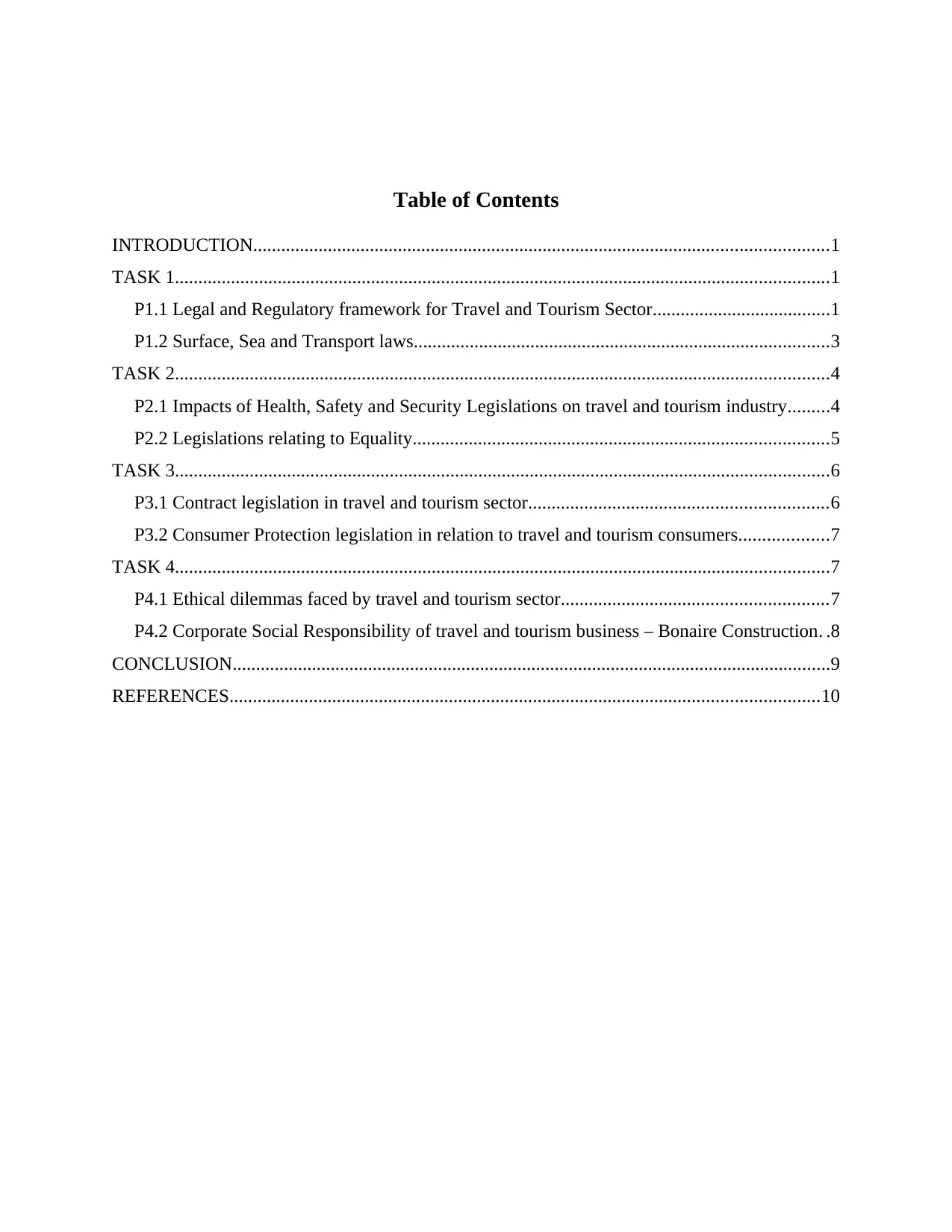
Table of Contents
INTRODUCTION...........................................................................................................................1
TASK 1............................................................................................................................................1
P1.1 Legal and Regulatory framework for Travel and Tourism Sector......................................1
P1.2 Surface, Sea and Transport laws.........................................................................................3
TASK 2............................................................................................................................................4
P2.1 Impacts of Health, Safety and Security Legislations on travel and tourism industry.........4
P2.2 Legislations relating to Equality.........................................................................................5
TASK 3............................................................................................................................................6
P3.1 Contract legislation in travel and tourism sector................................................................6
P3.2 Consumer Protection legislation in relation to travel and tourism consumers...................7
TASK 4............................................................................................................................................7
P4.1 Ethical dilemmas faced by travel and tourism sector.........................................................7
P4.2 Corporate Social Responsibility of travel and tourism business – Bonaire Construction. .8
CONCLUSION................................................................................................................................9
REFERENCES..............................................................................................................................10
INTRODUCTION...........................................................................................................................1
TASK 1............................................................................................................................................1
P1.1 Legal and Regulatory framework for Travel and Tourism Sector......................................1
P1.2 Surface, Sea and Transport laws.........................................................................................3
TASK 2............................................................................................................................................4
P2.1 Impacts of Health, Safety and Security Legislations on travel and tourism industry.........4
P2.2 Legislations relating to Equality.........................................................................................5
TASK 3............................................................................................................................................6
P3.1 Contract legislation in travel and tourism sector................................................................6
P3.2 Consumer Protection legislation in relation to travel and tourism consumers...................7
TASK 4............................................................................................................................................7
P4.1 Ethical dilemmas faced by travel and tourism sector.........................................................7
P4.2 Corporate Social Responsibility of travel and tourism business – Bonaire Construction. .8
CONCLUSION................................................................................................................................9
REFERENCES..............................................................................................................................10

⊘ This is a preview!⊘
Do you want full access?
Subscribe today to unlock all pages.

Trusted by 1+ million students worldwide
INTRODUCTION
Travel and tourism are very complex terms to fit into a definition, but in general terms
the words suggest movement of people for work or leisure. The term tourism was explained by
the United Nations World Tourism Organisation (UNWTO) as movement of people, which is
outside their usual environment to other places in another country for personal or business
purposes. (Boniface and et. al., 2016) The people travelling are called the visitor or travellers or
tourists.
As the travel and tourism is one of the fastest growing industries in the UK therefore, the
report gives an overview of the legal and regulatory framework pertaining to the travel and
tourism sector in the country along with the rules and regulations for health, safety and security
of the travellers. The report also gives a brief about the ethical issues involved and corporate
social responsibility of the travel and tourism corporations involved in building holiday homes in
the Caribbean islands, by examining an organization – Yates Associate Construction Company,
which is a construction company providing holiday rental in the British Virgin Islands.
TASK 1
P1.1 Legal and Regulatory framework for Travel and Tourism Sector
There are multiple features covered by the legal and regulatory framework for travel and
tourism which should be known to the people travelling. There are various legislations in Britain
which governs the concerns pertaining to travel and tourism, for instance, Travel Act, 1985.
(Buhalis and et. al., 2010) There are different laws for carriage of passengers, such as surface, air
and waterways laws. The various laws and regulations having an impact on the travel and
tourism sector are explained under:
Development of Tourism Act, 1969 – The legislation is formulated as initiative to co-
ordinate with all the organisations comprising of travel and tourism sector and provide
them a single platform and voice.
Transport Act, 1985 – The act is formulated to relax the previous rules and permit the
private entities to operate in on different routes in Britain.
Licensing Act, 2003 – This act came into existence to curb the menace created after
consumption of alcohol, as it regulated the sale of alcohol and consumption in
entertainment places at night.
1
Travel and tourism are very complex terms to fit into a definition, but in general terms
the words suggest movement of people for work or leisure. The term tourism was explained by
the United Nations World Tourism Organisation (UNWTO) as movement of people, which is
outside their usual environment to other places in another country for personal or business
purposes. (Boniface and et. al., 2016) The people travelling are called the visitor or travellers or
tourists.
As the travel and tourism is one of the fastest growing industries in the UK therefore, the
report gives an overview of the legal and regulatory framework pertaining to the travel and
tourism sector in the country along with the rules and regulations for health, safety and security
of the travellers. The report also gives a brief about the ethical issues involved and corporate
social responsibility of the travel and tourism corporations involved in building holiday homes in
the Caribbean islands, by examining an organization – Yates Associate Construction Company,
which is a construction company providing holiday rental in the British Virgin Islands.
TASK 1
P1.1 Legal and Regulatory framework for Travel and Tourism Sector
There are multiple features covered by the legal and regulatory framework for travel and
tourism which should be known to the people travelling. There are various legislations in Britain
which governs the concerns pertaining to travel and tourism, for instance, Travel Act, 1985.
(Buhalis and et. al., 2010) There are different laws for carriage of passengers, such as surface, air
and waterways laws. The various laws and regulations having an impact on the travel and
tourism sector are explained under:
Development of Tourism Act, 1969 – The legislation is formulated as initiative to co-
ordinate with all the organisations comprising of travel and tourism sector and provide
them a single platform and voice.
Transport Act, 1985 – The act is formulated to relax the previous rules and permit the
private entities to operate in on different routes in Britain.
Licensing Act, 2003 – This act came into existence to curb the menace created after
consumption of alcohol, as it regulated the sale of alcohol and consumption in
entertainment places at night.
1
Paraphrase This Document
Need a fresh take? Get an instant paraphrase of this document with our AI Paraphraser
Disability Discrimination Act, 1995 – This legislation was made to end the
discriminatory practices at public places which are faced by the people with disability.
This act aimed at promoting equal opportunities for such people.
Trade Descriptions Act, 1968 – This act prevents from providing mis-description of
accommodation facilities to the tourists.
Regulatory framework
Apart from the legislations there are regulatory authorities for ensuring that the travel and
tourism service provider are working effectively in serving the people travelling. The national,
international and local bodies which are working in this field are as follows: (E-Laws, 2011)
Association of British Travel Agents: ABTA is an association comprising of the
operators, who are the members of the association. The association is working for
guiding the travelling passengers.
Civil Aviation Authority: CAA is responsible for looking into the aspects of civil
aviation in Britain. It also provides protection to the travellers as well.
International Air Transport Association: IATA is another regulatory authority which
is a world's airline trade association. It is representing 117 countries, currently and deals
with the passenger safety and security.
Strategic Railway Authority: This one is the regulatory body providing guidance to the
railways department. SRA is established and authorised under the Transport Act, 2000.
Structures and Processes of the Courts
The courts in the Britain are responsible for administration of legal systems. There is a
hierarchy of courts, and the courts are levelled in accordance to the seniority in the UK, starting
with the Supreme Court at the top, which is the highest court of appeal. The Royal courts or High
Court are the next in line, looking into variety of issues, followed by the Crown Courts which
deal with serious criminal matters. Then, there are Magistrate's Court which deal with minor
criminal matters and civil matters.
There is also a mechanism for alternate dispute resolution, in case the parties do not want
to get into litigation, administered by a regulatory body ACAS, which is a non departmental
public body providing, support in this regard.
2
discriminatory practices at public places which are faced by the people with disability.
This act aimed at promoting equal opportunities for such people.
Trade Descriptions Act, 1968 – This act prevents from providing mis-description of
accommodation facilities to the tourists.
Regulatory framework
Apart from the legislations there are regulatory authorities for ensuring that the travel and
tourism service provider are working effectively in serving the people travelling. The national,
international and local bodies which are working in this field are as follows: (E-Laws, 2011)
Association of British Travel Agents: ABTA is an association comprising of the
operators, who are the members of the association. The association is working for
guiding the travelling passengers.
Civil Aviation Authority: CAA is responsible for looking into the aspects of civil
aviation in Britain. It also provides protection to the travellers as well.
International Air Transport Association: IATA is another regulatory authority which
is a world's airline trade association. It is representing 117 countries, currently and deals
with the passenger safety and security.
Strategic Railway Authority: This one is the regulatory body providing guidance to the
railways department. SRA is established and authorised under the Transport Act, 2000.
Structures and Processes of the Courts
The courts in the Britain are responsible for administration of legal systems. There is a
hierarchy of courts, and the courts are levelled in accordance to the seniority in the UK, starting
with the Supreme Court at the top, which is the highest court of appeal. The Royal courts or High
Court are the next in line, looking into variety of issues, followed by the Crown Courts which
deal with serious criminal matters. Then, there are Magistrate's Court which deal with minor
criminal matters and civil matters.
There is also a mechanism for alternate dispute resolution, in case the parties do not want
to get into litigation, administered by a regulatory body ACAS, which is a non departmental
public body providing, support in this regard.
2
P1.2 Surface, Sea and Transport laws
The passengers travel through various modes, which are air, waterways and road. These
modes of travel are governed by a variety of legislations which are known as the transport laws.
The legislations cover up various provisions pertaining to arrangements between the carrier and
passengers. The variety of surface, waterway and air legislation relating to carriage of passengers
are as follows:
Surface Legislation
The Carriage of Passengers by Road Act, 1974 is the legislation, primarily relating to
the surface laws. It provides the regulations pertaining to carriage of passengers and luggage
traveling internationally.
The Carriage by Railway Act, 1972 deals with the loss of luggage while travelling.
Sea and Waterways Legislation
The Regulation (EU) No. 1177/2010, applicable in European countries, is related to the
passengers traveling in sea and inland waterways by means of ferries, ships, etc. It provides the
regulations for maintaining the minimum levels of security of the passengers.
International Maritime Organization and International Convention for Safety of life
at Sea (SOLAS) are the measures taken by the UN for protection of travelers by sea.
Air Legislation
The air transport legislation' are a result of variety of treaties and convention, which are
listed below:
Warsaw Convention, 1929 is for regulating the airlines and providing protection to the
passengers commuting through air transport. The convention also focused on providing
compensation for death, injury and damage.
Montreal Convention, 1999 unified the rules relating to protection of passenger,
carriage by air and baggage by replacing the terms of Warsaw convention.
Denied boarding compensation scheme, 1977 and EU Regulation 2004, provides for
rules to protect passengers. Also, it states the regulations for compensation to passengers affected
by delayed or cancelled flights.
3
The passengers travel through various modes, which are air, waterways and road. These
modes of travel are governed by a variety of legislations which are known as the transport laws.
The legislations cover up various provisions pertaining to arrangements between the carrier and
passengers. The variety of surface, waterway and air legislation relating to carriage of passengers
are as follows:
Surface Legislation
The Carriage of Passengers by Road Act, 1974 is the legislation, primarily relating to
the surface laws. It provides the regulations pertaining to carriage of passengers and luggage
traveling internationally.
The Carriage by Railway Act, 1972 deals with the loss of luggage while travelling.
Sea and Waterways Legislation
The Regulation (EU) No. 1177/2010, applicable in European countries, is related to the
passengers traveling in sea and inland waterways by means of ferries, ships, etc. It provides the
regulations for maintaining the minimum levels of security of the passengers.
International Maritime Organization and International Convention for Safety of life
at Sea (SOLAS) are the measures taken by the UN for protection of travelers by sea.
Air Legislation
The air transport legislation' are a result of variety of treaties and convention, which are
listed below:
Warsaw Convention, 1929 is for regulating the airlines and providing protection to the
passengers commuting through air transport. The convention also focused on providing
compensation for death, injury and damage.
Montreal Convention, 1999 unified the rules relating to protection of passenger,
carriage by air and baggage by replacing the terms of Warsaw convention.
Denied boarding compensation scheme, 1977 and EU Regulation 2004, provides for
rules to protect passengers. Also, it states the regulations for compensation to passengers affected
by delayed or cancelled flights.
3
⊘ This is a preview!⊘
Do you want full access?
Subscribe today to unlock all pages.
Trusted by 1+ million students worldwide
TASK 2
P2.1 Impacts of Health, Safety and Security Legislations on travel and tourism industry
The entrepreneurs or employers have a prime responsibility to ensure health, safety and
security of the worker or employees working in the tourism industry. The revenue generated by
the travel and tourism industry could be affected if health, safety and security are not considered
as the work of the industry would be hampered, which would affect the revenue. And, the
employees also play an important role in maintaining the safety and security in a work
environment. The various rules and regulations for maintaining safe and secure environment at
workplace as reported to Hotel Elegant by the health and safety officer are as follows:
The Health and Safety Framework Directive (Directive 89/391 EEC) is the major
European Union law for managing the health and safety regulations in the member countries.
The European Agency for Safety and Health at Work is a regulatory body for
examining that the health and safety rules are followed by the business organizations across
Europe. It also provides the guidelines for maintenance of safety and security while identifying
threats.
The Health and Safety at Work Act, 1974 (HASAW) is formulated by the parliament
of UK, which is the prime law promising protection of health and safety of employees at
workplace. The employer is duty bound to adhere with the provisions of this acts in maintaining
and providing a safe work environment, such as, the providing training, managing machinery and
premises, providing first aid etc.
Further, the Health and Safety Commission is a regulatory body for keeping a check on
the organizations with respect to adherence of laws and regulations.
Duty of care and Vicarious Liability
Every employer has a duty of care towards the customer or consumers, as to ensure that
no injury is caused because of his product. The vicarious liability is making an individual
responsible for the acts or activities of another individual, for example, making an employer
responsible for the acts of an employee done during the course of business. (Lemelin and et. al.,
2013)
There are certain laws on the principles of duty of care, which is the Occupier Liability
Act, 1984. The act was enacted for making or holding an occupier of land responsible for the
4
P2.1 Impacts of Health, Safety and Security Legislations on travel and tourism industry
The entrepreneurs or employers have a prime responsibility to ensure health, safety and
security of the worker or employees working in the tourism industry. The revenue generated by
the travel and tourism industry could be affected if health, safety and security are not considered
as the work of the industry would be hampered, which would affect the revenue. And, the
employees also play an important role in maintaining the safety and security in a work
environment. The various rules and regulations for maintaining safe and secure environment at
workplace as reported to Hotel Elegant by the health and safety officer are as follows:
The Health and Safety Framework Directive (Directive 89/391 EEC) is the major
European Union law for managing the health and safety regulations in the member countries.
The European Agency for Safety and Health at Work is a regulatory body for
examining that the health and safety rules are followed by the business organizations across
Europe. It also provides the guidelines for maintenance of safety and security while identifying
threats.
The Health and Safety at Work Act, 1974 (HASAW) is formulated by the parliament
of UK, which is the prime law promising protection of health and safety of employees at
workplace. The employer is duty bound to adhere with the provisions of this acts in maintaining
and providing a safe work environment, such as, the providing training, managing machinery and
premises, providing first aid etc.
Further, the Health and Safety Commission is a regulatory body for keeping a check on
the organizations with respect to adherence of laws and regulations.
Duty of care and Vicarious Liability
Every employer has a duty of care towards the customer or consumers, as to ensure that
no injury is caused because of his product. The vicarious liability is making an individual
responsible for the acts or activities of another individual, for example, making an employer
responsible for the acts of an employee done during the course of business. (Lemelin and et. al.,
2013)
There are certain laws on the principles of duty of care, which is the Occupier Liability
Act, 1984. The act was enacted for making or holding an occupier of land responsible for the
4
Paraphrase This Document
Need a fresh take? Get an instant paraphrase of this document with our AI Paraphraser
injuries caused to unlawful trespassers, that is the owner has a duty of care for the individuals
entering into his premises.
The Data Protection Act, 2018 ensures that the personal data of a person is protected
from being getting compromised or getting lost. The act was enacted in furtherance to the
European Union's GDPR which is primarily imposing a responsibility on the individuals against
using the personal data unfairly or unlawfully.
P2.2 Legislations relating to Equality
The health and safety officer is also reporting on the legal perspective of equality and
laws in relation to prevention of discrimination. The term Equality means that all the individuals
are equal before law without being subjected to any discrimination. The term Discrimination
means unequal treatment people on the basis of race, creed, caste, color, gender, sex etc.
The legislations which are formulated by the government in relation to protection from
discrimination are as follows: (E-Law, 2011)
Sexual Discrimination Act, 1975: This is an act which is formulated for
maintaining equality on the basis of gender. The provisions laid down in the act
are for protecting men and women against any sort of discrimination on the
grounds of sex or marital status, while ensuring equal opportunity to work.
Race Discrimination Act, 1975: This enactment focuses on eradicating the racial
discrimination on the grounds of race, color, nationality, origin etc. This act
ensures protection of individuals in every aspect, such ad at work or at
educational institutes, etc.
Employment Protection (Consolidation) Act, 1978: This act was made in
furtherance of the Employment Rights Act, 1996 ensuring that the rights of the
employees are protected and not infringed at the workplace during the course of
employment.
Disability Discrimination Act, 1995: This act as discussed above is for
protecting the rights of disabled person at public places by ensuring that such
places are made disabled people friendly.
Human Rights Act, 1998: This is enacted to make sure the human rights ensured
by the European Convention are adhered in Britain. There are provisions which
5
entering into his premises.
The Data Protection Act, 2018 ensures that the personal data of a person is protected
from being getting compromised or getting lost. The act was enacted in furtherance to the
European Union's GDPR which is primarily imposing a responsibility on the individuals against
using the personal data unfairly or unlawfully.
P2.2 Legislations relating to Equality
The health and safety officer is also reporting on the legal perspective of equality and
laws in relation to prevention of discrimination. The term Equality means that all the individuals
are equal before law without being subjected to any discrimination. The term Discrimination
means unequal treatment people on the basis of race, creed, caste, color, gender, sex etc.
The legislations which are formulated by the government in relation to protection from
discrimination are as follows: (E-Law, 2011)
Sexual Discrimination Act, 1975: This is an act which is formulated for
maintaining equality on the basis of gender. The provisions laid down in the act
are for protecting men and women against any sort of discrimination on the
grounds of sex or marital status, while ensuring equal opportunity to work.
Race Discrimination Act, 1975: This enactment focuses on eradicating the racial
discrimination on the grounds of race, color, nationality, origin etc. This act
ensures protection of individuals in every aspect, such ad at work or at
educational institutes, etc.
Employment Protection (Consolidation) Act, 1978: This act was made in
furtherance of the Employment Rights Act, 1996 ensuring that the rights of the
employees are protected and not infringed at the workplace during the course of
employment.
Disability Discrimination Act, 1995: This act as discussed above is for
protecting the rights of disabled person at public places by ensuring that such
places are made disabled people friendly.
Human Rights Act, 1998: This is enacted to make sure the human rights ensured
by the European Convention are adhered in Britain. There are provisions which
5
ensure that the people have judicial remedies in case human rights are infringed
by any one.
TASK 3
P3.1 Contract legislation in travel and tourism sector
A contract is a legally binding agreement between two parties for a consideration, in
which the party is bound to perform the terms of contract. If the parties breach the terms of
contract then the remedy for it is damages, whether liquidated or unliquidated. The English
Contract law clearly carves out that for a contract there should be valid components of a
contract present, which are offer, acceptance, consideration, capacity and certainty. If these
elements are present in an agreement then it becomes legally binding on the parties entering into
it, and any breach of it is compensated. (Coles and et. al., 2013) When the parties get into an
arrangement for booking holiday packages then there is a legally binding contract between the
travel operator and the person making the booking.
There is a regulation protecting this arrangement, which is the Package Holiday
Regulation, 1992. This regulation clearly provides that for an arrangement to become travel
package there should be at least two services, or there should be a combination of two or more
services. And, if the travel operator or his agent has agreed to provide the services to the traveler
then he has to provide the serviced promised, that is he cannot defer from the agreement later.
The result of refuting or denying services would amount to legal implications, such as payment
of compensation to the person travelling. (E-Law, 2011)
The Sale of Goods Act, 1979 provides that whenever goods or services are purchased
then the consumer expects that goods and services should fulfill the basic criteria of standard and
these should be provided with due care and skill. Similarly, when a party enters into a contract
for booking accommodation, it is expected that it would meet certain standards, such as
maintenance, cleanliness, health and safety, etc.
Similarly, the Unfair Contract Terms Act, 1977 provides provisions for regulation of
contracts by restricting the operation of unfair terms of a contract.
6
by any one.
TASK 3
P3.1 Contract legislation in travel and tourism sector
A contract is a legally binding agreement between two parties for a consideration, in
which the party is bound to perform the terms of contract. If the parties breach the terms of
contract then the remedy for it is damages, whether liquidated or unliquidated. The English
Contract law clearly carves out that for a contract there should be valid components of a
contract present, which are offer, acceptance, consideration, capacity and certainty. If these
elements are present in an agreement then it becomes legally binding on the parties entering into
it, and any breach of it is compensated. (Coles and et. al., 2013) When the parties get into an
arrangement for booking holiday packages then there is a legally binding contract between the
travel operator and the person making the booking.
There is a regulation protecting this arrangement, which is the Package Holiday
Regulation, 1992. This regulation clearly provides that for an arrangement to become travel
package there should be at least two services, or there should be a combination of two or more
services. And, if the travel operator or his agent has agreed to provide the services to the traveler
then he has to provide the serviced promised, that is he cannot defer from the agreement later.
The result of refuting or denying services would amount to legal implications, such as payment
of compensation to the person travelling. (E-Law, 2011)
The Sale of Goods Act, 1979 provides that whenever goods or services are purchased
then the consumer expects that goods and services should fulfill the basic criteria of standard and
these should be provided with due care and skill. Similarly, when a party enters into a contract
for booking accommodation, it is expected that it would meet certain standards, such as
maintenance, cleanliness, health and safety, etc.
Similarly, the Unfair Contract Terms Act, 1977 provides provisions for regulation of
contracts by restricting the operation of unfair terms of a contract.
6
⊘ This is a preview!⊘
Do you want full access?
Subscribe today to unlock all pages.
Trusted by 1+ million students worldwide
P3.2 Consumer Protection legislation in relation to travel and tourism consumers
The consumer protection legislations are formulated by the government for protection of
the consumers from being exploited by the travel businesses and organizations. The various laws
formulated by the government for protecting the consumers are as follows: (E-Law, 2011)
11 The Trade Description Act, 1968
This legislation provides certain provisions which states the amount of accommodation and
other services, which should neither falsely represented nor misleading. There are regulatory
authorities, such as the trade standard officers, to review and inspect, whether incorrect
information is provided, or the provider has given incorrect information pertaining to
services or facilities or not.
11 The Consumer Protection Act, 2007
The rights and duties of the consumers and providers are specified and protected under this
legislation. The act consolidates many other legislations existing for consumer protection. It
provides provision for making a person liable for causing damage because of faulty or
defective goods. The 2007 Act incorporates the EU Directive on unfair commercial practices
into the domestic law.
11 The Package Travel Regulations, 1992
The regulation provides the legal implications in case the travel operator or his agent, who
have booked a holiday package, refutes or denies providing the agreed services. The
consumer has a right to claim for damages for the services not provided by the travel operator
or his agent. This regulation simplifies the rules for dispute resolution. The customer can
resort to court or litigation, or can go for alternate dispute resolution for getting his issue
resolved.
TASK 4
P4.1 Ethical dilemmas faced by travel and tourism sector
A company working in the travel and tourism sector has to face certain ethical dilemmas,
such as unethical competition from the other players. For instance, extreme low prices offered by
a company are one of the unethical practices which other companies has to face. A company to
overshadow the impacts of unethical practices can come up with a code of ethical behavior,
which will allow it to work in peace with competitive advantage.
7
The consumer protection legislations are formulated by the government for protection of
the consumers from being exploited by the travel businesses and organizations. The various laws
formulated by the government for protecting the consumers are as follows: (E-Law, 2011)
11 The Trade Description Act, 1968
This legislation provides certain provisions which states the amount of accommodation and
other services, which should neither falsely represented nor misleading. There are regulatory
authorities, such as the trade standard officers, to review and inspect, whether incorrect
information is provided, or the provider has given incorrect information pertaining to
services or facilities or not.
11 The Consumer Protection Act, 2007
The rights and duties of the consumers and providers are specified and protected under this
legislation. The act consolidates many other legislations existing for consumer protection. It
provides provision for making a person liable for causing damage because of faulty or
defective goods. The 2007 Act incorporates the EU Directive on unfair commercial practices
into the domestic law.
11 The Package Travel Regulations, 1992
The regulation provides the legal implications in case the travel operator or his agent, who
have booked a holiday package, refutes or denies providing the agreed services. The
consumer has a right to claim for damages for the services not provided by the travel operator
or his agent. This regulation simplifies the rules for dispute resolution. The customer can
resort to court or litigation, or can go for alternate dispute resolution for getting his issue
resolved.
TASK 4
P4.1 Ethical dilemmas faced by travel and tourism sector
A company working in the travel and tourism sector has to face certain ethical dilemmas,
such as unethical competition from the other players. For instance, extreme low prices offered by
a company are one of the unethical practices which other companies has to face. A company to
overshadow the impacts of unethical practices can come up with a code of ethical behavior,
which will allow it to work in peace with competitive advantage.
7
Paraphrase This Document
Need a fresh take? Get an instant paraphrase of this document with our AI Paraphraser
The host country provides with the information about the country and other key factors,
such as health and safety issues and how they are to be redressed. The construction company
building holiday homes, often provide houses are rentals to the travelers, and therefore should
also provide the travelers with the information provided by the host country. Also, the travelers
should be motivated to respect the local culture and environment, they should also not engage
into unlawful or violent acts, disrespecting the legal system of the host nation.
The ethical code given by the United Nations as Global Ethical Code for travel and tourism
industry provides a guideline to be followed by the travelers, service providers and the
government of the host country, etc. (Hall and et. al., 2015) The ethical code states that the
tourism professional should impart honest and correct information about the destination to the
tourist and should plan the travel evenly so that the travel is smooth and the place does not get
over burdened.
Further, the construction companies, providing rentals should be considerate of safety and
security, and should co-operate and co-ordinate with the local public authorities to prevent any
mishap. And, lastly the travel operators or professionals should also be considerate of the cultural
and spiritual requirements of a tourist, and should allow them to practice their religion.
P4.2 Corporate Social Responsibility of travel and tourism business – Bonaire Construction
The CSR means that any company should have a positive effect on the society or
community and should not only focus on generating profits. (Coles and et. al., 2013) The CSR of
Yates Associates Construction Company is discussed. Yates Associates is a construction and
development company providing high quality holiday homes and yachts in British Virgin Islands
(BVI). The company is well-known in the region for its contribution and development of well-
designed villas in the region of BVI. The bay hosts multiple visitors throughout the years, and as
a company it has certain responsibility and objectives for the stakeholders.
As a construction company, Yates associates try to do more in terms of CSR, as they have
great improvements made in terms of maintaining health and safety. The travel industry is
always dealing with the issues of less amount of employees and cultural diversity issues, where
the women and ethnic minority are often scarcely represented. The company has taken care of
such issues as well in BVI.
Further, dealing with the travelling related concerns, Yates Associates respects the local
people’s culture and asks from their customers to respect the local culture and demand a certain
8
such as health and safety issues and how they are to be redressed. The construction company
building holiday homes, often provide houses are rentals to the travelers, and therefore should
also provide the travelers with the information provided by the host country. Also, the travelers
should be motivated to respect the local culture and environment, they should also not engage
into unlawful or violent acts, disrespecting the legal system of the host nation.
The ethical code given by the United Nations as Global Ethical Code for travel and tourism
industry provides a guideline to be followed by the travelers, service providers and the
government of the host country, etc. (Hall and et. al., 2015) The ethical code states that the
tourism professional should impart honest and correct information about the destination to the
tourist and should plan the travel evenly so that the travel is smooth and the place does not get
over burdened.
Further, the construction companies, providing rentals should be considerate of safety and
security, and should co-operate and co-ordinate with the local public authorities to prevent any
mishap. And, lastly the travel operators or professionals should also be considerate of the cultural
and spiritual requirements of a tourist, and should allow them to practice their religion.
P4.2 Corporate Social Responsibility of travel and tourism business – Bonaire Construction
The CSR means that any company should have a positive effect on the society or
community and should not only focus on generating profits. (Coles and et. al., 2013) The CSR of
Yates Associates Construction Company is discussed. Yates Associates is a construction and
development company providing high quality holiday homes and yachts in British Virgin Islands
(BVI). The company is well-known in the region for its contribution and development of well-
designed villas in the region of BVI. The bay hosts multiple visitors throughout the years, and as
a company it has certain responsibility and objectives for the stakeholders.
As a construction company, Yates associates try to do more in terms of CSR, as they have
great improvements made in terms of maintaining health and safety. The travel industry is
always dealing with the issues of less amount of employees and cultural diversity issues, where
the women and ethnic minority are often scarcely represented. The company has taken care of
such issues as well in BVI.
Further, dealing with the travelling related concerns, Yates Associates respects the local
people’s culture and asks from their customers to respect the local culture and demand a certain
8
code of conduct. Also, they promote litter free travelling, and do not purchase goods which are
manufactured involving endangered species, such as ivory etc. The company also understands
and believes that their CSR policy is benefiting the company and attracting new customers, while
also helps in reducing costs and improves efficiency in managing the business.
CONCLUSION
To conclude, it can be said that since travel and tourism is one of the fastest growing
industry, it creates more opportunities in terms of generating more revenue. Therefore, the
travel operators should be aware of the legal aspects involved in this sector, so, if any issue
arises then they are able to come up with a resolution. Similarly, the tourists or travelers
should also be aware of their rights, which are ensured by multiple legislations, formulated
nationally and internationally. There is also certain code of ethics required to be followed by
the tourists and the travel professionals for smooth and effective functioning of the industry.
The report also underlines the Corporate Social Responsibility of a construction company –
Yates Associates Construction Co. – functional in the British Virgin Islands, highlighting
their objectives and responsibility towards the society and stakeholders in the region.
9
manufactured involving endangered species, such as ivory etc. The company also understands
and believes that their CSR policy is benefiting the company and attracting new customers, while
also helps in reducing costs and improves efficiency in managing the business.
CONCLUSION
To conclude, it can be said that since travel and tourism is one of the fastest growing
industry, it creates more opportunities in terms of generating more revenue. Therefore, the
travel operators should be aware of the legal aspects involved in this sector, so, if any issue
arises then they are able to come up with a resolution. Similarly, the tourists or travelers
should also be aware of their rights, which are ensured by multiple legislations, formulated
nationally and internationally. There is also certain code of ethics required to be followed by
the tourists and the travel professionals for smooth and effective functioning of the industry.
The report also underlines the Corporate Social Responsibility of a construction company –
Yates Associates Construction Co. – functional in the British Virgin Islands, highlighting
their objectives and responsibility towards the society and stakeholders in the region.
9
⊘ This is a preview!⊘
Do you want full access?
Subscribe today to unlock all pages.
Trusted by 1+ million students worldwide

1 out of 13


Related Documents


Your All-in-One AI-Powered Toolkit for Academic Success.
+13062052269
info@desklib.com
Available 24*7 on WhatsApp / Email
![[object Object]](/_next/static/media/star-bottom.7253800d.svg)
Unlock your academic potential
Copyright © 2020–2026 A2Z Services. All Rights Reserved. Developed and managed by ZUCOL.