Tourism Marketing Strategies for Iceland: A Comprehensive Analysis
VerifiedAdded on 2023/04/20
|19
|4132
|319
Report
AI Summary
This report analyzes the significant growth of Iceland's tourism industry, which has become a crucial part of its economy. It examines the market potential, highlighting increased revenues, spending by foreign visitors, job creation, and the positive local attitudes towards tourism. The report delves into transport development, including domestic flights, waterways, public buses, and vehicle rentals. It also assesses accommodation development, focusing on the increase in demand and various accommodation types. Furthermore, the report addresses crisis and risk management, covering civil conflicts, natural disasters, technological failures, and security incidents. The influence of social media and visitor experience development are also considered. The report aims to provide a comprehensive understanding of the strategies and considerations necessary to successfully promote and capture the Icelandic tourism market.
Running head: TOURISM MARKETING
Tourism Marketing
Name of the Student
Name of the University
Author Note
Tourism Marketing
Name of the Student
Name of the University
Author Note

Paraphrase This Document
Need a fresh take? Get an instant paraphrase of this document with our AI Paraphraser
1TOURISM MARKETING
Destination: Iceland
Introduction
-background on the destination
The tourism industry in Iceland have significantly increased over the last 15 years and
as of 2016, tourism contributed to 10% of their national GDP and supports 30% of the
revenues from exports (Gil-Alana and Huijbens 2018). By 2017, more than 2 million
international tourists visited Iceland. The number of tourists in Iceland started increasing
since the 1980’s and the total number of visitors in the country even exceeded the total
population of the country. Additionally, the industry employs more than 21 thousand people
or 12% of the total workforce making it an important segment of the economy and
employment. The country has attracted tourists from all over the world, making it an
important tourist destination (ferdamalastofa.is 2018; Einarsson and Huijbens 2018).
-purpose of selecting the destination
Iceland has been selected for the purpose of this study due to the steady and
promising growth of the tourism industry in the country. Between 2003 and 2010, the
industry grew by 6% per year and between 2010 and 2014, it grew by 20% every year. By
2014, the number of tourists doubled the number of locals, amounting to a total of 4.4 billion
(Sigurðardóttir and Steinthorsson 2018). This makes the Icelandic tourism an ideal
destination for future tourism prospects. Moreover, Iceland provides an untouched beauty
that is isolated from other countries by the sea and boasts an even more unique culture and
language. Such factors make Iceland an ideal international destination (ferdamalastofa.is
2018; Guardado and Desaro 2018).
-aim of the study
Destination: Iceland
Introduction
-background on the destination
The tourism industry in Iceland have significantly increased over the last 15 years and
as of 2016, tourism contributed to 10% of their national GDP and supports 30% of the
revenues from exports (Gil-Alana and Huijbens 2018). By 2017, more than 2 million
international tourists visited Iceland. The number of tourists in Iceland started increasing
since the 1980’s and the total number of visitors in the country even exceeded the total
population of the country. Additionally, the industry employs more than 21 thousand people
or 12% of the total workforce making it an important segment of the economy and
employment. The country has attracted tourists from all over the world, making it an
important tourist destination (ferdamalastofa.is 2018; Einarsson and Huijbens 2018).
-purpose of selecting the destination
Iceland has been selected for the purpose of this study due to the steady and
promising growth of the tourism industry in the country. Between 2003 and 2010, the
industry grew by 6% per year and between 2010 and 2014, it grew by 20% every year. By
2014, the number of tourists doubled the number of locals, amounting to a total of 4.4 billion
(Sigurðardóttir and Steinthorsson 2018). This makes the Icelandic tourism an ideal
destination for future tourism prospects. Moreover, Iceland provides an untouched beauty
that is isolated from other countries by the sea and boasts an even more unique culture and
language. Such factors make Iceland an ideal international destination (ferdamalastofa.is
2018; Guardado and Desaro 2018).
-aim of the study
2TOURISM MARKETING
The aim of the study is to analyze the market potential, transport development,
accommodation development, crisis and risk management services, social media influences
and visitor experience development considerations that must be taken in order to successfully
promote and capture the Icelandic tourism market.
Body
-Tourist market potential
The tourism market of Iceland has a significantly large potential mainly because of a
boom in the tourism industry and favorable conditions of the country that promotes the
experiences of the tourists and makes Iceland an ideal destination for several tourists
worldwide. The potential of the tourism market in Denmark can be understood through the
following aspects/trends:
Increase of the share of tourism in export revenues:
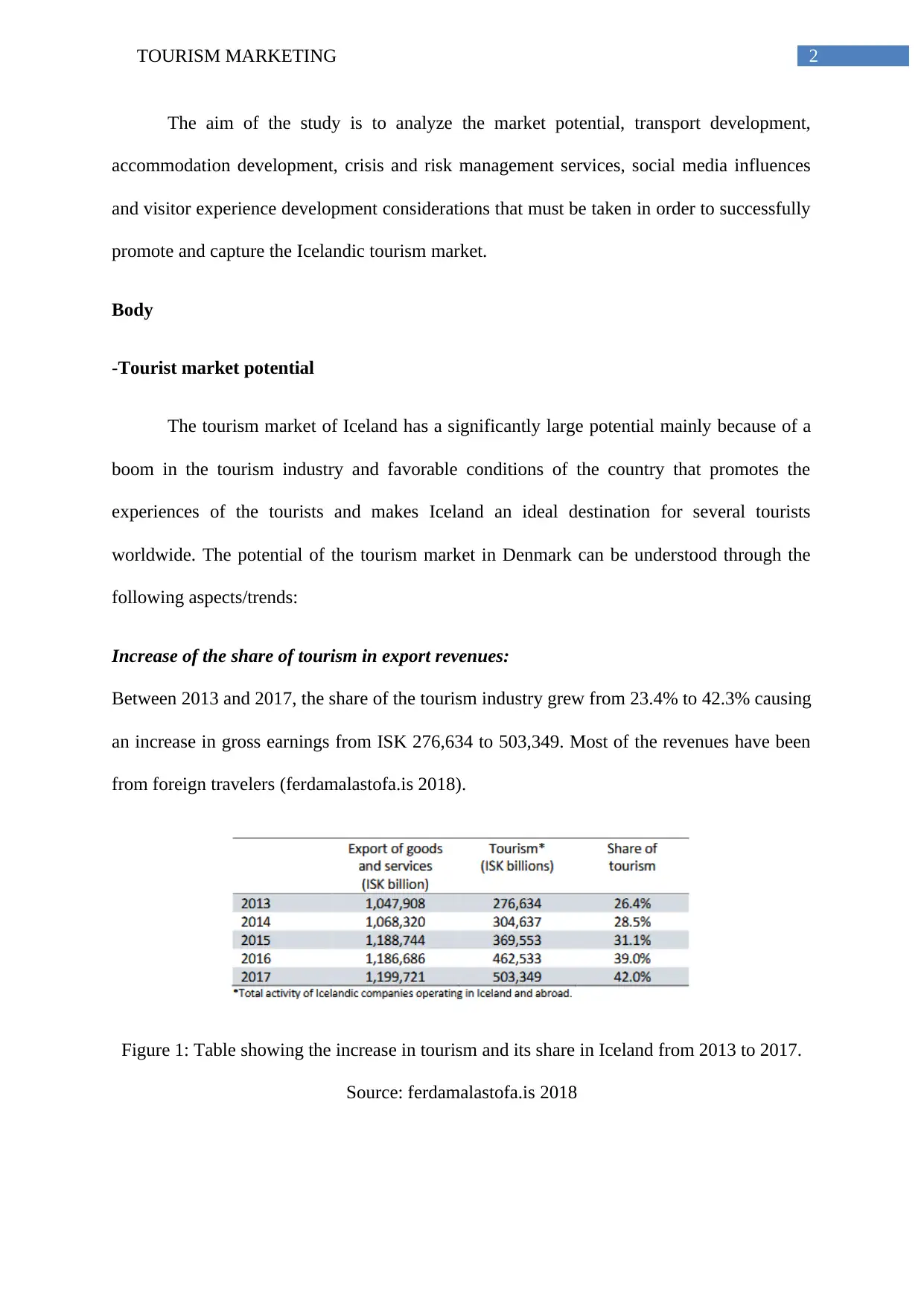
Between 2013 and 2017, the share of the tourism industry grew from 23.4% to 42.3% causing
an increase in gross earnings from ISK 276,634 to 503,349. Most of the revenues have been
from foreign travelers (ferdamalastofa.is 2018).
Figure 1: Table showing the increase in tourism and its share in Iceland from 2013 to 2017.
Source: ferdamalastofa.is 2018
The aim of the study is to analyze the market potential, transport development,
accommodation development, crisis and risk management services, social media influences
and visitor experience development considerations that must be taken in order to successfully
promote and capture the Icelandic tourism market.
Body
-Tourist market potential
The tourism market of Iceland has a significantly large potential mainly because of a
boom in the tourism industry and favorable conditions of the country that promotes the
experiences of the tourists and makes Iceland an ideal destination for several tourists
worldwide. The potential of the tourism market in Denmark can be understood through the
following aspects/trends:
Increase of the share of tourism in export revenues:
Between 2013 and 2017, the share of the tourism industry grew from 23.4% to 42.3% causing
an increase in gross earnings from ISK 276,634 to 503,349. Most of the revenues have been
from foreign travelers (ferdamalastofa.is 2018).
Figure 1: Table showing the increase in tourism and its share in Iceland from 2013 to 2017.
Source: ferdamalastofa.is 2018
⊘ This is a preview!⊘
Do you want full access?
Subscribe today to unlock all pages.

Trusted by 1+ million students worldwide
3TOURISM MARKETING
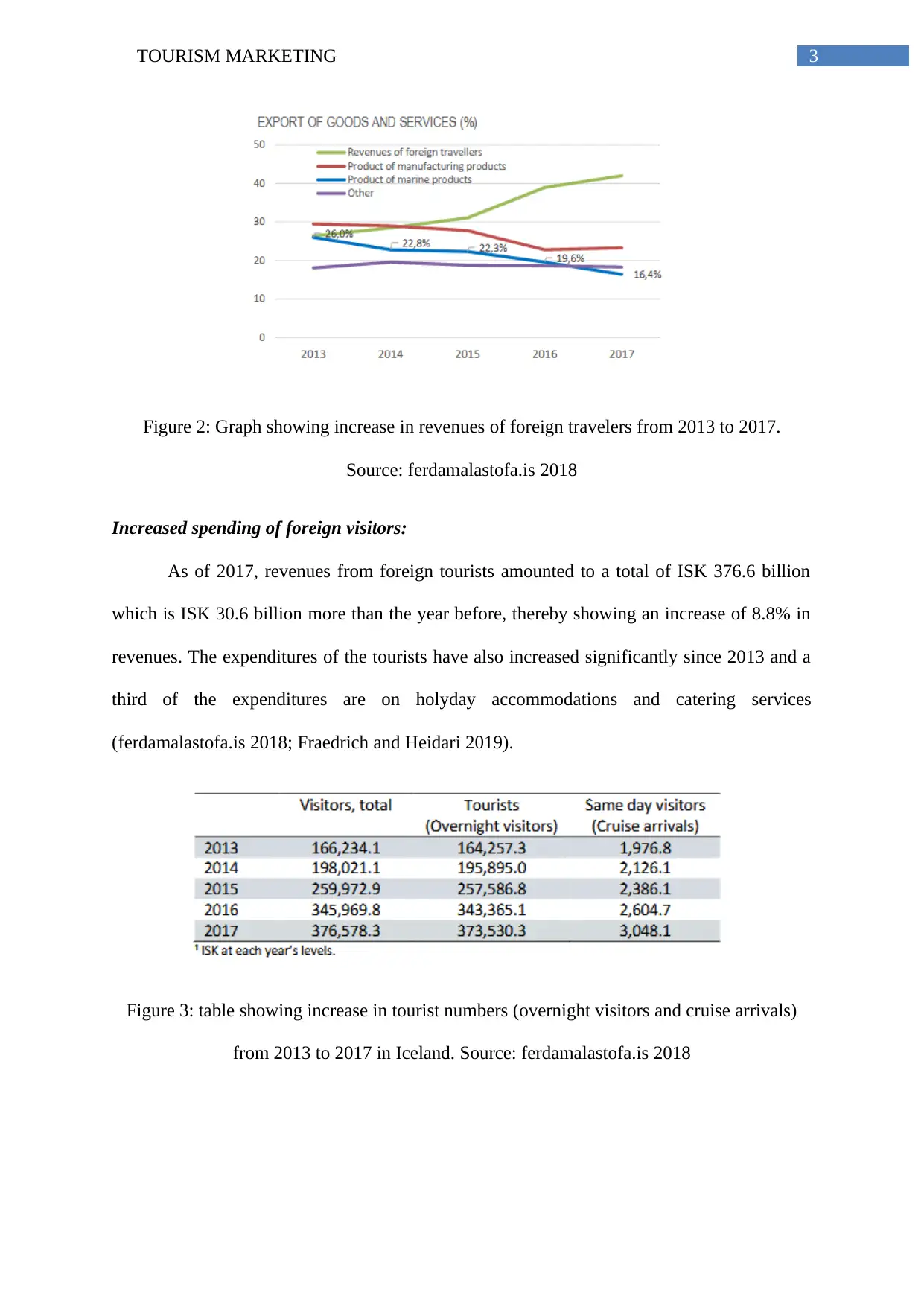
Figure 2: Graph showing increase in revenues of foreign travelers from 2013 to 2017.
Source: ferdamalastofa.is 2018
Increased spending of foreign visitors:
As of 2017, revenues from foreign tourists amounted to a total of ISK 376.6 billion
which is ISK 30.6 billion more than the year before, thereby showing an increase of 8.8% in
revenues. The expenditures of the tourists have also increased significantly since 2013 and a
third of the expenditures are on holyday accommodations and catering services
(ferdamalastofa.is 2018; Fraedrich and Heidari 2019).
Figure 3: table showing increase in tourist numbers (overnight visitors and cruise arrivals)
from 2013 to 2017 in Iceland. Source: ferdamalastofa.is 2018
Figure 2: Graph showing increase in revenues of foreign travelers from 2013 to 2017.
Source: ferdamalastofa.is 2018
Increased spending of foreign visitors:
As of 2017, revenues from foreign tourists amounted to a total of ISK 376.6 billion
which is ISK 30.6 billion more than the year before, thereby showing an increase of 8.8% in
revenues. The expenditures of the tourists have also increased significantly since 2013 and a
third of the expenditures are on holyday accommodations and catering services
(ferdamalastofa.is 2018; Fraedrich and Heidari 2019).
Figure 3: table showing increase in tourist numbers (overnight visitors and cruise arrivals)
from 2013 to 2017 in Iceland. Source: ferdamalastofa.is 2018
Paraphrase This Document
Need a fresh take? Get an instant paraphrase of this document with our AI Paraphraser
4TOURISM MARKETING
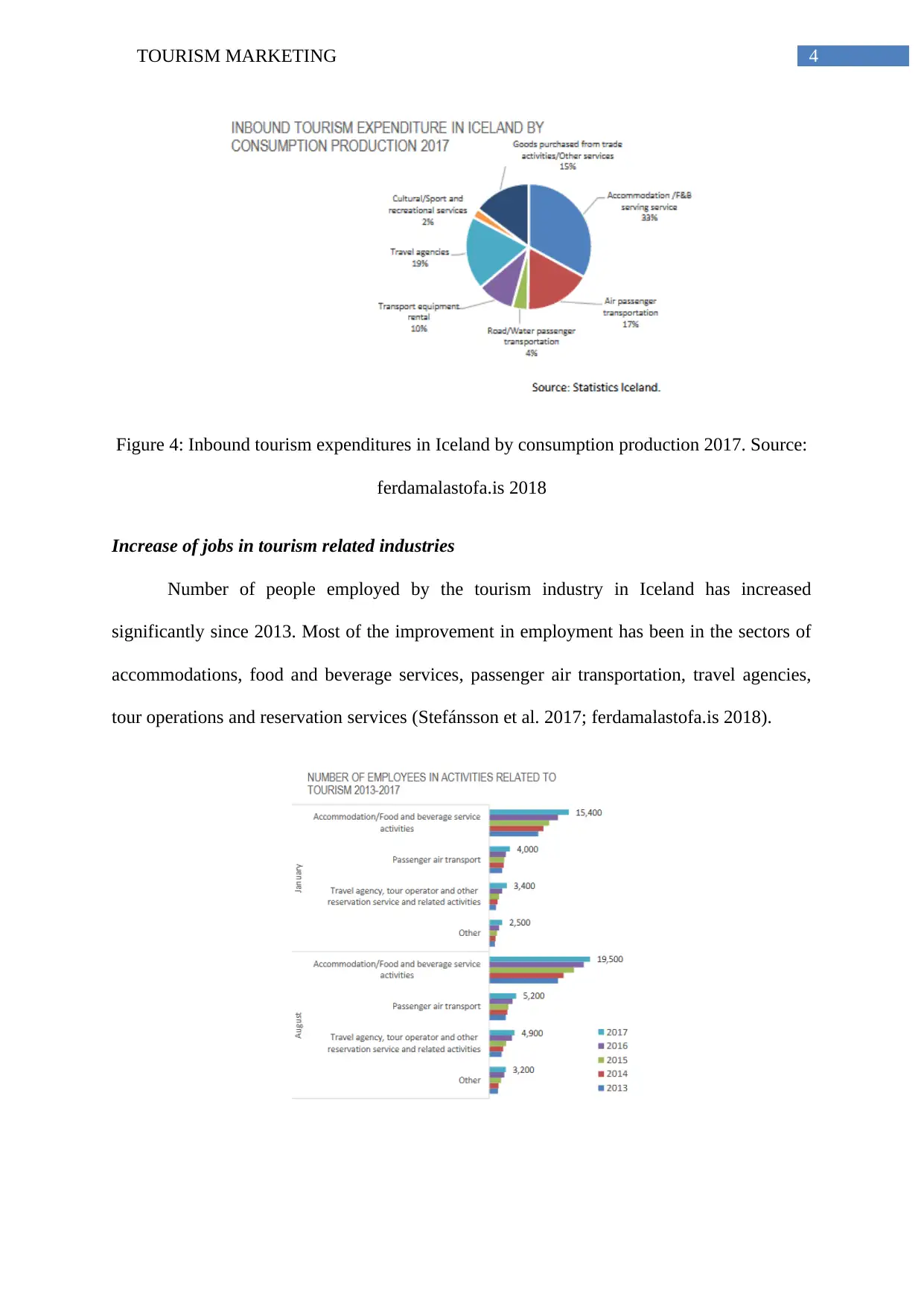
Figure 4: Inbound tourism expenditures in Iceland by consumption production 2017. Source:
ferdamalastofa.is 2018
Increase of jobs in tourism related industries
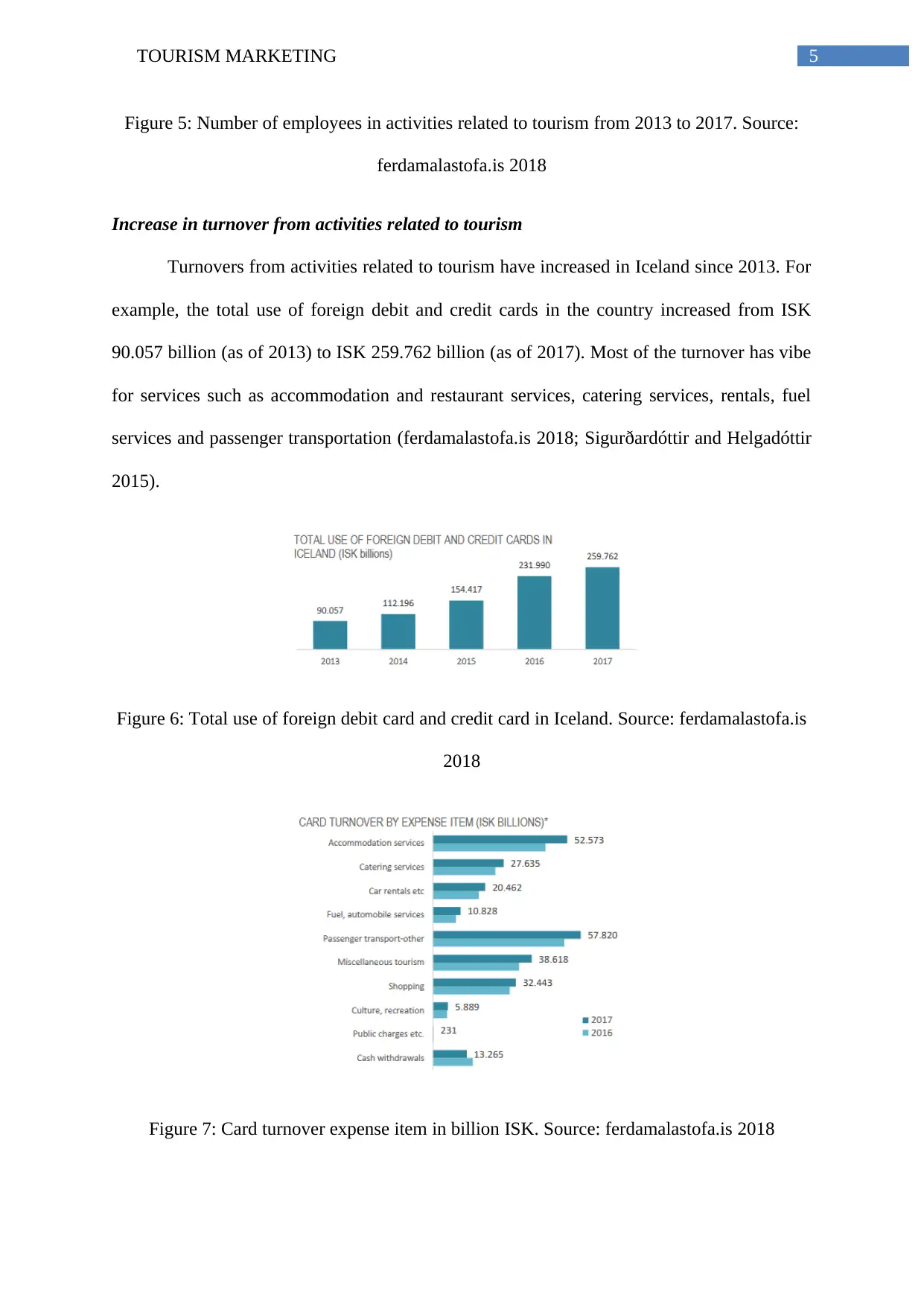
Number of people employed by the tourism industry in Iceland has increased
significantly since 2013. Most of the improvement in employment has been in the sectors of
accommodations, food and beverage services, passenger air transportation, travel agencies,
tour operations and reservation services (Stefánsson et al. 2017; ferdamalastofa.is 2018).
Figure 4: Inbound tourism expenditures in Iceland by consumption production 2017. Source:
ferdamalastofa.is 2018
Increase of jobs in tourism related industries
Number of people employed by the tourism industry in Iceland has increased
significantly since 2013. Most of the improvement in employment has been in the sectors of
accommodations, food and beverage services, passenger air transportation, travel agencies,
tour operations and reservation services (Stefánsson et al. 2017; ferdamalastofa.is 2018).
5TOURISM MARKETING
Figure 5: Number of employees in activities related to tourism from 2013 to 2017. Source:
ferdamalastofa.is 2018
Increase in turnover from activities related to tourism
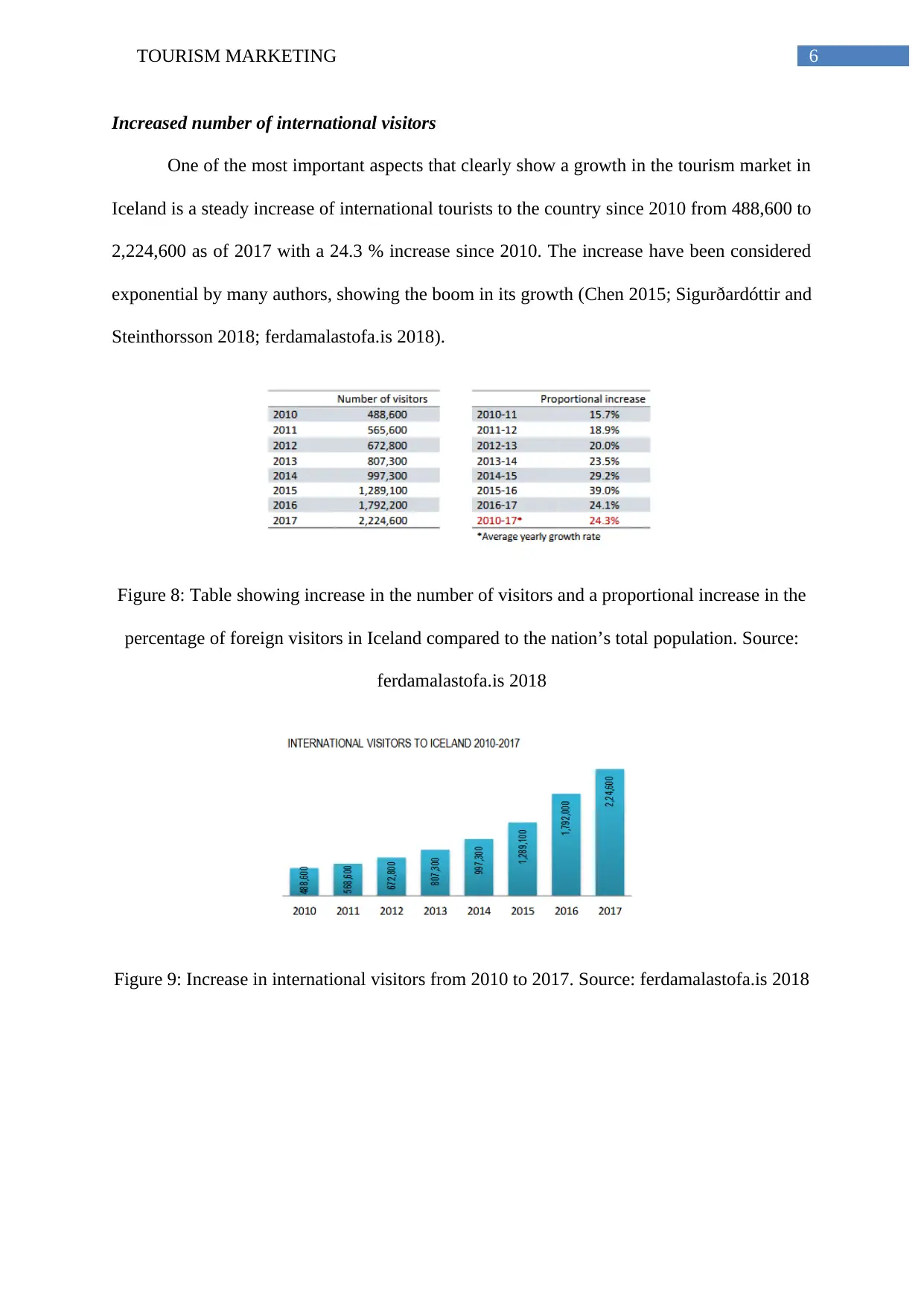
Turnovers from activities related to tourism have increased in Iceland since 2013. For
example, the total use of foreign debit and credit cards in the country increased from ISK
90.057 billion (as of 2013) to ISK 259.762 billion (as of 2017). Most of the turnover has vibe
for services such as accommodation and restaurant services, catering services, rentals, fuel
services and passenger transportation (ferdamalastofa.is 2018; Sigurðardóttir and Helgadóttir
2015).
Figure 6: Total use of foreign debit card and credit card in Iceland. Source: ferdamalastofa.is
2018
Figure 7: Card turnover expense item in billion ISK. Source: ferdamalastofa.is 2018
Figure 5: Number of employees in activities related to tourism from 2013 to 2017. Source:
ferdamalastofa.is 2018
Increase in turnover from activities related to tourism
Turnovers from activities related to tourism have increased in Iceland since 2013. For
example, the total use of foreign debit and credit cards in the country increased from ISK
90.057 billion (as of 2013) to ISK 259.762 billion (as of 2017). Most of the turnover has vibe
for services such as accommodation and restaurant services, catering services, rentals, fuel
services and passenger transportation (ferdamalastofa.is 2018; Sigurðardóttir and Helgadóttir
2015).
Figure 6: Total use of foreign debit card and credit card in Iceland. Source: ferdamalastofa.is
2018
Figure 7: Card turnover expense item in billion ISK. Source: ferdamalastofa.is 2018
⊘ This is a preview!⊘
Do you want full access?
Subscribe today to unlock all pages.
Trusted by 1+ million students worldwide
6TOURISM MARKETING
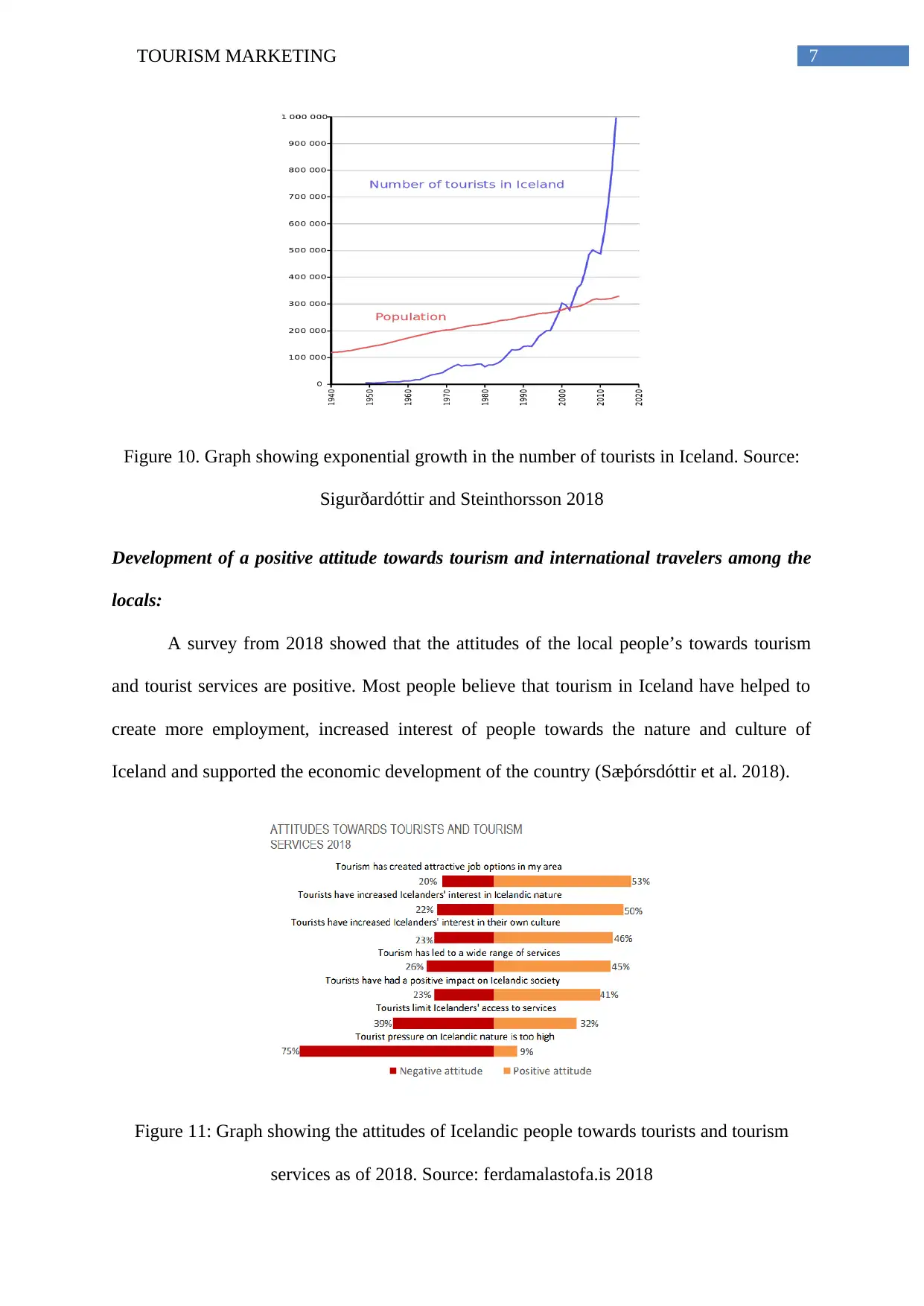
Increased number of international visitors
One of the most important aspects that clearly show a growth in the tourism market in
Iceland is a steady increase of international tourists to the country since 2010 from 488,600 to
2,224,600 as of 2017 with a 24.3 % increase since 2010. The increase have been considered
exponential by many authors, showing the boom in its growth (Chen 2015; Sigurðardóttir and
Steinthorsson 2018; ferdamalastofa.is 2018).
Figure 8: Table showing increase in the number of visitors and a proportional increase in the
percentage of foreign visitors in Iceland compared to the nation’s total population. Source:
ferdamalastofa.is 2018
Figure 9: Increase in international visitors from 2010 to 2017. Source: ferdamalastofa.is 2018
Increased number of international visitors
One of the most important aspects that clearly show a growth in the tourism market in
Iceland is a steady increase of international tourists to the country since 2010 from 488,600 to
2,224,600 as of 2017 with a 24.3 % increase since 2010. The increase have been considered
exponential by many authors, showing the boom in its growth (Chen 2015; Sigurðardóttir and
Steinthorsson 2018; ferdamalastofa.is 2018).
Figure 8: Table showing increase in the number of visitors and a proportional increase in the
percentage of foreign visitors in Iceland compared to the nation’s total population. Source:
ferdamalastofa.is 2018
Figure 9: Increase in international visitors from 2010 to 2017. Source: ferdamalastofa.is 2018
Paraphrase This Document
Need a fresh take? Get an instant paraphrase of this document with our AI Paraphraser
7TOURISM MARKETING
Figure 10. Graph showing exponential growth in the number of tourists in Iceland. Source:
Sigurðardóttir and Steinthorsson 2018
Development of a positive attitude towards tourism and international travelers among the
locals:
A survey from 2018 showed that the attitudes of the local people’s towards tourism
and tourist services are positive. Most people believe that tourism in Iceland have helped to
create more employment, increased interest of people towards the nature and culture of
Iceland and supported the economic development of the country (Sæþórsdóttir et al. 2018).
Figure 11: Graph showing the attitudes of Icelandic people towards tourists and tourism
services as of 2018. Source: ferdamalastofa.is 2018
Figure 10. Graph showing exponential growth in the number of tourists in Iceland. Source:
Sigurðardóttir and Steinthorsson 2018
Development of a positive attitude towards tourism and international travelers among the
locals:
A survey from 2018 showed that the attitudes of the local people’s towards tourism
and tourist services are positive. Most people believe that tourism in Iceland have helped to
create more employment, increased interest of people towards the nature and culture of
Iceland and supported the economic development of the country (Sæþórsdóttir et al. 2018).
Figure 11: Graph showing the attitudes of Icelandic people towards tourists and tourism
services as of 2018. Source: ferdamalastofa.is 2018
8TOURISM MARKETING
-Transport development
The transport system of Iceland is significantly governed by the landscape and natural
terrain of the region as well as the small population of the country. The country does not have
any railways. The main modes of transportation available in the country include:
Domestic Flights: Few domestic airlines provide connectivity to various cities of Iceland
such as Akureyri, Egilsstadir, Isafjordur, Akureyri, Husavik and Westman Islands. This
provides a fast model of travelling from one part to another part of the country and also
provides a beautiful bird’s eye view of the landscape of the country (isavia.is 2019; Sovacool
et al. 2018).
Waterways: Iceland has several major ports and harbors located in Keflavík, Straumsvík,
Akureyri, Ísafjörður, Hornafjördur, Vestmannaeyjar, Seyðisfjörður, Raufarhöfn and
Reykjavík. These ports provide an ample connectivity for the tourists trough the waterways
and to get around Iceland (Classen 2018).
Public Bus services: Even though Iceland does not have a railway system, the public bus
services are very extensive and connect most of the tourist places, towns, cities and villages
of Iceland. The services are mainly provided by the companies: Stræto, Reikevic excursions
and Sterna, all of which takes routes through the ring road, the highlands and west fjords
(Jónasdóttir et al. 2018).
Renting Vehicles: Tourists can also rent private vehicles like cars and motorcycles to drive
across the country on their own. The tourists can avail anything between small cars, the size
of a Prius to an SUV for more flexibility of choice. This can allow the tourists to explore
places off the beaten path (Gil-Alana and Huijbens 2018).
-Transport development
The transport system of Iceland is significantly governed by the landscape and natural
terrain of the region as well as the small population of the country. The country does not have
any railways. The main modes of transportation available in the country include:
Domestic Flights: Few domestic airlines provide connectivity to various cities of Iceland
such as Akureyri, Egilsstadir, Isafjordur, Akureyri, Husavik and Westman Islands. This
provides a fast model of travelling from one part to another part of the country and also
provides a beautiful bird’s eye view of the landscape of the country (isavia.is 2019; Sovacool
et al. 2018).
Waterways: Iceland has several major ports and harbors located in Keflavík, Straumsvík,
Akureyri, Ísafjörður, Hornafjördur, Vestmannaeyjar, Seyðisfjörður, Raufarhöfn and
Reykjavík. These ports provide an ample connectivity for the tourists trough the waterways
and to get around Iceland (Classen 2018).
Public Bus services: Even though Iceland does not have a railway system, the public bus
services are very extensive and connect most of the tourist places, towns, cities and villages
of Iceland. The services are mainly provided by the companies: Stræto, Reikevic excursions
and Sterna, all of which takes routes through the ring road, the highlands and west fjords
(Jónasdóttir et al. 2018).
Renting Vehicles: Tourists can also rent private vehicles like cars and motorcycles to drive
across the country on their own. The tourists can avail anything between small cars, the size
of a Prius to an SUV for more flexibility of choice. This can allow the tourists to explore
places off the beaten path (Gil-Alana and Huijbens 2018).
⊘ This is a preview!⊘
Do you want full access?
Subscribe today to unlock all pages.
Trusted by 1+ million students worldwide
9TOURISM MARKETING
Bicycle: The clean air and limited traffic on the roads of Iceland makes them ideal to be
travelled by Bicycle. Moreover, bicycles are more environmentally friendly as they do not
cause any pollution. The government provides tourists to rent bicycles from several places to
get around the terrain (Einarsson and Huijbens 2018).
Hitchhiking: Tourists can also hitchhike their way through Iceland on other transportation.
The locals are very welcoming of the tourists and hitchhiking offers an affordable and early
mode of transportation in the country (Sigurðardóttir and Steinthorsson 2018).
These factors show that transportation in Iceland is extensive and is sufficient to
support further growth in the tourism industry.
-Accommodation development
Requirements for accommodation for tourists have steadily increased in Iceland along
with a proportional increase in the number of tourists ever year. In 2013, a total of 166,234.1
tourists came to Iceland of which 164,257.3 were overnight visitors (98.81%), by 2017, the
total number of visitors increased to 376, 578.3, of which 373,530.3 (99.19%). Moreover, a
third of the total spending made by the tourists (33%) who amounted to ISK 124 billion. This
shows a significant rise in the needs of accommodation services for tourists in Iceland. Also,
there has been a significant increase in the number of jobs and employment to support an
increased need for accommodation services for tourists from 2013 to 2017, especially in the
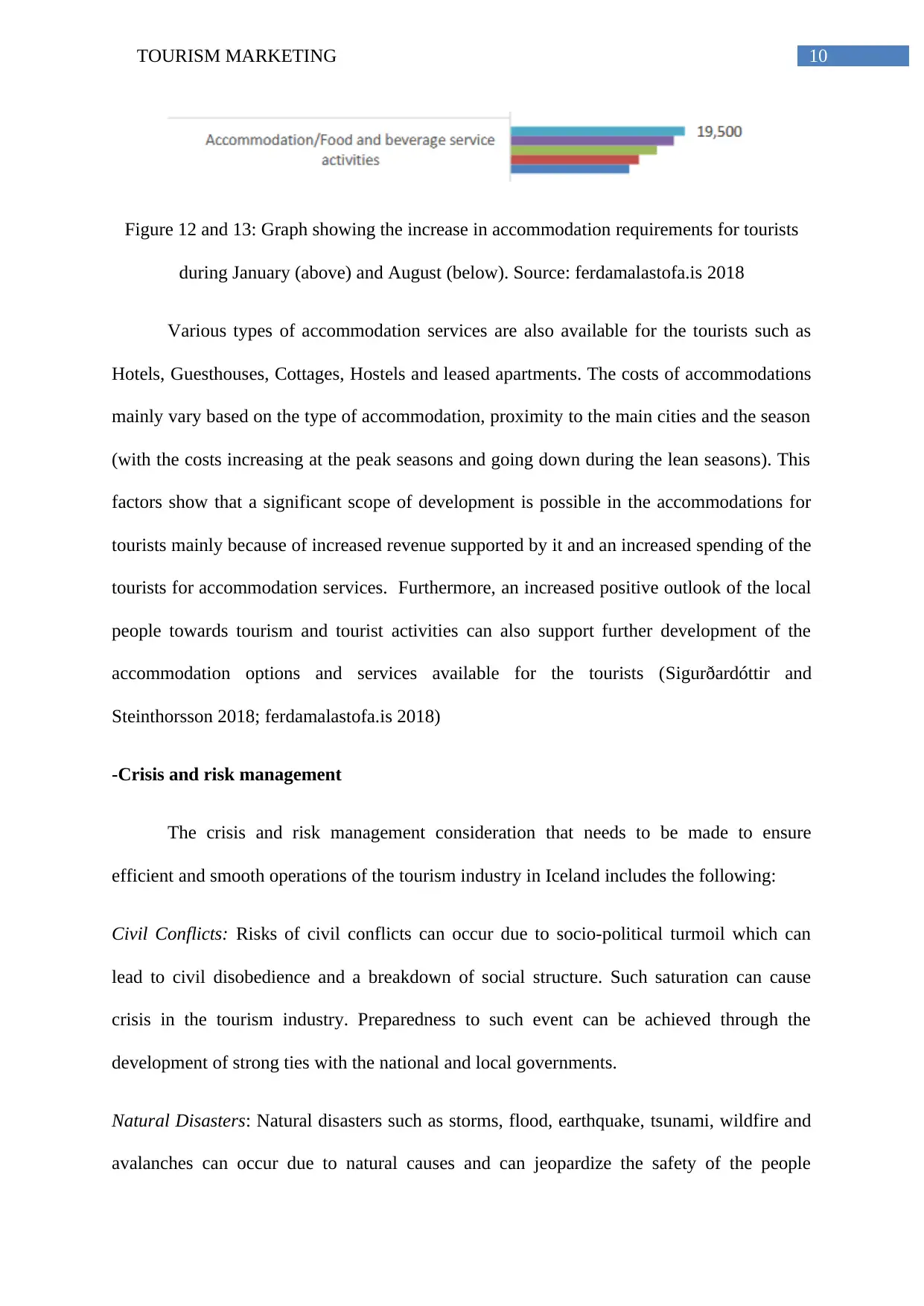
peak seasons of January and August (as shown below) (ferdamalastofa.is 2018; Einarsson
and Huijbens 2018).
Bicycle: The clean air and limited traffic on the roads of Iceland makes them ideal to be
travelled by Bicycle. Moreover, bicycles are more environmentally friendly as they do not
cause any pollution. The government provides tourists to rent bicycles from several places to
get around the terrain (Einarsson and Huijbens 2018).
Hitchhiking: Tourists can also hitchhike their way through Iceland on other transportation.
The locals are very welcoming of the tourists and hitchhiking offers an affordable and early
mode of transportation in the country (Sigurðardóttir and Steinthorsson 2018).
These factors show that transportation in Iceland is extensive and is sufficient to
support further growth in the tourism industry.
-Accommodation development
Requirements for accommodation for tourists have steadily increased in Iceland along
with a proportional increase in the number of tourists ever year. In 2013, a total of 166,234.1
tourists came to Iceland of which 164,257.3 were overnight visitors (98.81%), by 2017, the
total number of visitors increased to 376, 578.3, of which 373,530.3 (99.19%). Moreover, a
third of the total spending made by the tourists (33%) who amounted to ISK 124 billion. This
shows a significant rise in the needs of accommodation services for tourists in Iceland. Also,
there has been a significant increase in the number of jobs and employment to support an
increased need for accommodation services for tourists from 2013 to 2017, especially in the
peak seasons of January and August (as shown below) (ferdamalastofa.is 2018; Einarsson
and Huijbens 2018).
Paraphrase This Document
Need a fresh take? Get an instant paraphrase of this document with our AI Paraphraser
10TOURISM MARKETING
Figure 12 and 13: Graph showing the increase in accommodation requirements for tourists
during January (above) and August (below). Source: ferdamalastofa.is 2018
Various types of accommodation services are also available for the tourists such as
Hotels, Guesthouses, Cottages, Hostels and leased apartments. The costs of accommodations
mainly vary based on the type of accommodation, proximity to the main cities and the season
(with the costs increasing at the peak seasons and going down during the lean seasons). This
factors show that a significant scope of development is possible in the accommodations for
tourists mainly because of increased revenue supported by it and an increased spending of the
tourists for accommodation services. Furthermore, an increased positive outlook of the local
people towards tourism and tourist activities can also support further development of the
accommodation options and services available for the tourists (Sigurðardóttir and
Steinthorsson 2018; ferdamalastofa.is 2018)
-Crisis and risk management
The crisis and risk management consideration that needs to be made to ensure
efficient and smooth operations of the tourism industry in Iceland includes the following:
Civil Conflicts: Risks of civil conflicts can occur due to socio-political turmoil which can
lead to civil disobedience and a breakdown of social structure. Such saturation can cause
crisis in the tourism industry. Preparedness to such event can be achieved through the
development of strong ties with the national and local governments.
Natural Disasters: Natural disasters such as storms, flood, earthquake, tsunami, wildfire and
avalanches can occur due to natural causes and can jeopardize the safety of the people
Figure 12 and 13: Graph showing the increase in accommodation requirements for tourists
during January (above) and August (below). Source: ferdamalastofa.is 2018
Various types of accommodation services are also available for the tourists such as
Hotels, Guesthouses, Cottages, Hostels and leased apartments. The costs of accommodations
mainly vary based on the type of accommodation, proximity to the main cities and the season
(with the costs increasing at the peak seasons and going down during the lean seasons). This
factors show that a significant scope of development is possible in the accommodations for
tourists mainly because of increased revenue supported by it and an increased spending of the
tourists for accommodation services. Furthermore, an increased positive outlook of the local
people towards tourism and tourist activities can also support further development of the
accommodation options and services available for the tourists (Sigurðardóttir and
Steinthorsson 2018; ferdamalastofa.is 2018)
-Crisis and risk management
The crisis and risk management consideration that needs to be made to ensure
efficient and smooth operations of the tourism industry in Iceland includes the following:
Civil Conflicts: Risks of civil conflicts can occur due to socio-political turmoil which can
lead to civil disobedience and a breakdown of social structure. Such saturation can cause
crisis in the tourism industry. Preparedness to such event can be achieved through the
development of strong ties with the national and local governments.
Natural Disasters: Natural disasters such as storms, flood, earthquake, tsunami, wildfire and
avalanches can occur due to natural causes and can jeopardize the safety of the people
11TOURISM MARKETING
causing a national crisis. Such risks are hard to manage and mitigate and early reporting
strategies and effective evacuation on the event of a disaster can help to minimize casualties
caused due to them.
Failure of technology: One of the biggest risks of technology is that of a technological
failure. Since technology have permeated into every faced of an organization and its
operations, a technology failure can cause massive disruptions to businesses and the lives of
people. Having redundancies in technologies as a backup system can be an effective strategy
to manage the risk.
Security Incidents: Incidents such as terrorist attacks and violence against others can also be
significant source of a crisis situation that can harm tourists and people of Iceland. These
incidents can lead to loss of lives and properties and can adversely impact tourism in the
region. Risks such as there can be mitigated by ensuring better safety policies and systems
through the country.
Fire Hazard: Hazards of fire is another significant source of crisis for Icelandic tourism. This
is especially true in the Icelandic wilderness in the dry months. The forest fires can spread to
the houses and nearby neighborhood thereby putting at risks the safety of the people.
(Farsani et al. 2018; Mikulić et al. 2018; Jiang et al. 2018; ferdamalastofa.is 2018)
-Social media influence
Iceland also has a strong social media platform with several tourism and
transportation related pages dedicated for Iceland and developing networks for the tourists to
use to develop their network and communicate with local people (Hale 2018). According to
Rúdólfsdóttir and Jóhannsdóttir (2018), Iceland is significantly depending on the efficacy of
social media to reach out to people to bring about a nation-wide development and to attract
causing a national crisis. Such risks are hard to manage and mitigate and early reporting
strategies and effective evacuation on the event of a disaster can help to minimize casualties
caused due to them.
Failure of technology: One of the biggest risks of technology is that of a technological
failure. Since technology have permeated into every faced of an organization and its
operations, a technology failure can cause massive disruptions to businesses and the lives of
people. Having redundancies in technologies as a backup system can be an effective strategy
to manage the risk.
Security Incidents: Incidents such as terrorist attacks and violence against others can also be
significant source of a crisis situation that can harm tourists and people of Iceland. These
incidents can lead to loss of lives and properties and can adversely impact tourism in the
region. Risks such as there can be mitigated by ensuring better safety policies and systems
through the country.
Fire Hazard: Hazards of fire is another significant source of crisis for Icelandic tourism. This
is especially true in the Icelandic wilderness in the dry months. The forest fires can spread to
the houses and nearby neighborhood thereby putting at risks the safety of the people.
(Farsani et al. 2018; Mikulić et al. 2018; Jiang et al. 2018; ferdamalastofa.is 2018)
-Social media influence
Iceland also has a strong social media platform with several tourism and
transportation related pages dedicated for Iceland and developing networks for the tourists to
use to develop their network and communicate with local people (Hale 2018). According to
Rúdólfsdóttir and Jóhannsdóttir (2018), Iceland is significantly depending on the efficacy of
social media to reach out to people to bring about a nation-wide development and to attract
⊘ This is a preview!⊘
Do you want full access?
Subscribe today to unlock all pages.
Trusted by 1+ million students worldwide

1 out of 19


Related Documents


Your All-in-One AI-Powered Toolkit for Academic Success.
+13062052269
info@desklib.com
Available 24*7 on WhatsApp / Email
![[object Object]](/_next/static/media/star-bottom.7253800d.svg)
Unlock your academic potential
Copyright © 2020–2026 A2Z Services. All Rights Reserved. Developed and managed by ZUCOL.