Analysis of Policy and Planning in the Tourism Industry
VerifiedAdded on 2021/02/19
|12
|3749
|38
Report
AI Summary
This report provides a comprehensive analysis of the tourism industry, focusing on policy and planning. It begins by investigating the roles and responsibilities of key organizations such as the United Nations World Tourism Organisation (UNWTO), the World Travel and Tourism Council (WTTC), and Visit Britain, and how they influence the travel and tourism sector. The report then explores various marketing strategies for achieving tourism planning objectives, including the use of social media, surveys, Google Analytics, media monitoring tools, marketing events, and customer loyalty programs. It also evaluates the impacts of poor tourism planning. Furthermore, the report offers examples of successful destination marketing strategies. The report concludes with an evaluation of the tourism planning process and approaches, providing a well-rounded overview of the subject.
Policy and Planning in the
Tourism Industry
Tourism Industry

Paraphrase This Document
Need a fresh take? Get an instant paraphrase of this document with our AI Paraphraser
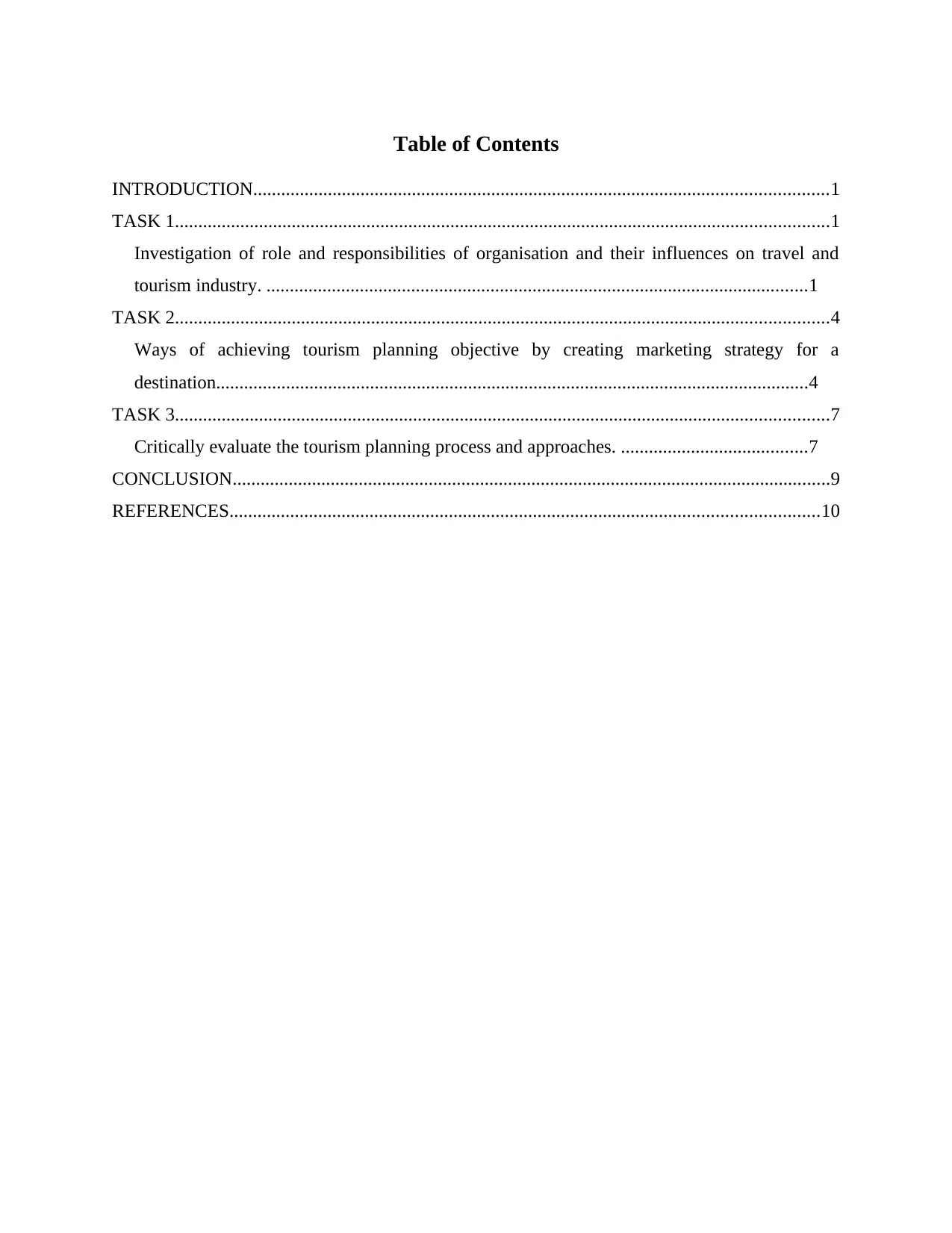
Table of Contents
INTRODUCTION...........................................................................................................................1
TASK 1............................................................................................................................................1
Investigation of role and responsibilities of organisation and their influences on travel and
tourism industry. ....................................................................................................................1
TASK 2............................................................................................................................................4
Ways of achieving tourism planning objective by creating marketing strategy for a
destination...............................................................................................................................4
TASK 3............................................................................................................................................7
Critically evaluate the tourism planning process and approaches. ........................................7
CONCLUSION................................................................................................................................9
REFERENCES..............................................................................................................................10
INTRODUCTION...........................................................................................................................1
TASK 1............................................................................................................................................1
Investigation of role and responsibilities of organisation and their influences on travel and
tourism industry. ....................................................................................................................1
TASK 2............................................................................................................................................4
Ways of achieving tourism planning objective by creating marketing strategy for a
destination...............................................................................................................................4
TASK 3............................................................................................................................................7
Critically evaluate the tourism planning process and approaches. ........................................7
CONCLUSION................................................................................................................................9
REFERENCES..............................................................................................................................10
INTRODUCTION
Tourism sectors is refers to those business and firm which are related to travelling and
touring activities (Swanson and Edgell, 2013). This is industry is very vast and dynamic as well
as all activities of these industry is to serve needs and wants of tourists. Companies dealing in
this sectors are planning to achieve goals and objective by following all rules or policies in order
to achieve set targets of company. This report is based on travel and tourism sector and
companies included in this are United National World Tourism Organisation, World Travel and
Tourism Council and Visit Britain. This assignment consist of roles and responsibilities of these
organisation as well as influences of these organisation on travel and tourism industry. It also
includes marketing strategies that will help in achieving tourism planning objectives. This report
will help in critically evaluating tourism planning and approaches.
TASK 1
Investigation of role and responsibilities of organisation and their influences on travel and
tourism industry.
Roles and responsibilities of organisation
These organisation are responsible for conducting various activities that are beneficial for
travel and tourism sector. Different roles and responsibility of these organisation are mention
below.
United Nation World Tourism Organisation
This is specialised agency of United Nation which is responsible for promoting
sustainability and universally accessible tourism. This is the largest and leading organisation in
travel and tourism field. United Nation World Tourism Organisation is very helpful in promoting
and tourism as a driving force in enhancing economic growth or development (Mason, 2015).
This organisation focus on developing economical sustainability in order to offer leadership to
support this sector. This organisation was established in October 1975 with the motive of
developing rule and policy for improving tourism sector. This is a legal company and its
headquarter is located in Madrid, Spain. UNWTO is headed by Secretary General. Roles and
responsibilities of this organisation includes developing plans for this sector as well as building
effective policy. Travel planning is one of the major aspect of UNWTO in order to boost
economy of country. It is also making policies by putting 17 sustainable development goals.
1
Tourism sectors is refers to those business and firm which are related to travelling and
touring activities (Swanson and Edgell, 2013). This is industry is very vast and dynamic as well
as all activities of these industry is to serve needs and wants of tourists. Companies dealing in
this sectors are planning to achieve goals and objective by following all rules or policies in order
to achieve set targets of company. This report is based on travel and tourism sector and
companies included in this are United National World Tourism Organisation, World Travel and
Tourism Council and Visit Britain. This assignment consist of roles and responsibilities of these
organisation as well as influences of these organisation on travel and tourism industry. It also
includes marketing strategies that will help in achieving tourism planning objectives. This report
will help in critically evaluating tourism planning and approaches.
TASK 1
Investigation of role and responsibilities of organisation and their influences on travel and
tourism industry.
Roles and responsibilities of organisation
These organisation are responsible for conducting various activities that are beneficial for
travel and tourism sector. Different roles and responsibility of these organisation are mention
below.
United Nation World Tourism Organisation
This is specialised agency of United Nation which is responsible for promoting
sustainability and universally accessible tourism. This is the largest and leading organisation in
travel and tourism field. United Nation World Tourism Organisation is very helpful in promoting
and tourism as a driving force in enhancing economic growth or development (Mason, 2015).
This organisation focus on developing economical sustainability in order to offer leadership to
support this sector. This organisation was established in October 1975 with the motive of
developing rule and policy for improving tourism sector. This is a legal company and its
headquarter is located in Madrid, Spain. UNWTO is headed by Secretary General. Roles and
responsibilities of this organisation includes developing plans for this sector as well as building
effective policy. Travel planning is one of the major aspect of UNWTO in order to boost
economy of country. It is also making policies by putting 17 sustainable development goals.
1
⊘ This is a preview!⊘
Do you want full access?
Subscribe today to unlock all pages.

Trusted by 1+ million students worldwide
These policies will help companies dealing in travel and tourism sector to effectively conduct
their business and operations. Aim and objective of UNWTO is remove poverty and fight for
inequalities in upcoming years. This organisation have huge impact on travel and tourism sectors
as it is working to promote and develop sustainable tourism sector. Motive of this organisation is
mention below:
Maximum contribution in economic development
Understanding international market area
World Peace and prosperity
Providing respect for human right and fundamentals freedom to all without any bias and
discrimination.
UNWTO have huge impact on tourism and crisis management. This organisation work
closely with government institution which are responsible for emergency planning in tourism
sector. This organisation is also helpful in coordination and management in order to development
crisis management system (Moutinho and Vargas-Sanchez, 2018). UNWTO has set up various
numbers of measures to ensure safe and effective movement of travellers. This organisation is
also recognise as a appropriate organisation for collecting and analysing statistics of tourism. It
also influences market area and trends of market as this UNWTO analyse market area and new
trends. Its impact on economic will generate foreign exchange and leads to develop employment
opportunities.
World Travel and Tourism Council
This can be refer as WTTC which is a non profit and non government organisation. This
organisation is dealing in travel and tourism sector. Its headquarter is located in London, United
Kingdom. World travel and tourism council chairman is Chistopher J Nassetta and President is
Gloria Guevara. WTTC is business leaders' forum for travel and tourism company and it was
formed in 1990. This organisation is made up of different members from across the global
business community (Tribe, 2016). WTTC members include more thatthan 170 CEOs, Chairman
as well as Presidents of the world leading travel and tourism companies. These members are
includes from all geographies covering all industries. Work structure of this organisation
includes some key priorities such as freedom to travel, polices forfro growth and Tourism for
tomorrow. All of these are roles and responsibility of WTTC. This organisation believes that it
is right of people to travel safely and securely. This organisation is genuinely concern about
2
their business and operations. Aim and objective of UNWTO is remove poverty and fight for
inequalities in upcoming years. This organisation have huge impact on travel and tourism sectors
as it is working to promote and develop sustainable tourism sector. Motive of this organisation is
mention below:
Maximum contribution in economic development
Understanding international market area
World Peace and prosperity
Providing respect for human right and fundamentals freedom to all without any bias and
discrimination.
UNWTO have huge impact on tourism and crisis management. This organisation work
closely with government institution which are responsible for emergency planning in tourism
sector. This organisation is also helpful in coordination and management in order to development
crisis management system (Moutinho and Vargas-Sanchez, 2018). UNWTO has set up various
numbers of measures to ensure safe and effective movement of travellers. This organisation is
also recognise as a appropriate organisation for collecting and analysing statistics of tourism. It
also influences market area and trends of market as this UNWTO analyse market area and new
trends. Its impact on economic will generate foreign exchange and leads to develop employment
opportunities.
World Travel and Tourism Council
This can be refer as WTTC which is a non profit and non government organisation. This
organisation is dealing in travel and tourism sector. Its headquarter is located in London, United
Kingdom. World travel and tourism council chairman is Chistopher J Nassetta and President is
Gloria Guevara. WTTC is business leaders' forum for travel and tourism company and it was
formed in 1990. This organisation is made up of different members from across the global
business community (Tribe, 2016). WTTC members include more thatthan 170 CEOs, Chairman
as well as Presidents of the world leading travel and tourism companies. These members are
includes from all geographies covering all industries. Work structure of this organisation
includes some key priorities such as freedom to travel, polices forfro growth and Tourism for
tomorrow. All of these are roles and responsibility of WTTC. This organisation believes that it
is right of people to travel safely and securely. This organisation is genuinely concern about
2
Paraphrase This Document
Need a fresh take? Get an instant paraphrase of this document with our AI Paraphraser
sovereign border security of travel so that they can travel across international borders. Policies
for growth includes developing and implementing various policies that support growth for travel
and tourism sectors. It is responsibility of World Travel and Tourism Council to create new and
innovative strategies which leads to growth for this sector as well as creation of competitive
business environment. This organisation believes that most appropriate way to enhance growth
policies is based on equity, efficiency, simplicity, fair revenue generation and effective stimulus
to growth.
WTTC is responsible for gaining sustainablegaining sustainable growth in travel and
tourism sector. Better future of tourism for better tomorrow is motive of this organisation.
Mission of WTTC includes advocate partnership between public sector and private sector. Its
goals and objective is based on government recognising travel and tourism as top priority (Moyle
and et.al, 2014). Business economics must have balance with people, culture and environment of
organisation. This organisation works to increase awareness of Travel and Tourism sector as well
as this is one of the world largest sector which is supporting Approx 319 million jobs in the
world wide opportunities. WTTC have huge impact on economic conditions as well as GDP of
the world. This sector is generating 10.4% of worlds GDP.
Visit Britain
This organisation is British Tourist Authority which is developed in tourism act 1969.
Visit Britain is a national Tourism agency and it is a non - departmental public body dealing in
travel and tourism sector. This organisation was founded by the department of digital, culture,
media and sport. Visit Britain organisation have unique role in building England's tourism
products with the motive on enhancing and raising worldwide profits of Britain. This
organisation is working with motive of increasing volume and value of tourism exports all
around the globe (Fang and et.al., 2016). This organisation was established in April of 2003 in
order to market Britain to rest of the world. Aim and objective of this organisation is advertise
and promote in order to develop economy of England. Visit Britain organisation was founded
with merger of British Tourist Authority and English Tourism Council. This organisation is a
founding partners of European Network for Accessible Tourism. This is an international
organisation which developed in 2006 and this is based in Europe. Roles and responsibilities of
Visit Britain organisation is mention below.
This organisation is working to develop world class English tourism products.
3
for growth includes developing and implementing various policies that support growth for travel
and tourism sectors. It is responsibility of World Travel and Tourism Council to create new and
innovative strategies which leads to growth for this sector as well as creation of competitive
business environment. This organisation believes that most appropriate way to enhance growth
policies is based on equity, efficiency, simplicity, fair revenue generation and effective stimulus
to growth.
WTTC is responsible for gaining sustainablegaining sustainable growth in travel and
tourism sector. Better future of tourism for better tomorrow is motive of this organisation.
Mission of WTTC includes advocate partnership between public sector and private sector. Its
goals and objective is based on government recognising travel and tourism as top priority (Moyle
and et.al, 2014). Business economics must have balance with people, culture and environment of
organisation. This organisation works to increase awareness of Travel and Tourism sector as well
as this is one of the world largest sector which is supporting Approx 319 million jobs in the
world wide opportunities. WTTC have huge impact on economic conditions as well as GDP of
the world. This sector is generating 10.4% of worlds GDP.
Visit Britain
This organisation is British Tourist Authority which is developed in tourism act 1969.
Visit Britain is a national Tourism agency and it is a non - departmental public body dealing in
travel and tourism sector. This organisation was founded by the department of digital, culture,
media and sport. Visit Britain organisation have unique role in building England's tourism
products with the motive on enhancing and raising worldwide profits of Britain. This
organisation is working with motive of increasing volume and value of tourism exports all
around the globe (Fang and et.al., 2016). This organisation was established in April of 2003 in
order to market Britain to rest of the world. Aim and objective of this organisation is advertise
and promote in order to develop economy of England. Visit Britain organisation was founded
with merger of British Tourist Authority and English Tourism Council. This organisation is a
founding partners of European Network for Accessible Tourism. This is an international
organisation which developed in 2006 and this is based in Europe. Roles and responsibilities of
Visit Britain organisation is mention below.
This organisation is working to develop world class English tourism products.
3
Role of this Visit Britain is to develop effective network. ItsIt is responsibilities of this
organisation to develop collaborating relationship globally.
Visit Britain major roles and responsibilities includes attracting travellers as well as
inspiring the world to explore different destination in Britain.
It is responsibility of this organisation to build and develop trust among customer with
the aims of becoming trusted partner and advisor for its target audience.
TASK 2
Ways of achieving tourism planning objective by creating marketing strategy for a destination.
Tools that can be used by organisation to meet marketing objective of tourism planning.
There are various tools and techniques which can be used by organisation in order to
achieve desired goals and objectives (Wang and Ap, 2013). These tools of marketing will help in
attaining objective of tourism planning. Each and every organisation have to develop an effective
plan that will help in providing direction to organisation in successful achieve set goals and
objectives. Social media: There are different social media platforms which is helpful in developing
and implementing successful tourism planning. Companies dealing in travel and tourism
sector can use several social media platforms to create and build strong relationship with
customers as well as market different offerings. Survey: Company can also conduct survey in order to analyse needs and wants of
customers as well as marketing trends. There are both online and offline survey which is
easy to implement and very helpful in collecting information about market environment
and trends. Google analytics: This is very effective marketing tool that a company can use. Google
analytics is extremely useful for creating successful online market and business area. This
tool of marketing will help in analysing information about market area and targeted
customers of company. Media monitoring tools: These tools is beneficial for company as they monitor and scan
various web and information which is available over net. This type of tools will help in
4
organisation to develop collaborating relationship globally.
Visit Britain major roles and responsibilities includes attracting travellers as well as
inspiring the world to explore different destination in Britain.
It is responsibility of this organisation to build and develop trust among customer with
the aims of becoming trusted partner and advisor for its target audience.
TASK 2
Ways of achieving tourism planning objective by creating marketing strategy for a destination.
Tools that can be used by organisation to meet marketing objective of tourism planning.
There are various tools and techniques which can be used by organisation in order to
achieve desired goals and objectives (Wang and Ap, 2013). These tools of marketing will help in
attaining objective of tourism planning. Each and every organisation have to develop an effective
plan that will help in providing direction to organisation in successful achieve set goals and
objectives. Social media: There are different social media platforms which is helpful in developing
and implementing successful tourism planning. Companies dealing in travel and tourism
sector can use several social media platforms to create and build strong relationship with
customers as well as market different offerings. Survey: Company can also conduct survey in order to analyse needs and wants of
customers as well as marketing trends. There are both online and offline survey which is
easy to implement and very helpful in collecting information about market environment
and trends. Google analytics: This is very effective marketing tool that a company can use. Google
analytics is extremely useful for creating successful online market and business area. This
tool of marketing will help in analysing information about market area and targeted
customers of company. Media monitoring tools: These tools is beneficial for company as they monitor and scan
various web and information which is available over net. This type of tools will help in
4
⊘ This is a preview!⊘
Do you want full access?
Subscribe today to unlock all pages.
Trusted by 1+ million students worldwide
gaining information through several web sites, social media, forums, blogs, videos and so
on. Information collected through these will help company in achieving set objectives. Marketing events: Company can also conduct some marketing events. These marketing
events are very helpful in building and developing strong and positive image of company
(George and et.al., 2016). Customers will also attract to companies which have positive
image and offer new or innovative services.
Customer loyalty programs: This is the most effective tools for achieving objectives of
organisation. Customers loyalty program is very helpful in maintaining and developing
effective relationship with customers. Customers loyalty can be refers as their likelihood
to chosechoose organisation over other companies in market area.
Analysing marketing impacts of lack or poor tourism planning
Lack of tourism planning or poor planning can have negative effect on organisation.
Company dealing in travel and tourism sector needs to develop effective and efficient marketing
strategies so that they can attain desired goals and objectives (Orchiston, Prayag and Brown,
2016). There areis some drawback which company have to face if it fails to develop and
implement tourism planning. Impact of poor planning of tourism company is mention below.
This will leads to failure in captioning right market possibility. Lack of planning can
affect in capitalize on new market opportunities
Lack of tourism planning will have direct impact on market share. It will leads to erosion
of market share due to effective actions of competitive destination area.
Poor planning in tourism sector will leads to lack of sufficient awareness in prime
market.
Ineffective planning will affect competitive advertising to attract potential customers
towards organisation.
It will also affect in developing unclear image of destination area in potential market.
Lack of clear image of desired area will not influences any travel and customers towards
organisation.
Lack of planning in tourism sector will leads to inadequate capitalization in packaging
opportunities
Example of destination where tourism planning is supported by successful marketing
strategy
5
on. Information collected through these will help company in achieving set objectives. Marketing events: Company can also conduct some marketing events. These marketing
events are very helpful in building and developing strong and positive image of company
(George and et.al., 2016). Customers will also attract to companies which have positive
image and offer new or innovative services.
Customer loyalty programs: This is the most effective tools for achieving objectives of
organisation. Customers loyalty program is very helpful in maintaining and developing
effective relationship with customers. Customers loyalty can be refers as their likelihood
to chosechoose organisation over other companies in market area.
Analysing marketing impacts of lack or poor tourism planning
Lack of tourism planning or poor planning can have negative effect on organisation.
Company dealing in travel and tourism sector needs to develop effective and efficient marketing
strategies so that they can attain desired goals and objectives (Orchiston, Prayag and Brown,
2016). There areis some drawback which company have to face if it fails to develop and
implement tourism planning. Impact of poor planning of tourism company is mention below.
This will leads to failure in captioning right market possibility. Lack of planning can
affect in capitalize on new market opportunities
Lack of tourism planning will have direct impact on market share. It will leads to erosion
of market share due to effective actions of competitive destination area.
Poor planning in tourism sector will leads to lack of sufficient awareness in prime
market.
Ineffective planning will affect competitive advertising to attract potential customers
towards organisation.
It will also affect in developing unclear image of destination area in potential market.
Lack of clear image of desired area will not influences any travel and customers towards
organisation.
Lack of planning in tourism sector will leads to inadequate capitalization in packaging
opportunities
Example of destination where tourism planning is supported by successful marketing
strategy
5
Paraphrase This Document
Need a fresh take? Get an instant paraphrase of this document with our AI Paraphraser
Marketing strategies are very helpful in attracting customers towards any particular
destination. It will leads to developing effective plans to influence travellers towards a travelling
destinations (Ruhanen and et.al., 2013). There are different successful marketing strategies that
provides aid to companies dealing in travel and tourism sector. In order to identify there
successful marketing strategies example of destination like London, UK has been taken. Travel
and tourism sector are using and implement attractive strategies in market. Implementation of
these strategies are helping in gaining competitive advantage over other rival companies.
Marketing strategies that are used for effective tourism planning to attract travellers towards
London destination are mention below:
Creative idea to market destinations: Companies operating in London tourism sector
are develop and creative create a new or attractive image of this destination in customers mind.
This marketing strategy help in building effective impression about this destination. By
developing creative image of destinations in London such as London eye, Tower of London,
tourism companies are successful in improving ratio of visitors in these destination.
Create awesome videos: Creating new and awesome videos is also an effective
strategies that is used for marketing this travel destination. Companies in this sectors are
capturing interesting and amazing videos of London which leads to stimulates travellers to visit
this destination area. By creating attractive videos and publishing it over different websites it has
improved demand and popularity of these locations in market.
Internet marketing: Internet marketing is another effective strategy of for promoting
and advertising travel destination (Kimbu and Ngoasong, 2013). This marketing strategy are
helpful ins targeting large number of customer at same time. Companies are using internet
marketing to promoting travel destination of London such as Stonehenge, Big bus London tour
and so on. Attractive images and videos as well as informative blogs and content published by
these companies has increase numbers of visitors or travellers in these places.
TASK 3
Critically evaluate the tourism planning process and approaches.
There are several shortcoming approaches which helps in development of tourism sector.
With the reference of Turkey as a developing country these short coming approaches are
explained below.
6
destination. It will leads to developing effective plans to influence travellers towards a travelling
destinations (Ruhanen and et.al., 2013). There are different successful marketing strategies that
provides aid to companies dealing in travel and tourism sector. In order to identify there
successful marketing strategies example of destination like London, UK has been taken. Travel
and tourism sector are using and implement attractive strategies in market. Implementation of
these strategies are helping in gaining competitive advantage over other rival companies.
Marketing strategies that are used for effective tourism planning to attract travellers towards
London destination are mention below:
Creative idea to market destinations: Companies operating in London tourism sector
are develop and creative create a new or attractive image of this destination in customers mind.
This marketing strategy help in building effective impression about this destination. By
developing creative image of destinations in London such as London eye, Tower of London,
tourism companies are successful in improving ratio of visitors in these destination.
Create awesome videos: Creating new and awesome videos is also an effective
strategies that is used for marketing this travel destination. Companies in this sectors are
capturing interesting and amazing videos of London which leads to stimulates travellers to visit
this destination area. By creating attractive videos and publishing it over different websites it has
improved demand and popularity of these locations in market.
Internet marketing: Internet marketing is another effective strategy of for promoting
and advertising travel destination (Kimbu and Ngoasong, 2013). This marketing strategy are
helpful ins targeting large number of customer at same time. Companies are using internet
marketing to promoting travel destination of London such as Stonehenge, Big bus London tour
and so on. Attractive images and videos as well as informative blogs and content published by
these companies has increase numbers of visitors or travellers in these places.
TASK 3
Critically evaluate the tourism planning process and approaches.
There are several shortcoming approaches which helps in development of tourism sector.
With the reference of Turkey as a developing country these short coming approaches are
explained below.
6
Over-centralization of tourism planning and improper practice of public
administration: Planning of tourism activities and functions are highly centralized. Most of the
planning offices are centralised and decisions are taken by national chief political executive.
They are directly responsible for operations of tourism planning. For example, in developing
country like Turkey, centre government is a body which is completely responsible for decision
making. Centre government roles are to decide the scope of planning for tourism as well as other
sectors which leads to growth of economy.
Tourism development planning is rigid and inflexible
As per current constitution, SPO is responsible for developing every five yearfive-year plan. All
rules and regulation developed in these plans will be followed for next five years of the country.
These plans provides very rigid framework of planning (Singh, 2017). Central government is
only body which has rights and authority to decide form and style of tourism development.
Process of tourism planning is inflexible.
Plans are not comprehensive enough and not prepared in an prepared in an integrated
manner
Planning of tourism sector is not conducted by comprehensive ways as well as it is not prepared
in an integrated manner. Lack of integrated planning in Turkey is argued that sectoral planning in
isolation dominates. For developing effective tourism plans allocation of stated owned resources
and provision of range of incentives are very essentials (Boukas and Ziakas, 2013). These factors
help in attaining and achieving goals but in Turkey tourism growth is not effectively planning.
They are not reflecting concern of contemporary approaches towards development of tourism.
Lack of community based approach
In developing country for example Turkey, with the lack of community bases there is
lack of participation towards development approaches of tourism. There is lack of community
approach it will affect implication of distribution of power and resources. Due to this politician
does not realize development ideals and special participatory strategy development.
Tourism development planning is dominantly supply oriented
Tourism development planning is dependsdepending upon building physical facilities
such as hotels, restaurants, telecommunication system, transportation and so on. This process of
tourism planning can be referreferring as a simplistic process which encourages introduction of
7
administration: Planning of tourism activities and functions are highly centralized. Most of the
planning offices are centralised and decisions are taken by national chief political executive.
They are directly responsible for operations of tourism planning. For example, in developing
country like Turkey, centre government is a body which is completely responsible for decision
making. Centre government roles are to decide the scope of planning for tourism as well as other
sectors which leads to growth of economy.
Tourism development planning is rigid and inflexible
As per current constitution, SPO is responsible for developing every five yearfive-year plan. All
rules and regulation developed in these plans will be followed for next five years of the country.
These plans provides very rigid framework of planning (Singh, 2017). Central government is
only body which has rights and authority to decide form and style of tourism development.
Process of tourism planning is inflexible.
Plans are not comprehensive enough and not prepared in an prepared in an integrated
manner
Planning of tourism sector is not conducted by comprehensive ways as well as it is not prepared
in an integrated manner. Lack of integrated planning in Turkey is argued that sectoral planning in
isolation dominates. For developing effective tourism plans allocation of stated owned resources
and provision of range of incentives are very essentials (Boukas and Ziakas, 2013). These factors
help in attaining and achieving goals but in Turkey tourism growth is not effectively planning.
They are not reflecting concern of contemporary approaches towards development of tourism.
Lack of community based approach
In developing country for example Turkey, with the lack of community bases there is
lack of participation towards development approaches of tourism. There is lack of community
approach it will affect implication of distribution of power and resources. Due to this politician
does not realize development ideals and special participatory strategy development.
Tourism development planning is dominantly supply oriented
Tourism development planning is dependsdepending upon building physical facilities
such as hotels, restaurants, telecommunication system, transportation and so on. This process of
tourism planning can be referreferring as a simplistic process which encourages introduction of
7
⊘ This is a preview!⊘
Do you want full access?
Subscribe today to unlock all pages.
Trusted by 1+ million students worldwide
new hotels. These facilities of tourism hashave developed haphazardly and it leads to reaching
high level. But infrastructure is not able to developed at same extent and because of this prime
tourist is free for all type of development. The major reason for damage of natural environment
and resources of tourist places is physical construction.
Tourism development planning is highly driven by the market
Developing effective promotional strategies and campaigns is the most important after
analysing supply oriented tourism development. For developing countries, promotional
campaigns hashave become very essential component in for planning in tourist destinations
countries (Nunkoo, 2015). Supply oriented tourism development leads to over productions. So
market oriented tourism development seems to have necessary reactions.
Lack of consistency and continuity in planning policies
Lack of consistency in development of tourism is because of inconsistency in political
party. This is main problem which leads to sustainable development in Turkey. In 1990 Turkey
has lost decades and during this few structural reforms has taken place. Political instability has
that has been prevented emergence of strong government essentials for the public sectors.
Ministry of Tourism foreign exchanges has reported that in between 1963 to 1996 tourism has
been very different.
Myopic approach to establishing goal of tourism development planning
It has been some confusion over specific goals and objective of tourism planning and
developing policies. Because of sub sector within the industry it is very difficulty to targets
desired group of customers. Target customer is not an easy as desired type of customers was
never clearly defined. Five yearFive-year development plan has suggested that increase of
foreign exchanges should be the primary concern on tourism development plans. This can be
achieved by increasing physical capacity of tourism sector so that it leads to arriving of more
international customers.
The plans are difficult to implement
Plans are very difficult to implement because planning frameworks is very rigid. Tourism
planning and development was ignored and due to lack of continuity in tourism planning affects
the implementation of plans in effective manners. Planning is very important and it can be refers
as a routine activity that must be conducted in certain period of time (Sloan, Legrand and
8
high level. But infrastructure is not able to developed at same extent and because of this prime
tourist is free for all type of development. The major reason for damage of natural environment
and resources of tourist places is physical construction.
Tourism development planning is highly driven by the market
Developing effective promotional strategies and campaigns is the most important after
analysing supply oriented tourism development. For developing countries, promotional
campaigns hashave become very essential component in for planning in tourist destinations
countries (Nunkoo, 2015). Supply oriented tourism development leads to over productions. So
market oriented tourism development seems to have necessary reactions.
Lack of consistency and continuity in planning policies
Lack of consistency in development of tourism is because of inconsistency in political
party. This is main problem which leads to sustainable development in Turkey. In 1990 Turkey
has lost decades and during this few structural reforms has taken place. Political instability has
that has been prevented emergence of strong government essentials for the public sectors.
Ministry of Tourism foreign exchanges has reported that in between 1963 to 1996 tourism has
been very different.
Myopic approach to establishing goal of tourism development planning
It has been some confusion over specific goals and objective of tourism planning and
developing policies. Because of sub sector within the industry it is very difficulty to targets
desired group of customers. Target customer is not an easy as desired type of customers was
never clearly defined. Five yearFive-year development plan has suggested that increase of
foreign exchanges should be the primary concern on tourism development plans. This can be
achieved by increasing physical capacity of tourism sector so that it leads to arriving of more
international customers.
The plans are difficult to implement
Plans are very difficult to implement because planning frameworks is very rigid. Tourism
planning and development was ignored and due to lack of continuity in tourism planning affects
the implementation of plans in effective manners. Planning is very important and it can be refers
as a routine activity that must be conducted in certain period of time (Sloan, Legrand and
8
Paraphrase This Document
Need a fresh take? Get an instant paraphrase of this document with our AI Paraphraser
Simons-Kaufmann, 2014). Focus was on developing effective political party rather than building
and creating tourism plans.
From above shortcoming approaches in tourism development it can be analysed that
policy recommendations and modern planning approaches to tourism development have emerged
in developing countries. Current defects in planning approaches affects tourism development in
many countries.
CONCLUSION
From the above report it can be easily concludes concluded that policies and planning is
major part for travel and tourism sector. Planning is very essential part of organisation as it
provideprovides path for achieve acheiving set goals and objective. Policies helps company in
effectively and efficient functioning of its operations. There are various marketing tools that will
help in developing a successful tourism plan. Effective implementation of marketing strategies
will lead to achieving desired goals and objective of organisation.
9
and creating tourism plans.
From above shortcoming approaches in tourism development it can be analysed that
policy recommendations and modern planning approaches to tourism development have emerged
in developing countries. Current defects in planning approaches affects tourism development in
many countries.
CONCLUSION
From the above report it can be easily concludes concluded that policies and planning is
major part for travel and tourism sector. Planning is very essential part of organisation as it
provideprovides path for achieve acheiving set goals and objective. Policies helps company in
effectively and efficient functioning of its operations. There are various marketing tools that will
help in developing a successful tourism plan. Effective implementation of marketing strategies
will lead to achieving desired goals and objective of organisation.
9
REFERENCES
Books and Journal
Swanson, J.R. and Edgell Sr, D.L., 2013. Tourism policy and planning: Yesterday, today, and
tomorrow. Routledge.
Mason, P., 2015. Tourism impacts, planning and management. Routledge.
Moutinho, L. and Vargas-Sanchez, A. eds., 2018. Strategic Management in Tourism, CABI
Tourism Texts. Cabi.
Tribe, J., 2016. Strategy for tourism (No. Ed. 2). Goodfellow Publisher Limited.
Moyle, B and et.al., 2014. Tracking the concept of sustainability in Australian tourism policy
and planning documents. Journal of Sustainable Tourism. 22(7). pp.1037-1051.
Fang, B. and et.al., 2016. Effect of sharing economy on tourism industry employment. Annals of
Tourism Research. 57. pp.264-267.
Wang, D. and Ap, J., 2013. Factors affecting tourism policy implementation: A conceptual
framework and a case study in China. Tourism Management. 36. pp.221-233.
George, R. and et.al., 2016. Managing tourism in South Africa (No. Ed. 2). Oxford University
Press.
Orchiston, C., Prayag, G. and Brown, C., 2016. Organizational resilience in the tourism
sector. Annals of Tourism Research. 56. pp.145-148.
Ruhanen, L.M. and et.al., 2013. Strategic issues in the Australian tourism industry: A 10-year
analysis of national strategies and plans. Asia Pacific Journal of Tourism
Research. 18(3). pp.220-240.
Kimbu, A.N. and Ngoasong, M.Z., 2013. Centralised decentralisation of tourism development: A
network perspective. Annals of Tourism Research. 40. pp.235-259.
Singh, T.V., 2017. Tourism and development: not an easy alliance. In Tourism and Economic
Development (pp. 30-41). Routledge.
Boukas, N. and Ziakas, V., 2013. Impacts of the global economic crisis on Cyprus tourism and
policy responses. International Journal of Tourism Research. 15(4). pp.329-345.
Nunkoo, R., 2015. Tourism development and trust in local government. Tourism
Management. 46. pp.623-634.
Sloan, P., Legrand, W. and Simons-Kaufmann, C., 2014. A survey of social entrepreneurial
community-based hospitality and tourism initiatives in developing economies: A new
business approach for industry. Worldwide Hospitality and Tourism Themes. 6(1).
pp.51-61.
10
Books and Journal
Swanson, J.R. and Edgell Sr, D.L., 2013. Tourism policy and planning: Yesterday, today, and
tomorrow. Routledge.
Mason, P., 2015. Tourism impacts, planning and management. Routledge.
Moutinho, L. and Vargas-Sanchez, A. eds., 2018. Strategic Management in Tourism, CABI
Tourism Texts. Cabi.
Tribe, J., 2016. Strategy for tourism (No. Ed. 2). Goodfellow Publisher Limited.
Moyle, B and et.al., 2014. Tracking the concept of sustainability in Australian tourism policy
and planning documents. Journal of Sustainable Tourism. 22(7). pp.1037-1051.
Fang, B. and et.al., 2016. Effect of sharing economy on tourism industry employment. Annals of
Tourism Research. 57. pp.264-267.
Wang, D. and Ap, J., 2013. Factors affecting tourism policy implementation: A conceptual
framework and a case study in China. Tourism Management. 36. pp.221-233.
George, R. and et.al., 2016. Managing tourism in South Africa (No. Ed. 2). Oxford University
Press.
Orchiston, C., Prayag, G. and Brown, C., 2016. Organizational resilience in the tourism
sector. Annals of Tourism Research. 56. pp.145-148.
Ruhanen, L.M. and et.al., 2013. Strategic issues in the Australian tourism industry: A 10-year
analysis of national strategies and plans. Asia Pacific Journal of Tourism
Research. 18(3). pp.220-240.
Kimbu, A.N. and Ngoasong, M.Z., 2013. Centralised decentralisation of tourism development: A
network perspective. Annals of Tourism Research. 40. pp.235-259.
Singh, T.V., 2017. Tourism and development: not an easy alliance. In Tourism and Economic
Development (pp. 30-41). Routledge.
Boukas, N. and Ziakas, V., 2013. Impacts of the global economic crisis on Cyprus tourism and
policy responses. International Journal of Tourism Research. 15(4). pp.329-345.
Nunkoo, R., 2015. Tourism development and trust in local government. Tourism
Management. 46. pp.623-634.
Sloan, P., Legrand, W. and Simons-Kaufmann, C., 2014. A survey of social entrepreneurial
community-based hospitality and tourism initiatives in developing economies: A new
business approach for industry. Worldwide Hospitality and Tourism Themes. 6(1).
pp.51-61.
10
⊘ This is a preview!⊘
Do you want full access?
Subscribe today to unlock all pages.
Trusted by 1+ million students worldwide

1 out of 12


Related Documents


Your All-in-One AI-Powered Toolkit for Academic Success.
+13062052269
info@desklib.com
Available 24*7 on WhatsApp / Email
![[object Object]](/_next/static/media/star-bottom.7253800d.svg)
Unlock your academic potential
Copyright © 2020–2026 A2Z Services. All Rights Reserved. Developed and managed by ZUCOL.