TRM302: Tourism Policy and Strategy - Case Study Analysis Report
VerifiedAdded on 2022/09/15
|15
|3353
|14
Case Study
AI Summary
This assignment presents a comprehensive analysis of three case studies related to tourism policy and strategic planning. The first case study focuses on Broken Hill, Australia, examining the importance of tourism for regional economies, the catalysts for long-term strategic planning, the aims of sustainable tourism, and the stakeholder consultation process. It also explores the implications for other regional destinations. The second case study investigates the Gippsland Tourism Plan, covering its aims, vision, strategic priorities, overarching objectives, key opportunities, and implementation details. The analysis includes a review of the plan's goals, actions, and measures. The third case study delves into the concept of pro-poor tourism, exploring its definition and the benefits it generates for economically disadvantaged communities. The assignment aims to provide a detailed overview of tourism policy, planning, and sustainable practices, along with the involvement of stakeholders in the process.

Running Head: TOURISM POLICY
Tourism Policy
Name of Student
Name of University
Author Note
Tourism Policy
Name of Student
Name of University
Author Note

Paraphrase This Document
Need a fresh take? Get an instant paraphrase of this document with our AI Paraphraser
1TOURISM POLICY
Case Study 1
Why is tourism important for the Broken Hill and what are its main
attractions/experiences for visitors?
Tourism is important for the Broken Hill as tourism contributes majorly to the
sustainability of regional economies. Tourism promotes growth of the place and also helps in
identifying and mobilizing the endogenous potential in order to penetrate into the unused
potential in the regional areas for focusing in the sustainable development and also for the well-
being of the local people (Wray & Wilde, 2013).
The visitors from all over the world come to this destination as the place have wide range
of attractions, heritage, film, outback culture and mining.
What were the catalysts that influenced the development of a long-term strategic tourism
planning process?
The catalysts that influenced the development of a long-term strategic tourism planning
process are-
Re-developing the Broken Hill Central Power Station into a film studio.
The filming of the movie Mad Max 4 which was in the process of pre-production in the
year 2010 (Wray & Wilde, 2013).
Nomination of the Broken Hill to the National Heritage Register.
What is the aim of sustainable tourism planning?
Case Study 1
Why is tourism important for the Broken Hill and what are its main
attractions/experiences for visitors?
Tourism is important for the Broken Hill as tourism contributes majorly to the
sustainability of regional economies. Tourism promotes growth of the place and also helps in
identifying and mobilizing the endogenous potential in order to penetrate into the unused
potential in the regional areas for focusing in the sustainable development and also for the well-
being of the local people (Wray & Wilde, 2013).
The visitors from all over the world come to this destination as the place have wide range
of attractions, heritage, film, outback culture and mining.
What were the catalysts that influenced the development of a long-term strategic tourism
planning process?
The catalysts that influenced the development of a long-term strategic tourism planning
process are-
Re-developing the Broken Hill Central Power Station into a film studio.
The filming of the movie Mad Max 4 which was in the process of pre-production in the
year 2010 (Wray & Wilde, 2013).
Nomination of the Broken Hill to the National Heritage Register.
What is the aim of sustainable tourism planning?
2TOURISM POLICY
The aim of the sustainable tourism planning was to establish the competitive factors that
is related to development, destination management and marketing for the development of the
regional destination which in turn will directly or directly uplift the economic condition of the
place. The tourism plan will help in understanding and analyzing the issues and challenges faced
by the regional destinations of Australia which in turn will help in promoting various innovations
in tourism services and improve the quality of tourism experiences.
What did the situational analysis process involve?
The situational analysis process involved the secondary analysis of the various plans,
strategies, policy documents and reports that is relevant to the Broken Hill. It also involved the
analysis of the visitation data and the audit of the experiences and tourism product which was
utilized during the month of May and June in the year 2010 (Wray & Wilde, 2013). The
situational analysis also helped in developing the situational analysis report that was established
and presented to the BHTAG for the purpose of feedback.
What methods were used as part of the stakeholder consultation process and how what did
analysis of findings involve?
The process of stakeholder consultation was done by organizing interviews with 21
representatives of the stakeholder organizations situated across state and in the regional and local
levels who had knowledge and idea about the culture of tourism in the Broken Hill and Outback
NSW (Wray & Wilde, 2013).
The stakeholder consultation involved workshops by including 26 local stakeholder
organizations and teams who have interest in the tourism industry of the region. The interviews
of the stakeholders and the consultation forums were recorded with the help of a recorder. The
The aim of the sustainable tourism planning was to establish the competitive factors that
is related to development, destination management and marketing for the development of the
regional destination which in turn will directly or directly uplift the economic condition of the
place. The tourism plan will help in understanding and analyzing the issues and challenges faced
by the regional destinations of Australia which in turn will help in promoting various innovations
in tourism services and improve the quality of tourism experiences.
What did the situational analysis process involve?
The situational analysis process involved the secondary analysis of the various plans,
strategies, policy documents and reports that is relevant to the Broken Hill. It also involved the
analysis of the visitation data and the audit of the experiences and tourism product which was
utilized during the month of May and June in the year 2010 (Wray & Wilde, 2013). The
situational analysis also helped in developing the situational analysis report that was established
and presented to the BHTAG for the purpose of feedback.
What methods were used as part of the stakeholder consultation process and how what did
analysis of findings involve?
The process of stakeholder consultation was done by organizing interviews with 21
representatives of the stakeholder organizations situated across state and in the regional and local
levels who had knowledge and idea about the culture of tourism in the Broken Hill and Outback
NSW (Wray & Wilde, 2013).
The stakeholder consultation involved workshops by including 26 local stakeholder
organizations and teams who have interest in the tourism industry of the region. The interviews
of the stakeholders and the consultation forums were recorded with the help of a recorder. The
⊘ This is a preview!⊘
Do you want full access?
Subscribe today to unlock all pages.

Trusted by 1+ million students worldwide
3TOURISM POLICY
stakeholder analysis also involved the transcription of all the data that was being collected from
the process of consultation (Wray & Wilde, 2013). This process has helped in identifying the
challenges and opportunities of the region.
Why are these stages important?
These stages are important for seeking involvement of the common people for the future
development and economic growth of the region. The result and the feedbacks will help the
government in improving the tourism industry of the place and in turn will help in the economic
development.
Why is it important to consider destination competitiveness factors for regional
destinations?
It is very essential to consider the competitiveness of the destination in order to establish
the strategic planning which will guide the management in the development and marketing of the
tourism industry of the region. The economic condition of the regional areas of Australia has
diversity related to geographic location, climate, size, population, political attitudes, transport
infrastructure and resource endowment which needs to be promoted by mitigating the challenges
the region face on a regular basis (Wray & Wilde, 2013).
The final plan determined eleven key directions and associated strategies. Why were these
presented under the themes of management, development and marketing?
The final plan had determined eleven key directions and other related strategies and were
presented under the themes of management, development and marketing because it will help in
establishing an effective destination management structure for including the tourism industry. It
stakeholder analysis also involved the transcription of all the data that was being collected from
the process of consultation (Wray & Wilde, 2013). This process has helped in identifying the
challenges and opportunities of the region.
Why are these stages important?
These stages are important for seeking involvement of the common people for the future
development and economic growth of the region. The result and the feedbacks will help the
government in improving the tourism industry of the place and in turn will help in the economic
development.
Why is it important to consider destination competitiveness factors for regional
destinations?
It is very essential to consider the competitiveness of the destination in order to establish
the strategic planning which will guide the management in the development and marketing of the
tourism industry of the region. The economic condition of the regional areas of Australia has
diversity related to geographic location, climate, size, population, political attitudes, transport
infrastructure and resource endowment which needs to be promoted by mitigating the challenges
the region face on a regular basis (Wray & Wilde, 2013).
The final plan determined eleven key directions and associated strategies. Why were these
presented under the themes of management, development and marketing?
The final plan had determined eleven key directions and other related strategies and were
presented under the themes of management, development and marketing because it will help in
establishing an effective destination management structure for including the tourism industry. It
Paraphrase This Document
Need a fresh take? Get an instant paraphrase of this document with our AI Paraphraser
4TOURISM POLICY
will also help in integrating the management of tourism and in preparing a Broken Hill Visitor
Information strategy (Wray & Wilde, 2013).
Identify one strategy and one associated competiveness factor for the key direction of
‘governance’.
One strategy that is associated with the competitive factor for the key direction of
governance is integration of the management of tourism into the culture of Broken Hill and the
Tourism Trust that comprises of the personnel with commercial expertise from the film tourism,
cultural sectors, mining and Council (Wray & Wilde, 2013). The associated competitiveness
factor is mobilizing the endogenous potential of the region for establishing an effective and
efficient structure from the destination management that includes a broader view of tourism.
Identify three implications of this case study research for other regional destinations.
Three implications of this case study research for other regional destinations are-
Utilizing the academic researchers that had worked collaboratively with the Tourism
Advisory Group and the Council for determining the strategy for improving the tourism
in that area.
Developing a strategic plan for tourism management. This involved a review of the
tourism industry and development of the destination region.
Establishing an integrated framework of destination management that can harness the
capacity of the regions.
will also help in integrating the management of tourism and in preparing a Broken Hill Visitor
Information strategy (Wray & Wilde, 2013).
Identify one strategy and one associated competiveness factor for the key direction of
‘governance’.
One strategy that is associated with the competitive factor for the key direction of
governance is integration of the management of tourism into the culture of Broken Hill and the
Tourism Trust that comprises of the personnel with commercial expertise from the film tourism,
cultural sectors, mining and Council (Wray & Wilde, 2013). The associated competitiveness
factor is mobilizing the endogenous potential of the region for establishing an effective and
efficient structure from the destination management that includes a broader view of tourism.
Identify three implications of this case study research for other regional destinations.
Three implications of this case study research for other regional destinations are-
Utilizing the academic researchers that had worked collaboratively with the Tourism
Advisory Group and the Council for determining the strategy for improving the tourism
in that area.
Developing a strategic plan for tourism management. This involved a review of the
tourism industry and development of the destination region.
Establishing an integrated framework of destination management that can harness the
capacity of the regions.
5TOURISM POLICY
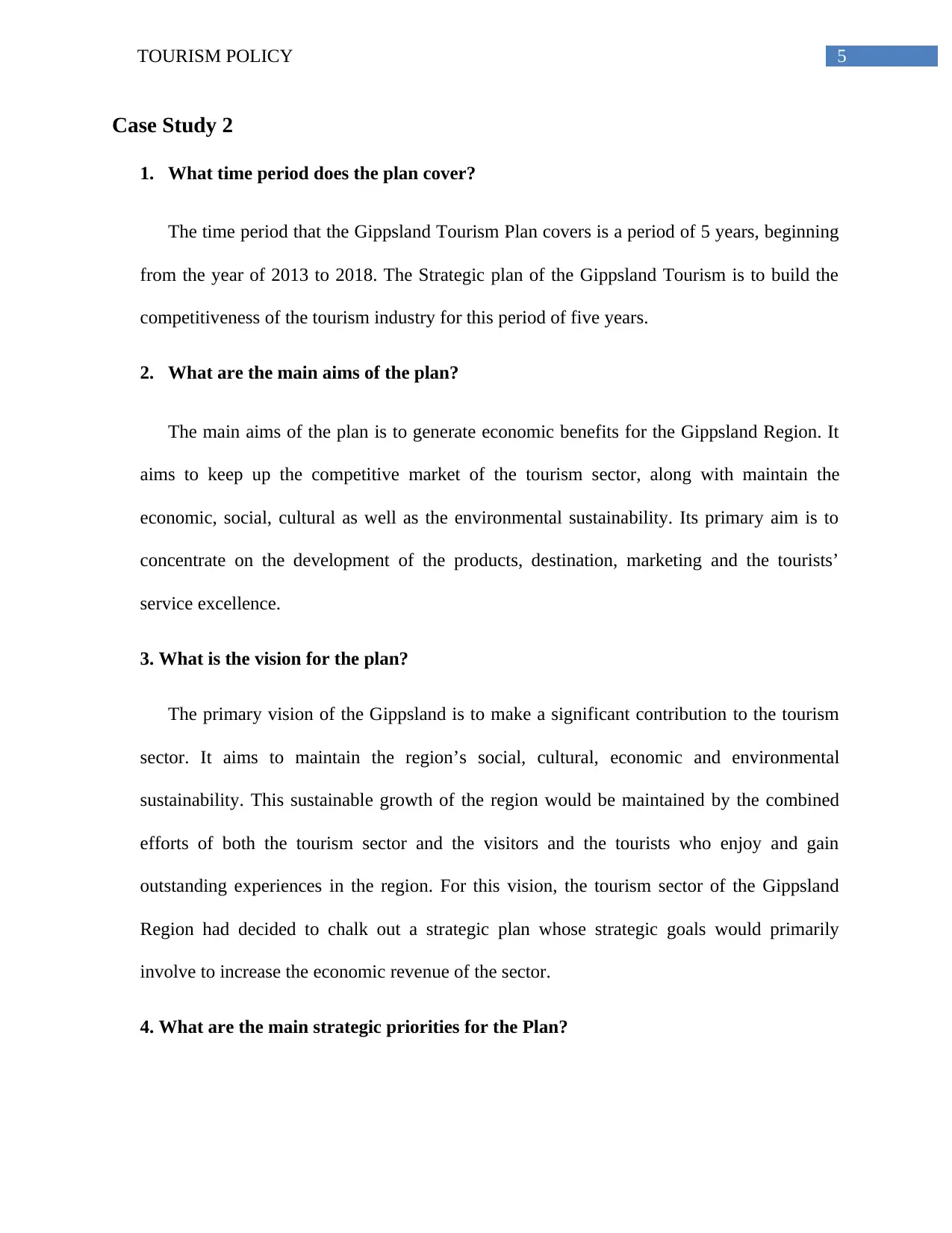
Case Study 2
1. What time period does the plan cover?
The time period that the Gippsland Tourism Plan covers is a period of 5 years, beginning
from the year of 2013 to 2018. The Strategic plan of the Gippsland Tourism is to build the
competitiveness of the tourism industry for this period of five years.
2. What are the main aims of the plan?
The main aims of the plan is to generate economic benefits for the Gippsland Region. It
aims to keep up the competitive market of the tourism sector, along with maintain the
economic, social, cultural as well as the environmental sustainability. Its primary aim is to
concentrate on the development of the products, destination, marketing and the tourists’
service excellence.
3. What is the vision for the plan?
The primary vision of the Gippsland is to make a significant contribution to the tourism
sector. It aims to maintain the region’s social, cultural, economic and environmental
sustainability. This sustainable growth of the region would be maintained by the combined
efforts of both the tourism sector and the visitors and the tourists who enjoy and gain
outstanding experiences in the region. For this vision, the tourism sector of the Gippsland
Region had decided to chalk out a strategic plan whose strategic goals would primarily
involve to increase the economic revenue of the sector.
4. What are the main strategic priorities for the Plan?
Case Study 2
1. What time period does the plan cover?
The time period that the Gippsland Tourism Plan covers is a period of 5 years, beginning
from the year of 2013 to 2018. The Strategic plan of the Gippsland Tourism is to build the
competitiveness of the tourism industry for this period of five years.
2. What are the main aims of the plan?
The main aims of the plan is to generate economic benefits for the Gippsland Region. It
aims to keep up the competitive market of the tourism sector, along with maintain the
economic, social, cultural as well as the environmental sustainability. Its primary aim is to
concentrate on the development of the products, destination, marketing and the tourists’
service excellence.
3. What is the vision for the plan?
The primary vision of the Gippsland is to make a significant contribution to the tourism
sector. It aims to maintain the region’s social, cultural, economic and environmental
sustainability. This sustainable growth of the region would be maintained by the combined
efforts of both the tourism sector and the visitors and the tourists who enjoy and gain
outstanding experiences in the region. For this vision, the tourism sector of the Gippsland
Region had decided to chalk out a strategic plan whose strategic goals would primarily
involve to increase the economic revenue of the sector.
4. What are the main strategic priorities for the Plan?
⊘ This is a preview!⊘
Do you want full access?
Subscribe today to unlock all pages.
Trusted by 1+ million students worldwide
6TOURISM POLICY
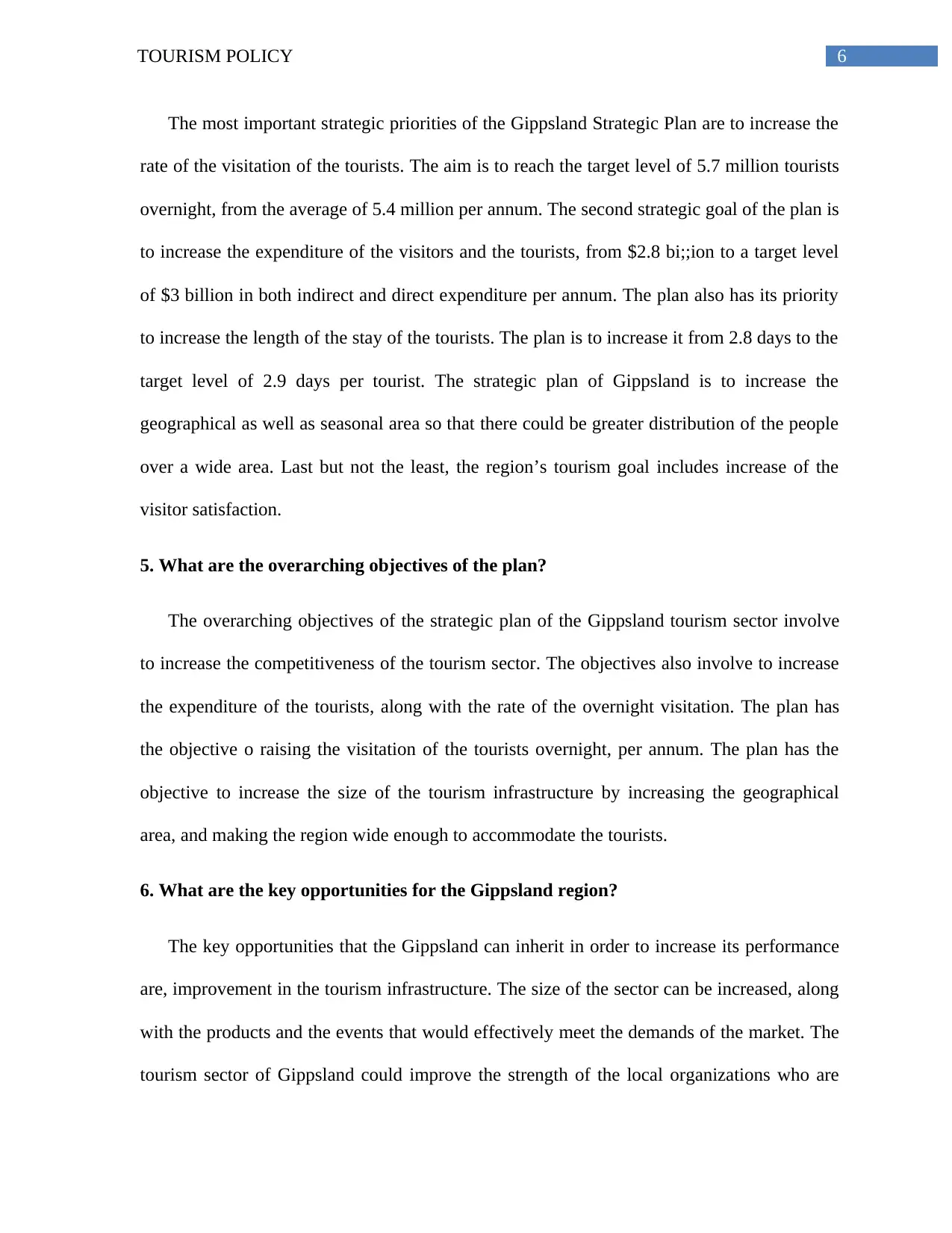
The most important strategic priorities of the Gippsland Strategic Plan are to increase the
rate of the visitation of the tourists. The aim is to reach the target level of 5.7 million tourists
overnight, from the average of 5.4 million per annum. The second strategic goal of the plan is
to increase the expenditure of the visitors and the tourists, from $2.8 bi;;ion to a target level
of $3 billion in both indirect and direct expenditure per annum. The plan also has its priority
to increase the length of the stay of the tourists. The plan is to increase it from 2.8 days to the
target level of 2.9 days per tourist. The strategic plan of Gippsland is to increase the
geographical as well as seasonal area so that there could be greater distribution of the people
over a wide area. Last but not the least, the region’s tourism goal includes increase of the
visitor satisfaction.
5. What are the overarching objectives of the plan?
The overarching objectives of the strategic plan of the Gippsland tourism sector involve
to increase the competitiveness of the tourism sector. The objectives also involve to increase
the expenditure of the tourists, along with the rate of the overnight visitation. The plan has
the objective o raising the visitation of the tourists overnight, per annum. The plan has the
objective to increase the size of the tourism infrastructure by increasing the geographical
area, and making the region wide enough to accommodate the tourists.
6. What are the key opportunities for the Gippsland region?
The key opportunities that the Gippsland can inherit in order to increase its performance
are, improvement in the tourism infrastructure. The size of the sector can be increased, along
with the products and the events that would effectively meet the demands of the market. The
tourism sector of Gippsland could improve the strength of the local organizations who are
The most important strategic priorities of the Gippsland Strategic Plan are to increase the
rate of the visitation of the tourists. The aim is to reach the target level of 5.7 million tourists
overnight, from the average of 5.4 million per annum. The second strategic goal of the plan is
to increase the expenditure of the visitors and the tourists, from $2.8 bi;;ion to a target level
of $3 billion in both indirect and direct expenditure per annum. The plan also has its priority
to increase the length of the stay of the tourists. The plan is to increase it from 2.8 days to the
target level of 2.9 days per tourist. The strategic plan of Gippsland is to increase the
geographical as well as seasonal area so that there could be greater distribution of the people
over a wide area. Last but not the least, the region’s tourism goal includes increase of the
visitor satisfaction.
5. What are the overarching objectives of the plan?
The overarching objectives of the strategic plan of the Gippsland tourism sector involve
to increase the competitiveness of the tourism sector. The objectives also involve to increase
the expenditure of the tourists, along with the rate of the overnight visitation. The plan has
the objective o raising the visitation of the tourists overnight, per annum. The plan has the
objective to increase the size of the tourism infrastructure by increasing the geographical
area, and making the region wide enough to accommodate the tourists.
6. What are the key opportunities for the Gippsland region?
The key opportunities that the Gippsland can inherit in order to increase its performance
are, improvement in the tourism infrastructure. The size of the sector can be increased, along
with the products and the events that would effectively meet the demands of the market. The
tourism sector of Gippsland could improve the strength of the local organizations who are
Paraphrase This Document
Need a fresh take? Get an instant paraphrase of this document with our AI Paraphraser
7TOURISM POLICY
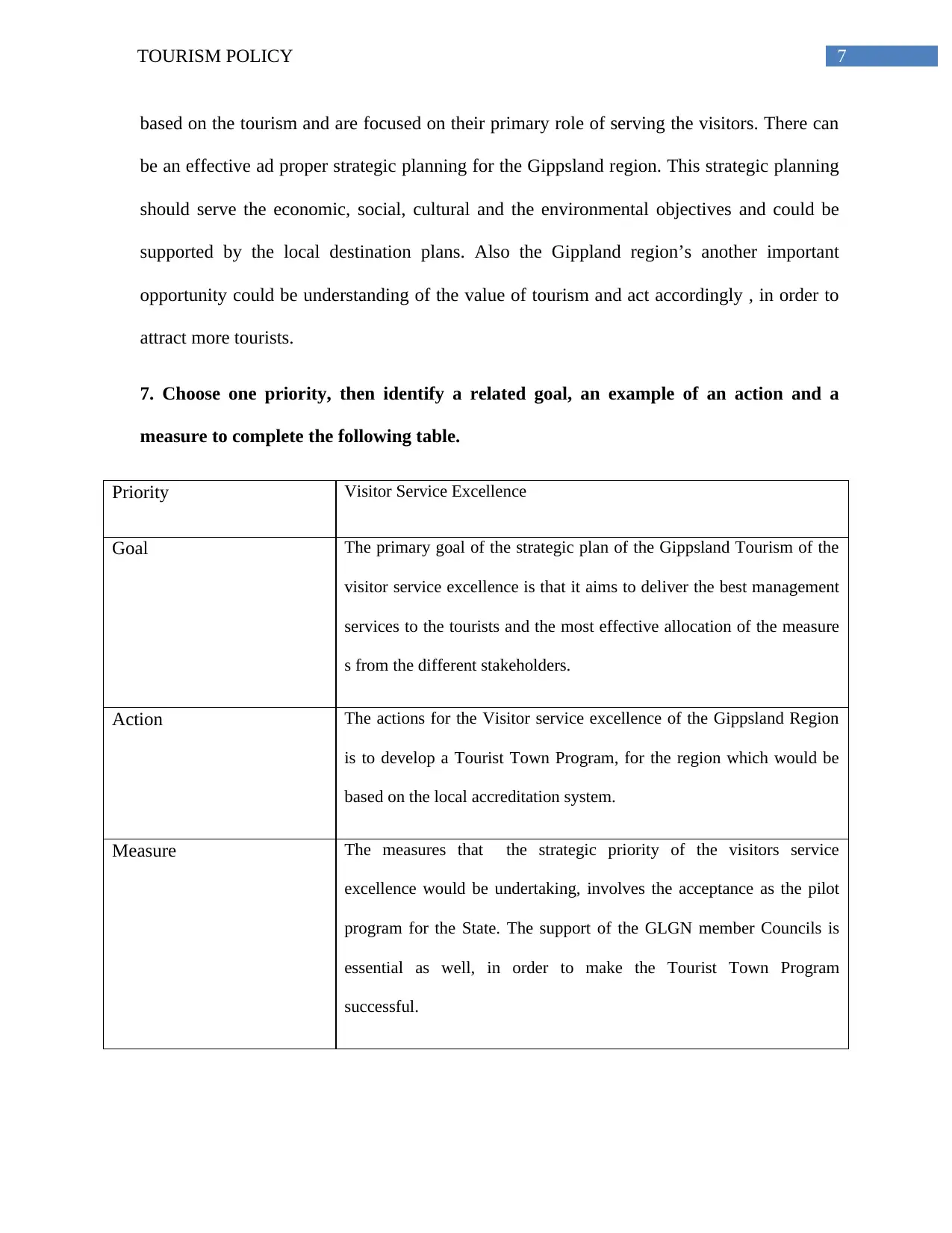
based on the tourism and are focused on their primary role of serving the visitors. There can
be an effective ad proper strategic planning for the Gippsland region. This strategic planning
should serve the economic, social, cultural and the environmental objectives and could be
supported by the local destination plans. Also the Gippland region’s another important
opportunity could be understanding of the value of tourism and act accordingly , in order to
attract more tourists.
7. Choose one priority, then identify a related goal, an example of an action and a
measure to complete the following table.
Priority Visitor Service Excellence
Goal The primary goal of the strategic plan of the Gippsland Tourism of the
visitor service excellence is that it aims to deliver the best management
services to the tourists and the most effective allocation of the measure
s from the different stakeholders.
Action The actions for the Visitor service excellence of the Gippsland Region
is to develop a Tourist Town Program, for the region which would be
based on the local accreditation system.
Measure The measures that the strategic priority of the visitors service
excellence would be undertaking, involves the acceptance as the pilot
program for the State. The support of the GLGN member Councils is
essential as well, in order to make the Tourist Town Program
successful.
based on the tourism and are focused on their primary role of serving the visitors. There can
be an effective ad proper strategic planning for the Gippsland region. This strategic planning
should serve the economic, social, cultural and the environmental objectives and could be
supported by the local destination plans. Also the Gippland region’s another important
opportunity could be understanding of the value of tourism and act accordingly , in order to
attract more tourists.
7. Choose one priority, then identify a related goal, an example of an action and a
measure to complete the following table.
Priority Visitor Service Excellence
Goal The primary goal of the strategic plan of the Gippsland Tourism of the
visitor service excellence is that it aims to deliver the best management
services to the tourists and the most effective allocation of the measure
s from the different stakeholders.
Action The actions for the Visitor service excellence of the Gippsland Region
is to develop a Tourist Town Program, for the region which would be
based on the local accreditation system.
Measure The measures that the strategic priority of the visitors service
excellence would be undertaking, involves the acceptance as the pilot
program for the State. The support of the GLGN member Councils is
essential as well, in order to make the Tourist Town Program
successful.
8TOURISM POLICY
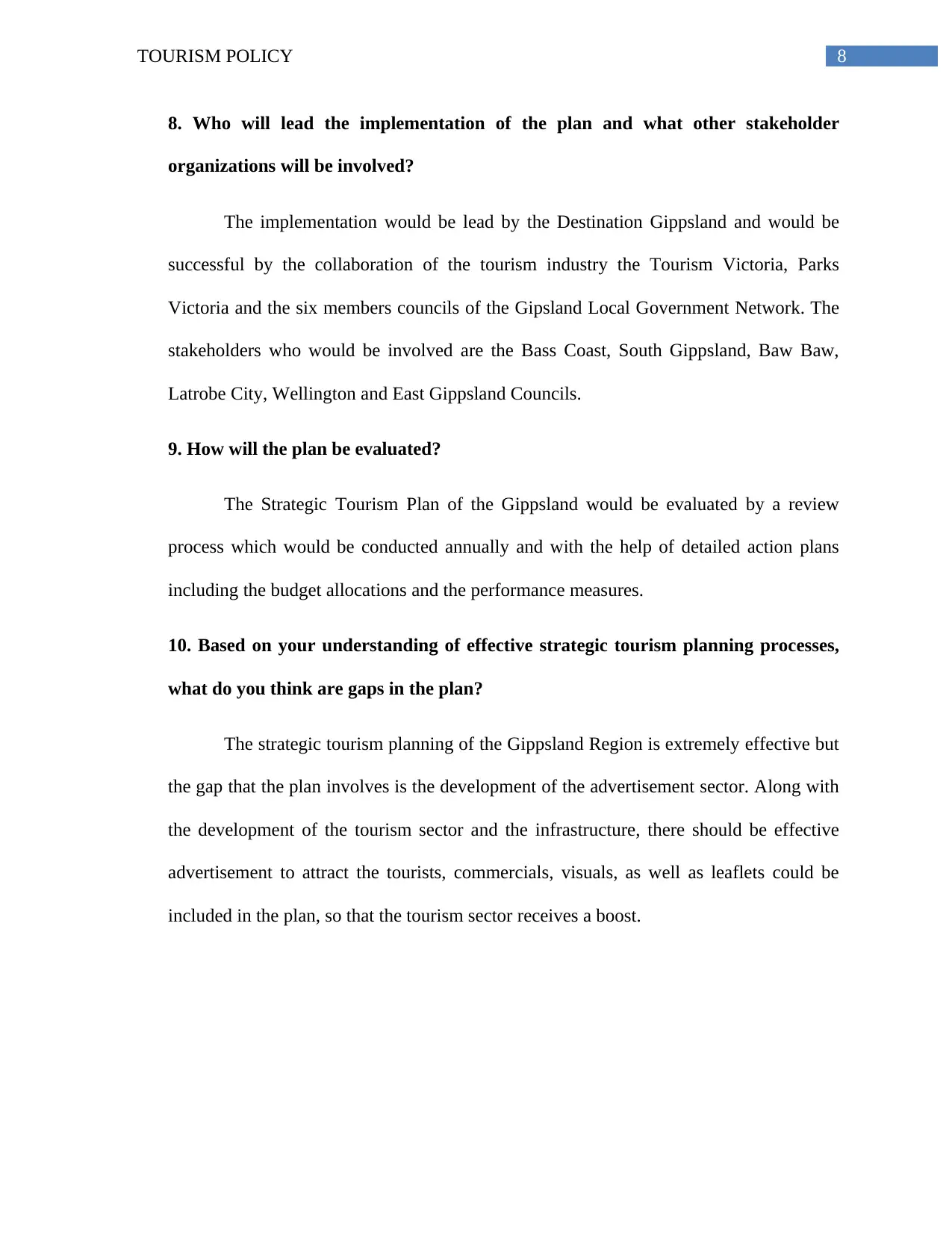
8. Who will lead the implementation of the plan and what other stakeholder
organizations will be involved?
The implementation would be lead by the Destination Gippsland and would be
successful by the collaboration of the tourism industry the Tourism Victoria, Parks
Victoria and the six members councils of the Gipsland Local Government Network. The
stakeholders who would be involved are the Bass Coast, South Gippsland, Baw Baw,
Latrobe City, Wellington and East Gippsland Councils.
9. How will the plan be evaluated?
The Strategic Tourism Plan of the Gippsland would be evaluated by a review
process which would be conducted annually and with the help of detailed action plans
including the budget allocations and the performance measures.
10. Based on your understanding of effective strategic tourism planning processes,
what do you think are gaps in the plan?
The strategic tourism planning of the Gippsland Region is extremely effective but
the gap that the plan involves is the development of the advertisement sector. Along with
the development of the tourism sector and the infrastructure, there should be effective
advertisement to attract the tourists, commercials, visuals, as well as leaflets could be
included in the plan, so that the tourism sector receives a boost.
8. Who will lead the implementation of the plan and what other stakeholder
organizations will be involved?
The implementation would be lead by the Destination Gippsland and would be
successful by the collaboration of the tourism industry the Tourism Victoria, Parks
Victoria and the six members councils of the Gipsland Local Government Network. The
stakeholders who would be involved are the Bass Coast, South Gippsland, Baw Baw,
Latrobe City, Wellington and East Gippsland Councils.
9. How will the plan be evaluated?
The Strategic Tourism Plan of the Gippsland would be evaluated by a review
process which would be conducted annually and with the help of detailed action plans
including the budget allocations and the performance measures.
10. Based on your understanding of effective strategic tourism planning processes,
what do you think are gaps in the plan?
The strategic tourism planning of the Gippsland Region is extremely effective but
the gap that the plan involves is the development of the advertisement sector. Along with
the development of the tourism sector and the infrastructure, there should be effective
advertisement to attract the tourists, commercials, visuals, as well as leaflets could be
included in the plan, so that the tourism sector receives a boost.
⊘ This is a preview!⊘
Do you want full access?
Subscribe today to unlock all pages.
Trusted by 1+ million students worldwide
9TOURISM POLICY
Case Study 3
Explain the concept of pro poor tourism?
There is a growing idea that tourism can contribute to increase in poverty. Pro-poor
tourism is defined as the tourism that helps in generating the benefits for the poor people in the
cities where tourism is one of the main sources of revenue. The benefits that are generated could
be economic, social, cultural or environmental. Hence till the time the financially backward
people have the ability to enjoy the benefits of the tourism industry it is known as pro-poor
tourism. The main of the pro-poor tourism is to use the opportunities of the tourism for the poor.
Pro-poor tourism is not a different sector of the tourism industry; it is an approach to the tourism
industry (Scheyvens & Russel, 2012). It also involves a number of stakeholders operating at
various levels, from micro to macro. The stakeholders include the government, the private sector
and the civil society.
Identify four factors that have contributed to the poverty situation in Fiji?
The four factors that have contributed to the situation of poverty in Fiji, among the South
Pacific country, the largest tourism industry is in country of Fiji. The dependencies on tourism
have increased quite a bit because of the decline in the traditional export sales in the country
(Scheyvens & Russel, 2012).. Sugar is one of the most important crops in Fiji and decline in the
export market, especially losing the European market have adversely affected the economy of
Fiji. The exports of other material such as the garment and fisheries have also suffered in a
massive way and this has led to the decline in the economy of Fiji. These are reason why the
dependency on tourism has increased and the reason behind the benefit of creating a pro-poor
Case Study 3
Explain the concept of pro poor tourism?
There is a growing idea that tourism can contribute to increase in poverty. Pro-poor
tourism is defined as the tourism that helps in generating the benefits for the poor people in the
cities where tourism is one of the main sources of revenue. The benefits that are generated could
be economic, social, cultural or environmental. Hence till the time the financially backward
people have the ability to enjoy the benefits of the tourism industry it is known as pro-poor
tourism. The main of the pro-poor tourism is to use the opportunities of the tourism for the poor.
Pro-poor tourism is not a different sector of the tourism industry; it is an approach to the tourism
industry (Scheyvens & Russel, 2012). It also involves a number of stakeholders operating at
various levels, from micro to macro. The stakeholders include the government, the private sector
and the civil society.
Identify four factors that have contributed to the poverty situation in Fiji?
The four factors that have contributed to the situation of poverty in Fiji, among the South
Pacific country, the largest tourism industry is in country of Fiji. The dependencies on tourism
have increased quite a bit because of the decline in the traditional export sales in the country
(Scheyvens & Russel, 2012).. Sugar is one of the most important crops in Fiji and decline in the
export market, especially losing the European market have adversely affected the economy of
Fiji. The exports of other material such as the garment and fisheries have also suffered in a
massive way and this has led to the decline in the economy of Fiji. These are reason why the
dependency on tourism has increased and the reason behind the benefit of creating a pro-poor
Paraphrase This Document
Need a fresh take? Get an instant paraphrase of this document with our AI Paraphraser
10TOURISM POLICY
tourism. The tourism growth has not helped with the situation of poverty in any way. In Fiji
approximately 15% of the household lived below the poverty line in the year 1977. This figure
rose to 34.4% in the years 2203-2003 (Scheyvens & Russel, 2012). This shows that poverty is
Fiji is gradually increasing. Poverty is the worst social problem in the country of Fiji. As
mentioned earlier, the problem of poverty has worsened because of the decrease in the export of
sugar and other materials. The loosing of the European market has been a severe blow to the
country’s economy. This has led to increase in the poverty situation of the country. There has
been a cutback in the employment rate of the government. The bargaining power of the labor
unions has also decreased and finally the introduction of the value added tax on all items and
including the basic necessities.
What is the main tourism policy document for Fiji?
The main tourism policy in the country of Fiji is the Tourism Development Plan 2007-
2016. This policy tries to put special emphasis on the four planks of prosperity which is the
social, cultural, environmental and economic as the key to sustainable economic development.
The goal of the Tourism Development Plan 2007-2016 is achieving 1.1 million visitors and
building a tourism infrastructure with more than 16000 rooms. This is the only tourism policy
that Fiji has (Scheyvens & Russel, 2012).
What are the main criticisms of this policy?
The Tourism Development Plan 2007-2016 is a plan that involves large scale growth.
The government has been criticized for this policy as the government is failing to take any steps
to amend the negative impact that is caused by the high level of foreign ownership (Scheyvens &
tourism. The tourism growth has not helped with the situation of poverty in any way. In Fiji
approximately 15% of the household lived below the poverty line in the year 1977. This figure
rose to 34.4% in the years 2203-2003 (Scheyvens & Russel, 2012). This shows that poverty is
Fiji is gradually increasing. Poverty is the worst social problem in the country of Fiji. As
mentioned earlier, the problem of poverty has worsened because of the decrease in the export of
sugar and other materials. The loosing of the European market has been a severe blow to the
country’s economy. This has led to increase in the poverty situation of the country. There has
been a cutback in the employment rate of the government. The bargaining power of the labor
unions has also decreased and finally the introduction of the value added tax on all items and
including the basic necessities.
What is the main tourism policy document for Fiji?
The main tourism policy in the country of Fiji is the Tourism Development Plan 2007-
2016. This policy tries to put special emphasis on the four planks of prosperity which is the
social, cultural, environmental and economic as the key to sustainable economic development.
The goal of the Tourism Development Plan 2007-2016 is achieving 1.1 million visitors and
building a tourism infrastructure with more than 16000 rooms. This is the only tourism policy
that Fiji has (Scheyvens & Russel, 2012).
What are the main criticisms of this policy?
The Tourism Development Plan 2007-2016 is a plan that involves large scale growth.
The government has been criticized for this policy as the government is failing to take any steps
to amend the negative impact that is caused by the high level of foreign ownership (Scheyvens &
11TOURISM POLICY
Russel, 2012). These includes unequal geographic and spatial developments, long term leakage
and repatriation of profits and most significantly the failure to develop any links between tourism
facilities and the local economies.
Identify two ways small-scale resorts make a contribution to alleviate
poverty?
A small scale resort in Fiji is the Yasawa Island Backpacker resorts. This is a small scale
resort and has a lot of ways in which the common population can benefit from them and this can
decrease in the amount of poverty that is present in the island of Fiji. Proper paid employment
will be generated as a result of the backpacker resort. This will be a new source of economy to
the Yasawas as they have very little source of income (Scheyvens & Russel, 2012). Another
benefit from the resort is that there could be some sort of entertainment that can be provided by
the locals as usually in a resort there are activities especially entertainment activities that are
organized.
Identify two ways large-scale resorts make a contribution to alleviate poverty?
The large scale resorts are financially stronger and they have more ways to employ
people as there are usually a lot of weddings that take place in the large scale resorts and they for
a wedding more local people have to be employed and this would help the locals in getting some
amount of money. According to one of the Native Lands Trust Board requirement, a local
representative has to be present in the board of directors. This means that a person from the
community is getting permanent employment (Scheyvens & Russel, 2012).
Russel, 2012). These includes unequal geographic and spatial developments, long term leakage
and repatriation of profits and most significantly the failure to develop any links between tourism
facilities and the local economies.
Identify two ways small-scale resorts make a contribution to alleviate
poverty?
A small scale resort in Fiji is the Yasawa Island Backpacker resorts. This is a small scale
resort and has a lot of ways in which the common population can benefit from them and this can
decrease in the amount of poverty that is present in the island of Fiji. Proper paid employment
will be generated as a result of the backpacker resort. This will be a new source of economy to
the Yasawas as they have very little source of income (Scheyvens & Russel, 2012). Another
benefit from the resort is that there could be some sort of entertainment that can be provided by
the locals as usually in a resort there are activities especially entertainment activities that are
organized.
Identify two ways large-scale resorts make a contribution to alleviate poverty?
The large scale resorts are financially stronger and they have more ways to employ
people as there are usually a lot of weddings that take place in the large scale resorts and they for
a wedding more local people have to be employed and this would help the locals in getting some
amount of money. According to one of the Native Lands Trust Board requirement, a local
representative has to be present in the board of directors. This means that a person from the
community is getting permanent employment (Scheyvens & Russel, 2012).
⊘ This is a preview!⊘
Do you want full access?
Subscribe today to unlock all pages.
Trusted by 1+ million students worldwide

1 out of 15


Related Documents


Your All-in-One AI-Powered Toolkit for Academic Success.
+13062052269
info@desklib.com
Available 24*7 on WhatsApp / Email
![[object Object]](/_next/static/media/star-bottom.7253800d.svg)
Unlock your academic potential
Copyright © 2020–2026 A2Z Services. All Rights Reserved. Developed and managed by ZUCOL.