Critical Review of Tourism Planning Environment and Policy Frameworks
VerifiedAdded on 2020/03/04
|9
|2213
|55
Report
AI Summary
This report presents a critical review of the tourism planning environment, focusing on two discussion papers related to tourism in Australia: Alpine Shire Rural Land Strategy and South Australian Nature-based Tourism. The review examines the policy development frameworks, research methods (quantitative for Alpine Shire and qualitative for South Australia), and findings related to tourism growth and development. It highlights recommendations for improvements, such as enhancing rural and agricultural tourism, developing marketing campaigns, and improving visitor resources. The report also critiques the discussion papers' credibility and usefulness, emphasizing the importance of policy formulation and the potential for further research to address existing gaps. It concludes by underscoring the significance of these papers for students and professionals in the field of tourism and policy development, providing valuable insights into the complexities of tourism planning and its impact on the industry. The report also highlights the differences and similarities of tourism in the two regions, and how this can be helpful in formulating tourism policies.
0
Tourism Planning Environment
CRITICAL REVIEW
Tourism Planning Environment
Student’s Name
Course Code
Tourism Planning Environment
CRITICAL REVIEW
Tourism Planning Environment
Student’s Name
Course Code
Paraphrase This Document
Need a fresh take? Get an instant paraphrase of this document with our AI Paraphraser

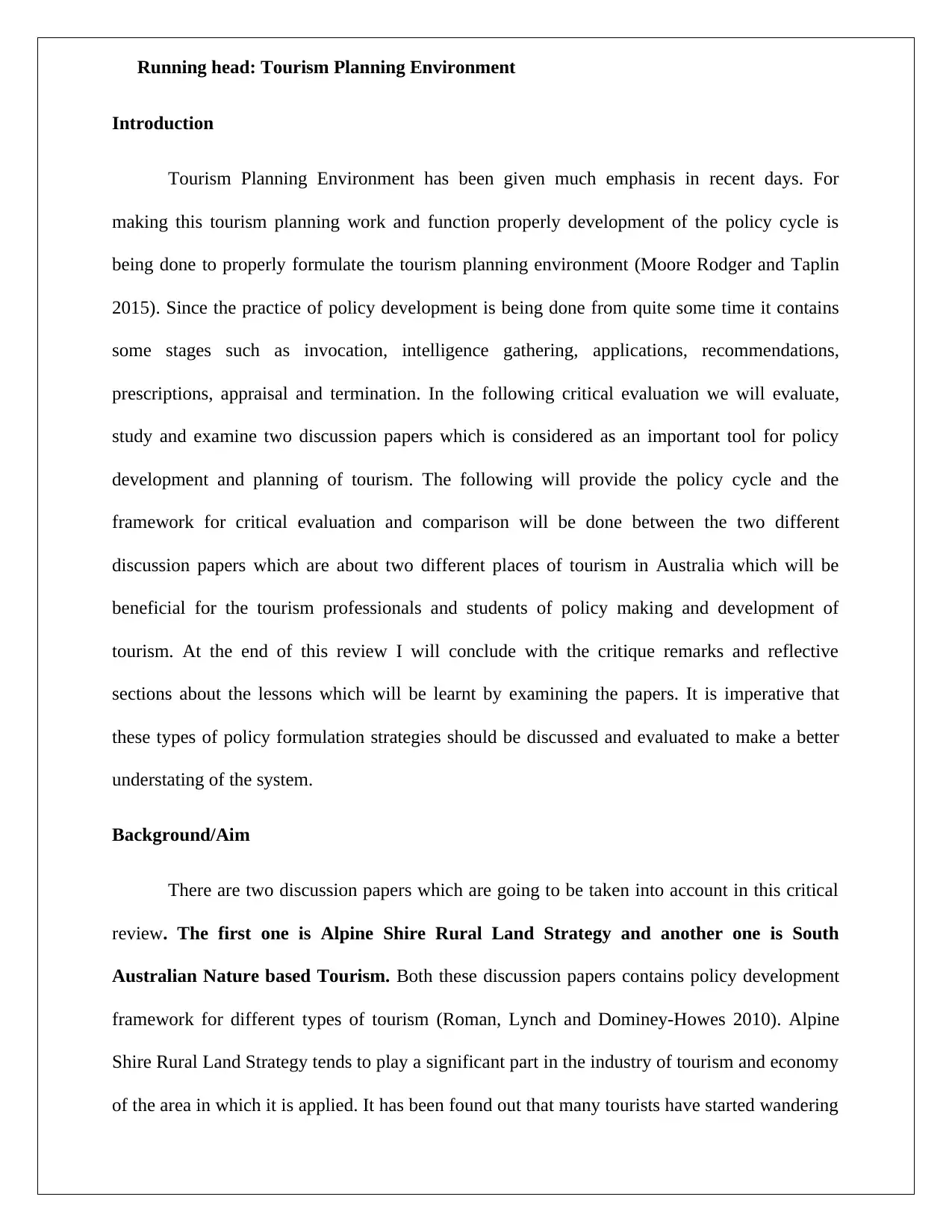
Running head: Tourism Planning Environment
Introduction
Tourism Planning Environment has been given much emphasis in recent days. For
making this tourism planning work and function properly development of the policy cycle is
being done to properly formulate the tourism planning environment (Moore Rodger and Taplin
2015). Since the practice of policy development is being done from quite some time it contains
some stages such as invocation, intelligence gathering, applications, recommendations,
prescriptions, appraisal and termination. In the following critical evaluation we will evaluate,
study and examine two discussion papers which is considered as an important tool for policy
development and planning of tourism. The following will provide the policy cycle and the
framework for critical evaluation and comparison will be done between the two different
discussion papers which are about two different places of tourism in Australia which will be
beneficial for the tourism professionals and students of policy making and development of
tourism. At the end of this review I will conclude with the critique remarks and reflective
sections about the lessons which will be learnt by examining the papers. It is imperative that
these types of policy formulation strategies should be discussed and evaluated to make a better
understating of the system.
Background/Aim
There are two discussion papers which are going to be taken into account in this critical
review. The first one is Alpine Shire Rural Land Strategy and another one is South
Australian Nature based Tourism. Both these discussion papers contains policy development
framework for different types of tourism (Roman, Lynch and Dominey-Howes 2010). Alpine
Shire Rural Land Strategy tends to play a significant part in the industry of tourism and economy
of the area in which it is applied. It has been found out that many tourists have started wandering
Introduction
Tourism Planning Environment has been given much emphasis in recent days. For
making this tourism planning work and function properly development of the policy cycle is
being done to properly formulate the tourism planning environment (Moore Rodger and Taplin
2015). Since the practice of policy development is being done from quite some time it contains
some stages such as invocation, intelligence gathering, applications, recommendations,
prescriptions, appraisal and termination. In the following critical evaluation we will evaluate,
study and examine two discussion papers which is considered as an important tool for policy
development and planning of tourism. The following will provide the policy cycle and the
framework for critical evaluation and comparison will be done between the two different
discussion papers which are about two different places of tourism in Australia which will be
beneficial for the tourism professionals and students of policy making and development of
tourism. At the end of this review I will conclude with the critique remarks and reflective
sections about the lessons which will be learnt by examining the papers. It is imperative that
these types of policy formulation strategies should be discussed and evaluated to make a better
understating of the system.
Background/Aim
There are two discussion papers which are going to be taken into account in this critical
review. The first one is Alpine Shire Rural Land Strategy and another one is South
Australian Nature based Tourism. Both these discussion papers contains policy development
framework for different types of tourism (Roman, Lynch and Dominey-Howes 2010). Alpine
Shire Rural Land Strategy tends to play a significant part in the industry of tourism and economy
of the area in which it is applied. It has been found out that many tourists have started wandering

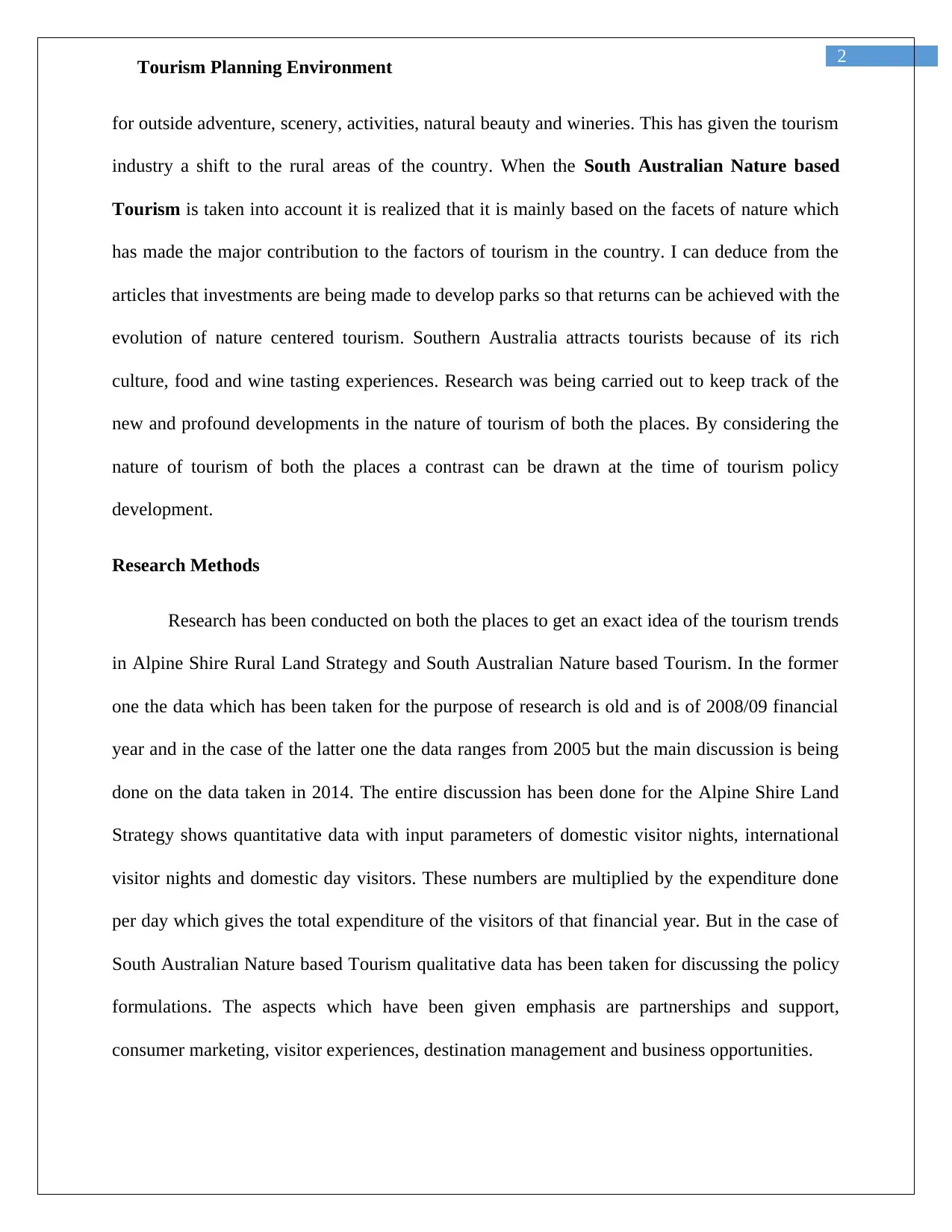
2
Tourism Planning Environment
for outside adventure, scenery, activities, natural beauty and wineries. This has given the tourism
industry a shift to the rural areas of the country. When the South Australian Nature based
Tourism is taken into account it is realized that it is mainly based on the facets of nature which
has made the major contribution to the factors of tourism in the country. I can deduce from the
articles that investments are being made to develop parks so that returns can be achieved with the
evolution of nature centered tourism. Southern Australia attracts tourists because of its rich
culture, food and wine tasting experiences. Research was being carried out to keep track of the
new and profound developments in the nature of tourism of both the places. By considering the
nature of tourism of both the places a contrast can be drawn at the time of tourism policy
development.
Research Methods
Research has been conducted on both the places to get an exact idea of the tourism trends
in Alpine Shire Rural Land Strategy and South Australian Nature based Tourism. In the former
one the data which has been taken for the purpose of research is old and is of 2008/09 financial
year and in the case of the latter one the data ranges from 2005 but the main discussion is being
done on the data taken in 2014. The entire discussion has been done for the Alpine Shire Land
Strategy shows quantitative data with input parameters of domestic visitor nights, international
visitor nights and domestic day visitors. These numbers are multiplied by the expenditure done
per day which gives the total expenditure of the visitors of that financial year. But in the case of
South Australian Nature based Tourism qualitative data has been taken for discussing the policy
formulations. The aspects which have been given emphasis are partnerships and support,
consumer marketing, visitor experiences, destination management and business opportunities.
Tourism Planning Environment
for outside adventure, scenery, activities, natural beauty and wineries. This has given the tourism
industry a shift to the rural areas of the country. When the South Australian Nature based
Tourism is taken into account it is realized that it is mainly based on the facets of nature which
has made the major contribution to the factors of tourism in the country. I can deduce from the
articles that investments are being made to develop parks so that returns can be achieved with the
evolution of nature centered tourism. Southern Australia attracts tourists because of its rich
culture, food and wine tasting experiences. Research was being carried out to keep track of the
new and profound developments in the nature of tourism of both the places. By considering the
nature of tourism of both the places a contrast can be drawn at the time of tourism policy
development.
Research Methods
Research has been conducted on both the places to get an exact idea of the tourism trends
in Alpine Shire Rural Land Strategy and South Australian Nature based Tourism. In the former
one the data which has been taken for the purpose of research is old and is of 2008/09 financial
year and in the case of the latter one the data ranges from 2005 but the main discussion is being
done on the data taken in 2014. The entire discussion has been done for the Alpine Shire Land
Strategy shows quantitative data with input parameters of domestic visitor nights, international
visitor nights and domestic day visitors. These numbers are multiplied by the expenditure done
per day which gives the total expenditure of the visitors of that financial year. But in the case of
South Australian Nature based Tourism qualitative data has been taken for discussing the policy
formulations. The aspects which have been given emphasis are partnerships and support,
consumer marketing, visitor experiences, destination management and business opportunities.
⊘ This is a preview!⊘
Do you want full access?
Subscribe today to unlock all pages.

Trusted by 1+ million students worldwide

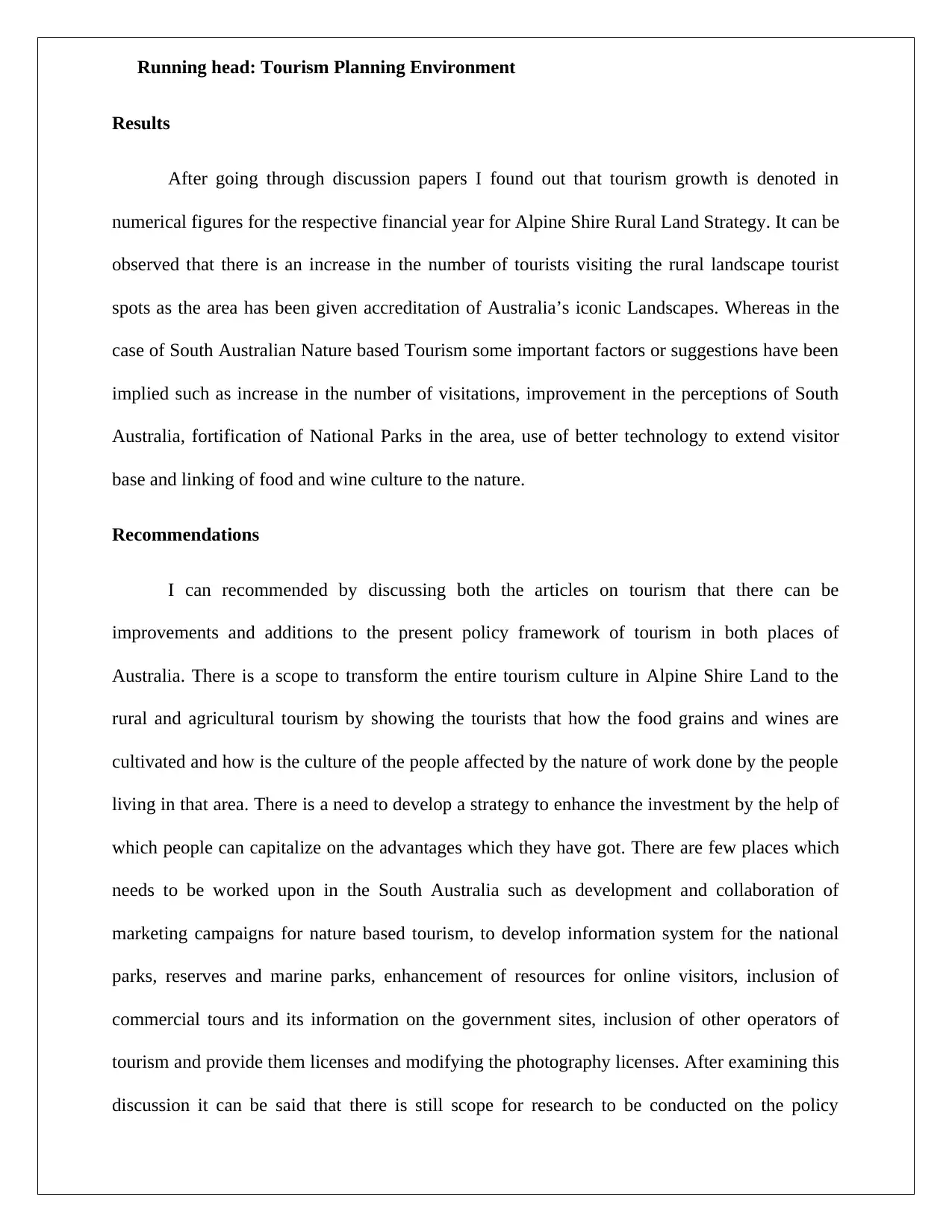
Running head: Tourism Planning Environment
Results
After going through discussion papers I found out that tourism growth is denoted in
numerical figures for the respective financial year for Alpine Shire Rural Land Strategy. It can be
observed that there is an increase in the number of tourists visiting the rural landscape tourist
spots as the area has been given accreditation of Australia’s iconic Landscapes. Whereas in the
case of South Australian Nature based Tourism some important factors or suggestions have been
implied such as increase in the number of visitations, improvement in the perceptions of South
Australia, fortification of National Parks in the area, use of better technology to extend visitor
base and linking of food and wine culture to the nature.
Recommendations
I can recommended by discussing both the articles on tourism that there can be
improvements and additions to the present policy framework of tourism in both places of
Australia. There is a scope to transform the entire tourism culture in Alpine Shire Land to the
rural and agricultural tourism by showing the tourists that how the food grains and wines are
cultivated and how is the culture of the people affected by the nature of work done by the people
living in that area. There is a need to develop a strategy to enhance the investment by the help of
which people can capitalize on the advantages which they have got. There are few places which
needs to be worked upon in the South Australia such as development and collaboration of
marketing campaigns for nature based tourism, to develop information system for the national
parks, reserves and marine parks, enhancement of resources for online visitors, inclusion of
commercial tours and its information on the government sites, inclusion of other operators of
tourism and provide them licenses and modifying the photography licenses. After examining this
discussion it can be said that there is still scope for research to be conducted on the policy
Results
After going through discussion papers I found out that tourism growth is denoted in
numerical figures for the respective financial year for Alpine Shire Rural Land Strategy. It can be
observed that there is an increase in the number of tourists visiting the rural landscape tourist
spots as the area has been given accreditation of Australia’s iconic Landscapes. Whereas in the
case of South Australian Nature based Tourism some important factors or suggestions have been
implied such as increase in the number of visitations, improvement in the perceptions of South
Australia, fortification of National Parks in the area, use of better technology to extend visitor
base and linking of food and wine culture to the nature.
Recommendations
I can recommended by discussing both the articles on tourism that there can be
improvements and additions to the present policy framework of tourism in both places of
Australia. There is a scope to transform the entire tourism culture in Alpine Shire Land to the
rural and agricultural tourism by showing the tourists that how the food grains and wines are
cultivated and how is the culture of the people affected by the nature of work done by the people
living in that area. There is a need to develop a strategy to enhance the investment by the help of
which people can capitalize on the advantages which they have got. There are few places which
needs to be worked upon in the South Australia such as development and collaboration of
marketing campaigns for nature based tourism, to develop information system for the national
parks, reserves and marine parks, enhancement of resources for online visitors, inclusion of
commercial tours and its information on the government sites, inclusion of other operators of
tourism and provide them licenses and modifying the photography licenses. After examining this
discussion it can be said that there is still scope for research to be conducted on the policy
Paraphrase This Document
Need a fresh take? Get an instant paraphrase of this document with our AI Paraphraser

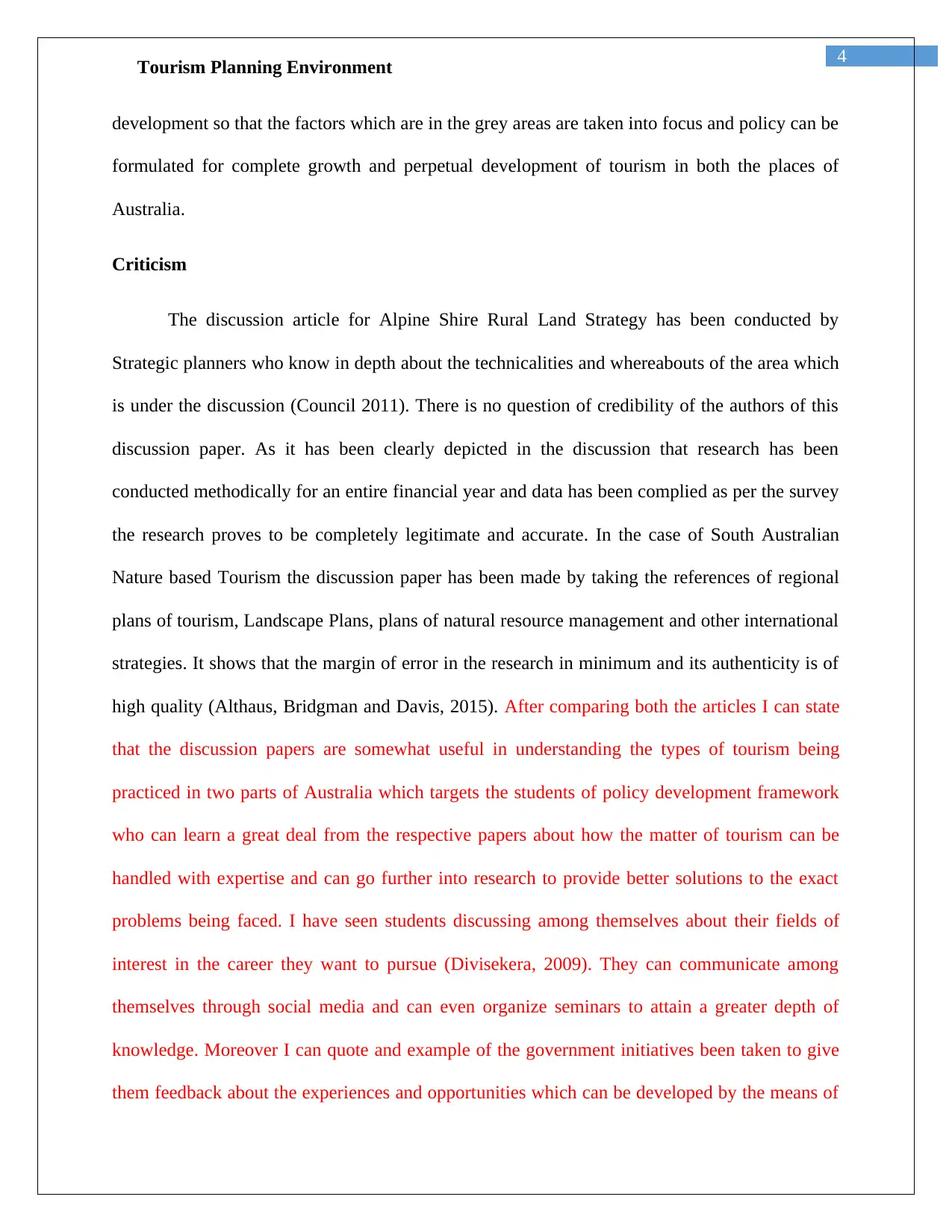
4
Tourism Planning Environment
development so that the factors which are in the grey areas are taken into focus and policy can be
formulated for complete growth and perpetual development of tourism in both the places of
Australia.
Criticism
The discussion article for Alpine Shire Rural Land Strategy has been conducted by
Strategic planners who know in depth about the technicalities and whereabouts of the area which
is under the discussion (Council 2011). There is no question of credibility of the authors of this
discussion paper. As it has been clearly depicted in the discussion that research has been
conducted methodically for an entire financial year and data has been complied as per the survey
the research proves to be completely legitimate and accurate. In the case of South Australian
Nature based Tourism the discussion paper has been made by taking the references of regional
plans of tourism, Landscape Plans, plans of natural resource management and other international
strategies. It shows that the margin of error in the research in minimum and its authenticity is of
high quality (Althaus, Bridgman and Davis, 2015). After comparing both the articles I can state
that the discussion papers are somewhat useful in understanding the types of tourism being
practiced in two parts of Australia which targets the students of policy development framework
who can learn a great deal from the respective papers about how the matter of tourism can be
handled with expertise and can go further into research to provide better solutions to the exact
problems being faced. I have seen students discussing among themselves about their fields of
interest in the career they want to pursue (Divisekera, 2009). They can communicate among
themselves through social media and can even organize seminars to attain a greater depth of
knowledge. Moreover I can quote and example of the government initiatives been taken to give
them feedback about the experiences and opportunities which can be developed by the means of
Tourism Planning Environment
development so that the factors which are in the grey areas are taken into focus and policy can be
formulated for complete growth and perpetual development of tourism in both the places of
Australia.
Criticism
The discussion article for Alpine Shire Rural Land Strategy has been conducted by
Strategic planners who know in depth about the technicalities and whereabouts of the area which
is under the discussion (Council 2011). There is no question of credibility of the authors of this
discussion paper. As it has been clearly depicted in the discussion that research has been
conducted methodically for an entire financial year and data has been complied as per the survey
the research proves to be completely legitimate and accurate. In the case of South Australian
Nature based Tourism the discussion paper has been made by taking the references of regional
plans of tourism, Landscape Plans, plans of natural resource management and other international
strategies. It shows that the margin of error in the research in minimum and its authenticity is of
high quality (Althaus, Bridgman and Davis, 2015). After comparing both the articles I can state
that the discussion papers are somewhat useful in understanding the types of tourism being
practiced in two parts of Australia which targets the students of policy development framework
who can learn a great deal from the respective papers about how the matter of tourism can be
handled with expertise and can go further into research to provide better solutions to the exact
problems being faced. I have seen students discussing among themselves about their fields of
interest in the career they want to pursue (Divisekera, 2009). They can communicate among
themselves through social media and can even organize seminars to attain a greater depth of
knowledge. Moreover I can quote and example of the government initiatives been taken to give
them feedback about the experiences and opportunities which can be developed by the means of

Running head: Tourism Planning Environment
suggestions given by the students interested in policy development framework. This platform is
the most pragmatic and effective place to discuss and develop each other’s outlook (Carroll and
Hession, 2015). The research is both comprehensive and limited in nature as it covers both
qualitative and quantitative methods which give both objective and subjective nature of policy
development framework strategy. Author of the discussions papers has simplified the concepts
and factors that affect the tourism of both the places by giving proper evidences and supporting
content (Gunn, 2015). Writer has been completely transparent in its article about the upside and
downside of tourism stating the advantages and challenges both at the same time which gives
ample space for improvement in the future. All the recommendations provided by the author are
genuine and pertinent and can be applied to other situations without any hesitation. Since both
places are different in topology and demography some of the recommendations may not be
relevant in every scenario (Howlett and Ramesh, 2014). The article in its full capacity achieves
its aim of providing a detailed idea about the nature and type of tourism being done in both
places of Australia and their similarities and differences.
Conclusion
The article discussed above has a great significance and purpose in determining and
educating the students of policy development framework. It illustrates that how the development
policy is formulated and which factors are taken into consideration (KVAMSDAL, 2011). The
discussion papers describe almost each and every facet of tourism in that particular segment or
area of Australia which gives proper knowledge about the type of tourism being done and people
participating in that business (LEE, 2013). The article clearly depicts the type of research which
was conducted to get the data which was taken in the qualitative as well as quantitative form and
the results which were deduced are also very clear and neutral (National Parks in South
suggestions given by the students interested in policy development framework. This platform is
the most pragmatic and effective place to discuss and develop each other’s outlook (Carroll and
Hession, 2015). The research is both comprehensive and limited in nature as it covers both
qualitative and quantitative methods which give both objective and subjective nature of policy
development framework strategy. Author of the discussions papers has simplified the concepts
and factors that affect the tourism of both the places by giving proper evidences and supporting
content (Gunn, 2015). Writer has been completely transparent in its article about the upside and
downside of tourism stating the advantages and challenges both at the same time which gives
ample space for improvement in the future. All the recommendations provided by the author are
genuine and pertinent and can be applied to other situations without any hesitation. Since both
places are different in topology and demography some of the recommendations may not be
relevant in every scenario (Howlett and Ramesh, 2014). The article in its full capacity achieves
its aim of providing a detailed idea about the nature and type of tourism being done in both
places of Australia and their similarities and differences.
Conclusion
The article discussed above has a great significance and purpose in determining and
educating the students of policy development framework. It illustrates that how the development
policy is formulated and which factors are taken into consideration (KVAMSDAL, 2011). The
discussion papers describe almost each and every facet of tourism in that particular segment or
area of Australia which gives proper knowledge about the type of tourism being done and people
participating in that business (LEE, 2013). The article clearly depicts the type of research which
was conducted to get the data which was taken in the qualitative as well as quantitative form and
the results which were deduced are also very clear and neutral (National Parks in South
⊘ This is a preview!⊘
Do you want full access?
Subscribe today to unlock all pages.

Trusted by 1+ million students worldwide

6
Tourism Planning Environment
Australia, 1964). Discussion papers based on the surveys prove to be very articulate and precise
in their aims and objectives which give the readers a profound knowledge of the subject. It can
be stated that both the discussion papers of Alpine Shire Rural Land Strategy and that of South
Australian Nature based Tourism are articles which can state a basic level of understanding for
policy development framework and studies related to it in the field of tourism. It contains two
different types of tourism sectors of the same country (Roehr, 2013), influenced by different
dynamics and having different types of tourists visiting those places. This provides a contrast of
features of the same sector and even the same country which can be the crux in formulating the
policy development strategy for higher authorities and a perfect tool for understanding that how
things work for the students.
References
Althaus, C., Bridgman, P. and Davis, G. (2015). Learning about Learning: Discovering the Work
of Policy by Adams, Colebatch, and Walker. Australian Journal of Public Administration, 74(2),
pp.112-113.
Carroll, J. and Hession, K. (2015). Developing a Tourism Opportunity Spectrum Scale. Journal
of Tourism Insights, 6(1).
Council, A., 2011. Draft economic development strategy.
Divisekera, S. (2009). Ex Post Demand for Australian Tourism Goods and Services. Tourism
Economics, 15(1), pp.153-180.
Tourism Planning Environment
Australia, 1964). Discussion papers based on the surveys prove to be very articulate and precise
in their aims and objectives which give the readers a profound knowledge of the subject. It can
be stated that both the discussion papers of Alpine Shire Rural Land Strategy and that of South
Australian Nature based Tourism are articles which can state a basic level of understanding for
policy development framework and studies related to it in the field of tourism. It contains two
different types of tourism sectors of the same country (Roehr, 2013), influenced by different
dynamics and having different types of tourists visiting those places. This provides a contrast of
features of the same sector and even the same country which can be the crux in formulating the
policy development strategy for higher authorities and a perfect tool for understanding that how
things work for the students.
References
Althaus, C., Bridgman, P. and Davis, G. (2015). Learning about Learning: Discovering the Work
of Policy by Adams, Colebatch, and Walker. Australian Journal of Public Administration, 74(2),
pp.112-113.
Carroll, J. and Hession, K. (2015). Developing a Tourism Opportunity Spectrum Scale. Journal
of Tourism Insights, 6(1).
Council, A., 2011. Draft economic development strategy.
Divisekera, S. (2009). Ex Post Demand for Australian Tourism Goods and Services. Tourism
Economics, 15(1), pp.153-180.
Paraphrase This Document
Need a fresh take? Get an instant paraphrase of this document with our AI Paraphraser

Running head: Tourism Planning Environment
Gunn (2015). Journal search results - Cite This For Me. Scandinavian Studies, 87(2), p.295.
Howlett, M. and Ramesh, M. (2014). The Achilles Heel of Governance: Critical Capacity
Deficits and Their Role in Governance Failures. SSRN Electronic Journal.
KVAMSDAL, S. (2011). EXOGENOUS SHOCKS AND MARINE RESERVES. Natural
Resource Modeling, 24(3), pp.316-334.
LEE, T. (2013). Environmentally Responsible Behavior of Nature-Based Tourists: Related
Concepts, Measurement, and Research. Journal of Tourism & Hospitality, 02(02).
Moore, S.A., Rodger, K. and Taplin, R., 2015. Moving beyond visitor satisfaction to loyalty in
nature-based tourism: a review and research agenda. Current Issues in Tourism, 18(7), pp.667-
683.
National Parks in South Australia. (1964). Nature, 203(4944), pp.459-459.
Roehr, B. (2013). C Everett Koop. BMJ, 346(mar15 1), pp.f1491-f1491.
Roman, C.E., Lynch, A.H. and Dominey-Howes, D., 2010. Uncovering the essence of the
climate change adaptation problem—A case study of the tourism sector at Alpine Shire, Victoria,
Australia. Tourism and Hospitality Planning & Development, 7(3), pp.237-252.
Gunn (2015). Journal search results - Cite This For Me. Scandinavian Studies, 87(2), p.295.
Howlett, M. and Ramesh, M. (2014). The Achilles Heel of Governance: Critical Capacity
Deficits and Their Role in Governance Failures. SSRN Electronic Journal.
KVAMSDAL, S. (2011). EXOGENOUS SHOCKS AND MARINE RESERVES. Natural
Resource Modeling, 24(3), pp.316-334.
LEE, T. (2013). Environmentally Responsible Behavior of Nature-Based Tourists: Related
Concepts, Measurement, and Research. Journal of Tourism & Hospitality, 02(02).
Moore, S.A., Rodger, K. and Taplin, R., 2015. Moving beyond visitor satisfaction to loyalty in
nature-based tourism: a review and research agenda. Current Issues in Tourism, 18(7), pp.667-
683.
National Parks in South Australia. (1964). Nature, 203(4944), pp.459-459.
Roehr, B. (2013). C Everett Koop. BMJ, 346(mar15 1), pp.f1491-f1491.
Roman, C.E., Lynch, A.H. and Dominey-Howes, D., 2010. Uncovering the essence of the
climate change adaptation problem—A case study of the tourism sector at Alpine Shire, Victoria,
Australia. Tourism and Hospitality Planning & Development, 7(3), pp.237-252.

8
Tourism Planning Environment
⊘ This is a preview!⊘
Do you want full access?
Subscribe today to unlock all pages.

Trusted by 1+ million students worldwide
1 out of 9
Related Documents
Your All-in-One AI-Powered Toolkit for Academic Success.
+13062052269
info@desklib.com
Available 24*7 on WhatsApp / Email
Unlock your academic potential
Copyright © 2020–2025 A2Z Services. All Rights Reserved. Developed and managed by ZUCOL.