Comprehensive Analysis of Singapore's Tourism Industry
VerifiedAdded on 2019/11/14
|14
|2788
|153
Report
AI Summary
This report provides a comprehensive analysis of Singapore's tourism industry. It begins by identifying current issues impacting the region, such as the Formula One Grand Prix, and evaluates their positive and negative influences on tourist flow and revenue generation. The report then delves into the strategic plans implemented by the Singapore Tourism Board (STB), outlining goals related to investment attraction, event development, and infrastructure renovation. It also examines the role of technology in enhancing transport access, targeting different tourist categories, and leveraging digital platforms for marketing and customer engagement. Furthermore, the report evaluates the tourism market using the Butler Model, placing Singapore in the Development Stage. The analysis encompasses various aspects of the tourism sector, offering insights into the industry's dynamics and future prospects, including the use of technology and strategic planning for sustainable growth and attracting a diverse range of tourists.
Global Tourism 1
Global Tourism
Global Tourism

Paraphrase This Document
Need a fresh take? Get an instant paraphrase of this document with our AI Paraphraser
Global Tourism 2
Table of Contents
Introduction................................................................................................................................3
Current Issues.............................................................................................................................3
Current Issues in Singapore...................................................................................................3
Positive and Negative Impact of the Issues............................................................................3
Positive Influences.............................................................................................................3
Negative Influences............................................................................................................4
Strategic Plans concerning Tourism in Singapore.....................................................................4
Four Different Goals about Strategic Plan.............................................................................4
Technology Development for Future Tourism in Singapore.....................................................5
Transport Access....................................................................................................................5
Type of Tourists.....................................................................................................................6
Categories of Tourists being targeted....................................................................................7
Evaluation of Tourism................................................................................................................8
Application of Butler Model of Tourism...................................................................................9
Conclusions..............................................................................................................................10
Situation of Tourism............................................................................................................10
Achievement of Strategic Goals...........................................................................................12
References................................................................................................................................13
Table of Contents
Introduction................................................................................................................................3
Current Issues.............................................................................................................................3
Current Issues in Singapore...................................................................................................3
Positive and Negative Impact of the Issues............................................................................3
Positive Influences.............................................................................................................3
Negative Influences............................................................................................................4
Strategic Plans concerning Tourism in Singapore.....................................................................4
Four Different Goals about Strategic Plan.............................................................................4
Technology Development for Future Tourism in Singapore.....................................................5
Transport Access....................................................................................................................5
Type of Tourists.....................................................................................................................6
Categories of Tourists being targeted....................................................................................7
Evaluation of Tourism................................................................................................................8
Application of Butler Model of Tourism...................................................................................9
Conclusions..............................................................................................................................10
Situation of Tourism............................................................................................................10
Achievement of Strategic Goals...........................................................................................12
References................................................................................................................................13
Global Tourism 3
Introduction
The report focuses on identifying the current issues affecting Singapore and its impacts on the
tourism industry of the region. Further, it would focus on understanding and evaluating the
different technological and strategic developments that are being generated in the tourism
market of Singapore and its fallout in attracting potential tourists and revenue in the region.
Use of an empirical model is also being planned for evaluating the situation of the tourism
market of Singapore.
Current Issues
Current Issues in Singapore
In one of the latest new concerning events held in Singapore, the country would be hosting
the Formula One Singapore Grand Prix event for a period of four consecutive years. The 10th
Edition of the Grand Prix based in Singapore would be hosted during the night which would
contribute in creating an effective blend of partying atmosphere with promotion of business
opportunities in the region. The blend of Formula One and Singaporean region is taken to
promote needed success. The Grand Prix event based in Singapore is observed to have gained
needed popularity as a F1 race. Further, the Grand Prix racing event being held during the
nighttime at Marina Bay is taken to attract considerable number of tourists and business
opportunities in the region. The race is coupled with other events like business meets and
conferences that is envisioned to draw potential number of business tourists. The cost of
organizing the Grand Prix event is estimated to cost around $135 million (Meng, 2017).
Positive and Negative Impact of the Issues
Positive Influences
In terms of positive influences the holding of the Grand Prix event in Singapore during 2017
and during prior periods had helped in the flow of around 450,000 international tourists. The
flow of international tourists to the region had contributed to the generation of around $1.4
billion as tourism receipts (Meng, 2017). The holding of the Grand Prix sporting event during
2017 coupled with the performance of entertainers like Mariah Carey and Beyonce Knowles
is taken to account for the growth of flow of international tourists to the region. The number
Introduction
The report focuses on identifying the current issues affecting Singapore and its impacts on the
tourism industry of the region. Further, it would focus on understanding and evaluating the
different technological and strategic developments that are being generated in the tourism
market of Singapore and its fallout in attracting potential tourists and revenue in the region.
Use of an empirical model is also being planned for evaluating the situation of the tourism
market of Singapore.
Current Issues
Current Issues in Singapore
In one of the latest new concerning events held in Singapore, the country would be hosting
the Formula One Singapore Grand Prix event for a period of four consecutive years. The 10th
Edition of the Grand Prix based in Singapore would be hosted during the night which would
contribute in creating an effective blend of partying atmosphere with promotion of business
opportunities in the region. The blend of Formula One and Singaporean region is taken to
promote needed success. The Grand Prix event based in Singapore is observed to have gained
needed popularity as a F1 race. Further, the Grand Prix racing event being held during the
nighttime at Marina Bay is taken to attract considerable number of tourists and business
opportunities in the region. The race is coupled with other events like business meets and
conferences that is envisioned to draw potential number of business tourists. The cost of
organizing the Grand Prix event is estimated to cost around $135 million (Meng, 2017).
Positive and Negative Impact of the Issues
Positive Influences
In terms of positive influences the holding of the Grand Prix event in Singapore during 2017
and during prior periods had helped in the flow of around 450,000 international tourists. The
flow of international tourists to the region had contributed to the generation of around $1.4
billion as tourism receipts (Meng, 2017). The holding of the Grand Prix sporting event during
2017 coupled with the performance of entertainers like Mariah Carey and Beyonce Knowles
is taken to account for the growth of flow of international tourists to the region. The number
⊘ This is a preview!⊘
Do you want full access?
Subscribe today to unlock all pages.

Trusted by 1+ million students worldwide
Global Tourism 4
of tourists visiting the Singaporean market is estimated by the Singaporean Tourism Board to
increase by around 2 percent during 2017. During 2016, the growth of flow of international
tourists to Singapore was estimated to have gained a growth by 7.7 percent owing to the flow
of tourists from different international Asian markets like Indonesia, China and India.
Further, Singapore gained on the basis of tourism receipts around S$24.8 billion during 2016.
Compared to 2015 the tourism receipts during 2016 reflect a growth of around 13.9 percent
during 2016. The same is evaluated to gain an crease by 1 to 4 percent during 2017 to reach a
figure of S$25.8 billion (Cheok, 2017).
Negative Influences
In terms of negative influences it is often argued that reflecting on the Grand Prix event for
attracting foreign tourists to the region tends to create great amount of dependency on the
hosting of the event. However, analysis carried out reflects that the flow international tourists
are made possible in Indonesia owing to the development of an effective brand image of the
region in the global tourism mandate (Today Online , 2017).
Strategic Plans concerning Tourism in Singapore
Four Different Goals about Strategic Plan
The goals of the Strategic Plan concerning development of tourism in Singapore are
identified as follows.
-Closely focus on attracting potential investments from international markets for developing
and enhancing on tourist attractions in Singapore.
-Development and growth of events associated to leisure and business tourism in Singapore.
The same would help in attracting tourists interested in leisure and business activities in the
region.
-Renovation of the Orchard Road in Singapore in becoming as an attractive shopping center
is being rightly planned by the Singapore Tourism Board. STB is also planning the
development of the Singapore Flyer with also renovation of the Sentosa Island in Singapore.
of tourists visiting the Singaporean market is estimated by the Singaporean Tourism Board to
increase by around 2 percent during 2017. During 2016, the growth of flow of international
tourists to Singapore was estimated to have gained a growth by 7.7 percent owing to the flow
of tourists from different international Asian markets like Indonesia, China and India.
Further, Singapore gained on the basis of tourism receipts around S$24.8 billion during 2016.
Compared to 2015 the tourism receipts during 2016 reflect a growth of around 13.9 percent
during 2016. The same is evaluated to gain an crease by 1 to 4 percent during 2017 to reach a
figure of S$25.8 billion (Cheok, 2017).
Negative Influences
In terms of negative influences it is often argued that reflecting on the Grand Prix event for
attracting foreign tourists to the region tends to create great amount of dependency on the
hosting of the event. However, analysis carried out reflects that the flow international tourists
are made possible in Indonesia owing to the development of an effective brand image of the
region in the global tourism mandate (Today Online , 2017).
Strategic Plans concerning Tourism in Singapore
Four Different Goals about Strategic Plan
The goals of the Strategic Plan concerning development of tourism in Singapore are
identified as follows.
-Closely focus on attracting potential investments from international markets for developing
and enhancing on tourist attractions in Singapore.
-Development and growth of events associated to leisure and business tourism in Singapore.
The same would help in attracting tourists interested in leisure and business activities in the
region.
-Renovation of the Orchard Road in Singapore in becoming as an attractive shopping center
is being rightly planned by the Singapore Tourism Board. STB is also planning the
development of the Singapore Flyer with also renovation of the Sentosa Island in Singapore.
Paraphrase This Document
Need a fresh take? Get an instant paraphrase of this document with our AI Paraphraser
Global Tourism 5
-Finally, the different precincts like China Town, Little India and also the Singapore River
are also being focused on being effectively enhanced for attracting potential tourists (Ministry
for Trade and Industry , 2015).
Technology Development for Future Tourism in Singapore
Transport Access
The development of Wi-Fi enabled transportation infrastructures like trains and buses in
Singapore has potentially contributed in enhancing its accessibility and availability for
servicing the needs of the commuters. Incorporation of Wi-Fi technology in buses and trains
not only contributes in effective facility management but also in enhancing the service
experience gained by customers (Y5ZONE Singapore Pte Ltd., 2016). Further, the Land
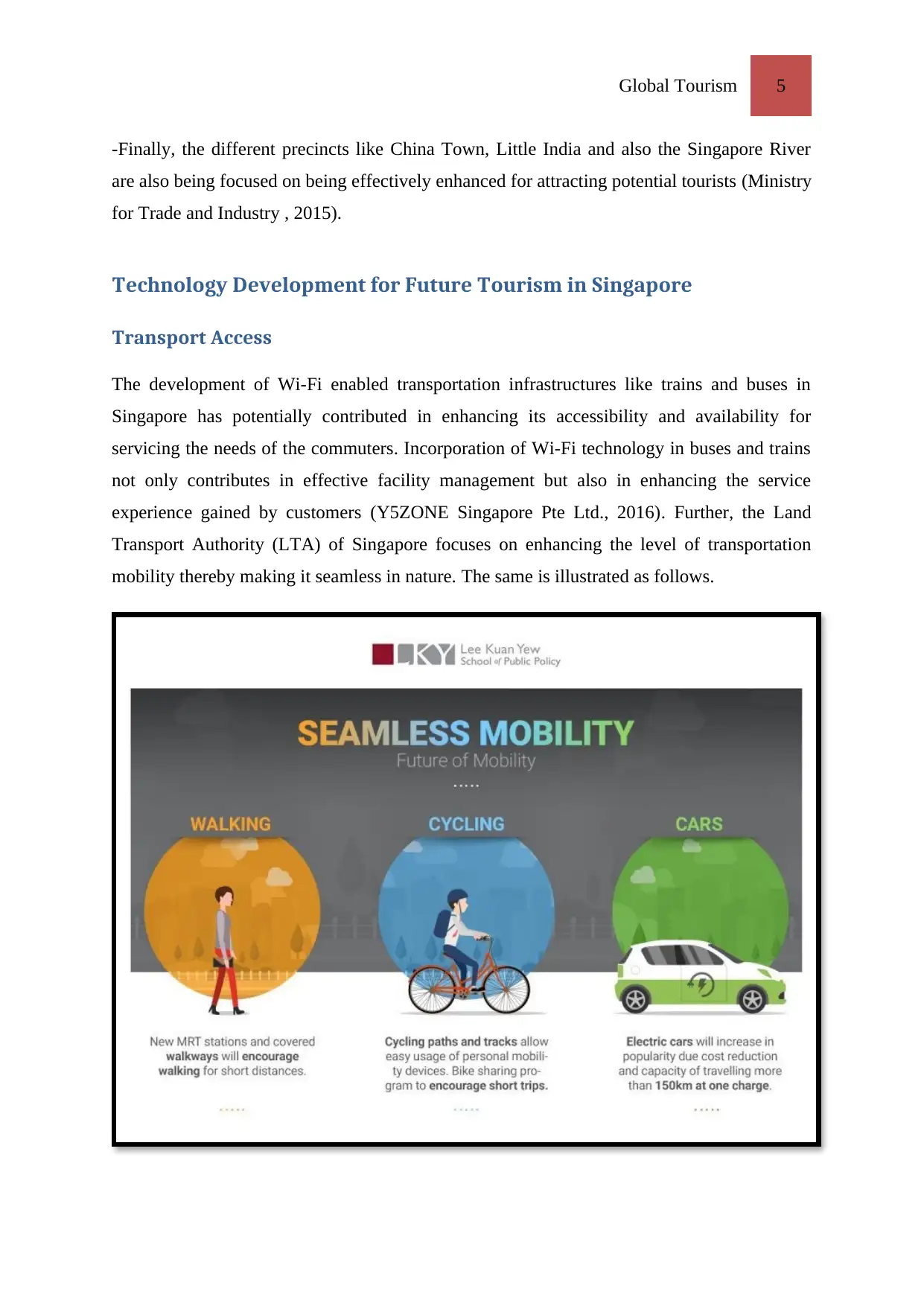
Transport Authority (LTA) of Singapore focuses on enhancing the level of transportation
mobility thereby making it seamless in nature. The same is illustrated as follows.
-Finally, the different precincts like China Town, Little India and also the Singapore River
are also being focused on being effectively enhanced for attracting potential tourists (Ministry
for Trade and Industry , 2015).
Technology Development for Future Tourism in Singapore
Transport Access
The development of Wi-Fi enabled transportation infrastructures like trains and buses in
Singapore has potentially contributed in enhancing its accessibility and availability for
servicing the needs of the commuters. Incorporation of Wi-Fi technology in buses and trains
not only contributes in effective facility management but also in enhancing the service
experience gained by customers (Y5ZONE Singapore Pte Ltd., 2016). Further, the Land
Transport Authority (LTA) of Singapore focuses on enhancing the level of transportation
mobility thereby making it seamless in nature. The same is illustrated as follows.
Global Tourism 6
(Jain, 2017)
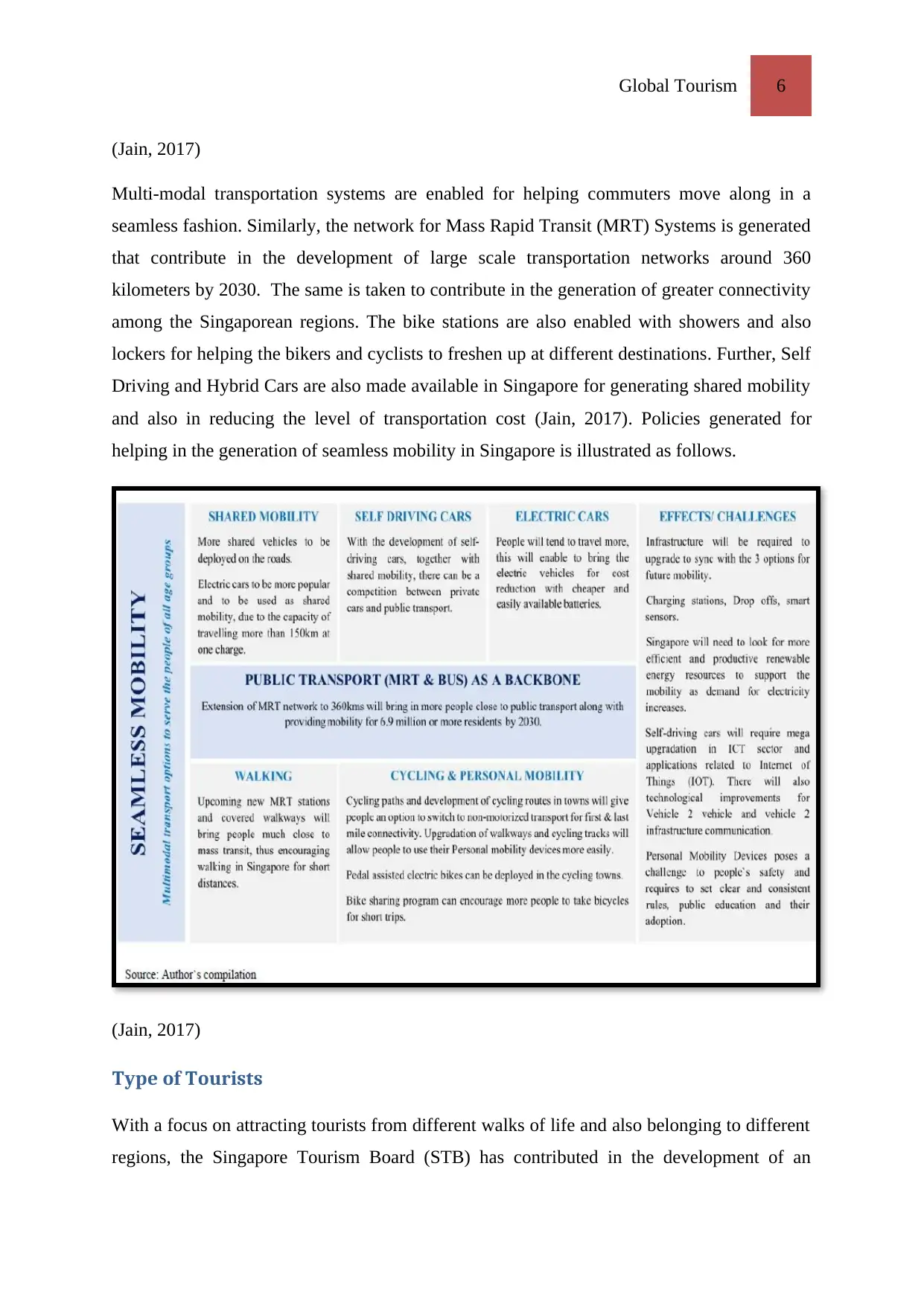
Multi-modal transportation systems are enabled for helping commuters move along in a
seamless fashion. Similarly, the network for Mass Rapid Transit (MRT) Systems is generated
that contribute in the development of large scale transportation networks around 360
kilometers by 2030. The same is taken to contribute in the generation of greater connectivity
among the Singaporean regions. The bike stations are also enabled with showers and also
lockers for helping the bikers and cyclists to freshen up at different destinations. Further, Self
Driving and Hybrid Cars are also made available in Singapore for generating shared mobility
and also in reducing the level of transportation cost (Jain, 2017). Policies generated for
helping in the generation of seamless mobility in Singapore is illustrated as follows.
(Jain, 2017)
Type of Tourists
With a focus on attracting tourists from different walks of life and also belonging to different
regions, the Singapore Tourism Board (STB) has contributed in the development of an
(Jain, 2017)
Multi-modal transportation systems are enabled for helping commuters move along in a
seamless fashion. Similarly, the network for Mass Rapid Transit (MRT) Systems is generated
that contribute in the development of large scale transportation networks around 360
kilometers by 2030. The same is taken to contribute in the generation of greater connectivity
among the Singaporean regions. The bike stations are also enabled with showers and also
lockers for helping the bikers and cyclists to freshen up at different destinations. Further, Self
Driving and Hybrid Cars are also made available in Singapore for generating shared mobility
and also in reducing the level of transportation cost (Jain, 2017). Policies generated for
helping in the generation of seamless mobility in Singapore is illustrated as follows.
(Jain, 2017)
Type of Tourists
With a focus on attracting tourists from different walks of life and also belonging to different
regions, the Singapore Tourism Board (STB) has contributed in the development of an
⊘ This is a preview!⊘
Do you want full access?
Subscribe today to unlock all pages.
Trusted by 1+ million students worldwide
Global Tourism 7
effective website, YourSingapore.com with also the generation of a potential social
networking platform through use of Facebook for large number of tourists and visitors to the
region. The production of the website along with the development of the Facebook page has
helped STB in sharing tourism stories and feeds while it also encourages the tourists to share
their own experiences with colleagues, friends and relatives. Incorporation of technological
mediums like digital and social media networks potentially help in generating an effective
word-of-mouth marketing activity for Singapore Tourism. Further, STB has also teamed up
with the online tourism agent, TripAdvisor for helping in the development of an online
tourism hub, ‘Live like a Local’. The same helps international tourists get the feel of
Singaporean region with needed attractions from the eyes of the local residents. It is taken
that the partnership of STB with TripAdvisor would contribute in inspiring large number of
people and thereby attracting them to visit Singapore (Singapore Tourism Board , 2015).
Categories of Tourists being targeted
Effective technology is being pursued to target different types of market segments pertaining
to the tourism sector. The hero-hub-hygiene framework or HHH Framework developed
through the use of YouTube and also the development of the Destination Newsroom actively
contribute in encouraging customers to share their stories and experiences while STB
employs the same for reproduction of different types of contents and feeds regarding tourism
attractions and emerging facilities, networks and offers. Moreover, information is gathered
through the use of the social networking mediums and other customer databases that help in
evaluating the travelling interests of the customers with also gaining an effective
understanding of the income potential of the different tourists groups. Information gained
along both psychographic and demographic parameters with also personal information
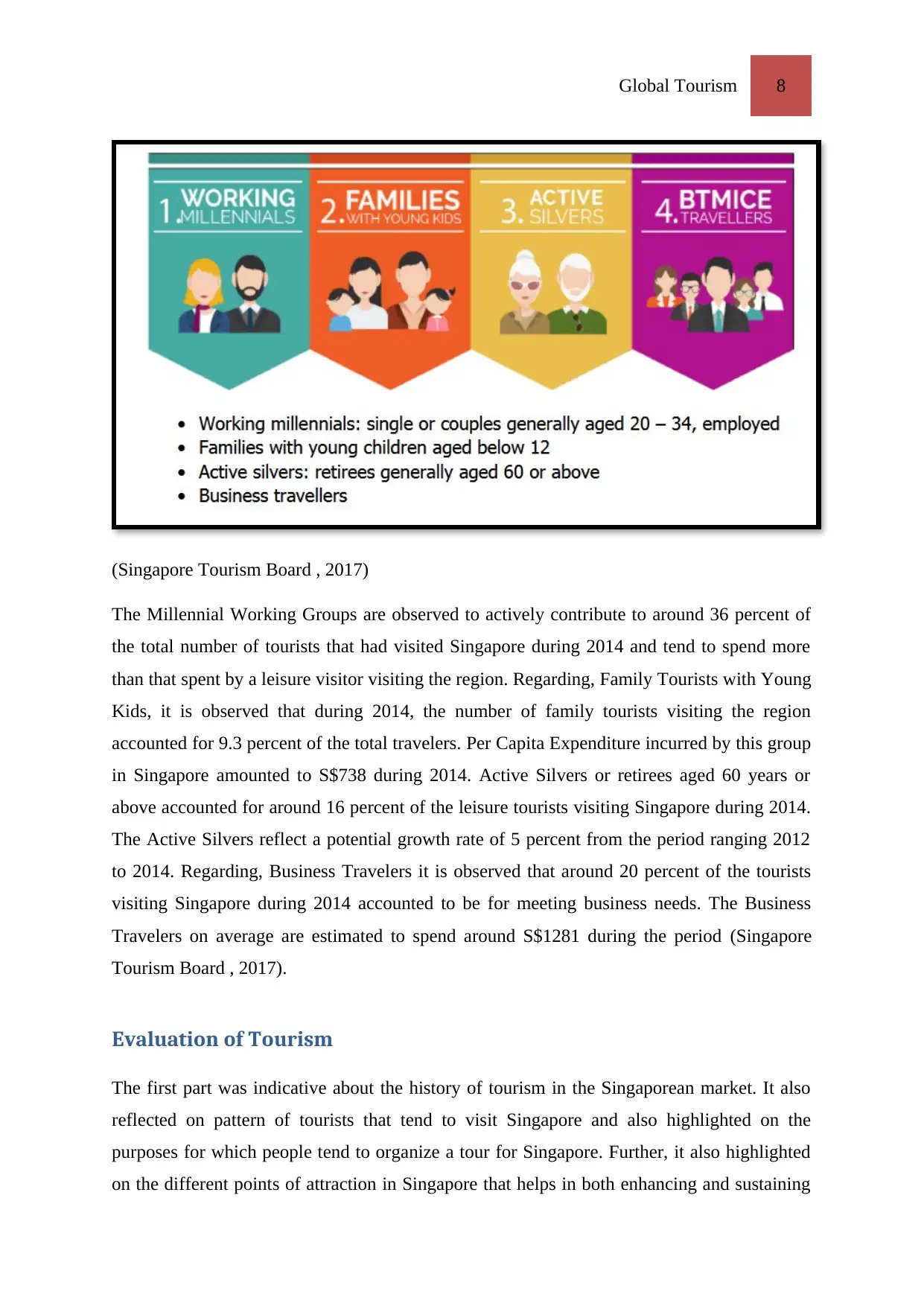
associated to age and profession contribute in targeting tourists along four different categories
like working groups which are mainly millennial customers, family groups consisting of
young kids, active silvers consisting of retired population and finally the business categories
of customers (Lim, 2017). The same is reflected in the following illustration.
effective website, YourSingapore.com with also the generation of a potential social
networking platform through use of Facebook for large number of tourists and visitors to the
region. The production of the website along with the development of the Facebook page has
helped STB in sharing tourism stories and feeds while it also encourages the tourists to share
their own experiences with colleagues, friends and relatives. Incorporation of technological
mediums like digital and social media networks potentially help in generating an effective
word-of-mouth marketing activity for Singapore Tourism. Further, STB has also teamed up
with the online tourism agent, TripAdvisor for helping in the development of an online
tourism hub, ‘Live like a Local’. The same helps international tourists get the feel of
Singaporean region with needed attractions from the eyes of the local residents. It is taken
that the partnership of STB with TripAdvisor would contribute in inspiring large number of
people and thereby attracting them to visit Singapore (Singapore Tourism Board , 2015).
Categories of Tourists being targeted
Effective technology is being pursued to target different types of market segments pertaining
to the tourism sector. The hero-hub-hygiene framework or HHH Framework developed
through the use of YouTube and also the development of the Destination Newsroom actively
contribute in encouraging customers to share their stories and experiences while STB
employs the same for reproduction of different types of contents and feeds regarding tourism
attractions and emerging facilities, networks and offers. Moreover, information is gathered
through the use of the social networking mediums and other customer databases that help in
evaluating the travelling interests of the customers with also gaining an effective
understanding of the income potential of the different tourists groups. Information gained
along both psychographic and demographic parameters with also personal information
associated to age and profession contribute in targeting tourists along four different categories
like working groups which are mainly millennial customers, family groups consisting of
young kids, active silvers consisting of retired population and finally the business categories
of customers (Lim, 2017). The same is reflected in the following illustration.
Paraphrase This Document
Need a fresh take? Get an instant paraphrase of this document with our AI Paraphraser
Global Tourism 8
(Singapore Tourism Board , 2017)
The Millennial Working Groups are observed to actively contribute to around 36 percent of
the total number of tourists that had visited Singapore during 2014 and tend to spend more
than that spent by a leisure visitor visiting the region. Regarding, Family Tourists with Young
Kids, it is observed that during 2014, the number of family tourists visiting the region
accounted for 9.3 percent of the total travelers. Per Capita Expenditure incurred by this group
in Singapore amounted to S$738 during 2014. Active Silvers or retirees aged 60 years or
above accounted for around 16 percent of the leisure tourists visiting Singapore during 2014.
The Active Silvers reflect a potential growth rate of 5 percent from the period ranging 2012
to 2014. Regarding, Business Travelers it is observed that around 20 percent of the tourists
visiting Singapore during 2014 accounted to be for meeting business needs. The Business
Travelers on average are estimated to spend around S$1281 during the period (Singapore
Tourism Board , 2017).
Evaluation of Tourism
The first part was indicative about the history of tourism in the Singaporean market. It also
reflected on pattern of tourists that tend to visit Singapore and also highlighted on the
purposes for which people tend to organize a tour for Singapore. Further, it also highlighted
on the different points of attraction in Singapore that helps in both enhancing and sustaining
(Singapore Tourism Board , 2017)
The Millennial Working Groups are observed to actively contribute to around 36 percent of
the total number of tourists that had visited Singapore during 2014 and tend to spend more
than that spent by a leisure visitor visiting the region. Regarding, Family Tourists with Young
Kids, it is observed that during 2014, the number of family tourists visiting the region
accounted for 9.3 percent of the total travelers. Per Capita Expenditure incurred by this group
in Singapore amounted to S$738 during 2014. Active Silvers or retirees aged 60 years or
above accounted for around 16 percent of the leisure tourists visiting Singapore during 2014.
The Active Silvers reflect a potential growth rate of 5 percent from the period ranging 2012
to 2014. Regarding, Business Travelers it is observed that around 20 percent of the tourists
visiting Singapore during 2014 accounted to be for meeting business needs. The Business
Travelers on average are estimated to spend around S$1281 during the period (Singapore
Tourism Board , 2017).
Evaluation of Tourism
The first part was indicative about the history of tourism in the Singaporean market. It also
reflected on pattern of tourists that tend to visit Singapore and also highlighted on the
purposes for which people tend to organize a tour for Singapore. Further, it also highlighted
on the different points of attraction in Singapore that helps in both enhancing and sustaining
Global Tourism 9
tourism in the region. Herein, the second part serves as an extension of the first part regarding
analyzing the current issues affecting Singapore and also its impacts both positive and
negative on tourism. It also contributes in understanding the technological developments
made in the tourism sector of Singapore for attracting potential tourists with also the goals for
the strategic planning initiatives concerning development of an effective tourism market.
Further, the analysis of Singapore as a potential tourism destination is also rendered in second
part based on the application of Butler’s Model.
Application of Butler Model of Tourism
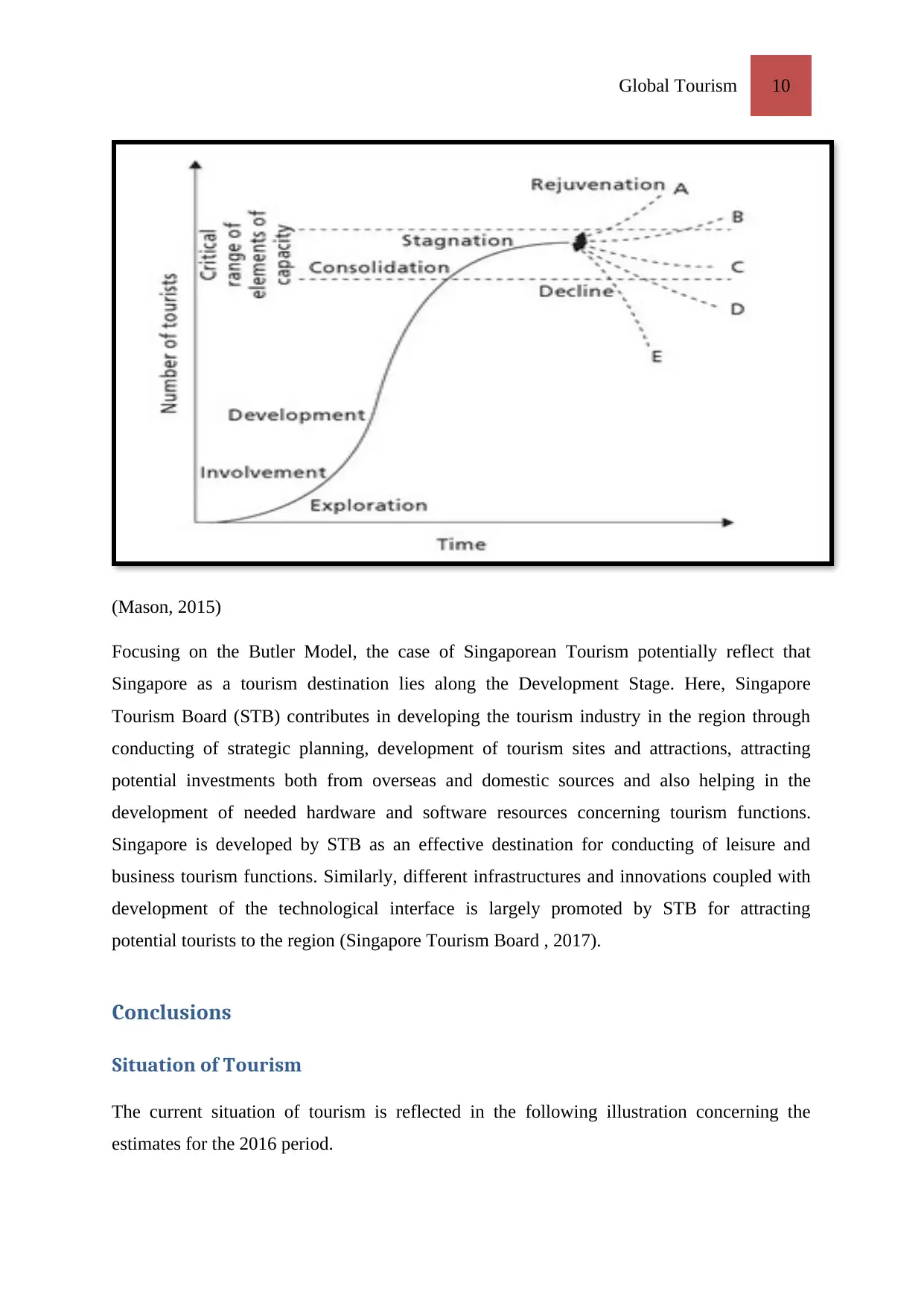
Butler’s Theory or Model on Tourism is influenced by the ideas of Plog, Cohen Doxy and
Christaller. The Model designed by Butler during 1980 also featured the attributes of the
business marketing concept of Product Life Cycle (PLC). The different stages of Butler’s
Model are identified as Exploration, Involvement, Development, Consolidation, Stagnation
and finally Post-Stagnation. In the Exploration Stage, adventurous tourists tend to visit newer
and untapped markets owing to the existence of scenic attractions that however suffer from
lack of effective facilities. The Involvement Stage reflects on the growth of tourism
advertising that helps in the generation and growth of awareness regarding tourism among the
local customers. Growing level of involvement rightly helps in the provision of different
types of services (Mason, 2015). Along the Developmental Stage the tourism authority and
the regional government focus on the development of greater tourism related infrastructure
and facilities for attracting and sustaining greater number of tourists in the region. Further, in
the Consolidation Stage the tourism activity is observed to have become an integral part of
the nation’s activity. Tourism in this stage tends to show effective growth rates with efforts
rendered by local tourists for developing local facilities. Subsequently, in the Stagnation
Stage, the number of tourists has reached the peak stage while the Post-Stagnation reflects
increased number of possibilities with one end reflecting increased success of local
management while the other extreme reflects rejuvenation and finally decline (Mason, 2015).
The same is illustrated in the following diagram.
tourism in the region. Herein, the second part serves as an extension of the first part regarding
analyzing the current issues affecting Singapore and also its impacts both positive and
negative on tourism. It also contributes in understanding the technological developments
made in the tourism sector of Singapore for attracting potential tourists with also the goals for
the strategic planning initiatives concerning development of an effective tourism market.
Further, the analysis of Singapore as a potential tourism destination is also rendered in second
part based on the application of Butler’s Model.
Application of Butler Model of Tourism
Butler’s Theory or Model on Tourism is influenced by the ideas of Plog, Cohen Doxy and
Christaller. The Model designed by Butler during 1980 also featured the attributes of the
business marketing concept of Product Life Cycle (PLC). The different stages of Butler’s
Model are identified as Exploration, Involvement, Development, Consolidation, Stagnation
and finally Post-Stagnation. In the Exploration Stage, adventurous tourists tend to visit newer
and untapped markets owing to the existence of scenic attractions that however suffer from
lack of effective facilities. The Involvement Stage reflects on the growth of tourism
advertising that helps in the generation and growth of awareness regarding tourism among the
local customers. Growing level of involvement rightly helps in the provision of different
types of services (Mason, 2015). Along the Developmental Stage the tourism authority and
the regional government focus on the development of greater tourism related infrastructure
and facilities for attracting and sustaining greater number of tourists in the region. Further, in
the Consolidation Stage the tourism activity is observed to have become an integral part of
the nation’s activity. Tourism in this stage tends to show effective growth rates with efforts
rendered by local tourists for developing local facilities. Subsequently, in the Stagnation
Stage, the number of tourists has reached the peak stage while the Post-Stagnation reflects
increased number of possibilities with one end reflecting increased success of local
management while the other extreme reflects rejuvenation and finally decline (Mason, 2015).
The same is illustrated in the following diagram.
⊘ This is a preview!⊘
Do you want full access?
Subscribe today to unlock all pages.
Trusted by 1+ million students worldwide
Global Tourism 10
(Mason, 2015)
Focusing on the Butler Model, the case of Singaporean Tourism potentially reflect that
Singapore as a tourism destination lies along the Development Stage. Here, Singapore
Tourism Board (STB) contributes in developing the tourism industry in the region through
conducting of strategic planning, development of tourism sites and attractions, attracting
potential investments both from overseas and domestic sources and also helping in the
development of needed hardware and software resources concerning tourism functions.
Singapore is developed by STB as an effective destination for conducting of leisure and
business tourism functions. Similarly, different infrastructures and innovations coupled with
development of the technological interface is largely promoted by STB for attracting
potential tourists to the region (Singapore Tourism Board , 2017).
Conclusions
Situation of Tourism
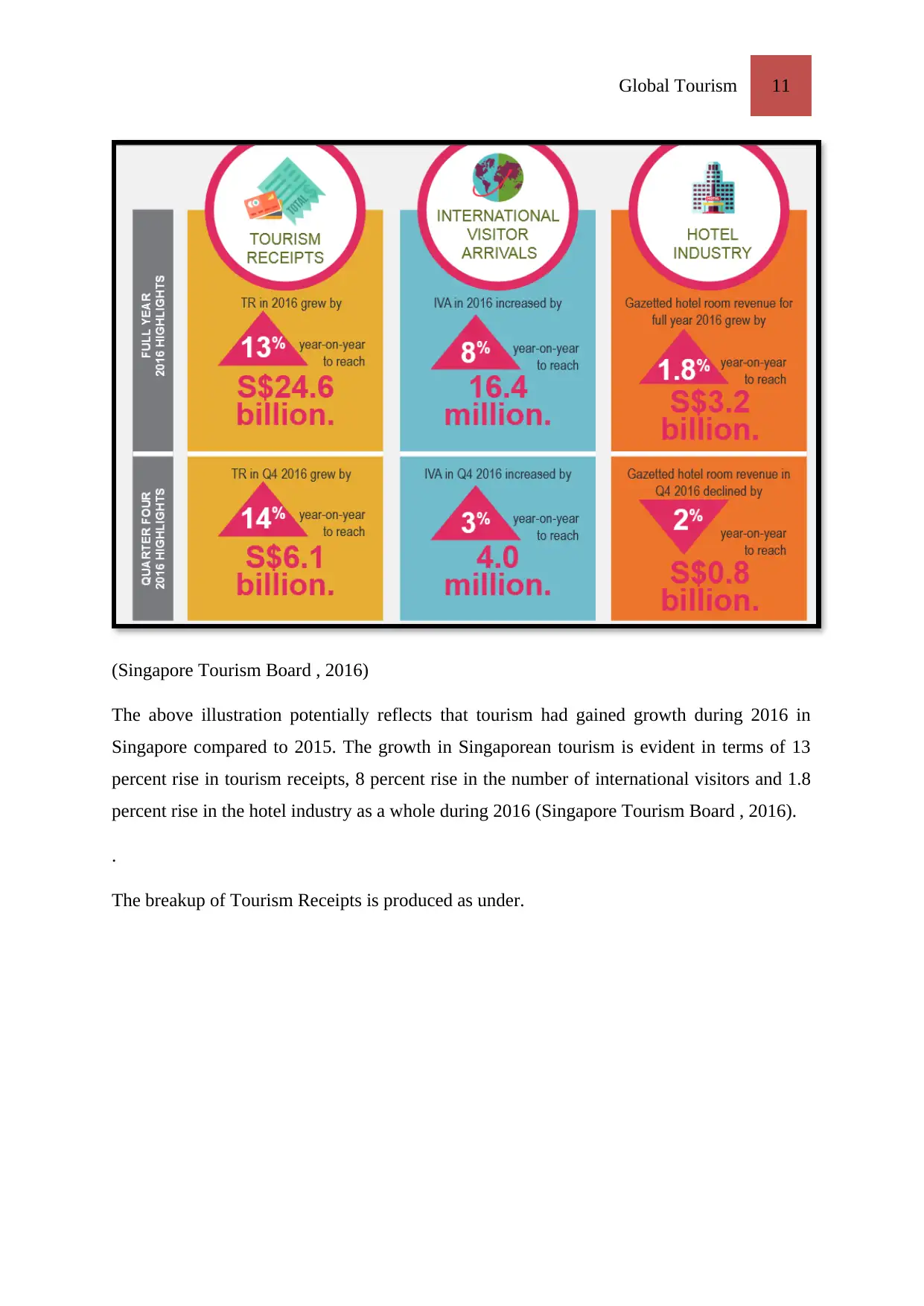
The current situation of tourism is reflected in the following illustration concerning the
estimates for the 2016 period.
(Mason, 2015)
Focusing on the Butler Model, the case of Singaporean Tourism potentially reflect that
Singapore as a tourism destination lies along the Development Stage. Here, Singapore
Tourism Board (STB) contributes in developing the tourism industry in the region through
conducting of strategic planning, development of tourism sites and attractions, attracting
potential investments both from overseas and domestic sources and also helping in the
development of needed hardware and software resources concerning tourism functions.
Singapore is developed by STB as an effective destination for conducting of leisure and
business tourism functions. Similarly, different infrastructures and innovations coupled with
development of the technological interface is largely promoted by STB for attracting
potential tourists to the region (Singapore Tourism Board , 2017).
Conclusions
Situation of Tourism
The current situation of tourism is reflected in the following illustration concerning the
estimates for the 2016 period.
Paraphrase This Document
Need a fresh take? Get an instant paraphrase of this document with our AI Paraphraser
Global Tourism 11
(Singapore Tourism Board , 2016)
The above illustration potentially reflects that tourism had gained growth during 2016 in
Singapore compared to 2015. The growth in Singaporean tourism is evident in terms of 13
percent rise in tourism receipts, 8 percent rise in the number of international visitors and 1.8
percent rise in the hotel industry as a whole during 2016 (Singapore Tourism Board , 2016).
.
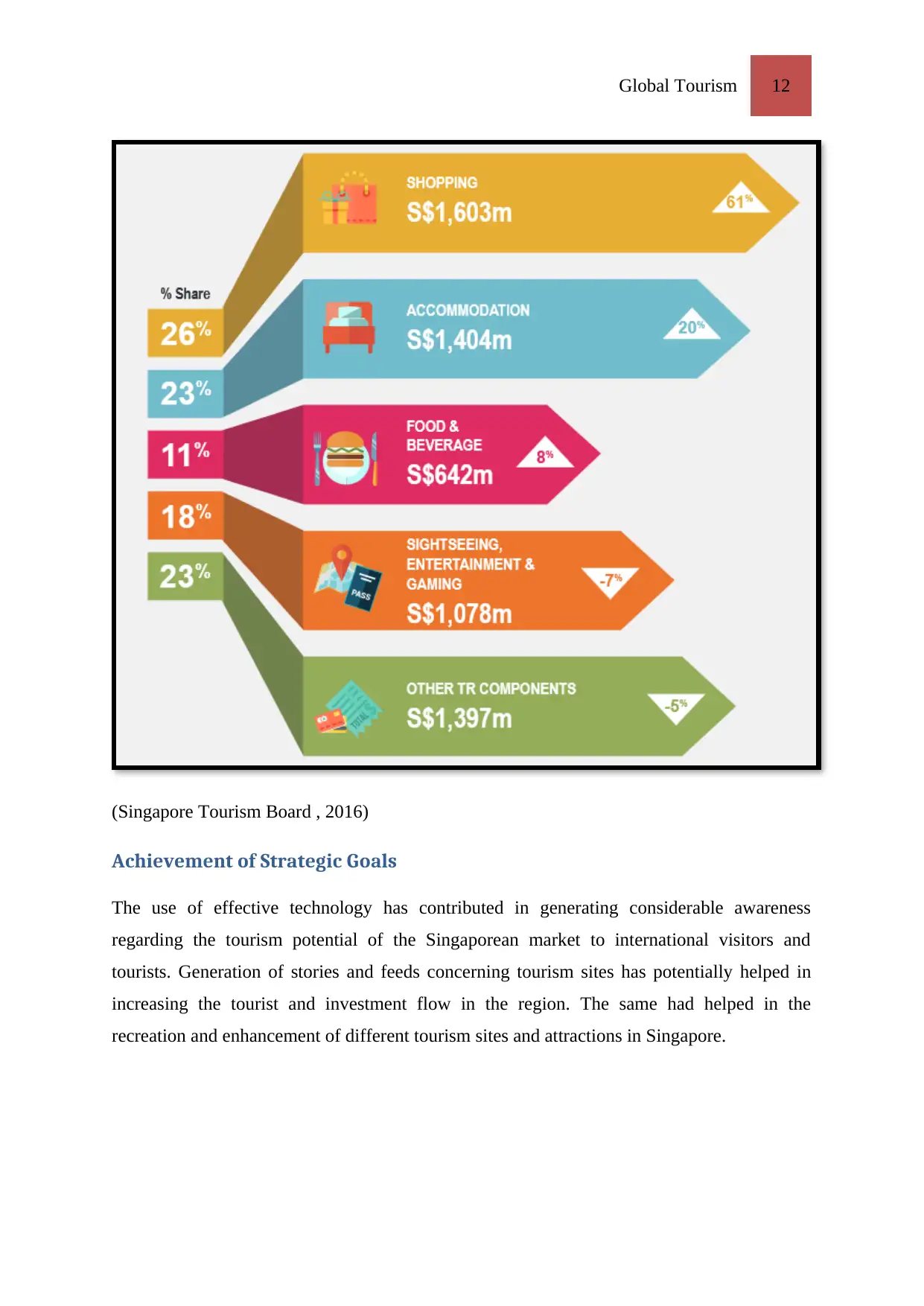
The breakup of Tourism Receipts is produced as under.
(Singapore Tourism Board , 2016)
The above illustration potentially reflects that tourism had gained growth during 2016 in
Singapore compared to 2015. The growth in Singaporean tourism is evident in terms of 13
percent rise in tourism receipts, 8 percent rise in the number of international visitors and 1.8
percent rise in the hotel industry as a whole during 2016 (Singapore Tourism Board , 2016).
.
The breakup of Tourism Receipts is produced as under.
Global Tourism 12
(Singapore Tourism Board , 2016)
Achievement of Strategic Goals
The use of effective technology has contributed in generating considerable awareness
regarding the tourism potential of the Singaporean market to international visitors and
tourists. Generation of stories and feeds concerning tourism sites has potentially helped in
increasing the tourist and investment flow in the region. The same had helped in the
recreation and enhancement of different tourism sites and attractions in Singapore.
(Singapore Tourism Board , 2016)
Achievement of Strategic Goals
The use of effective technology has contributed in generating considerable awareness
regarding the tourism potential of the Singaporean market to international visitors and
tourists. Generation of stories and feeds concerning tourism sites has potentially helped in
increasing the tourist and investment flow in the region. The same had helped in the
recreation and enhancement of different tourism sites and attractions in Singapore.
⊘ This is a preview!⊘
Do you want full access?
Subscribe today to unlock all pages.
Trusted by 1+ million students worldwide

1 out of 14


Your All-in-One AI-Powered Toolkit for Academic Success.
+13062052269
info@desklib.com
Available 24*7 on WhatsApp / Email
![[object Object]](/_next/static/media/star-bottom.7253800d.svg)
Unlock your academic potential
Copyright © 2020–2026 A2Z Services. All Rights Reserved. Developed and managed by ZUCOL.