Analyzing Germany's Tourism System: Stakeholders, Elements, Pressures

Verified

Added on  2023/06/09

|7
|683
|390
Presentation
AI Summary
This presentation provides an analysis of the German tourism system, highlighting its key stakeholders, major elements, and the relationships between them. It begins by introducing Germany's position as a leading European tourism destination, noting its economic contribution and safety. The analysis identifies key stakeholders such as the Federal Minister for Economic Affairs and Energy, the Federal Government’s Commissioner for Tourism, and the Advisory Council on Issues of Tourism. Major elements of the system, including both direct (attractions, accommodation, transport) and indirect (infrastructure, communications) components, are discussed, with a focus on culture and nature. The presentation further examines the coordination of tourism policies and the roles of various organizations and business associations like BTW, DEHOGA/IHA, DRV, and GNTB. Finally, it touches upon the significant forces impacting the German tourism system, including tourism organizations and business associations at various levels. The presentation references academic works to support its analysis of the German tourism system.
Document Page
TOURISM SYTEMS
ANALYSIS
An Analysis of the German Tourism System
tabler-icon-diamond-filled.svg

Paraphrase This Document

Need a fresh take? Get an instant paraphrase of this document with our AI Paraphraser
Document Page
INTRODUCTION
Germany is among the leading European tourism destinations. Over the years, the country has grown to be
acknowledged as a leader in the sense of business and leisure travel.
Between the years 2009 and 2013, Germany’s tourism sector has seen rapid growth, and according to the Economic
Forum’s Travel and Tourism, Germany is among the safest travel destinations across the globe.
The German tourism sector contributes to approximately 8% of the total GDP, and is among the country’s most
important economic industries.
Document Page
KEY STAKEHOLDERS
Germany is a centralized state.
The country’s sixteen states nurture their tourism development and shape and promote their tourism industries.
The Federal Minister for Economic Affairs and Energy, who leads the tourism policies within the German Government;
Federal Government’s Commissioner for Tourism, responsible for organizing tourism policies within the German
parliament and government, and with the Tourism Committee;
The Advisory Council on Issues of Tourism, responsible for reconciling the interests.
Document Page
MAJOR ELEMENTS
Being a dynamic and extremely competitive industry, tourism requires adaptation instincts to the constantly changing desires and needs
of consumers.
Two key elements are instrumental in tourism. They are the direct and indirect elements.
Direct elements are the areas in tourism that are in straight contact with tourists. They include attractions, accommodation, transport,
and sales.
The indirect elements are not in direct contact with tourists. They include infrastructure, communications, among other. For Germany,
the key tourism elements are culture and nature.
tabler-icon-diamond-filled.svg

Paraphrase This Document

Need a fresh take? Get an instant paraphrase of this document with our AI Paraphraser
Document Page
STAKEHOLDERS AND ELEMENTS
Coordination of tourism policies between the country’s states and the Federal Government happens in the
Federal-Länder Committee, which is chaired by the Federal Ministry for Economic Affairs and Energy.
The Federal-Länder-Committee on Tourism conducts two meetings annually, aimed at enhancing information
exchange as well as the co-ordination of measures involving multiple states.
In the German tourism system, a majority of tourism service providers and business associations cite the Federal
Ministry for Economic Affairs and Energy as the core contact point.
The ministry works with organizations and business associations in the tourism industry to instrument projects
that improve innovation and competitiveness within the industry
Document Page
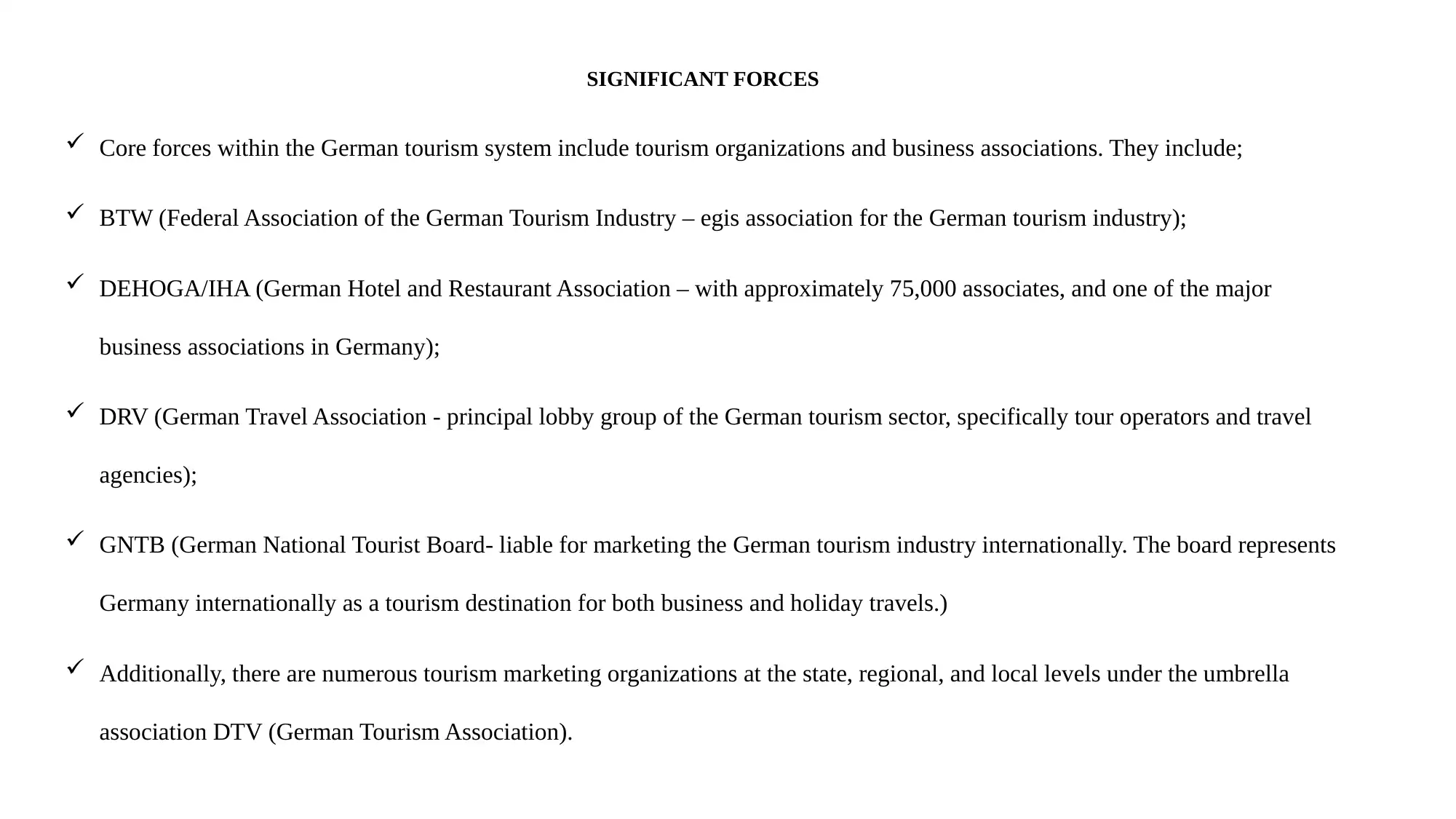
SIGNIFICANT FORCES
Core forces within the German tourism system include tourism organizations and business associations. They include;
BTW (Federal Association of the German Tourism Industry – egis association for the German tourism industry);
DEHOGA/IHA (German Hotel and Restaurant Association – with approximately 75,000 associates, and one of the major
business associations in Germany);
DRV (German Travel Association - principal lobby group of the German tourism sector, specifically tour operators and travel
agencies);
GNTB (German National Tourist Board- liable for marketing the German tourism industry internationally. The board represents
Germany internationally as a tourism destination for both business and holiday travels.)
Additionally, there are numerous tourism marketing organizations at the state, regional, and local levels under the umbrella
association DTV (German Tourism Association).
Document Page
References
Boyer, D. (2005). Spirit and system: Media, intellectuals, and the dialectic in modern German
culture. University of Chicago Press.
Jack, G., & Phipps, A. (2003). On the uses of travel guides in the context of German tourism to
Scotland. Tourist Studies, 3(3), 281-300.
Koshar, R. (2000). German travel cultures. Berg Publishers.
Matias, Á., Nijkamp, P., & Sarmento, M. (Eds.). (2011). Tourism economics: Impact analysis.
Springer Science & Business Media.
chevron_up_icon
1 out of 7
circle_padding
hide_on_mobile
zoom_out_icon
[object Object]