National Yunlin University: Cross-Cultural Factors on Tourist Behavior
VerifiedAdded on 2022/01/18
|20
|4986
|143
Report
AI Summary
This term paper from National Yunlin University of Science and Technology examines the influence of cross-cultural factors, particularly Hofstede's cultural dimensions, on tourist behavior. The study focuses on comparing the travel behaviors of tourists from Vietnam and Taiwan across three stages: Before-Travel, During-Travel, and After-Travel. The paper begins with an introduction to culture's impact on consumer behavior, especially within the tourism sector. It reviews Hofstede's six cultural dimensions (Power Distance, Uncertainty Avoidance, Individualism vs. Collectivism, Masculinity vs. Femininity, Long-term vs. Short-term Orientation, and Indulgence vs. Restraint) and their relevance to tourist decision-making. The literature review explores tourist behavior stages, including information search, evaluation of alternatives, and post-purchase behaviors. The study aims to answer the research question: Are there differences between Taiwan and Vietnam tourists behavior based on culture value? By analyzing these dimensions and comparing the cultural values of Vietnam and Taiwan, the paper seeks to understand how these differences shape preferences related to travel mode, destination, accommodation, and other travel-related decisions, offering valuable insights into cross-cultural management within the tourism industry.
NATIONAL YUNLIN UNIVERSITY OF
SCIENCE AND TECHNOLOGY
Department of Business Administration
CROSS CULTURAL MANAGEMENT
TERM PAPER
THE EFFECT OF CROSS-CULTURAL FACTORS ON THE
TOURIST BEHAVIOUR: A COMPARISON BETWEEN
VIETNAM AND TAIWAN TOURISTS BASED ON HOFSTEDE’S
CULTURAL DIMENSIONS
STUDENT NAME: NGUYEN DUC TAM
STUDENT ID: D10922013
SCIENCE AND TECHNOLOGY
Department of Business Administration
CROSS CULTURAL MANAGEMENT
TERM PAPER
THE EFFECT OF CROSS-CULTURAL FACTORS ON THE
TOURIST BEHAVIOUR: A COMPARISON BETWEEN
VIETNAM AND TAIWAN TOURISTS BASED ON HOFSTEDE’S
CULTURAL DIMENSIONS
STUDENT NAME: NGUYEN DUC TAM
STUDENT ID: D10922013

Paraphrase This Document
Need a fresh take? Get an instant paraphrase of this document with our AI Paraphraser
ABSTRACT
This paper evaluates the impacts of Hofstede cross-cultural dimensions that driven the
travel behaviors of tourists. Furthermore, it investigates the differences of tourist behaviors
between Vietnam and Taiwan based on the applications of Hofstede’s cultural dimensions. There
are three main stages of tourists behavior when they decide to take a trip: Before-Travel, During-
Travel, and After-Travel. This research analyzes how Hofstede’s cultural dimensions affect to
tourist behavior on each of these stages.
This paper evaluates the impacts of Hofstede cross-cultural dimensions that driven the
travel behaviors of tourists. Furthermore, it investigates the differences of tourist behaviors
between Vietnam and Taiwan based on the applications of Hofstede’s cultural dimensions. There
are three main stages of tourists behavior when they decide to take a trip: Before-Travel, During-
Travel, and After-Travel. This research analyzes how Hofstede’s cultural dimensions affect to
tourist behavior on each of these stages.
INTRODUCTION
Culture, the collection of meanings, norms, values and traditions shared among the
members of an organization or a society, is the general programming to distinguish members of a
group or a society from those of another (Solomon, 1996). There are several research studies focus
on the cross-cultural differences in consumer behavior in the field of marketing (Beatty, Lynn, &
Pamela, 1991) (Beatty, Lynn, & Pamela,1991; (Plummer, 1977) (Watkins & Lin, 1996) (De Mooij
& Hofstede, 2011) (Manrai & Manrai, 1996) (Manrai & Manrai, 2011). The subjects of these
studies differ in the cultural contribution to different aspects of consumer behavior such as
consumer decision-making, consumer satisfaction, complaining behavior, etc. The impact of
culture on consumer behavior is undoubtedly in all service sectors, especially in tourism and travel.
Tourism and travel are an extremely complex product for a number of reasons. First, it
deals with tangible goods and products (gifts, food, etc.) as well as intangible services (sightseeing
tours, cultural performances, etc.). Second, tourism products consist of a variety of goods and
services that are putting together, so there are variety of alternative choice from each tangible and
intangible one. Third, there are various of factors that influence the decision-making and tourist
behavior. Kotler & Keller (2009) propose a conceptual model in which consumer behavior is
described based on the cultural, social and personal characteristics of the consumer as well as the
consumer psychology. Besides, model of multicultural consumer behavior presented by Manrai
and Manrai (1996, 2011) conceptualize four effects: cultural, social, personal, and psychological
factors in a hierarchical design and integrated with culture is one of the most influential. In their
models, each of the four described factors has a direct as well as indirect effect on consumer
behavior.
Culture, the collection of meanings, norms, values and traditions shared among the
members of an organization or a society, is the general programming to distinguish members of a
group or a society from those of another (Solomon, 1996). There are several research studies focus
on the cross-cultural differences in consumer behavior in the field of marketing (Beatty, Lynn, &
Pamela, 1991) (Beatty, Lynn, & Pamela,1991; (Plummer, 1977) (Watkins & Lin, 1996) (De Mooij
& Hofstede, 2011) (Manrai & Manrai, 1996) (Manrai & Manrai, 2011). The subjects of these
studies differ in the cultural contribution to different aspects of consumer behavior such as
consumer decision-making, consumer satisfaction, complaining behavior, etc. The impact of
culture on consumer behavior is undoubtedly in all service sectors, especially in tourism and travel.
Tourism and travel are an extremely complex product for a number of reasons. First, it
deals with tangible goods and products (gifts, food, etc.) as well as intangible services (sightseeing
tours, cultural performances, etc.). Second, tourism products consist of a variety of goods and
services that are putting together, so there are variety of alternative choice from each tangible and
intangible one. Third, there are various of factors that influence the decision-making and tourist
behavior. Kotler & Keller (2009) propose a conceptual model in which consumer behavior is
described based on the cultural, social and personal characteristics of the consumer as well as the
consumer psychology. Besides, model of multicultural consumer behavior presented by Manrai
and Manrai (1996, 2011) conceptualize four effects: cultural, social, personal, and psychological
factors in a hierarchical design and integrated with culture is one of the most influential. In their
models, each of the four described factors has a direct as well as indirect effect on consumer
behavior.
⊘ This is a preview!⊘
Do you want full access?
Subscribe today to unlock all pages.

Trusted by 1+ million students worldwide
With the development and importance of global tourism, more and more scholars are
compacting national culture as a key variable in their research (Pizam & Sussmann, 1995). These
studies seek to understand how culture interprets tourist behavior patterns. Countries representing
different degrees of one or more cultural factors are selected for testing. These nations survey their
citizens, with differences in responses being analyzed and review regarding the tested country's
distinct cultural values.
The foundation for cross-cultural research is the pioneering work of Geert Hofstede. He
developed six cultural dimensions that affect to customer behavior in three different levels:
individual, group and country. There are several scholars conducting their research based on
Hofstede’s cultural dimensions.
However, empirical research to date has not examined effects of Hofstede’s cultural values
to tourist behavior in Taiwan and Vietnam. Therefore, the objective of this paper is to develop a
conceptual framework analyzing the Hofstede’s cultural values and the processes underlying the
influence of these values in various domains of tourist behaviors in the pre-travel, during-travel,
and after-travel stages. Hence, this study proposes the comparison of tourist behavior between
Taiwanese and Vietnamese tourists. The goal in this study is to answer the research question: Are
there differences between Taiwan and Vietnam tourists behavior based on culture value?
compacting national culture as a key variable in their research (Pizam & Sussmann, 1995). These
studies seek to understand how culture interprets tourist behavior patterns. Countries representing
different degrees of one or more cultural factors are selected for testing. These nations survey their
citizens, with differences in responses being analyzed and review regarding the tested country's
distinct cultural values.
The foundation for cross-cultural research is the pioneering work of Geert Hofstede. He
developed six cultural dimensions that affect to customer behavior in three different levels:
individual, group and country. There are several scholars conducting their research based on
Hofstede’s cultural dimensions.
However, empirical research to date has not examined effects of Hofstede’s cultural values
to tourist behavior in Taiwan and Vietnam. Therefore, the objective of this paper is to develop a
conceptual framework analyzing the Hofstede’s cultural values and the processes underlying the
influence of these values in various domains of tourist behaviors in the pre-travel, during-travel,
and after-travel stages. Hence, this study proposes the comparison of tourist behavior between
Taiwanese and Vietnamese tourists. The goal in this study is to answer the research question: Are
there differences between Taiwan and Vietnam tourists behavior based on culture value?
Paraphrase This Document
Need a fresh take? Get an instant paraphrase of this document with our AI Paraphraser
LITERATURE REVIEW
1. Hofstede’s Cultural Dimensions
Hofstede started his research in 1979 with 40 countries and in 1980 published his landmark
research on work-related values of employees in 50 countries and three regions of the world
(Hofstede, 1979, 1980). The database for his study included questionnaires completed by 100,000
employees of IBM, a large multinational enterprise. Based on factor analysis of the data, Hofstede
has extracted four aspects that he thinks effectively differentiate people from different countries
(Hofstede, 1983, 1984). In 1991, an independent study from Michael Harris Bond and his
colleagues in Hong Kong prompted Hofstede to add a fifth dimension, a long-term direction, to
cover aspects of the values not discussed in the original model. In 2010, Hofstede added a sixth
dimension, indulgence versus self-restraint. He defined these six dimensions as follows:
• Power Distance: The extent to which the less powerful members of institutions and
organizations accept that power is distributed unequally.
• Uncertainty Avoidance: The extent to which people feel threatened by ambiguous
situations, and have created beliefs and institutions that try to avoid in such situations.
• Individualism versus Collectivism:
A situation in which people are supposed to look after themselves and their immediate
family only (Individualism).
A situation in which people belong to in-group or collectivities, which are supposed to look
after them, in exchange for loyalty (Collectivism).
1. Hofstede’s Cultural Dimensions
Hofstede started his research in 1979 with 40 countries and in 1980 published his landmark
research on work-related values of employees in 50 countries and three regions of the world
(Hofstede, 1979, 1980). The database for his study included questionnaires completed by 100,000
employees of IBM, a large multinational enterprise. Based on factor analysis of the data, Hofstede
has extracted four aspects that he thinks effectively differentiate people from different countries
(Hofstede, 1983, 1984). In 1991, an independent study from Michael Harris Bond and his
colleagues in Hong Kong prompted Hofstede to add a fifth dimension, a long-term direction, to
cover aspects of the values not discussed in the original model. In 2010, Hofstede added a sixth
dimension, indulgence versus self-restraint. He defined these six dimensions as follows:
• Power Distance: The extent to which the less powerful members of institutions and
organizations accept that power is distributed unequally.
• Uncertainty Avoidance: The extent to which people feel threatened by ambiguous
situations, and have created beliefs and institutions that try to avoid in such situations.
• Individualism versus Collectivism:
A situation in which people are supposed to look after themselves and their immediate
family only (Individualism).
A situation in which people belong to in-group or collectivities, which are supposed to look
after them, in exchange for loyalty (Collectivism).
• Masculinity versus Femininity:
A situation in which the dominant values of society are success, money, and things
(Masculinity).
A situation in which the dominant values of a society are caring for others and quality of
life (Femininity).
• Long-term orientation vs. short-term orientation: This dimension associates the
connection of the past with the current and future actions/challenges.
A lower degree of this index (short-term) indicates that traditions are honored and kept,
while steadfastness is valued.
Societies with a high degree in this index (long-term) view adaptation and circumstantial,
pragmatic problem-solving as a necessity.
A poor country that is short-term oriented usually has little to no economic development,
while long-term oriented countries continue to develop to a level of prosperity.
• Indulgence vs restraint: This dimension refers to the degree of freedom that societal norms
give to citizens in fulfilling their human desires.
Indulgence is defined as "a society that allows relatively free gratification of basic and
natural human desires related to enjoying life and having fun".
Restraint is defined as "a society that controls gratification of needs and regulates it by
means of strict social norms"
An overall examination of the cultural average scores and rankings of the various countries
included in the Hofstede’s studies suggests that the Western countries tend to be low on power
distance, low on uncertainty avoidance, high on individualism, mixed on masculinity – femininity,
short-term oriented and are indulgence. In contrast, Eastern countries tend to be high on power
A situation in which the dominant values of society are success, money, and things
(Masculinity).
A situation in which the dominant values of a society are caring for others and quality of
life (Femininity).
• Long-term orientation vs. short-term orientation: This dimension associates the
connection of the past with the current and future actions/challenges.
A lower degree of this index (short-term) indicates that traditions are honored and kept,
while steadfastness is valued.
Societies with a high degree in this index (long-term) view adaptation and circumstantial,
pragmatic problem-solving as a necessity.
A poor country that is short-term oriented usually has little to no economic development,
while long-term oriented countries continue to develop to a level of prosperity.
• Indulgence vs restraint: This dimension refers to the degree of freedom that societal norms
give to citizens in fulfilling their human desires.
Indulgence is defined as "a society that allows relatively free gratification of basic and
natural human desires related to enjoying life and having fun".
Restraint is defined as "a society that controls gratification of needs and regulates it by
means of strict social norms"
An overall examination of the cultural average scores and rankings of the various countries
included in the Hofstede’s studies suggests that the Western countries tend to be low on power
distance, low on uncertainty avoidance, high on individualism, mixed on masculinity – femininity,
short-term oriented and are indulgence. In contrast, Eastern countries tend to be high on power
⊘ This is a preview!⊘
Do you want full access?
Subscribe today to unlock all pages.
Trusted by 1+ million students worldwide
distance, high on uncertainty avoidance, high on collectivism, mixed on masculinity – femininity,
long-term oriented and are restraint.
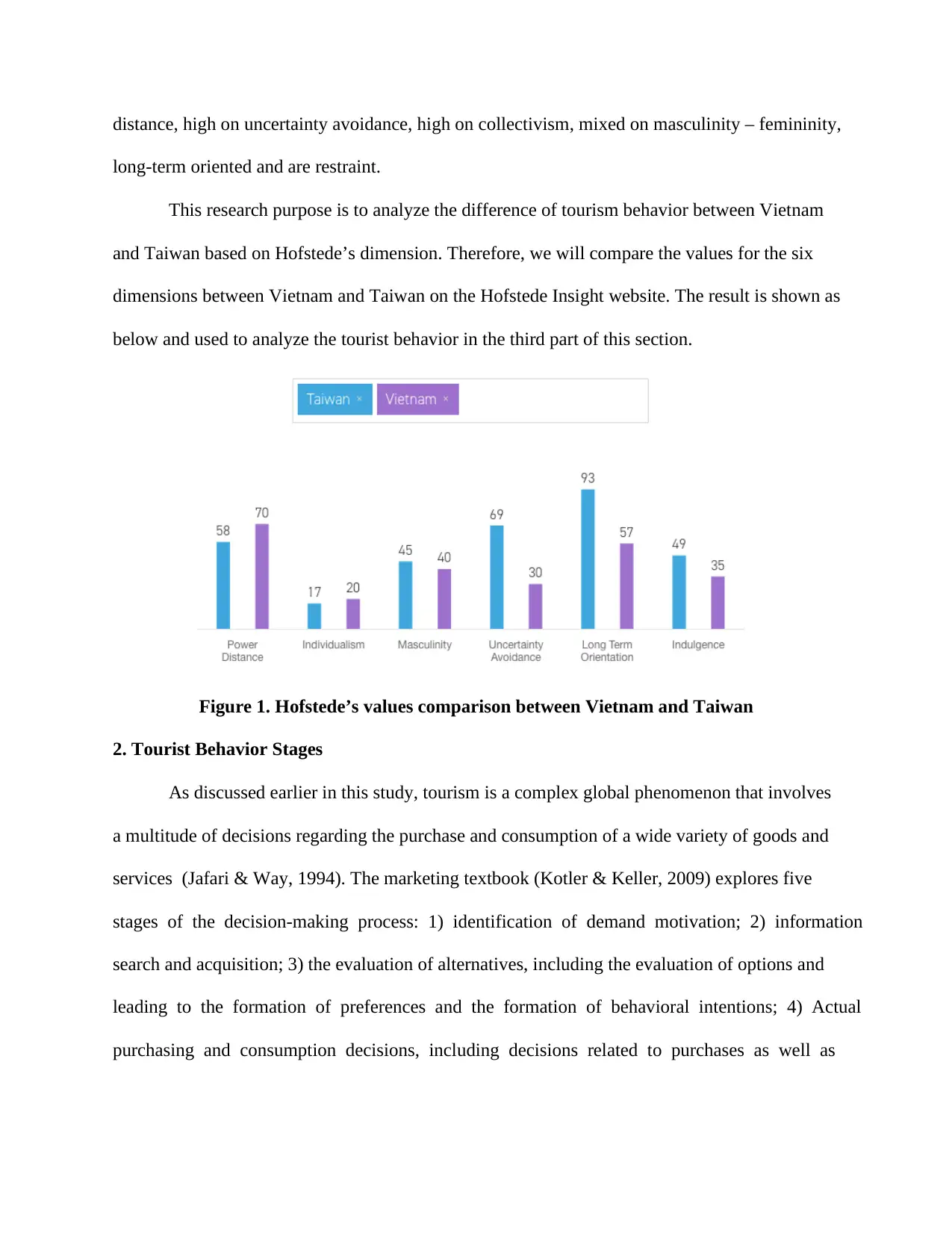
This research purpose is to analyze the difference of tourism behavior between Vietnam
and Taiwan based on Hofstede’s dimension. Therefore, we will compare the values for the six
dimensions between Vietnam and Taiwan on the Hofstede Insight website. The result is shown as
below and used to analyze the tourist behavior in the third part of this section.
Figure 1. Hofstede’s values comparison between Vietnam and Taiwan
2. Tourist Behavior Stages
As discussed earlier in this study, tourism is a complex global phenomenon that involves
a multitude of decisions regarding the purchase and consumption of a wide variety of goods and
services (Jafari & Way, 1994). The marketing textbook (Kotler & Keller, 2009) explores five
stages of the decision-making process: 1) identification of demand motivation; 2) information
search and acquisition; 3) the evaluation of alternatives, including the evaluation of options and
leading to the formation of preferences and the formation of behavioral intentions; 4) Actual
purchasing and consumption decisions, including decisions related to purchases as well as
long-term oriented and are restraint.
This research purpose is to analyze the difference of tourism behavior between Vietnam
and Taiwan based on Hofstede’s dimension. Therefore, we will compare the values for the six
dimensions between Vietnam and Taiwan on the Hofstede Insight website. The result is shown as
below and used to analyze the tourist behavior in the third part of this section.
Figure 1. Hofstede’s values comparison between Vietnam and Taiwan
2. Tourist Behavior Stages
As discussed earlier in this study, tourism is a complex global phenomenon that involves
a multitude of decisions regarding the purchase and consumption of a wide variety of goods and
services (Jafari & Way, 1994). The marketing textbook (Kotler & Keller, 2009) explores five
stages of the decision-making process: 1) identification of demand motivation; 2) information
search and acquisition; 3) the evaluation of alternatives, including the evaluation of options and
leading to the formation of preferences and the formation of behavioral intentions; 4) Actual
purchasing and consumption decisions, including decisions related to purchases as well as
Paraphrase This Document
Need a fresh take? Get an instant paraphrase of this document with our AI Paraphraser
decisions related to consumption; and 5) post-purchase behaviors such as consumer satisfaction /
dissatisfaction, brand loyalty/brand switching, etc. (Manrai & Manrai, 2011).
The above five stages of consumer decision-making and related consumer behavior are
divided into three groups: 1) before purchase and consumption; 2) during purchase and
consumption; and 3) after purchase consumption. The “before” group contains the first three stages
of the decision-making process listed above, leading to the formation of behavioral preferences
and intentions. The "during" group covers the fourth stage, covering behaviors related to the
purchase and consumption of products. The "after" group consists of stage 5, which includes
evaluations related to the consumer's purchase and consumption experience. Parallel to this, tourist
behavior is divided into three sections: 1) before travel; 2) during travel; and, 3) after travel
(Manrai & Manrai, 2011).
Tourist Behavior in Before-Travel stage
The first decision a potential tourist faces is whether or not to travel, and whether they
should travel. There are many reasons for this tricky situation. On the “No” side there may be
personal, social or financial limitation; there may be travel safety and risk concerns (like Covid 19
pandemic), and travel anxiety. On the "Yes" side, there is plenty of evidence supporting the
benefits of travel. It meets a wide range of personal, social and recreational needs, providing
motivations and incentives for travel. In general, a potential tourist must carefully consider the
advantages and disadvantages of undertaking tourism and travel activities and make that very
important first decision (Manrai & Manrai, 2011).
The estimation of advantages and disadvantages of the trip requires the second steps:
information search and acquisition. The activity of information search and acquisition continues
in case the individual has decided to attempt the travel. He / she needs to search and collect
dissatisfaction, brand loyalty/brand switching, etc. (Manrai & Manrai, 2011).
The above five stages of consumer decision-making and related consumer behavior are
divided into three groups: 1) before purchase and consumption; 2) during purchase and
consumption; and 3) after purchase consumption. The “before” group contains the first three stages
of the decision-making process listed above, leading to the formation of behavioral preferences
and intentions. The "during" group covers the fourth stage, covering behaviors related to the
purchase and consumption of products. The "after" group consists of stage 5, which includes
evaluations related to the consumer's purchase and consumption experience. Parallel to this, tourist
behavior is divided into three sections: 1) before travel; 2) during travel; and, 3) after travel
(Manrai & Manrai, 2011).
Tourist Behavior in Before-Travel stage
The first decision a potential tourist faces is whether or not to travel, and whether they
should travel. There are many reasons for this tricky situation. On the “No” side there may be
personal, social or financial limitation; there may be travel safety and risk concerns (like Covid 19
pandemic), and travel anxiety. On the "Yes" side, there is plenty of evidence supporting the
benefits of travel. It meets a wide range of personal, social and recreational needs, providing
motivations and incentives for travel. In general, a potential tourist must carefully consider the
advantages and disadvantages of undertaking tourism and travel activities and make that very
important first decision (Manrai & Manrai, 2011).
The estimation of advantages and disadvantages of the trip requires the second steps:
information search and acquisition. The activity of information search and acquisition continues
in case the individual has decided to attempt the travel. He / she needs to search and collect
information related to various decisions such as destination, type of travel, type of accommodation,
etc. There are several resources on which information can be gathered such as travel agents,
internet, relatives and friends, etc. Individuals also differ in their need for planning and prior
arrangements (Manrai & Manrai, 2011).
Next, individuals synthesize the information they collect and evaluate their choices to form
preferences (Jafari & Way, 1994). The evaluation process considers four main variables: 1) the
attributes used to evaluate the alternatives; 2) the alternatives to understand the key attributes; 3)
the importance weights of individuals with different attributes; 4) a kind of information that
summarizes the above three variables to achieve the overall priority method. In this stage, the main
decision-making areas involve travel mode (package/group or individual/no package), destination,
mode of transportation, accommodation, food, etc. Considering the complexity of tourism products,
many travelers are either incapable or unwilling to arrange and use tour groups rather than
independently. On the other hand, many tourists are willing to make their own arrangements for
the benefits they see and their ability to make these arrangements. Therefore, the research field of
determinants of tourism preference (package and independent tourism) itself is an important field
of tourist behavior research. In fact, many travelers rely on travel companies and their travel
agencies to provide advice on destinations. Manrai & Manrai (2011) identified six more travel
behaviors in the “Before-Travel” stage: 1) Travel Mode Preference; 2) Destination Preference; 3)
Transportation Preference; 4) Accommodation Preference; 5) Food Preference; and, 6) Activities
at Destination Preference.
Tourist Behavior in During-Travel stage
While the last travel behavior group determined in the “Before Travel” phase deals with
the formation of behavioral preferences and intentions, the tourism behaviors discussed in this
etc. There are several resources on which information can be gathered such as travel agents,
internet, relatives and friends, etc. Individuals also differ in their need for planning and prior
arrangements (Manrai & Manrai, 2011).
Next, individuals synthesize the information they collect and evaluate their choices to form
preferences (Jafari & Way, 1994). The evaluation process considers four main variables: 1) the
attributes used to evaluate the alternatives; 2) the alternatives to understand the key attributes; 3)
the importance weights of individuals with different attributes; 4) a kind of information that
summarizes the above three variables to achieve the overall priority method. In this stage, the main
decision-making areas involve travel mode (package/group or individual/no package), destination,
mode of transportation, accommodation, food, etc. Considering the complexity of tourism products,
many travelers are either incapable or unwilling to arrange and use tour groups rather than
independently. On the other hand, many tourists are willing to make their own arrangements for
the benefits they see and their ability to make these arrangements. Therefore, the research field of
determinants of tourism preference (package and independent tourism) itself is an important field
of tourist behavior research. In fact, many travelers rely on travel companies and their travel
agencies to provide advice on destinations. Manrai & Manrai (2011) identified six more travel
behaviors in the “Before-Travel” stage: 1) Travel Mode Preference; 2) Destination Preference; 3)
Transportation Preference; 4) Accommodation Preference; 5) Food Preference; and, 6) Activities
at Destination Preference.
Tourist Behavior in During-Travel stage
While the last travel behavior group determined in the “Before Travel” phase deals with
the formation of behavioral preferences and intentions, the tourism behaviors discussed in this
⊘ This is a preview!⊘
Do you want full access?
Subscribe today to unlock all pages.
Trusted by 1+ million students worldwide
section refer to choices and behaviors related to the purchase and consumption of travel products.
As Manrai & Manrai (2011) argued, the first set of During Travel behaviors identified
corresponding to these options describes the following options: Selection of Travel Mode,
Selection of Destination, Selection of Transportation, Selection of Accommodation, Food
Selection and Activity at Destination Selection.
Each of the above decisions contains many sub-decisions regarding the differences
between tourists of different cultures. These differences reflect the norms of different societies,
individual differences or personal characteristics, and the underlying psychological processes of
travel and tourism behavior. In addition, these differences affect the tourism characteristics of
travelers from different cultures. In this study, following trip characteristics are included for study
based on Manrai & Manrai research (2011): Number of Destinations in Itinerary, Travel Party Size,
Travel Frequency, and Trip Duration.
Tourist Behavior in After-Travel stage
This type of travel behavior involves assessing the different components of the travel
experience after purchasing and consuming travel products. This travel product is rated on many
different attributes. However, two properties that stand out in the overall reviews are quality and
price. Therefore, we include these two variables separately in addition to the overall assessment.
Tourist reviews are followed by a series of post-purchase and consumer processes. These
processes include traveler satisfaction / dissatisfaction and intent to come back / buy back.
Satisfaction is based on the expectation that travelers typically have during the "Before-Travel"
period and the performance of the travel experience in the "During-Travel" phase. When cognitive
results exceed expectations, it leads to satisfaction; on the other hand, when perceived performance
drops below expectations, it leads to dissatisfaction. Usually, satisfaction is positively related to a
As Manrai & Manrai (2011) argued, the first set of During Travel behaviors identified
corresponding to these options describes the following options: Selection of Travel Mode,
Selection of Destination, Selection of Transportation, Selection of Accommodation, Food
Selection and Activity at Destination Selection.
Each of the above decisions contains many sub-decisions regarding the differences
between tourists of different cultures. These differences reflect the norms of different societies,
individual differences or personal characteristics, and the underlying psychological processes of
travel and tourism behavior. In addition, these differences affect the tourism characteristics of
travelers from different cultures. In this study, following trip characteristics are included for study
based on Manrai & Manrai research (2011): Number of Destinations in Itinerary, Travel Party Size,
Travel Frequency, and Trip Duration.
Tourist Behavior in After-Travel stage
This type of travel behavior involves assessing the different components of the travel
experience after purchasing and consuming travel products. This travel product is rated on many
different attributes. However, two properties that stand out in the overall reviews are quality and
price. Therefore, we include these two variables separately in addition to the overall assessment.
Tourist reviews are followed by a series of post-purchase and consumer processes. These
processes include traveler satisfaction / dissatisfaction and intent to come back / buy back.
Satisfaction is based on the expectation that travelers typically have during the "Before-Travel"
period and the performance of the travel experience in the "During-Travel" phase. When cognitive
results exceed expectations, it leads to satisfaction; on the other hand, when perceived performance
drops below expectations, it leads to dissatisfaction. Usually, satisfaction is positively related to a
Paraphrase This Document
Need a fresh take? Get an instant paraphrase of this document with our AI Paraphraser
repeat visit or repeat purchase intention. Therefore, for each of the six basic components of the
travel experience (travel mode, destination, transportation, accommodation, food, and destination
activity), five measures of the behavior of travelers in the "After-Travel" period were considered:
1) service quality rating, 2) price rating, 3) overall rating, 4) satisfaction and 5) repurchase/revisit
intention (Jafari & Way, 1994).
3. Research Framework and Hypotheses development
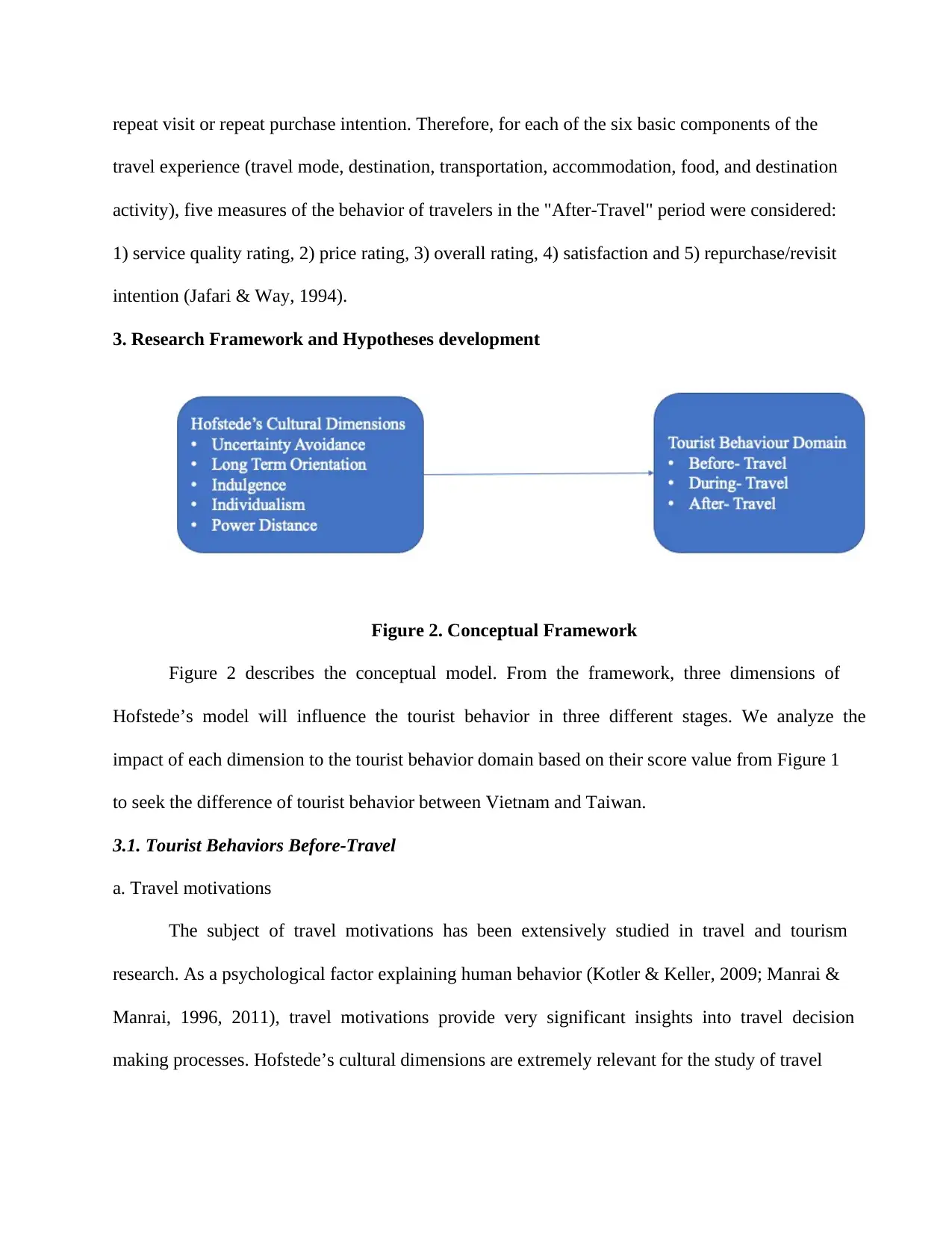
Figure 2. Conceptual Framework
Figure 2 describes the conceptual model. From the framework, three dimensions of
Hofstede’s model will influence the tourist behavior in three different stages. We analyze the
impact of each dimension to the tourist behavior domain based on their score value from Figure 1
to seek the difference of tourist behavior between Vietnam and Taiwan.
3.1. Tourist Behaviors Before-Travel
a. Travel motivations
The subject of travel motivations has been extensively studied in travel and tourism
research. As a psychological factor explaining human behavior (Kotler & Keller, 2009; Manrai &
Manrai, 1996, 2011), travel motivations provide very significant insights into travel decision
making processes. Hofstede’s cultural dimensions are extremely relevant for the study of travel
travel experience (travel mode, destination, transportation, accommodation, food, and destination
activity), five measures of the behavior of travelers in the "After-Travel" period were considered:
1) service quality rating, 2) price rating, 3) overall rating, 4) satisfaction and 5) repurchase/revisit
intention (Jafari & Way, 1994).
3. Research Framework and Hypotheses development
Figure 2. Conceptual Framework
Figure 2 describes the conceptual model. From the framework, three dimensions of
Hofstede’s model will influence the tourist behavior in three different stages. We analyze the
impact of each dimension to the tourist behavior domain based on their score value from Figure 1
to seek the difference of tourist behavior between Vietnam and Taiwan.
3.1. Tourist Behaviors Before-Travel
a. Travel motivations
The subject of travel motivations has been extensively studied in travel and tourism
research. As a psychological factor explaining human behavior (Kotler & Keller, 2009; Manrai &
Manrai, 1996, 2011), travel motivations provide very significant insights into travel decision
making processes. Hofstede’s cultural dimensions are extremely relevant for the study of travel
motivations because cultural values influence all aspects of human life including personal factors
like lifestyle and psychological factors like motivation (Manrai & Manrai, 1996, 2011).
The cultural values of Individualism in Vietnam and Taiwan are quite low (20 and 17
respectively) prevail that Taiwanese and Vietnamese tourists prefer travelling with their families
and their friends (in a group) rather than going alone. The tourist behavior about motivation in
Vietnam and Taiwan is expected to be similar.
b. Travel risk perception, safety concerns
Several researcher studies have addressed the issue of perceived travel risk (Moutinho,
1987) (Roehl & Fesenmaier, 1992) (Reisinger & Mavondo, 2005). (Hofstede, 1980). The
perception of travel risk affects a tourist’s assessment of travel safety and also leads to travel
anxiety. A study by Ressinger and Mavondo (2005) examined the relationship between cultural
orientation, travel motivation, travel safety, travel anxiety and intention to travel internationally.
The fifth cultural dimension of long-term versus short-term orientation can be used here to identify.
The Taiwanese tourists with high long-term orientation score (93) may tend to have more safety
concerns than Vietnamese tourists with low long-term orientation score (57). Indeed, Taiwanese
tourists care more about the conditions affecting to the travelling like: crime, political, terrorism,
etc. than Vietnamese tourists do. Thus, we propose the following:
H1: Taiwanese tourists (vs. Vietnamese tourists) have greater perception about travel
risk and safety in before-travel stage.
c. Trip planning/arrangements
Considering the complexity of the tourism products and various risks associated with
international travel, it is natural for many tourists to take measures to reduce such risks. In this
context, Hofstede’s (1980) cultural dimension of uncertainty avoidance is extremely relevant.
like lifestyle and psychological factors like motivation (Manrai & Manrai, 1996, 2011).
The cultural values of Individualism in Vietnam and Taiwan are quite low (20 and 17
respectively) prevail that Taiwanese and Vietnamese tourists prefer travelling with their families
and their friends (in a group) rather than going alone. The tourist behavior about motivation in
Vietnam and Taiwan is expected to be similar.
b. Travel risk perception, safety concerns
Several researcher studies have addressed the issue of perceived travel risk (Moutinho,
1987) (Roehl & Fesenmaier, 1992) (Reisinger & Mavondo, 2005). (Hofstede, 1980). The
perception of travel risk affects a tourist’s assessment of travel safety and also leads to travel
anxiety. A study by Ressinger and Mavondo (2005) examined the relationship between cultural
orientation, travel motivation, travel safety, travel anxiety and intention to travel internationally.
The fifth cultural dimension of long-term versus short-term orientation can be used here to identify.
The Taiwanese tourists with high long-term orientation score (93) may tend to have more safety
concerns than Vietnamese tourists with low long-term orientation score (57). Indeed, Taiwanese
tourists care more about the conditions affecting to the travelling like: crime, political, terrorism,
etc. than Vietnamese tourists do. Thus, we propose the following:
H1: Taiwanese tourists (vs. Vietnamese tourists) have greater perception about travel
risk and safety in before-travel stage.
c. Trip planning/arrangements
Considering the complexity of the tourism products and various risks associated with
international travel, it is natural for many tourists to take measures to reduce such risks. In this
context, Hofstede’s (1980) cultural dimension of uncertainty avoidance is extremely relevant.
⊘ This is a preview!⊘
Do you want full access?
Subscribe today to unlock all pages.
Trusted by 1+ million students worldwide

1 out of 20


Your All-in-One AI-Powered Toolkit for Academic Success.
+13062052269
info@desklib.com
Available 24*7 on WhatsApp / Email
![[object Object]](/_next/static/media/star-bottom.7253800d.svg)
Unlock your academic potential
Copyright © 2020–2026 A2Z Services. All Rights Reserved. Developed and managed by ZUCOL.