Strategic Analysis: Evaluating Toyota Australia's Business Strategy
VerifiedAdded on 2023/06/04
|14
|3957
|357
Report
AI Summary
This report provides a comprehensive evaluation of Toyota Australia's business strategies, encompassing corporate-level, business-level, networking, and global strategies. It identifies the strategies currently employed by the company, such as generic business-level strategies, growth-corporate level, and networking strategies, and assesses their suitability in the context of the competitive automotive industry. The analysis highlights Toyota's focus on cost leadership, differentiation, and technological innovation. The report recommends that Toyota maintain its differentiation strategy and further leverage networking to foster innovation through collaborations and partnerships. While acknowledging Toyota's existing engagement with these strategies, the report suggests expanding these efforts to enhance business growth and maximize asset value. Ultimately, the report concludes that Toyota's current strategies are generally effective, but continuous improvement and adaptation are essential for maintaining a leading role in the strategic environment.

Business Strategies

Paraphrase This Document
Need a fresh take? Get an instant paraphrase of this document with our AI Paraphraser
EXECUTIVE SUMMARY
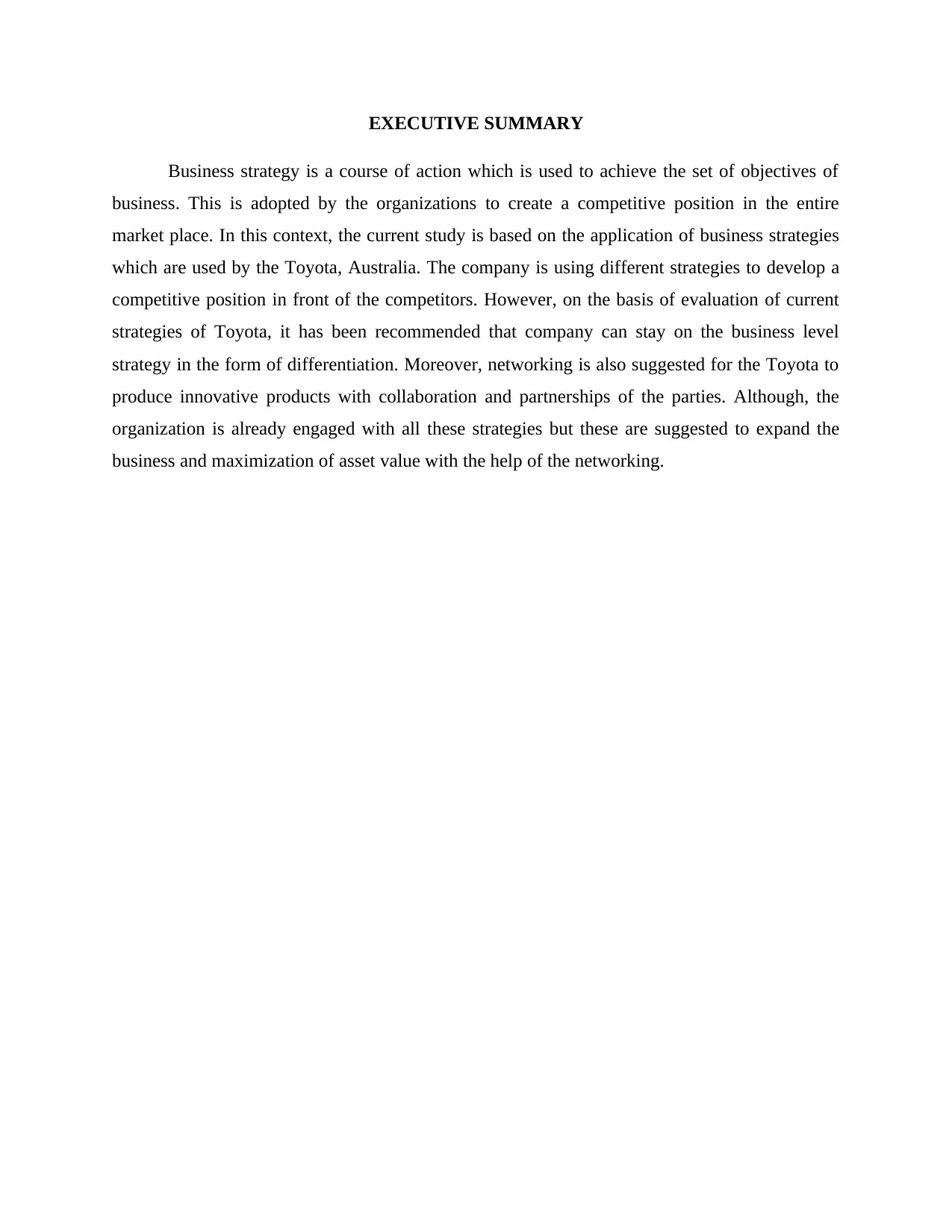
Business strategy is a course of action which is used to achieve the set of objectives of
business. This is adopted by the organizations to create a competitive position in the entire
market place. In this context, the current study is based on the application of business strategies
which are used by the Toyota, Australia. The company is using different strategies to develop a
competitive position in front of the competitors. However, on the basis of evaluation of current
strategies of Toyota, it has been recommended that company can stay on the business level
strategy in the form of differentiation. Moreover, networking is also suggested for the Toyota to
produce innovative products with collaboration and partnerships of the parties. Although, the
organization is already engaged with all these strategies but these are suggested to expand the
business and maximization of asset value with the help of the networking.
Business strategy is a course of action which is used to achieve the set of objectives of
business. This is adopted by the organizations to create a competitive position in the entire
market place. In this context, the current study is based on the application of business strategies
which are used by the Toyota, Australia. The company is using different strategies to develop a
competitive position in front of the competitors. However, on the basis of evaluation of current
strategies of Toyota, it has been recommended that company can stay on the business level
strategy in the form of differentiation. Moreover, networking is also suggested for the Toyota to
produce innovative products with collaboration and partnerships of the parties. Although, the
organization is already engaged with all these strategies but these are suggested to expand the
business and maximization of asset value with the help of the networking.
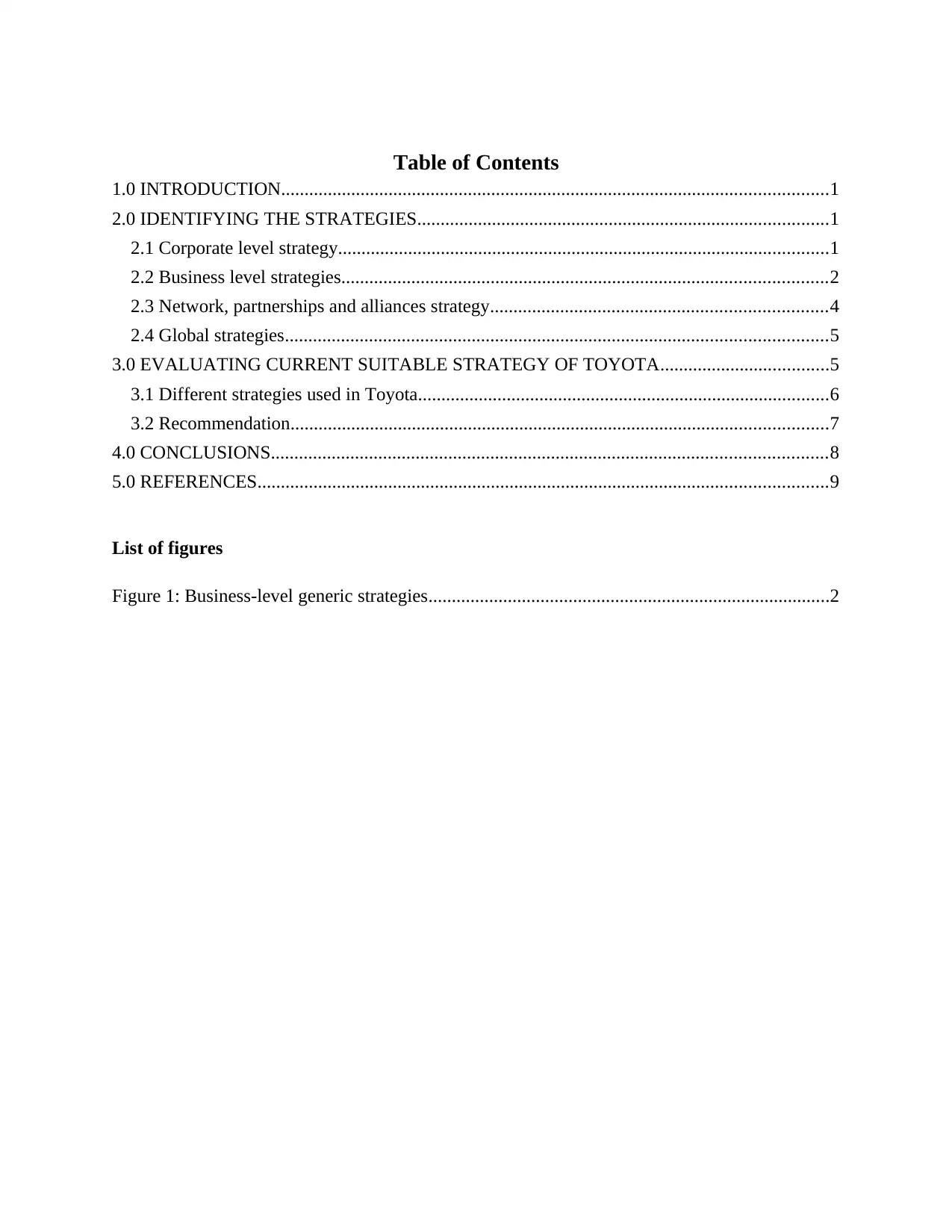
Table of Contents
1.0 INTRODUCTION.....................................................................................................................1
2.0 IDENTIFYING THE STRATEGIES........................................................................................1
2.1 Corporate level strategy.........................................................................................................1
2.2 Business level strategies........................................................................................................2
2.3 Network, partnerships and alliances strategy........................................................................4
2.4 Global strategies....................................................................................................................5
3.0 EVALUATING CURRENT SUITABLE STRATEGY OF TOYOTA....................................5
3.1 Different strategies used in Toyota........................................................................................6
3.2 Recommendation...................................................................................................................7
4.0 CONCLUSIONS.......................................................................................................................8
5.0 REFERENCES..........................................................................................................................9
List of figures
Figure 1: Business-level generic strategies......................................................................................2
1.0 INTRODUCTION.....................................................................................................................1
2.0 IDENTIFYING THE STRATEGIES........................................................................................1
2.1 Corporate level strategy.........................................................................................................1
2.2 Business level strategies........................................................................................................2
2.3 Network, partnerships and alliances strategy........................................................................4
2.4 Global strategies....................................................................................................................5
3.0 EVALUATING CURRENT SUITABLE STRATEGY OF TOYOTA....................................5
3.1 Different strategies used in Toyota........................................................................................6
3.2 Recommendation...................................................................................................................7
4.0 CONCLUSIONS.......................................................................................................................8
5.0 REFERENCES..........................................................................................................................9
List of figures
Figure 1: Business-level generic strategies......................................................................................2
⊘ This is a preview!⊘
Do you want full access?
Subscribe today to unlock all pages.

Trusted by 1+ million students worldwide
1.0 INTRODUCTION
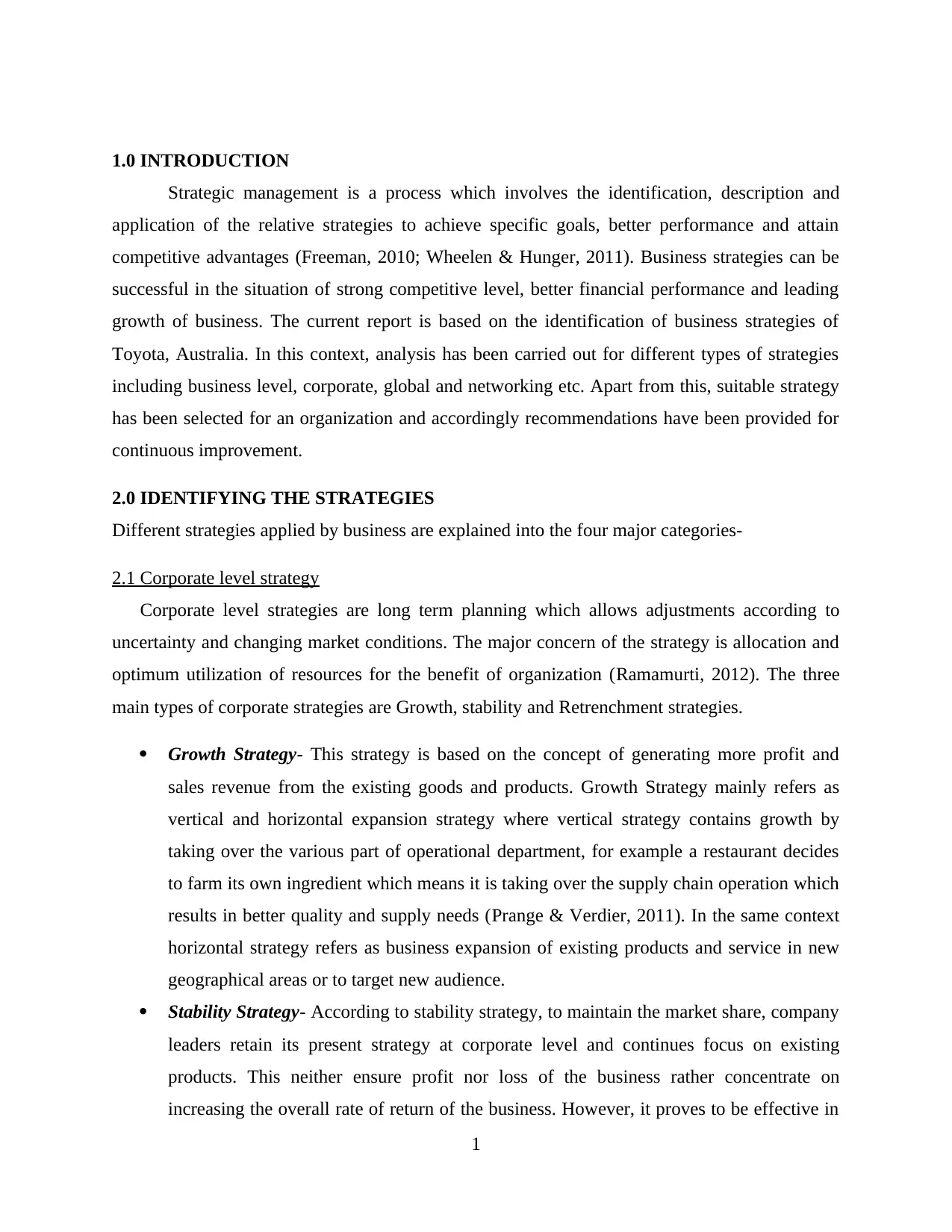
Strategic management is a process which involves the identification, description and
application of the relative strategies to achieve specific goals, better performance and attain
competitive advantages (Freeman, 2010; Wheelen & Hunger, 2011). Business strategies can be
successful in the situation of strong competitive level, better financial performance and leading
growth of business. The current report is based on the identification of business strategies of
Toyota, Australia. In this context, analysis has been carried out for different types of strategies
including business level, corporate, global and networking etc. Apart from this, suitable strategy
has been selected for an organization and accordingly recommendations have been provided for
continuous improvement.
2.0 IDENTIFYING THE STRATEGIES
Different strategies applied by business are explained into the four major categories-
2.1 Corporate level strategy
Corporate level strategies are long term planning which allows adjustments according to
uncertainty and changing market conditions. The major concern of the strategy is allocation and
optimum utilization of resources for the benefit of organization (Ramamurti, 2012). The three
main types of corporate strategies are Growth, stability and Retrenchment strategies.
Growth Strategy- This strategy is based on the concept of generating more profit and
sales revenue from the existing goods and products. Growth Strategy mainly refers as
vertical and horizontal expansion strategy where vertical strategy contains growth by
taking over the various part of operational department, for example a restaurant decides
to farm its own ingredient which means it is taking over the supply chain operation which
results in better quality and supply needs (Prange & Verdier, 2011). In the same context
horizontal strategy refers as business expansion of existing products and service in new
geographical areas or to target new audience.
Stability Strategy- According to stability strategy, to maintain the market share, company
leaders retain its present strategy at corporate level and continues focus on existing
products. This neither ensure profit nor loss of the business rather concentrate on
increasing the overall rate of return of the business. However, it proves to be effective in
1
Strategic management is a process which involves the identification, description and
application of the relative strategies to achieve specific goals, better performance and attain
competitive advantages (Freeman, 2010; Wheelen & Hunger, 2011). Business strategies can be
successful in the situation of strong competitive level, better financial performance and leading
growth of business. The current report is based on the identification of business strategies of
Toyota, Australia. In this context, analysis has been carried out for different types of strategies
including business level, corporate, global and networking etc. Apart from this, suitable strategy
has been selected for an organization and accordingly recommendations have been provided for
continuous improvement.
2.0 IDENTIFYING THE STRATEGIES
Different strategies applied by business are explained into the four major categories-
2.1 Corporate level strategy
Corporate level strategies are long term planning which allows adjustments according to
uncertainty and changing market conditions. The major concern of the strategy is allocation and
optimum utilization of resources for the benefit of organization (Ramamurti, 2012). The three
main types of corporate strategies are Growth, stability and Retrenchment strategies.
Growth Strategy- This strategy is based on the concept of generating more profit and
sales revenue from the existing goods and products. Growth Strategy mainly refers as
vertical and horizontal expansion strategy where vertical strategy contains growth by
taking over the various part of operational department, for example a restaurant decides
to farm its own ingredient which means it is taking over the supply chain operation which
results in better quality and supply needs (Prange & Verdier, 2011). In the same context
horizontal strategy refers as business expansion of existing products and service in new
geographical areas or to target new audience.
Stability Strategy- According to stability strategy, to maintain the market share, company
leaders retain its present strategy at corporate level and continues focus on existing
products. This neither ensure profit nor loss of the business rather concentrate on
increasing the overall rate of return of the business. However, it proves to be effective in
1
Paraphrase This Document
Need a fresh take? Get an instant paraphrase of this document with our AI Paraphraser
increasing the profitability of the business through customer retention (Lubatkin, 2013).
At this juncture, businesses like Toyota focuses on increasing the customer satisfaction
by offering the discount and other related lucrative offers.
Retrenchment strategy-This strategy is applied when company finds itself in weak
competitive stage and declining in market position due to poor performance of existing
product line. It helps to improve company’s performance by various strategy as
turnaround, divestment and liquidation strategy (Hill, Jones & Schilling, 2015). The
turnaround strategy emphasizes on operational efficiency in beginning of the decline
rather than on the critical stage. However, such strategies work when the business does
not sufficient resources and finance to continue with the operation and meet the
expectations of clients.
2.2 Business level strategies
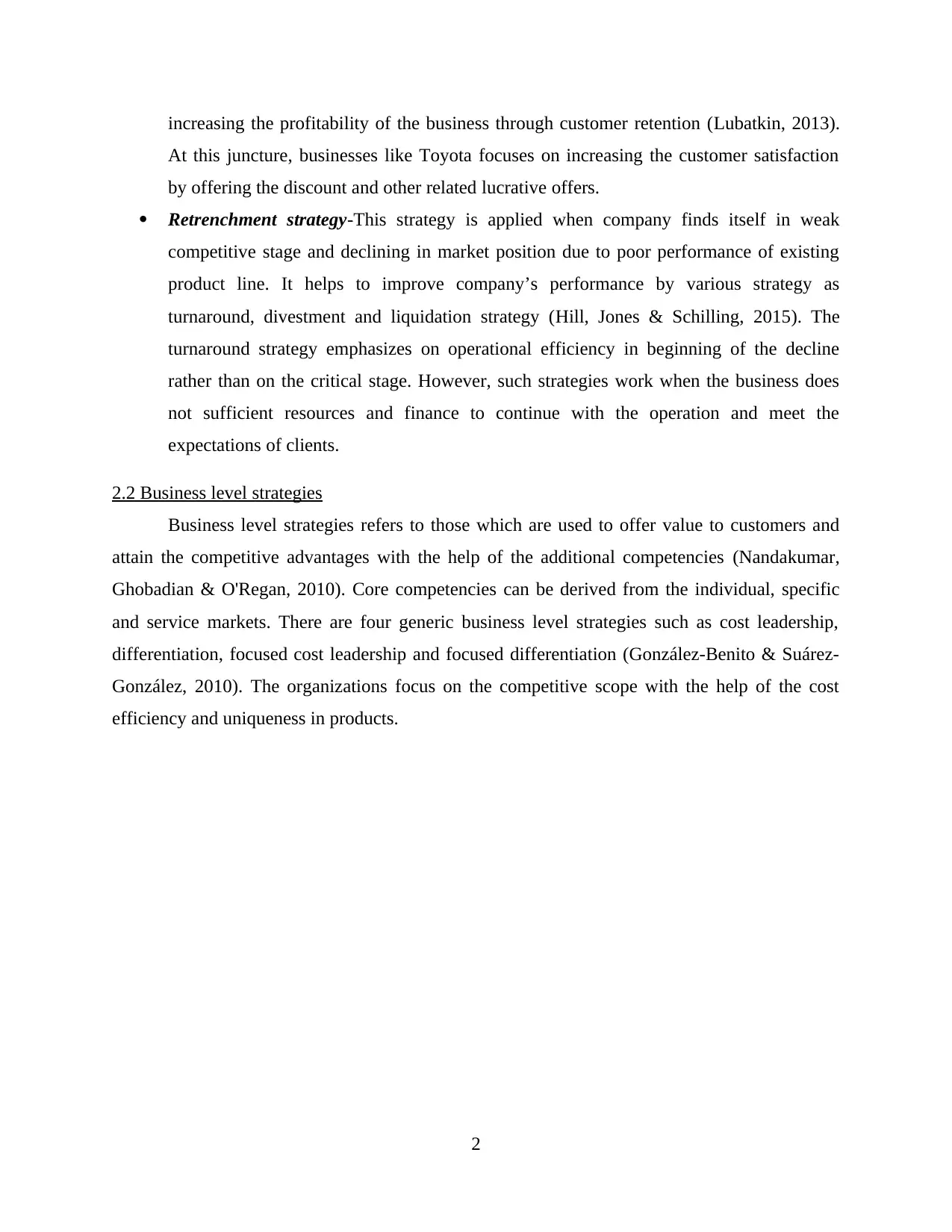
Business level strategies refers to those which are used to offer value to customers and
attain the competitive advantages with the help of the additional competencies (Nandakumar,
Ghobadian & O'Regan, 2010). Core competencies can be derived from the individual, specific
and service markets. There are four generic business level strategies such as cost leadership,
differentiation, focused cost leadership and focused differentiation (González‐Benito & Suárez‐
González, 2010). The organizations focus on the competitive scope with the help of the cost
efficiency and uniqueness in products.
2
At this juncture, businesses like Toyota focuses on increasing the customer satisfaction
by offering the discount and other related lucrative offers.
Retrenchment strategy-This strategy is applied when company finds itself in weak
competitive stage and declining in market position due to poor performance of existing
product line. It helps to improve company’s performance by various strategy as
turnaround, divestment and liquidation strategy (Hill, Jones & Schilling, 2015). The
turnaround strategy emphasizes on operational efficiency in beginning of the decline
rather than on the critical stage. However, such strategies work when the business does
not sufficient resources and finance to continue with the operation and meet the
expectations of clients.
2.2 Business level strategies
Business level strategies refers to those which are used to offer value to customers and
attain the competitive advantages with the help of the additional competencies (Nandakumar,
Ghobadian & O'Regan, 2010). Core competencies can be derived from the individual, specific
and service markets. There are four generic business level strategies such as cost leadership,
differentiation, focused cost leadership and focused differentiation (González‐Benito & Suárez‐
González, 2010). The organizations focus on the competitive scope with the help of the cost
efficiency and uniqueness in products.
2
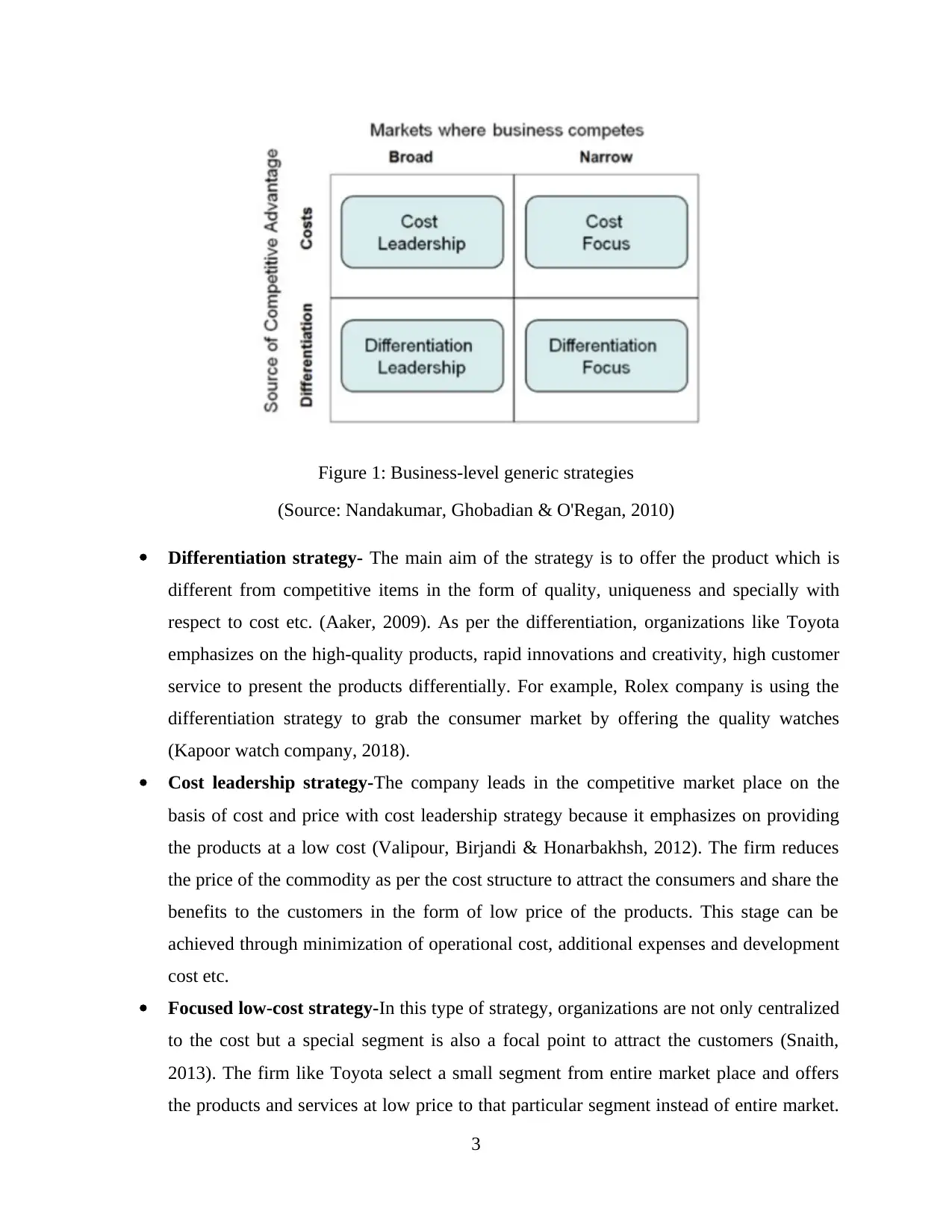
Figure 1: Business-level generic strategies
(Source: Nandakumar, Ghobadian & O'Regan, 2010)
Differentiation strategy- The main aim of the strategy is to offer the product which is
different from competitive items in the form of quality, uniqueness and specially with
respect to cost etc. (Aaker, 2009). As per the differentiation, organizations like Toyota
emphasizes on the high-quality products, rapid innovations and creativity, high customer
service to present the products differentially. For example, Rolex company is using the
differentiation strategy to grab the consumer market by offering the quality watches
(Kapoor watch company, 2018).
Cost leadership strategy-The company leads in the competitive market place on the
basis of cost and price with cost leadership strategy because it emphasizes on providing
the products at a low cost (Valipour, Birjandi & Honarbakhsh, 2012). The firm reduces
the price of the commodity as per the cost structure to attract the consumers and share the
benefits to the customers in the form of low price of the products. This stage can be
achieved through minimization of operational cost, additional expenses and development
cost etc.
Focused low-cost strategy-In this type of strategy, organizations are not only centralized
to the cost but a special segment is also a focal point to attract the customers (Snaith,
2013). The firm like Toyota select a small segment from entire market place and offers
the products and services at low price to that particular segment instead of entire market.
3
(Source: Nandakumar, Ghobadian & O'Regan, 2010)
Differentiation strategy- The main aim of the strategy is to offer the product which is
different from competitive items in the form of quality, uniqueness and specially with
respect to cost etc. (Aaker, 2009). As per the differentiation, organizations like Toyota
emphasizes on the high-quality products, rapid innovations and creativity, high customer
service to present the products differentially. For example, Rolex company is using the
differentiation strategy to grab the consumer market by offering the quality watches
(Kapoor watch company, 2018).
Cost leadership strategy-The company leads in the competitive market place on the
basis of cost and price with cost leadership strategy because it emphasizes on providing
the products at a low cost (Valipour, Birjandi & Honarbakhsh, 2012). The firm reduces
the price of the commodity as per the cost structure to attract the consumers and share the
benefits to the customers in the form of low price of the products. This stage can be
achieved through minimization of operational cost, additional expenses and development
cost etc.
Focused low-cost strategy-In this type of strategy, organizations are not only centralized
to the cost but a special segment is also a focal point to attract the customers (Snaith,
2013). The firm like Toyota select a small segment from entire market place and offers
the products and services at low price to that particular segment instead of entire market.
3
⊘ This is a preview!⊘
Do you want full access?
Subscribe today to unlock all pages.
Trusted by 1+ million students worldwide
For example, a supplier company which is delivering the goods only to one country and
giving a special weightage to requirements of a small segment.
Focused differentiation-The organizations not only emphasize on the differentiation in
the form of quality, price, uniqueness but also centralized with special segment of the
consumer market (Huselid & Becker, 2011). Further, in this type of strategy,
organizations offer the products and services in more efficient manner to attract the
particular segment; however, there is a risk that competitors may overcome the selected
segment by offering the variety of products.
2.3 Network, partnerships and alliances strategy
These are the strategies used to get success in the competitive environment by developing
network, formation of partnerships and alliances etc.
Network strategy-Networking strategies are used to generate new connections as well as
retaining the existing networks for the growth of the businesses such as Toyota. With the
help of these strategies’ organizations can be effectively communicate with expertise to
know about potential customers. Further, it would be beneficial to the businesses in the
form of achievements of targets and to reach at the level of expected potentials. These
strategies involve the focuses on relationship building, enter into unknown branches of
business and generate the social creeps to expand (Jennifer, 2018).
Partnerships strategy-Companies work with partners across the country as well as
within the value chain due to different reasons such as to expansion of business and the
requirement to cut cost (IMD, 2018). Partnerships strategies are useful for all the parties
of business because it is based on the bargaining situation of both the sides. At this
juncture, the success of partnerships has been accelerated in current business era due to
marking of risk-sharing, technology upgradation and pool of resources etc. (Nadkarni,
2010). Moreover, it would be helpful for the organizations like Toyota to share the risk
and maximize the availability of resources.
Alliances strategy-Strategic alliance is a small part of legal partnership entity which is
based on the agreement between two or more than two parties (CFI Education Inc, 2018).
This type of formation can be adopted by many organizations such as Toyota to achieve
the set of agreed objectives. For example, in a strategic alliance, two companies such as
4
giving a special weightage to requirements of a small segment.
Focused differentiation-The organizations not only emphasize on the differentiation in
the form of quality, price, uniqueness but also centralized with special segment of the
consumer market (Huselid & Becker, 2011). Further, in this type of strategy,
organizations offer the products and services in more efficient manner to attract the
particular segment; however, there is a risk that competitors may overcome the selected
segment by offering the variety of products.
2.3 Network, partnerships and alliances strategy
These are the strategies used to get success in the competitive environment by developing
network, formation of partnerships and alliances etc.
Network strategy-Networking strategies are used to generate new connections as well as
retaining the existing networks for the growth of the businesses such as Toyota. With the
help of these strategies’ organizations can be effectively communicate with expertise to
know about potential customers. Further, it would be beneficial to the businesses in the
form of achievements of targets and to reach at the level of expected potentials. These
strategies involve the focuses on relationship building, enter into unknown branches of
business and generate the social creeps to expand (Jennifer, 2018).
Partnerships strategy-Companies work with partners across the country as well as
within the value chain due to different reasons such as to expansion of business and the
requirement to cut cost (IMD, 2018). Partnerships strategies are useful for all the parties
of business because it is based on the bargaining situation of both the sides. At this
juncture, the success of partnerships has been accelerated in current business era due to
marking of risk-sharing, technology upgradation and pool of resources etc. (Nadkarni,
2010). Moreover, it would be helpful for the organizations like Toyota to share the risk
and maximize the availability of resources.
Alliances strategy-Strategic alliance is a small part of legal partnership entity which is
based on the agreement between two or more than two parties (CFI Education Inc, 2018).
This type of formation can be adopted by many organizations such as Toyota to achieve
the set of agreed objectives. For example, in a strategic alliance, two companies such as
4
Paraphrase This Document
Need a fresh take? Get an instant paraphrase of this document with our AI Paraphraser
A and B can integrate their respective capabilities, resources as well as core
competencies. All these would be done to acquire mutual interest in manufacturing,
designing or products along with distribution of services.
2.4 Global strategies
There are different global strategies used by businesses operating across the globe. It
consists of standardization and adaptation through which business can effectively track the
performance. However, Bordean, Borza, Nistor & Mitra (2010) cultural differences of each
country impede the performance of corporation because of unique belief system of each region.
For this purpose, it becomes crucial for an organization to focus on those differences and
accordingly shed light on actual performance. However, adaptation facilitates to resolve the issue
related to cultural barriers. Also, the appropriate degree of adaptation makes it easy to adapt the
current business practices on the basis of changing scenario (Ramamurti, 2012). This contribute
towards increasing overall rate of return. Owing to this, companies like Toyota standardize its
marketing practices and business model along with the appropriate degree of adaptation. This
enables business to cater the requirement of different stakeholders.
3.0 EVALUATING CURRENT SUITABLE STRATEGY OF TOYOTA
According to several studies, Toyota is using different types of strategies such as generic-
business level strategies, growth-corporate level and networking strategies (Toyota Annual
Report, 2017; Andrew Thompson, 2018). Toyota motor corporation is a global force in the
automobile industry of competitive business environment and success of the organization is
based on the effectiveness of the generic and growth strategies (Andrew Thompson, 2018). In
this regard, growth strategies have an aim to achieve the large market share with minimum
expenditure for short-term earnings (Hill, 2017). As per the several studies, growth strategies
have tremendous effects on the technological innovations of the products to achieve the
competitive expansion against another firms (Boxall & Purcell, 2011; Rothaermel, 2015). In this
context, Toyota is ensuring the benefits and high rate of technological advancements in
comparison to Maruti, Suzuki and other automobile companies (Toyota Motor Corporation,
2018).
5
competencies. All these would be done to acquire mutual interest in manufacturing,
designing or products along with distribution of services.
2.4 Global strategies
There are different global strategies used by businesses operating across the globe. It
consists of standardization and adaptation through which business can effectively track the
performance. However, Bordean, Borza, Nistor & Mitra (2010) cultural differences of each
country impede the performance of corporation because of unique belief system of each region.
For this purpose, it becomes crucial for an organization to focus on those differences and
accordingly shed light on actual performance. However, adaptation facilitates to resolve the issue
related to cultural barriers. Also, the appropriate degree of adaptation makes it easy to adapt the
current business practices on the basis of changing scenario (Ramamurti, 2012). This contribute
towards increasing overall rate of return. Owing to this, companies like Toyota standardize its
marketing practices and business model along with the appropriate degree of adaptation. This
enables business to cater the requirement of different stakeholders.
3.0 EVALUATING CURRENT SUITABLE STRATEGY OF TOYOTA
According to several studies, Toyota is using different types of strategies such as generic-
business level strategies, growth-corporate level and networking strategies (Toyota Annual
Report, 2017; Andrew Thompson, 2018). Toyota motor corporation is a global force in the
automobile industry of competitive business environment and success of the organization is
based on the effectiveness of the generic and growth strategies (Andrew Thompson, 2018). In
this regard, growth strategies have an aim to achieve the large market share with minimum
expenditure for short-term earnings (Hill, 2017). As per the several studies, growth strategies
have tremendous effects on the technological innovations of the products to achieve the
competitive expansion against another firms (Boxall & Purcell, 2011; Rothaermel, 2015). In this
context, Toyota is ensuring the benefits and high rate of technological advancements in
comparison to Maruti, Suzuki and other automobile companies (Toyota Motor Corporation,
2018).
5
3.1 Different strategies used in Toyota
The Toyota is expanding its business at global level by applying the appropriate growth
strategy with the help of specification like market diversification, product and market
development along with market penetration etc. (PR Newswire, 2018). On the other hand,
Toyota is getting success and focusing on the innovations in the automobile products through the
application of growth strategies. Thus, it indicates that the growth and generic strategies are
suitable for the Toyota which are currently in use. These generic strategies are the combination
of the cost leadership and vast differentiation for the Toyota motor corporation. At this juncture,
with the help of the cost leadership, Toyota is centralizing with minimization of cost and selling
price of the products. However, differentiation strategy is ensuring that Toyota is offering the
unique products with the proper development as well as innovations to achieve the competitive
advantages in the market (Toyota Annual Report, 2017). Further, Toyota is encompassing a
connected manifesto which is important for the businesses of automakers to provide a vide
variety of cars, develop new modes to use and create new value for the connected cars (Toyota
Annual Report, 2017). Nonetheless, with the help of the networking strategy company is
focusing on the connected technologies to attain further growth (Toyota Motor Corporation,
2017). Therefore, it reveals that the current strategies of the Toyota are effective in nature for the
growth of the business and maintain a leading role in the stratgeic environment.
The analysis of the strategies indicates that recently Toyota is focusing on the alliance’s
strategies for the developments in the car models and expansion of the business along with
creativity. For instance, Toyota has done alliances with other Japanese car makers such as
Subaru and Suzuki to maximize the sales ratio in the Asian countries. In this alliance, the
company has decided to spent on the fuel cell ungradation and realize that there is a risk factor so
company turn to electronic vehicle mix (Steve, 2018). At this juncture, Cartwright & Cooper
(2012) stated that company can apply the strategic alliances in three different forms involving
joint venture, equity and non-equity strategic alliance etc. In this context, the companies agreed
upon a contractual relationship to share the resources-financial, human, physical-machinery,
equipment’s and capabilities for the expansion and growth of the business (Das & Rahman,
2010). Thus, it reveals that strategic alliances are effective for the companies to achieve the high
volume of profits with minimum application of resources because all types of resources would be
shared as per the requirements.
6
The Toyota is expanding its business at global level by applying the appropriate growth
strategy with the help of specification like market diversification, product and market
development along with market penetration etc. (PR Newswire, 2018). On the other hand,
Toyota is getting success and focusing on the innovations in the automobile products through the
application of growth strategies. Thus, it indicates that the growth and generic strategies are
suitable for the Toyota which are currently in use. These generic strategies are the combination
of the cost leadership and vast differentiation for the Toyota motor corporation. At this juncture,
with the help of the cost leadership, Toyota is centralizing with minimization of cost and selling
price of the products. However, differentiation strategy is ensuring that Toyota is offering the
unique products with the proper development as well as innovations to achieve the competitive
advantages in the market (Toyota Annual Report, 2017). Further, Toyota is encompassing a
connected manifesto which is important for the businesses of automakers to provide a vide
variety of cars, develop new modes to use and create new value for the connected cars (Toyota
Annual Report, 2017). Nonetheless, with the help of the networking strategy company is
focusing on the connected technologies to attain further growth (Toyota Motor Corporation,
2017). Therefore, it reveals that the current strategies of the Toyota are effective in nature for the
growth of the business and maintain a leading role in the stratgeic environment.
The analysis of the strategies indicates that recently Toyota is focusing on the alliance’s
strategies for the developments in the car models and expansion of the business along with
creativity. For instance, Toyota has done alliances with other Japanese car makers such as
Subaru and Suzuki to maximize the sales ratio in the Asian countries. In this alliance, the
company has decided to spent on the fuel cell ungradation and realize that there is a risk factor so
company turn to electronic vehicle mix (Steve, 2018). At this juncture, Cartwright & Cooper
(2012) stated that company can apply the strategic alliances in three different forms involving
joint venture, equity and non-equity strategic alliance etc. In this context, the companies agreed
upon a contractual relationship to share the resources-financial, human, physical-machinery,
equipment’s and capabilities for the expansion and growth of the business (Das & Rahman,
2010). Thus, it reveals that strategic alliances are effective for the companies to achieve the high
volume of profits with minimum application of resources because all types of resources would be
shared as per the requirements.
6
⊘ This is a preview!⊘
Do you want full access?
Subscribe today to unlock all pages.
Trusted by 1+ million students worldwide
Partnership is also followed by Toyota to build a continuous relationship with automotive
companies and to establish the brand image in the front of the competitors. For instance, Toyota
has entered into a partnership agreement with Mazda before 3 years ago and both the companies
were mutually benefited in terms of adoption of new technologies and products. Further, the
company has decided to change of resources, complementing the technologies and products
towards the achievement of goal to deliver more luxury cars (Toyota Motor Corporation, 2017).
At this juncture, main aim of partnership with Mazda is to achieve the sustainable growth of the
business, strong collaboration with parties, to deal with the challenges of automotive industry.
Thus, it reveals that partnership offers the competitive advantages to firms by providing the
variety of products and services to grab the entire consumer market.
3.2 Recommendation
On the basis of the study, it has been found that Toyota is using almost all the required
strategies involving business-level, corporate, networking, partnership, alliances and global to
expand the business and create innovations in production of cars. Although, it has been
recommended that Toyota should stay on the business level strategies- differentiation and
networking strategy to achieve higher growth and fulfill the demands of customers.
Differentiation strategy- As per the analysis, Toyota focuses on the international
strategies and gain the attention of customers. However, it is suggested that Toyota
should implement business level strategy as the differentiation. In this type of strategy,
company would be able to offer the unique, innovative and advanced technology related
products to attract the large number of customers. Further, the company can meet the
demand of the customers as well as can apply the extra amount or premium for the
produced goods and services. In this regard, Toyota can enhance the customer loyalty and
make the strong identity in front of the competitors.
Networking strategy- Although, Toyota is already engaged with networking strategy but
it is suggested that business should build vaster network since it would be helpful in
collaborating the key partners who can helps in bringing innovation in the current
products and services. Business networking has huge benefits because it generates new
opportunities through joint venture, partnerships, increases asset sales and lead the
7
companies and to establish the brand image in the front of the competitors. For instance, Toyota
has entered into a partnership agreement with Mazda before 3 years ago and both the companies
were mutually benefited in terms of adoption of new technologies and products. Further, the
company has decided to change of resources, complementing the technologies and products
towards the achievement of goal to deliver more luxury cars (Toyota Motor Corporation, 2017).
At this juncture, main aim of partnership with Mazda is to achieve the sustainable growth of the
business, strong collaboration with parties, to deal with the challenges of automotive industry.
Thus, it reveals that partnership offers the competitive advantages to firms by providing the
variety of products and services to grab the entire consumer market.
3.2 Recommendation
On the basis of the study, it has been found that Toyota is using almost all the required
strategies involving business-level, corporate, networking, partnership, alliances and global to
expand the business and create innovations in production of cars. Although, it has been
recommended that Toyota should stay on the business level strategies- differentiation and
networking strategy to achieve higher growth and fulfill the demands of customers.
Differentiation strategy- As per the analysis, Toyota focuses on the international
strategies and gain the attention of customers. However, it is suggested that Toyota
should implement business level strategy as the differentiation. In this type of strategy,
company would be able to offer the unique, innovative and advanced technology related
products to attract the large number of customers. Further, the company can meet the
demand of the customers as well as can apply the extra amount or premium for the
produced goods and services. In this regard, Toyota can enhance the customer loyalty and
make the strong identity in front of the competitors.
Networking strategy- Although, Toyota is already engaged with networking strategy but
it is suggested that business should build vaster network since it would be helpful in
collaborating the key partners who can helps in bringing innovation in the current
products and services. Business networking has huge benefits because it generates new
opportunities through joint venture, partnerships, increases asset sales and lead the
7
Paraphrase This Document
Need a fresh take? Get an instant paraphrase of this document with our AI Paraphraser
clients. At this juncture, joint venture in developed countries can be used as the platform
to expand into the new market and increase the volume of buyers.
4.0 CONCLUSIONS
On the basis of report, it has been concluded that the use of strategies is depends on the
nature of the business. Toyota uses different types of business level strategies such as cost
leaderships, differentiation, focused cost etc. to enhance the business and improve the volume. In
this regard, with the help of the cost leadership strategy, company is focusing on the low prices
with delivery of quality cars. However, company uses networking strategy to develop the new
connections along with retaining the current growth and enhance the profits. On the basis of
evaluation, it has also been concluded that alliances strategy is supportive to develop the new car
models due to collaboration of resources and assets.
8
to expand into the new market and increase the volume of buyers.
4.0 CONCLUSIONS
On the basis of report, it has been concluded that the use of strategies is depends on the
nature of the business. Toyota uses different types of business level strategies such as cost
leaderships, differentiation, focused cost etc. to enhance the business and improve the volume. In
this regard, with the help of the cost leadership strategy, company is focusing on the low prices
with delivery of quality cars. However, company uses networking strategy to develop the new
connections along with retaining the current growth and enhance the profits. On the basis of
evaluation, it has also been concluded that alliances strategy is supportive to develop the new car
models due to collaboration of resources and assets.
8
5.0 REFERENCES
Aaker, D. A. (2009). Brand portfolio strategy: Creating relevance, differentiation, energy,
leverage, and clarity. Simon and Schuster.
Andrew, T. (2018). Toyota’s Generic Strategy & Intensive Growth Strategies. [Online].
Available at: <http://panmore.com/toyota-generic-strategy-intensive-growth-strategies>.
[Accessed on: 24th September 2018].
Bordean, O. N., Borza, A. I., Nistor, R. L., & Mitra, C. S. (2010). The use of Michael Porter's
generic strategies in the Romanian hotel industry. International Journal of Trade,
Economics and Finance, 1(2), 173.
Boxall, P., & Purcell, J. (2011). Strategy and human resource management. Macmillan
International Higher Education.
Cartwright, S., & Cooper, C. L. (2012). Managing mergers acquisitions and strategic alliances.
Routledge.
CFI Education Inc, (2018). Strategic Alliances. [Online]. Available at:
<https://corporatefinanceinstitute.com/resources/knowledge/strategy/strategic-alliances/>.
[Accessed on: 24th September 2018].
Das, T. K., & Rahman, N. (2010). Determinants of partner opportunism in strategic alliances: a
conceptual framework. Journal of Business and Psychology, 25(1), 55-74.
Freeman, R. E. (2010). Strategic management: A stakeholder approach. Cambridge university
press.
González‐Benito, J., & Suárez‐González, I. (2010). A study of the role played by manufacturing
strategic objectives and capabilities in understanding the relationship between Porter's
generic strategies and business performance. British Journal of Management, 21(4), 1027-
1043.
Hill, C. W., Jones, G. R., & Schilling, M. A. (2015). Strategic management theory. Cengage
Learning,.
9
Aaker, D. A. (2009). Brand portfolio strategy: Creating relevance, differentiation, energy,
leverage, and clarity. Simon and Schuster.
Andrew, T. (2018). Toyota’s Generic Strategy & Intensive Growth Strategies. [Online].
Available at: <http://panmore.com/toyota-generic-strategy-intensive-growth-strategies>.
[Accessed on: 24th September 2018].
Bordean, O. N., Borza, A. I., Nistor, R. L., & Mitra, C. S. (2010). The use of Michael Porter's
generic strategies in the Romanian hotel industry. International Journal of Trade,
Economics and Finance, 1(2), 173.
Boxall, P., & Purcell, J. (2011). Strategy and human resource management. Macmillan
International Higher Education.
Cartwright, S., & Cooper, C. L. (2012). Managing mergers acquisitions and strategic alliances.
Routledge.
CFI Education Inc, (2018). Strategic Alliances. [Online]. Available at:
<https://corporatefinanceinstitute.com/resources/knowledge/strategy/strategic-alliances/>.
[Accessed on: 24th September 2018].
Das, T. K., & Rahman, N. (2010). Determinants of partner opportunism in strategic alliances: a
conceptual framework. Journal of Business and Psychology, 25(1), 55-74.
Freeman, R. E. (2010). Strategic management: A stakeholder approach. Cambridge university
press.
González‐Benito, J., & Suárez‐González, I. (2010). A study of the role played by manufacturing
strategic objectives and capabilities in understanding the relationship between Porter's
generic strategies and business performance. British Journal of Management, 21(4), 1027-
1043.
Hill, C. W., Jones, G. R., & Schilling, M. A. (2015). Strategic management theory. Cengage
Learning,.
9
⊘ This is a preview!⊘
Do you want full access?
Subscribe today to unlock all pages.
Trusted by 1+ million students worldwide

1 out of 14


Related Documents


Your All-in-One AI-Powered Toolkit for Academic Success.
+13062052269
info@desklib.com
Available 24*7 on WhatsApp / Email
![[object Object]](/_next/static/media/star-bottom.7253800d.svg)
Unlock your academic potential
Copyright © 2020–2026 A2Z Services. All Rights Reserved. Developed and managed by ZUCOL.