Toyota Global: Strategic Information Systems for Business Development
VerifiedAdded on 2023/06/04
|18
|4019
|122
Report
AI Summary
This report provides an in-depth analysis of the information systems utilized by Toyota Global to enhance its business operations and maintain a competitive edge in the global market. It begins by outlining the core components of information systems, including computer hardware, software, telecommunications, databases, and human resources, and then details how Toyota has strategically implemented these systems across various business units. The report examines the theoretical and practical applications of information systems within the company, highlighting the integration of concepts like lean manufacturing, Kaizen, and the Toyota Production System. It further discusses the merits, demerits, strengths, and deficiencies associated with Toyota's approach to information systems, including the use of Management Information Systems (MIS) in finance, marketing, and quality control. The analysis extends to the role of MIS in shaping Toyota's business strategies and adapting to the evolving global economy and environmental standards. The document is available on Desklib, a platform offering study tools and resources for students.
Running head: INFORMATION SYTSEM IN TOYOTA GLOBAL
INFORMATION SYTSEM IN TOYOTA GLOBAL
Name of the student:
Name of the university:
Author note:
INFORMATION SYTSEM IN TOYOTA GLOBAL
Name of the student:
Name of the university:
Author note:

Paraphrase This Document
Need a fresh take? Get an instant paraphrase of this document with our AI Paraphraser
1INFORMATION SYTSEM IN TOYOTA GLOBAL
Executive summary:
Most of the companies in today’s world are implementing information systems within
their work culture for the betterment of the working operations. Information systems are mainly
used to automate the systems and enable to perform even faster and efficiently than before,
which is often termed as computerized information systems. The information systems are used to
perform different kinds of tasks within the organizations such as collecting, processing,
transmitting as well as disseminating data before passing it on to the client.
In the following study, the different information systems that are being used within the
company y of Toyota global will be studied and explained in details. The different aspects such
as the advantage as well as the disadvantages of the information systems will be studied in
details. By the end of the report, the reader will be able to understand the different aspects of
implementing information systems within the organization and have a clear understanding of the
working of the Toyota global.
Executive summary:
Most of the companies in today’s world are implementing information systems within
their work culture for the betterment of the working operations. Information systems are mainly
used to automate the systems and enable to perform even faster and efficiently than before,
which is often termed as computerized information systems. The information systems are used to
perform different kinds of tasks within the organizations such as collecting, processing,
transmitting as well as disseminating data before passing it on to the client.
In the following study, the different information systems that are being used within the
company y of Toyota global will be studied and explained in details. The different aspects such
as the advantage as well as the disadvantages of the information systems will be studied in
details. By the end of the report, the reader will be able to understand the different aspects of
implementing information systems within the organization and have a clear understanding of the
working of the Toyota global.
2INFORMATION SYTSEM IN TOYOTA GLOBAL
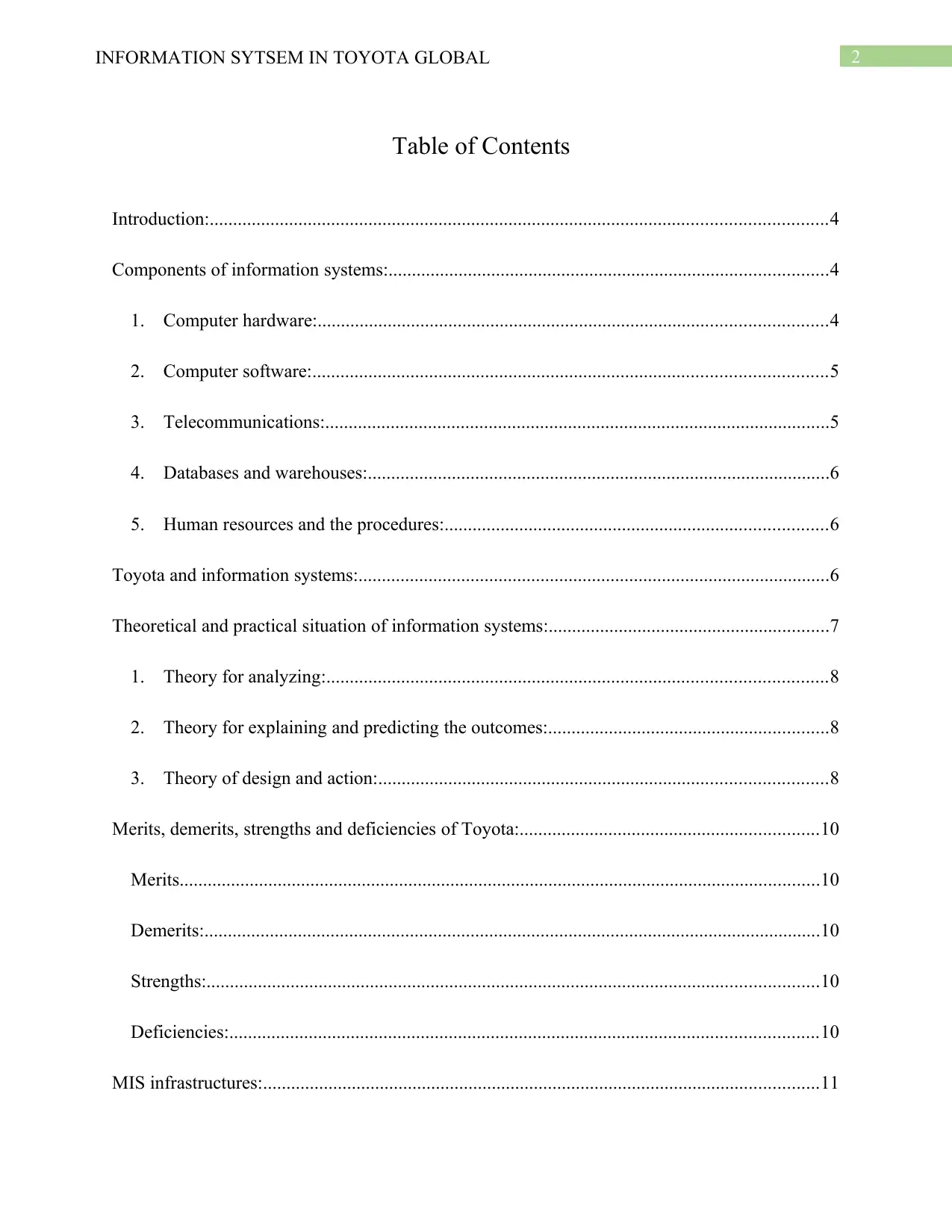
Table of Contents
Introduction:....................................................................................................................................4
Components of information systems:..............................................................................................4
1. Computer hardware:.............................................................................................................4
2. Computer software:..............................................................................................................5
3. Telecommunications:............................................................................................................5
4. Databases and warehouses:...................................................................................................6
5. Human resources and the procedures:..................................................................................6
Toyota and information systems:.....................................................................................................6
Theoretical and practical situation of information systems:............................................................7
1. Theory for analyzing:...........................................................................................................8
2. Theory for explaining and predicting the outcomes:............................................................8
3. Theory of design and action:................................................................................................8
Merits, demerits, strengths and deficiencies of Toyota:................................................................10
Merits.........................................................................................................................................10
Demerits:....................................................................................................................................10
Strengths:...................................................................................................................................10
Deficiencies:..............................................................................................................................10
MIS infrastructures:.......................................................................................................................11
Table of Contents
Introduction:....................................................................................................................................4
Components of information systems:..............................................................................................4
1. Computer hardware:.............................................................................................................4
2. Computer software:..............................................................................................................5
3. Telecommunications:............................................................................................................5
4. Databases and warehouses:...................................................................................................6
5. Human resources and the procedures:..................................................................................6
Toyota and information systems:.....................................................................................................6
Theoretical and practical situation of information systems:............................................................7
1. Theory for analyzing:...........................................................................................................8
2. Theory for explaining and predicting the outcomes:............................................................8
3. Theory of design and action:................................................................................................8
Merits, demerits, strengths and deficiencies of Toyota:................................................................10
Merits.........................................................................................................................................10
Demerits:....................................................................................................................................10
Strengths:...................................................................................................................................10
Deficiencies:..............................................................................................................................10
MIS infrastructures:.......................................................................................................................11
⊘ This is a preview!⊘
Do you want full access?
Subscribe today to unlock all pages.

Trusted by 1+ million students worldwide
3INFORMATION SYTSEM IN TOYOTA GLOBAL
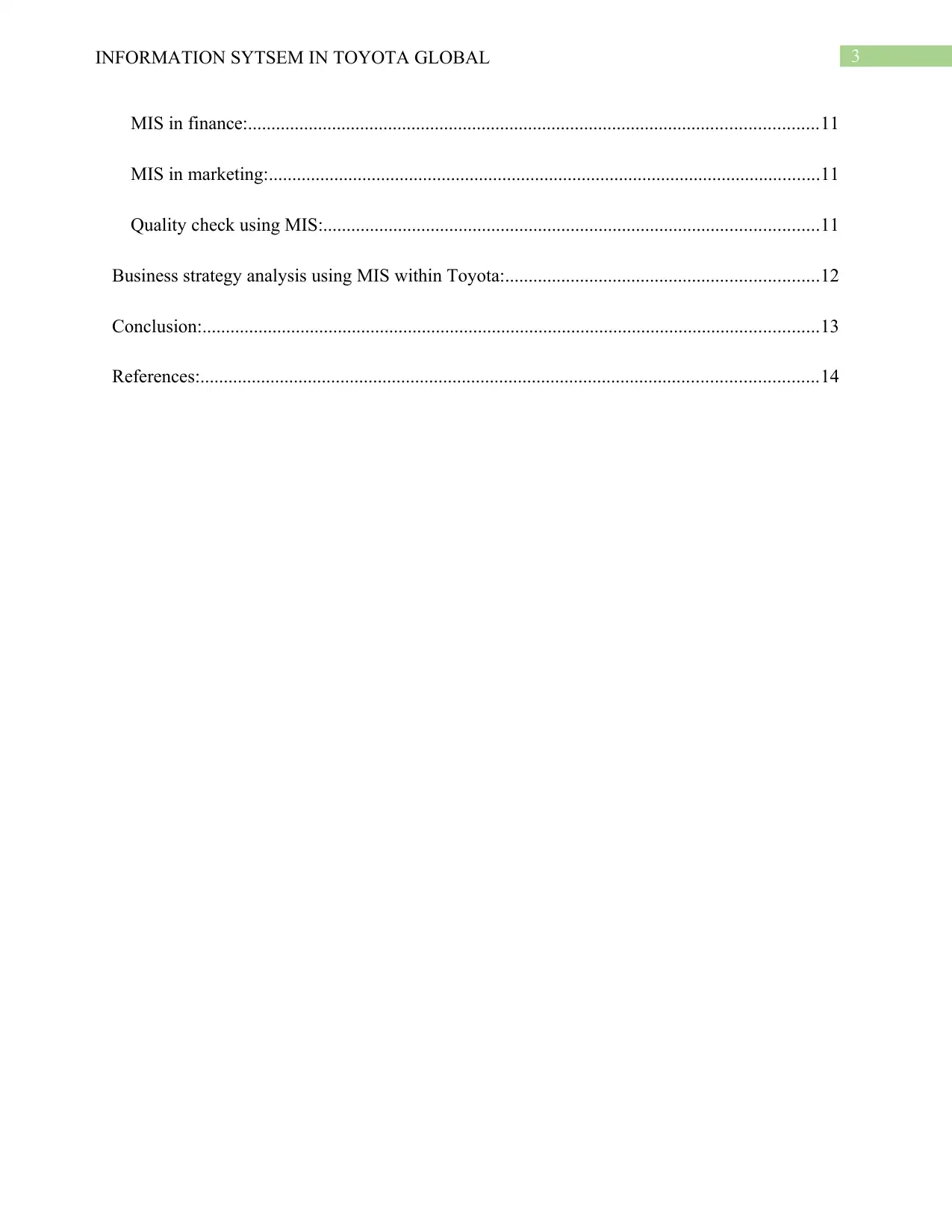
MIS in finance:..........................................................................................................................11
MIS in marketing:......................................................................................................................11
Quality check using MIS:..........................................................................................................11
Business strategy analysis using MIS within Toyota:...................................................................12
Conclusion:....................................................................................................................................13
References:....................................................................................................................................14
MIS in finance:..........................................................................................................................11
MIS in marketing:......................................................................................................................11
Quality check using MIS:..........................................................................................................11
Business strategy analysis using MIS within Toyota:...................................................................12
Conclusion:....................................................................................................................................13
References:....................................................................................................................................14
Paraphrase This Document
Need a fresh take? Get an instant paraphrase of this document with our AI Paraphraser
4INFORMATION SYTSEM IN TOYOTA GLOBAL
Introduction:
Information systems is one of the most widely used advances in the world of technology
today. Different companies have started implementing information systems in their work places
in order to improve the quality of the work operations as well as to make the task of the manager
as well as the leadership teams much easier. Information systems can be used to accomplish
different kinds of tasks within the work places such as gathering, processing as well as efficiently
transmitting crucial data to the different clients and users across the networks.
The following study will highlight the implementation of information systems within the
working of automobile giant Toyota global. Toyota is one of the leading car manufacturers in the
market in the present day and there are a number of innovative business ideas used by the
organization, which has helped the organization, reach the height it has been able to reach today.
The organization has been able to efficiently define and implement information systems within
in order to get most of its business tasks done with ease and much more efficiently. By the end of
this repot the reader will be able to have a clear understanding of the different aspects of
information systems including its advantages, disadvantages as well as the cost factors and other
requirements needed to implement information systems within the organization.
Components of information systems:
There are five main components of information systems that have to be understood in
order to implement it within the organization. They can be briefly explained below as:
1. Computer hardware:
The hardware can be a laptop, a desktop computer, or even a smartphone, which
can be used as a physical hardware device, which plays the role of the platform for
Introduction:
Information systems is one of the most widely used advances in the world of technology
today. Different companies have started implementing information systems in their work places
in order to improve the quality of the work operations as well as to make the task of the manager
as well as the leadership teams much easier. Information systems can be used to accomplish
different kinds of tasks within the work places such as gathering, processing as well as efficiently
transmitting crucial data to the different clients and users across the networks.
The following study will highlight the implementation of information systems within the
working of automobile giant Toyota global. Toyota is one of the leading car manufacturers in the
market in the present day and there are a number of innovative business ideas used by the
organization, which has helped the organization, reach the height it has been able to reach today.
The organization has been able to efficiently define and implement information systems within
in order to get most of its business tasks done with ease and much more efficiently. By the end of
this repot the reader will be able to have a clear understanding of the different aspects of
information systems including its advantages, disadvantages as well as the cost factors and other
requirements needed to implement information systems within the organization.
Components of information systems:
There are five main components of information systems that have to be understood in
order to implement it within the organization. They can be briefly explained below as:
1. Computer hardware:
The hardware can be a laptop, a desktop computer, or even a smartphone, which
can be used as a physical hardware device, which plays the role of the platform for
5INFORMATION SYTSEM IN TOYOTA GLOBAL
running the programs and performing the tasks. Peripheral devices such as keyboards,
external hard disk drivers as well as routers that can be the hardware components used in
the information systems.
2. Computer software:
Computer software refers to the programs as well as the applications that run on
different platforms such as IOS, android as well as windows operating systems. These are
the programs and applications that helps in performing tasks such as handling different
spreadsheets, creating and editing document as well as webpage designing. There are
different computer software’s that are used in the organization such as specialized finance
software for the payroll department that calculates the salary of the employees. There are
other management software’s that are used for risk calculation and predicting the future
outputs of the calculations and business strategies and decisions taken by the manager
within the organization (Rainer et al., 2013).
3. Telecommunications:
Local area networks (LAN) are also a crucial part of the information systems and
different network components such as fiber optics, Wi-Fi, wires and Ethernet cables a
reused to set up and establish connections within the networks. Internet itself is an
integral part of information systems and are considered network of the networks
(Rajaguru & Matanda, 2013). These network devices are integrated using the information
systems in order to transmit data securely among the different computers and the mobile
devices within the organization to ensure that the correct information reaches the correct
user at the right point of time to avoid any kind of delays in the business operations. This
running the programs and performing the tasks. Peripheral devices such as keyboards,
external hard disk drivers as well as routers that can be the hardware components used in
the information systems.
2. Computer software:
Computer software refers to the programs as well as the applications that run on
different platforms such as IOS, android as well as windows operating systems. These are
the programs and applications that helps in performing tasks such as handling different
spreadsheets, creating and editing document as well as webpage designing. There are
different computer software’s that are used in the organization such as specialized finance
software for the payroll department that calculates the salary of the employees. There are
other management software’s that are used for risk calculation and predicting the future
outputs of the calculations and business strategies and decisions taken by the manager
within the organization (Rainer et al., 2013).
3. Telecommunications:
Local area networks (LAN) are also a crucial part of the information systems and
different network components such as fiber optics, Wi-Fi, wires and Ethernet cables a
reused to set up and establish connections within the networks. Internet itself is an
integral part of information systems and are considered network of the networks
(Rajaguru & Matanda, 2013). These network devices are integrated using the information
systems in order to transmit data securely among the different computers and the mobile
devices within the organization to ensure that the correct information reaches the correct
user at the right point of time to avoid any kind of delays in the business operations. This
⊘ This is a preview!⊘
Do you want full access?
Subscribe today to unlock all pages.
Trusted by 1+ million students worldwide
6INFORMATION SYTSEM IN TOYOTA GLOBAL
will not only ensure smoother work operations but also save time and cost for the
company in different ways.
4. Databases and warehouses:
A database is a storage space, which contains all the important data of the
organization and where new data can be added and retrieved using specific queries as and
when needed by the administrators and managers within the company. Data warehouses
an important part of the information systems within the organizations that can store data
in whatever format the company needs them to e stored. For instance, in big data
analytics, huge chunks of data are analyzed and stored in the databases within the
organizations (Simkin, Norman & Rose, 2014).
5. Human resources and the procedures:
Human element is one of the most important parts of the information systems
which involves the tasks done by the human in order to improve the efficiency of the
systems and ensure a smoother and a faster output delivery by the information systems.
The past actions and their outputs can be studied in order to determine the future actions
and develop back up plans, which need the involvement of humans. This also needs
adequate training on the information systems, which are generally conducted by the
human resource department within an organization (Zheng, Zhao & Stylianou, 2013).
Toyota and information systems:
Toyota is one of the companies that has rapidly implemented the features of information
systems and has been immensely successful in using the technologies to counter attack the
rapidly changing nature of the global markets and the external environment. Rapid competition
faced by the company in terms of its sales, increasing globalization in the field of technology
will not only ensure smoother work operations but also save time and cost for the
company in different ways.
4. Databases and warehouses:
A database is a storage space, which contains all the important data of the
organization and where new data can be added and retrieved using specific queries as and
when needed by the administrators and managers within the company. Data warehouses
an important part of the information systems within the organizations that can store data
in whatever format the company needs them to e stored. For instance, in big data
analytics, huge chunks of data are analyzed and stored in the databases within the
organizations (Simkin, Norman & Rose, 2014).
5. Human resources and the procedures:
Human element is one of the most important parts of the information systems
which involves the tasks done by the human in order to improve the efficiency of the
systems and ensure a smoother and a faster output delivery by the information systems.
The past actions and their outputs can be studied in order to determine the future actions
and develop back up plans, which need the involvement of humans. This also needs
adequate training on the information systems, which are generally conducted by the
human resource department within an organization (Zheng, Zhao & Stylianou, 2013).
Toyota and information systems:
Toyota is one of the companies that has rapidly implemented the features of information
systems and has been immensely successful in using the technologies to counter attack the
rapidly changing nature of the global markets and the external environment. Rapid competition
faced by the company in terms of its sales, increasing globalization in the field of technology
Paraphrase This Document
Need a fresh take? Get an instant paraphrase of this document with our AI Paraphraser
7INFORMATION SYTSEM IN TOYOTA GLOBAL
development, advancement sin the technologies used in the cars todays as well as their
manufacturing units are all being addressed by the information systems. Changes in the global
economy of Japan and the different environmental standards set by the government are also
considered and met by the organization under the guidelines of the usage of the information
systems (Stair & Reynolds 2013).
In the growth phase of the organization from 1980s to 1990s, offices were automated and
there were innovations as well as globalization in the field of corporate as well as commercial
systems across all the business units of the world. CAD/CAM systems were also developed by
the company to in order to expand to other sectors of activities as well as improve interactions
with the different chains of suppliers.
During the time of early 2000s, improvements in the field of administrative systems enabled
information systems to be more globally adaptable. Information systems made the administration
as well as the management within the organization even more efficient than ever. Engineering
system as well as data were innovated and integrated on a global scale (Venkatesh, Brown &
Bala, 2013).
Since the late 2000s, Toyota implemented strategies of global standardization of business
operations using information systems. Network systems using integrated circuits as well as
TCP/IP-based network technologies were being used in Japan and overseas Toyota offices. Since
the economic crisis from 2008-2009, the organization has sought to make its information system
more efficient than ever and is in a continuous process of improving them within the work place
(Peppard, Galliers & Thorogood, 2014).
development, advancement sin the technologies used in the cars todays as well as their
manufacturing units are all being addressed by the information systems. Changes in the global
economy of Japan and the different environmental standards set by the government are also
considered and met by the organization under the guidelines of the usage of the information
systems (Stair & Reynolds 2013).
In the growth phase of the organization from 1980s to 1990s, offices were automated and
there were innovations as well as globalization in the field of corporate as well as commercial
systems across all the business units of the world. CAD/CAM systems were also developed by
the company to in order to expand to other sectors of activities as well as improve interactions
with the different chains of suppliers.
During the time of early 2000s, improvements in the field of administrative systems enabled
information systems to be more globally adaptable. Information systems made the administration
as well as the management within the organization even more efficient than ever. Engineering
system as well as data were innovated and integrated on a global scale (Venkatesh, Brown &
Bala, 2013).
Since the late 2000s, Toyota implemented strategies of global standardization of business
operations using information systems. Network systems using integrated circuits as well as
TCP/IP-based network technologies were being used in Japan and overseas Toyota offices. Since
the economic crisis from 2008-2009, the organization has sought to make its information system
more efficient than ever and is in a continuous process of improving them within the work place
(Peppard, Galliers & Thorogood, 2014).
8INFORMATION SYTSEM IN TOYOTA GLOBAL
Theoretical and practical situation of information systems:
In theory, there are five different aspects of information systems that need to be studied
with respect to the working of Toyota global. They are explained below as:
1. Theory for analyzing:
In Toyota, there are different techniques such as lean manufacturing, kaizen,
which are being used in the efficient functioning of the organization in all aspects. The
“Toyota way” of production is extensively used which is a theory which was invented
long back and has efficiently been incorporated within the organization (Zhong et al.,
2013). Although most of the theoretical features are not been able to be applied
completely at all points of time in the organization but most of it are followed which has
also helped Toyota to recover the economic crises in the period late 1990s (Fichman,
Santos & Zheng, 2014).
2. Theory for explaining and predicting the outcomes:
The outcomes of the different decisions that are being taken within the
organization are properly defined using the theoretical concepts such as the Toyota
production system, Kaizen as well as the Genchi Genbutsu in which a manager himself
goes and checks a situation instead of blindly believing computer data before taking any
decision. This also eliminates the theoretical disadvantages of information system to
some extent. These are extensively used and implemented by the company in order to
decide and predict the desirable outcomes of the business decisions taken by the leaders
as well as the managers. These are theoretical concepts that has also been applied
efficiently in the practical scenarios by the organization (Galliers & Leidner, 2014).
Theoretical and practical situation of information systems:
In theory, there are five different aspects of information systems that need to be studied
with respect to the working of Toyota global. They are explained below as:
1. Theory for analyzing:
In Toyota, there are different techniques such as lean manufacturing, kaizen,
which are being used in the efficient functioning of the organization in all aspects. The
“Toyota way” of production is extensively used which is a theory which was invented
long back and has efficiently been incorporated within the organization (Zhong et al.,
2013). Although most of the theoretical features are not been able to be applied
completely at all points of time in the organization but most of it are followed which has
also helped Toyota to recover the economic crises in the period late 1990s (Fichman,
Santos & Zheng, 2014).
2. Theory for explaining and predicting the outcomes:
The outcomes of the different decisions that are being taken within the
organization are properly defined using the theoretical concepts such as the Toyota
production system, Kaizen as well as the Genchi Genbutsu in which a manager himself
goes and checks a situation instead of blindly believing computer data before taking any
decision. This also eliminates the theoretical disadvantages of information system to
some extent. These are extensively used and implemented by the company in order to
decide and predict the desirable outcomes of the business decisions taken by the leaders
as well as the managers. These are theoretical concepts that has also been applied
efficiently in the practical scenarios by the organization (Galliers & Leidner, 2014).
⊘ This is a preview!⊘
Do you want full access?
Subscribe today to unlock all pages.
Trusted by 1+ million students worldwide
9INFORMATION SYTSEM IN TOYOTA GLOBAL
3. Theory of design and action:
There are different theories in information systems for designing the different
applications and computer programs, which should be able to deliver the desired outputs
and results. These a redesigned by a specialized team of engineers. The actions are
dependent on the algorithms of these programs and therefore are carefully programmed
and implemented within the working of the organizations (Hendriks, 2013).
Toyota has a firm belief that the secret to its success is just not the theoretical
concepts of information systems but it also believes in certain parameters that are more
practical and real-time in nature. For instance, the organization believes in maintaining
customer and dealer trust and always comes up with innovations that address customer
needs and have implemented information systems vastly in this field. This in turn has
made the tasks of the customers much easier and has automated the tasks of the customer
to great extents (Ostapenko et al., 2013). Feedback surveys as well as improved product
knowledge availability on the customer’s mobile devices such as laptops and
smartphones have improved customer satisfaction and they are more satisfied with the
way the company passes any new communication to them. It applies to all the dealers of
Toyota (Pearlson, Saunders & Galletta, 2016).
In practical situations, the organization uses management information systems
(MIS) systems that takes into consideration the critical MIS needs at different strategic
levels. Yearly reports by the MIS systems help in developing the new and innovative
operating as well as management schemes and deciding the budgetary factors within the
organization. They are also utilized in support of the future strategic MIS and business
preparation activities. Managers also often visit the factories and interact with the
3. Theory of design and action:
There are different theories in information systems for designing the different
applications and computer programs, which should be able to deliver the desired outputs
and results. These a redesigned by a specialized team of engineers. The actions are
dependent on the algorithms of these programs and therefore are carefully programmed
and implemented within the working of the organizations (Hendriks, 2013).
Toyota has a firm belief that the secret to its success is just not the theoretical
concepts of information systems but it also believes in certain parameters that are more
practical and real-time in nature. For instance, the organization believes in maintaining
customer and dealer trust and always comes up with innovations that address customer
needs and have implemented information systems vastly in this field. This in turn has
made the tasks of the customers much easier and has automated the tasks of the customer
to great extents (Ostapenko et al., 2013). Feedback surveys as well as improved product
knowledge availability on the customer’s mobile devices such as laptops and
smartphones have improved customer satisfaction and they are more satisfied with the
way the company passes any new communication to them. It applies to all the dealers of
Toyota (Pearlson, Saunders & Galletta, 2016).
In practical situations, the organization uses management information systems
(MIS) systems that takes into consideration the critical MIS needs at different strategic
levels. Yearly reports by the MIS systems help in developing the new and innovative
operating as well as management schemes and deciding the budgetary factors within the
organization. They are also utilized in support of the future strategic MIS and business
preparation activities. Managers also often visit the factories and interact with the
Paraphrase This Document
Need a fresh take? Get an instant paraphrase of this document with our AI Paraphraser
10INFORMATION SYTSEM IN TOYOTA GLOBAL
workers there to counter attack a problematic situation instead of relying on the
computer-generated information of the information systems, which in turn eliminate the
disadvantages of these systems within the organization (Allahbakhsh et al., 2013).
Merits, demerits, strengths and deficiencies of Toyota:
Merits:
- It has the flexibility within the work force policies to implement any new technology.
Information systems can be widely implemented across all the offices across the world, which
will help the different data centers to be, connected more efficiently using the networking
technologies (Jones, 2014).
Demerits:
- Employee vandalism and a strange secrecy exists in the company, which can often be
problematic for the information systems to be used.
- Supply issues as well as complexity of the information systems is another major demerit
of the information systems because the employees are often not adequately trained and
knowledgeable about the systems and the new technologies.
Strengths:
- Toyota production system is an efficient tool that the company uses which makes use of
information systems in the different departments within the organization. It believes in
waste reduction and improving the productivity of the employees by making use of the
information systems, which help them immensely in their operational tasks.
Learning management system is available 24 hours for the employees to constantly learn and
develop themselves and keep educating themselves about the latest technologies and information
workers there to counter attack a problematic situation instead of relying on the
computer-generated information of the information systems, which in turn eliminate the
disadvantages of these systems within the organization (Allahbakhsh et al., 2013).
Merits, demerits, strengths and deficiencies of Toyota:
Merits:
- It has the flexibility within the work force policies to implement any new technology.
Information systems can be widely implemented across all the offices across the world, which
will help the different data centers to be, connected more efficiently using the networking
technologies (Jones, 2014).
Demerits:
- Employee vandalism and a strange secrecy exists in the company, which can often be
problematic for the information systems to be used.
- Supply issues as well as complexity of the information systems is another major demerit
of the information systems because the employees are often not adequately trained and
knowledgeable about the systems and the new technologies.
Strengths:
- Toyota production system is an efficient tool that the company uses which makes use of
information systems in the different departments within the organization. It believes in
waste reduction and improving the productivity of the employees by making use of the
information systems, which help them immensely in their operational tasks.
Learning management system is available 24 hours for the employees to constantly learn and
develop themselves and keep educating themselves about the latest technologies and information
11INFORMATION SYTSEM IN TOYOTA GLOBAL
systems that are being used within and outside the companies (Chatterjee & Ravichandran,
2013).
Deficiencies:
- The warehouse management system used by the company is an extremely costly
approach and involves lot of cost to the company.
The information systems take a lot of time to be designed and implemented within the company
since the company believes in perfection before implementation and at the same time, the
company believes in a constant process of learning of the employees (Laudon & Laudon, 2015).
MIS infrastructures:
Toyota has incorporated the management information systems in most of its important
departments. They are described below:
MIS in finance:
The company has started to use SAP in its financial operations where in earlier as well as
present financial data, figures and calculations are analyzed to give the finance personnel the
required data outputs required by the organization. It also helps the personnel predict possible
future financial turnovers and outputs (Bharati & Chaudhury, 2015).
MIS in marketing:
The SAP solutions that are used in the management information systems helps the personnel to
develop marketing strategies and decide activities pricing and product development. Sales
outcomes are also determined using these information systems (Liu, Santhanam & Webster,
2017).
systems that are being used within and outside the companies (Chatterjee & Ravichandran,
2013).
Deficiencies:
- The warehouse management system used by the company is an extremely costly
approach and involves lot of cost to the company.
The information systems take a lot of time to be designed and implemented within the company
since the company believes in perfection before implementation and at the same time, the
company believes in a constant process of learning of the employees (Laudon & Laudon, 2015).
MIS infrastructures:
Toyota has incorporated the management information systems in most of its important
departments. They are described below:
MIS in finance:
The company has started to use SAP in its financial operations where in earlier as well as
present financial data, figures and calculations are analyzed to give the finance personnel the
required data outputs required by the organization. It also helps the personnel predict possible
future financial turnovers and outputs (Bharati & Chaudhury, 2015).
MIS in marketing:
The SAP solutions that are used in the management information systems helps the personnel to
develop marketing strategies and decide activities pricing and product development. Sales
outcomes are also determined using these information systems (Liu, Santhanam & Webster,
2017).
⊘ This is a preview!⊘
Do you want full access?
Subscribe today to unlock all pages.
Trusted by 1+ million students worldwide

1 out of 18


Related Documents


Your All-in-One AI-Powered Toolkit for Academic Success.
+13062052269
info@desklib.com
Available 24*7 on WhatsApp / Email
![[object Object]](/_next/static/media/star-bottom.7253800d.svg)
Unlock your academic potential
Copyright © 2020–2026 A2Z Services. All Rights Reserved. Developed and managed by ZUCOL.