Toyota Australia: A Comprehensive Marketing Communication Report
VerifiedAdded on 2023/04/24
|18
|3647
|434
Report
AI Summary
This report provides a comprehensive analysis of Toyota Australia's marketing communication strategies. It begins with an executive summary and introduction, followed by an overview of the company's background and brand elements. The report delves into Toyota's brand equity, market positioning, and brand loyalty programs, along with its social media presence. An external environment analysis, including SWOT and PESTEL analyses, is conducted to assess the company's strengths, weaknesses, opportunities, and threats, as well as political, economic, social, technological, environmental, and legal factors. The report also explores the future brand outlook and presents a detailed media plan, outlining communication objectives, media selection, scheduling, and measurement. The report concludes with a summary of findings and references.
Running head: MARKETING COMMUNICATION
MARKETING COMMUNICATION
Name of the student
Name of the University
Author notes:
MARKETING COMMUNICATION
Name of the student
Name of the University
Author notes:

Paraphrase This Document
Need a fresh take? Get an instant paraphrase of this document with our AI Paraphraser
1MARKETING COMMUNICATION
Executive summary
The aim of this report is to put forward the current initiatives and mode of operation of
Toyota Australia. The marketing plan of the company and its position in comparison with its
competition is enumerated in this report. Furthermore a media plan involving the company’s
plans to acquire more amount of market share is also presented. A SWOT analysis and a
PESTEL analysis has also been carried out that help determine the threats to the existence of
the company and the fields in which the company has an upper hand when compared with its
competitors. The company’s goal can be seen to be perfectly aligned with the changing needs
of the environment. The revolutionary technology that is being constantly developed at
Toyota showcases how well they are perfectly aligned with the future demands that are
associated with the changing environment and consumer community.
Executive summary
The aim of this report is to put forward the current initiatives and mode of operation of
Toyota Australia. The marketing plan of the company and its position in comparison with its
competition is enumerated in this report. Furthermore a media plan involving the company’s
plans to acquire more amount of market share is also presented. A SWOT analysis and a
PESTEL analysis has also been carried out that help determine the threats to the existence of
the company and the fields in which the company has an upper hand when compared with its
competitors. The company’s goal can be seen to be perfectly aligned with the changing needs
of the environment. The revolutionary technology that is being constantly developed at
Toyota showcases how well they are perfectly aligned with the future demands that are
associated with the changing environment and consumer community.
2MARKETING COMMUNICATION
Table of Contents
Introduction................................................................................................................................3
Company background................................................................................................................3
Brand elements...........................................................................................................................4
Brand equity...............................................................................................................................5
Market Positioning.....................................................................................................................5
Brand Loyalty programs........................................................................................................6
Social media communities.....................................................................................................6
External Environment................................................................................................................7
SWOT analysis.......................................................................................................................7
PESTEL analysis....................................................................................................................8
Future brand outlook..................................................................................................................9
Media plan................................................................................................................................10
Media communication objectives........................................................................................10
Justification for selected media............................................................................................10
Media schedule.....................................................................................................................11
Media measurement.............................................................................................................11
Possible expenses.................................................................................................................11
Conclusion................................................................................................................................11
References................................................................................................................................13
Table of Contents
Introduction................................................................................................................................3
Company background................................................................................................................3
Brand elements...........................................................................................................................4
Brand equity...............................................................................................................................5
Market Positioning.....................................................................................................................5
Brand Loyalty programs........................................................................................................6
Social media communities.....................................................................................................6
External Environment................................................................................................................7
SWOT analysis.......................................................................................................................7
PESTEL analysis....................................................................................................................8
Future brand outlook..................................................................................................................9
Media plan................................................................................................................................10
Media communication objectives........................................................................................10
Justification for selected media............................................................................................10
Media schedule.....................................................................................................................11
Media measurement.............................................................................................................11
Possible expenses.................................................................................................................11
Conclusion................................................................................................................................11
References................................................................................................................................13
⊘ This is a preview!⊘
Do you want full access?
Subscribe today to unlock all pages.

Trusted by 1+ million students worldwide
3MARKETING COMMUNICATION
Paraphrase This Document
Need a fresh take? Get an instant paraphrase of this document with our AI Paraphraser
4MARKETING COMMUNICATION
Introduction
It is the aim of every company to gain a competitive advantage from its counterparts.
In order to do so a company must carefully analyse all the possible threats and opportunities
that directly correlate with the company’s aims and long term goals (Bryson 2018). The
report is prepared in order to present the current market position of the company in
comparison with their competitors. The success of a company can be adjudged by simply
looking at the Brand Equity (Budac and Baltador 2013). The success of a company can get
reflected through the enthusiasm in the consumer community. It is of great importance how
the brand carries out its STP strategy and how effectively it carries out its marketing
campaigns (Barton 2015). Along with the success of the marketing and promotional
campaigns, the product also plays a crucial role in retaining and gaining new consumer base
(Cant, Wiid and Kallier 2015). The paper will throw light on the current brand positioning,
marketing and loyalty programs along with screening the threats and competition for Toyota
Australia. Furthermore, a new media plan for the company will be devices in the later part of
the paper followed by a report on the above discussed issues.
Company background
Toyota is a Japanese Motor company that found great success in the Australian
market (Toyota.com.au 2019). Toyota Australia are based at Port Melbourne Australia as its
headquarters. They also have branches in other Australian cities such as Sydney, Perth,
Adelaide and Queensland (Toyota.com.au 2019). The first Toyota motors vehicle was
assembled in Port Melbourne in 1963 (Toyota.com.au 2019). The manufacturing started after
the company was set up in 1958. Kevin Rudd, who was the Prime minister of Australia in
2009 drove the first Australian made Toyota car called Hybrid Camry.
Introduction
It is the aim of every company to gain a competitive advantage from its counterparts.
In order to do so a company must carefully analyse all the possible threats and opportunities
that directly correlate with the company’s aims and long term goals (Bryson 2018). The
report is prepared in order to present the current market position of the company in
comparison with their competitors. The success of a company can be adjudged by simply
looking at the Brand Equity (Budac and Baltador 2013). The success of a company can get
reflected through the enthusiasm in the consumer community. It is of great importance how
the brand carries out its STP strategy and how effectively it carries out its marketing
campaigns (Barton 2015). Along with the success of the marketing and promotional
campaigns, the product also plays a crucial role in retaining and gaining new consumer base
(Cant, Wiid and Kallier 2015). The paper will throw light on the current brand positioning,
marketing and loyalty programs along with screening the threats and competition for Toyota
Australia. Furthermore, a new media plan for the company will be devices in the later part of
the paper followed by a report on the above discussed issues.
Company background
Toyota is a Japanese Motor company that found great success in the Australian
market (Toyota.com.au 2019). Toyota Australia are based at Port Melbourne Australia as its
headquarters. They also have branches in other Australian cities such as Sydney, Perth,
Adelaide and Queensland (Toyota.com.au 2019). The first Toyota motors vehicle was
assembled in Port Melbourne in 1963 (Toyota.com.au 2019). The manufacturing started after
the company was set up in 1958. Kevin Rudd, who was the Prime minister of Australia in
2009 drove the first Australian made Toyota car called Hybrid Camry.
5MARKETING COMMUNICATION
Brand elements
With issues such as global warming and vehicular emissions, Toyota aims to provide
the community a service that ensures its contribution to the sustainable development of the
community. At Toyota Australia, the aim is to provide mobility through their wide range of
vehicle keeping in mind and using an environment friendly approach in doing so.
Figure: Toyota logo (Source: Toyota.com.au).
Although the logo of toyota might appear as simple and minimalistic at first, one must
be informed that there lies a hidden meaning in the logo. The logo that is made out of three
oval rims. The two inner ovals represent the heart of the consumers and that of Toyota, they
appear as a ‘T” which represents the brand, these withing the outer oval represents Toyota
within the world ann it also appar like a stearing wheel which cirlce around the company’s
reportoire. The company slogan is “ LET’S GO PLACES”.
Brand elements
With issues such as global warming and vehicular emissions, Toyota aims to provide
the community a service that ensures its contribution to the sustainable development of the
community. At Toyota Australia, the aim is to provide mobility through their wide range of
vehicle keeping in mind and using an environment friendly approach in doing so.
Figure: Toyota logo (Source: Toyota.com.au).
Although the logo of toyota might appear as simple and minimalistic at first, one must
be informed that there lies a hidden meaning in the logo. The logo that is made out of three
oval rims. The two inner ovals represent the heart of the consumers and that of Toyota, they
appear as a ‘T” which represents the brand, these withing the outer oval represents Toyota
within the world ann it also appar like a stearing wheel which cirlce around the company’s
reportoire. The company slogan is “ LET’S GO PLACES”.
⊘ This is a preview!⊘
Do you want full access?
Subscribe today to unlock all pages.
Trusted by 1+ million students worldwide

6MARKETING COMMUNICATION
Brand equity
With year full of innovations in technology and environment sustainability activities,
the net operating income of four hundred and six billion eight hundred and sixty seven
million dollars ($406,867,000,000) (Toyota.com.au 2019). The figure have considerably
improved from last year, after the company decided to stop production within the country.
The net operating income of last year amounted to three billion eight hundred three and one
hundred seventy five million dollars ($383,175,000,000). The company have made a ten
billion dollars ($10,000,000,000) jump from last year and all the credit goes to adaptability
that the company has showcase in the last year (toyota.com.au 2019).
Market Positioning
In a market full of competitors, it has been a struggle for all the companies in the
automotive industry, same in the case of Toyota motors. In 2017, Toyota Australia
announced that they would halt the production of Toyota engines in Australia. This decision
was taken after screening the increased expenses associated with cost of production along
with the increasing number of competitors in the small local market. However the company
have created a Unique Selling Proposition for their products. Toyota has started producing
vehicles that are self-automated. The company aim to differentiate themselves from the rest
of the competition in the Australian market by introducing self-driven vehicles. The
Company has gone a further step to take their Competitive advantage to the next level by
playing close attention to sustainable development and environment sustainability
(Urbancova 2013). The company is aware of the threats that are posed to the environment by
vehicular emissions and have devised technological innovations that help cope with the same.
They are working on prototypes that are powered by alternative fuels such as natural gas.
This initiative of the company separates the company from its competition.
Brand equity
With year full of innovations in technology and environment sustainability activities,
the net operating income of four hundred and six billion eight hundred and sixty seven
million dollars ($406,867,000,000) (Toyota.com.au 2019). The figure have considerably
improved from last year, after the company decided to stop production within the country.
The net operating income of last year amounted to three billion eight hundred three and one
hundred seventy five million dollars ($383,175,000,000). The company have made a ten
billion dollars ($10,000,000,000) jump from last year and all the credit goes to adaptability
that the company has showcase in the last year (toyota.com.au 2019).
Market Positioning
In a market full of competitors, it has been a struggle for all the companies in the
automotive industry, same in the case of Toyota motors. In 2017, Toyota Australia
announced that they would halt the production of Toyota engines in Australia. This decision
was taken after screening the increased expenses associated with cost of production along
with the increasing number of competitors in the small local market. However the company
have created a Unique Selling Proposition for their products. Toyota has started producing
vehicles that are self-automated. The company aim to differentiate themselves from the rest
of the competition in the Australian market by introducing self-driven vehicles. The
Company has gone a further step to take their Competitive advantage to the next level by
playing close attention to sustainable development and environment sustainability
(Urbancova 2013). The company is aware of the threats that are posed to the environment by
vehicular emissions and have devised technological innovations that help cope with the same.
They are working on prototypes that are powered by alternative fuels such as natural gas.
This initiative of the company separates the company from its competition.
Paraphrase This Document
Need a fresh take? Get an instant paraphrase of this document with our AI Paraphraser
7MARKETING COMMUNICATION
Toyota’s cars range from family cars such as the Yaris and the Corolla, to SUVs such
as the RAV4 and the C-HR and to luxury cars such as the Toyota Supra (toyota.com.au
2019). Thus Toyota has been able to produce products that cater to a diverse market.
However their recent promotion plans are aimed at the environment conscious generation.
Brand Loyalty programs
Unlike other brands, Toyota Australia does not carry out any form of intensive
promotion strategy (Jiang et al. 2015). Although they have carried out promotion through
advertising on various forms of media, they are recently more focused on social media
marketing. The company has faced turbulence in the Australian market and the time has been
identified as perfect for adapting to the changing needs of the society. Toyota Australia let
their products that is their cars speak for themselves. The quality of the cars that are
produced, backed up by cheap and largely available maintenance and service act as loyalty
services on their own (Saeed 2013). The company has seen a rising number of returning
customers who come back to the brand since they have been happy with what they have
received. The customers at Toyota Australia are said to have experienced high quality after
sales services. That lets the company focus on is sustainable initiative rather than spending
millions on promotional activities.
Social media communities
Toyota Australia have dedicated handles for Facebook, Twitter, YouTube and
Instagram (toyota.com 2019). The Facebook handles are further divided into three section,
one for spreading awareness related to sustainable development and environmental
awareness, one page dedicated to the customer service and complaints helpline and the other
for informing the community about their recent products and innovations. The same is carried
out on Twitter, where there are two handles aimed towards the eco-conscious community and
Toyota’s cars range from family cars such as the Yaris and the Corolla, to SUVs such
as the RAV4 and the C-HR and to luxury cars such as the Toyota Supra (toyota.com.au
2019). Thus Toyota has been able to produce products that cater to a diverse market.
However their recent promotion plans are aimed at the environment conscious generation.
Brand Loyalty programs
Unlike other brands, Toyota Australia does not carry out any form of intensive
promotion strategy (Jiang et al. 2015). Although they have carried out promotion through
advertising on various forms of media, they are recently more focused on social media
marketing. The company has faced turbulence in the Australian market and the time has been
identified as perfect for adapting to the changing needs of the society. Toyota Australia let
their products that is their cars speak for themselves. The quality of the cars that are
produced, backed up by cheap and largely available maintenance and service act as loyalty
services on their own (Saeed 2013). The company has seen a rising number of returning
customers who come back to the brand since they have been happy with what they have
received. The customers at Toyota Australia are said to have experienced high quality after
sales services. That lets the company focus on is sustainable initiative rather than spending
millions on promotional activities.
Social media communities
Toyota Australia have dedicated handles for Facebook, Twitter, YouTube and
Instagram (toyota.com 2019). The Facebook handles are further divided into three section,
one for spreading awareness related to sustainable development and environmental
awareness, one page dedicated to the customer service and complaints helpline and the other
for informing the community about their recent products and innovations. The same is carried
out on Twitter, where there are two handles aimed towards the eco-conscious community and
8MARKETING COMMUNICATION
one for customer service and product promotion. Their YouTube and Instagram handles are
for showcasing their innovative products and the initiatives that they are engaged into.
External Environment
Judging the external environment can give a company advantage regarding what it
takes to gain considerably more percentage of market share (Zhu, Sarkis and Lai 2013). The
SWOT and PESTEL analysis for the operations of the Toyota Australia will define the
margins that exist between the company and the competitors.
SWOT analysis
Strengths Toyota have been providing the consumers
with top quality and highly graded cars for
years. Along with that their efficient after
sales service results in satisfied buyers. In
return all the past and present users of the
Toyota vehicles have been returning to the
brand over and over again. The happy
customers spread awareness about the
product through word of mouth.
Weakness With the parent company situated in Japan,
the cost incurred to produce their vehicles in
Australia are rising. Thus they are not able
to carry out most of the production within
the boundaries of Australia. This results in
inadequate supply that is available to the
market.
Opportunities The Company’s initiative are favourably
aligned with the changing needs of the
environment conscious consumers. Toyota’s
products are created with sustainability in
the mind. The vehicles that are produced in
the company can be powered through non-
renewable sources of fuel and they possess
vehicles that require lesser amounts of fuel
than their counterparts.
Threats Although Toyota have been a trusted car
brand in Australia for decades, the
emergence of competitors, specialising in
the same, pose serious threats to the
operations of the company. Brands such as
one for customer service and product promotion. Their YouTube and Instagram handles are
for showcasing their innovative products and the initiatives that they are engaged into.
External Environment
Judging the external environment can give a company advantage regarding what it
takes to gain considerably more percentage of market share (Zhu, Sarkis and Lai 2013). The
SWOT and PESTEL analysis for the operations of the Toyota Australia will define the
margins that exist between the company and the competitors.
SWOT analysis
Strengths Toyota have been providing the consumers
with top quality and highly graded cars for
years. Along with that their efficient after
sales service results in satisfied buyers. In
return all the past and present users of the
Toyota vehicles have been returning to the
brand over and over again. The happy
customers spread awareness about the
product through word of mouth.
Weakness With the parent company situated in Japan,
the cost incurred to produce their vehicles in
Australia are rising. Thus they are not able
to carry out most of the production within
the boundaries of Australia. This results in
inadequate supply that is available to the
market.
Opportunities The Company’s initiative are favourably
aligned with the changing needs of the
environment conscious consumers. Toyota’s
products are created with sustainability in
the mind. The vehicles that are produced in
the company can be powered through non-
renewable sources of fuel and they possess
vehicles that require lesser amounts of fuel
than their counterparts.
Threats Although Toyota have been a trusted car
brand in Australia for decades, the
emergence of competitors, specialising in
the same, pose serious threats to the
operations of the company. Brands such as
⊘ This is a preview!⊘
Do you want full access?
Subscribe today to unlock all pages.
Trusted by 1+ million students worldwide
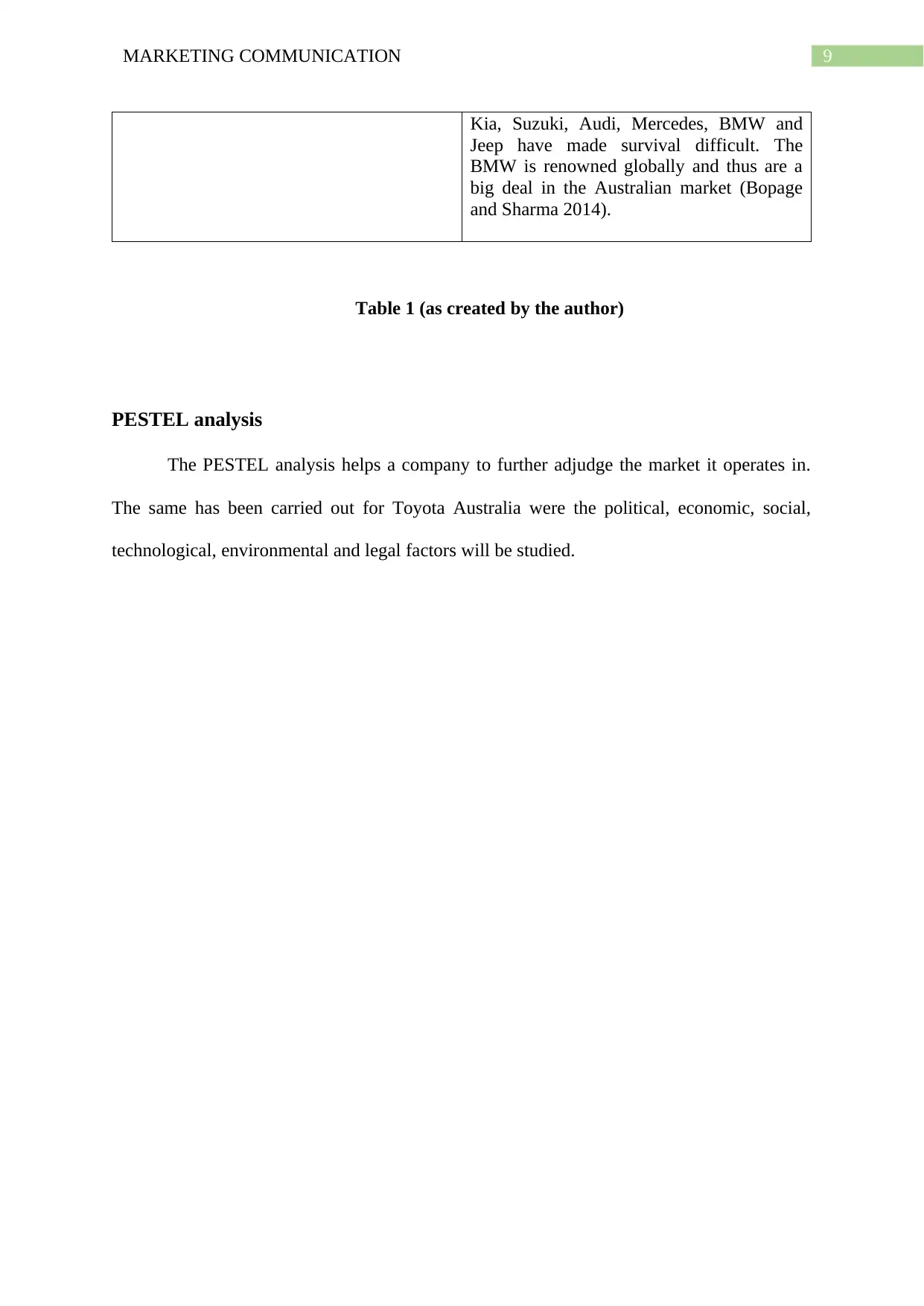
9MARKETING COMMUNICATION
Kia, Suzuki, Audi, Mercedes, BMW and
Jeep have made survival difficult. The
BMW is renowned globally and thus are a
big deal in the Australian market (Bopage
and Sharma 2014).
Table 1 (as created by the author)
PESTEL analysis
The PESTEL analysis helps a company to further adjudge the market it operates in.
The same has been carried out for Toyota Australia were the political, economic, social,
technological, environmental and legal factors will be studied.
Kia, Suzuki, Audi, Mercedes, BMW and
Jeep have made survival difficult. The
BMW is renowned globally and thus are a
big deal in the Australian market (Bopage
and Sharma 2014).
Table 1 (as created by the author)
PESTEL analysis
The PESTEL analysis helps a company to further adjudge the market it operates in.
The same has been carried out for Toyota Australia were the political, economic, social,
technological, environmental and legal factors will be studied.
Paraphrase This Document
Need a fresh take? Get an instant paraphrase of this document with our AI Paraphraser
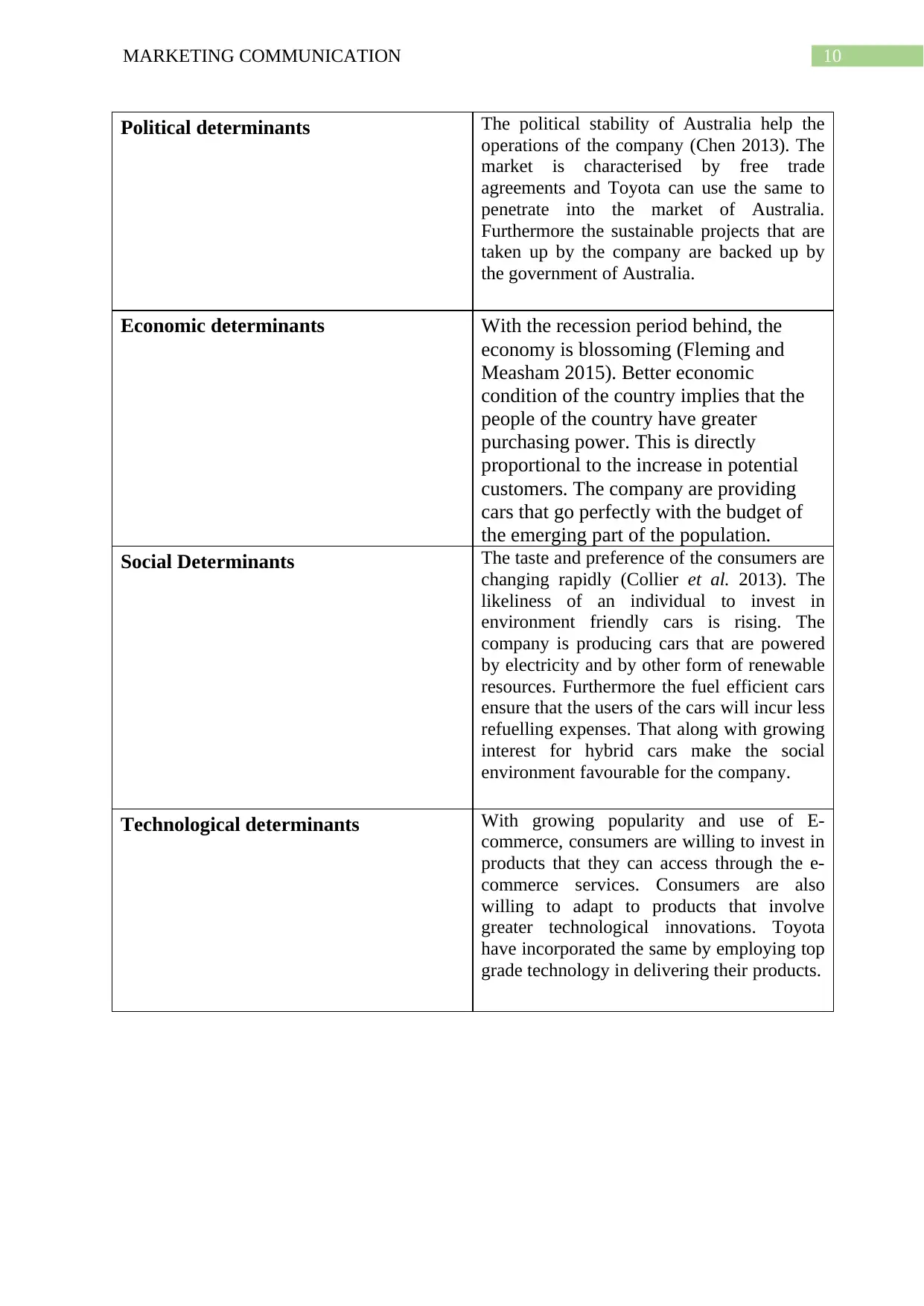
10MARKETING COMMUNICATION
Political determinants The political stability of Australia help the
operations of the company (Chen 2013). The
market is characterised by free trade
agreements and Toyota can use the same to
penetrate into the market of Australia.
Furthermore the sustainable projects that are
taken up by the company are backed up by
the government of Australia.
Economic determinants With the recession period behind, the
economy is blossoming (Fleming and
Measham 2015). Better economic
condition of the country implies that the
people of the country have greater
purchasing power. This is directly
proportional to the increase in potential
customers. The company are providing
cars that go perfectly with the budget of
the emerging part of the population.
Social Determinants The taste and preference of the consumers are
changing rapidly (Collier et al. 2013). The
likeliness of an individual to invest in
environment friendly cars is rising. The
company is producing cars that are powered
by electricity and by other form of renewable
resources. Furthermore the fuel efficient cars
ensure that the users of the cars will incur less
refuelling expenses. That along with growing
interest for hybrid cars make the social
environment favourable for the company.
Technological determinants With growing popularity and use of E-
commerce, consumers are willing to invest in
products that they can access through the e-
commerce services. Consumers are also
willing to adapt to products that involve
greater technological innovations. Toyota
have incorporated the same by employing top
grade technology in delivering their products.
Political determinants The political stability of Australia help the
operations of the company (Chen 2013). The
market is characterised by free trade
agreements and Toyota can use the same to
penetrate into the market of Australia.
Furthermore the sustainable projects that are
taken up by the company are backed up by
the government of Australia.
Economic determinants With the recession period behind, the
economy is blossoming (Fleming and
Measham 2015). Better economic
condition of the country implies that the
people of the country have greater
purchasing power. This is directly
proportional to the increase in potential
customers. The company are providing
cars that go perfectly with the budget of
the emerging part of the population.
Social Determinants The taste and preference of the consumers are
changing rapidly (Collier et al. 2013). The
likeliness of an individual to invest in
environment friendly cars is rising. The
company is producing cars that are powered
by electricity and by other form of renewable
resources. Furthermore the fuel efficient cars
ensure that the users of the cars will incur less
refuelling expenses. That along with growing
interest for hybrid cars make the social
environment favourable for the company.
Technological determinants With growing popularity and use of E-
commerce, consumers are willing to invest in
products that they can access through the e-
commerce services. Consumers are also
willing to adapt to products that involve
greater technological innovations. Toyota
have incorporated the same by employing top
grade technology in delivering their products.
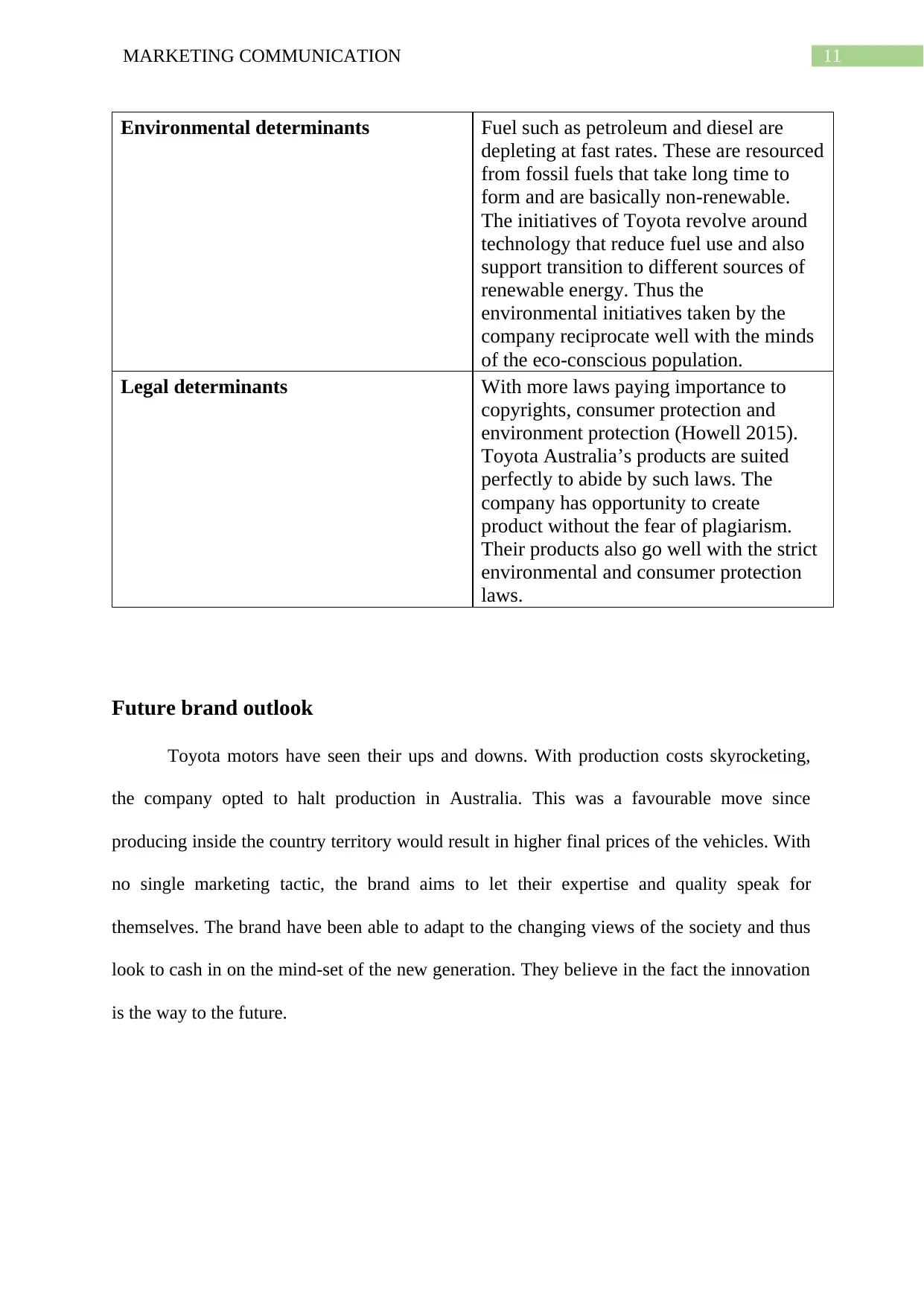
11MARKETING COMMUNICATION
Environmental determinants Fuel such as petroleum and diesel are
depleting at fast rates. These are resourced
from fossil fuels that take long time to
form and are basically non-renewable.
The initiatives of Toyota revolve around
technology that reduce fuel use and also
support transition to different sources of
renewable energy. Thus the
environmental initiatives taken by the
company reciprocate well with the minds
of the eco-conscious population.
Legal determinants With more laws paying importance to
copyrights, consumer protection and
environment protection (Howell 2015).
Toyota Australia’s products are suited
perfectly to abide by such laws. The
company has opportunity to create
product without the fear of plagiarism.
Their products also go well with the strict
environmental and consumer protection
laws.
Future brand outlook
Toyota motors have seen their ups and downs. With production costs skyrocketing,
the company opted to halt production in Australia. This was a favourable move since
producing inside the country territory would result in higher final prices of the vehicles. With
no single marketing tactic, the brand aims to let their expertise and quality speak for
themselves. The brand have been able to adapt to the changing views of the society and thus
look to cash in on the mind-set of the new generation. They believe in the fact the innovation
is the way to the future.
Environmental determinants Fuel such as petroleum and diesel are
depleting at fast rates. These are resourced
from fossil fuels that take long time to
form and are basically non-renewable.
The initiatives of Toyota revolve around
technology that reduce fuel use and also
support transition to different sources of
renewable energy. Thus the
environmental initiatives taken by the
company reciprocate well with the minds
of the eco-conscious population.
Legal determinants With more laws paying importance to
copyrights, consumer protection and
environment protection (Howell 2015).
Toyota Australia’s products are suited
perfectly to abide by such laws. The
company has opportunity to create
product without the fear of plagiarism.
Their products also go well with the strict
environmental and consumer protection
laws.
Future brand outlook
Toyota motors have seen their ups and downs. With production costs skyrocketing,
the company opted to halt production in Australia. This was a favourable move since
producing inside the country territory would result in higher final prices of the vehicles. With
no single marketing tactic, the brand aims to let their expertise and quality speak for
themselves. The brand have been able to adapt to the changing views of the society and thus
look to cash in on the mind-set of the new generation. They believe in the fact the innovation
is the way to the future.
⊘ This is a preview!⊘
Do you want full access?
Subscribe today to unlock all pages.
Trusted by 1+ million students worldwide

1 out of 18


Related Documents


Your All-in-One AI-Powered Toolkit for Academic Success.
+13062052269
info@desklib.com
Available 24*7 on WhatsApp / Email
![[object Object]](/_next/static/media/star-bottom.7253800d.svg)
Unlock your academic potential
Copyright © 2020–2026 A2Z Services. All Rights Reserved. Developed and managed by ZUCOL.