Toyota: Comparing Manager and Leader Roles, Functions, and Theories
VerifiedAdded on 2023/02/02
|23
|6590
|84
Report
AI Summary
This report examines the management and operational aspects of Toyota Motor Corporation. It begins by introducing Toyota's structure, highlighting its global hierarchy, geographic divisions, and product-based divisions. The report then analyzes and differentiates the roles of leaders and managers, comparing their functions, characteristics, and responsibilities, and applying various management and leadership theories to different situations, such as fast-changing and slow-changing environments. The report assesses the strengths and weaknesses of management and leadership theories, like classical, behavioral, and systems theories, and their impact on the work environment. Furthermore, the report investigates key operational functions, roles, and responsibilities within Toyota, evaluating how leaders and managers can improve operational management to meet business objectives and analysing the effects of various factors on the business environment and wider community. The report concludes with recommendations to enhance operational efficiency and management practices within the organization, offering a comprehensive overview of Toyota's management and operational strategies.
Management and
Operations
Operations

Paraphrase This Document
Need a fresh take? Get an instant paraphrase of this document with our AI Paraphraser
Table of Contents
INTRODUCTION...........................................................................................................................4
TASK1.............................................................................................................................................4
1. Introduction of Toyota........................................................................................................4
2. Management structure of Toyota........................................................................................4
M1. Analyse and differentiate between the role of a leader and function of a manager by
effectively applying a range of theories and concepts............................................................6
3. Definition of manager and leader.......................................................................................6
3. Comparison of roles and characteristics of manager and leaders.......................................6
4. Comparison of functions of manager and leader................................................................7
5. Differences between manager and leader...........................................................................8
6. Management and leadership theories applied in different situation...................................9
M2 Assess the strengths and weaknesses of different approaches to situations within the work
environment............................................................................................................................9
7. Conclusion and recommendations....................................................................................12
TASK2...........................................................................................................................................13
1. Introduction to key operations of Toyota.........................................................................13
2. Key operational function and roles and responsibilities of managers in it.......................13
3. Key operational approaches of operational management.................................................14
M4 Analyse how these different factors affect the business environment and wider
community............................................................................................................................15
M3. Evaluate how leaders and managers can improve efficiencies of operational management
to successfully meet business objectives..............................................................................17
6. Conclusion and recommendations....................................................................................18
CONCLUSION .............................................................................................................................19
REFRENCES ................................................................................................................................20
INTRODUCTION...........................................................................................................................4
TASK1.............................................................................................................................................4
1. Introduction of Toyota........................................................................................................4
2. Management structure of Toyota........................................................................................4
M1. Analyse and differentiate between the role of a leader and function of a manager by
effectively applying a range of theories and concepts............................................................6
3. Definition of manager and leader.......................................................................................6
3. Comparison of roles and characteristics of manager and leaders.......................................6
4. Comparison of functions of manager and leader................................................................7
5. Differences between manager and leader...........................................................................8
6. Management and leadership theories applied in different situation...................................9
M2 Assess the strengths and weaknesses of different approaches to situations within the work
environment............................................................................................................................9
7. Conclusion and recommendations....................................................................................12
TASK2...........................................................................................................................................13
1. Introduction to key operations of Toyota.........................................................................13
2. Key operational function and roles and responsibilities of managers in it.......................13
3. Key operational approaches of operational management.................................................14
M4 Analyse how these different factors affect the business environment and wider
community............................................................................................................................15
M3. Evaluate how leaders and managers can improve efficiencies of operational management
to successfully meet business objectives..............................................................................17
6. Conclusion and recommendations....................................................................................18
CONCLUSION .............................................................................................................................19
REFRENCES ................................................................................................................................20
INTRODUCTION
Operation management is concerned with preparation, organising and supervising process
and make required improvements for higher productiveness. This deals with managing
operations and processes within a company. Organisation undertaken in this report is Toyota
Motor Corporation which was founded in 1937 in Japan and deals in auto mobile industry. This
report will analyse and distinguish between the role of a leader and function of a manager by
effectively applying a range of theories and concepts. It will further assess the strengths and
weaknesses of different approaches to situations within the work environment. It will also
evaluate about how managers and leaders will improve their efficiencies of operational
management to successfully accomplish business objectives. The later party of the report will
give clear understanding of different environmental factors that affects the business environment.
TASK1
1. Introduction of Toyota.
Organisation undertaken is Toyota Motor Corporation which is a Japan based company
and deals in auto mobile industry and is the second largest automotive manufacturer. It
encourages the mass hybrid vehicles across the globe (Schwarz, Hall and Shibli, 2015).
Operation management is very important for maintaining day to day functioning and smooth
operation of business.
2. Management structure of Toyota.
Toyota' s management structure is based on varied business operations of the company all
over the world. Their structure is linked to the traditional organisation structure used in Japanese
business. The effectiveness of Toyota is maintaining a strong global presence shows its ability to
utilise its organisation structure to increase its efficiency. Its organisational structure determines
the patterns and arrangements in the firm resources and processes. It has a divisional structure
which is seen as a response to the safety issues and corresponding products recalls. It has the
following characteristics:
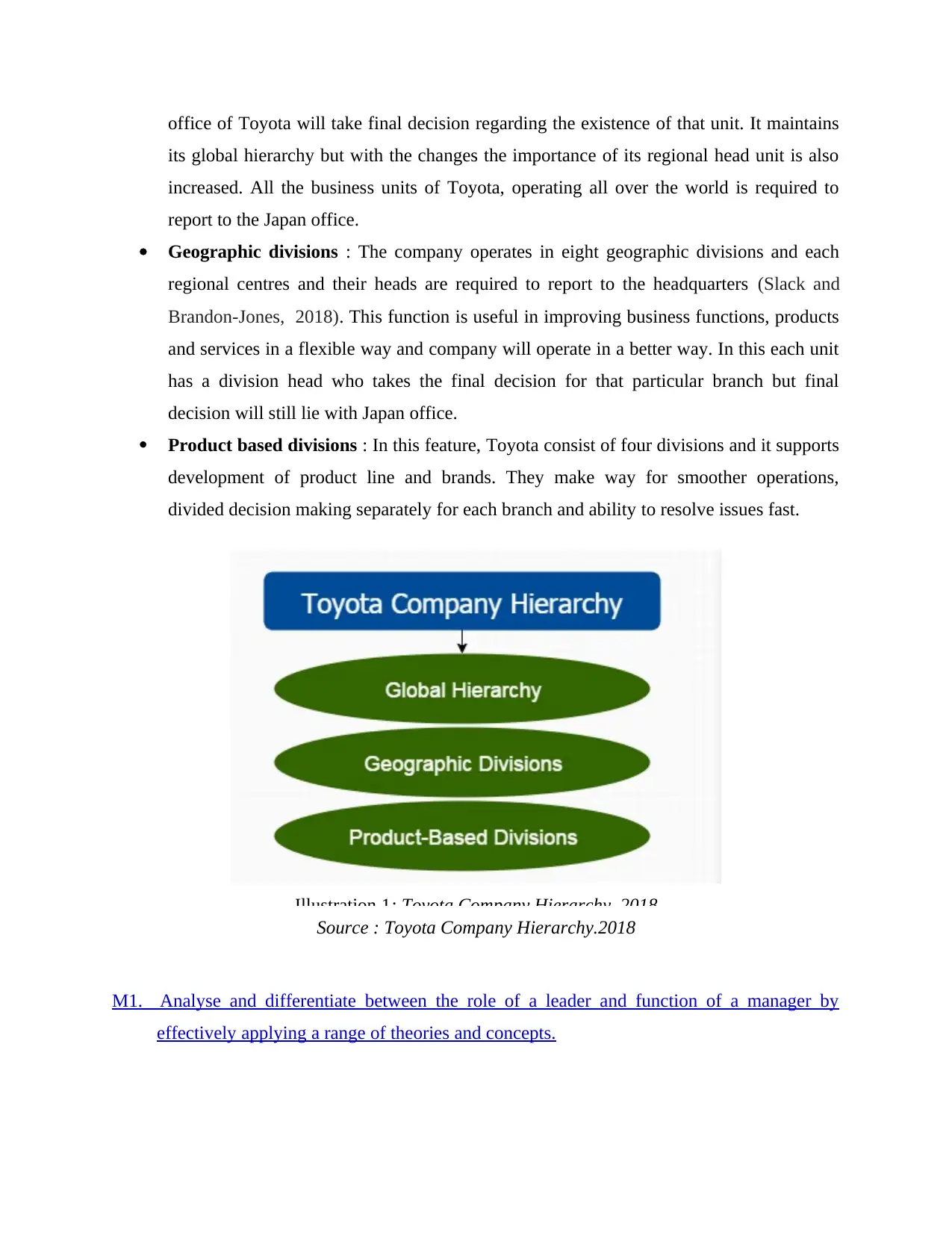
Global hierarchy : This maintain its global businesses with its headquarters in Japan.
The main headquarter is accountable for taking all the relevant decisions and is
responsible for passing all the judgements and decisions on major issues (Ravindran,
2016). For instance, if individual business unit does not communicate well then the Japan
Operation management is concerned with preparation, organising and supervising process
and make required improvements for higher productiveness. This deals with managing
operations and processes within a company. Organisation undertaken in this report is Toyota
Motor Corporation which was founded in 1937 in Japan and deals in auto mobile industry. This
report will analyse and distinguish between the role of a leader and function of a manager by
effectively applying a range of theories and concepts. It will further assess the strengths and
weaknesses of different approaches to situations within the work environment. It will also
evaluate about how managers and leaders will improve their efficiencies of operational
management to successfully accomplish business objectives. The later party of the report will
give clear understanding of different environmental factors that affects the business environment.
TASK1
1. Introduction of Toyota.
Organisation undertaken is Toyota Motor Corporation which is a Japan based company
and deals in auto mobile industry and is the second largest automotive manufacturer. It
encourages the mass hybrid vehicles across the globe (Schwarz, Hall and Shibli, 2015).
Operation management is very important for maintaining day to day functioning and smooth
operation of business.
2. Management structure of Toyota.
Toyota' s management structure is based on varied business operations of the company all
over the world. Their structure is linked to the traditional organisation structure used in Japanese
business. The effectiveness of Toyota is maintaining a strong global presence shows its ability to
utilise its organisation structure to increase its efficiency. Its organisational structure determines
the patterns and arrangements in the firm resources and processes. It has a divisional structure
which is seen as a response to the safety issues and corresponding products recalls. It has the
following characteristics:
Global hierarchy : This maintain its global businesses with its headquarters in Japan.
The main headquarter is accountable for taking all the relevant decisions and is
responsible for passing all the judgements and decisions on major issues (Ravindran,
2016). For instance, if individual business unit does not communicate well then the Japan
⊘ This is a preview!⊘
Do you want full access?
Subscribe today to unlock all pages.

Trusted by 1+ million students worldwide
office of Toyota will take final decision regarding the existence of that unit. It maintains
its global hierarchy but with the changes the importance of its regional head unit is also
increased. All the business units of Toyota, operating all over the world is required to
report to the Japan office.
Geographic divisions : The company operates in eight geographic divisions and each
regional centres and their heads are required to report to the headquarters (Slack and
Brandon-Jones, 2018). This function is useful in improving business functions, products
and services in a flexible way and company will operate in a better way. In this each unit
has a division head who takes the final decision for that particular branch but final
decision will still lie with Japan office.
Product based divisions : In this feature, Toyota consist of four divisions and it supports
development of product line and brands. They make way for smoother operations,
divided decision making separately for each branch and ability to resolve issues fast.
Source : Toyota Company Hierarchy.2018
M1. Analyse and differentiate between the role of a leader and function of a manager by
effectively applying a range of theories and concepts.
Illustration 1: Toyota Company Hierarchy. 2018
its global hierarchy but with the changes the importance of its regional head unit is also
increased. All the business units of Toyota, operating all over the world is required to
report to the Japan office.
Geographic divisions : The company operates in eight geographic divisions and each
regional centres and their heads are required to report to the headquarters (Slack and
Brandon-Jones, 2018). This function is useful in improving business functions, products
and services in a flexible way and company will operate in a better way. In this each unit
has a division head who takes the final decision for that particular branch but final
decision will still lie with Japan office.
Product based divisions : In this feature, Toyota consist of four divisions and it supports
development of product line and brands. They make way for smoother operations,
divided decision making separately for each branch and ability to resolve issues fast.
Source : Toyota Company Hierarchy.2018
M1. Analyse and differentiate between the role of a leader and function of a manager by
effectively applying a range of theories and concepts.
Illustration 1: Toyota Company Hierarchy. 2018
Paraphrase This Document
Need a fresh take? Get an instant paraphrase of this document with our AI Paraphraser
Managers and leaders are two very crucial element of business organisation. They are
different entities and have distinct roles and functions which are to be performed (Nielsen and et.
al., 2014).
3. Definition of manager and leader.
Manager : In operation management of business, managers are the people who handles
the various activities which are necessary for operating in business world.
Leader : Leaders are responsible for influencing people to work towards the attainment
of goals and objectives of the organisation.
3. Comparison of roles and characteristics of manager and leaders.
Roles of manager
As a manager, every person is required to perform various roles in everyday life and they
are discussed below:
Informational roles : This role of the manager is concerned with providing and
analysing various information and sharing the same with people.
Decision making role : As manager is one of the top position in company, they are held
liable for making various decisions which will be useful in meeting business objectives.
Interpersonal roles : It cover a relationship between manager and others. In this,
individual will act as figurehead, liaison and leader to maintain a connection with outside
organisations.
Roles of leader
Various roles to be performed by leader in Toyota are :
Training : They provide effective training and guidance to the workers to effectively
accomplish the objectives of Toyota.
Motivation : They provide motivation to make people passionate about their work in
form of financial and non financial methods.
Characteristics of managers
Managers are the people who manages people and activities in the organisation.
They focus on tactical activities and have more directive and controlling approaches.
They ensure that work is done on time, emphasis on day to day activities and manage the
activities of others.
Characteristics of leaders
different entities and have distinct roles and functions which are to be performed (Nielsen and et.
al., 2014).
3. Definition of manager and leader.
Manager : In operation management of business, managers are the people who handles
the various activities which are necessary for operating in business world.
Leader : Leaders are responsible for influencing people to work towards the attainment
of goals and objectives of the organisation.
3. Comparison of roles and characteristics of manager and leaders.
Roles of manager
As a manager, every person is required to perform various roles in everyday life and they
are discussed below:
Informational roles : This role of the manager is concerned with providing and
analysing various information and sharing the same with people.
Decision making role : As manager is one of the top position in company, they are held
liable for making various decisions which will be useful in meeting business objectives.
Interpersonal roles : It cover a relationship between manager and others. In this,
individual will act as figurehead, liaison and leader to maintain a connection with outside
organisations.
Roles of leader
Various roles to be performed by leader in Toyota are :
Training : They provide effective training and guidance to the workers to effectively
accomplish the objectives of Toyota.
Motivation : They provide motivation to make people passionate about their work in
form of financial and non financial methods.
Characteristics of managers
Managers are the people who manages people and activities in the organisation.
They focus on tactical activities and have more directive and controlling approaches.
They ensure that work is done on time, emphasis on day to day activities and manage the
activities of others.
Characteristics of leaders
They inspire and motivate employees to drive themselves.
They are focussed towards the change.
They recognises the continual improvement that can be achieved and accomplishes
greater success.
4. Comparison of functions of manager and leader.
Functions of managers
There are various functions which are required to be performed by the manager of Toyota
and they are discussed below :
Planning : The manager is responsible for making plans and programme of how to
accomplish the task with all relevant details. It further determines the goals and
objectives for the Toyota and methods to accomplish those goals.
Organising : Manager is responsible for organising an organisation by establishing
patterns of relationships among people and other resources that work to produce an
output for the production process (McCrie, 2015).
Controlling : As the organisation moves towards the goals, manager is responsible for
maintaining development. It involves taking appropriate actions to assure that
organisational goals and objectives are planned and carried out and firm makes maximum
effectiveness.
Staffing : It is the organisational function which is responsible for hiring and retaining an
appropriate workforce in an organisation. Toyota will involve the process of recruitment,
training, developing, etc. to the individuals.
Directing : This is concerned with leadership, communication and motivation which
assures that employees perform their duties effectively and efficiently in Toyota.
Function of leader
There are numerous functions performed by leader in Toyota and they are discussed
below:
Setting clear vision : This means influencing the present and future state of the business
and leader will exercise their duties by explaining and clarifying the vision and
importance of setting goals (Mahadevan, 2015).
Initiating actions : Function of leader is to take initiative in all matters of the interest to
the group. Leaders will float new ideas and their decisions will reflect original thinking.
They are focussed towards the change.
They recognises the continual improvement that can be achieved and accomplishes
greater success.
4. Comparison of functions of manager and leader.
Functions of managers
There are various functions which are required to be performed by the manager of Toyota
and they are discussed below :
Planning : The manager is responsible for making plans and programme of how to
accomplish the task with all relevant details. It further determines the goals and
objectives for the Toyota and methods to accomplish those goals.
Organising : Manager is responsible for organising an organisation by establishing
patterns of relationships among people and other resources that work to produce an
output for the production process (McCrie, 2015).
Controlling : As the organisation moves towards the goals, manager is responsible for
maintaining development. It involves taking appropriate actions to assure that
organisational goals and objectives are planned and carried out and firm makes maximum
effectiveness.
Staffing : It is the organisational function which is responsible for hiring and retaining an
appropriate workforce in an organisation. Toyota will involve the process of recruitment,
training, developing, etc. to the individuals.
Directing : This is concerned with leadership, communication and motivation which
assures that employees perform their duties effectively and efficiently in Toyota.
Function of leader
There are numerous functions performed by leader in Toyota and they are discussed
below:
Setting clear vision : This means influencing the present and future state of the business
and leader will exercise their duties by explaining and clarifying the vision and
importance of setting goals (Mahadevan, 2015).
Initiating actions : Function of leader is to take initiative in all matters of the interest to
the group. Leaders will float new ideas and their decisions will reflect original thinking.
⊘ This is a preview!⊘
Do you want full access?
Subscribe today to unlock all pages.
Trusted by 1+ million students worldwide
Act as link between management and workers : They act as a link between
management and workers for communicating the vision and mission of organisation to
the workers and transmitting workers problems to the management.
5. Differences between manager and leader
Basis Manager Leader
Focus Their focus is on managing the
work.
It stresses on managing people
to accomplish goals.
Risk They minimises the risk. They initiate to take risk.
Goals Concerned with long term
goal.
They are involved in
accomplishing short term
goals.
6. Management and leadership theories applied in different situation.
There are various situations which Toyota faces in their everyday functioning and
operations. For instance,
Fast changing situation
When the business environment and policies changes quickly and the environment is not
stable then there are various roles which managers and leaders will perform. In such cases,
managers will do environmental scanning, which help them in taking various decisions regarding
the prices, market stability, etc. Leaders will follow autocratic leadership style in contingency
situations to deal with the quick changes as decisions are required to be taken without wasting
time. For instance, the social factors which influences the preferences and taste of customers and
when they changes quickly because customers need fluctuate so leaders of will opt for autocratic
leadership style to rapidly deal with the change.
Slow changing situation
This stresses on stability of organisation. Under such situations, market is proven to be
stable and company can do detailed analyses and research on improving various methods and
plans. Manager will perform the function of planning thoroughly which will include the future
predictions and measures as well depending on various situations which may occur in future
(Kato and et. al., 2015). Leaders will follow democratic leadership style in such situations, they
management and workers for communicating the vision and mission of organisation to
the workers and transmitting workers problems to the management.
5. Differences between manager and leader
Basis Manager Leader
Focus Their focus is on managing the
work.
It stresses on managing people
to accomplish goals.
Risk They minimises the risk. They initiate to take risk.
Goals Concerned with long term
goal.
They are involved in
accomplishing short term
goals.
6. Management and leadership theories applied in different situation.
There are various situations which Toyota faces in their everyday functioning and
operations. For instance,
Fast changing situation
When the business environment and policies changes quickly and the environment is not
stable then there are various roles which managers and leaders will perform. In such cases,
managers will do environmental scanning, which help them in taking various decisions regarding
the prices, market stability, etc. Leaders will follow autocratic leadership style in contingency
situations to deal with the quick changes as decisions are required to be taken without wasting
time. For instance, the social factors which influences the preferences and taste of customers and
when they changes quickly because customers need fluctuate so leaders of will opt for autocratic
leadership style to rapidly deal with the change.
Slow changing situation
This stresses on stability of organisation. Under such situations, market is proven to be
stable and company can do detailed analyses and research on improving various methods and
plans. Manager will perform the function of planning thoroughly which will include the future
predictions and measures as well depending on various situations which may occur in future
(Kato and et. al., 2015). Leaders will follow democratic leadership style in such situations, they
Paraphrase This Document
Need a fresh take? Get an instant paraphrase of this document with our AI Paraphraser
will discuss view points of workers and take decisions by considering their suggestions and
issues. For instance, when there is economic stability in the business environment of then
leaders of the company will follow democratic leadership style which will help them in taking
suggestion and advices from the staff and subordinates and then develop the policies. This will
help them in making various decisions regarding expansion, innovation, etc.
M2 Assess the strengths and weaknesses of different approaches to situations within the work
environment.
6.1 Management theories.
There are various theories which are adopted by the leaders working in Toyota and some of them
are discussed below along with their strengths and weaknesses :
6.1.1 Classical theory
It is based on the assumption that worker only have physical and economic needs and
does not focuses on social needs and job satisfaction of the employees. Following are the
strength and weakness of this theory :
Strength Weakness
It has a clear hierarchical structure which
comprises of three distinct levels and each
have different set of roles and responsibilities.
Lack of social sentiments, needs and feelings
of people which is necessary in accomplishing
the people's desires.
Puts emphasis on division of labour in which
task is broken into pieces and work is assigned
according to the skills and knowledge of the
people.
Influenced by external conditions that can
fluctuate over time.
6.1.2 Behavioural theory
This focuses on human relation movement because it focuses on human dimensions of
work and believes that better understanding of human behaviour at work such as motivation,
conflict, expectations, etc.
Strength Weakness
It can be used to build behaviour step by step
to help people develop new behaviours and
This only stresses on the surface of people's
issues like behaviour and lacks to look
issues. For instance, when there is economic stability in the business environment of then
leaders of the company will follow democratic leadership style which will help them in taking
suggestion and advices from the staff and subordinates and then develop the policies. This will
help them in making various decisions regarding expansion, innovation, etc.
M2 Assess the strengths and weaknesses of different approaches to situations within the work
environment.
6.1 Management theories.
There are various theories which are adopted by the leaders working in Toyota and some of them
are discussed below along with their strengths and weaknesses :
6.1.1 Classical theory
It is based on the assumption that worker only have physical and economic needs and
does not focuses on social needs and job satisfaction of the employees. Following are the
strength and weakness of this theory :
Strength Weakness
It has a clear hierarchical structure which
comprises of three distinct levels and each
have different set of roles and responsibilities.
Lack of social sentiments, needs and feelings
of people which is necessary in accomplishing
the people's desires.
Puts emphasis on division of labour in which
task is broken into pieces and work is assigned
according to the skills and knowledge of the
people.
Influenced by external conditions that can
fluctuate over time.
6.1.2 Behavioural theory
This focuses on human relation movement because it focuses on human dimensions of
work and believes that better understanding of human behaviour at work such as motivation,
conflict, expectations, etc.
Strength Weakness
It can be used to build behaviour step by step
to help people develop new behaviours and
This only stresses on the surface of people's
issues like behaviour and lacks to look
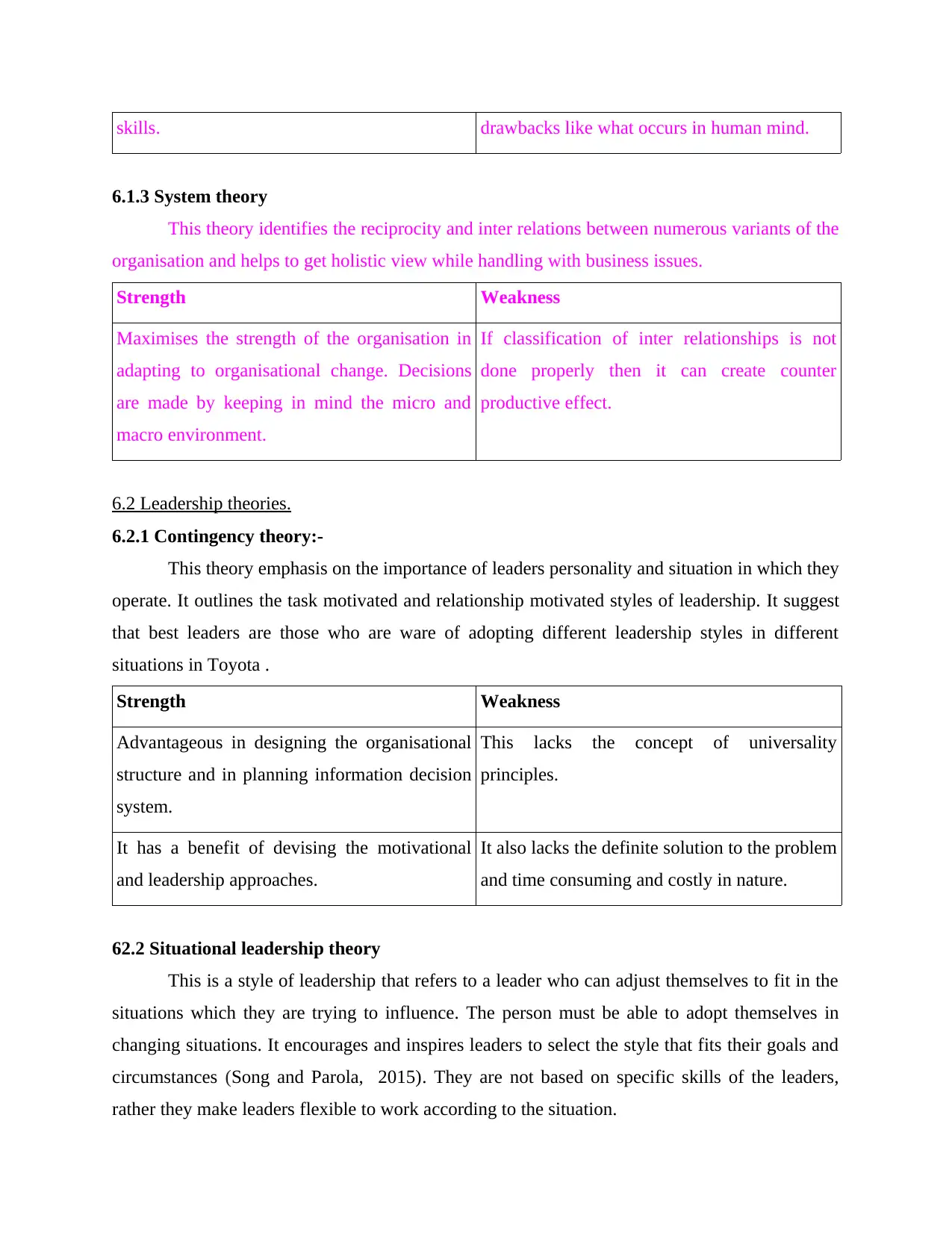
skills. drawbacks like what occurs in human mind.
6.1.3 System theory
This theory identifies the reciprocity and inter relations between numerous variants of the
organisation and helps to get holistic view while handling with business issues.
Strength Weakness
Maximises the strength of the organisation in
adapting to organisational change. Decisions
are made by keeping in mind the micro and
macro environment.
If classification of inter relationships is not
done properly then it can create counter
productive effect.
6.2 Leadership theories.
6.2.1 Contingency theory:-
This theory emphasis on the importance of leaders personality and situation in which they
operate. It outlines the task motivated and relationship motivated styles of leadership. It suggest
that best leaders are those who are ware of adopting different leadership styles in different
situations in Toyota .
Strength Weakness
Advantageous in designing the organisational
structure and in planning information decision
system.
This lacks the concept of universality
principles.
It has a benefit of devising the motivational
and leadership approaches.
It also lacks the definite solution to the problem
and time consuming and costly in nature.
62.2 Situational leadership theory
This is a style of leadership that refers to a leader who can adjust themselves to fit in the
situations which they are trying to influence. The person must be able to adopt themselves in
changing situations. It encourages and inspires leaders to select the style that fits their goals and
circumstances (Song and Parola, 2015). They are not based on specific skills of the leaders,
rather they make leaders flexible to work according to the situation.
6.1.3 System theory
This theory identifies the reciprocity and inter relations between numerous variants of the
organisation and helps to get holistic view while handling with business issues.
Strength Weakness
Maximises the strength of the organisation in
adapting to organisational change. Decisions
are made by keeping in mind the micro and
macro environment.
If classification of inter relationships is not
done properly then it can create counter
productive effect.
6.2 Leadership theories.
6.2.1 Contingency theory:-
This theory emphasis on the importance of leaders personality and situation in which they
operate. It outlines the task motivated and relationship motivated styles of leadership. It suggest
that best leaders are those who are ware of adopting different leadership styles in different
situations in Toyota .
Strength Weakness
Advantageous in designing the organisational
structure and in planning information decision
system.
This lacks the concept of universality
principles.
It has a benefit of devising the motivational
and leadership approaches.
It also lacks the definite solution to the problem
and time consuming and costly in nature.
62.2 Situational leadership theory
This is a style of leadership that refers to a leader who can adjust themselves to fit in the
situations which they are trying to influence. The person must be able to adopt themselves in
changing situations. It encourages and inspires leaders to select the style that fits their goals and
circumstances (Song and Parola, 2015). They are not based on specific skills of the leaders,
rather they make leaders flexible to work according to the situation.
⊘ This is a preview!⊘
Do you want full access?
Subscribe today to unlock all pages.
Trusted by 1+ million students worldwide
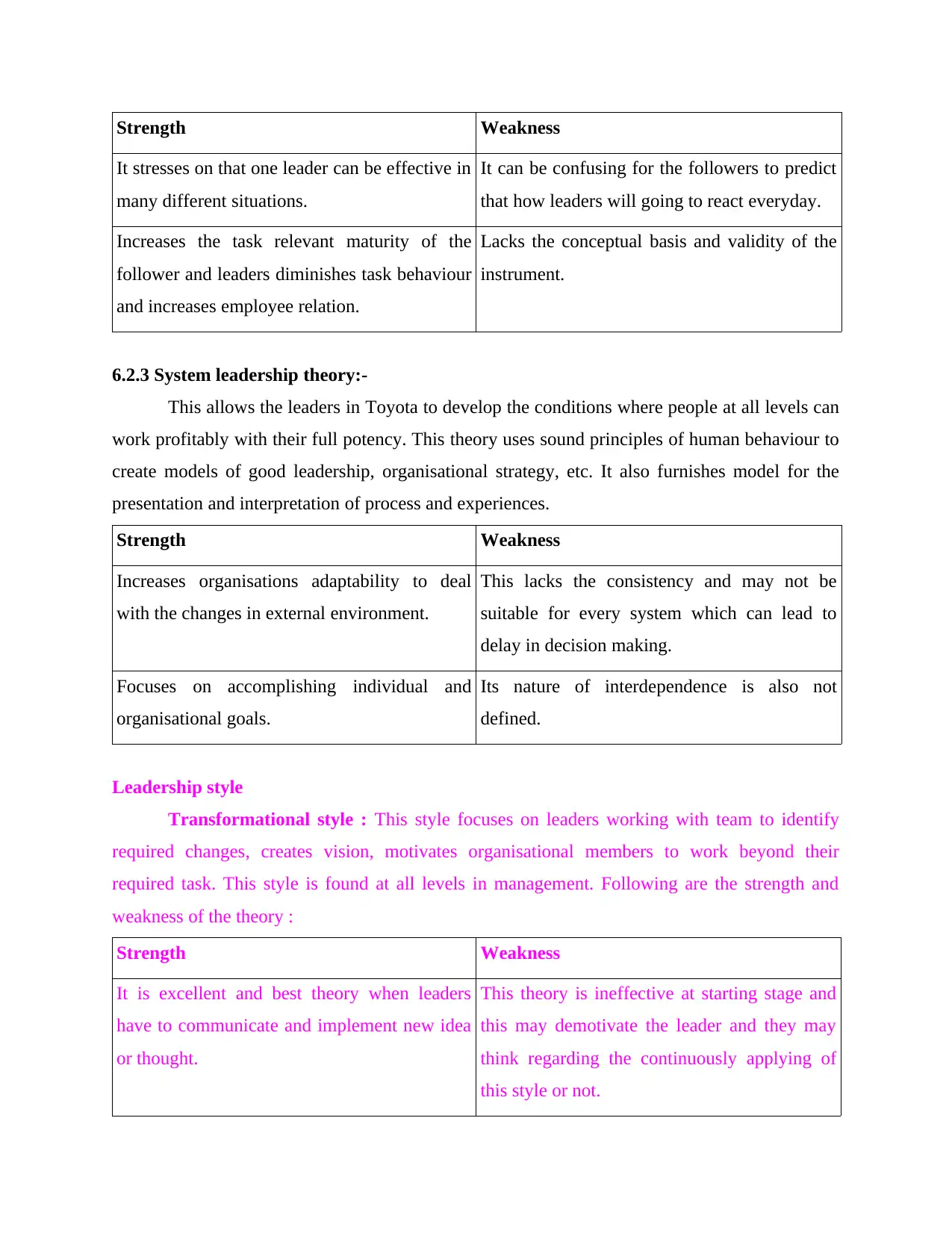
Strength Weakness
It stresses on that one leader can be effective in
many different situations.
It can be confusing for the followers to predict
that how leaders will going to react everyday.
Increases the task relevant maturity of the
follower and leaders diminishes task behaviour
and increases employee relation.
Lacks the conceptual basis and validity of the
instrument.
6.2.3 System leadership theory:-
This allows the leaders in Toyota to develop the conditions where people at all levels can
work profitably with their full potency. This theory uses sound principles of human behaviour to
create models of good leadership, organisational strategy, etc. It also furnishes model for the
presentation and interpretation of process and experiences.
Strength Weakness
Increases organisations adaptability to deal
with the changes in external environment.
This lacks the consistency and may not be
suitable for every system which can lead to
delay in decision making.
Focuses on accomplishing individual and
organisational goals.
Its nature of interdependence is also not
defined.
Leadership style
Transformational style : This style focuses on leaders working with team to identify
required changes, creates vision, motivates organisational members to work beyond their
required task. This style is found at all levels in management. Following are the strength and
weakness of the theory :
Strength Weakness
It is excellent and best theory when leaders
have to communicate and implement new idea
or thought.
This theory is ineffective at starting stage and
this may demotivate the leader and they may
think regarding the continuously applying of
this style or not.
It stresses on that one leader can be effective in
many different situations.
It can be confusing for the followers to predict
that how leaders will going to react everyday.
Increases the task relevant maturity of the
follower and leaders diminishes task behaviour
and increases employee relation.
Lacks the conceptual basis and validity of the
instrument.
6.2.3 System leadership theory:-
This allows the leaders in Toyota to develop the conditions where people at all levels can
work profitably with their full potency. This theory uses sound principles of human behaviour to
create models of good leadership, organisational strategy, etc. It also furnishes model for the
presentation and interpretation of process and experiences.
Strength Weakness
Increases organisations adaptability to deal
with the changes in external environment.
This lacks the consistency and may not be
suitable for every system which can lead to
delay in decision making.
Focuses on accomplishing individual and
organisational goals.
Its nature of interdependence is also not
defined.
Leadership style
Transformational style : This style focuses on leaders working with team to identify
required changes, creates vision, motivates organisational members to work beyond their
required task. This style is found at all levels in management. Following are the strength and
weakness of the theory :
Strength Weakness
It is excellent and best theory when leaders
have to communicate and implement new idea
or thought.
This theory is ineffective at starting stage and
this may demotivate the leader and they may
think regarding the continuously applying of
this style or not.
Paraphrase This Document
Need a fresh take? Get an instant paraphrase of this document with our AI Paraphraser
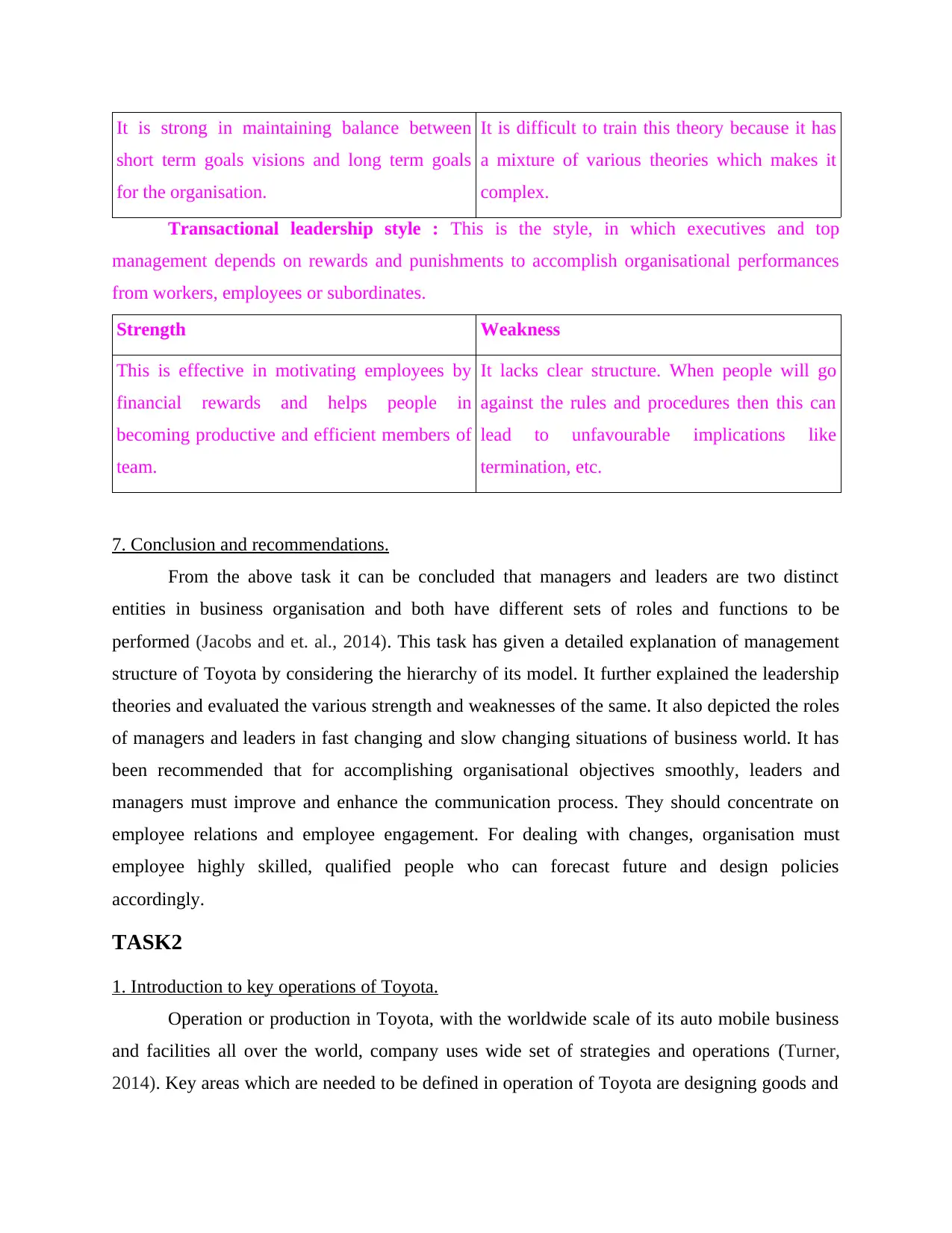
It is strong in maintaining balance between
short term goals visions and long term goals
for the organisation.
It is difficult to train this theory because it has
a mixture of various theories which makes it
complex.
Transactional leadership style : This is the style, in which executives and top
management depends on rewards and punishments to accomplish organisational performances
from workers, employees or subordinates.
Strength Weakness
This is effective in motivating employees by
financial rewards and helps people in
becoming productive and efficient members of
team.
It lacks clear structure. When people will go
against the rules and procedures then this can
lead to unfavourable implications like
termination, etc.
7. Conclusion and recommendations.
From the above task it can be concluded that managers and leaders are two distinct
entities in business organisation and both have different sets of roles and functions to be
performed (Jacobs and et. al., 2014). This task has given a detailed explanation of management
structure of Toyota by considering the hierarchy of its model. It further explained the leadership
theories and evaluated the various strength and weaknesses of the same. It also depicted the roles
of managers and leaders in fast changing and slow changing situations of business world. It has
been recommended that for accomplishing organisational objectives smoothly, leaders and
managers must improve and enhance the communication process. They should concentrate on
employee relations and employee engagement. For dealing with changes, organisation must
employee highly skilled, qualified people who can forecast future and design policies
accordingly.
TASK2
1. Introduction to key operations of Toyota.
Operation or production in Toyota, with the worldwide scale of its auto mobile business
and facilities all over the world, company uses wide set of strategies and operations (Turner,
2014). Key areas which are needed to be defined in operation of Toyota are designing goods and
short term goals visions and long term goals
for the organisation.
It is difficult to train this theory because it has
a mixture of various theories which makes it
complex.
Transactional leadership style : This is the style, in which executives and top
management depends on rewards and punishments to accomplish organisational performances
from workers, employees or subordinates.
Strength Weakness
This is effective in motivating employees by
financial rewards and helps people in
becoming productive and efficient members of
team.
It lacks clear structure. When people will go
against the rules and procedures then this can
lead to unfavourable implications like
termination, etc.
7. Conclusion and recommendations.
From the above task it can be concluded that managers and leaders are two distinct
entities in business organisation and both have different sets of roles and functions to be
performed (Jacobs and et. al., 2014). This task has given a detailed explanation of management
structure of Toyota by considering the hierarchy of its model. It further explained the leadership
theories and evaluated the various strength and weaknesses of the same. It also depicted the roles
of managers and leaders in fast changing and slow changing situations of business world. It has
been recommended that for accomplishing organisational objectives smoothly, leaders and
managers must improve and enhance the communication process. They should concentrate on
employee relations and employee engagement. For dealing with changes, organisation must
employee highly skilled, qualified people who can forecast future and design policies
accordingly.
TASK2
1. Introduction to key operations of Toyota.
Operation or production in Toyota, with the worldwide scale of its auto mobile business
and facilities all over the world, company uses wide set of strategies and operations (Turner,
2014). Key areas which are needed to be defined in operation of Toyota are designing goods and
services, quality management, process designing, supply chain management, inventory
management, etc. Decisions are required to be taken in accordance with these operations so that
Toyota can meet business objectives effectively and efficiently.
2. Key operational function and roles and responsibilities of managers in it.
Every business is managed through multiple business functions each responsible for
handling certain aspects of business. It deals with handling processes and operations within the
organisation. Following are the key operational functions of Toyota which are discussed below:
Designing of goods and services : Toyota describes their strategic decision area of
operation management with technological advancement and quality. For this purpose,
managers are responsible to use its research and development department to assure advance
features in its products (Harrison and Lock, 2017). Managers of Toyota also integrates
dealership personal needs in designing after sales services.
Quality management : This is concerned with maintaining the superiority in its quality and
production processes. The Toyota production system helps the organisation to maximise
quality. Managers are responsible for making continuous improvements which is covered in
The Toyota way.
Supply chain management : It is concerned with transmitting the goods and services
produced. Toyota uses lean manufacturing for supply chain management. In this strategic
decision area of management, manager is responsible for using automation system for real
time adjustments in supply chain activity. This help managers of Toyota in minimising the
bull whip effect of supply chain management.
Inventory management : This is concerned with managing the stock of the company. It is
very important to meet the obstacle of deficit in supply. Toyota uses this for minimising
inventory levels through just in time inventory management. Manager is responsible to
reduce inventory size and its corresponding cost.
Facilitates location : They are strategic decisions and once plant is set up at location, it
cannot be moved from its place. It is concerned directly with setting up of plan for
production purpose (Grant, Trautrims and Wong, 2017). Managers will be responsible to
evaluate the location alternatives against multiplicity of relevant factors and considering
their importance to the organisation and selecting those which are operationally beneficial
to the company.
management, etc. Decisions are required to be taken in accordance with these operations so that
Toyota can meet business objectives effectively and efficiently.
2. Key operational function and roles and responsibilities of managers in it.
Every business is managed through multiple business functions each responsible for
handling certain aspects of business. It deals with handling processes and operations within the
organisation. Following are the key operational functions of Toyota which are discussed below:
Designing of goods and services : Toyota describes their strategic decision area of
operation management with technological advancement and quality. For this purpose,
managers are responsible to use its research and development department to assure advance
features in its products (Harrison and Lock, 2017). Managers of Toyota also integrates
dealership personal needs in designing after sales services.
Quality management : This is concerned with maintaining the superiority in its quality and
production processes. The Toyota production system helps the organisation to maximise
quality. Managers are responsible for making continuous improvements which is covered in
The Toyota way.
Supply chain management : It is concerned with transmitting the goods and services
produced. Toyota uses lean manufacturing for supply chain management. In this strategic
decision area of management, manager is responsible for using automation system for real
time adjustments in supply chain activity. This help managers of Toyota in minimising the
bull whip effect of supply chain management.
Inventory management : This is concerned with managing the stock of the company. It is
very important to meet the obstacle of deficit in supply. Toyota uses this for minimising
inventory levels through just in time inventory management. Manager is responsible to
reduce inventory size and its corresponding cost.
Facilitates location : They are strategic decisions and once plant is set up at location, it
cannot be moved from its place. It is concerned directly with setting up of plan for
production purpose (Grant, Trautrims and Wong, 2017). Managers will be responsible to
evaluate the location alternatives against multiplicity of relevant factors and considering
their importance to the organisation and selecting those which are operationally beneficial
to the company.
⊘ This is a preview!⊘
Do you want full access?
Subscribe today to unlock all pages.
Trusted by 1+ million students worldwide

1 out of 23


Related Documents


Your All-in-One AI-Powered Toolkit for Academic Success.
+13062052269
info@desklib.com
Available 24*7 on WhatsApp / Email
![[object Object]](/_next/static/media/star-bottom.7253800d.svg)
Unlock your academic potential
Copyright © 2020–2026 A2Z Services. All Rights Reserved. Developed and managed by ZUCOL.