Report on Toyota: Structure, Culture, and Organizational Performance
VerifiedAdded on 2021/02/21
|10
|2703
|31
Report
AI Summary
This report provides a comprehensive analysis of Toyota's organizational structure and culture, exploring their impact on the company's performance. It examines the interrelation between structure, culture, and the workforce, highlighting how Toyota's decentralized structure and emphasis on employee development contribute to its success. The report delves into factors influencing organizational culture, such as employee relations, environmental considerations, and customer focus, and their effects on productivity. It discusses various leadership styles, with a focus on the participative approach, and explores relevant organizational design models, including Edgar Schein's model. The report concludes by emphasizing the importance of aligning organizational culture, structure, and leadership to achieve optimal results in the competitive automotive industry.
Structure and Culture of Toyota

Paraphrase This Document
Need a fresh take? Get an instant paraphrase of this document with our AI Paraphraser
Table of Contents
INTRODUCTION...........................................................................................................................1
TASK ..............................................................................................................................................1
Structures and culture of organisation.........................................................................................1
Factors through which structure and culture of organisation contribute in organisation
performance.................................................................................................................................2
Theories and models for organisational design and culture........................................................5
CONCLUSION................................................................................................................................7
REFERENCES................................................................................................................................7
INTRODUCTION...........................................................................................................................1
TASK ..............................................................................................................................................1
Structures and culture of organisation.........................................................................................1
Factors through which structure and culture of organisation contribute in organisation
performance.................................................................................................................................2
Theories and models for organisational design and culture........................................................5
CONCLUSION................................................................................................................................7
REFERENCES................................................................................................................................7
INTRODUCTION
Organisational structure well organizational culture both are related with concepts that
leads them to understand the forms and reason of people's behaviour who are engage in the
organisation. The main agenda to understand this research is to predict behaviour of individuals
that describe their psychology, attitudes, experience, belief etc. Another term organisation
structure undertakes legal structures such rules, regulation, policy and authority for an
organisation and country. It develops a formal system through which it is ey for organisation to
complete their work within systematic and sequential manner (Nonaka and et. al., 2014). This
report is bed from the perspective of Toyota which operates their business's in auto-mobile
industry. It is a leading organisation that is operating their business's in all over world. This
project highlights on relationship between structure, culture and people of the organisation.
Along with this nature of managerial work and relevant theories or model will also be discuss in
this report.
TASK
Structures and culture of organisation
Organisational culture and structure are two inter-related factor which affect on a
business's and its performance. First culture for an organisation formulate around the
organisation structure which determines employee's holds the power for modifying structure of a
particular organisation. Second structure which is developed by organisation is constant but
culture is always flexible. It states that organisation culture will be change if management
changes perspective of employee's to perform their role in similar structure. In context of Toyota
organisational culture it represent the responses of employee's on different challenges which are
faced by Toyota in the industry (Moore, 2012). They is a global leader of auto-mobile industry.
So to overcome from issue of culture they are focused to increase capabilities of their employee's
that proceeds to enhance value in their performance through improving their skills, knowledge
and practice. In order to consider it effectively they provide and organise training and
development classes or seminar for their employee's.
Organisation structure refers to the norms, rules, policies, that is formulated by
management in order to achieve their objective. It is an independent structure which put more
emphasis on attitude, policy and framework through which an organisational culture is
Organisational structure well organizational culture both are related with concepts that
leads them to understand the forms and reason of people's behaviour who are engage in the
organisation. The main agenda to understand this research is to predict behaviour of individuals
that describe their psychology, attitudes, experience, belief etc. Another term organisation
structure undertakes legal structures such rules, regulation, policy and authority for an
organisation and country. It develops a formal system through which it is ey for organisation to
complete their work within systematic and sequential manner (Nonaka and et. al., 2014). This
report is bed from the perspective of Toyota which operates their business's in auto-mobile
industry. It is a leading organisation that is operating their business's in all over world. This
project highlights on relationship between structure, culture and people of the organisation.
Along with this nature of managerial work and relevant theories or model will also be discuss in
this report.
TASK
Structures and culture of organisation
Organisational culture and structure are two inter-related factor which affect on a
business's and its performance. First culture for an organisation formulate around the
organisation structure which determines employee's holds the power for modifying structure of a
particular organisation. Second structure which is developed by organisation is constant but
culture is always flexible. It states that organisation culture will be change if management
changes perspective of employee's to perform their role in similar structure. In context of Toyota
organisational culture it represent the responses of employee's on different challenges which are
faced by Toyota in the industry (Moore, 2012). They is a global leader of auto-mobile industry.
So to overcome from issue of culture they are focused to increase capabilities of their employee's
that proceeds to enhance value in their performance through improving their skills, knowledge
and practice. In order to consider it effectively they provide and organise training and
development classes or seminar for their employee's.
Organisation structure refers to the norms, rules, policies, that is formulated by
management in order to achieve their objective. It is an independent structure which put more
emphasis on attitude, policy and framework through which an organisational culture is
⊘ This is a preview!⊘
Do you want full access?
Subscribe today to unlock all pages.

Trusted by 1+ million students worldwide
developed. For instance- An organisation who follow strict hierarchy in their structure it
determines authority to take decision is fixed and allotted to top management. In this it is
difficult for employee's to formulate an effective culture due to which it is less effective and
rigid. Therefore to overcome from this Toyota follow decentralized structure that helps them to
delegates responsibility and authority on a equal level. So it is simple for workforce of Toyota
Motor corporation to take effective decision because management share power with them (Jones,
Latham and Betta, 2013). Moreover it also explains relationship between structure, culture and
employee's of organisation. Like the way in which organisation distribute authority,
responsibility to organisation workforce defines and symbolise behaviour of employee's which is
engage in their work performance. This leads them to complete their work through managing
their operations with execution and follow of structure such decentralize structure helps to make
effective decision within minimum time period.
Factors through which structure and culture of organisation contribute in organisation
performance
Organisation culture is developed by the employee's of an organisation that are engaged
in their operations, function and activities of Toyota. Their are several factors are present in
environment by which organisational culture is directly impacted. Employee's are first factor that
work an set for organisation. It not impact on them but it directly impacts on overall productivity
and performance of organisation. Through analysing several pects such working hours of
employee's, team performance of employee's and communication factors it is analysed.
Colleagues or co-workers spend more time in working environment so it is mandatory for Toyota
to implement an effective communication channel. Like formal interaction between employee's
in order to maintain positive decorum and ambiance in organisation. So to reduce this impact
management of Toyota trained employee's to work a team that enhances their productivity. In
Toyota large number of employee's are engage that belongs to different culture and backgrounds.
Thus managing team work helps them to deal with diversity which increases their overall
performance (Ganter and Hecker, 2014).
Environment by which an organisation is surrounded directly impacts on its working
conditions and performance. For instance if factory of Toyota is situated in mid of a particular
country then government and society raises issue it releasees emission gases that is not suitable
for a residential area. Where on the other side Toyota is delivering their products at global level.
determines authority to take decision is fixed and allotted to top management. In this it is
difficult for employee's to formulate an effective culture due to which it is less effective and
rigid. Therefore to overcome from this Toyota follow decentralized structure that helps them to
delegates responsibility and authority on a equal level. So it is simple for workforce of Toyota
Motor corporation to take effective decision because management share power with them (Jones,
Latham and Betta, 2013). Moreover it also explains relationship between structure, culture and
employee's of organisation. Like the way in which organisation distribute authority,
responsibility to organisation workforce defines and symbolise behaviour of employee's which is
engage in their work performance. This leads them to complete their work through managing
their operations with execution and follow of structure such decentralize structure helps to make
effective decision within minimum time period.
Factors through which structure and culture of organisation contribute in organisation
performance
Organisation culture is developed by the employee's of an organisation that are engaged
in their operations, function and activities of Toyota. Their are several factors are present in
environment by which organisational culture is directly impacted. Employee's are first factor that
work an set for organisation. It not impact on them but it directly impacts on overall productivity
and performance of organisation. Through analysing several pects such working hours of
employee's, team performance of employee's and communication factors it is analysed.
Colleagues or co-workers spend more time in working environment so it is mandatory for Toyota
to implement an effective communication channel. Like formal interaction between employee's
in order to maintain positive decorum and ambiance in organisation. So to reduce this impact
management of Toyota trained employee's to work a team that enhances their productivity. In
Toyota large number of employee's are engage that belongs to different culture and backgrounds.
Thus managing team work helps them to deal with diversity which increases their overall
performance (Ganter and Hecker, 2014).
Environment by which an organisation is surrounded directly impacts on its working
conditions and performance. For instance if factory of Toyota is situated in mid of a particular
country then government and society raises issue it releasees emission gases that is not suitable
for a residential area. Where on the other side Toyota is delivering their products at global level.
Paraphrase This Document
Need a fresh take? Get an instant paraphrase of this document with our AI Paraphraser
In order to deal with changes they implement different factors that considers continue
improvement and evaluate trends it is beneficial for organisation because they helps them to
formulate effective policy and strategy for organisation. Due to this they are able to make
positive outcomes from their operations. Further organisation culture of Toyota focuses on to
adopt new methods of learning it helps them to solve issue and problem in easy manner. On
other side it increases their trust among society through developing their goodwill.
Customer are major factor for each and every organisation well industry. They support a
business's to boost their sale by defining it in market (Crane, 2017). In present scenario most
business's are successful by encouraging and convincing customer to purchase their product. But
due to heavy competition it is difficult for organisation to cover more market share. On the other
side this factor is beyond the control of every organisation. Customer's are attracted for Toyota
products because management focused on increasing and maintaining quality of auto-mobiles. In
order to consider it effectively organisation execute effective culture which says that stop to
build a culture of fixing problems and approach to get a right quality at first time. So to deal with
it Toyota approaches and implement business principle to implement them in overall
organisation. This leads them to get make quality products by improving their efficiency and
effectiveness.
Organisation structure is developed by organisation to complete their work in an
appropriate manner. For this Toyota formulate norms, policy and regulations to maintain internal
environment. Along with this they also follow country rules to attain their goals as their
stakeholders such as customer, investor etc. are exist outside organisation. Strategy determines a
course of particular action that is directly related with organisational activities. For this they
develop plans that helps to co-ordinate employee's and work-force of organisation it leads them
towards achievement of common objective. Toyota need to make decision at wider level because
their business's is present in all over globe. In this strategy management divides their product
lines according to market condition (Brashear, Gebauer and Kowalkowski, 2012). In UK there is
stable market conditions for this it is easy for organisation to make effective strategies.
In today's scenario auto-mobile industry of UK is a well developed by executing updated
technology for all of its operations. Another factor stand for economic condition of country and
customer's. This governs purchasing power of UK residents is strong so demand of their auto-
mobiles is high. Toyota execute mass production in its working environment with help of
improvement and evaluate trends it is beneficial for organisation because they helps them to
formulate effective policy and strategy for organisation. Due to this they are able to make
positive outcomes from their operations. Further organisation culture of Toyota focuses on to
adopt new methods of learning it helps them to solve issue and problem in easy manner. On
other side it increases their trust among society through developing their goodwill.
Customer are major factor for each and every organisation well industry. They support a
business's to boost their sale by defining it in market (Crane, 2017). In present scenario most
business's are successful by encouraging and convincing customer to purchase their product. But
due to heavy competition it is difficult for organisation to cover more market share. On the other
side this factor is beyond the control of every organisation. Customer's are attracted for Toyota
products because management focused on increasing and maintaining quality of auto-mobiles. In
order to consider it effectively organisation execute effective culture which says that stop to
build a culture of fixing problems and approach to get a right quality at first time. So to deal with
it Toyota approaches and implement business principle to implement them in overall
organisation. This leads them to get make quality products by improving their efficiency and
effectiveness.
Organisation structure is developed by organisation to complete their work in an
appropriate manner. For this Toyota formulate norms, policy and regulations to maintain internal
environment. Along with this they also follow country rules to attain their goals as their
stakeholders such as customer, investor etc. are exist outside organisation. Strategy determines a
course of particular action that is directly related with organisational activities. For this they
develop plans that helps to co-ordinate employee's and work-force of organisation it leads them
towards achievement of common objective. Toyota need to make decision at wider level because
their business's is present in all over globe. In this strategy management divides their product
lines according to market condition (Brashear, Gebauer and Kowalkowski, 2012). In UK there is
stable market conditions for this it is easy for organisation to make effective strategies.
In today's scenario auto-mobile industry of UK is a well developed by executing updated
technology for all of its operations. Another factor stand for economic condition of country and
customer's. This governs purchasing power of UK residents is strong so demand of their auto-
mobiles is high. Toyota execute mass production in its working environment with help of
technology it helps them to fulfil demand of large customer's with in minimum time period.
Mechanistic structure is most appropriate for continues production of auto-mobile as it also
ensures their productivity as well as performance inside organisation. For boost organisation
performance this structure is useful (Barton, 2013). As right quality goods are prefers and
purchase by customer's it governs that it will boost their sales.
Leadership and management
Leaders are those person who are able to influence and involve other individuals to
complete their work. For this leaders uses communication and listening skill to clear and convey
organisational goals to all employee's of Toyota. Managers are also a ruling body of organisation
who are responsible to complete organisational work by dividing their task to people's according
to their roles and skills.
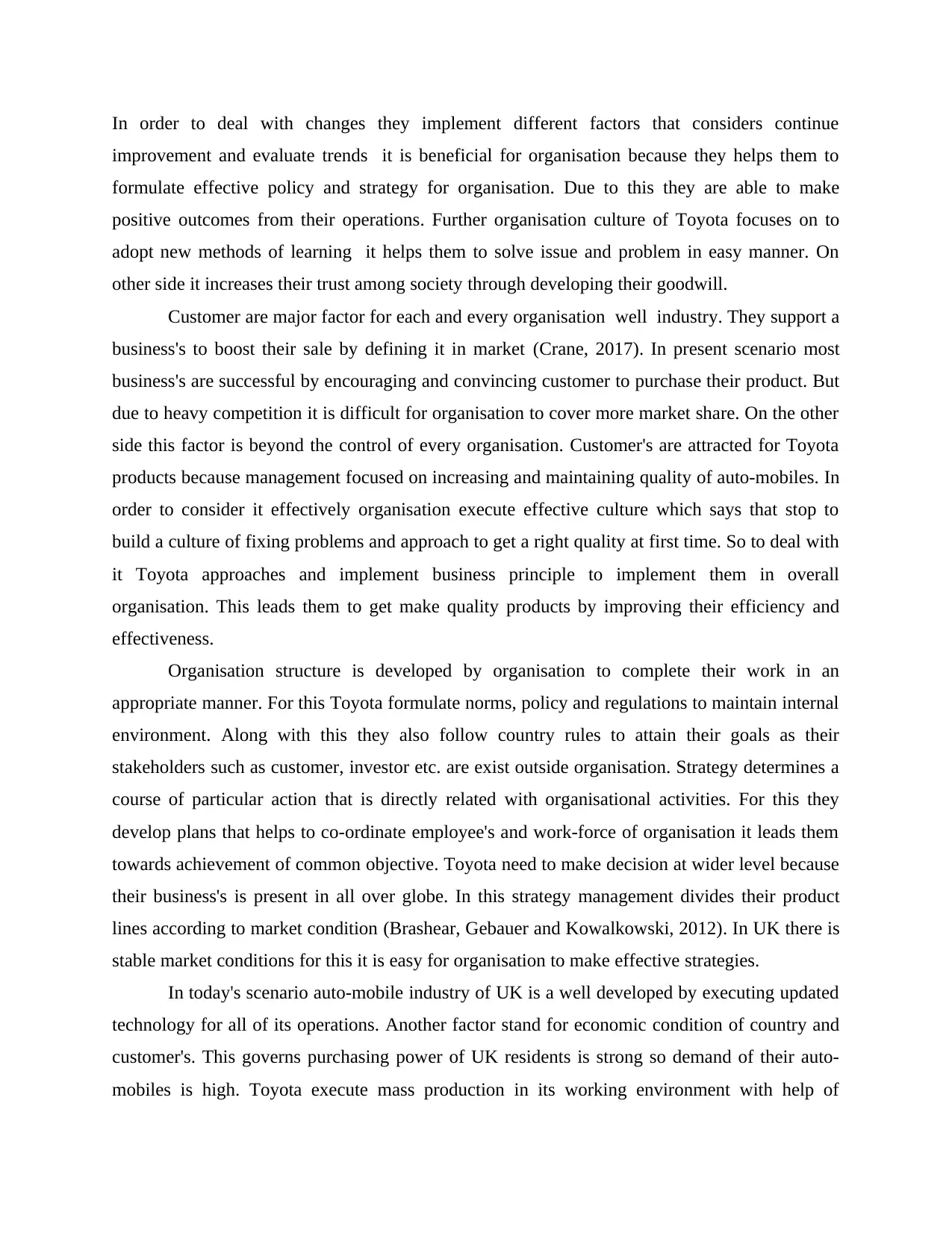
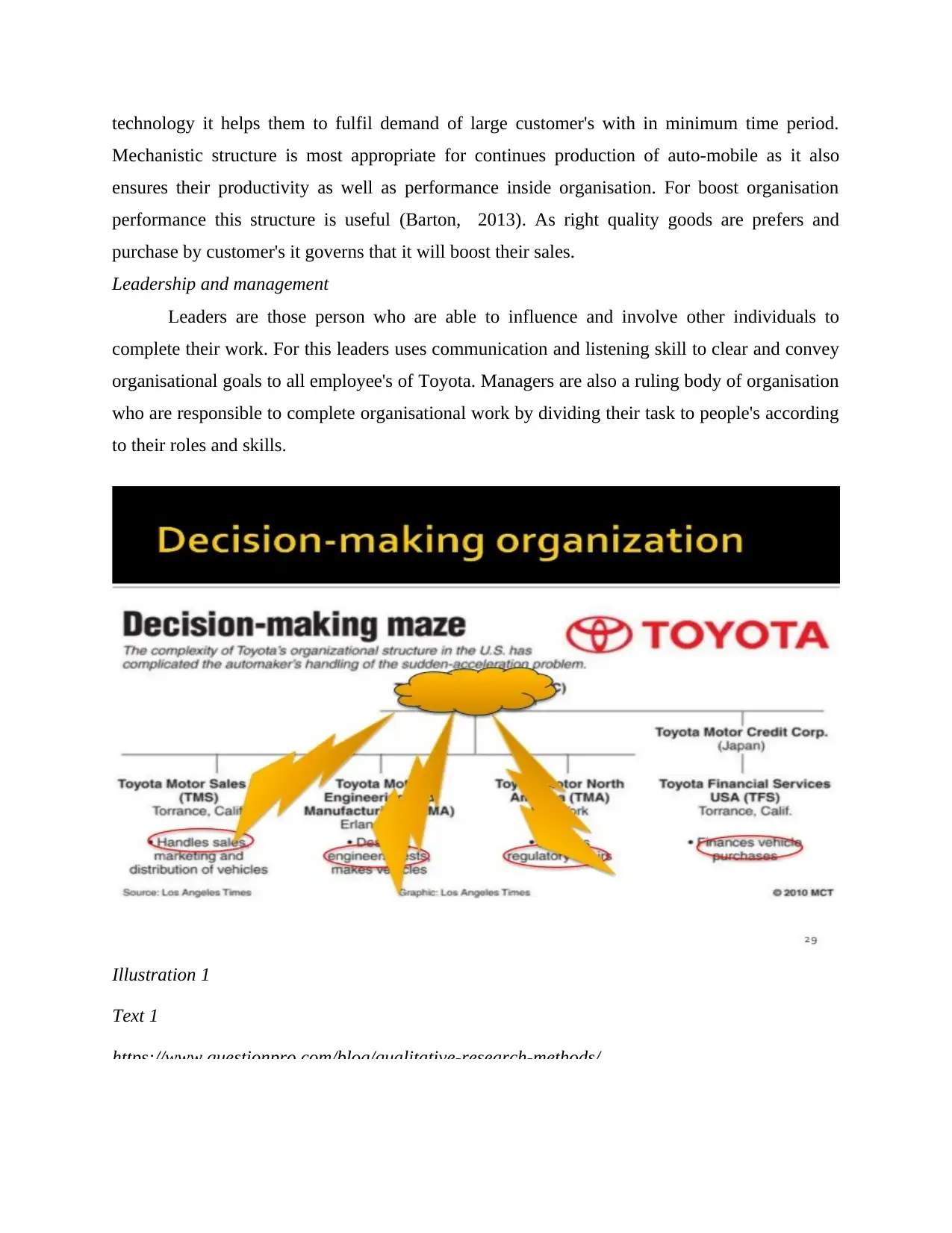
Illustration 1
Text 1
https://www.questionpro.com/blog/qualitative-research-methods/
Mechanistic structure is most appropriate for continues production of auto-mobile as it also
ensures their productivity as well as performance inside organisation. For boost organisation
performance this structure is useful (Barton, 2013). As right quality goods are prefers and
purchase by customer's it governs that it will boost their sales.
Leadership and management
Leaders are those person who are able to influence and involve other individuals to
complete their work. For this leaders uses communication and listening skill to clear and convey
organisational goals to all employee's of Toyota. Managers are also a ruling body of organisation
who are responsible to complete organisational work by dividing their task to people's according
to their roles and skills.
Illustration 1
Text 1
https://www.questionpro.com/blog/qualitative-research-methods/
⊘ This is a preview!⊘
Do you want full access?
Subscribe today to unlock all pages.
Trusted by 1+ million students worldwide
In recent years or decade autocratic leadership style is best method to control employee's
of organisation. Autocratic style reflects difference between upper, middle and lower level of
employee's. In this style human resources of organisation are demotivated because of strict rules
and regulations. Outcome of hard and rigid rules reduces organisational performance.
Democratic leadership style is another method of leadership in this all employee's are free
to interact with each other. It states top management of Toyota share powers with lower
department of organisation. Positive outcomes are generated from this style as employee's are
motivated and holds power to take quick decision in organisation. But Toyota is a inter-national
organisation therefore democratic style is not feasible. This cause delay in decision due to large
and complex involvement of employee's (Antony, Setijono and Dahlgaard, 2016).
Most appropriate and effective leadership style for Toyota is participative. It is also
known as collaborative leadership style moreover this is totally vice-versa of autocratic style.
Large number of employee's are involved to take decisions. So to make effective contribution
leaders or management gives authority to subordinates for involving them in decision making
power. Toyota uses participative leadership style as in this decision power holds by top level
executive but ideas, feedback, view, suggestion and many more are asked from employee's for
taking effective decision.
Theories and models for organisational design and culture
In year 1980 American management professor Edgar Schein developed a model of
organisational culture that represent employee's background, values and system in a transparent
way. This model contains three different levels which are basic underlying assumptions,
espoused values and artefacts and symbols. First factor which reflects this model is artefacts and
symbols it involves all factors that are tangible such as logos, structure, processes and clothing.
Within circumstances of Toyota they recognise their symbol that represent them as a brand. It
not present in inside organisation but also help to recognise by external parties.
of organisation. Autocratic style reflects difference between upper, middle and lower level of
employee's. In this style human resources of organisation are demotivated because of strict rules
and regulations. Outcome of hard and rigid rules reduces organisational performance.
Democratic leadership style is another method of leadership in this all employee's are free
to interact with each other. It states top management of Toyota share powers with lower
department of organisation. Positive outcomes are generated from this style as employee's are
motivated and holds power to take quick decision in organisation. But Toyota is a inter-national
organisation therefore democratic style is not feasible. This cause delay in decision due to large
and complex involvement of employee's (Antony, Setijono and Dahlgaard, 2016).
Most appropriate and effective leadership style for Toyota is participative. It is also
known as collaborative leadership style moreover this is totally vice-versa of autocratic style.
Large number of employee's are involved to take decisions. So to make effective contribution
leaders or management gives authority to subordinates for involving them in decision making
power. Toyota uses participative leadership style as in this decision power holds by top level
executive but ideas, feedback, view, suggestion and many more are asked from employee's for
taking effective decision.
Theories and models for organisational design and culture
In year 1980 American management professor Edgar Schein developed a model of
organisational culture that represent employee's background, values and system in a transparent
way. This model contains three different levels which are basic underlying assumptions,
espoused values and artefacts and symbols. First factor which reflects this model is artefacts and
symbols it involves all factors that are tangible such as logos, structure, processes and clothing.
Within circumstances of Toyota they recognise their symbol that represent them as a brand. It
not present in inside organisation but also help to recognise by external parties.
Paraphrase This Document
Need a fresh take? Get an instant paraphrase of this document with our AI Paraphraser
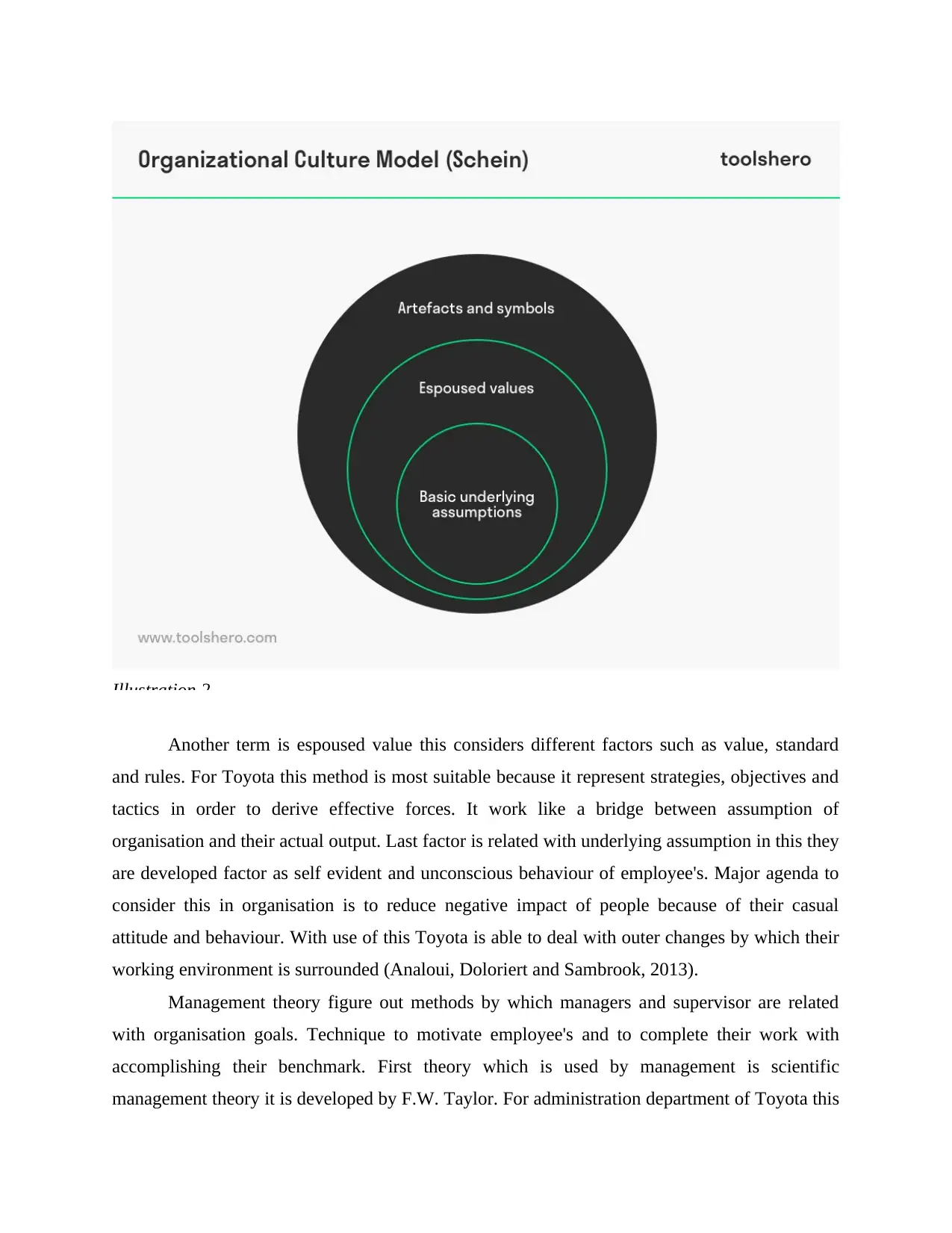
Another term is espoused value this considers different factors such as value, standard
and rules. For Toyota this method is most suitable because it represent strategies, objectives and
tactics in order to derive effective forces. It work like a bridge between assumption of
organisation and their actual output. Last factor is related with underlying assumption in this they
are developed factor as self evident and unconscious behaviour of employee's. Major agenda to
consider this in organisation is to reduce negative impact of people because of their casual
attitude and behaviour. With use of this Toyota is able to deal with outer changes by which their
working environment is surrounded (Analoui, Doloriert and Sambrook, 2013).
Management theory figure out methods by which managers and supervisor are related
with organisation goals. Technique to motivate employee's and to complete their work with
accomplishing their benchmark. First theory which is used by management is scientific
management theory it is developed by F.W. Taylor. For administration department of Toyota this
Illustration 2
and rules. For Toyota this method is most suitable because it represent strategies, objectives and
tactics in order to derive effective forces. It work like a bridge between assumption of
organisation and their actual output. Last factor is related with underlying assumption in this they
are developed factor as self evident and unconscious behaviour of employee's. Major agenda to
consider this in organisation is to reduce negative impact of people because of their casual
attitude and behaviour. With use of this Toyota is able to deal with outer changes by which their
working environment is surrounded (Analoui, Doloriert and Sambrook, 2013).
Management theory figure out methods by which managers and supervisor are related
with organisation goals. Technique to motivate employee's and to complete their work with
accomplishing their benchmark. First theory which is used by management is scientific
management theory it is developed by F.W. Taylor. For administration department of Toyota this
Illustration 2
method is useful as it simple to implement and increases performance of organisation by
maximizing and simplifying jobs. Scientific concept is useful for organisation as they
accomplish their target through executing scientific methods. Moreover they emphasis on factors
that encourage employee's to work hard. As their performance is directly related with
organisational goal. In last concept this method is advantageous as it leads to generate effective
and positive relationship between people, culture, structure and organisational performance.
CONCLUSION
For excluding meaningful conclusion culture, structure, design, behaviour with
management and leadership style is included in this report with example of Toyota and in the end
by sum of all above points it is concluded organisation culture and structure are mandatory part
for achieving huge success in market. There are several factors such customer's, teamwork,
technology etc. included that directly impacts on organisation and their performance. Behaviour
of an organisation reflects that by which method they are functioning. Moreover it includes
different factors by which organisational goals will be achieved in upcoming future. Further
success of a business's depends on culture along with this it assist employee's to retain in
organisation for a longer time period.
REFERENCES
Books and Journals
Analoui, B.D., Doloriert, C.H. and Sambrook, S., 2013. Leadership and knowledge management
in UK ICT organisations.
Antony, J., Setijono, D. and Dahlgaard, J.J., 2016. Lean Six Sigma and Innovation–an
exploratory study among UK organisations. Total Quality Management & Business
Excellence. 27(1-2). pp.124-140.
Barton, H., 2013. ‘Lean’policing? New approaches to business process improvement across the
UK police service. Public Money & Management, 33(3), pp.221-224.
Brashear, T., Gebauer, H. and Kowalkowski, C., 2012. Customer‐focused and service‐focused
orientation in organizational structures. Journal of Business & Industrial Marketing.
Crane, A., 2017. Rhetoric and reality in the greening of organisational culture. In Greening the
Boardroom (pp. 129-144). Routledge.
Ganter, A. and Hecker, A., 2014. Configurational paths to organizational innovation: qualitative
comparative analyses of antecedents and contingencies. Journal of Business
Research, 67(6), pp.1285-1292.
Jones, R., Latham, J. and Betta, M., 2013. Creating the illusion of employee empowerment: Lean
production in the international automobile industry. The International Journal of Human
Resource Management, 24(8), pp.1629-1645.
maximizing and simplifying jobs. Scientific concept is useful for organisation as they
accomplish their target through executing scientific methods. Moreover they emphasis on factors
that encourage employee's to work hard. As their performance is directly related with
organisational goal. In last concept this method is advantageous as it leads to generate effective
and positive relationship between people, culture, structure and organisational performance.
CONCLUSION
For excluding meaningful conclusion culture, structure, design, behaviour with
management and leadership style is included in this report with example of Toyota and in the end
by sum of all above points it is concluded organisation culture and structure are mandatory part
for achieving huge success in market. There are several factors such customer's, teamwork,
technology etc. included that directly impacts on organisation and their performance. Behaviour
of an organisation reflects that by which method they are functioning. Moreover it includes
different factors by which organisational goals will be achieved in upcoming future. Further
success of a business's depends on culture along with this it assist employee's to retain in
organisation for a longer time period.
REFERENCES
Books and Journals
Analoui, B.D., Doloriert, C.H. and Sambrook, S., 2013. Leadership and knowledge management
in UK ICT organisations.
Antony, J., Setijono, D. and Dahlgaard, J.J., 2016. Lean Six Sigma and Innovation–an
exploratory study among UK organisations. Total Quality Management & Business
Excellence. 27(1-2). pp.124-140.
Barton, H., 2013. ‘Lean’policing? New approaches to business process improvement across the
UK police service. Public Money & Management, 33(3), pp.221-224.
Brashear, T., Gebauer, H. and Kowalkowski, C., 2012. Customer‐focused and service‐focused
orientation in organizational structures. Journal of Business & Industrial Marketing.
Crane, A., 2017. Rhetoric and reality in the greening of organisational culture. In Greening the
Boardroom (pp. 129-144). Routledge.
Ganter, A. and Hecker, A., 2014. Configurational paths to organizational innovation: qualitative
comparative analyses of antecedents and contingencies. Journal of Business
Research, 67(6), pp.1285-1292.
Jones, R., Latham, J. and Betta, M., 2013. Creating the illusion of employee empowerment: Lean
production in the international automobile industry. The International Journal of Human
Resource Management, 24(8), pp.1629-1645.
⊘ This is a preview!⊘
Do you want full access?
Subscribe today to unlock all pages.
Trusted by 1+ million students worldwide
Moore, F., 2012. Identity, knowledge and strategy in the UK subsidiary of an Anglo-German
automobile manufacturer. International Business Review, 21(2), pp.281-292.
Nonaka, I., Kodama, M., Hirose, A. and Kohlbacher, F., 2014. Dynamic fractal organizations for
promoting knowledge-based transformation–A new paradigm for organizational
theory. European Management Journal, 32(1), pp.137-146.
Paro, P.E.P. and Gerolamo, M.C., 2017. Organizational culture for lean programs. Journal of
Organizational Change Management, 30(4), pp.584-598.
Shang, G. and Sui Pheng, L., 2012. The adoption of Toyota Way principles in large Chinese
construction firms 7(3), pp.291-316.
Sosnovskikh, S., 2016. Toyota Motor Corporation: Organizational Culture. Philosophy
Study, 6(7), pp.442-454.
Online
Organisation structure and culture, 2017. [Online]. Available
through:<https://www.upcounsel.com/definition-of-organizational-structure-and-culture>
automobile manufacturer. International Business Review, 21(2), pp.281-292.
Nonaka, I., Kodama, M., Hirose, A. and Kohlbacher, F., 2014. Dynamic fractal organizations for
promoting knowledge-based transformation–A new paradigm for organizational
theory. European Management Journal, 32(1), pp.137-146.
Paro, P.E.P. and Gerolamo, M.C., 2017. Organizational culture for lean programs. Journal of
Organizational Change Management, 30(4), pp.584-598.
Shang, G. and Sui Pheng, L., 2012. The adoption of Toyota Way principles in large Chinese
construction firms 7(3), pp.291-316.
Sosnovskikh, S., 2016. Toyota Motor Corporation: Organizational Culture. Philosophy
Study, 6(7), pp.442-454.
Online
Organisation structure and culture, 2017. [Online]. Available
through:<https://www.upcounsel.com/definition-of-organizational-structure-and-culture>

1 out of 10


Related Documents


Your All-in-One AI-Powered Toolkit for Academic Success.
+13062052269
info@desklib.com
Available 24*7 on WhatsApp / Email
![[object Object]](/_next/static/media/star-bottom.7253800d.svg)
Unlock your academic potential
Copyright © 2020–2026 A2Z Services. All Rights Reserved. Developed and managed by ZUCOL.