Analysis of Trade Stocks and Tax Implications in Business Operations

Verified

Added on  2020/04/01

|8
|1726
|46
AI Summary
The assignment delves into the classification of spare parts as trade stocks due to their role in facilitating business operations with an expectation of economic reward. It highlights that despite computers being leased, the maintenance services using these spare parts make them eligible for classification as trade stocks if used within a year. The analysis extends to taxation issues, focusing on GST registration and its implications on inventory management. This involves understanding how spare parts are handled tax-wise, considering their disposability post-service. Further, it explores the influence of corporate income tax rules on financial statement accuracy, examining discrepancies between taxable income and accounting profit. References include studies on taxation practices and the interaction between tax and accounting standards.
Document Page
TAXATION
Accounting For Income Tax
Students' Name
Course Title
Instructor’s Name
Institutional Affiliation
City and State
Date of Submission
tabler-icon-diamond-filled.svg

Paraphrase This Document

Need a fresh take? Get an instant paraphrase of this document with our AI Paraphraser
Document Page
TAXATION
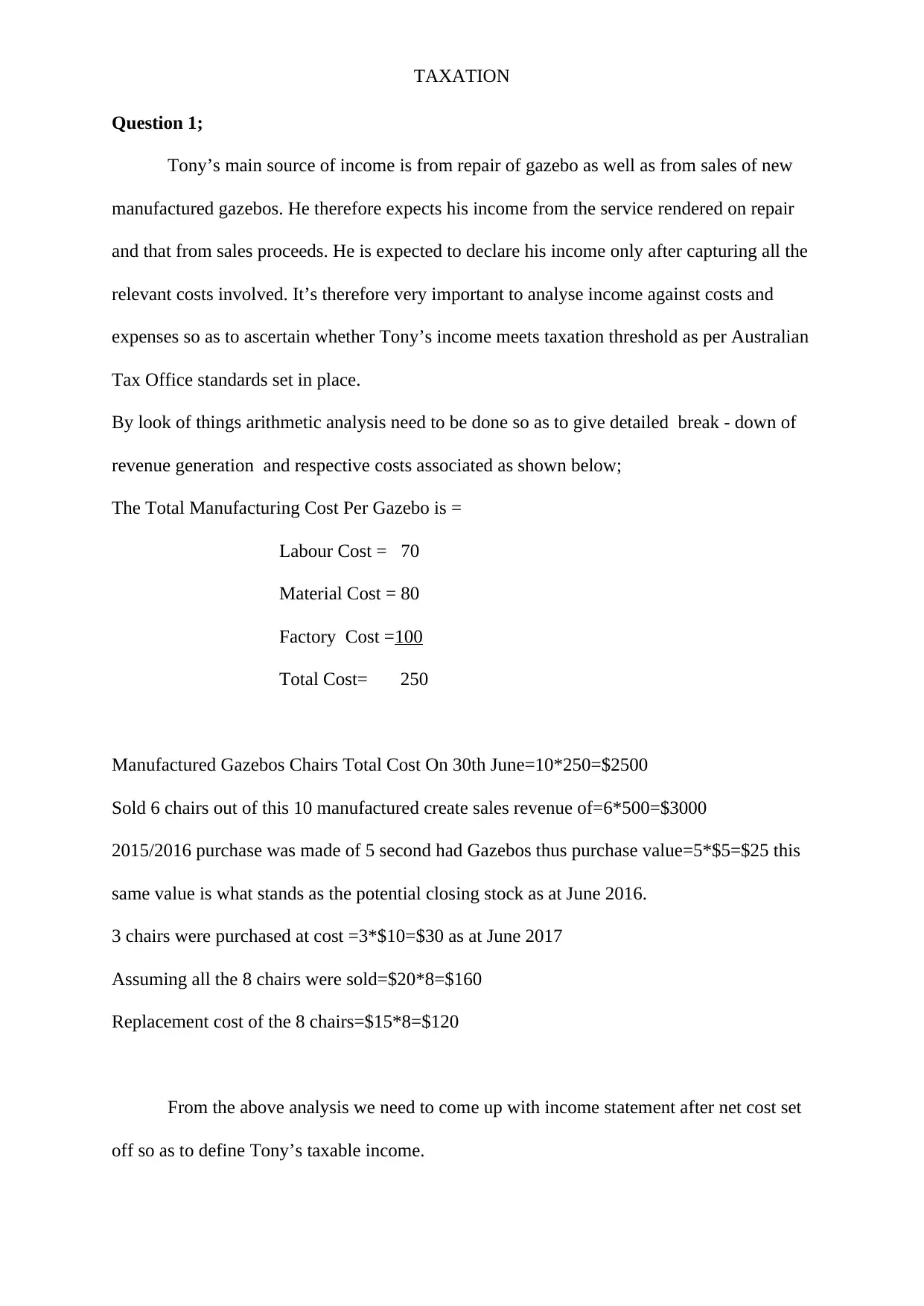
Question 1;
Tony’s main source of income is from repair of gazebo as well as from sales of new
manufactured gazebos. He therefore expects his income from the service rendered on repair
and that from sales proceeds. He is expected to declare his income only after capturing all the
relevant costs involved. It’s therefore very important to analyse income against costs and
expenses so as to ascertain whether Tony’s income meets taxation threshold as per Australian
Tax Office standards set in place.
By look of things arithmetic analysis need to be done so as to give detailed break - down of
revenue generation and respective costs associated as shown below;
The Total Manufacturing Cost Per Gazebo is =
Labour Cost = 70
Material Cost = 80
Factory Cost =100
Total Cost= 250
Manufactured Gazebos Chairs Total Cost On 30th June=10*250=$2500
Sold 6 chairs out of this 10 manufactured create sales revenue of=6*500=$3000
2015/2016 purchase was made of 5 second had Gazebos thus purchase value=5*$5=$25 this
same value is what stands as the potential closing stock as at June 2016.
3 chairs were purchased at cost =3*$10=$30 as at June 2017
Assuming all the 8 chairs were sold=$20*8=$160
Replacement cost of the 8 chairs=$15*8=$120
From the above analysis we need to come up with income statement after net cost set
off so as to define Tony’s taxable income.
Document Page
TAXATION
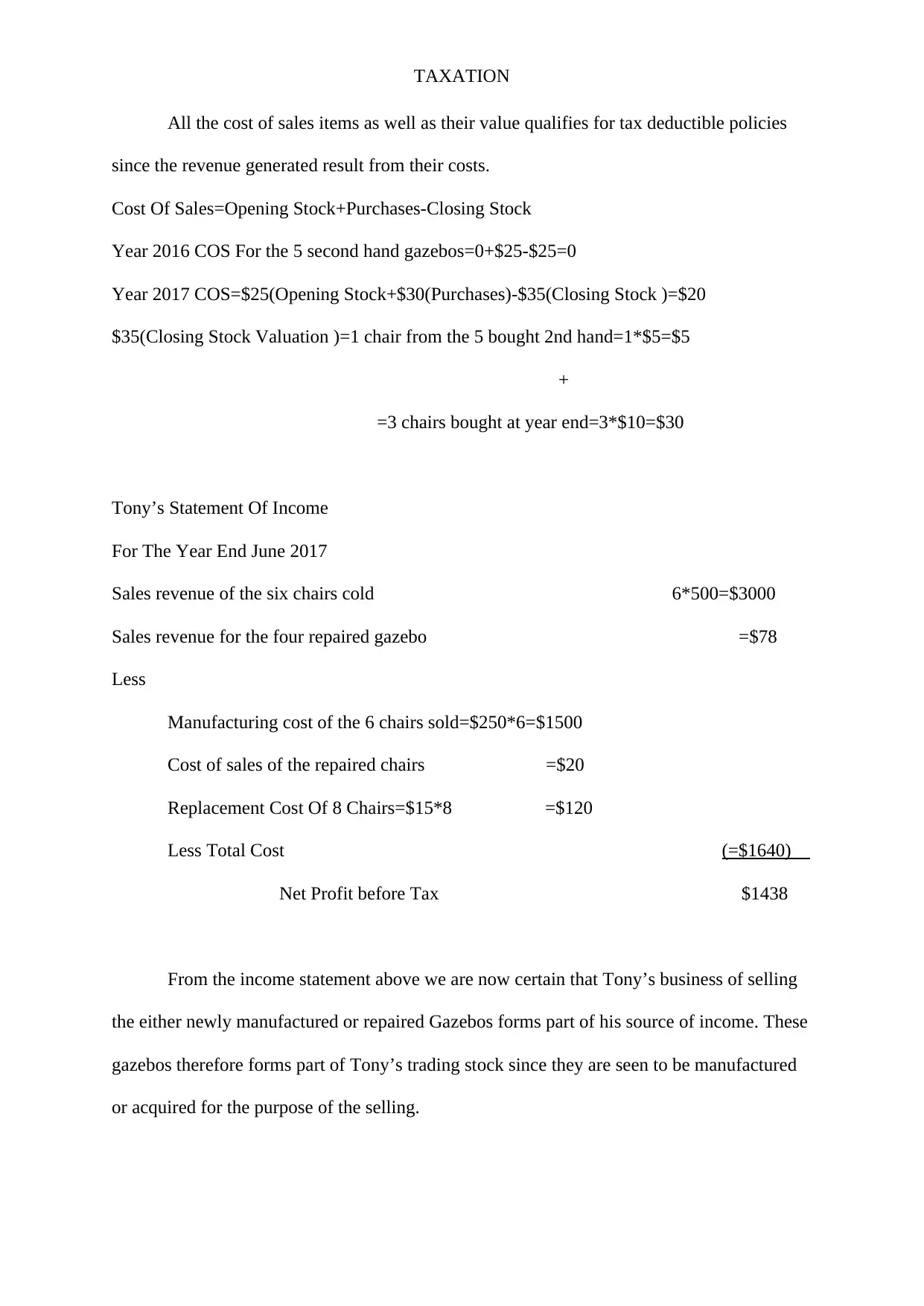
All the cost of sales items as well as their value qualifies for tax deductible policies
since the revenue generated result from their costs.
Cost Of Sales=Opening Stock+Purchases-Closing Stock
Year 2016 COS For the 5 second hand gazebos=0+$25-$25=0
Year 2017 COS=$25(Opening Stock+$30(Purchases)-$35(Closing Stock )=$20
$35(Closing Stock Valuation )=1 chair from the 5 bought 2nd hand=1*$5=$5
+
=3 chairs bought at year end=3*$10=$30
Tony’s Statement Of Income
For The Year End June 2017
Sales revenue of the six chairs cold 6*500=$3000
Sales revenue for the four repaired gazebo =$78
Less
Manufacturing cost of the 6 chairs sold=$250*6=$1500
Cost of sales of the repaired chairs =$20
Replacement Cost Of 8 Chairs=$15*8 =$120
Less Total Cost (=$1640)
Net Profit before Tax $1438
From the income statement above we are now certain that Tony’s business of selling
the either newly manufactured or repaired Gazebos forms part of his source of income. These
gazebos therefore forms part of Tony’s trading stock since they are seen to be manufactured
or acquired for the purpose of the selling.
Document Page
TAXATION
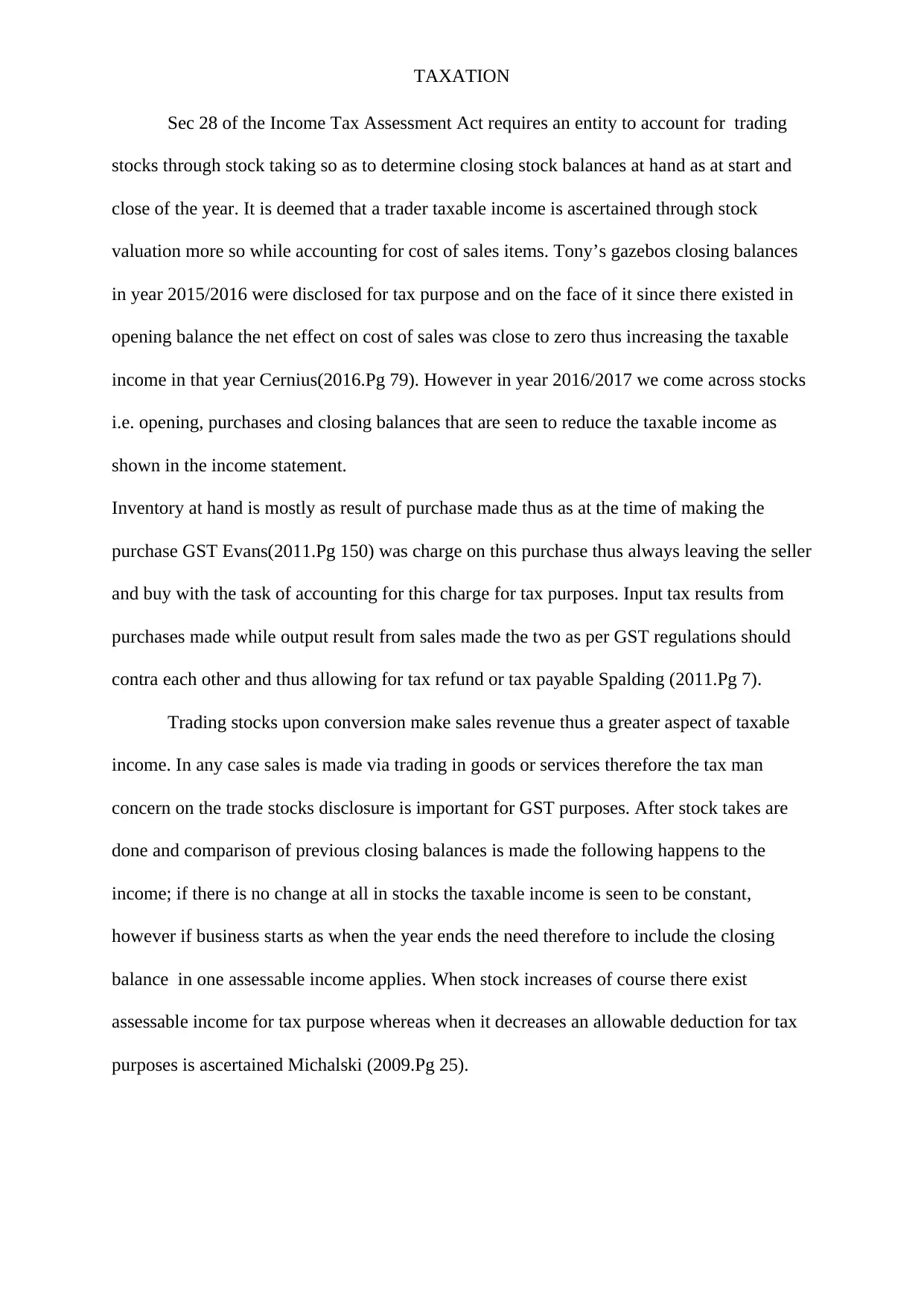
Sec 28 of the Income Tax Assessment Act requires an entity to account for trading
stocks through stock taking so as to determine closing stock balances at hand as at start and
close of the year. It is deemed that a trader taxable income is ascertained through stock
valuation more so while accounting for cost of sales items. Tony’s gazebos closing balances
in year 2015/2016 were disclosed for tax purpose and on the face of it since there existed in
opening balance the net effect on cost of sales was close to zero thus increasing the taxable
income in that year Cernius(2016.Pg 79). However in year 2016/2017 we come across stocks
i.e. opening, purchases and closing balances that are seen to reduce the taxable income as
shown in the income statement.
Inventory at hand is mostly as result of purchase made thus as at the time of making the
purchase GST Evans(2011.Pg 150) was charge on this purchase thus always leaving the seller
and buy with the task of accounting for this charge for tax purposes. Input tax results from
purchases made while output result from sales made the two as per GST regulations should
contra each other and thus allowing for tax refund or tax payable Spalding (2011.Pg 7).
Trading stocks upon conversion make sales revenue thus a greater aspect of taxable
income. In any case sales is made via trading in goods or services therefore the tax man
concern on the trade stocks disclosure is important for GST purposes. After stock takes are
done and comparison of previous closing balances is made the following happens to the
income; if there is no change at all in stocks the taxable income is seen to be constant,
however if business starts as when the year ends the need therefore to include the closing
balance in one assessable income applies. When stock increases of course there exist
assessable income for tax purpose whereas when it decreases an allowable deduction for tax
purposes is ascertained Michalski (2009.Pg 25).
tabler-icon-diamond-filled.svg

Paraphrase This Document

Need a fresh take? Get an instant paraphrase of this document with our AI Paraphraser
Document Page
TAXATION
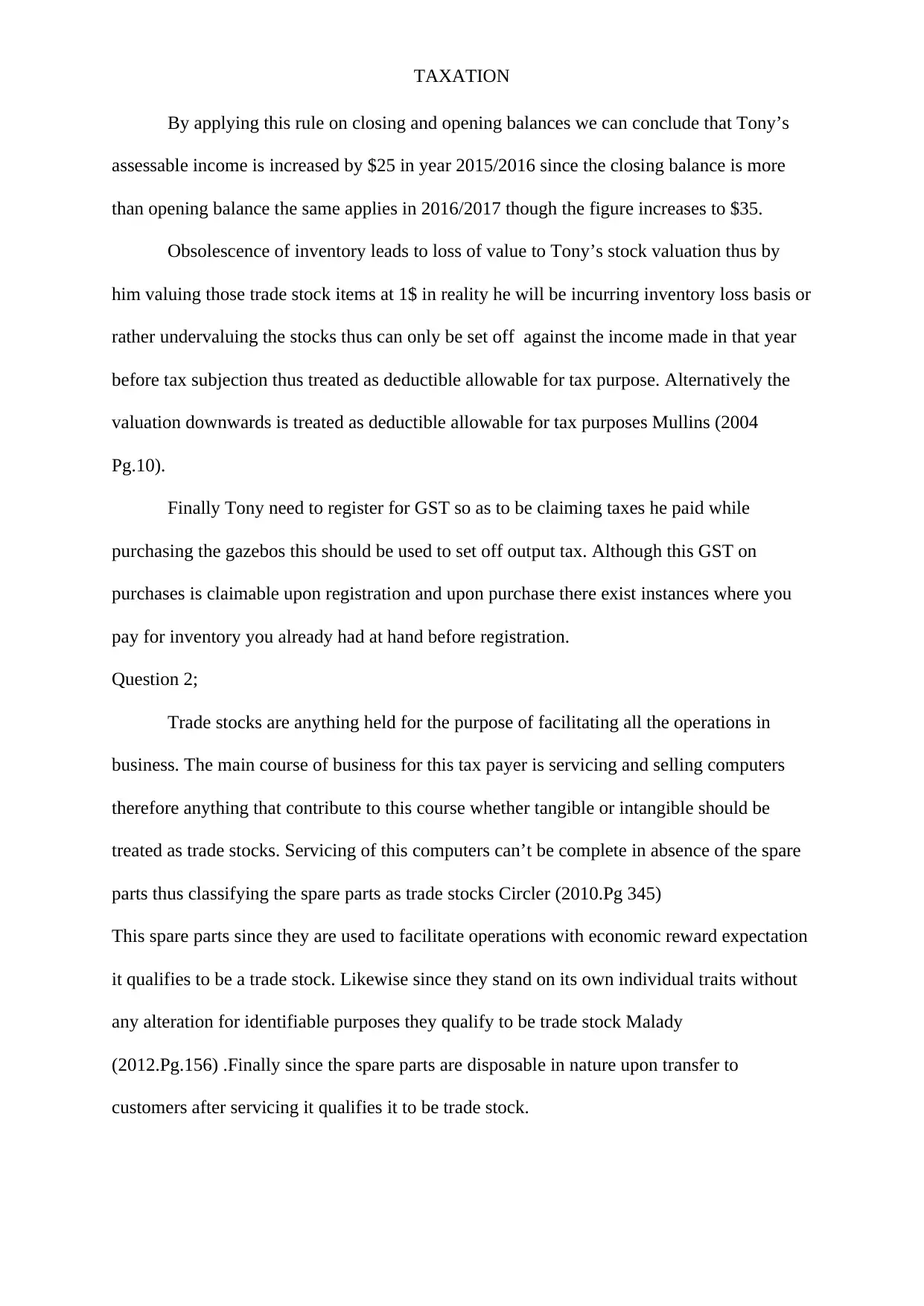
By applying this rule on closing and opening balances we can conclude that Tony’s
assessable income is increased by $25 in year 2015/2016 since the closing balance is more
than opening balance the same applies in 2016/2017 though the figure increases to $35.
Obsolescence of inventory leads to loss of value to Tony’s stock valuation thus by
him valuing those trade stock items at 1$ in reality he will be incurring inventory loss basis or
rather undervaluing the stocks thus can only be set off against the income made in that year
before tax subjection thus treated as deductible allowable for tax purpose. Alternatively the
valuation downwards is treated as deductible allowable for tax purposes Mullins (2004
Pg.10).
Finally Tony need to register for GST so as to be claiming taxes he paid while
purchasing the gazebos this should be used to set off output tax. Although this GST on
purchases is claimable upon registration and upon purchase there exist instances where you
pay for inventory you already had at hand before registration.
Question 2;
Trade stocks are anything held for the purpose of facilitating all the operations in
business. The main course of business for this tax payer is servicing and selling computers
therefore anything that contribute to this course whether tangible or intangible should be
treated as trade stocks. Servicing of this computers can’t be complete in absence of the spare
parts thus classifying the spare parts as trade stocks Circler (2010.Pg 345)
This spare parts since they are used to facilitate operations with economic reward expectation
it qualifies to be a trade stock. Likewise since they stand on its own individual traits without
any alteration for identifiable purposes they qualify to be trade stock Malady
(2012.Pg.156) .Finally since the spare parts are disposable in nature upon transfer to
customers after servicing it qualifies it to be trade stock.
Document Page
TAXATION
Despite the fact that the computers are leased , the tax payer is still seen to use the spare parts
to service the items that had already generated reward, from this therefore the conclusion is
that the spare parts are classified as trade stocks .This is so because they are used to render
maintenance service. However the classification is only applicable if the spare parts period is
that of less than a year or a year of which in our case an assumption of it being used for one
year is applied.
Spare parts are therefore classified depending on the time aspect whereby if it’s used to
operate an asset for a duration less than a year then it worth classified as trade stock and vice
versa. Likewise the classification is made on the purpose or sole use of the spare part
whereby if it’s used for rendering any service like in our case maintenance or for production
purpose.
Document Page
TAXATION
References
Spalding, A.D., 2011. Mark-to-market and the widening gap between financial and tax
accounting.
Noguchi*, M., 2005. Interaction between tax and accounting practice: Accounting for stock-
in-trade. Accounting, Business & Financial History, 15(1), pp.1-34.
Grin blatt, M. and Keloharju, M., 2004. Tax-loss trading and wash sales. Journal of
Financial Economics, 71(1), pp.51-76.
Evans, M., Peacock, and C., 2011. The GST Treatment of Financial Services in Australia.
GST in Australia: Looking Forward from the First Decade, pp.133-160.
Sharma, P. and Gupta, T.C., Role of GST in inventory management.
Schenk, A., Thuronyi, V. and Cui, W., 2015. Value added tax. Cambridge University Press.
Carlon, S., Tran, A. and Tran-Nam, B., 2013. How close are taxable income and accounting
profit? An empirical study of large Australian companies.
Cernius, G., Birskyte, L. and Balkevicius, A., 2016. Influence of Rules for Computing
Corporate Income Tax on the Accuracy of Financial Statements of Lithuanian Companies.
Scientific Annals of Economics and Business, 63(1), pp.65-81.
tabler-icon-diamond-filled.svg

Paraphrase This Document

Need a fresh take? Get an instant paraphrase of this document with our AI Paraphraser
Document Page
TAXATION
Kirchler, E. and Wahl, I., 2010. Tax compliance inventory TAX-I: Designing an inventory
for surveys of tax compliance. Journal of Economic Psychology, 31(3), pp.331-346.
Mullins, D.R. and Wallin, B.A., 2004. Tax and expenditure limitations: Introduction and
overview. Public Budgeting & Finance, 24(4), pp.2-15.
Mulyadi, M.S., Soepriyanto, G. and Anwar, Y., 2012. IFRS adoption and taxation issue.
International Journal of Arts and Commerce, 1(7), pp.159-165.
Michalski, G., 2009. Inventory management optimization as part of operational risk
management.
chevron_up_icon
1 out of 8
circle_padding
hide_on_mobile
zoom_out_icon
[object Object]