MBA402: Risk Assessment Report on Trading.com Company
VerifiedAdded on 2023/01/16
|8
|2708
|77
Report
AI Summary
This report provides a comprehensive risk assessment of Trading.com, a financial service firm based in Australia. The assessment utilizes the Risk Exposure Calculator developed by Simons to evaluate the company's risk profile across three key areas: growth, culture, and information management. The report analyzes pressure points related to performance pressure, pace of expansion, and inexperience of new recruits. It further examines cultural factors such as rewards for risk-taking, executive resistance to negative feedback, and internal competition. Lastly, the assessment delves into information management risks, including transaction complexity, gaps in diagnostic performance, and the degree of decentralized decision-making. The conclusion places Trading.com in the cautious zone based on the total risk score, with recommendations for corrective actions, including product development research, reducing internal competition, investing in technology-based solutions, and improving information flow to mitigate identified risks. The report is based on the provided case study and the HBR article, 'How Risky is Your Company?' and includes references to support the analysis.
Introduction
Trading.com is a financial service firm based out of Australia that deals in selling financial
literacy and investment related courses. The main objective of the company is to help their
customers get maximum out of their investments. The business is witnessing a great success and
the courses are increasingly becoming popular which makes the business prone to certain risk
factors. The present report deals with the risk assessment of Trading.com
Purpose of risk assessment
As trading.com is experiencing the growth in its business, it is the right time to reflect on the
risks that are starting to appear in the organization. From the problems in work culture to the lack
of information system in the organization, the company has started showing signs of few major
risks that might create problems for it in the future. The present report tries to analyze the risk
profile of the company in order to help stakeholders take preventive and corrective measures.
Method
The risk assessment would be conducted using the risk exposure calculator developed by Simons
which acts as a qualitative measure of risks being phased by a business. The REC calculates risks
on company’s pressure points in terms of growth, culture and information system. Each category
has further sub category, which is scored from 1-5, 5 being the most risky (Simons 1999). On the
basis of total score, the firm is divided into three zones, safety, cautious and danger zone as per
the risk exposure of the business.
Risks due to growth
All businesses intend to grow but with growth come a lot of risks which need to be identified at
early stage. With growth in the business, new competition comes in the market thereby
increasing the pressure to outperform (info Entrepreneur 2009). Growing companies often have
high part of variable compensation in their sales teams which often lead to employees taking
risky decisions and compromising on quality for earning more (Simons 1999) (Slutsky & Olsen
2012).Also with growth comes the increase in the requirement of resources, both manual and
financial which often compels the firms to take compromising measures in terms of risk and
Trading.com is a financial service firm based out of Australia that deals in selling financial
literacy and investment related courses. The main objective of the company is to help their
customers get maximum out of their investments. The business is witnessing a great success and
the courses are increasingly becoming popular which makes the business prone to certain risk
factors. The present report deals with the risk assessment of Trading.com
Purpose of risk assessment
As trading.com is experiencing the growth in its business, it is the right time to reflect on the
risks that are starting to appear in the organization. From the problems in work culture to the lack
of information system in the organization, the company has started showing signs of few major
risks that might create problems for it in the future. The present report tries to analyze the risk
profile of the company in order to help stakeholders take preventive and corrective measures.
Method
The risk assessment would be conducted using the risk exposure calculator developed by Simons
which acts as a qualitative measure of risks being phased by a business. The REC calculates risks
on company’s pressure points in terms of growth, culture and information system. Each category
has further sub category, which is scored from 1-5, 5 being the most risky (Simons 1999). On the
basis of total score, the firm is divided into three zones, safety, cautious and danger zone as per
the risk exposure of the business.
Risks due to growth
All businesses intend to grow but with growth come a lot of risks which need to be identified at
early stage. With growth in the business, new competition comes in the market thereby
increasing the pressure to outperform (info Entrepreneur 2009). Growing companies often have
high part of variable compensation in their sales teams which often lead to employees taking
risky decisions and compromising on quality for earning more (Simons 1999) (Slutsky & Olsen
2012).Also with growth comes the increase in the requirement of resources, both manual and
financial which often compels the firms to take compromising measures in terms of risk and

Paraphrase This Document
Need a fresh take? Get an instant paraphrase of this document with our AI Paraphraser
quality (Business Queensland 2019). These quality issues often lead to increase in dissatisfaction of
consumers and stress among the workforce ultimately leading to high workforce turnover.
The first element is the pressure of expectations. As per the case, the consultants were facing a
high degree of performance pressure. The compensation of the consultants is highly variable in
nature if not entirely commission based as earlier; they were working on targets set for them by
the senior management without their inputs. This resulted in bad after sales services and the
rising consumer complaints about the same. Also the company had an atmosphere where rivalry
was promoted leading to increase in the pressure of performance for the consultants. Considering
these facts given in the case, the segment of performance pressure is given the score of 4.
The second part of the growth risk is the pace of growth. In the case, the business has grown
rapidly in the last year itself, which has put pressure on the team to expand. Expansion has lead
to many risks in terms of hiring of consultants, arranging finances as well as development of new
courses to keep up with the pace of expansion. However, the pace of expansion is still not
uncontrollable and business is still a medium sized organization, where things can be controlled.
As a result, the score in this segment will be 3.
The last part of growth risk is the risk caused by inexperienced new recruits. This risk is very
high in trading.com as company has hired lot of new consultants, many of which do not have
prior experience in sales. As a result, there is increasing number of customer complaints due to
faulty after sales services and lack of networking by them. Since these people are quickly put on
board, there is no time to train them about the products and culture of company, thereby leading
to further problems and risks. Due to these risks, the score in this segment comes out to be 4.
Pressure points due to culture
The next category of risks relate to risks due to company culture. While the company is growing,
it becomes important for the entrepreneurs to take moderate risks to grow, however such risks do
not generally generate the rewards in the hope of which they are undertaken (Veskovic 2014). Also
the entrepreneurs sometimes tend to take excessive risks considering initial risks paid off which
sometimes lead to faulty products, issues in quality services, excessive range of product internal
competition failures etc. Another issue with the culture of growing business is the lack of
feedback towards bad news. The top management often blocks the news which they think is bad
consumers and stress among the workforce ultimately leading to high workforce turnover.
The first element is the pressure of expectations. As per the case, the consultants were facing a
high degree of performance pressure. The compensation of the consultants is highly variable in
nature if not entirely commission based as earlier; they were working on targets set for them by
the senior management without their inputs. This resulted in bad after sales services and the
rising consumer complaints about the same. Also the company had an atmosphere where rivalry
was promoted leading to increase in the pressure of performance for the consultants. Considering
these facts given in the case, the segment of performance pressure is given the score of 4.
The second part of the growth risk is the pace of growth. In the case, the business has grown
rapidly in the last year itself, which has put pressure on the team to expand. Expansion has lead
to many risks in terms of hiring of consultants, arranging finances as well as development of new
courses to keep up with the pace of expansion. However, the pace of expansion is still not
uncontrollable and business is still a medium sized organization, where things can be controlled.
As a result, the score in this segment will be 3.
The last part of growth risk is the risk caused by inexperienced new recruits. This risk is very
high in trading.com as company has hired lot of new consultants, many of which do not have
prior experience in sales. As a result, there is increasing number of customer complaints due to
faulty after sales services and lack of networking by them. Since these people are quickly put on
board, there is no time to train them about the products and culture of company, thereby leading
to further problems and risks. Due to these risks, the score in this segment comes out to be 4.
Pressure points due to culture
The next category of risks relate to risks due to company culture. While the company is growing,
it becomes important for the entrepreneurs to take moderate risks to grow, however such risks do
not generally generate the rewards in the hope of which they are undertaken (Veskovic 2014). Also
the entrepreneurs sometimes tend to take excessive risks considering initial risks paid off which
sometimes lead to faulty products, issues in quality services, excessive range of product internal
competition failures etc. Another issue with the culture of growing business is the lack of
feedback towards bad news. The top management often blocks the news which they think is bad
and refuse to acknowledge the risk. The feedback is also interrupted because top management
keeps only those people around who don’t supply bad information (Schwartz 2018). Another
element of risk in this category is the intensity of internal competition. Internal competition is
often promoted as a short tem means of improving performance, but it is not effective in long run
(Hoskisson et al. 2017). Internal competition is often preferred by the companies as it leads to the
removal of non performing employees on its own. However, it leads to focus on competition
among the employees instead of focusing on the organizational objectives (DUBOIS 2012). The
culture of the organization should focus on collaboration and innovation instead of internal
competition (Saiz-Álvarez et al. 2019).
As per the case, many of the newly launched products have been failing in case of trading.com.
Also the success of business is left in the hands of mostly new recruits who are not properly
trained in their work and customer service. The product development is also not done as a team
after taking into consideration the requirements of customers and promoters just wish to develop
something innovative. As a result, the risk score in this segment comes out to be 4.
The second part of the cultural risks includes the resistance to bad news. It can be clearly seen in
the case that management has kept a team of yes men around and hence are not really aware of
the grown realities being faced by the consultants. Similarly, the CEO is happy in hiring new
employees without having any idea about the feelings of his middle management regarding their
fear of risks associated with fast growth. As a result, the score in this category would be 4.
The last pressure point of the cultural risk factor is the internal competition. The culture of
trading.com is “up or out” where performers are rewarded and compensation is deeply linked
with the performance. This has created a lot of rivalry among the staff. Although the CEO has
tried to reduce the variable component of the compensation, yet the top management has npto
done to promote collaboration in the culture. The culture in the senior team is not of
collaboration but each one tries to launch its own successful course without much information
sharing. The score in this segment will also be 4 out of 5.
keeps only those people around who don’t supply bad information (Schwartz 2018). Another
element of risk in this category is the intensity of internal competition. Internal competition is
often promoted as a short tem means of improving performance, but it is not effective in long run
(Hoskisson et al. 2017). Internal competition is often preferred by the companies as it leads to the
removal of non performing employees on its own. However, it leads to focus on competition
among the employees instead of focusing on the organizational objectives (DUBOIS 2012). The
culture of the organization should focus on collaboration and innovation instead of internal
competition (Saiz-Álvarez et al. 2019).
As per the case, many of the newly launched products have been failing in case of trading.com.
Also the success of business is left in the hands of mostly new recruits who are not properly
trained in their work and customer service. The product development is also not done as a team
after taking into consideration the requirements of customers and promoters just wish to develop
something innovative. As a result, the risk score in this segment comes out to be 4.
The second part of the cultural risks includes the resistance to bad news. It can be clearly seen in
the case that management has kept a team of yes men around and hence are not really aware of
the grown realities being faced by the consultants. Similarly, the CEO is happy in hiring new
employees without having any idea about the feelings of his middle management regarding their
fear of risks associated with fast growth. As a result, the score in this category would be 4.
The last pressure point of the cultural risk factor is the internal competition. The culture of
trading.com is “up or out” where performers are rewarded and compensation is deeply linked
with the performance. This has created a lot of rivalry among the staff. Although the CEO has
tried to reduce the variable component of the compensation, yet the top management has npto
done to promote collaboration in the culture. The culture in the senior team is not of
collaboration but each one tries to launch its own successful course without much information
sharing. The score in this segment will also be 4 out of 5.
⊘ This is a preview!⊘
Do you want full access?
Subscribe today to unlock all pages.

Trusted by 1+ million students worldwide
Risks related to information management
The last category of risks being faced by the business relate to information management. As the
businesses grow, so the does the amount of transactions and it creates complexity in the existing
work culture. Complex work cultures sometimes lead to bureaucratic environment in the
organization or it might lead to lack of expertise in handling this sheer complexity (Disparte &
Wagner 2016). Complexity in business might arise from the related party transactions, use of
complex technologies and sheer structure of growing entity (Johnstone, Gramling & Rittenberg
2016). Complexity also increases because companies have to often resort to use complex
financial instruments which is sometimes difficult to comprehend for the management, causing
increased risks. Second parameter of risks under this category is the gaps in diagnostic
performance which generally occur due to lack of information management system. This causes
problem for the management to take decisions, causes unnecessary delays and lot of time being
spent in doing routine and mundane work (Fels 2018). It is the job of the diagnostic performance
management system to integrate relevant controls in the system itself so as to assist the middle
and senior level management in taking decisions (Demartini 2014). Another type of red flag
relates to decentralization. When the decision making is decentralized, it improves the speed and
efficiency of decisions (Reuvid 2012), but it also increases the risk if the idle management is
incompetent. Coupled with lack of information system, this means that sometimes top
management does not even get to know the real problem before it’s too late. Firms should
decentralize only operating and day to day decisions, while strategic decisions should remain
centralized (Malone 2014).
Trading.com is launching too many products without waiting for the success of previous
products which has started bringing bad results. Regional managers often find themselves failing
to understand the technicalities of transactions done by consultants. However, the risk is still
medium as the company has not resorted to the use of complex financial instruments for
financing and the capital position is still stable. As a result, the score in this segment is 3.
Trading.com is facing lot of issues in terms of competency of its information systems. Regional
managers have lack of information about the performance and the issues being faced at the
ground level. Also the products design team does not have any knowledge of the customer
The last category of risks being faced by the business relate to information management. As the
businesses grow, so the does the amount of transactions and it creates complexity in the existing
work culture. Complex work cultures sometimes lead to bureaucratic environment in the
organization or it might lead to lack of expertise in handling this sheer complexity (Disparte &
Wagner 2016). Complexity in business might arise from the related party transactions, use of
complex technologies and sheer structure of growing entity (Johnstone, Gramling & Rittenberg
2016). Complexity also increases because companies have to often resort to use complex
financial instruments which is sometimes difficult to comprehend for the management, causing
increased risks. Second parameter of risks under this category is the gaps in diagnostic
performance which generally occur due to lack of information management system. This causes
problem for the management to take decisions, causes unnecessary delays and lot of time being
spent in doing routine and mundane work (Fels 2018). It is the job of the diagnostic performance
management system to integrate relevant controls in the system itself so as to assist the middle
and senior level management in taking decisions (Demartini 2014). Another type of red flag
relates to decentralization. When the decision making is decentralized, it improves the speed and
efficiency of decisions (Reuvid 2012), but it also increases the risk if the idle management is
incompetent. Coupled with lack of information system, this means that sometimes top
management does not even get to know the real problem before it’s too late. Firms should
decentralize only operating and day to day decisions, while strategic decisions should remain
centralized (Malone 2014).
Trading.com is launching too many products without waiting for the success of previous
products which has started bringing bad results. Regional managers often find themselves failing
to understand the technicalities of transactions done by consultants. However, the risk is still
medium as the company has not resorted to the use of complex financial instruments for
financing and the capital position is still stable. As a result, the score in this segment is 3.
Trading.com is facing lot of issues in terms of competency of its information systems. Regional
managers have lack of information about the performance and the issues being faced at the
ground level. Also the products design team does not have any knowledge of the customer
Paraphrase This Document
Need a fresh take? Get an instant paraphrase of this document with our AI Paraphraser
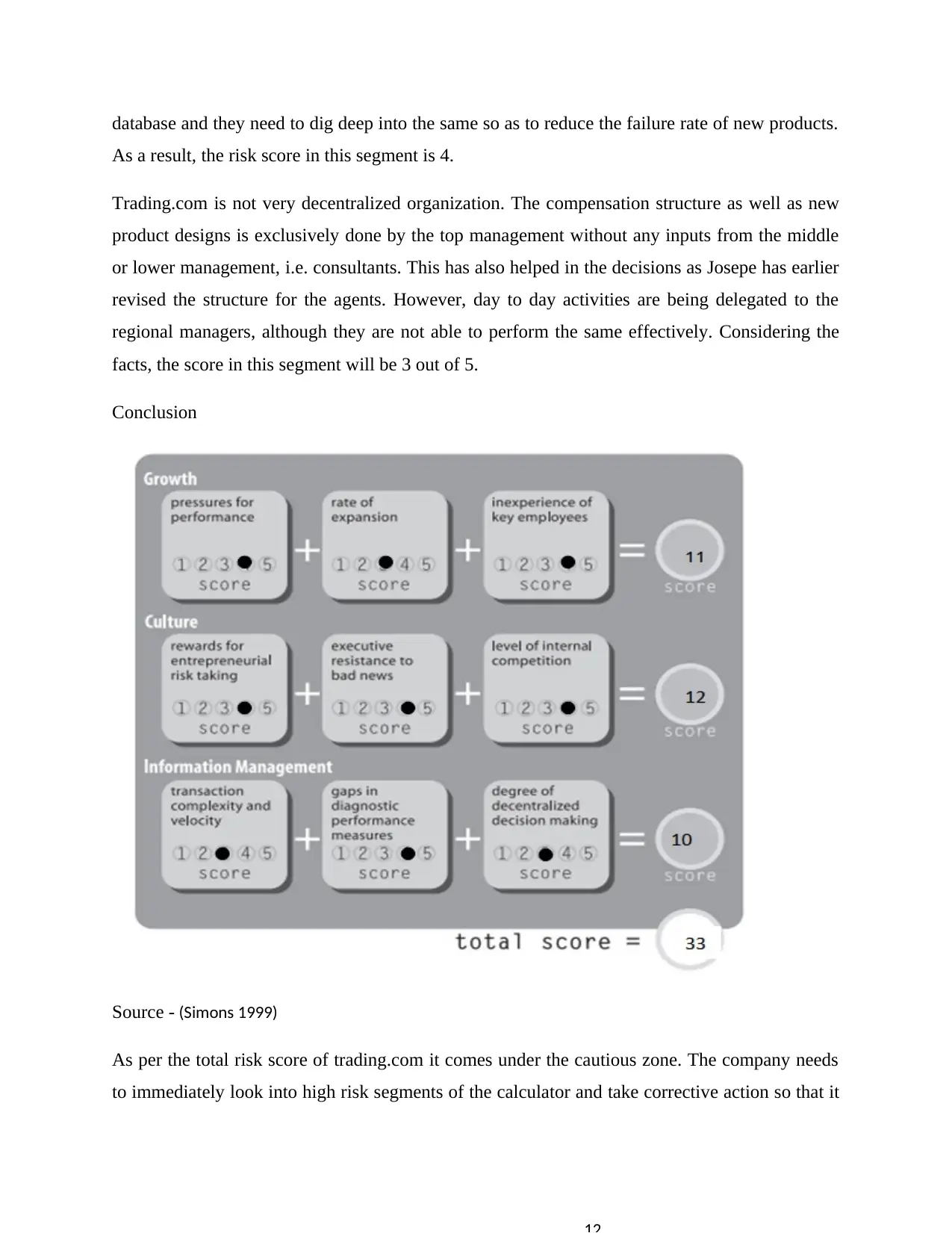
database and they need to dig deep into the same so as to reduce the failure rate of new products.
As a result, the risk score in this segment is 4.
Trading.com is not very decentralized organization. The compensation structure as well as new
product designs is exclusively done by the top management without any inputs from the middle
or lower management, i.e. consultants. This has also helped in the decisions as Josepe has earlier
revised the structure for the agents. However, day to day activities are being delegated to the
regional managers, although they are not able to perform the same effectively. Considering the
facts, the score in this segment will be 3 out of 5.
Conclusion
Source - (Simons 1999)
As per the total risk score of trading.com it comes under the cautious zone. The company needs
to immediately look into high risk segments of the calculator and take corrective action so that it
As a result, the risk score in this segment is 4.
Trading.com is not very decentralized organization. The compensation structure as well as new
product designs is exclusively done by the top management without any inputs from the middle
or lower management, i.e. consultants. This has also helped in the decisions as Josepe has earlier
revised the structure for the agents. However, day to day activities are being delegated to the
regional managers, although they are not able to perform the same effectively. Considering the
facts, the score in this segment will be 3 out of 5.
Conclusion
Source - (Simons 1999)
As per the total risk score of trading.com it comes under the cautious zone. The company needs
to immediately look into high risk segments of the calculator and take corrective action so that it
does not go beyond this level of risk. The company needs to look at the cultural factors
especially because out of all the three risks, the score is highest in the same.
Recommendations
Trading.com faces a lot of risks as per REC. The company can avoid some of the risks. For
example, frequent launches of new products can be avoided till the time proper research is done
in their development. Similarly, company can avoid the excessive internal competition among
employees which is causing unnecessary compromise to performance. This can be done by
introducing group incentive schemes.
Second way of dealing with the risks is to reduce some of them. For example firm should reduce
the risk of lack of competent information system by buying some technology based solutions.
Similarly, the risk of complexity can be reduced by giving the regional managers and other
middle managers training in the products and their complexities. This would improve the
problem solving ability of these managers as well. Some of the risks can simply be reduced by
ensuring the flow of information from bottom to top so that CEO is aware of the problems faced
by employees as well as customers.
Another strategy which can be used in the management of risk is the transfer of risks. Some of
the risks can be transferred to the middle and senior level managers as well. If the company
introduces a performance based system for top management, wherein they will be accountable
for every failed course, it will propel them to do more research before product launch.
Some of the risks can be retained by the firm as it is not possible to completely eliminate them.
For example if the senior management delegates the work, it has to rely on the information
provided by the middle level managers. Similarly, a company cannot control the pace of its
growth, but can try to manage its resources more efficiently. For example new employees will
have to be hired, but they can be put through proper induction before sending them off to field.
Works Cited
Business Queensland 2019, Pros and cons of business growth, viewed 12 May 2019,
<https://www.business.qld.gov.au/running-business/growing-business/ways-grow/pros-cons>.
especially because out of all the three risks, the score is highest in the same.
Recommendations
Trading.com faces a lot of risks as per REC. The company can avoid some of the risks. For
example, frequent launches of new products can be avoided till the time proper research is done
in their development. Similarly, company can avoid the excessive internal competition among
employees which is causing unnecessary compromise to performance. This can be done by
introducing group incentive schemes.
Second way of dealing with the risks is to reduce some of them. For example firm should reduce
the risk of lack of competent information system by buying some technology based solutions.
Similarly, the risk of complexity can be reduced by giving the regional managers and other
middle managers training in the products and their complexities. This would improve the
problem solving ability of these managers as well. Some of the risks can simply be reduced by
ensuring the flow of information from bottom to top so that CEO is aware of the problems faced
by employees as well as customers.
Another strategy which can be used in the management of risk is the transfer of risks. Some of
the risks can be transferred to the middle and senior level managers as well. If the company
introduces a performance based system for top management, wherein they will be accountable
for every failed course, it will propel them to do more research before product launch.
Some of the risks can be retained by the firm as it is not possible to completely eliminate them.
For example if the senior management delegates the work, it has to rely on the information
provided by the middle level managers. Similarly, a company cannot control the pace of its
growth, but can try to manage its resources more efficiently. For example new employees will
have to be hired, but they can be put through proper induction before sending them off to field.
Works Cited
Business Queensland 2019, Pros and cons of business growth, viewed 12 May 2019,
<https://www.business.qld.gov.au/running-business/growing-business/ways-grow/pros-cons>.
⊘ This is a preview!⊘
Do you want full access?
Subscribe today to unlock all pages.
Trusted by 1+ million students worldwide
Demartini, C 2014, Performance Management Systems: Design, Diagnosis and Use, springer Verlag
Heidelberg ltd, Italy.
Disparte, D & Wagner, D 2016, The Cost of Complexity, viewed 13 May 2019,
<http://www.rmmagazine.com/2016/12/12/the-cost-of-complexity/>.
DUBOIS, S 2012, Internal competition at work: Worth the trouble?, viewed 13 May 2019,
<http://fortune.com/2012/01/25/internal-competition-at-work-worth-the-trouble/>.
Fels, E 2018, Dangers of Rapid Business Growth and What to Do About Them, viewed 13 May 2019,
<https://www.businessknowhow.com/money/rapidgrowth.htm>.
Hoskisson, RE, Chirico, F, Zyung, J( & Gambeta, E 2017, 'Managerial Risk Taking: A Multitheoretical
Review and Future Research Agenda', Journal of Management, vol 43, no. 1, pp. 137-169.
info Entrepreneur 2009, The challenges of growing a business - and how to meet them, viewed 12 May
2019, <https://m.infoentrepreneurs.org/en/guides/the-challenges-of-growing-a-business---and-how-to-
meet-them/>.
Johnstone, K, Gramling, A & Rittenberg, LE 2016, Auditing: A Risk-Based Approach to Conducting a
Quality Audit, 9th edn, South West Cengage Learning.
Malone, TW 2014, Making the Decision to Decentralize, viewed 13 May 2019,
<https://hbswk.hbs.edu/archive/making-the-decision-to-decentralize>.
Reuvid, J 2012, Managing Business Risk: A Practical Guide to Protecting Your Business, Kogan Page.
Saiz-Álvarez, Manuel, J, Palma-Ruiz & Manuel, J 2019, Handbook of Research on Entrepreneurial
Leadership and Competitive Strategy in Family Business, IGI Global.
Schwartz, T 2018, Create a Growth Culture, Not a Performance-Obsessed One, viewed 13 May 2019,
<https://hbr.org/2018/03/create-a-growth-culture-not-a-performance-obsessed-one>.
Simons, R 1999, How Risky Is Your Company?, viewed 12 may 2019, <https://hbr.org/1999/05/how-
risky-is-your-company>.
Slutsky, S & Olsen, S 2012, Analyze Compensation Programs to Reveal Business Risks, viewed 14 May
2019, <https://www.shrm.org/resourcesandtools/hr-topics/compensation/pages/revealrisks.aspx>.
Veskovic, N 2014, 'Aspects of Entrepreneurial Risk', FINIZ Singidunum University International Scientific
Conference, , Belgrade, Serbia.
Heidelberg ltd, Italy.
Disparte, D & Wagner, D 2016, The Cost of Complexity, viewed 13 May 2019,
<http://www.rmmagazine.com/2016/12/12/the-cost-of-complexity/>.
DUBOIS, S 2012, Internal competition at work: Worth the trouble?, viewed 13 May 2019,
<http://fortune.com/2012/01/25/internal-competition-at-work-worth-the-trouble/>.
Fels, E 2018, Dangers of Rapid Business Growth and What to Do About Them, viewed 13 May 2019,
<https://www.businessknowhow.com/money/rapidgrowth.htm>.
Hoskisson, RE, Chirico, F, Zyung, J( & Gambeta, E 2017, 'Managerial Risk Taking: A Multitheoretical
Review and Future Research Agenda', Journal of Management, vol 43, no. 1, pp. 137-169.
info Entrepreneur 2009, The challenges of growing a business - and how to meet them, viewed 12 May
2019, <https://m.infoentrepreneurs.org/en/guides/the-challenges-of-growing-a-business---and-how-to-
meet-them/>.
Johnstone, K, Gramling, A & Rittenberg, LE 2016, Auditing: A Risk-Based Approach to Conducting a
Quality Audit, 9th edn, South West Cengage Learning.
Malone, TW 2014, Making the Decision to Decentralize, viewed 13 May 2019,
<https://hbswk.hbs.edu/archive/making-the-decision-to-decentralize>.
Reuvid, J 2012, Managing Business Risk: A Practical Guide to Protecting Your Business, Kogan Page.
Saiz-Álvarez, Manuel, J, Palma-Ruiz & Manuel, J 2019, Handbook of Research on Entrepreneurial
Leadership and Competitive Strategy in Family Business, IGI Global.
Schwartz, T 2018, Create a Growth Culture, Not a Performance-Obsessed One, viewed 13 May 2019,
<https://hbr.org/2018/03/create-a-growth-culture-not-a-performance-obsessed-one>.
Simons, R 1999, How Risky Is Your Company?, viewed 12 may 2019, <https://hbr.org/1999/05/how-
risky-is-your-company>.
Slutsky, S & Olsen, S 2012, Analyze Compensation Programs to Reveal Business Risks, viewed 14 May
2019, <https://www.shrm.org/resourcesandtools/hr-topics/compensation/pages/revealrisks.aspx>.
Veskovic, N 2014, 'Aspects of Entrepreneurial Risk', FINIZ Singidunum University International Scientific
Conference, , Belgrade, Serbia.
Paraphrase This Document
Need a fresh take? Get an instant paraphrase of this document with our AI Paraphraser


1 out of 8


Related Documents


Your All-in-One AI-Powered Toolkit for Academic Success.
+13062052269
info@desklib.com
Available 24*7 on WhatsApp / Email
![[object Object]](/_next/static/media/star-bottom.7253800d.svg)
Unlock your academic potential
Copyright © 2020–2026 A2Z Services. All Rights Reserved. Developed and managed by ZUCOL.