Risk Assessment Report: Trading.com Case Study - MBA402 Analysis
VerifiedAdded on 2023/06/03
|11
|2950
|84
Report
AI Summary
This report provides a comprehensive risk assessment of Trading.com, a company offering educational services in Australia, using the Risk Exposure Calculator framework. The analysis, conducted for the MBA402 Governance, Ethics, and Sustainability course, examines pressure points related to growth (performance, expansion, and employee inexperience), culture (reward systems, feedback resistance, and internal competition), and information management (transaction complexity, diagnostic gaps, and decentralization). The report delves into the theoretical underpinnings of risk management, referencing the work of Robert Simons, and applies the Risk Exposure Calculator to evaluate specific challenges faced by Trading.com, such as unrealistic sales targets, unhealthy competition, and a lack of attention to past experiences. The findings highlight areas of vulnerability and suggest potential improvements for the company. The report includes a detailed case study analysis, demonstrating the practical application of the risk assessment methodology.
Running head: GOVERNANCE, ETHICS AND SUSTAINABILITY
Governance, Ethics and Sustainability
Name of the Student
Name of the University
Author Note
Governance, Ethics and Sustainability
Name of the Student
Name of the University
Author Note

Paraphrase This Document
Need a fresh take? Get an instant paraphrase of this document with our AI Paraphraser
1GOVERNANCE, ETHICS AND SUSTAINABILITY
Introduction
Risk is an inevitable part of any business venture. An enterprise cannot survive in the
long run if it exhibits an aversion towards taking risk. The market situations are forever in a state
of change, thereby necessitating the need to constantly adapt to the needs of the hour, as and
when required. Though risks are at the face value extremely negative and detrimental, but they
are in essence the driving force which motivates an organization to expand and explore newer
avenues. Naturally, the organizations are supposed to take the risk factor in a positive light,
which they do by calculating the appropriation of the risk factor needing attention. On the basis
of it, the organizations devote themselves to serious decision making so that the potential
obstacles could be overcome (Begenau, 2016). In this report an analysis of the theoretical
construction of risk and the significance of risk calculator as an important evaluative tool for
undertaking business related decisions shall be discussed at length. Following that, a section
shall be devoted towards analyzing a practical situation provided in form of a case study related
to a firm by the name trading.com against the template of risk calculator. Thus, this report has
the qualities of being theoretical, analytical and practical, all at once.
Background: Theoretical explanation of Risk Calculator, and an overview of the
chosen organization
Moments of success are temporary and delusional. They can overwhelm business
organizers with a sense of achievement and deprive them of the sense of urgency to act
proactively in intercepting the imminent risks, and act accordingly. For that purpose, the
structurization of the risk exposure calculator has been done by Robert Simons, who is a
professor of Business Administration at the Harvard School of Business. The risk exposure
Introduction
Risk is an inevitable part of any business venture. An enterprise cannot survive in the
long run if it exhibits an aversion towards taking risk. The market situations are forever in a state
of change, thereby necessitating the need to constantly adapt to the needs of the hour, as and
when required. Though risks are at the face value extremely negative and detrimental, but they
are in essence the driving force which motivates an organization to expand and explore newer
avenues. Naturally, the organizations are supposed to take the risk factor in a positive light,
which they do by calculating the appropriation of the risk factor needing attention. On the basis
of it, the organizations devote themselves to serious decision making so that the potential
obstacles could be overcome (Begenau, 2016). In this report an analysis of the theoretical
construction of risk and the significance of risk calculator as an important evaluative tool for
undertaking business related decisions shall be discussed at length. Following that, a section
shall be devoted towards analyzing a practical situation provided in form of a case study related
to a firm by the name trading.com against the template of risk calculator. Thus, this report has
the qualities of being theoretical, analytical and practical, all at once.
Background: Theoretical explanation of Risk Calculator, and an overview of the
chosen organization
Moments of success are temporary and delusional. They can overwhelm business
organizers with a sense of achievement and deprive them of the sense of urgency to act
proactively in intercepting the imminent risks, and act accordingly. For that purpose, the
structurization of the risk exposure calculator has been done by Robert Simons, who is a
professor of Business Administration at the Harvard School of Business. The risk exposure
2GOVERNANCE, ETHICS AND SUSTAINABILITY
calculator has been tested by hundreds of business executives who have attended his classes, and
only then has it been confirmed to be an instrument for testifying the levels of risk against certain
parameters, which shall be discussed subsequently.
How the Risk Exposure Calculator works
The risk calculator is equipped with certain parameters which Professor Robert Simons
has defined as pressure points. Those are basically the areas on which the nature, type and
intensity of the risk is supposed to be evaluated. A summation of the numerical points marked on
each parameter provides an account of the risk posed by a single factor, and those when totaled,
becomes reflective of the net amount of risk threatening the organization (Simons 1987). The
calculation is a two way process. Firstly, the employees as well as the managing authorities
placed at different levels of hierarchy are asked to individually mark the parameters of the risk
exposure calculator, by the managers of the organization. Secondly, the scores derived are
analyzed to deduce the level of risk following a comparative approach. The scores are then taken
to analyze the situations that prevailed almost two years ago, and then, it is compared with the
actual scenario that prevailed during the time when the risk related calculation was derived. The
method is so followed in order to determine the level of vulnerability of the organization, and to
determine the course of action to be undertaken based on whether the level of vulnerability has
increased or decreased, by what percentage, and on which areas specifically.
The Pressure Points
The Pressure Points have been categorized into three broad headships, which are internal
pressures related to, Growth, Culture and Information Management. The internal risks are a
result of lacking in expertise on part of the personnels and a gap in communication between the
superior and the subordinates as a result of reluctance or due to some genuine impediments.
calculator has been tested by hundreds of business executives who have attended his classes, and
only then has it been confirmed to be an instrument for testifying the levels of risk against certain
parameters, which shall be discussed subsequently.
How the Risk Exposure Calculator works
The risk calculator is equipped with certain parameters which Professor Robert Simons
has defined as pressure points. Those are basically the areas on which the nature, type and
intensity of the risk is supposed to be evaluated. A summation of the numerical points marked on
each parameter provides an account of the risk posed by a single factor, and those when totaled,
becomes reflective of the net amount of risk threatening the organization (Simons 1987). The
calculation is a two way process. Firstly, the employees as well as the managing authorities
placed at different levels of hierarchy are asked to individually mark the parameters of the risk
exposure calculator, by the managers of the organization. Secondly, the scores derived are
analyzed to deduce the level of risk following a comparative approach. The scores are then taken
to analyze the situations that prevailed almost two years ago, and then, it is compared with the
actual scenario that prevailed during the time when the risk related calculation was derived. The
method is so followed in order to determine the level of vulnerability of the organization, and to
determine the course of action to be undertaken based on whether the level of vulnerability has
increased or decreased, by what percentage, and on which areas specifically.
The Pressure Points
The Pressure Points have been categorized into three broad headships, which are internal
pressures related to, Growth, Culture and Information Management. The internal risks are a
result of lacking in expertise on part of the personnels and a gap in communication between the
superior and the subordinates as a result of reluctance or due to some genuine impediments.
⊘ This is a preview!⊘
Do you want full access?
Subscribe today to unlock all pages.

Trusted by 1+ million students worldwide
3GOVERNANCE, ETHICS AND SUSTAINABILITY
These pressure areas if left unchecked can cause the organization to collapse (Arnesen, and
Foster 2016).
Growth Oriented Pressure Points
The mounting Pressure of Performance pushes an employee to perform better for the
sake of bagging the rewards and incentives. Or else, incompetency shall deprive the employee
from the share of benefits dished out from the organization. The score for this parameter is
supposed to be high if the rate of bonuses earned by the employees is high (Cipovová, and
Dlasková 2016).
A business venture always looks forward for opportunities to keep its Rate of Expansion
at a high level. It is an indicator of a business venture being successful. However, without the
necessary logistical support in terms of infrastructure and finance, the quality of the produce of
an organization shall fall by leaps and bounds (Salmela, 2016). That shall not enable the
organization to expand. Rate of Expansion shall be considered as a negative pressure point if the
quality of the product is not compromised with (Ayadi, Ferri and Pesic 2016).
Organizations look for efficiency on part of the employees, especially the important ones.
If the key employees are inefficient, then the level of pressure shall exert negative pressure on
the organization, and escalate the chances of risk (Blundell-Wignall, Atkinson and Roulet 2014).
The key employees are supposed to be the ones on whom the greater share of the burden of
responsibility lies in making the organization function properly. Hence, the risk score shall be
less if the key employees are quite efficient, and it shall be high, if the key employees are not
adequately skilled (Khameneh, Taheri and Ershadi 2016).
These pressure areas if left unchecked can cause the organization to collapse (Arnesen, and
Foster 2016).
Growth Oriented Pressure Points
The mounting Pressure of Performance pushes an employee to perform better for the
sake of bagging the rewards and incentives. Or else, incompetency shall deprive the employee
from the share of benefits dished out from the organization. The score for this parameter is
supposed to be high if the rate of bonuses earned by the employees is high (Cipovová, and
Dlasková 2016).
A business venture always looks forward for opportunities to keep its Rate of Expansion
at a high level. It is an indicator of a business venture being successful. However, without the
necessary logistical support in terms of infrastructure and finance, the quality of the produce of
an organization shall fall by leaps and bounds (Salmela, 2016). That shall not enable the
organization to expand. Rate of Expansion shall be considered as a negative pressure point if the
quality of the product is not compromised with (Ayadi, Ferri and Pesic 2016).
Organizations look for efficiency on part of the employees, especially the important ones.
If the key employees are inefficient, then the level of pressure shall exert negative pressure on
the organization, and escalate the chances of risk (Blundell-Wignall, Atkinson and Roulet 2014).
The key employees are supposed to be the ones on whom the greater share of the burden of
responsibility lies in making the organization function properly. Hence, the risk score shall be
less if the key employees are quite efficient, and it shall be high, if the key employees are not
adequately skilled (Khameneh, Taheri and Ershadi 2016).
Paraphrase This Document
Need a fresh take? Get an instant paraphrase of this document with our AI Paraphraser
4GOVERNANCE, ETHICS AND SUSTAINABILITY
Culture Oriented Pressure Points
Reward driven risk taking can prove to be detrimental to the stability of an organization
if allowed to flow unrelented. Successes and achievements have the ability to invigorate a great
deal of confidence in an entrepreneur, and that might drive the entrepreneur to indulge in
unethical practices of making promises which can never be fulfilled at all (Burkholz et al., 2016).
Naturally, when the clients shall not be satisfied with the net result, they shall take steps against
the organization to seek compensation for the loss. Thus it can be deduced that higher the
ambition for reward, the greater shall be the risk (Berghöfer and Lucey 2014).
If the managing authorities of an organization are adverse to negative feedback, that
shall cause the risk factor of the organization to increase. It should not be expected on part of the
managing authorities that opinions shall always sound favourable. It is however not uncommon
to shun employees who criticize the policies of the company, and endear them whose opinions
are artificially convincing (Chen et al., 2015).
It is not a negative thing to have competition among the employees for performing better.
However if that internal competition damages the team spirit and replaces it solely with selfish
interest, then that shall be problematic in the long run for organization, as the risk score shall
escalate to a high level (Gregory 2015).
Information Management Oriented Pressure Points
As an organization expands, and the level of complexity and the velocity of
transactions also increases, which poses serious logistical inconveniences to the organization.
Effective counter-active measures should be taken to solve the issue, or else the risk factor shall
increase (Belás et al., 2015).
Culture Oriented Pressure Points
Reward driven risk taking can prove to be detrimental to the stability of an organization
if allowed to flow unrelented. Successes and achievements have the ability to invigorate a great
deal of confidence in an entrepreneur, and that might drive the entrepreneur to indulge in
unethical practices of making promises which can never be fulfilled at all (Burkholz et al., 2016).
Naturally, when the clients shall not be satisfied with the net result, they shall take steps against
the organization to seek compensation for the loss. Thus it can be deduced that higher the
ambition for reward, the greater shall be the risk (Berghöfer and Lucey 2014).
If the managing authorities of an organization are adverse to negative feedback, that
shall cause the risk factor of the organization to increase. It should not be expected on part of the
managing authorities that opinions shall always sound favourable. It is however not uncommon
to shun employees who criticize the policies of the company, and endear them whose opinions
are artificially convincing (Chen et al., 2015).
It is not a negative thing to have competition among the employees for performing better.
However if that internal competition damages the team spirit and replaces it solely with selfish
interest, then that shall be problematic in the long run for organization, as the risk score shall
escalate to a high level (Gregory 2015).
Information Management Oriented Pressure Points
As an organization expands, and the level of complexity and the velocity of
transactions also increases, which poses serious logistical inconveniences to the organization.
Effective counter-active measures should be taken to solve the issue, or else the risk factor shall
increase (Belás et al., 2015).
5GOVERNANCE, ETHICS AND SUSTAINABILITY
It is however also not possible that all the previous reports, observations and experiences
be taken into account while diagnosing an issue area. This tendency to devote less attention to
the past experiences of a company can be problematic for the organization (Wolke 2017).
Decentralization of administration can also the risk factor of an organization to
increase. In big companies, it is quite common to give autonomy to act to managers at different
levels. However, if that level of decentralization goes unchecked, the mangers at subordinate
levels can channelize benefits unto themselves without caring about the concerns of the company
at all, and that shall increase the risk factor of the organization (Mitra et al., 2015).
Overview of the chosen organization
For the purpose of analysis in this report, the case of trading.com, a company which
offers educational services and guidance to their clients in order to enable them to invest
judiciously. The company is driven by the philosophy that with a little amount of knowledge
about how to channelize money for greater returns, any individual can invest the correct way.
The company is based in Australia, and has offices in several important cities of the country like
Sydney, Adelaide, Brisbane and Melbourne, with over a hundred employees. The company is
indeed very ambitious, is seeking opportunities and taking adequate steps by employing more
personnel and by increasing the intensity of its operations. However, since the operational aspect
is proceeding at a very fast rate, which is exposing the organization to a great degree of risk. In
the subsequent sections, the risk factor of trading.com shall be analyzed and depicted in a risk
calculator.
Calculation of risk factor by a Risk Calculator
In this section the pressure points affecting trading.com shall be discussed, one by one.
It is however also not possible that all the previous reports, observations and experiences
be taken into account while diagnosing an issue area. This tendency to devote less attention to
the past experiences of a company can be problematic for the organization (Wolke 2017).
Decentralization of administration can also the risk factor of an organization to
increase. In big companies, it is quite common to give autonomy to act to managers at different
levels. However, if that level of decentralization goes unchecked, the mangers at subordinate
levels can channelize benefits unto themselves without caring about the concerns of the company
at all, and that shall increase the risk factor of the organization (Mitra et al., 2015).
Overview of the chosen organization
For the purpose of analysis in this report, the case of trading.com, a company which
offers educational services and guidance to their clients in order to enable them to invest
judiciously. The company is driven by the philosophy that with a little amount of knowledge
about how to channelize money for greater returns, any individual can invest the correct way.
The company is based in Australia, and has offices in several important cities of the country like
Sydney, Adelaide, Brisbane and Melbourne, with over a hundred employees. The company is
indeed very ambitious, is seeking opportunities and taking adequate steps by employing more
personnel and by increasing the intensity of its operations. However, since the operational aspect
is proceeding at a very fast rate, which is exposing the organization to a great degree of risk. In
the subsequent sections, the risk factor of trading.com shall be analyzed and depicted in a risk
calculator.
Calculation of risk factor by a Risk Calculator
In this section the pressure points affecting trading.com shall be discussed, one by one.
⊘ This is a preview!⊘
Do you want full access?
Subscribe today to unlock all pages.
Trusted by 1+ million students worldwide
6GOVERNANCE, ETHICS AND SUSTAINABILITY
Growth Oriented Pressure Points
The pressure for performance is indeed there, as the consultants are made to face quite a
rigorous target with regard to the sales. The greater the share of the sale of consulting service, the
greater is their remuneration. The rate of expansion too is unchecked, and that is reflected in the
consultancy firm hiring more and more consultants who are mostly not backed by any kind of
experience in sales. Even the course structure has been formulated without consulting the
consultants. It has been authoritatively dumped upon the consultants to disseminate. The owner
of the company, Jospe Drake is quite satisfied with the fact that the sale of consulting services
shall increase because the number of consultants have increased. The managers at the lower level
are however not as satisfied as the quality of the services have witnessed a downfall. Resultantly,
several clients have complained against it. They have alleged that the consultants were reluctant
to pick up phone calls.
Culture Oriented Pressure Points
As it has already been discussed earlier that the firm has set unrealistic targets for the
consultants which is generating an unhealthy sense of competition among the employees which
is pitting all of them against each other. This is disrupting the team spirit in the firm, and the
nature of the business model is responsible for it. It is creating a collection of autonomous acting
consultants who are interested only in their personal gains. This unhealthy internal competition is
also forcing the employees to compromise with the quality of service. They are showing more
interest in garnering more and more clients and charging them, ignoring the factor of customer
satisfaction. They cannot be blamed as the firm has created conditions which inhibits the
enthusiasm on part of the consultants to devote attention to the interests of the clients. The
managing authorities too are also adverse to any kind critical point of view. They keep
Growth Oriented Pressure Points
The pressure for performance is indeed there, as the consultants are made to face quite a
rigorous target with regard to the sales. The greater the share of the sale of consulting service, the
greater is their remuneration. The rate of expansion too is unchecked, and that is reflected in the
consultancy firm hiring more and more consultants who are mostly not backed by any kind of
experience in sales. Even the course structure has been formulated without consulting the
consultants. It has been authoritatively dumped upon the consultants to disseminate. The owner
of the company, Jospe Drake is quite satisfied with the fact that the sale of consulting services
shall increase because the number of consultants have increased. The managers at the lower level
are however not as satisfied as the quality of the services have witnessed a downfall. Resultantly,
several clients have complained against it. They have alleged that the consultants were reluctant
to pick up phone calls.
Culture Oriented Pressure Points
As it has already been discussed earlier that the firm has set unrealistic targets for the
consultants which is generating an unhealthy sense of competition among the employees which
is pitting all of them against each other. This is disrupting the team spirit in the firm, and the
nature of the business model is responsible for it. It is creating a collection of autonomous acting
consultants who are interested only in their personal gains. This unhealthy internal competition is
also forcing the employees to compromise with the quality of service. They are showing more
interest in garnering more and more clients and charging them, ignoring the factor of customer
satisfaction. They cannot be blamed as the firm has created conditions which inhibits the
enthusiasm on part of the consultants to devote attention to the interests of the clients. The
managing authorities too are also adverse to any kind critical point of view. They keep
Paraphrase This Document
Need a fresh take? Get an instant paraphrase of this document with our AI Paraphraser
7GOVERNANCE, ETHICS AND SUSTAINABILITY
themselves surrounded by their yes persons who only provide them with the kind of feedbacks
that are very pleasant in nature. The hard realities and the areas deserving attention when
highlighted are not given due consideration. Naturally, this is demotivating and at the same time
alienating the consultants from the firm.
Information Oriented Pressure Points
There have been no mention of anything which hints at the initiative of scrutinizing the
situation of the company by looking into the past records and databases. The company seems to
be too preoccupied with a futuristic approach of expanding relentlessly and earning more
revenues. The requirement to learn from past experiences is ignored. This hints at the gap in
diagnostic and analytical approach in arriving at business related decisions. There is also a low
degree of decentralization in the internal dynamics of the working of the firm. The lower level
managers more often than not find it difficult to connect with the management placed at a high
level. There is a serious gap in communication. The management at the higher echelons of the
bureaucratic structure also do not find it necessary to communicate with the managers at the
lower level. Naturally, the exchange of essential information gets inhibited. The ground reality is
something which the lower level managers are aware of, like client satisfaction. The higher level
managers are however only concerned with revenues.
Having gathered all the information about the pressure points, now it shall be depicted in
a risk calculator. It is assumed that each risk factor shall be assigned a mark of one unit.
Growth
- pressure for performance- high
- rate of expansion- high
themselves surrounded by their yes persons who only provide them with the kind of feedbacks
that are very pleasant in nature. The hard realities and the areas deserving attention when
highlighted are not given due consideration. Naturally, this is demotivating and at the same time
alienating the consultants from the firm.
Information Oriented Pressure Points
There have been no mention of anything which hints at the initiative of scrutinizing the
situation of the company by looking into the past records and databases. The company seems to
be too preoccupied with a futuristic approach of expanding relentlessly and earning more
revenues. The requirement to learn from past experiences is ignored. This hints at the gap in
diagnostic and analytical approach in arriving at business related decisions. There is also a low
degree of decentralization in the internal dynamics of the working of the firm. The lower level
managers more often than not find it difficult to connect with the management placed at a high
level. There is a serious gap in communication. The management at the higher echelons of the
bureaucratic structure also do not find it necessary to communicate with the managers at the
lower level. Naturally, the exchange of essential information gets inhibited. The ground reality is
something which the lower level managers are aware of, like client satisfaction. The higher level
managers are however only concerned with revenues.
Having gathered all the information about the pressure points, now it shall be depicted in
a risk calculator. It is assumed that each risk factor shall be assigned a mark of one unit.
Growth
- pressure for performance- high
- rate of expansion- high
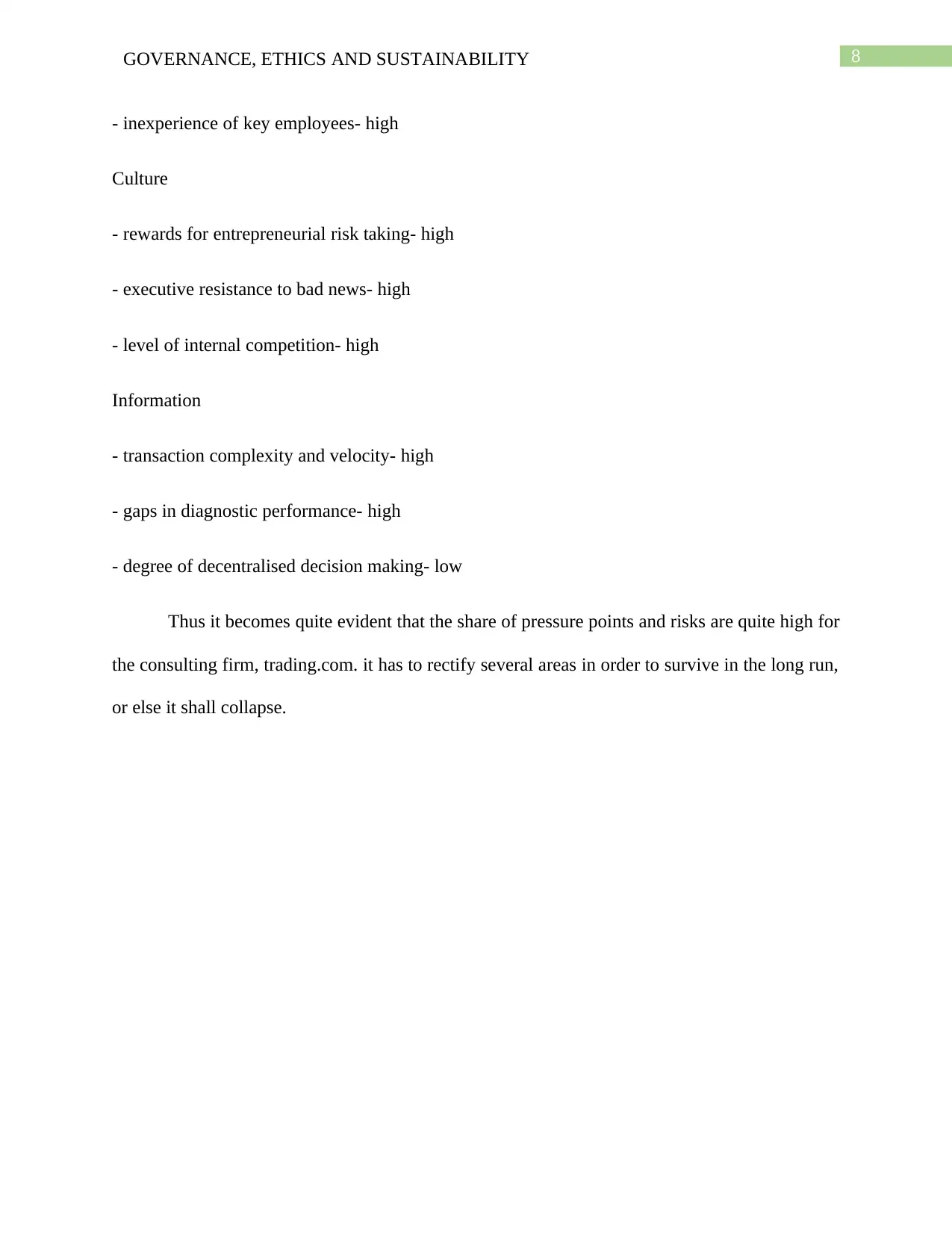
8GOVERNANCE, ETHICS AND SUSTAINABILITY
- inexperience of key employees- high
Culture
- rewards for entrepreneurial risk taking- high
- executive resistance to bad news- high
- level of internal competition- high
Information
- transaction complexity and velocity- high
- gaps in diagnostic performance- high
- degree of decentralised decision making- low
Thus it becomes quite evident that the share of pressure points and risks are quite high for
the consulting firm, trading.com. it has to rectify several areas in order to survive in the long run,
or else it shall collapse.
- inexperience of key employees- high
Culture
- rewards for entrepreneurial risk taking- high
- executive resistance to bad news- high
- level of internal competition- high
Information
- transaction complexity and velocity- high
- gaps in diagnostic performance- high
- degree of decentralised decision making- low
Thus it becomes quite evident that the share of pressure points and risks are quite high for
the consulting firm, trading.com. it has to rectify several areas in order to survive in the long run,
or else it shall collapse.
⊘ This is a preview!⊘
Do you want full access?
Subscribe today to unlock all pages.
Trusted by 1+ million students worldwide
9GOVERNANCE, ETHICS AND SUSTAINABILITY
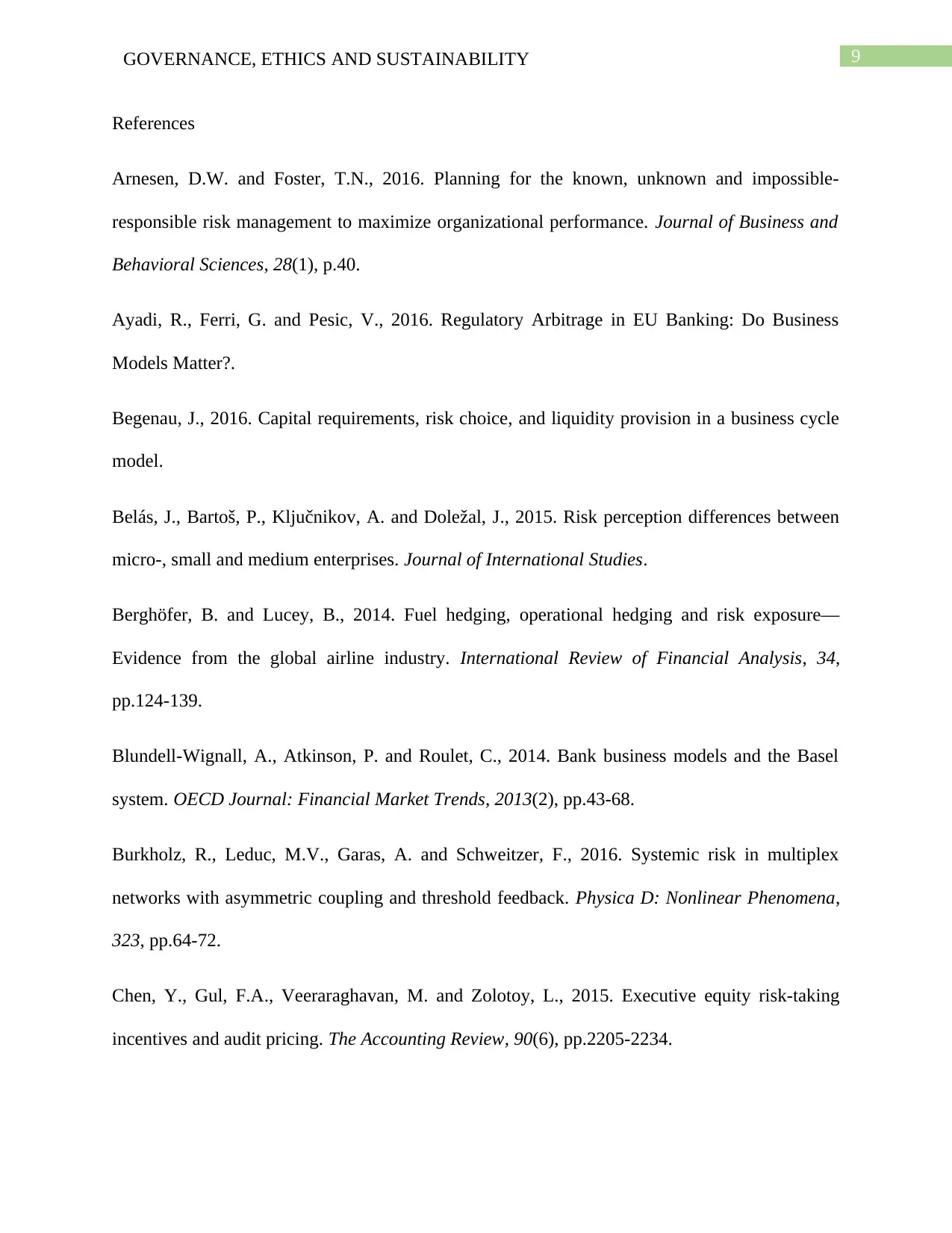
References
Arnesen, D.W. and Foster, T.N., 2016. Planning for the known, unknown and impossible-
responsible risk management to maximize organizational performance. Journal of Business and
Behavioral Sciences, 28(1), p.40.
Ayadi, R., Ferri, G. and Pesic, V., 2016. Regulatory Arbitrage in EU Banking: Do Business
Models Matter?.
Begenau, J., 2016. Capital requirements, risk choice, and liquidity provision in a business cycle
model.
Belás, J., Bartoš, P., Ključnikov, A. and Doležal, J., 2015. Risk perception differences between
micro-, small and medium enterprises. Journal of International Studies.
Berghöfer, B. and Lucey, B., 2014. Fuel hedging, operational hedging and risk exposure—
Evidence from the global airline industry. International Review of Financial Analysis, 34,
pp.124-139.
Blundell-Wignall, A., Atkinson, P. and Roulet, C., 2014. Bank business models and the Basel
system. OECD Journal: Financial Market Trends, 2013(2), pp.43-68.
Burkholz, R., Leduc, M.V., Garas, A. and Schweitzer, F., 2016. Systemic risk in multiplex
networks with asymmetric coupling and threshold feedback. Physica D: Nonlinear Phenomena,
323, pp.64-72.
Chen, Y., Gul, F.A., Veeraraghavan, M. and Zolotoy, L., 2015. Executive equity risk-taking
incentives and audit pricing. The Accounting Review, 90(6), pp.2205-2234.
References
Arnesen, D.W. and Foster, T.N., 2016. Planning for the known, unknown and impossible-
responsible risk management to maximize organizational performance. Journal of Business and
Behavioral Sciences, 28(1), p.40.
Ayadi, R., Ferri, G. and Pesic, V., 2016. Regulatory Arbitrage in EU Banking: Do Business
Models Matter?.
Begenau, J., 2016. Capital requirements, risk choice, and liquidity provision in a business cycle
model.
Belás, J., Bartoš, P., Ključnikov, A. and Doležal, J., 2015. Risk perception differences between
micro-, small and medium enterprises. Journal of International Studies.
Berghöfer, B. and Lucey, B., 2014. Fuel hedging, operational hedging and risk exposure—
Evidence from the global airline industry. International Review of Financial Analysis, 34,
pp.124-139.
Blundell-Wignall, A., Atkinson, P. and Roulet, C., 2014. Bank business models and the Basel
system. OECD Journal: Financial Market Trends, 2013(2), pp.43-68.
Burkholz, R., Leduc, M.V., Garas, A. and Schweitzer, F., 2016. Systemic risk in multiplex
networks with asymmetric coupling and threshold feedback. Physica D: Nonlinear Phenomena,
323, pp.64-72.
Chen, Y., Gul, F.A., Veeraraghavan, M. and Zolotoy, L., 2015. Executive equity risk-taking
incentives and audit pricing. The Accounting Review, 90(6), pp.2205-2234.
Paraphrase This Document
Need a fresh take? Get an instant paraphrase of this document with our AI Paraphraser
10GOVERNANCE, ETHICS AND SUSTAINABILITY
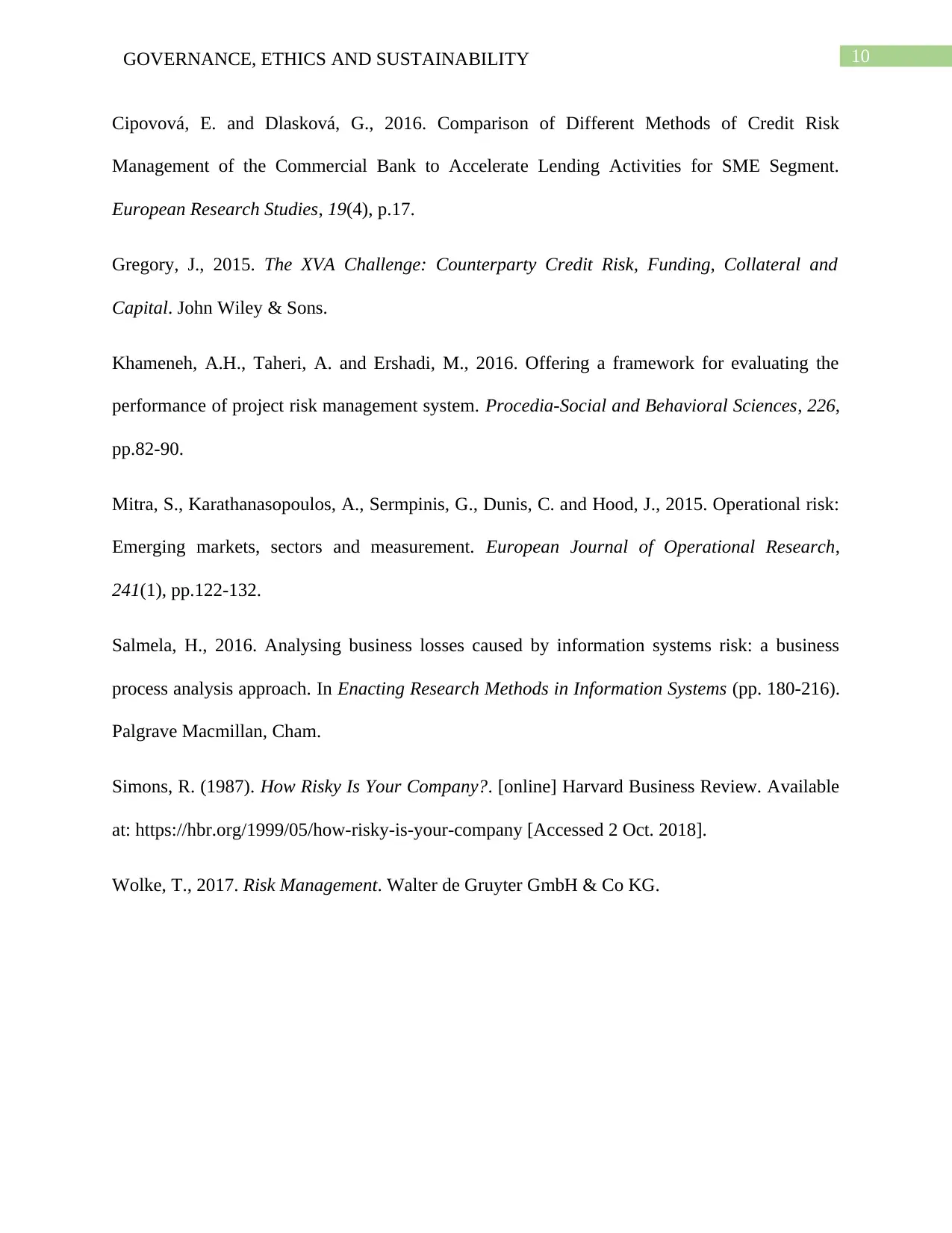
Cipovová, E. and Dlasková, G., 2016. Comparison of Different Methods of Credit Risk
Management of the Commercial Bank to Accelerate Lending Activities for SME Segment.
European Research Studies, 19(4), p.17.
Gregory, J., 2015. The XVA Challenge: Counterparty Credit Risk, Funding, Collateral and
Capital. John Wiley & Sons.
Khameneh, A.H., Taheri, A. and Ershadi, M., 2016. Offering a framework for evaluating the
performance of project risk management system. Procedia-Social and Behavioral Sciences, 226,
pp.82-90.
Mitra, S., Karathanasopoulos, A., Sermpinis, G., Dunis, C. and Hood, J., 2015. Operational risk:
Emerging markets, sectors and measurement. European Journal of Operational Research,
241(1), pp.122-132.
Salmela, H., 2016. Analysing business losses caused by information systems risk: a business
process analysis approach. In Enacting Research Methods in Information Systems (pp. 180-216).
Palgrave Macmillan, Cham.
Simons, R. (1987). How Risky Is Your Company?. [online] Harvard Business Review. Available
at: https://hbr.org/1999/05/how-risky-is-your-company [Accessed 2 Oct. 2018].
Wolke, T., 2017. Risk Management. Walter de Gruyter GmbH & Co KG.
Cipovová, E. and Dlasková, G., 2016. Comparison of Different Methods of Credit Risk
Management of the Commercial Bank to Accelerate Lending Activities for SME Segment.
European Research Studies, 19(4), p.17.
Gregory, J., 2015. The XVA Challenge: Counterparty Credit Risk, Funding, Collateral and
Capital. John Wiley & Sons.
Khameneh, A.H., Taheri, A. and Ershadi, M., 2016. Offering a framework for evaluating the
performance of project risk management system. Procedia-Social and Behavioral Sciences, 226,
pp.82-90.
Mitra, S., Karathanasopoulos, A., Sermpinis, G., Dunis, C. and Hood, J., 2015. Operational risk:
Emerging markets, sectors and measurement. European Journal of Operational Research,
241(1), pp.122-132.
Salmela, H., 2016. Analysing business losses caused by information systems risk: a business
process analysis approach. In Enacting Research Methods in Information Systems (pp. 180-216).
Palgrave Macmillan, Cham.
Simons, R. (1987). How Risky Is Your Company?. [online] Harvard Business Review. Available
at: https://hbr.org/1999/05/how-risky-is-your-company [Accessed 2 Oct. 2018].
Wolke, T., 2017. Risk Management. Walter de Gruyter GmbH & Co KG.

1 out of 11


Related Documents


Your All-in-One AI-Powered Toolkit for Academic Success.
+13062052269
info@desklib.com
Available 24*7 on WhatsApp / Email
![[object Object]](/_next/static/media/star-bottom.7253800d.svg)
Unlock your academic potential
Copyright © 2020–2026 A2Z Services. All Rights Reserved. Developed and managed by ZUCOL.