MBA402 Governance, Ethics, and Sustainability: Risk Assessment Report
VerifiedAdded on 2023/06/07
|12
|3057
|117
Report
AI Summary
This report presents a comprehensive risk assessment of Trading.com, a company offering share investment courses. The analysis, conducted for the MBA402 module, evaluates pressure points stemming from growth, culture, and information management. The report examines the company's expansion, employee inexperience, rewards for risk-taking, executive resistance to bad news, internal competition, transaction complexity, gaps in performance, and decentralized decision-making. It utilizes the provided risk exposure calculator and addresses specific areas like pressure for performance, rate of expansion, rewards for entrepreneurial risk-taking, and others, providing a detailed evaluation of the risks faced by Trading.com and their potential impacts on the organization.
RISK ASSESSMENT REPORT 1
RISK ASSESSMENT REPORT
Student’s Name
Professor’s Name
Institution
Course
Student’s ID
Date
RISK ASSESSMENT REPORT
Student’s Name
Professor’s Name
Institution
Course
Student’s ID
Date

Paraphrase This Document
Need a fresh take? Get an instant paraphrase of this document with our AI Paraphraser
RISK ASSESSMENT REPORT 2
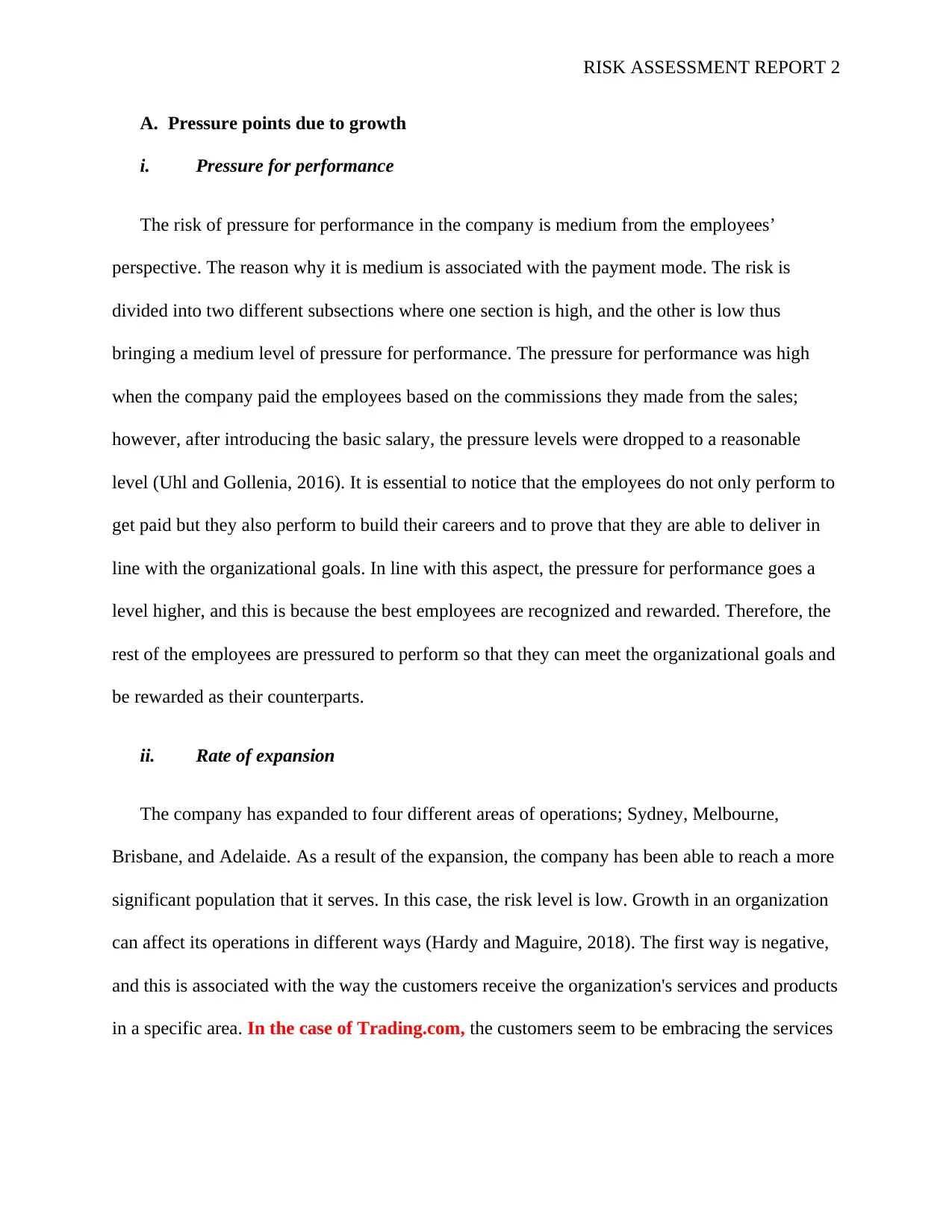
A. Pressure points due to growth
i. Pressure for performance
The risk of pressure for performance in the company is medium from the employees’
perspective. The reason why it is medium is associated with the payment mode. The risk is
divided into two different subsections where one section is high, and the other is low thus
bringing a medium level of pressure for performance. The pressure for performance was high
when the company paid the employees based on the commissions they made from the sales;
however, after introducing the basic salary, the pressure levels were dropped to a reasonable
level (Uhl and Gollenia, 2016). It is essential to notice that the employees do not only perform to
get paid but they also perform to build their careers and to prove that they are able to deliver in
line with the organizational goals. In line with this aspect, the pressure for performance goes a
level higher, and this is because the best employees are recognized and rewarded. Therefore, the
rest of the employees are pressured to perform so that they can meet the organizational goals and
be rewarded as their counterparts.
ii. Rate of expansion
The company has expanded to four different areas of operations; Sydney, Melbourne,
Brisbane, and Adelaide. As a result of the expansion, the company has been able to reach a more
significant population that it serves. In this case, the risk level is low. Growth in an organization
can affect its operations in different ways (Hardy and Maguire, 2018). The first way is negative,
and this is associated with the way the customers receive the organization's services and products
in a specific area. In the case of Trading.com, the customers seem to be embracing the services
A. Pressure points due to growth
i. Pressure for performance
The risk of pressure for performance in the company is medium from the employees’
perspective. The reason why it is medium is associated with the payment mode. The risk is
divided into two different subsections where one section is high, and the other is low thus
bringing a medium level of pressure for performance. The pressure for performance was high
when the company paid the employees based on the commissions they made from the sales;
however, after introducing the basic salary, the pressure levels were dropped to a reasonable
level (Uhl and Gollenia, 2016). It is essential to notice that the employees do not only perform to
get paid but they also perform to build their careers and to prove that they are able to deliver in
line with the organizational goals. In line with this aspect, the pressure for performance goes a
level higher, and this is because the best employees are recognized and rewarded. Therefore, the
rest of the employees are pressured to perform so that they can meet the organizational goals and
be rewarded as their counterparts.
ii. Rate of expansion
The company has expanded to four different areas of operations; Sydney, Melbourne,
Brisbane, and Adelaide. As a result of the expansion, the company has been able to reach a more
significant population that it serves. In this case, the risk level is low. Growth in an organization
can affect its operations in different ways (Hardy and Maguire, 2018). The first way is negative,
and this is associated with the way the customers receive the organization's services and products
in a specific area. In the case of Trading.com, the customers seem to be embracing the services
RISK ASSESSMENT REPORT 3
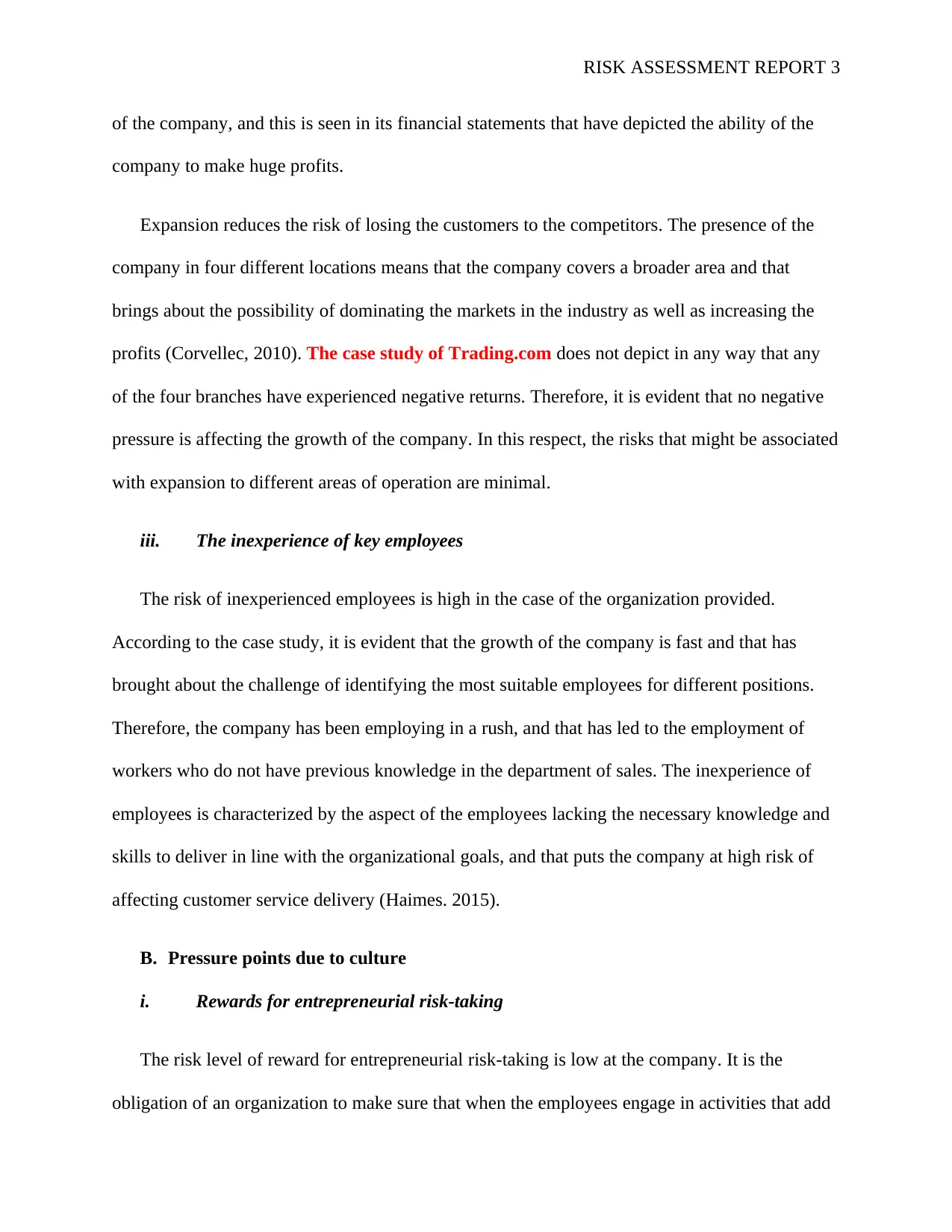
of the company, and this is seen in its financial statements that have depicted the ability of the
company to make huge profits.
Expansion reduces the risk of losing the customers to the competitors. The presence of the
company in four different locations means that the company covers a broader area and that
brings about the possibility of dominating the markets in the industry as well as increasing the
profits (Corvellec, 2010). The case study of Trading.com does not depict in any way that any
of the four branches have experienced negative returns. Therefore, it is evident that no negative
pressure is affecting the growth of the company. In this respect, the risks that might be associated
with expansion to different areas of operation are minimal.
iii. The inexperience of key employees
The risk of inexperienced employees is high in the case of the organization provided.
According to the case study, it is evident that the growth of the company is fast and that has
brought about the challenge of identifying the most suitable employees for different positions.
Therefore, the company has been employing in a rush, and that has led to the employment of
workers who do not have previous knowledge in the department of sales. The inexperience of
employees is characterized by the aspect of the employees lacking the necessary knowledge and
skills to deliver in line with the organizational goals, and that puts the company at high risk of
affecting customer service delivery (Haimes. 2015).
B. Pressure points due to culture
i. Rewards for entrepreneurial risk-taking
The risk level of reward for entrepreneurial risk-taking is low at the company. It is the
obligation of an organization to make sure that when the employees engage in activities that add
of the company, and this is seen in its financial statements that have depicted the ability of the
company to make huge profits.
Expansion reduces the risk of losing the customers to the competitors. The presence of the
company in four different locations means that the company covers a broader area and that
brings about the possibility of dominating the markets in the industry as well as increasing the
profits (Corvellec, 2010). The case study of Trading.com does not depict in any way that any
of the four branches have experienced negative returns. Therefore, it is evident that no negative
pressure is affecting the growth of the company. In this respect, the risks that might be associated
with expansion to different areas of operation are minimal.
iii. The inexperience of key employees
The risk of inexperienced employees is high in the case of the organization provided.
According to the case study, it is evident that the growth of the company is fast and that has
brought about the challenge of identifying the most suitable employees for different positions.
Therefore, the company has been employing in a rush, and that has led to the employment of
workers who do not have previous knowledge in the department of sales. The inexperience of
employees is characterized by the aspect of the employees lacking the necessary knowledge and
skills to deliver in line with the organizational goals, and that puts the company at high risk of
affecting customer service delivery (Haimes. 2015).
B. Pressure points due to culture
i. Rewards for entrepreneurial risk-taking
The risk level of reward for entrepreneurial risk-taking is low at the company. It is the
obligation of an organization to make sure that when the employees engage in activities that add
⊘ This is a preview!⊘
Do you want full access?
Subscribe today to unlock all pages.

Trusted by 1+ million students worldwide
RISK ASSESSMENT REPORT 4
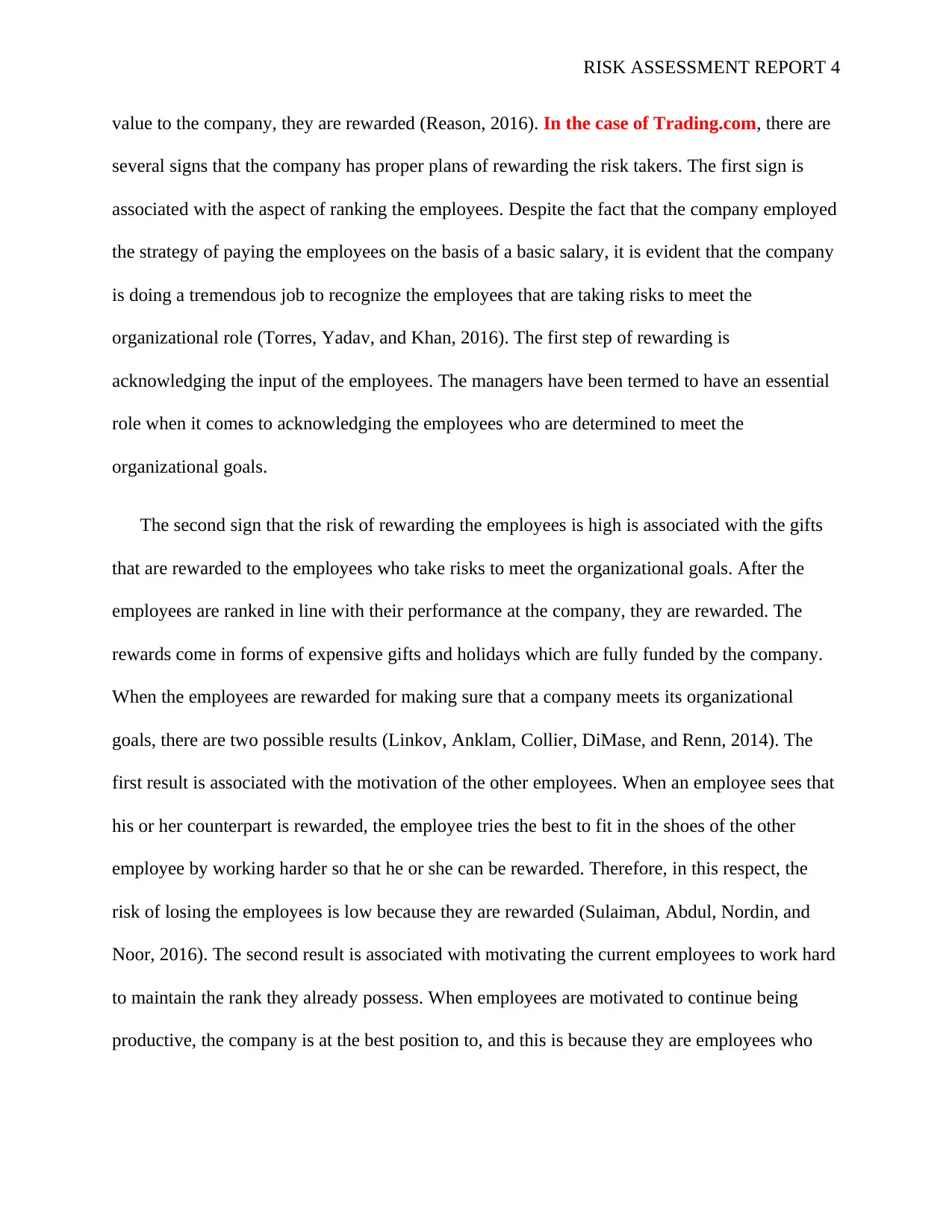
value to the company, they are rewarded (Reason, 2016). In the case of Trading.com, there are
several signs that the company has proper plans of rewarding the risk takers. The first sign is
associated with the aspect of ranking the employees. Despite the fact that the company employed
the strategy of paying the employees on the basis of a basic salary, it is evident that the company
is doing a tremendous job to recognize the employees that are taking risks to meet the
organizational role (Torres, Yadav, and Khan, 2016). The first step of rewarding is
acknowledging the input of the employees. The managers have been termed to have an essential
role when it comes to acknowledging the employees who are determined to meet the
organizational goals.
The second sign that the risk of rewarding the employees is high is associated with the gifts
that are rewarded to the employees who take risks to meet the organizational goals. After the
employees are ranked in line with their performance at the company, they are rewarded. The
rewards come in forms of expensive gifts and holidays which are fully funded by the company.
When the employees are rewarded for making sure that a company meets its organizational
goals, there are two possible results (Linkov, Anklam, Collier, DiMase, and Renn, 2014). The
first result is associated with the motivation of the other employees. When an employee sees that
his or her counterpart is rewarded, the employee tries the best to fit in the shoes of the other
employee by working harder so that he or she can be rewarded. Therefore, in this respect, the
risk of losing the employees is low because they are rewarded (Sulaiman, Abdul, Nordin, and
Noor, 2016). The second result is associated with motivating the current employees to work hard
to maintain the rank they already possess. When employees are motivated to continue being
productive, the company is at the best position to, and this is because they are employees who
value to the company, they are rewarded (Reason, 2016). In the case of Trading.com, there are
several signs that the company has proper plans of rewarding the risk takers. The first sign is
associated with the aspect of ranking the employees. Despite the fact that the company employed
the strategy of paying the employees on the basis of a basic salary, it is evident that the company
is doing a tremendous job to recognize the employees that are taking risks to meet the
organizational role (Torres, Yadav, and Khan, 2016). The first step of rewarding is
acknowledging the input of the employees. The managers have been termed to have an essential
role when it comes to acknowledging the employees who are determined to meet the
organizational goals.
The second sign that the risk of rewarding the employees is high is associated with the gifts
that are rewarded to the employees who take risks to meet the organizational goals. After the
employees are ranked in line with their performance at the company, they are rewarded. The
rewards come in forms of expensive gifts and holidays which are fully funded by the company.
When the employees are rewarded for making sure that a company meets its organizational
goals, there are two possible results (Linkov, Anklam, Collier, DiMase, and Renn, 2014). The
first result is associated with the motivation of the other employees. When an employee sees that
his or her counterpart is rewarded, the employee tries the best to fit in the shoes of the other
employee by working harder so that he or she can be rewarded. Therefore, in this respect, the
risk of losing the employees is low because they are rewarded (Sulaiman, Abdul, Nordin, and
Noor, 2016). The second result is associated with motivating the current employees to work hard
to maintain the rank they already possess. When employees are motivated to continue being
productive, the company is at the best position to, and this is because they are employees who
Paraphrase This Document
Need a fresh take? Get an instant paraphrase of this document with our AI Paraphraser
RISK ASSESSMENT REPORT 5
are ready to do anything to meet the organizational goals and this is because they know the
advantages that come along with being productive.
ii. Executive resistance to bad news
The risk associated with the executive resistance to bad news is high. An organization must
have an executive that knows about the best ways to handle news which are not pleasant
(Zsidisin, Ellram, Carter, and Cavinato, 2004). The bad news that reaches the executive is not
handled in the way they should. Looking at the case, the managers have proved that they are not
in the best position to manage the bad news they receive from the consultants. When the sad
news reaches the company, the consultants are left to deal with the news alone. The aspect of
leaving the junior employees to deal with bad news is unprofessional, and it demonstrates
leadership that only wants to be associated with the positive news of the company. An
organization that has the capability of dealing with the bad news does not need to leave the entire
burden on the shoulders of the junior employees. Instead, it comes out to deal with the news and
take full responsibility (Knechel and Salterio, 2016).
iii. Level of internal competition
The level of internal competition is high in the company, and that puts the organization at
risk of different units failing to work together to attain the organizational goals. It is essential to
note that as much as an organization might be fostering internal competition, it comes with its
fair share of challenges (Shameli-Sendi, Aghababaei-Barzegar, and Cheriet, 2016). One of the
challenges is the lack of transparency which is dangerous to a company. An organization ought
to make sure that the employees work together to attain the set goals. Failure to doing so, an
organization might lose, and this is because the employees might look down on others instead of
are ready to do anything to meet the organizational goals and this is because they know the
advantages that come along with being productive.
ii. Executive resistance to bad news
The risk associated with the executive resistance to bad news is high. An organization must
have an executive that knows about the best ways to handle news which are not pleasant
(Zsidisin, Ellram, Carter, and Cavinato, 2004). The bad news that reaches the executive is not
handled in the way they should. Looking at the case, the managers have proved that they are not
in the best position to manage the bad news they receive from the consultants. When the sad
news reaches the company, the consultants are left to deal with the news alone. The aspect of
leaving the junior employees to deal with bad news is unprofessional, and it demonstrates
leadership that only wants to be associated with the positive news of the company. An
organization that has the capability of dealing with the bad news does not need to leave the entire
burden on the shoulders of the junior employees. Instead, it comes out to deal with the news and
take full responsibility (Knechel and Salterio, 2016).
iii. Level of internal competition
The level of internal competition is high in the company, and that puts the organization at
risk of different units failing to work together to attain the organizational goals. It is essential to
note that as much as an organization might be fostering internal competition, it comes with its
fair share of challenges (Shameli-Sendi, Aghababaei-Barzegar, and Cheriet, 2016). One of the
challenges is the lack of transparency which is dangerous to a company. An organization ought
to make sure that the employees work together to attain the set goals. Failure to doing so, an
organization might lose, and this is because the employees might look down on others instead of
RISK ASSESSMENT REPORT 6
providing information and support that can help in attaining the organization's desired goals
(Chemweno, Pintelon, Van Horenbeek, and Muchiri, 2015). In the case of the organization at
hand, internal competition is evident because of the aspect of ranking and rewarding. The
method of ranking at the company does not target the input of the groups, but it targets the input
of individual employees. For example, the case study shows that the rewards and luxury holidays
are given to the top performing employees. Therefore, it is evident that most of the employees try
to deliver at an individual level and this is because they are likely to be rewarded as individuals
and not groups (Villa, Paltrinieri, Khan, and Cozzani, 2016). When internal competition is
promoted, the employees tend to work in secrecy and privacy because they want to emerge the
best among other workers (Renn, 2017). If the internal competition was not promoted at
Trading.com, it is evident that the ranking method would target teams and departments rather
than individual employees.
C. Pressure points due to information management
i. Transaction complexity and velocity
The company has proved that transacting in the company is not a complex aspect. The reason
for stating so is associated with the fact that the company has done well in sharing crucial
information with the clients. At the same time, the company has done a recommendable job
when it comes to sharing information with the consultants. From the consultants' perspective, it
is apparent that the customers have been provided with the information that they need to know
more about the organizational transactions (Glendon, Clarke, and McKenna, 2016). One point
that backs the point is when the customers state that the employees are too good to them until
they enroll in the course. Transaction complexity comes in place where the methods or structure
providing information and support that can help in attaining the organization's desired goals
(Chemweno, Pintelon, Van Horenbeek, and Muchiri, 2015). In the case of the organization at
hand, internal competition is evident because of the aspect of ranking and rewarding. The
method of ranking at the company does not target the input of the groups, but it targets the input
of individual employees. For example, the case study shows that the rewards and luxury holidays
are given to the top performing employees. Therefore, it is evident that most of the employees try
to deliver at an individual level and this is because they are likely to be rewarded as individuals
and not groups (Villa, Paltrinieri, Khan, and Cozzani, 2016). When internal competition is
promoted, the employees tend to work in secrecy and privacy because they want to emerge the
best among other workers (Renn, 2017). If the internal competition was not promoted at
Trading.com, it is evident that the ranking method would target teams and departments rather
than individual employees.
C. Pressure points due to information management
i. Transaction complexity and velocity
The company has proved that transacting in the company is not a complex aspect. The reason
for stating so is associated with the fact that the company has done well in sharing crucial
information with the clients. At the same time, the company has done a recommendable job
when it comes to sharing information with the consultants. From the consultants' perspective, it
is apparent that the customers have been provided with the information that they need to know
more about the organizational transactions (Glendon, Clarke, and McKenna, 2016). One point
that backs the point is when the customers state that the employees are too good to them until
they enroll in the course. Transaction complexity comes in place where the methods or structure
⊘ This is a preview!⊘
Do you want full access?
Subscribe today to unlock all pages.
Trusted by 1+ million students worldwide
RISK ASSESSMENT REPORT 7
of transactions is not familiarized with the people who are supposed to use them. Throughout the
case study, it is evident that at no point the aspect of transaction complexity emerges.
ii. Gaps in diagnostic performance
Gaps in performance are evident in different ways, and this means that the risk is high. The
organization has been employing the new employees in a hurry, and that has affected the quality
of the employees that are coming on board (Mohaghegh, Kazemi, and Mosleh, 2009). Most of
the employees that are coming on board do not have the experience that is needed for them to be
effective and that means that their performance cannot reach that of the employees who have
been working for the company. The gap is also evident in the case of the already experienced
employees. The customers have stated that the employees are good for them but until they
convince them to buy their products. The performance of the employees has proved to be
affected by the outcomes of the customers. When the customers agree to purchase from the
employees, the employees are satisfied, and immediately their performance reduces to an
incompetent level.
iii. The degree of decentralized decision making
There seems to be a high degree of decentralized decision making thus putting the company
at high risk. Trading.com is a company that has different branches, and that means that there
are different levels of management. According to the case study, the regional managers make
decisions without the consideration of the corporate strategy. The corporate strategy is put in
place to make sure that all branches of the company are guided on the best strategies to follow
(Bahr, 2014). Therefore, when the regional managers despise the strategy that should be
followed, they demonstrate that there is a decentralized decision-making process (Aven, 2016).
of transactions is not familiarized with the people who are supposed to use them. Throughout the
case study, it is evident that at no point the aspect of transaction complexity emerges.
ii. Gaps in diagnostic performance
Gaps in performance are evident in different ways, and this means that the risk is high. The
organization has been employing the new employees in a hurry, and that has affected the quality
of the employees that are coming on board (Mohaghegh, Kazemi, and Mosleh, 2009). Most of
the employees that are coming on board do not have the experience that is needed for them to be
effective and that means that their performance cannot reach that of the employees who have
been working for the company. The gap is also evident in the case of the already experienced
employees. The customers have stated that the employees are good for them but until they
convince them to buy their products. The performance of the employees has proved to be
affected by the outcomes of the customers. When the customers agree to purchase from the
employees, the employees are satisfied, and immediately their performance reduces to an
incompetent level.
iii. The degree of decentralized decision making
There seems to be a high degree of decentralized decision making thus putting the company
at high risk. Trading.com is a company that has different branches, and that means that there
are different levels of management. According to the case study, the regional managers make
decisions without the consideration of the corporate strategy. The corporate strategy is put in
place to make sure that all branches of the company are guided on the best strategies to follow
(Bahr, 2014). Therefore, when the regional managers despise the strategy that should be
followed, they demonstrate that there is a decentralized decision-making process (Aven, 2016).
Paraphrase This Document
Need a fresh take? Get an instant paraphrase of this document with our AI Paraphraser
RISK ASSESSMENT REPORT 8
A centralized decision-making process means that all the shareholders act in line with the
decisions that have been made by the highest authority of the company. Therefore, there are
different results that come along with centralized decision making (Aqlan and Lam, 2015). The
first result is a unified procedure while approaching matters of a company. An organization
practices the centralized decision-making process if the organization wants to establish law and
order. Law and order mean that an organization reads from the same script (Bromiley, McShane,
Nair, and Rustambekov, 2015). When some of the sections of management implement decisions
they have constituted, the aspect of centralized decision making is not evident. The second result
is associated with the sense of cooperation in the company. Cooperation means that the regional
management corporates with the highest office of the company. Unfortunately, in the case of
Trading.com, cooperation is not a term that has been taken seriously by the regional managers.
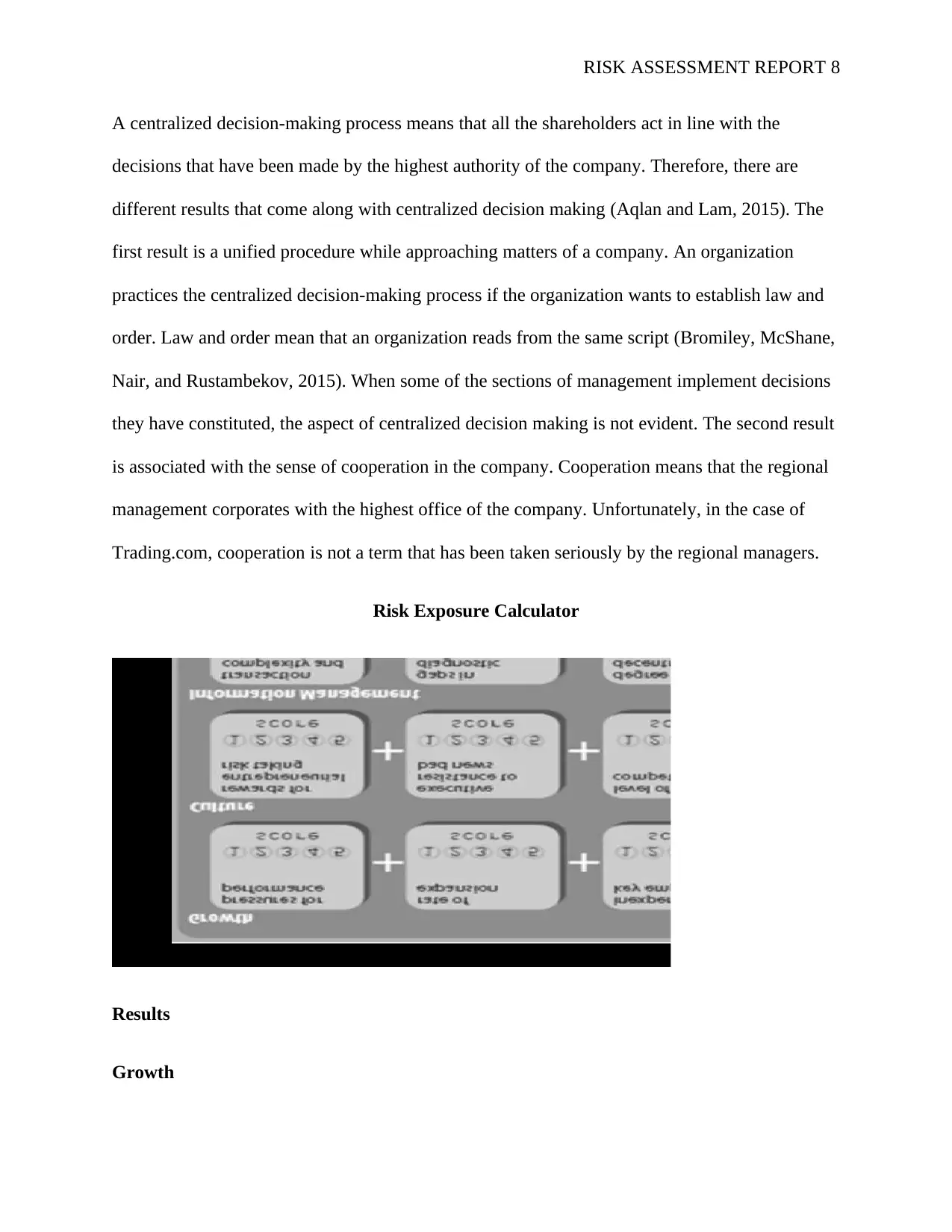
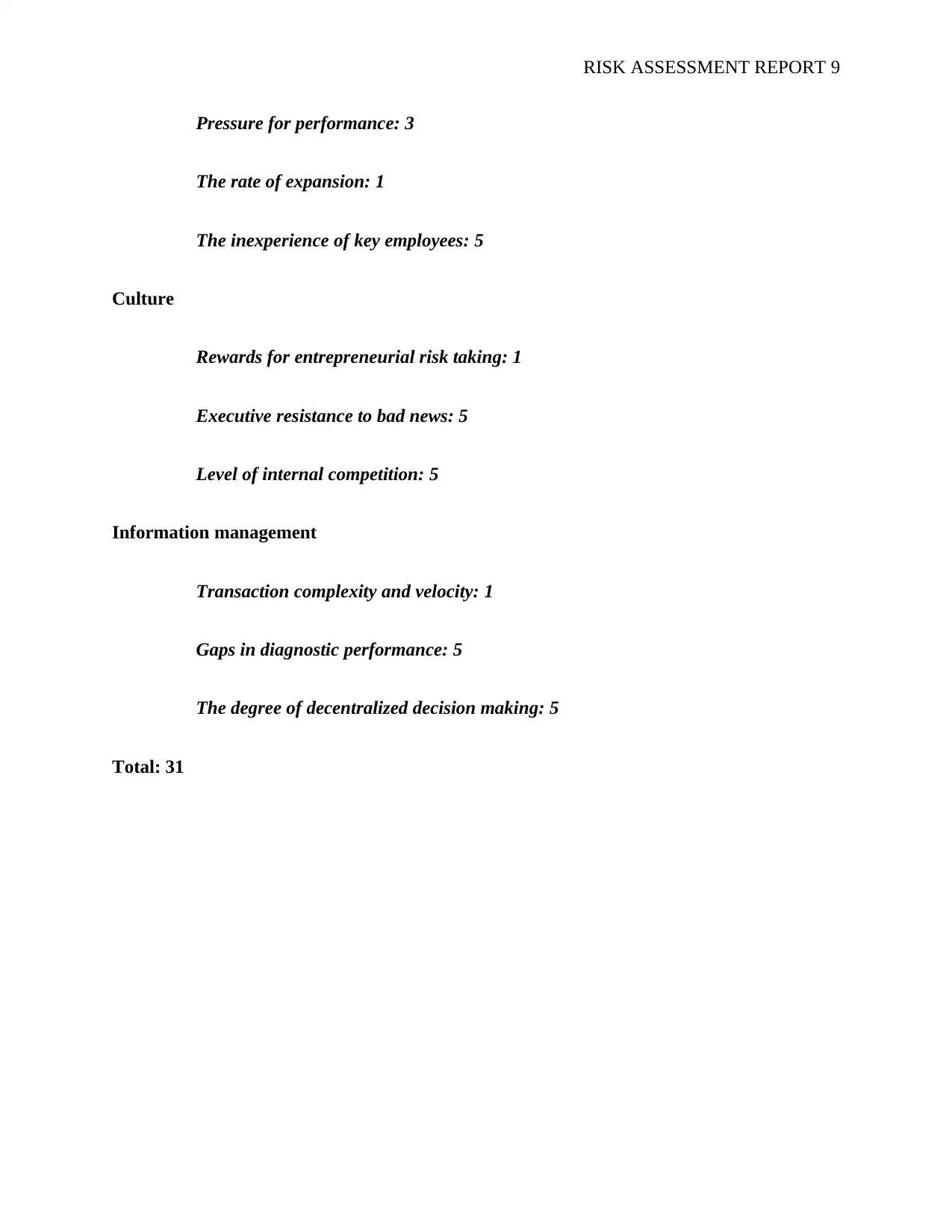
Risk Exposure Calculator
Results
Growth
A centralized decision-making process means that all the shareholders act in line with the
decisions that have been made by the highest authority of the company. Therefore, there are
different results that come along with centralized decision making (Aqlan and Lam, 2015). The
first result is a unified procedure while approaching matters of a company. An organization
practices the centralized decision-making process if the organization wants to establish law and
order. Law and order mean that an organization reads from the same script (Bromiley, McShane,
Nair, and Rustambekov, 2015). When some of the sections of management implement decisions
they have constituted, the aspect of centralized decision making is not evident. The second result
is associated with the sense of cooperation in the company. Cooperation means that the regional
management corporates with the highest office of the company. Unfortunately, in the case of
Trading.com, cooperation is not a term that has been taken seriously by the regional managers.
Risk Exposure Calculator
Results
Growth
RISK ASSESSMENT REPORT 9
Pressure for performance: 3
The rate of expansion: 1
The inexperience of key employees: 5
Culture
Rewards for entrepreneurial risk taking: 1
Executive resistance to bad news: 5
Level of internal competition: 5
Information management
Transaction complexity and velocity: 1
Gaps in diagnostic performance: 5
The degree of decentralized decision making: 5
Total: 31
Pressure for performance: 3
The rate of expansion: 1
The inexperience of key employees: 5
Culture
Rewards for entrepreneurial risk taking: 1
Executive resistance to bad news: 5
Level of internal competition: 5
Information management
Transaction complexity and velocity: 1
Gaps in diagnostic performance: 5
The degree of decentralized decision making: 5
Total: 31
⊘ This is a preview!⊘
Do you want full access?
Subscribe today to unlock all pages.
Trusted by 1+ million students worldwide
RISK ASSESSMENT REPORT 10
References
Aqlan, F. and Lam, S.S., 2015. A fuzzy-based integrated framework for supply chain risk
assessment. International Journal of Production Economics, 161, pp.54-63.
Aven, T., 2016. Risk assessment and risk management: Review of recent advances on their
foundation. European Journal of Operational Research, 253(1), pp.1-13.
Bahr, N.J., 2014. System safety engineering and risk assessment: a practical approach. CRC
Press.
Bromiley, P., McShane, M., Nair, A. and Rustambekov, E., 2015. Enterprise risk management:
Review, critique, and research directions. Long range planning, 48(4), pp.265-276.
Chemweno, P., Pintelon, L., Van Horenbeek, A. and Muchiri, P., 2015. Development of a risk
assessment selection methodology for asset maintenance decision making: An analytic network
process (ANP) approach. International Journal of Production Economics, 170, pp.663-676.
Corvellec, H., 2010. Organizational risk as it derives from what managers value: A practice‐
based approach to risk assessment. Journal of Contingencies and Crisis Management, 18(3),
pp.145-154.
Glendon, A.I., Clarke, S. and McKenna, E., 2016. Human safety and risk management. CRC
Press.
Haimes, Y.Y., 2015. Risk modeling, assessment, and management. John Wiley & Sons.
References
Aqlan, F. and Lam, S.S., 2015. A fuzzy-based integrated framework for supply chain risk
assessment. International Journal of Production Economics, 161, pp.54-63.
Aven, T., 2016. Risk assessment and risk management: Review of recent advances on their
foundation. European Journal of Operational Research, 253(1), pp.1-13.
Bahr, N.J., 2014. System safety engineering and risk assessment: a practical approach. CRC
Press.
Bromiley, P., McShane, M., Nair, A. and Rustambekov, E., 2015. Enterprise risk management:
Review, critique, and research directions. Long range planning, 48(4), pp.265-276.
Chemweno, P., Pintelon, L., Van Horenbeek, A. and Muchiri, P., 2015. Development of a risk
assessment selection methodology for asset maintenance decision making: An analytic network
process (ANP) approach. International Journal of Production Economics, 170, pp.663-676.
Corvellec, H., 2010. Organizational risk as it derives from what managers value: A practice‐
based approach to risk assessment. Journal of Contingencies and Crisis Management, 18(3),
pp.145-154.
Glendon, A.I., Clarke, S. and McKenna, E., 2016. Human safety and risk management. CRC
Press.
Haimes, Y.Y., 2015. Risk modeling, assessment, and management. John Wiley & Sons.
Paraphrase This Document
Need a fresh take? Get an instant paraphrase of this document with our AI Paraphraser
RISK ASSESSMENT REPORT 11
Hardy, C. and Maguire, S., 2018, July. An Organizational Perspective on Constructing Novel
Risks: The Case of Bisphenol A. In Academy of Management Proceedings (Vol. 2018, No. 1, p.
10284). Briarcliff Manor, NY 10510: Academy of Management.
Knechel, W.R., and Salterio, S.E., 2016. Auditing: Assurance and risk. Routledge.
Linkov, I., Anklam, E., Collier, Z.A., DiMase, D. and Renn, O., 2014. Risk-based standards:
integrating top-down and bottom-up approaches. Environment Systems and Decisions, 34(1),
pp.134-137.
Mohaghegh, Z., Kazemi, R. and Mosleh, A., 2009. Incorporating organizational factors into
Probabilistic Risk Assessment (PRA) of complex socio-technical systems: A hybrid technique
formalization. Reliability Engineering & System Safety, 94(5), pp.1000-1018.
The reason, J., 2016. Managing the risks of organizational accidents. Routledge.
Renn, O., 2017. Risk governance: coping with uncertainty in a complex world. Routledge.
Shameli-Sendi, A., Aghababaei-Barzegar, R. and Cheriet, M., 2016. Taxonomy of information
security risk assessment (ISRA). Computers & security, 57, pp.14-30.
Sulaiman, M.S., Abdul, R., Nordin, A. and Noor, N.L., 2016. Improving Knowledge
Preservation Strategy at Organizational Level through Knowledge Loss Risk Assessment
(KLRA) (No. IAEA-CN--241).
Torres, L., Yadav, O.P. and Khan, E., 2016. A review of risk assessment techniques for
hydraulic fracturing water and produced water management implemented in onshore
unconventional oil and gas production. Science of the Total Environment, 539, pp.478-493.
Hardy, C. and Maguire, S., 2018, July. An Organizational Perspective on Constructing Novel
Risks: The Case of Bisphenol A. In Academy of Management Proceedings (Vol. 2018, No. 1, p.
10284). Briarcliff Manor, NY 10510: Academy of Management.
Knechel, W.R., and Salterio, S.E., 2016. Auditing: Assurance and risk. Routledge.
Linkov, I., Anklam, E., Collier, Z.A., DiMase, D. and Renn, O., 2014. Risk-based standards:
integrating top-down and bottom-up approaches. Environment Systems and Decisions, 34(1),
pp.134-137.
Mohaghegh, Z., Kazemi, R. and Mosleh, A., 2009. Incorporating organizational factors into
Probabilistic Risk Assessment (PRA) of complex socio-technical systems: A hybrid technique
formalization. Reliability Engineering & System Safety, 94(5), pp.1000-1018.
The reason, J., 2016. Managing the risks of organizational accidents. Routledge.
Renn, O., 2017. Risk governance: coping with uncertainty in a complex world. Routledge.
Shameli-Sendi, A., Aghababaei-Barzegar, R. and Cheriet, M., 2016. Taxonomy of information
security risk assessment (ISRA). Computers & security, 57, pp.14-30.
Sulaiman, M.S., Abdul, R., Nordin, A. and Noor, N.L., 2016. Improving Knowledge
Preservation Strategy at Organizational Level through Knowledge Loss Risk Assessment
(KLRA) (No. IAEA-CN--241).
Torres, L., Yadav, O.P. and Khan, E., 2016. A review of risk assessment techniques for
hydraulic fracturing water and produced water management implemented in onshore
unconventional oil and gas production. Science of the Total Environment, 539, pp.478-493.
RISK ASSESSMENT REPORT 12
Uhl, A. and Gollenia, L.A. eds., 2016. Business transformation management methodology.
Routledge.
Villa, V., Paltrinieri, N., Khan, F. and Cozzani, V., 2016. Towards dynamic risk analysis: A
review of the risk assessment approach and its limitations in the chemical process
industry. Safety science, 89, pp.77-93.
Zsidisin, G.A., Ellram, L.M., Carter, J.R. and Cavinato, J.L., 2004. An analysis of supply risk
assessment techniques. International Journal of Physical Distribution & Logistics
Management, 34(5), pp.397-413.
Uhl, A. and Gollenia, L.A. eds., 2016. Business transformation management methodology.
Routledge.
Villa, V., Paltrinieri, N., Khan, F. and Cozzani, V., 2016. Towards dynamic risk analysis: A
review of the risk assessment approach and its limitations in the chemical process
industry. Safety science, 89, pp.77-93.
Zsidisin, G.A., Ellram, L.M., Carter, J.R. and Cavinato, J.L., 2004. An analysis of supply risk
assessment techniques. International Journal of Physical Distribution & Logistics
Management, 34(5), pp.397-413.
⊘ This is a preview!⊘
Do you want full access?
Subscribe today to unlock all pages.
Trusted by 1+ million students worldwide

1 out of 12


Related Documents


Your All-in-One AI-Powered Toolkit for Academic Success.
+13062052269
info@desklib.com
Available 24*7 on WhatsApp / Email
![[object Object]](/_next/static/media/star-bottom.7253800d.svg)
Unlock your academic potential
Copyright © 2020–2025 A2Z Services. All Rights Reserved. Developed and managed by ZUCOL.