Research Proposal: Training and Development's Role in Hospitality
VerifiedAdded on 2023/06/10
|13
|3322
|156
Report
AI Summary
This research proposal investigates the crucial role of training and development in the hospitality industry, specifically focusing on its impact on organizational performance and employee productivity at COMO Metropolitan London. The proposal outlines the importance of training in enhancing employee skills, addressing weaknesses, and improving overall job satisfaction. It explores various training methods employed by COMO Metropolitan London, including technology-based learning, on-the-job training, and mentoring programs. The research aims to determine the effects of training and development strategies on employee skills and knowledge, positive employee attitudes, and increased job satisfaction, ultimately influencing organizational success. The methodology includes a positivism research philosophy, a deductive approach, and a survey research strategy, employing quantitative data collection methods to achieve the research objectives.
RESEARCH PROPOSAL
(Importance of training and development of
employees and its impact over organisational
performance and employee's productivity
within hospitality industry)
(Importance of training and development of
employees and its impact over organisational
performance and employee's productivity
within hospitality industry)

Paraphrase This Document
Need a fresh take? Get an instant paraphrase of this document with our AI Paraphraser
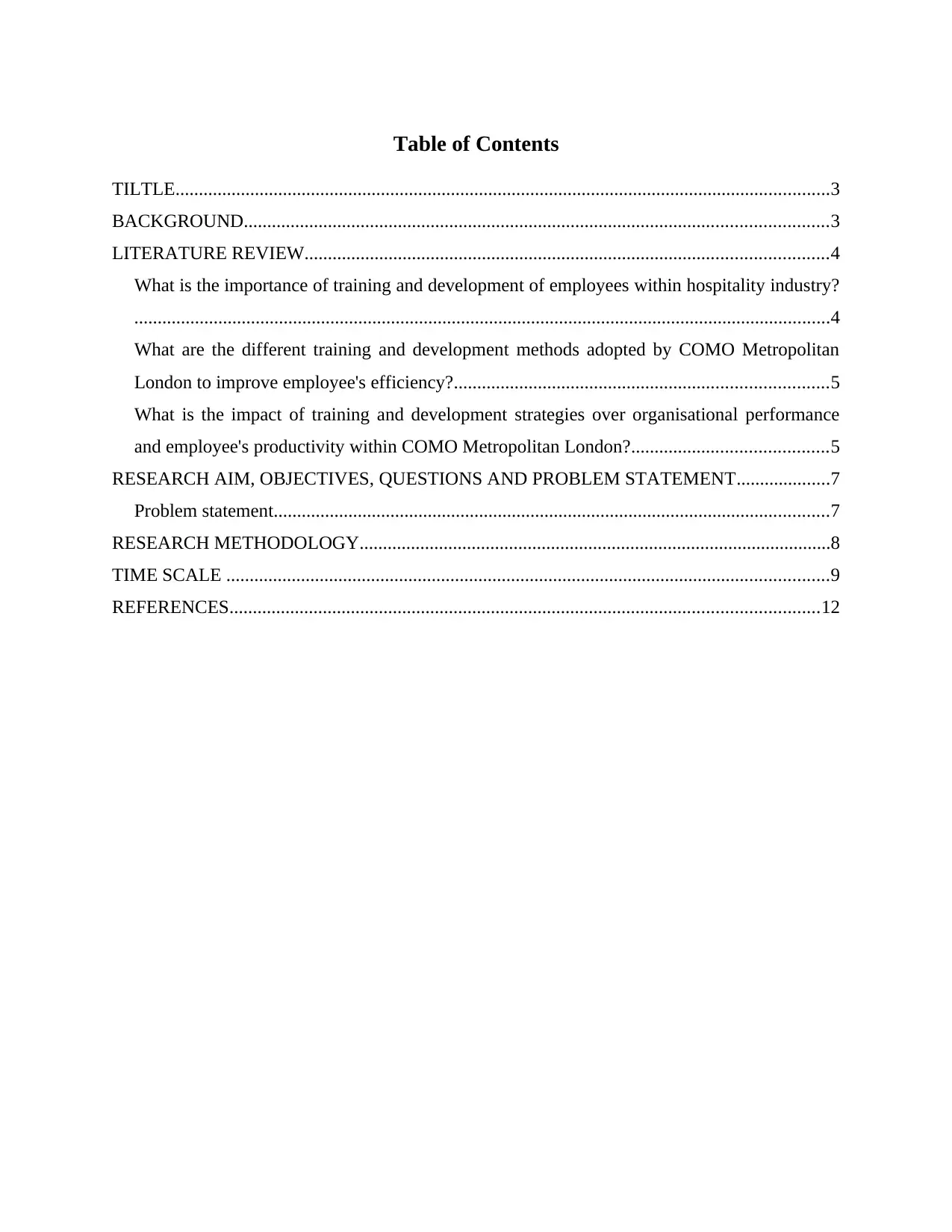
Table of Contents
TILTLE............................................................................................................................................3
BACKGROUND.............................................................................................................................3
LITERATURE REVIEW................................................................................................................4
What is the importance of training and development of employees within hospitality industry?
.....................................................................................................................................................4
What are the different training and development methods adopted by COMO Metropolitan
London to improve employee's efficiency?................................................................................5
What is the impact of training and development strategies over organisational performance
and employee's productivity within COMO Metropolitan London?..........................................5
RESEARCH AIM, OBJECTIVES, QUESTIONS AND PROBLEM STATEMENT....................7
Problem statement.......................................................................................................................7
RESEARCH METHODOLOGY.....................................................................................................8
TIME SCALE .................................................................................................................................9
REFERENCES..............................................................................................................................12
TILTLE............................................................................................................................................3
BACKGROUND.............................................................................................................................3
LITERATURE REVIEW................................................................................................................4
What is the importance of training and development of employees within hospitality industry?
.....................................................................................................................................................4
What are the different training and development methods adopted by COMO Metropolitan
London to improve employee's efficiency?................................................................................5
What is the impact of training and development strategies over organisational performance
and employee's productivity within COMO Metropolitan London?..........................................5
RESEARCH AIM, OBJECTIVES, QUESTIONS AND PROBLEM STATEMENT....................7
Problem statement.......................................................................................................................7
RESEARCH METHODOLOGY.....................................................................................................8
TIME SCALE .................................................................................................................................9
REFERENCES..............................................................................................................................12
TILTLE
To determine the importance of training and development of employees and its impact
over organisational performance and employee's productivity within hospitality industry.
BACKGROUND
Training and development plays a very important role in an organisation as it helps in
increasing the working efficiency and effectiveness of employees to achieve the desired aims and
objectives of the business in a successful manner (Maity, 2019). It is generally defined as the
educational activities in an organisation that is created for enhancing the skills and knowledge of
employees so that they perform the particular tasks in an effective way. It is important for every
organisation to provide effective and productive training to their employees because this helps in
improving their weak areas. It is the responsibility of the company leaders to train their
employees so that they work with high confidence and dedication for achieving high growth and
success in the competitive market. These training programs generally involves increasing the
employee knowledge and skills sets and in instilling higher motivation in enhancing their job
performance. When employees are updated with the new technology and trends they tend to
produce more and this helps in improving their level of productivity in the business market. It is
mainly considered as the main element of the human resource department and this helps in
improving their working capability for increased customer base and market share. It is defined
as a continuous process of gaining knowledge, improving skills, changing attitude and clarifying
concepts for attaining success in the business market. The chosen organisation in the present
research is COMO Metropolitan London which is a famous company and is headquartered in
London England (Miller and Akdere, 2019). It was founded in the year 1991 by Christina Ong
which mainly focus on providing best services to their customer in order to gain high
profitability and productivity.
To determine the importance of training and development of employees and its impact
over organisational performance and employee's productivity within hospitality industry.
BACKGROUND
Training and development plays a very important role in an organisation as it helps in
increasing the working efficiency and effectiveness of employees to achieve the desired aims and
objectives of the business in a successful manner (Maity, 2019). It is generally defined as the
educational activities in an organisation that is created for enhancing the skills and knowledge of
employees so that they perform the particular tasks in an effective way. It is important for every
organisation to provide effective and productive training to their employees because this helps in
improving their weak areas. It is the responsibility of the company leaders to train their
employees so that they work with high confidence and dedication for achieving high growth and
success in the competitive market. These training programs generally involves increasing the
employee knowledge and skills sets and in instilling higher motivation in enhancing their job
performance. When employees are updated with the new technology and trends they tend to
produce more and this helps in improving their level of productivity in the business market. It is
mainly considered as the main element of the human resource department and this helps in
improving their working capability for increased customer base and market share. It is defined
as a continuous process of gaining knowledge, improving skills, changing attitude and clarifying
concepts for attaining success in the business market. The chosen organisation in the present
research is COMO Metropolitan London which is a famous company and is headquartered in
London England (Miller and Akdere, 2019). It was founded in the year 1991 by Christina Ong
which mainly focus on providing best services to their customer in order to gain high
profitability and productivity.
⊘ This is a preview!⊘
Do you want full access?
Subscribe today to unlock all pages.

Trusted by 1+ million students worldwide
LITERATURE REVIEW
What is the importance of training and development of employees within hospitality industry?
As per the view of Johnson, Park and Bartlett (2018), training and development is very
important for employees because it helps in increasing their working ability and efficiency to
attain the predetermined goals and objectives of the business. Employees who generally miss out
on work and miss the training sessions organised by the company managers results in delaying
the time of project completion. With the changing marketing techniques and with high paced
development in the corporate world, it becomes necessary for the company to focus on providing
training and development to employees. Training and development helps in increasing the
overall growth and success in the hospitality industry by guiding employees in the right manner
for improving the working culture of the business. There are several benefits of training and
development of employees in the hospitality industry and it is defined below:
Addressing weaknesses of employee– Employees working in the hospitality industry
generally have several weaknesses and this requires proper guidance to them so that
perform in an effective way (Sheehan, Grant and Garavan, 2018). For this it is important
for an organisation to provide effective training to their employees so that they improve
their weaknesses and make them learn the concepts that helps in achieving the goals of
the business.
Improved performance of employees – An employee who receive effective and
proficient training by the company managers are more productive in their work. Trained
employees are comparatively more efficient and effective in their work as they know hoe
to gain success in the highly competitive business environment (Baum, 2019). Productive
training to employees helps in increasing their motivation and morale to work for
attaining the defined objectives of the company.
Job satisfaction among employees – It is important for the hospitality industry to train
and develop their employees in a proper manner so that they deliver services in an
efficient manner. When employees are properly trained, this helps in creating a sense of
satisfaction among them that they are valued for the company as they are the only person
that helps in achieving high number of customers towards receiving the services (Hassi,
2019).
What is the importance of training and development of employees within hospitality industry?
As per the view of Johnson, Park and Bartlett (2018), training and development is very
important for employees because it helps in increasing their working ability and efficiency to
attain the predetermined goals and objectives of the business. Employees who generally miss out
on work and miss the training sessions organised by the company managers results in delaying
the time of project completion. With the changing marketing techniques and with high paced
development in the corporate world, it becomes necessary for the company to focus on providing
training and development to employees. Training and development helps in increasing the
overall growth and success in the hospitality industry by guiding employees in the right manner
for improving the working culture of the business. There are several benefits of training and
development of employees in the hospitality industry and it is defined below:
Addressing weaknesses of employee– Employees working in the hospitality industry
generally have several weaknesses and this requires proper guidance to them so that
perform in an effective way (Sheehan, Grant and Garavan, 2018). For this it is important
for an organisation to provide effective training to their employees so that they improve
their weaknesses and make them learn the concepts that helps in achieving the goals of
the business.
Improved performance of employees – An employee who receive effective and
proficient training by the company managers are more productive in their work. Trained
employees are comparatively more efficient and effective in their work as they know hoe
to gain success in the highly competitive business environment (Baum, 2019). Productive
training to employees helps in increasing their motivation and morale to work for
attaining the defined objectives of the company.
Job satisfaction among employees – It is important for the hospitality industry to train
and develop their employees in a proper manner so that they deliver services in an
efficient manner. When employees are properly trained, this helps in creating a sense of
satisfaction among them that they are valued for the company as they are the only person
that helps in achieving high number of customers towards receiving the services (Hassi,
2019).
Paraphrase This Document
Need a fresh take? Get an instant paraphrase of this document with our AI Paraphraser
What are the different training and development methods adopted by COMO Metropolitan
London to improve employee's efficiency?
As per the view of Armstrong and Landers (2018), employees that are properly trained
tends to be more happier while preforming their tasks given by the senior members as they know
how to particular job in an effective manner. It is important for the company managers to provide
training to new employees as they are also excited and eager to know about the working nature
and techniques they use for gaining more number of customers. Existing employees working in
the company also needs training so that they learn new techniques and methods for doing their
work in a fast and efficient manner. There are different types of training methods that COMO
Metropolitan London for improving efficiency of employees and are defined below:
Learning through technology – With the development in the technology, training
through computerized method is more relevant for both employees and training members
of COMO Metropolitan London. It is also known as e-learning and this helps in giving
education through online platforms in order to give employees effective training about
the new methods so that they work more efficiently for achieving the defined goals
(Rawashdeh, 2018).
On the job training for employees – Providing training to employees while working in
COMO Metropolitan London is the most beneficial option that helps in saving their time
and in increasing their knowledge and skill. This helps in providing benefits to newly
hired employees as this results in increasing their working efficiency and effectiveness
for gaining high profitability and growth in the competitive hospitality industry (Saffar
and Obeidat, 2020).
Mentoring or coaching – Establishing a mentorship program in COMO Metropolitan
London along with effective training methods helps in creating more development
opportunities for employees as well as in developing strong relationships with the new
employees in order to make them feel supported and welcomed. This helps in giving
personal attention to every employee and in making them understand that they need to
work in this manner because it helps in accomplishing the long term goals of the
company (Guan and Frenkel, 2018).
London to improve employee's efficiency?
As per the view of Armstrong and Landers (2018), employees that are properly trained
tends to be more happier while preforming their tasks given by the senior members as they know
how to particular job in an effective manner. It is important for the company managers to provide
training to new employees as they are also excited and eager to know about the working nature
and techniques they use for gaining more number of customers. Existing employees working in
the company also needs training so that they learn new techniques and methods for doing their
work in a fast and efficient manner. There are different types of training methods that COMO
Metropolitan London for improving efficiency of employees and are defined below:
Learning through technology – With the development in the technology, training
through computerized method is more relevant for both employees and training members
of COMO Metropolitan London. It is also known as e-learning and this helps in giving
education through online platforms in order to give employees effective training about
the new methods so that they work more efficiently for achieving the defined goals
(Rawashdeh, 2018).
On the job training for employees – Providing training to employees while working in
COMO Metropolitan London is the most beneficial option that helps in saving their time
and in increasing their knowledge and skill. This helps in providing benefits to newly
hired employees as this results in increasing their working efficiency and effectiveness
for gaining high profitability and growth in the competitive hospitality industry (Saffar
and Obeidat, 2020).
Mentoring or coaching – Establishing a mentorship program in COMO Metropolitan
London along with effective training methods helps in creating more development
opportunities for employees as well as in developing strong relationships with the new
employees in order to make them feel supported and welcomed. This helps in giving
personal attention to every employee and in making them understand that they need to
work in this manner because it helps in accomplishing the long term goals of the
company (Guan and Frenkel, 2018).
What is the impact of training and development strategies over organisational performance and
employee's productivity within COMO Metropolitan London?
According to the view of Laing (2021), training and development has created positive
impact on the organisational performance and employee productivity of the COMO metropolitan
London. In recent time were competition is so high the it is very crucial for the company to
provide effect training to their employee so that they can match up with the need and wants of
the current time. Learning of an employee creates a positive impact which on the other hand,
develop a creative and innovative working environment for the organisation. Some of the effects
of coaching ate as follow:
Enhanced employee skills and knowledge: The foremost impact of training and
development is increased employee skill and knowledge which help the staff to conduct their
work in more efficient way (Irabor and Okolie, 2019). Learning session help the workforce to
work with advancement technology so that they can reduce their pressure and work with more
productivity.
Positive employee attitude; Another impact of training and development in COMO metro
politician London is positive attitude and behaviour of the employee towards their work and
peers which effect the organisational performance by creating a positive working environment
for the company. Training gives the direction to the staff for their job which on the other hand
reduce their stress. This also helps in minimising the grievance and conflict within the
organisation between team or employees (Kurdi, Alshurideh and Alnaser, 2020).
Increased employee satisfaction: One of the vital impact of training and development
strategies on organisation is more job satisfaction among employee which enhanced the retention
rate of the employee. low employee turnover in the company impact the organisational
performance in better manner (Hendri, 2019).
Thus, training and development strategies is very important and companies should focus on
designing creative and innovative training strategies for their employee.
employee's productivity within COMO Metropolitan London?
According to the view of Laing (2021), training and development has created positive
impact on the organisational performance and employee productivity of the COMO metropolitan
London. In recent time were competition is so high the it is very crucial for the company to
provide effect training to their employee so that they can match up with the need and wants of
the current time. Learning of an employee creates a positive impact which on the other hand,
develop a creative and innovative working environment for the organisation. Some of the effects
of coaching ate as follow:
Enhanced employee skills and knowledge: The foremost impact of training and
development is increased employee skill and knowledge which help the staff to conduct their
work in more efficient way (Irabor and Okolie, 2019). Learning session help the workforce to
work with advancement technology so that they can reduce their pressure and work with more
productivity.
Positive employee attitude; Another impact of training and development in COMO metro
politician London is positive attitude and behaviour of the employee towards their work and
peers which effect the organisational performance by creating a positive working environment
for the company. Training gives the direction to the staff for their job which on the other hand
reduce their stress. This also helps in minimising the grievance and conflict within the
organisation between team or employees (Kurdi, Alshurideh and Alnaser, 2020).
Increased employee satisfaction: One of the vital impact of training and development
strategies on organisation is more job satisfaction among employee which enhanced the retention
rate of the employee. low employee turnover in the company impact the organisational
performance in better manner (Hendri, 2019).
Thus, training and development strategies is very important and companies should focus on
designing creative and innovative training strategies for their employee.
⊘ This is a preview!⊘
Do you want full access?
Subscribe today to unlock all pages.
Trusted by 1+ million students worldwide
RESEARCH AIM, OBJECTIVES, QUESTIONS AND PROBLEM
STATEMENT
Research Aim:
To determine the importance of training and development of employees and its impact
over organisational performance and employee's productivity. A study on COMO Metropolitan
London
Research Objectives:
To examine the importance of training and development of employees within hospitality
industry
To evaluate the different training and development methods adopted by COMO
Metropolitan London to improve employee's efficiency
To discern the impact of training and development strategies over organisational
performance and employee's productivity within COMO Metropolitan London
Research Questions:
What is the importance of training and development of employees within hospitality
industry?
What are the different training and development methods adopted by COMO
Metropolitan London to improve employee's efficiency?
What is the impact of training and development strategies over organisational
performance and employee's productivity within COMO Metropolitan London?
Problem statement
The main problem of the present research is to identify the employees and weak point in
every area as it is difficult of the company to address the problem of each and every employee
performing the tasks of the business (Flannery, 2021). So it is important for the company to
implement an effective training session that helps in solving the problem of every employee and
in increasing their knowledge.
STATEMENT
Research Aim:
To determine the importance of training and development of employees and its impact
over organisational performance and employee's productivity. A study on COMO Metropolitan
London
Research Objectives:
To examine the importance of training and development of employees within hospitality
industry
To evaluate the different training and development methods adopted by COMO
Metropolitan London to improve employee's efficiency
To discern the impact of training and development strategies over organisational
performance and employee's productivity within COMO Metropolitan London
Research Questions:
What is the importance of training and development of employees within hospitality
industry?
What are the different training and development methods adopted by COMO
Metropolitan London to improve employee's efficiency?
What is the impact of training and development strategies over organisational
performance and employee's productivity within COMO Metropolitan London?
Problem statement
The main problem of the present research is to identify the employees and weak point in
every area as it is difficult of the company to address the problem of each and every employee
performing the tasks of the business (Flannery, 2021). So it is important for the company to
implement an effective training session that helps in solving the problem of every employee and
in increasing their knowledge.
Paraphrase This Document
Need a fresh take? Get an instant paraphrase of this document with our AI Paraphraser
RESEARCH METHODOLOGY
Research methodology is defined as the specific techniques or procedures used to select,
identify, analyse and process information about the research topic or study (Mohajan, 2018).
This section is considered as the most important part of the research methodology as it helps in
collecting and interpreting data in a more summarised way in order to complete the research.
Research philosophy
There are generally two types of research philosophy that are known as positivism and
interpretivism. Positivism philosophy will be selected in the current conducted investigation by
the investigator (Pandey and Pandey, 2021). The reason for selecting positivism philosophy
helps in gaining more detailed information about the given topic in an effective manner for
attaining research aims and objectives.
Research approach
Research approach is mainly divided into two parts that is known as deductive and
inductive approach. In the present investigation, the investigator will use deductive approach as
this helps in completing the research in an effective manner (Dźwigoł and Dźwigoł-Barosz,
2018). The reason for choosing deductive method is that it helps the investigator in collecting
and interpreting quantitative data because it contains of numerical information in a precise
manner.
Research strategy
There are various kinds of research strategies that help the researcher in gaining correct
data such as grounded theory, survey, systematic literature review, focus group, questionnaire
and many more (Zangirolami-Raimundo, Echeimberg and Leone, 2018). In the current research
going on, the researcher will be choosing survey research strategy. The advantage for choosing
this survey strategy is that it helps the researcher in gaining accurate and valuable information
from the large sample data.
Research choice
There are two methods involved in research choice and are defined as qualitative and
quantitative. In the carried on present research, the researcher will select quantitative method as
it is easy to understand (Ngozwana, 2018). The reason for choosing this method is that it helps in
calculating numerical data in an effective manner so that research objectives can be achieved.
Time horizon
Research methodology is defined as the specific techniques or procedures used to select,
identify, analyse and process information about the research topic or study (Mohajan, 2018).
This section is considered as the most important part of the research methodology as it helps in
collecting and interpreting data in a more summarised way in order to complete the research.
Research philosophy
There are generally two types of research philosophy that are known as positivism and
interpretivism. Positivism philosophy will be selected in the current conducted investigation by
the investigator (Pandey and Pandey, 2021). The reason for selecting positivism philosophy
helps in gaining more detailed information about the given topic in an effective manner for
attaining research aims and objectives.
Research approach
Research approach is mainly divided into two parts that is known as deductive and
inductive approach. In the present investigation, the investigator will use deductive approach as
this helps in completing the research in an effective manner (Dźwigoł and Dźwigoł-Barosz,
2018). The reason for choosing deductive method is that it helps the investigator in collecting
and interpreting quantitative data because it contains of numerical information in a precise
manner.
Research strategy
There are various kinds of research strategies that help the researcher in gaining correct
data such as grounded theory, survey, systematic literature review, focus group, questionnaire
and many more (Zangirolami-Raimundo, Echeimberg and Leone, 2018). In the current research
going on, the researcher will be choosing survey research strategy. The advantage for choosing
this survey strategy is that it helps the researcher in gaining accurate and valuable information
from the large sample data.
Research choice
There are two methods involved in research choice and are defined as qualitative and
quantitative. In the carried on present research, the researcher will select quantitative method as
it is easy to understand (Ngozwana, 2018). The reason for choosing this method is that it helps in
calculating numerical data in an effective manner so that research objectives can be achieved.
Time horizon
There are two types of time horizon methods such as cross-sectional and longitudinal
time horizon. In the present conducted study, the researcher will choose cross-sectional time
horizon method (Säfsten and Gustavsson, 2020). The benefit for selecting this method is that it
helps in collecting and interpreting numerical data from the large sample in a timely manner and
at low cost.
Data collection
There are two types of data collection methods such as primary and secondary data.
Primary and secondary method will be selected by the researcher for conducting the present
research in a proper way (Dodds and Hess, 2020). The reason for selecting this is that it helps in
gathering detailed information about the chosen topic in an accurate and reliable manner.
Data analysis
Data analysis consists of several techniques such as thematic analysis, frequency
distribution analysis and so on. In the current research, frequency distribution analysis will be
selected by the researcher (Abutabenjeh and Jaradat, 2018). The reason for selecting this method
is that it helps in accumulating data from large set of samples in an appropriate manner.
Sampling
Probability and non-probability are defined as two of the sampling methods for gathering
data. In the present conducted study, the researcher will use probability sampling method and
further in this random sampling method is used (Al-Ababneh, 2020). It helps the researcher in
collecting and analysing data from fair and equal number of respondents. The researcher has
selected 30 employees of COMO Metropolitan London.
TIME SCALE
In the present research, the researcher will be using Gantt chart for scheduling the tasks
and activities of the research in a more systematic manner (Xu, Wang and Liang, 2020). Gantt
chart has mainly two important sections: one section involves each activity and another section
involves time interval.
time horizon. In the present conducted study, the researcher will choose cross-sectional time
horizon method (Säfsten and Gustavsson, 2020). The benefit for selecting this method is that it
helps in collecting and interpreting numerical data from the large sample in a timely manner and
at low cost.
Data collection
There are two types of data collection methods such as primary and secondary data.
Primary and secondary method will be selected by the researcher for conducting the present
research in a proper way (Dodds and Hess, 2020). The reason for selecting this is that it helps in
gathering detailed information about the chosen topic in an accurate and reliable manner.
Data analysis
Data analysis consists of several techniques such as thematic analysis, frequency
distribution analysis and so on. In the current research, frequency distribution analysis will be
selected by the researcher (Abutabenjeh and Jaradat, 2018). The reason for selecting this method
is that it helps in accumulating data from large set of samples in an appropriate manner.
Sampling
Probability and non-probability are defined as two of the sampling methods for gathering
data. In the present conducted study, the researcher will use probability sampling method and
further in this random sampling method is used (Al-Ababneh, 2020). It helps the researcher in
collecting and analysing data from fair and equal number of respondents. The researcher has
selected 30 employees of COMO Metropolitan London.
TIME SCALE
In the present research, the researcher will be using Gantt chart for scheduling the tasks
and activities of the research in a more systematic manner (Xu, Wang and Liang, 2020). Gantt
chart has mainly two important sections: one section involves each activity and another section
involves time interval.
⊘ This is a preview!⊘
Do you want full access?
Subscribe today to unlock all pages.
Trusted by 1+ million students worldwide

Paraphrase This Document
Need a fresh take? Get an instant paraphrase of this document with our AI Paraphraser

REFERENCES
Books and Journals
Abutabenjeh, S. and Jaradat, R., 2018. Clarification of research design, research methods, and
research methodology: A guide for public administration researchers and
practitioners. Teaching Public Administration, 36(3), pp.237-258.
Al-Ababneh, M.M., 2020. Linking ontology, epistemology and research methodology. Science
& Philosophy, 8(1), pp.75-91.
Armstrong, M.B. and Landers, R.N., 2018. Gamification of employee training and
development. International Journal of Training and Development, 22(2), pp.162-169.
Baum, T., 2019. Does the hospitality industry need or deserve talent?. International Journal of
Contemporary Hospitality Management.
Dodds, S. and Hess, A.C., 2020. Adapting research methodology during COVID-19: lessons for
transformative service research. Journal of Service Management.
Dźwigoł, H. and Dźwigoł-Barosz, M., 2018. Scientific research methodology in management
sciences. Financial and credit activity problems of theory and practice, 2(25), pp.424-
437.
Flannery, K.V., 2021. The research problem. In Guilá Naquitz (pp. 3-18). Routledge.
Guan, X. and Frenkel, S., 2018. How perceptions of training impact employee performance:
Evidence from two Chinese manufacturing firms. Personnel Review.
Hassi, A., 2019. Empowering leadership and management innovation in the hospitality industry
context: The mediating role of climate for creativity. International Journal of
Contemporary Hospitality Management.
Hendri, M.I., 2019. The mediation effect of job satisfaction and organizational commitment on
the organizational learning effect of the employee performance. International Journal of
Productivity and Performance Management.
Irabor, I.E. and Okolie, U.C., 2019. A review of employees’ job satisfaction and its affect on
their retention. Annals of Spiru Haret University. Economic Series, 19(2), pp.93-114.
Johnson, K.R., Park, S. and Bartlett, K.R., 2018. Perceptions of customer service orientation,
training, and employee engagement in Jamaica’s hospitality sector. European Journal of
Training and Development.
Kurdi, B., Alshurideh, M. and Alnaser, A., 2020. The impact of employee satisfaction on
customer satisfaction: Theoretical and empirical underpinning. Management Science
Letters, 10(15), pp.3561-3570.
Laing, I.F., 2021. The impact of training and development on worker performance and
productivity in public sector organizations: A case study of Ghana Ports and Harbours
Authority. International Research Journal of Business and Strategic Management, 2(2).
Maity, S., 2019. Identifying opportunities for artificial intelligence in the evolution of training
and development practices. Journal of Management Development.
Miller, K.E. and Akdere, M., 2019. Advancing organizational corporate social responsibility
(CSR) agenda: Implications for training and development. European Journal of Training
and Development, 43(9), pp.860-872.
Mohajan, H.K., 2018. Qualitative research methodology in social sciences and related
subjects. Journal of Economic Development, Environment and People, 7(1), pp.23-48.
Ngozwana, N., 2018. Ethical dilemmas in qualitative research methodology: Researcher’s
reflections. International Journal of Educational Methodology, 4(1), pp.19-28.
Books and Journals
Abutabenjeh, S. and Jaradat, R., 2018. Clarification of research design, research methods, and
research methodology: A guide for public administration researchers and
practitioners. Teaching Public Administration, 36(3), pp.237-258.
Al-Ababneh, M.M., 2020. Linking ontology, epistemology and research methodology. Science
& Philosophy, 8(1), pp.75-91.
Armstrong, M.B. and Landers, R.N., 2018. Gamification of employee training and
development. International Journal of Training and Development, 22(2), pp.162-169.
Baum, T., 2019. Does the hospitality industry need or deserve talent?. International Journal of
Contemporary Hospitality Management.
Dodds, S. and Hess, A.C., 2020. Adapting research methodology during COVID-19: lessons for
transformative service research. Journal of Service Management.
Dźwigoł, H. and Dźwigoł-Barosz, M., 2018. Scientific research methodology in management
sciences. Financial and credit activity problems of theory and practice, 2(25), pp.424-
437.
Flannery, K.V., 2021. The research problem. In Guilá Naquitz (pp. 3-18). Routledge.
Guan, X. and Frenkel, S., 2018. How perceptions of training impact employee performance:
Evidence from two Chinese manufacturing firms. Personnel Review.
Hassi, A., 2019. Empowering leadership and management innovation in the hospitality industry
context: The mediating role of climate for creativity. International Journal of
Contemporary Hospitality Management.
Hendri, M.I., 2019. The mediation effect of job satisfaction and organizational commitment on
the organizational learning effect of the employee performance. International Journal of
Productivity and Performance Management.
Irabor, I.E. and Okolie, U.C., 2019. A review of employees’ job satisfaction and its affect on
their retention. Annals of Spiru Haret University. Economic Series, 19(2), pp.93-114.
Johnson, K.R., Park, S. and Bartlett, K.R., 2018. Perceptions of customer service orientation,
training, and employee engagement in Jamaica’s hospitality sector. European Journal of
Training and Development.
Kurdi, B., Alshurideh, M. and Alnaser, A., 2020. The impact of employee satisfaction on
customer satisfaction: Theoretical and empirical underpinning. Management Science
Letters, 10(15), pp.3561-3570.
Laing, I.F., 2021. The impact of training and development on worker performance and
productivity in public sector organizations: A case study of Ghana Ports and Harbours
Authority. International Research Journal of Business and Strategic Management, 2(2).
Maity, S., 2019. Identifying opportunities for artificial intelligence in the evolution of training
and development practices. Journal of Management Development.
Miller, K.E. and Akdere, M., 2019. Advancing organizational corporate social responsibility
(CSR) agenda: Implications for training and development. European Journal of Training
and Development, 43(9), pp.860-872.
Mohajan, H.K., 2018. Qualitative research methodology in social sciences and related
subjects. Journal of Economic Development, Environment and People, 7(1), pp.23-48.
Ngozwana, N., 2018. Ethical dilemmas in qualitative research methodology: Researcher’s
reflections. International Journal of Educational Methodology, 4(1), pp.19-28.
⊘ This is a preview!⊘
Do you want full access?
Subscribe today to unlock all pages.
Trusted by 1+ million students worldwide

1 out of 13


Related Documents


Your All-in-One AI-Powered Toolkit for Academic Success.
+13062052269
info@desklib.com
Available 24*7 on WhatsApp / Email
![[object Object]](/_next/static/media/star-bottom.7253800d.svg)
Unlock your academic potential
Copyright © 2020–2026 A2Z Services. All Rights Reserved. Developed and managed by ZUCOL.