HRD Report: Essentiality of Training and Development for Employees

Verified

Added on  2023/04/06

|8
|1797
|318
Report
AI Summary
This report examines the critical role of training and development in organizations, emphasizing its importance in today's global business context. It explores various theories of training and development, including learning types, experiential learning, social learning, humanist approaches, critical reflection, adult learning, and transformational learning. The report highlights how these theories influence the design, delivery, and measurement of learning within organizations. It further discusses the impact of training on work culture, productivity, and employee performance, as well as the challenges faced by multinational companies in implementing effective training programs. The report concludes by stressing the need for organizations to cultivate a workforce that is adaptable and competitive, while acknowledging the complexities of providing training across diverse markets, using Google as a case study. It offers insights into how companies can effectively support their employees and gain a competitive edge through strategic training initiatives.

Document Page
Running head: HUMAN RESOURCE DEVELOPMENT
HUMAN RESOURCE DEVELOPMENT
Name of the Student:
Name of the University:
Author Note:
tabler-icon-diamond-filled.svg

Paraphrase This Document

Need a fresh take? Get an instant paraphrase of this document with our AI Paraphraser
Document Page
1HUMAN RESOURCE DEVELOPMENT
The aim of this paper is to discuss the essentiality of the training and develop process
for the employees of the organisation. In this global business context, the training and
development of the work force in a company has become essential. It is the only way to
develop the company and reach the common goal. In case the employees are not properly
trained and do not possess needed knowledge they cannot perform properly which does not
allow the companies to have the competitive edge. Therefore the employees are actively
participating in various program organised by their organisations and observing demand for
arranging more training and development programs like those (Bamberger and Belogolovsky
2010). The successful organisations of today have been to there workforce as a highly
valuable asset so that any changes can be accepted without question and these result in
positive outcomes. There are several theories that emphasize on the essentiality of training
and development in organisation and provide different alternatives for this process. These
theories influence the design, delivery and measurement of learning. The seven major
theories of training and development are theory of learning types, theory of experiential
learning, Theory of social learning, humanist approach, theory of critical reflection, theory of
adult learning and transformational learning.
The theory of learning type is based on the study of Gagne that emphasizes on the
learning of intellectual skills. There are some skills then I found rare among the persons
therefore can you suggest to use different learning types in this theory and each of the
learning type contains some external and internal conditions. This theory deals with the kinds
of things people can learn and how they can learn them. There are two main components of
this theory which include techniques needed to teach people and taxonomy of learning
outcomes which means the material what is being learnt. There are five categories of human
performance and each of these require different sets of conditions which can help them
Document Page
2HUMAN RESOURCE DEVELOPMENT
maximizing the learning process, attention as well as transfer. These five categories include
verbal information, intellectual skills, cognitive categories, attitude and motor skills.
The theory of experiential learning relates to the two levels of learning and is
concerned with the internal cognitive processes of the learners. According to this theory there
are four stages of learning cycle which include concrete experience, reflective observation,
abstract conceptualization and active experimentation. The concrete experience relates to the
new experience and situation which the learners encounter and ready interpret for existing
experience (Ju 2019). Reflective observation relates to the consistency between the
experience and understanding. The abstract conceptualization gives rise to the new ideas and
modify the existing abstract concepts from which the learner might have learn from their
experience. Finally the active experimentation relates to the application of ideas of the learner
to the world surrounded.
The social learning theory emphasizes on the reciprocal interactions of environment
the person and his behaviour. Each of this component influence another from which the
learner learnt. The theorist of this concept, Albert Bandura has pointed out that directory
reinforcement like training process of the organization may not address all types of learning.
This is due to the fact that there are some social factors which may not be taught. These
elements are actually learnt by the learner from their surroundings which is called
observational learning and associate with the understanding of various human behaviour. For
an example, a new employee can learn a huge from the environment and surroundings of his
organisation which are very much professional and supportive of learning (Nolan and
Garavan 2016). This theory explains about the psychological states that play vital role in this
learning process (Seidle, Fernandez and Perry 2016). It is the mental status of the person is
positive regarding any type of learning activity then he will be able to be a part of the
learning process and again positivity from that particular process. Therefore the
Document Page
3HUMAN RESOURCE DEVELOPMENT
organisational training programs may be effective for learning other things by the employees
but these cannot be taught as mental state of different people are different. However these
programs can motivate the employees and build positive mental state so that the learners can
learn from their environment and their supervisors or co-workers.
The humanist approach of learning routes from the field of humanistic psychology
where the importance are put on self-esteem, self-development and motivation of the persons.
The humanistic approach relates to the learning from the reflection on personal experiences.
It is purely related to the search for the self-definition (Nolan and Garavan 2016). Hence in
this type of learning process, motivation plays an essential role that drives the individuals in
endeavours.
The critical learning theory is completely different from the critical reflection theory.
According this theory, the learning needs to questions which can lead the individuals to learn
to use the logical process of learning (Dochy et al. 2012). The logical process change the
personal knowledge and use factors like creativity, logical reflection, problems solving
abilities, evaluation and dialectic thinking process. The theorist of the concept of adult
learning and transformational learning, Mezirow has pointed out that there are three levels of
adult learning that include instrumental, communicative and emancipatory. On the other
hand, the three stages of transformational learning includes identification of dilemma or
crisis, establishment of the personal relevance and critical thinking.
Training and development of the workforce can lead the organisation to have
sustainable outcomes. It is important for maintaining a healthy work culture and cultivate
longevity of the business. The process of implementing proper training and development
process for the employees of the organisation can grow scopes for learning which engage the
employees with the organisation more effectively (Konings and Vanormelingen 2015). In this
tabler-icon-diamond-filled.svg

Paraphrase This Document

Need a fresh take? Get an instant paraphrase of this document with our AI Paraphraser
Document Page
4HUMAN RESOURCE DEVELOPMENT
competitive world most of the employees like interest and contribution in their work but
when the organisations motivate and inspire the employees to get growth opportunities
comma the employees get recognition and fair benefits that act as stimulus for sustainable
performance. This is the positive passion and ability to learn new things which make great
progress as well as innovation in the business therefore the leaders must try to cultivate both
these factors within the work culture. It is important that the employees feel connected to the
mission and vision of the organisation (Belogolovsky and Bamberger 2014). The training
process allow the teams of employees to share information which helps in progress of both
the employees as well as the organisation. This is also a process for keeping negative work
culture from the workplace and incorporate the process of interaction and productivity for
encountering all the negative effects of external as well as internal challenges.
The training and development of the employees in the organisation can significantly
impact on the work ethic, productivity, performance and the potential of the employees. They
are able to build a sustainable work culture by opening up and creating various opportunities
to know one another (Bamberger and Belogolovsky 2010). This nurtures their growth as well
as developed constructive and positive feedback based on which the company policies are
changed in support of the workforce. Training and development is essential for sharing
knowledge and eliminating any probability of bottleneck challenge (Colella et al. 2007). It
gives the company a scope for depending upon the teams and face any type of external or
internal changes within the organisation. The sustainability factors get promoted through
training and development of the employees and they can build themselves to have necessary
skills that give the organisation a competitive edge.
Implementing training and development programme for the employees is not an
easy job for the multinational companies. There are various factors affecting the growth and
structure of the workforce in different subsidiaries operating in different market. The
Document Page
5HUMAN RESOURCE DEVELOPMENT
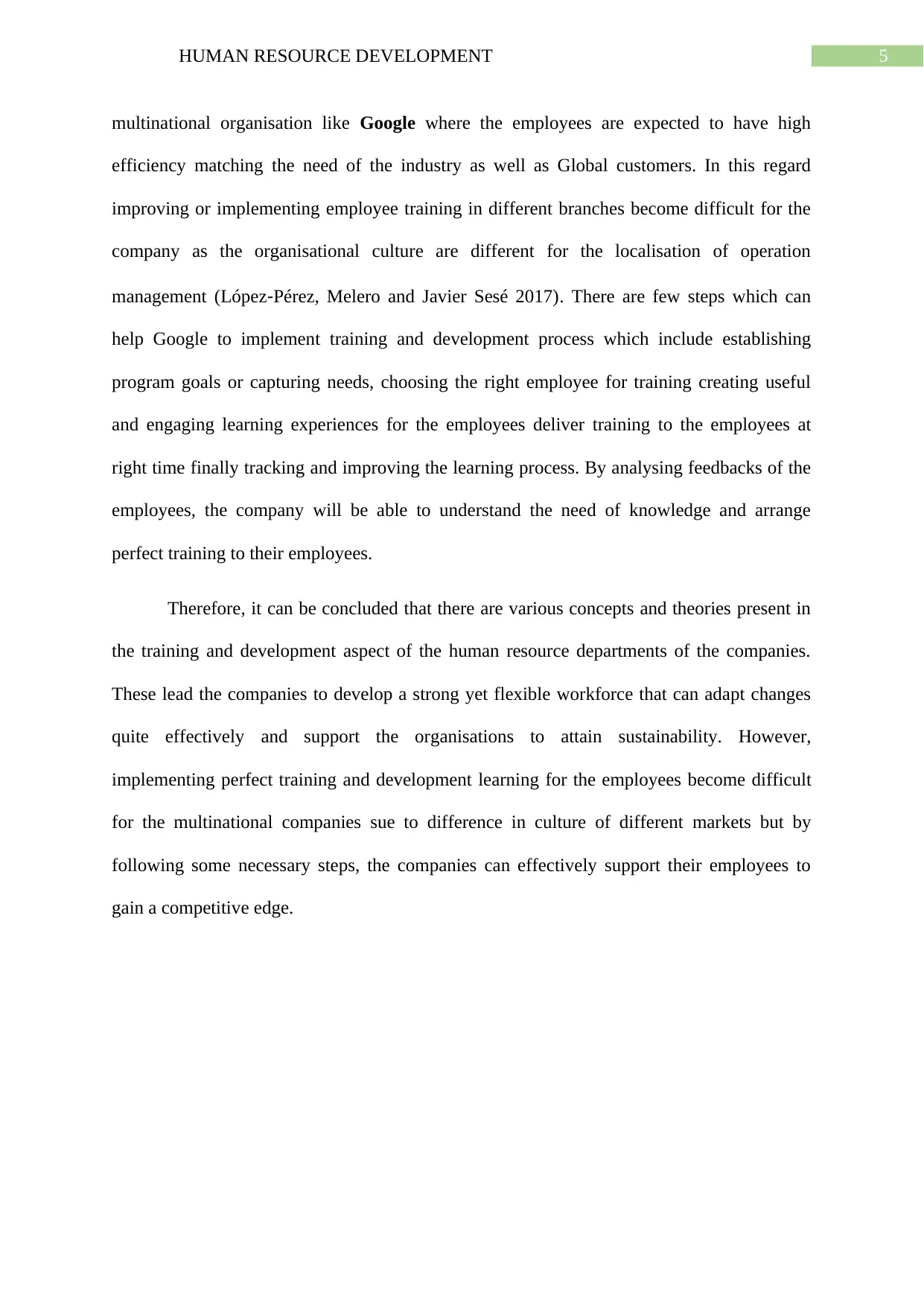
multinational organisation like Google where the employees are expected to have high
efficiency matching the need of the industry as well as Global customers. In this regard
improving or implementing employee training in different branches become difficult for the
company as the organisational culture are different for the localisation of operation
management (LópezPérez, Melero and Javier Sesé 2017). There are few steps which can
help Google to implement training and development process which include establishing
program goals or capturing needs, choosing the right employee for training creating useful
and engaging learning experiences for the employees deliver training to the employees at
right time finally tracking and improving the learning process. By analysing feedbacks of the
employees, the company will be able to understand the need of knowledge and arrange
perfect training to their employees.
Therefore, it can be concluded that there are various concepts and theories present in
the training and development aspect of the human resource departments of the companies.
These lead the companies to develop a strong yet flexible workforce that can adapt changes
quite effectively and support the organisations to attain sustainability. However,
implementing perfect training and development learning for the employees become difficult
for the multinational companies sue to difference in culture of different markets but by
following some necessary steps, the companies can effectively support their employees to
gain a competitive edge.
Document Page
6HUMAN RESOURCE DEVELOPMENT
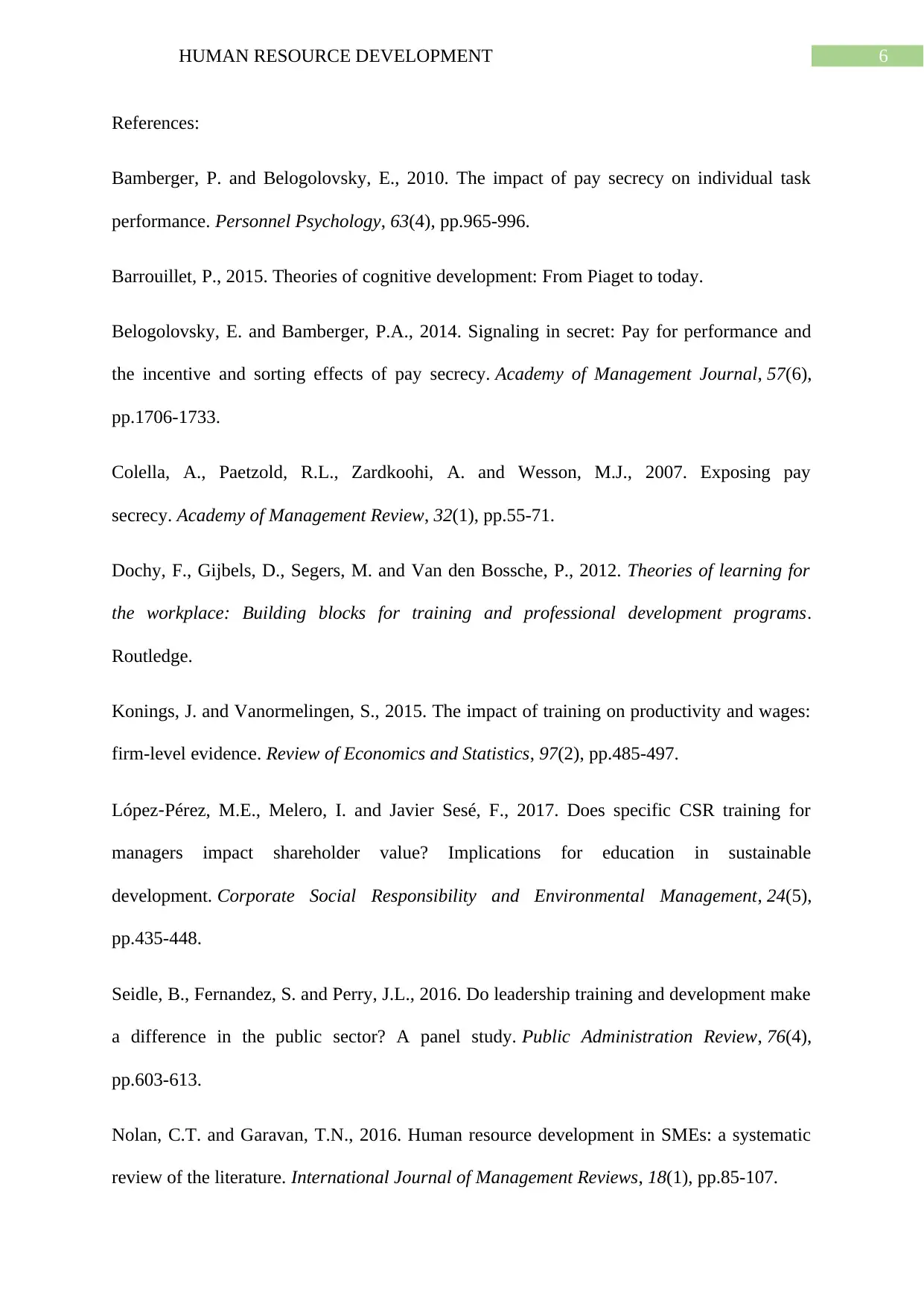
References:
Bamberger, P. and Belogolovsky, E., 2010. The impact of pay secrecy on individual task
performance. Personnel Psychology, 63(4), pp.965-996.
Barrouillet, P., 2015. Theories of cognitive development: From Piaget to today.
Belogolovsky, E. and Bamberger, P.A., 2014. Signaling in secret: Pay for performance and
the incentive and sorting effects of pay secrecy. Academy of Management Journal, 57(6),
pp.1706-1733.
Colella, A., Paetzold, R.L., Zardkoohi, A. and Wesson, M.J., 2007. Exposing pay
secrecy. Academy of Management Review, 32(1), pp.55-71.
Dochy, F., Gijbels, D., Segers, M. and Van den Bossche, P., 2012. Theories of learning for
the workplace: Building blocks for training and professional development programs.
Routledge.
Konings, J. and Vanormelingen, S., 2015. The impact of training on productivity and wages:
firm-level evidence. Review of Economics and Statistics, 97(2), pp.485-497.
LópezPérez, M.E., Melero, I. and Javier Sesé, F., 2017. Does specific CSR training for
managers impact shareholder value? Implications for education in sustainable
development. Corporate Social Responsibility and Environmental Management, 24(5),
pp.435-448.
Seidle, B., Fernandez, S. and Perry, J.L., 2016. Do leadership training and development make
a difference in the public sector? A panel study. Public Administration Review, 76(4),
pp.603-613.
Nolan, C.T. and Garavan, T.N., 2016. Human resource development in SMEs: a systematic
review of the literature. International Journal of Management Reviews, 18(1), pp.85-107.
tabler-icon-diamond-filled.svg

Paraphrase This Document

Need a fresh take? Get an instant paraphrase of this document with our AI Paraphraser
Document Page
7HUMAN RESOURCE DEVELOPMENT
Ju, B., 2019. The roles of the psychology, systems and economic theories in human resource
development. European Journal of Training and Development.
chevron_up_icon
1 out of 8
circle_padding
hide_on_mobile
zoom_out_icon
[object Object]