Professional Development Event: Teamwork and Communication
VerifiedAdded on 2022/07/06
|18
|4315
|37
Project
AI Summary
This project involves designing and implementing a two-day professional development training event for PA Consulting Group employees. The student, in the role of a new employee, is tasked with planning the event, which includes workshops, coaching sessions, and team-building activities at a residential center. The project requires creating a detailed schedule using project management software, designing a comprehensive training pack with various activities, and designing a two-hour workshop on teamwork. The student must also evaluate the effectiveness of interpersonal skills used during the design and delivery process and provide a report on problem-solving techniques. The assignment covers communication skills (verbal, non-verbal, and written), time management skills (planning, prioritization, organization, delegation), and the practical application of these skills in a professional setting. The provided content includes detailed explanations of communication and time management skills, along with a sample event schedule for a Docker training session. The project emphasizes practical application and evaluation of skills learned.
PROGRAM TITLE: ……………………………………………
UNIT TITLE: …………………………………………………….
ASSIGNMENT NUMBER: 01
ASSIGNMENT NAME: …………………………………….
SUBMISSION DATE: ……………………………………….
DATE RECEIVED: …………………………………………….
TUTORIAL LECTURER: ……………………………………
WORD COUNT: ……………………………………………..
STUDENT NAME: NGUYEN NGOC HA
STUDENT ID: BKC12404
MOBILE NUMBER: 0379165558
UNIT TITLE: …………………………………………………….
ASSIGNMENT NUMBER: 01
ASSIGNMENT NAME: …………………………………….
SUBMISSION DATE: ……………………………………….
DATE RECEIVED: …………………………………………….
TUTORIAL LECTURER: ……………………………………
WORD COUNT: ……………………………………………..
STUDENT NAME: NGUYEN NGOC HA
STUDENT ID: BKC12404
MOBILE NUMBER: 0379165558

Paraphrase This Document
Need a fresh take? Get an instant paraphrase of this document with our AI Paraphraser

Summative Feedback:
Internal verification:
Internal verification:
A. INTRODUCTION
You have recently joined PA CONSULTING GROUP, You have been asked to support
your training and development manager with the planning and implementation of a
professional development event targeted at internal employees within the organisation
that you work in. The training event is scheduled over a two-day period at a nearby
residential centre, and will include a number of workshops, coaching sessions and team-
building activities. The centre requires a schedule of the types of activities proposed so
that plans can be finalised. In addition, any guest speakers or motivational coaches will
also require a minimum of three weeks’ notice for all bookings. You have also been
asked to design and deliver a workshop as part of the training event based on the
dynamics of team working.
Working in small groups (3–5 per group):
1. Produce a professional schedule (using project management software) that identifies
planning and resourcing prior to the two-day event. In addition, design a training pack to
include a range of activities, seminars, workshops, team-building activities and break-out
sessions. It is expected that 30 employees will attend the event. There is a large
auditorium that will seat 50, and the outdoor centre can accommodate 15 at any one time
for activities. In addition, there are three break-out rooms, one with computers for up to
20 and two other seminar rooms that seat up to 45.
2. Design a two-hour workshop session based on ‘TEAMWORKING’ to include a
presentation, interactive links to suitable sites and an activity sheet that will require
delegates to take part in some form of team-building task.
3. Following the event, your training and development manager has asked you to provide
some feedback. Produce a written evaluation of the effectiveness and application of
interpersonal skills during the design and delivery process. You should also include an
evaluation of your performance in this project and your contribution to the team you
worked in.
4. Produce a report discussing problem-solving and its importance in planning and running
an event. Your report should include a discussion of various problem-solving techniques
and justify the solution methodologies used during your project. You should also include
a critique of the application of critical reasoning and your experiences of it.
You have recently joined PA CONSULTING GROUP, You have been asked to support
your training and development manager with the planning and implementation of a
professional development event targeted at internal employees within the organisation
that you work in. The training event is scheduled over a two-day period at a nearby
residential centre, and will include a number of workshops, coaching sessions and team-
building activities. The centre requires a schedule of the types of activities proposed so
that plans can be finalised. In addition, any guest speakers or motivational coaches will
also require a minimum of three weeks’ notice for all bookings. You have also been
asked to design and deliver a workshop as part of the training event based on the
dynamics of team working.
Working in small groups (3–5 per group):
1. Produce a professional schedule (using project management software) that identifies
planning and resourcing prior to the two-day event. In addition, design a training pack to
include a range of activities, seminars, workshops, team-building activities and break-out
sessions. It is expected that 30 employees will attend the event. There is a large
auditorium that will seat 50, and the outdoor centre can accommodate 15 at any one time
for activities. In addition, there are three break-out rooms, one with computers for up to
20 and two other seminar rooms that seat up to 45.
2. Design a two-hour workshop session based on ‘TEAMWORKING’ to include a
presentation, interactive links to suitable sites and an activity sheet that will require
delegates to take part in some form of team-building task.
3. Following the event, your training and development manager has asked you to provide
some feedback. Produce a written evaluation of the effectiveness and application of
interpersonal skills during the design and delivery process. You should also include an
evaluation of your performance in this project and your contribution to the team you
worked in.
4. Produce a report discussing problem-solving and its importance in planning and running
an event. Your report should include a discussion of various problem-solving techniques
and justify the solution methodologies used during your project. You should also include
a critique of the application of critical reasoning and your experiences of it.
⊘ This is a preview!⊘
Do you want full access?
Subscribe today to unlock all pages.

Trusted by 1+ million students worldwide
B. CONTENT
LO1: Demonstrate a range of interpersonal and transferable
communication skills to a target audience.
I. COMMUNICATION SKILLS
1) What are communication skills?
Communication skills are abilities you use when giving and receiving different kinds of
information. They involve listening, speaking, observing and empathising. It is also
helpful to understand the differences in how to communicate through face-to-face
interactions, phone conversations and digital communications, such as email and social
media.
2) Type of communication skill
Verbal: Verbal communication is when you’re talking to other people, whether it’s face-
to-face, on a video call, or over the phone. Your choice of words matter (a lot), but so do
smaller details like the tone of your voice and the timing of when you say things.
Non-verbal: Non-verbal communication, also referred to as body language, is what
people see when they’re looking at you during a conversation, either face-to-face or on
video. It’s your facial expressions, eye contact, and the positions of your body. You
might not realize that your body language is saying, “I don’t want to be talking to you
right now,” even if it’s an important conversation.
Written: These days, written communication mostly show up in emails and chat
messages, including an email to your partner or a customer service email for work. This
can also include chats on platforms like Facebook Messenger or Slack. If
you’re managing a remote team, it’s important for your written communication skills to
be on-point.
3) Examples of communication skills
Active listening: Active listening means paying close attention to the person who is
speaking to you. People who are active listeners are well-regarded by their coworkers
because of the attention and respect they offer others. While it seems simple, this is a skill
that can be hard to develop and improve. You can be an active listener by focusing on the
speaker, avoiding distractions such as mobile phones, laptops or other projects, and by
preparing questions, comments or ideas to thoughtfully respond.
Adapting your communication style to your audience: Different communication styles are
appropriate in different situations. To make the best use of your communication skills,
LO1: Demonstrate a range of interpersonal and transferable
communication skills to a target audience.
I. COMMUNICATION SKILLS
1) What are communication skills?
Communication skills are abilities you use when giving and receiving different kinds of
information. They involve listening, speaking, observing and empathising. It is also
helpful to understand the differences in how to communicate through face-to-face
interactions, phone conversations and digital communications, such as email and social
media.
2) Type of communication skill
Verbal: Verbal communication is when you’re talking to other people, whether it’s face-
to-face, on a video call, or over the phone. Your choice of words matter (a lot), but so do
smaller details like the tone of your voice and the timing of when you say things.
Non-verbal: Non-verbal communication, also referred to as body language, is what
people see when they’re looking at you during a conversation, either face-to-face or on
video. It’s your facial expressions, eye contact, and the positions of your body. You
might not realize that your body language is saying, “I don’t want to be talking to you
right now,” even if it’s an important conversation.
Written: These days, written communication mostly show up in emails and chat
messages, including an email to your partner or a customer service email for work. This
can also include chats on platforms like Facebook Messenger or Slack. If
you’re managing a remote team, it’s important for your written communication skills to
be on-point.
3) Examples of communication skills
Active listening: Active listening means paying close attention to the person who is
speaking to you. People who are active listeners are well-regarded by their coworkers
because of the attention and respect they offer others. While it seems simple, this is a skill
that can be hard to develop and improve. You can be an active listener by focusing on the
speaker, avoiding distractions such as mobile phones, laptops or other projects, and by
preparing questions, comments or ideas to thoughtfully respond.
Adapting your communication style to your audience: Different communication styles are
appropriate in different situations. To make the best use of your communication skills,
Paraphrase This Document
Need a fresh take? Get an instant paraphrase of this document with our AI Paraphraser
it’s important to consider your audience and the most effective format to communicate
with them in.
Confidence: In the workplace, people are more likely to respond to ideas that are
presented with confidence. There are many ways to appear confident, including by
making eye contact when you’re addressing someone, sitting up straight with your
shoulders open and preparing ahead of time so your thoughts are polished. You’ll find
confident communication is useful not just on the job but during the interview process as
well.
Giving and receiving feedback: Strong communicators are able to accept critical
feedback and provide constructive input to others. Feedback should answer questions,
provide solutions or help strengthen the project or topic at hand.
4) How to communicate effectively?
Ask a close friend or colleague for constructive criticism: It can be hard to know how
you are perceived as a communicator. To get an objective opinion, ask a trusted friend for
their honest feedback. Understanding your areas of improvement for communication can
help you identify what to focus on.
Practice improving communication habits: Many communication skills are habits you
have developed over time. You can improve those skills by practicing new habits that
make you a better communicator. That might include being more responsive to
communications when they are sent, reminding yourself to make eye contact, practicing
giving positive feedback and asking questions in conversations.
Attend communication skills workshops or classes: There are several online and
offline seminars, workshops and classes that can help you be a better communicator.
These classes may include instruction, roleplay, written assignments and open
discussions.
Seek opportunities to communicate: Find opportunities both on and off the job that
require you to use your communication skills. This will improve your clarity and
confidence.
II. TIME MANAGEMENT SKILLS
1. What is time management skill?
Time-management skills are the skills that help you organise your time effectively to be
more productive. Learning to manage your time effectively will benefit your career as
time-management skills are useful transferable skills that apply in any job. Time-
management skills include:
with them in.
Confidence: In the workplace, people are more likely to respond to ideas that are
presented with confidence. There are many ways to appear confident, including by
making eye contact when you’re addressing someone, sitting up straight with your
shoulders open and preparing ahead of time so your thoughts are polished. You’ll find
confident communication is useful not just on the job but during the interview process as
well.
Giving and receiving feedback: Strong communicators are able to accept critical
feedback and provide constructive input to others. Feedback should answer questions,
provide solutions or help strengthen the project or topic at hand.
4) How to communicate effectively?
Ask a close friend or colleague for constructive criticism: It can be hard to know how
you are perceived as a communicator. To get an objective opinion, ask a trusted friend for
their honest feedback. Understanding your areas of improvement for communication can
help you identify what to focus on.
Practice improving communication habits: Many communication skills are habits you
have developed over time. You can improve those skills by practicing new habits that
make you a better communicator. That might include being more responsive to
communications when they are sent, reminding yourself to make eye contact, practicing
giving positive feedback and asking questions in conversations.
Attend communication skills workshops or classes: There are several online and
offline seminars, workshops and classes that can help you be a better communicator.
These classes may include instruction, roleplay, written assignments and open
discussions.
Seek opportunities to communicate: Find opportunities both on and off the job that
require you to use your communication skills. This will improve your clarity and
confidence.
II. TIME MANAGEMENT SKILLS
1. What is time management skill?
Time-management skills are the skills that help you organise your time effectively to be
more productive. Learning to manage your time effectively will benefit your career as
time-management skills are useful transferable skills that apply in any job. Time-
management skills include:
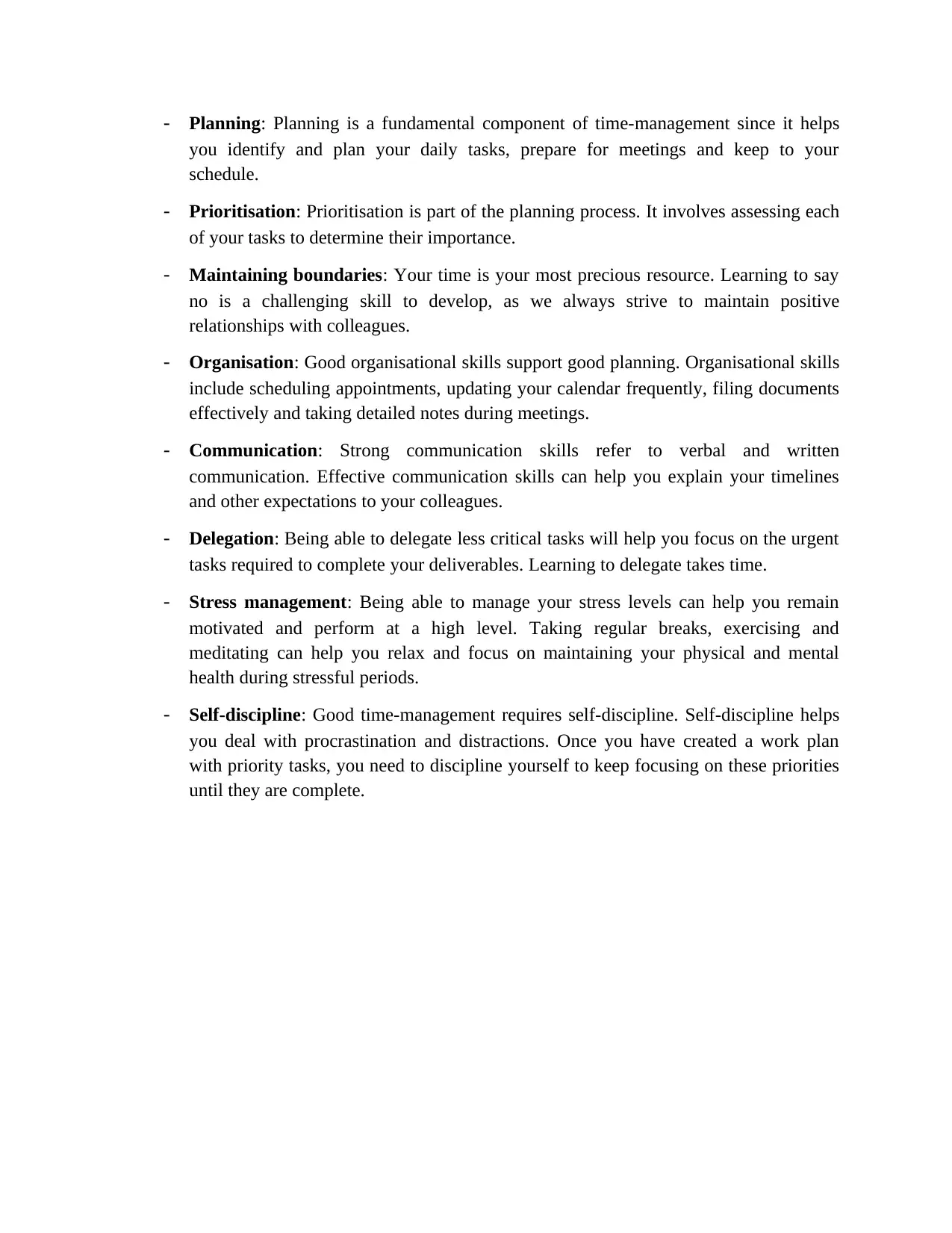
- Planning: Planning is a fundamental component of time-management since it helps
you identify and plan your daily tasks, prepare for meetings and keep to your
schedule.
- Prioritisation: Prioritisation is part of the planning process. It involves assessing each
of your tasks to determine their importance.
- Maintaining boundaries: Your time is your most precious resource. Learning to say
no is a challenging skill to develop, as we always strive to maintain positive
relationships with colleagues.
- Organisation: Good organisational skills support good planning. Organisational skills
include scheduling appointments, updating your calendar frequently, filing documents
effectively and taking detailed notes during meetings.
- Communication: Strong communication skills refer to verbal and written
communication. Effective communication skills can help you explain your timelines
and other expectations to your colleagues.
- Delegation: Being able to delegate less critical tasks will help you focus on the urgent
tasks required to complete your deliverables. Learning to delegate takes time.
- Stress management: Being able to manage your stress levels can help you remain
motivated and perform at a high level. Taking regular breaks, exercising and
meditating can help you relax and focus on maintaining your physical and mental
health during stressful periods.
- Self-discipline: Good time-management requires self-discipline. Self-discipline helps
you deal with procrastination and distractions. Once you have created a work plan
with priority tasks, you need to discipline yourself to keep focusing on these priorities
until they are complete.
you identify and plan your daily tasks, prepare for meetings and keep to your
schedule.
- Prioritisation: Prioritisation is part of the planning process. It involves assessing each
of your tasks to determine their importance.
- Maintaining boundaries: Your time is your most precious resource. Learning to say
no is a challenging skill to develop, as we always strive to maintain positive
relationships with colleagues.
- Organisation: Good organisational skills support good planning. Organisational skills
include scheduling appointments, updating your calendar frequently, filing documents
effectively and taking detailed notes during meetings.
- Communication: Strong communication skills refer to verbal and written
communication. Effective communication skills can help you explain your timelines
and other expectations to your colleagues.
- Delegation: Being able to delegate less critical tasks will help you focus on the urgent
tasks required to complete your deliverables. Learning to delegate takes time.
- Stress management: Being able to manage your stress levels can help you remain
motivated and perform at a high level. Taking regular breaks, exercising and
meditating can help you relax and focus on maintaining your physical and mental
health during stressful periods.
- Self-discipline: Good time-management requires self-discipline. Self-discipline helps
you deal with procrastination and distractions. Once you have created a work plan
with priority tasks, you need to discipline yourself to keep focusing on these priorities
until they are complete.
⊘ This is a preview!⊘
Do you want full access?
Subscribe today to unlock all pages.
Trusted by 1+ million students worldwide
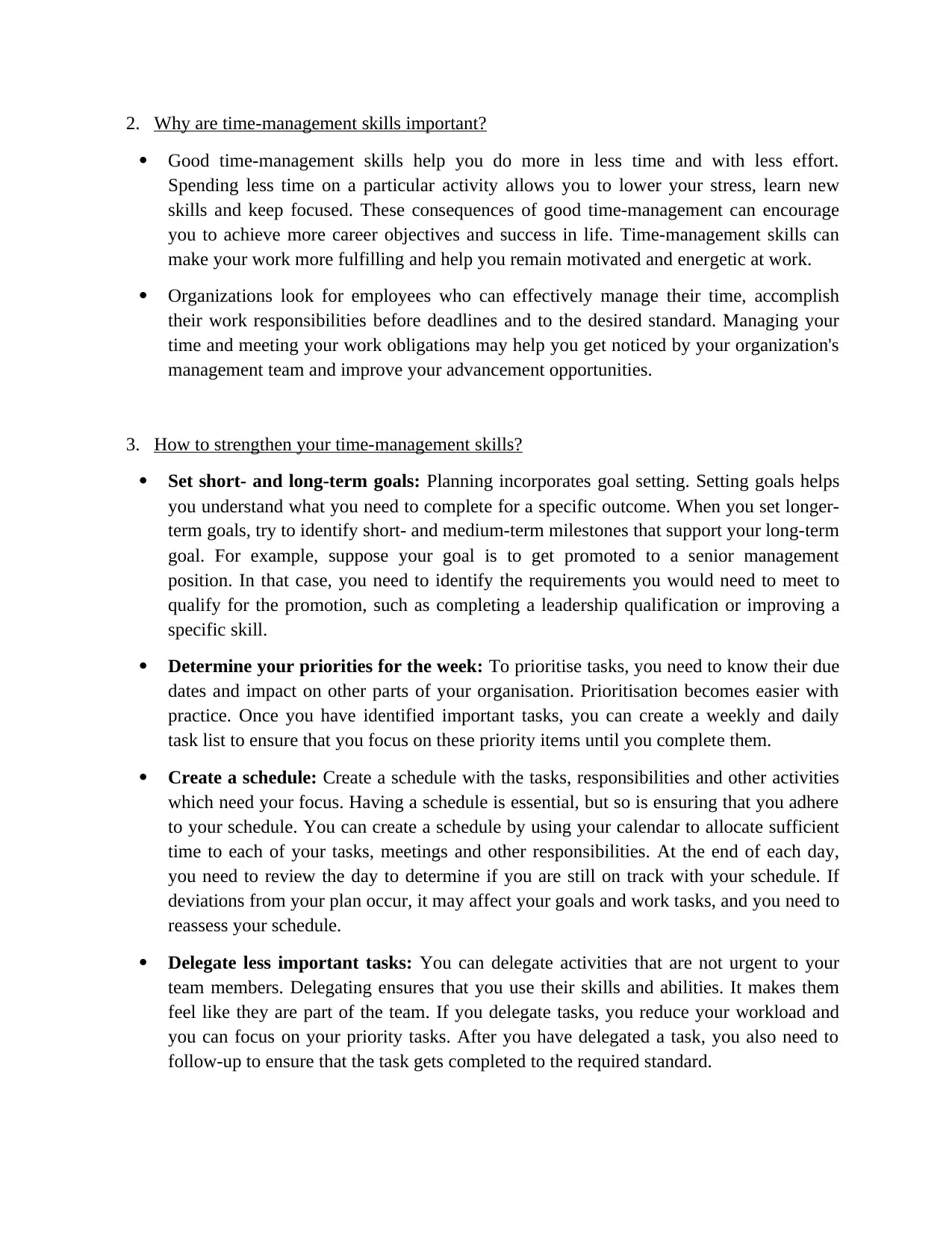
2. Why are time-management skills important?
Good time-management skills help you do more in less time and with less effort.
Spending less time on a particular activity allows you to lower your stress, learn new
skills and keep focused. These consequences of good time-management can encourage
you to achieve more career objectives and success in life. Time-management skills can
make your work more fulfilling and help you remain motivated and energetic at work.
Organizations look for employees who can effectively manage their time, accomplish
their work responsibilities before deadlines and to the desired standard. Managing your
time and meeting your work obligations may help you get noticed by your organization's
management team and improve your advancement opportunities.
3. How to strengthen your time-management skills?
Set short- and long-term goals: Planning incorporates goal setting. Setting goals helps
you understand what you need to complete for a specific outcome. When you set longer-
term goals, try to identify short- and medium-term milestones that support your long-term
goal. For example, suppose your goal is to get promoted to a senior management
position. In that case, you need to identify the requirements you would need to meet to
qualify for the promotion, such as completing a leadership qualification or improving a
specific skill.
Determine your priorities for the week: To prioritise tasks, you need to know their due
dates and impact on other parts of your organisation. Prioritisation becomes easier with
practice. Once you have identified important tasks, you can create a weekly and daily
task list to ensure that you focus on these priority items until you complete them.
Create a schedule: Create a schedule with the tasks, responsibilities and other activities
which need your focus. Having a schedule is essential, but so is ensuring that you adhere
to your schedule. You can create a schedule by using your calendar to allocate sufficient
time to each of your tasks, meetings and other responsibilities. At the end of each day,
you need to review the day to determine if you are still on track with your schedule. If
deviations from your plan occur, it may affect your goals and work tasks, and you need to
reassess your schedule.
Delegate less important tasks: You can delegate activities that are not urgent to your
team members. Delegating ensures that you use their skills and abilities. It makes them
feel like they are part of the team. If you delegate tasks, you reduce your workload and
you can focus on your priority tasks. After you have delegated a task, you also need to
follow-up to ensure that the task gets completed to the required standard.
Good time-management skills help you do more in less time and with less effort.
Spending less time on a particular activity allows you to lower your stress, learn new
skills and keep focused. These consequences of good time-management can encourage
you to achieve more career objectives and success in life. Time-management skills can
make your work more fulfilling and help you remain motivated and energetic at work.
Organizations look for employees who can effectively manage their time, accomplish
their work responsibilities before deadlines and to the desired standard. Managing your
time and meeting your work obligations may help you get noticed by your organization's
management team and improve your advancement opportunities.
3. How to strengthen your time-management skills?
Set short- and long-term goals: Planning incorporates goal setting. Setting goals helps
you understand what you need to complete for a specific outcome. When you set longer-
term goals, try to identify short- and medium-term milestones that support your long-term
goal. For example, suppose your goal is to get promoted to a senior management
position. In that case, you need to identify the requirements you would need to meet to
qualify for the promotion, such as completing a leadership qualification or improving a
specific skill.
Determine your priorities for the week: To prioritise tasks, you need to know their due
dates and impact on other parts of your organisation. Prioritisation becomes easier with
practice. Once you have identified important tasks, you can create a weekly and daily
task list to ensure that you focus on these priority items until you complete them.
Create a schedule: Create a schedule with the tasks, responsibilities and other activities
which need your focus. Having a schedule is essential, but so is ensuring that you adhere
to your schedule. You can create a schedule by using your calendar to allocate sufficient
time to each of your tasks, meetings and other responsibilities. At the end of each day,
you need to review the day to determine if you are still on track with your schedule. If
deviations from your plan occur, it may affect your goals and work tasks, and you need to
reassess your schedule.
Delegate less important tasks: You can delegate activities that are not urgent to your
team members. Delegating ensures that you use their skills and abilities. It makes them
feel like they are part of the team. If you delegate tasks, you reduce your workload and
you can focus on your priority tasks. After you have delegated a task, you also need to
follow-up to ensure that the task gets completed to the required standard.
Paraphrase This Document
Need a fresh take? Get an instant paraphrase of this document with our AI Paraphraser
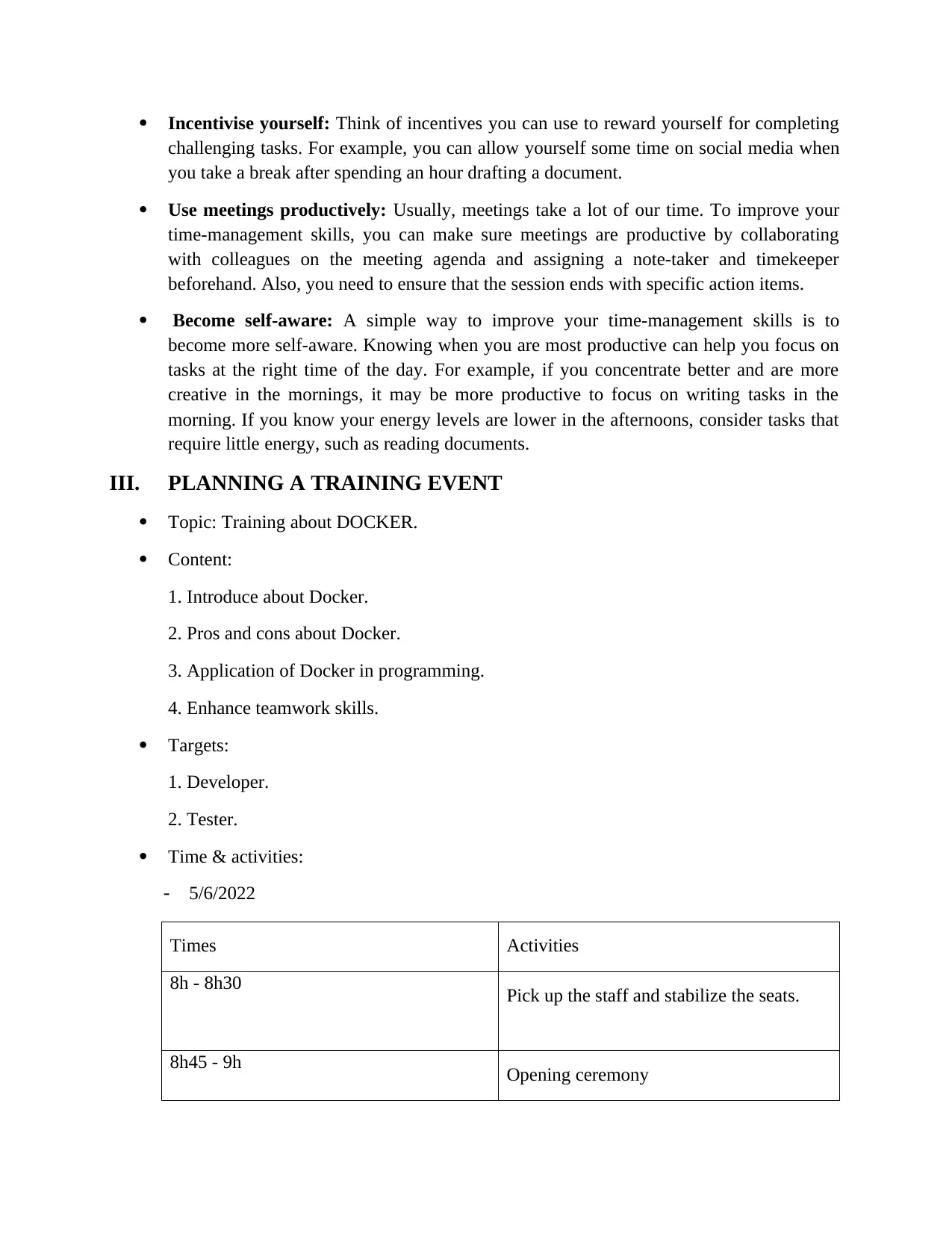
Incentivise yourself: Think of incentives you can use to reward yourself for completing
challenging tasks. For example, you can allow yourself some time on social media when
you take a break after spending an hour drafting a document.
Use meetings productively: Usually, meetings take a lot of our time. To improve your
time-management skills, you can make sure meetings are productive by collaborating
with colleagues on the meeting agenda and assigning a note-taker and timekeeper
beforehand. Also, you need to ensure that the session ends with specific action items.
Become self-aware: A simple way to improve your time-management skills is to
become more self-aware. Knowing when you are most productive can help you focus on
tasks at the right time of the day. For example, if you concentrate better and are more
creative in the mornings, it may be more productive to focus on writing tasks in the
morning. If you know your energy levels are lower in the afternoons, consider tasks that
require little energy, such as reading documents.
III. PLANNING A TRAINING EVENT
Topic: Training about DOCKER.
Content:
1. Introduce about Docker.
2. Pros and cons about Docker.
3. Application of Docker in programming.
4. Enhance teamwork skills.
Targets:
1. Developer.
2. Tester.
Time & activities:
- 5/6/2022
Times Activities
8h - 8h30 Pick up the staff and stabilize the seats.
8h45 - 9h Opening ceremony
challenging tasks. For example, you can allow yourself some time on social media when
you take a break after spending an hour drafting a document.
Use meetings productively: Usually, meetings take a lot of our time. To improve your
time-management skills, you can make sure meetings are productive by collaborating
with colleagues on the meeting agenda and assigning a note-taker and timekeeper
beforehand. Also, you need to ensure that the session ends with specific action items.
Become self-aware: A simple way to improve your time-management skills is to
become more self-aware. Knowing when you are most productive can help you focus on
tasks at the right time of the day. For example, if you concentrate better and are more
creative in the mornings, it may be more productive to focus on writing tasks in the
morning. If you know your energy levels are lower in the afternoons, consider tasks that
require little energy, such as reading documents.
III. PLANNING A TRAINING EVENT
Topic: Training about DOCKER.
Content:
1. Introduce about Docker.
2. Pros and cons about Docker.
3. Application of Docker in programming.
4. Enhance teamwork skills.
Targets:
1. Developer.
2. Tester.
Time & activities:
- 5/6/2022
Times Activities
8h - 8h30 Pick up the staff and stabilize the seats.
8h45 - 9h Opening ceremony
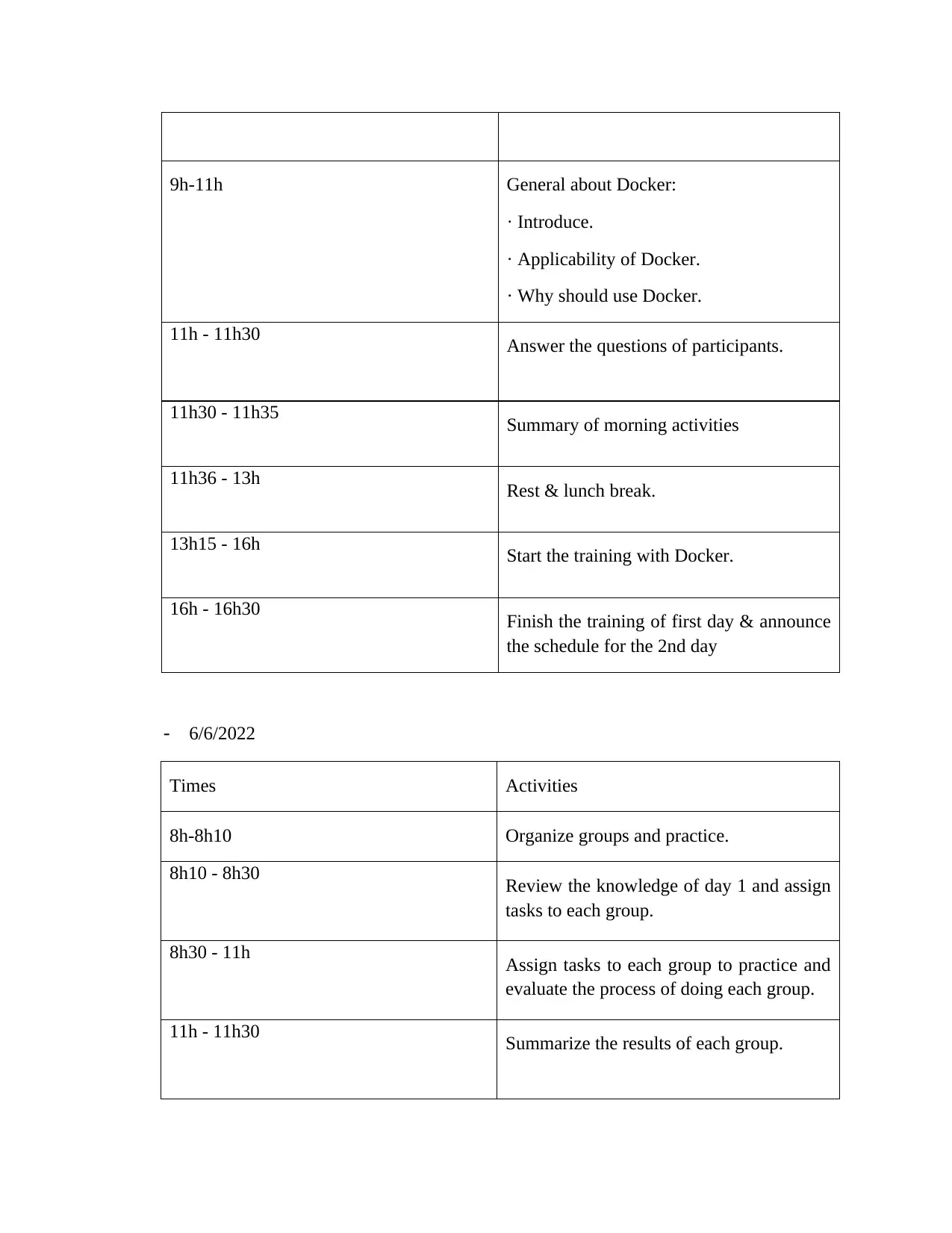
9h-11h General about Docker:
· Introduce.
· Applicability of Docker.
· Why should use Docker.
11h - 11h30 Answer the questions of participants.
11h30 - 11h35 Summary of morning activities
11h36 - 13h Rest & lunch break.
13h15 - 16h Start the training with Docker.
16h - 16h30 Finish the training of first day & announce
the schedule for the 2nd day
- 6/6/2022
Times Activities
8h-8h10 Organize groups and practice.
8h10 - 8h30 Review the knowledge of day 1 and assign
tasks to each group.
8h30 - 11h Assign tasks to each group to practice and
evaluate the process of doing each group.
11h - 11h30 Summarize the results of each group.
· Introduce.
· Applicability of Docker.
· Why should use Docker.
11h - 11h30 Answer the questions of participants.
11h30 - 11h35 Summary of morning activities
11h36 - 13h Rest & lunch break.
13h15 - 16h Start the training with Docker.
16h - 16h30 Finish the training of first day & announce
the schedule for the 2nd day
- 6/6/2022
Times Activities
8h-8h10 Organize groups and practice.
8h10 - 8h30 Review the knowledge of day 1 and assign
tasks to each group.
8h30 - 11h Assign tasks to each group to practice and
evaluate the process of doing each group.
11h - 11h30 Summarize the results of each group.
⊘ This is a preview!⊘
Do you want full access?
Subscribe today to unlock all pages.
Trusted by 1+ million students worldwide
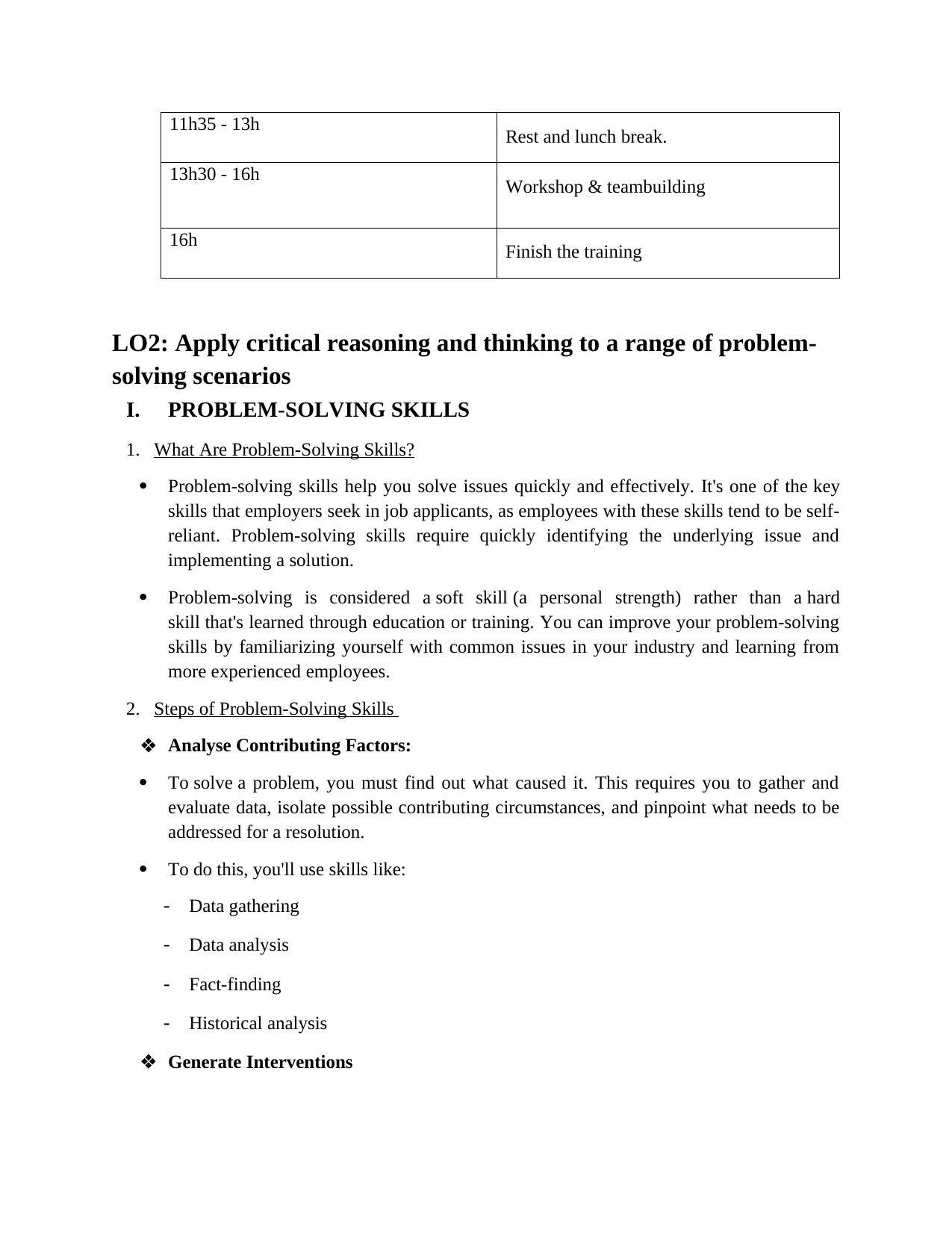
11h35 - 13h Rest and lunch break.
13h30 - 16h Workshop & teambuilding
16h Finish the training
LO2: Apply critical reasoning and thinking to a range of problem-
solving scenarios
I. PROBLEM-SOLVING SKILLS
1. What Are Problem-Solving Skills?
Problem-solving skills help you solve issues quickly and effectively. It's one of the key
skills that employers seek in job applicants, as employees with these skills tend to be self-
reliant. Problem-solving skills require quickly identifying the underlying issue and
implementing a solution.
Problem-solving is considered a soft skill (a personal strength) rather than a hard
skill that's learned through education or training. You can improve your problem-solving
skills by familiarizing yourself with common issues in your industry and learning from
more experienced employees.
2. Steps of Problem-Solving Skills
Analyse Contributing Factors:
To solve a problem, you must find out what caused it. This requires you to gather and
evaluate data, isolate possible contributing circumstances, and pinpoint what needs to be
addressed for a resolution.
To do this, you'll use skills like:
- Data gathering
- Data analysis
- Fact-finding
- Historical analysis
Generate Interventions
13h30 - 16h Workshop & teambuilding
16h Finish the training
LO2: Apply critical reasoning and thinking to a range of problem-
solving scenarios
I. PROBLEM-SOLVING SKILLS
1. What Are Problem-Solving Skills?
Problem-solving skills help you solve issues quickly and effectively. It's one of the key
skills that employers seek in job applicants, as employees with these skills tend to be self-
reliant. Problem-solving skills require quickly identifying the underlying issue and
implementing a solution.
Problem-solving is considered a soft skill (a personal strength) rather than a hard
skill that's learned through education or training. You can improve your problem-solving
skills by familiarizing yourself with common issues in your industry and learning from
more experienced employees.
2. Steps of Problem-Solving Skills
Analyse Contributing Factors:
To solve a problem, you must find out what caused it. This requires you to gather and
evaluate data, isolate possible contributing circumstances, and pinpoint what needs to be
addressed for a resolution.
To do this, you'll use skills like:
- Data gathering
- Data analysis
- Fact-finding
- Historical analysis
Generate Interventions
Paraphrase This Document
Need a fresh take? Get an instant paraphrase of this document with our AI Paraphraser
Once you’ve determined the cause, brainstorm possible solutions. Sometimes this
involves teamwork since two (or more) minds are often better than one. A single strategy
is rarely the obvious route to solving a complex problem; devising a set of alternatives
helps you cover your bases and reduces your risk of exposure should the first strategy
you implement fail.
This involves skills like:
- Brainstorming
- Creative thinking
- Prediction
- Forecasting
- Project design
- Project planning
Evaluate Solutions
Depending on the nature of the problem and your chain of command, evaluating best
solutions may be performed by assigned teams, team leads, or forwarded to corporate
decision-makers. Whoever makes the decision must evaluate potential costs, required
resources, and possible barriers to successful solution implementation.
This requires several skills, including:
- Analysis
- Discussion
- Corroboration
- Teamwork
- Test development
- Mediation
- Prioritizing
Implement a Plan
Once a course of action has been decided, it must be implemented along with
benchmarks that can quickly and accurately determine whether it’s working. Plan
implementation also involves letting personnel know about changes in standard operating
procedures.
involves teamwork since two (or more) minds are often better than one. A single strategy
is rarely the obvious route to solving a complex problem; devising a set of alternatives
helps you cover your bases and reduces your risk of exposure should the first strategy
you implement fail.
This involves skills like:
- Brainstorming
- Creative thinking
- Prediction
- Forecasting
- Project design
- Project planning
Evaluate Solutions
Depending on the nature of the problem and your chain of command, evaluating best
solutions may be performed by assigned teams, team leads, or forwarded to corporate
decision-makers. Whoever makes the decision must evaluate potential costs, required
resources, and possible barriers to successful solution implementation.
This requires several skills, including:
- Analysis
- Discussion
- Corroboration
- Teamwork
- Test development
- Mediation
- Prioritizing
Implement a Plan
Once a course of action has been decided, it must be implemented along with
benchmarks that can quickly and accurately determine whether it’s working. Plan
implementation also involves letting personnel know about changes in standard operating
procedures.
This requires skills like:
- Project management
- Project implementation
- Collaboration
- Time management
- Benchmark development
Assess the Solution's Effectiveness
Once a solution is implemented, the best problem-solvers have systems in place to
evaluate if and how quickly it's working. This way, they know as soon as possible
whether the issue has been resolved or whether they’ll have to change their response to
the problem mid-stream.
This requires:
- Communication
- Data analysis
- Surveys
- Customer feedback
- Follow-through
- Troubleshooting
II. CRITICAL THINKING
1. What is critical thinking?
Critical thinking means making reasoned judgments that are logical and well-thought out.
It is a way of thinking in which you don't simply accept all arguments and conclusions
you are exposed to but rather have an attitude involving questioning such arguments and
conclusions. It requires wanting to see what evidence is involved to support a particular
argument or conclusion.
Critical thinking is divided into three skills:
- Curiosity is the desire to learn more information and seek evidence as well as being open
to new ideas.
- Project management
- Project implementation
- Collaboration
- Time management
- Benchmark development
Assess the Solution's Effectiveness
Once a solution is implemented, the best problem-solvers have systems in place to
evaluate if and how quickly it's working. This way, they know as soon as possible
whether the issue has been resolved or whether they’ll have to change their response to
the problem mid-stream.
This requires:
- Communication
- Data analysis
- Surveys
- Customer feedback
- Follow-through
- Troubleshooting
II. CRITICAL THINKING
1. What is critical thinking?
Critical thinking means making reasoned judgments that are logical and well-thought out.
It is a way of thinking in which you don't simply accept all arguments and conclusions
you are exposed to but rather have an attitude involving questioning such arguments and
conclusions. It requires wanting to see what evidence is involved to support a particular
argument or conclusion.
Critical thinking is divided into three skills:
- Curiosity is the desire to learn more information and seek evidence as well as being open
to new ideas.
⊘ This is a preview!⊘
Do you want full access?
Subscribe today to unlock all pages.
Trusted by 1+ million students worldwide

1 out of 18


Related Documents


Your All-in-One AI-Powered Toolkit for Academic Success.
+13062052269
info@desklib.com
Available 24*7 on WhatsApp / Email
![[object Object]](/_next/static/media/star-bottom.7253800d.svg)
Unlock your academic potential
Copyright © 2020–2026 A2Z Services. All Rights Reserved. Developed and managed by ZUCOL.