Analysis of Training and Development for Organizational Success
VerifiedAdded on 2023/01/17
|10
|1915
|37
Report
AI Summary
This report provides a comprehensive analysis of training and development within organizations, addressing key issues and offering actionable recommendations. It begins with an executive summary and table of contents, followed by an introduction that emphasizes the importance of training and development as a subsystem crucial for enhancing individual and group performance. The report explores the significance of training and development in achieving sustainable outcomes, such as improved productivity, adherence to quality standards, organizational stability, and reduced employee turnover. It then delves into the challenges faced by organizations, including employee engagement, scheduling difficulties, the impact of rapid technological changes, and language barriers in training programs. The report offers recommendations like implementing experiential learning, optimizing training for mobile access, focusing on training needs analysis, leveraging just-in-time training, and incorporating feedback mechanisms. The conclusion underscores the critical role of training and development in organizational effectiveness, advocating for strategic investment in skilled professionals and team development.

Running head: MANAGEMENT
Management
Name of the Student
Name of the University
Author note
Management
Name of the Student
Name of the University
Author note
Paraphrase This Document
Need a fresh take? Get an instant paraphrase of this document with our AI Paraphraser

1
MANAGEMENT
Executive Summary
The report has thrown light on the overall analysis of the different kinds of training and
development of the employees in the organization. Moreover, the various issues which can be
faced in the process of training and development of the employees have been analyzed along
with the recommendations provided to improve the scenario positively. With the help of the
different recommendations such as analysing the need for training along with understanding
the importance of the same in managing the overall process is useful in gaining competitive
advantage.
MANAGEMENT
Executive Summary
The report has thrown light on the overall analysis of the different kinds of training and
development of the employees in the organization. Moreover, the various issues which can be
faced in the process of training and development of the employees have been analyzed along
with the recommendations provided to improve the scenario positively. With the help of the
different recommendations such as analysing the need for training along with understanding
the importance of the same in managing the overall process is useful in gaining competitive
advantage.

2
MANAGEMENT
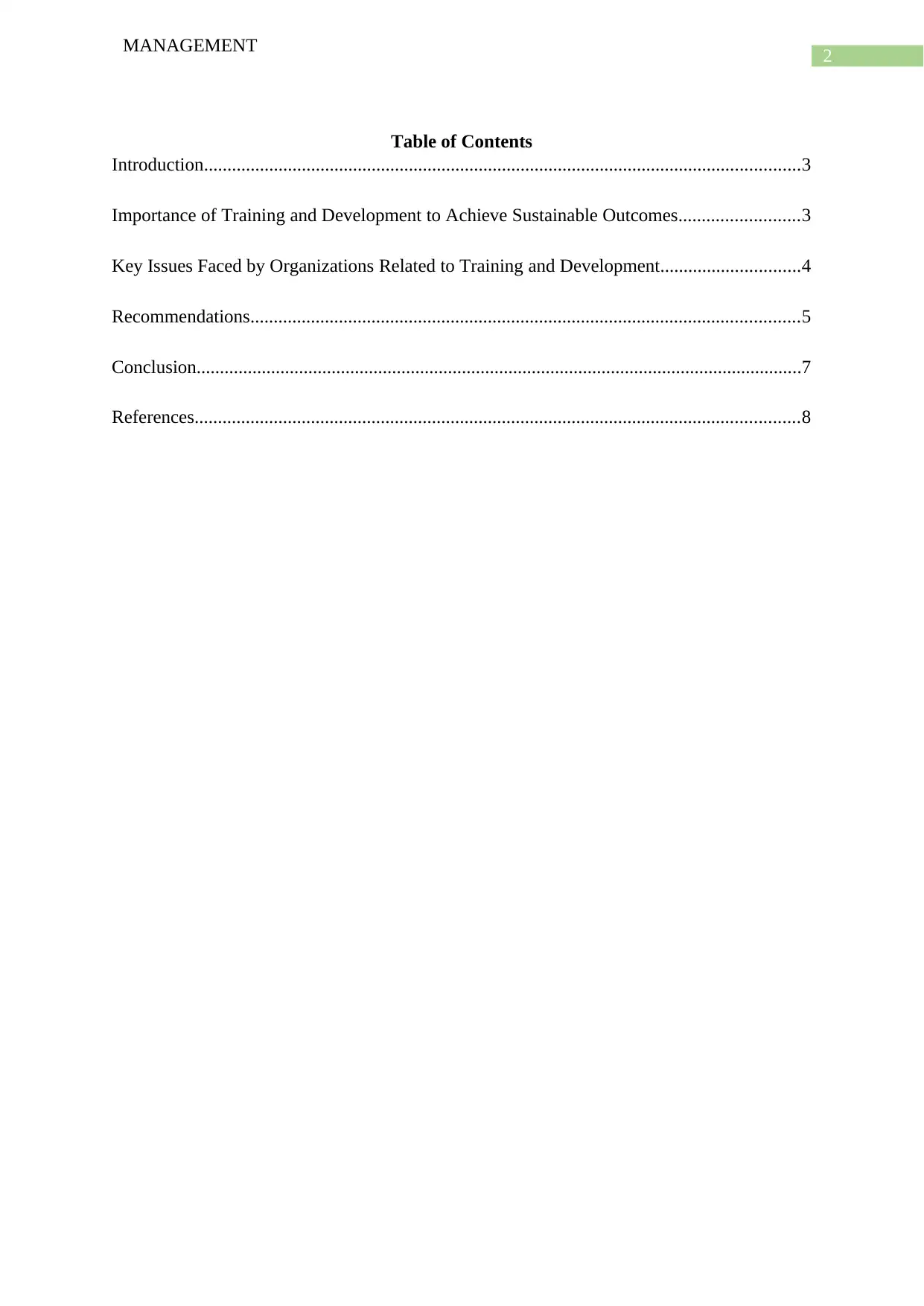
Table of Contents
Introduction................................................................................................................................3
Importance of Training and Development to Achieve Sustainable Outcomes..........................3
Key Issues Faced by Organizations Related to Training and Development..............................4
Recommendations......................................................................................................................5
Conclusion..................................................................................................................................7
References..................................................................................................................................8
MANAGEMENT
Table of Contents
Introduction................................................................................................................................3
Importance of Training and Development to Achieve Sustainable Outcomes..........................3
Key Issues Faced by Organizations Related to Training and Development..............................4
Recommendations......................................................................................................................5
Conclusion..................................................................................................................................7
References..................................................................................................................................8
⊘ This is a preview!⊘
Do you want full access?
Subscribe today to unlock all pages.

Trusted by 1+ million students worldwide

3
MANAGEMENT
Introduction
The report throws light on the overall analysis of the different kinds of problems
which arise during the training and development of the employees working in the
organizations. The training along with development is the subsystem of the companies which
mainly emphasises on the overall improvement of the performance of the groups and
individuals. The training is one of the significant educational processes which include the
sharpening the different skills, changing the attitude along with gaining more knowledge to
enhance the overall performance of the individuals (Donate, Peña and Sanchez de Pablo
2016). Moreover, the main aim and purpose of the report are to understand the different kinds
of solutions which can be applied to solve the issues related to the same and gain competence
in the competitive business environment appropriately with the proper application of theories.
Importance of Training and Development to Achieve Sustainable Outcomes
Training and development are one of the significant approaches which will help
achieve the sustainable outcomes and gain competitive advantage, and the employees will be
receiving extensive knowledge on the different new and rigid aspects which have been
introduced in the organization.
Firstly, training and development is a part of the performance management system in
the organization which helps in improving the productivity of the company as well as the
adherence to the quality standards (Garavan et al. 2016).
Moreover, the training and development of the employees help in increasing stability as well
as the flexibility of the organization. Additionally, there will be a reduction in accidents or
errors which can affect the growth of the company (Renwick et al. 2016).
MANAGEMENT
Introduction
The report throws light on the overall analysis of the different kinds of problems
which arise during the training and development of the employees working in the
organizations. The training along with development is the subsystem of the companies which
mainly emphasises on the overall improvement of the performance of the groups and
individuals. The training is one of the significant educational processes which include the
sharpening the different skills, changing the attitude along with gaining more knowledge to
enhance the overall performance of the individuals (Donate, Peña and Sanchez de Pablo
2016). Moreover, the main aim and purpose of the report are to understand the different kinds
of solutions which can be applied to solve the issues related to the same and gain competence
in the competitive business environment appropriately with the proper application of theories.
Importance of Training and Development to Achieve Sustainable Outcomes
Training and development are one of the significant approaches which will help
achieve the sustainable outcomes and gain competitive advantage, and the employees will be
receiving extensive knowledge on the different new and rigid aspects which have been
introduced in the organization.
Firstly, training and development is a part of the performance management system in
the organization which helps in improving the productivity of the company as well as the
adherence to the quality standards (Garavan et al. 2016).
Moreover, the training and development of the employees help in increasing stability as well
as the flexibility of the organization. Additionally, there will be a reduction in accidents or
errors which can affect the growth of the company (Renwick et al. 2016).
Paraphrase This Document
Need a fresh take? Get an instant paraphrase of this document with our AI Paraphraser

4
MANAGEMENT
Lastly, due to proper training and development of employees, there will be a
reduction of the turnover and absenteeism among the employees which will be beneficial for
the overall growth of the company (Radel 2019).
Key Issues Faced by Organizations Related to Training and Development
There are different kinds of challenges which are faced by the various organizations
regarding the training and development of the employees are as follows:
Engaging People in Training Program- It is the other aspect which can affect the
program related to training as different individuals are disengaged and it is a distinct
challenge towards workplace productivity. Training is a two-way process wherein when the
management shows interest in providing training to the employees; it is the duty of the
employees to feel good and fortunate that they are receiving such training for the different
changes which have been included in the organization (Saks 2015). When the different
employees fail to take the entire responsibility for their development, the training does not
succeed, and it can affect the overall productivity of the organization.
Schedule- It is one of the significant challenges which is faced by the different
organizations as scheduling the training is one of the most inappropriate aspects, and it is a
challenge for the human resource department (Meijerink, Bondarouk and Lepak 2016).
Different managers in the organizations are reluctant in providing and letting the employees
take much time away from the various duties which are required to be performed by them for
training activities. It has been noticed that in the different organizations, there is no support
from management and staffs are not motivated to perform the various operations and upgrade
their skills which will be the negative aspect of the training (Kadiresan et al. 2015).
MANAGEMENT
Lastly, due to proper training and development of employees, there will be a
reduction of the turnover and absenteeism among the employees which will be beneficial for
the overall growth of the company (Radel 2019).
Key Issues Faced by Organizations Related to Training and Development
There are different kinds of challenges which are faced by the various organizations
regarding the training and development of the employees are as follows:
Engaging People in Training Program- It is the other aspect which can affect the
program related to training as different individuals are disengaged and it is a distinct
challenge towards workplace productivity. Training is a two-way process wherein when the
management shows interest in providing training to the employees; it is the duty of the
employees to feel good and fortunate that they are receiving such training for the different
changes which have been included in the organization (Saks 2015). When the different
employees fail to take the entire responsibility for their development, the training does not
succeed, and it can affect the overall productivity of the organization.
Schedule- It is one of the significant challenges which is faced by the different
organizations as scheduling the training is one of the most inappropriate aspects, and it is a
challenge for the human resource department (Meijerink, Bondarouk and Lepak 2016).
Different managers in the organizations are reluctant in providing and letting the employees
take much time away from the various duties which are required to be performed by them for
training activities. It has been noticed that in the different organizations, there is no support
from management and staffs are not motivated to perform the various operations and upgrade
their skills which will be the negative aspect of the training (Kadiresan et al. 2015).

5
MANAGEMENT
Swift Changes and Return on Investment- The different kinds of rapid changes in
the technological aspects, corporate initiatives along with programs makes it difficult to
adequately prepare the different materials of training and deliver the training before the
different employees need the information and new skills (Hassan 2016). Training is defined
as the investment which requires to show returns, however often it is shown at times which
means that the training was not successful as there has been no increase in the productivity or
the sales of the company.
The problem of Language Faced in Training at Organizations- The languages
comprise both unspoken and spoken modes of communication. The best programs of training
are inclusive of the different knowledge of the trainer in communicating the individual, and it
can affect the procedure when the trainer does not have proper knowledge relating to the
various training materials and when they are not able to connect with the trainees (Hassan
2016).
Recommendations
From the above, it can be identified that there are different issues which are affecting
the training and development program negatively in the organizations. However, there are
different recommendations which can be provided to improve the overall scenario positively
and gain competitive advantage.
There can be the inclusion of the Theory of Experiential Learning and training
which will be beneficial in addressing the different needs as well as wants by the particular
kind of learning (Garavan et al. 2016). Proper experience will help provide the person with
maturity, and it will be increasing the power of learning as well as the knowledge. Moreover,
training causes learning which is described as the process that takes place within the trainee
and the theories which can be considered are as follows:
MANAGEMENT
Swift Changes and Return on Investment- The different kinds of rapid changes in
the technological aspects, corporate initiatives along with programs makes it difficult to
adequately prepare the different materials of training and deliver the training before the
different employees need the information and new skills (Hassan 2016). Training is defined
as the investment which requires to show returns, however often it is shown at times which
means that the training was not successful as there has been no increase in the productivity or
the sales of the company.
The problem of Language Faced in Training at Organizations- The languages
comprise both unspoken and spoken modes of communication. The best programs of training
are inclusive of the different knowledge of the trainer in communicating the individual, and it
can affect the procedure when the trainer does not have proper knowledge relating to the
various training materials and when they are not able to connect with the trainees (Hassan
2016).
Recommendations
From the above, it can be identified that there are different issues which are affecting
the training and development program negatively in the organizations. However, there are
different recommendations which can be provided to improve the overall scenario positively
and gain competitive advantage.
There can be the inclusion of the Theory of Experiential Learning and training
which will be beneficial in addressing the different needs as well as wants by the particular
kind of learning (Garavan et al. 2016). Proper experience will help provide the person with
maturity, and it will be increasing the power of learning as well as the knowledge. Moreover,
training causes learning which is described as the process that takes place within the trainee
and the theories which can be considered are as follows:
⊘ This is a preview!⊘
Do you want full access?
Subscribe today to unlock all pages.

Trusted by 1+ million students worldwide

6
MANAGEMENT
Connectionist Theory- It helps in believing that it is the stimulus and response
approach which is the two-way process wherein the organization and the employees
need to be managing the different needs which will be beneficial in improving the
overall scenario (Donate, Peña and Sanchez de Pablo 2016). Cognitive Theory- IT is considered that all the different learnings lead to goals which
will help improve the overall scenario and it will be beneficial for the overall
organizational growth and the individual growth of the employees (Hassan 2016)
Moreover, there can be the inclusion of the different optimisation of the training for
mobile wherein the various features in mobile can help the learners in access the LMS as well
as training materials anywhere at any time. The organizations need to focus on the different
kinds of training needs as it will be helpful for the organisational growth (Donate, Peña and
Sanchez de Pablo 2016). For instance- Google is one such company in which the need
analysis along with program design are followed to become the innovative workplace as to
improve the overall scenario (Google.com 2019).
Proper leveraging of the just in time training is required to update the skills or
conveying the new information as and when needed which will be appropriate for the
employees to gain more knowledge (Donate, Peña and Sanchez de Pablo 2016). Furthermore,
after conducting the overall training procedure in the organization, the survey feedback can
be generated among the employees to know and analyze their views regarding the training,
and there can be the inclusion of feedbacks which will help improve the overall scenario
appropriately. Lastly, the training and development need to be the two-way process as proper
usage of the, and high performing LMS will create huge difference and budget will be
reduced which will be beneficial in improving the morale of employees (Noe et al. 2017).
MANAGEMENT
Connectionist Theory- It helps in believing that it is the stimulus and response
approach which is the two-way process wherein the organization and the employees
need to be managing the different needs which will be beneficial in improving the
overall scenario (Donate, Peña and Sanchez de Pablo 2016). Cognitive Theory- IT is considered that all the different learnings lead to goals which
will help improve the overall scenario and it will be beneficial for the overall
organizational growth and the individual growth of the employees (Hassan 2016)
Moreover, there can be the inclusion of the different optimisation of the training for
mobile wherein the various features in mobile can help the learners in access the LMS as well
as training materials anywhere at any time. The organizations need to focus on the different
kinds of training needs as it will be helpful for the organisational growth (Donate, Peña and
Sanchez de Pablo 2016). For instance- Google is one such company in which the need
analysis along with program design are followed to become the innovative workplace as to
improve the overall scenario (Google.com 2019).
Proper leveraging of the just in time training is required to update the skills or
conveying the new information as and when needed which will be appropriate for the
employees to gain more knowledge (Donate, Peña and Sanchez de Pablo 2016). Furthermore,
after conducting the overall training procedure in the organization, the survey feedback can
be generated among the employees to know and analyze their views regarding the training,
and there can be the inclusion of feedbacks which will help improve the overall scenario
appropriately. Lastly, the training and development need to be the two-way process as proper
usage of the, and high performing LMS will create huge difference and budget will be
reduced which will be beneficial in improving the morale of employees (Noe et al. 2017).
Paraphrase This Document
Need a fresh take? Get an instant paraphrase of this document with our AI Paraphraser

7
MANAGEMENT
Conclusion
Therefore, it can be concluded that training and development are the two major
approaches which can help manage the overall effectiveness of the organizations
appropriately. Moreover, the training and development help in improving the handling
practices related to equipment, and it will be beneficial for the overall development of the
employees towards advancement. However, there are different kinds of issues of the training
and development that can be improved through the proper usage of the various concepts such
as on and off the job training and the organizations need to include the training costs which
will be beneficial for improving and developing the team of skilled professionals, team
organization along with morale.
MANAGEMENT
Conclusion
Therefore, it can be concluded that training and development are the two major
approaches which can help manage the overall effectiveness of the organizations
appropriately. Moreover, the training and development help in improving the handling
practices related to equipment, and it will be beneficial for the overall development of the
employees towards advancement. However, there are different kinds of issues of the training
and development that can be improved through the proper usage of the various concepts such
as on and off the job training and the organizations need to include the training costs which
will be beneficial for improving and developing the team of skilled professionals, team
organization along with morale.

8
MANAGEMENT
References
Donate, M.J., Peña, I. and Sanchez de Pablo, J.D., 2016. HRM practices for human and social
capital development: effects on innovation capabilities. The International Journal of Human
Resource Management, 27(9), pp.928-953.
Garavan, T., Watson, S., Carbery, R. and O’Brien, F., 2016. The antecedents of leadership
development practices in SMEs: The influence of HRM strategy and practice. International
Small Business Journal, 34(6), pp.870-890.
Google.com 2019 Google (online) Retrieved from https://www.google.com/ [Accessed on 6th
April 2019]
Hassan, S., 2016. Impact of HRM practices on employee’s performance. International
Journal of Academic Research in Accounting, Finance and Management Sciences, 6(1),
pp.15-22.
Kadiresan, V., Selamat, M.H., Selladurai, S., Ramendran, C.S. and Mohamed, R.K.M.H.,
2015. Performance appraisal and training and development of human resource management
practices (HRM) on organizational commitment and turnover intention. Asian Social
Science, 11(24), p.162.
Meijerink, J.G., Bondarouk, T. and Lepak, D.P., 2016. Employees as active consumers of
HRM: Linking employees' HRM competencies with their perceptions of HRM service value.
Human resource management, 55(2), pp.219-240.
Noe, R.A., Hollenbeck, J.R., Gerhart, B. and Wright, P.M., 2017. Human resource
management: Gaining a competitive advantage. New York, NY: McGraw-Hill Education.
MANAGEMENT
References
Donate, M.J., Peña, I. and Sanchez de Pablo, J.D., 2016. HRM practices for human and social
capital development: effects on innovation capabilities. The International Journal of Human
Resource Management, 27(9), pp.928-953.
Garavan, T., Watson, S., Carbery, R. and O’Brien, F., 2016. The antecedents of leadership
development practices in SMEs: The influence of HRM strategy and practice. International
Small Business Journal, 34(6), pp.870-890.
Google.com 2019 Google (online) Retrieved from https://www.google.com/ [Accessed on 6th
April 2019]
Hassan, S., 2016. Impact of HRM practices on employee’s performance. International
Journal of Academic Research in Accounting, Finance and Management Sciences, 6(1),
pp.15-22.
Kadiresan, V., Selamat, M.H., Selladurai, S., Ramendran, C.S. and Mohamed, R.K.M.H.,
2015. Performance appraisal and training and development of human resource management
practices (HRM) on organizational commitment and turnover intention. Asian Social
Science, 11(24), p.162.
Meijerink, J.G., Bondarouk, T. and Lepak, D.P., 2016. Employees as active consumers of
HRM: Linking employees' HRM competencies with their perceptions of HRM service value.
Human resource management, 55(2), pp.219-240.
Noe, R.A., Hollenbeck, J.R., Gerhart, B. and Wright, P.M., 2017. Human resource
management: Gaining a competitive advantage. New York, NY: McGraw-Hill Education.
⊘ This is a preview!⊘
Do you want full access?
Subscribe today to unlock all pages.

Trusted by 1+ million students worldwide

9
MANAGEMENT
Radel, J., 2019. Human Resources Management and Human Resources
Development. Handbook of Vocational Education and Training: Developments in the
Changing World of Work, pp.1-24.
Renwick, D.W., Jabbour, C.J., Muller-Camen, M., Redman, T. and Wilkinson, A., 2016.
Contemporary developments in Green (environmental) HRM scholarship.
Saks, A., 2015. Managing Performance Through Training & Development, (Canadian ed.).
Nelson Education.
MANAGEMENT
Radel, J., 2019. Human Resources Management and Human Resources
Development. Handbook of Vocational Education and Training: Developments in the
Changing World of Work, pp.1-24.
Renwick, D.W., Jabbour, C.J., Muller-Camen, M., Redman, T. and Wilkinson, A., 2016.
Contemporary developments in Green (environmental) HRM scholarship.
Saks, A., 2015. Managing Performance Through Training & Development, (Canadian ed.).
Nelson Education.
1 out of 10
Related Documents
Your All-in-One AI-Powered Toolkit for Academic Success.
+13062052269
info@desklib.com
Available 24*7 on WhatsApp / Email
Unlock your academic potential
Copyright © 2020–2026 A2Z Services. All Rights Reserved. Developed and managed by ZUCOL.