Evaluating Impact of Training and Development on Sainsbury's Workforce
VerifiedAdded on 2023/01/05
|14
|3912
|61
Report
AI Summary
This report investigates the impact of training and development programs on the workforce within Sainsbury PLC, a major player in the retail industry. The study begins with an overview of the importance of training and development in the context of a changing business environment, including technological advancements and the need for a skilled and adaptable workforce. It outlines the aim to study the concept of training and development programs, analyze the methods used, identify their impact on Sainsbury's growth, and recommend improvements. The report covers the concept of training and development, various methods used, and their impact on employee performance and organizational goals. The research methodology includes qualitative research approach and inductive method for data analysis. The report concludes by highlighting the significance of training and development in enhancing employee morale, increasing productivity, and fostering organizational growth. The study suggests recommendations for improving training programs and addressing challenges.
Management Research
Methods
Methods

Paraphrase This Document
Need a fresh take? Get an instant paraphrase of this document with our AI Paraphraser
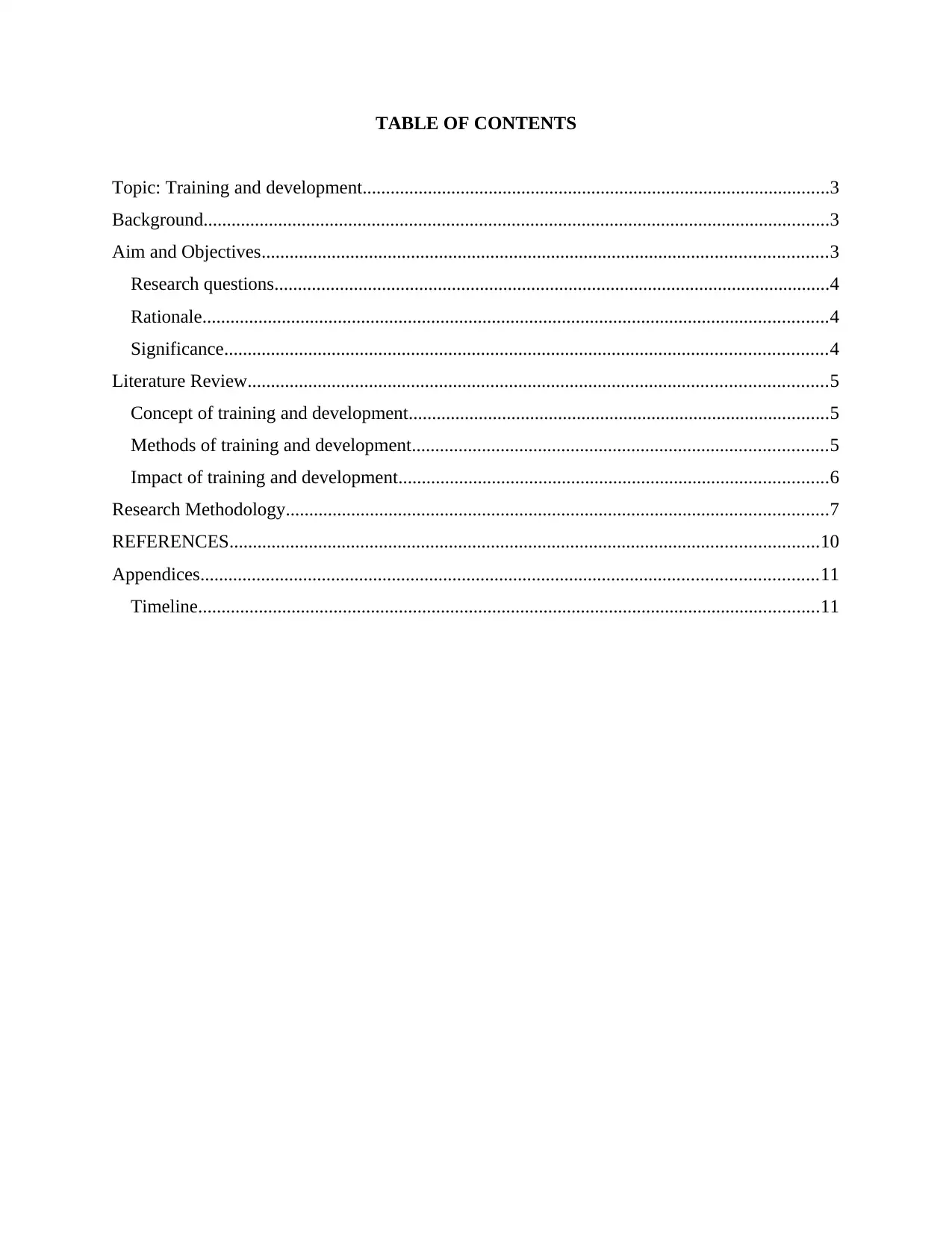
TABLE OF CONTENTS
Topic: Training and development....................................................................................................3
Background......................................................................................................................................3
Aim and Objectives.........................................................................................................................3
Research questions.......................................................................................................................4
Rationale......................................................................................................................................4
Significance.................................................................................................................................4
Literature Review............................................................................................................................5
Concept of training and development..........................................................................................5
Methods of training and development.........................................................................................5
Impact of training and development............................................................................................6
Research Methodology....................................................................................................................7
REFERENCES..............................................................................................................................10
Appendices....................................................................................................................................11
Timeline.....................................................................................................................................11
Topic: Training and development....................................................................................................3
Background......................................................................................................................................3
Aim and Objectives.........................................................................................................................3
Research questions.......................................................................................................................4
Rationale......................................................................................................................................4
Significance.................................................................................................................................4
Literature Review............................................................................................................................5
Concept of training and development..........................................................................................5
Methods of training and development.........................................................................................5
Impact of training and development............................................................................................6
Research Methodology....................................................................................................................7
REFERENCES..............................................................................................................................10
Appendices....................................................................................................................................11
Timeline.....................................................................................................................................11

Title: Training and development
To evaluate impact of training and development on workforce in the context of retail
industry: A study on Sainsbury plc
3
To evaluate impact of training and development on workforce in the context of retail
industry: A study on Sainsbury plc
3
⊘ This is a preview!⊘
Do you want full access?
Subscribe today to unlock all pages.

Trusted by 1+ million students worldwide
Background
Training and development programs plays important role in building human resource in
organisation. There are number of problems that organisation faces in changing business such as
technological advancement which requires skilled workforce, Maintaining diversify culture can
only by possible by proper training as well as development (Haugen, and et.al., 2019).
Organisation now days want people that are highly professional and talented which can help in
gaining competitive advantage and hence for it invest in Human Resource Management
programs which focus on their personal as well as professional growth (Lee and Suh, 2018).
Retail industry provides various training and development programs such as sales, customer
serving, communication, market and product knowledge, developing leadership quality and
many more. This will help in targeting customers and increase profit share in business
environment. This also helps firm in analysing capacity of workforce which can become
profitable for new projects. However, it increases cost and time of firm which can be utilised for
other productive purpose. It become necessary for retail firm to focus on particular programs
which can be sustainable in nature and hence support growth of firm rather than investing time in
improper tasks which cannot contribute growth in company (Larsen, 2017). Training and
development Programs must be aligned with goals and objectives of firm which support
organisation in taking competitive advantage (Noe and Kodwani, 2018). Sainsbury Plc. is one of
growing retail firm which focuses on providing specific training and development programs
which increase efficiency, quality and productivity of work and hence market share. HRM first
identify need of training and development program and according to design it and hence it
impacts growth of firm (Okechukwu, 2017). It builds diversified culture in organisation and for it
giving communication lectures which imbibed skills of understanding information according to
that provides training and development programs.
Aim and Objectives
Aim: Impact of training and development programs within Sainsbury's.
Objectives
1. To study concept of Training and Development programs
4
Training and development programs plays important role in building human resource in
organisation. There are number of problems that organisation faces in changing business such as
technological advancement which requires skilled workforce, Maintaining diversify culture can
only by possible by proper training as well as development (Haugen, and et.al., 2019).
Organisation now days want people that are highly professional and talented which can help in
gaining competitive advantage and hence for it invest in Human Resource Management
programs which focus on their personal as well as professional growth (Lee and Suh, 2018).
Retail industry provides various training and development programs such as sales, customer
serving, communication, market and product knowledge, developing leadership quality and
many more. This will help in targeting customers and increase profit share in business
environment. This also helps firm in analysing capacity of workforce which can become
profitable for new projects. However, it increases cost and time of firm which can be utilised for
other productive purpose. It become necessary for retail firm to focus on particular programs
which can be sustainable in nature and hence support growth of firm rather than investing time in
improper tasks which cannot contribute growth in company (Larsen, 2017). Training and
development Programs must be aligned with goals and objectives of firm which support
organisation in taking competitive advantage (Noe and Kodwani, 2018). Sainsbury Plc. is one of
growing retail firm which focuses on providing specific training and development programs
which increase efficiency, quality and productivity of work and hence market share. HRM first
identify need of training and development program and according to design it and hence it
impacts growth of firm (Okechukwu, 2017). It builds diversified culture in organisation and for it
giving communication lectures which imbibed skills of understanding information according to
that provides training and development programs.
Aim and Objectives
Aim: Impact of training and development programs within Sainsbury's.
Objectives
1. To study concept of Training and Development programs
4
Paraphrase This Document
Need a fresh take? Get an instant paraphrase of this document with our AI Paraphraser
2. To analyse methods of Training and Development Programs provided to employees in
retail industry.
3. To identify Impact of Training and Development programs to contribute in growth of
Sainsbury.
4. To recommend suggestion for countering challenges in training and Development
programs for Sainsbury.
Research questions
What are different types of Training and Development methods that are use by retail
sector in present times?
How training and development programs supporting growth of Sainsbury in changing
business?
What recommendation can be suggested for changes in successful implementation of
training and development Programs in Sainsbury?
Rationale
Training and development programs become one of the important concerns for various
industries in time of globalisation (Mikami and Furukawa, 2018). This is because with the
continuous changes that are taking place in the business environment regarding changes in
technologies or customer's trends. Thus, it becomes very essential for every company to provide
adequate training to their employees, so that along with meeting those changes they can also
accomplish their own objectives (Karim, Choudhury and Latif, 2019). This study while help in
understanding importance of training and development in time of globalisation and its impact on
employees’ performance of Sainsbury. It also gives idea regarding the ways in which training
methods can be improved so that changes can easily be adopted by workers and hence these
changes will support firm in gaining competitive advantage (Holmes, 2020).
Significance
This study will help future scholars in their research because it covers various aspects of
training and development programs (Adda, Bachri and Thahir, 2019). This research will also act
as a base by which importance of training and development will be analysed in every
organisation. It helps different firm in making changes in training and development programs so
that they can successfully implement it in organisation culture. It will also helps Sainsbury in
making changes various types training and development programs which is used by firm in
increasing efficiency, quality and productivity. Journalist and media can take help of it for
writing article on training and development impact on retail sector which is one of important
5
retail industry.
3. To identify Impact of Training and Development programs to contribute in growth of
Sainsbury.
4. To recommend suggestion for countering challenges in training and Development
programs for Sainsbury.
Research questions
What are different types of Training and Development methods that are use by retail
sector in present times?
How training and development programs supporting growth of Sainsbury in changing
business?
What recommendation can be suggested for changes in successful implementation of
training and development Programs in Sainsbury?
Rationale
Training and development programs become one of the important concerns for various
industries in time of globalisation (Mikami and Furukawa, 2018). This is because with the
continuous changes that are taking place in the business environment regarding changes in
technologies or customer's trends. Thus, it becomes very essential for every company to provide
adequate training to their employees, so that along with meeting those changes they can also
accomplish their own objectives (Karim, Choudhury and Latif, 2019). This study while help in
understanding importance of training and development in time of globalisation and its impact on
employees’ performance of Sainsbury. It also gives idea regarding the ways in which training
methods can be improved so that changes can easily be adopted by workers and hence these
changes will support firm in gaining competitive advantage (Holmes, 2020).
Significance
This study will help future scholars in their research because it covers various aspects of
training and development programs (Adda, Bachri and Thahir, 2019). This research will also act
as a base by which importance of training and development will be analysed in every
organisation. It helps different firm in making changes in training and development programs so
that they can successfully implement it in organisation culture. It will also helps Sainsbury in
making changes various types training and development programs which is used by firm in
increasing efficiency, quality and productivity. Journalist and media can take help of it for
writing article on training and development impact on retail sector which is one of important
5
topic. Book author can also take help of it while writing concepts and writing books regarding
training and development. Since, books are the great source of information so this research will
provide useful information regarding these concepts of training.
Literature Review
Concept of training and development
According to the views of Armstrong and Landers (2018) it is being stated as an
educational activity which guides the employees of the company in manner and provide direction
of how to get task done in order to achieve the common desired goals of the company. It is the
educational activity in company which is being created with the view to enhance and improve
the skills and knowledge of employees while providing various instruction and information on
how to perform task or activity with efficiency and effectiveness which helps in increasing
productivity of the company and which helps the company to gain competitive advantage and
winning in the marketplace.
It is being termed by the Armstrong and Landers (2018) as the process in context with the
business activity which is being focused upon the improvement of performance of individuals
and groups of employees. It states that training leads to teaching of specific skills whereas
development is being focused with the enhancement of employees management and personality
skills. Training is being referred and viewed as immediate changes in the effectiveness of the
company which is being guided by the instruction. However, Frost (2016) stated that
development is related with longer term employees and organisational goals. They both
technically have different definition but can be used as term that are interchangeable. These are
the topic which are being closely associated with the department of HRM. This is very essential
to have a focus over these terms in order to raise efficiency of employees along with raising their
level of performance. This will not only consider as necessary for individual employees but in
broad sense it will also help organisation to achieve their own objectives too.
Methods of training and development
As per the view of the Sung Choi (2018), training and development methods accounts to
case study method which helps in boosting up employees' motivation, which assist when the
employees lack the resources necessary for completion of a case study. Whereas a result it
becomes a challenge to employees which helps in assessing where an employee of the company
6
training and development. Since, books are the great source of information so this research will
provide useful information regarding these concepts of training.
Literature Review
Concept of training and development
According to the views of Armstrong and Landers (2018) it is being stated as an
educational activity which guides the employees of the company in manner and provide direction
of how to get task done in order to achieve the common desired goals of the company. It is the
educational activity in company which is being created with the view to enhance and improve
the skills and knowledge of employees while providing various instruction and information on
how to perform task or activity with efficiency and effectiveness which helps in increasing
productivity of the company and which helps the company to gain competitive advantage and
winning in the marketplace.
It is being termed by the Armstrong and Landers (2018) as the process in context with the
business activity which is being focused upon the improvement of performance of individuals
and groups of employees. It states that training leads to teaching of specific skills whereas
development is being focused with the enhancement of employees management and personality
skills. Training is being referred and viewed as immediate changes in the effectiveness of the
company which is being guided by the instruction. However, Frost (2016) stated that
development is related with longer term employees and organisational goals. They both
technically have different definition but can be used as term that are interchangeable. These are
the topic which are being closely associated with the department of HRM. This is very essential
to have a focus over these terms in order to raise efficiency of employees along with raising their
level of performance. This will not only consider as necessary for individual employees but in
broad sense it will also help organisation to achieve their own objectives too.
Methods of training and development
As per the view of the Sung Choi (2018), training and development methods accounts to
case study method which helps in boosting up employees' motivation, which assist when the
employees lack the resources necessary for completion of a case study. Whereas a result it
becomes a challenge to employees which helps in assessing where an employee of the company
6
⊘ This is a preview!⊘
Do you want full access?
Subscribe today to unlock all pages.
Trusted by 1+ million students worldwide
is lacking and what measures are required to be taken to improve the same. Ahmad (2019) has
also stated that it is being beneficial when trainees have the core knowledge and accounts with
low cost of implementing the same. Another best method that has led down is job rotation which
can do lot in terms of employees commitment and motivation which gives them the chance to
further enhance, develop and work towards a promotion which helps in engendering co-
operation and satisfaction for the employees. This is the best method for employees who are
being introverts as it relates to there fear which serves there fear that they might fall in front of
other while displaying out there roles and responsibilities which serves as the means of methods
to provide with effective training and development. It is being stated that it could also be
ascertained with the help of providing on the job experience which is considered as the method
where real life experience are given to the employees. This will accounts to how to deal with
various customer needs and queries whereby it assesses the things to employer where
improvements are required on the end of employees.
Impact of training and development
According to Noe Kodwani (2018), training and development helps the company in the
way as it helps in increasing the employees' morale which gives the sense of understanding to
employees. Those efforts are being taken by the company to account for there better performance
by continuously conducting various activities for them which helps in enhancement of there skill
and understanding. As a result account to increased productivity at the workplace. This will leads
to company getting an edge over the competition and helps in winning over competition and
surviving in various business dynamics. The impact stated by the Sung and Choi (2018) is that it
helps the company to retain its talented employees as a result leads to fostering growth of the
company and does not account to turnover of employees in the company which affect the smooth
functioning of the business. By this it is being stated that there is an increased capacity to adapt
to new methods and technologies which helps in efficient business operation and also by this
company will move towards innovation and creativity. As a result, it will help the companies in
launching new products and services which in turn accounts to earning high revenue and
accomplishment of their objectives. It also accounts to efficiencies in various processes, resulting
in various financial gain as a result helps the company in facing with various challenges which
can come up in there way as a result leads company and individual employee to achieve their
required goals. Thus, it can say that it is very important for company to implement the practice of
7
also stated that it is being beneficial when trainees have the core knowledge and accounts with
low cost of implementing the same. Another best method that has led down is job rotation which
can do lot in terms of employees commitment and motivation which gives them the chance to
further enhance, develop and work towards a promotion which helps in engendering co-
operation and satisfaction for the employees. This is the best method for employees who are
being introverts as it relates to there fear which serves there fear that they might fall in front of
other while displaying out there roles and responsibilities which serves as the means of methods
to provide with effective training and development. It is being stated that it could also be
ascertained with the help of providing on the job experience which is considered as the method
where real life experience are given to the employees. This will accounts to how to deal with
various customer needs and queries whereby it assesses the things to employer where
improvements are required on the end of employees.
Impact of training and development
According to Noe Kodwani (2018), training and development helps the company in the
way as it helps in increasing the employees' morale which gives the sense of understanding to
employees. Those efforts are being taken by the company to account for there better performance
by continuously conducting various activities for them which helps in enhancement of there skill
and understanding. As a result account to increased productivity at the workplace. This will leads
to company getting an edge over the competition and helps in winning over competition and
surviving in various business dynamics. The impact stated by the Sung and Choi (2018) is that it
helps the company to retain its talented employees as a result leads to fostering growth of the
company and does not account to turnover of employees in the company which affect the smooth
functioning of the business. By this it is being stated that there is an increased capacity to adapt
to new methods and technologies which helps in efficient business operation and also by this
company will move towards innovation and creativity. As a result, it will help the companies in
launching new products and services which in turn accounts to earning high revenue and
accomplishment of their objectives. It also accounts to efficiencies in various processes, resulting
in various financial gain as a result helps the company in facing with various challenges which
can come up in there way as a result leads company and individual employee to achieve their
required goals. Thus, it can say that it is very important for company to implement the practice of
7
Paraphrase This Document
Need a fresh take? Get an instant paraphrase of this document with our AI Paraphraser
training so that it can accomplish its goals along with development of its employees which will
further leads to achievement of individual goals too.
Research Methodology
It can be described as a process in which research is being conducted such as collection
of data, analysis it and various other steps. Scholar uses it in study which helps in completing
work on time with proper methods that is standardized by University. It also describes designing
process of research as well as ensures validity and reliability.
Research Type
Research types can be defined as selection research method such as wants factual or more
numerical. It is divided into two parts namely quantitative and qualitative. Quantitative research
usually emphasizes on collection of large information from a section of people and accordingly
making prediction and pursuing research study. It takes times to identify specific information
from quantitative and hence less chosen method (Snyder, 2019). However, quantitative research
is beneficial in finding accurate and adequate data because of the involvement of facts and figure
(Aspers and Corte, 2019). Qualitative focuses on quality of information that is only specific to
research and hence save time as well as gives accurate result. Since, this study is concerned with
human resource and it is easy to analyse and get result from qualitative research so scholar has
chosen this method for pursuing its research regarding training and development programs and
its impact on performance of employees (Korstjens and Moser, 2018).
Research Approach
It can be define as a way in which scholar approach for the research of chosen topic. It
has two elements namely deductive and inductive. First one emphasizes on gathered information
from books and journals or creating theory from existing hypothesis which decrease accuracy of
result and hence less chosen by researchers (Alase, 2017). Next focuses on creating theory from
personal experience such as observation, identification and then developing a theory and hence
obtained result will gives more light on topic. Scholar has taken inductive method for the topic as
study on Sainsbury are not existed in previous hypothesis as well as accuracy of result can be
compromised by taking deductive method for the research.
Research Philosophy
Research philosophy can be discussed as scholar’s ideology for conducting study as well
as analyses of it. It is divided into two parts namely positivism and interpretivism. Former one
8
further leads to achievement of individual goals too.
Research Methodology
It can be described as a process in which research is being conducted such as collection
of data, analysis it and various other steps. Scholar uses it in study which helps in completing
work on time with proper methods that is standardized by University. It also describes designing
process of research as well as ensures validity and reliability.
Research Type
Research types can be defined as selection research method such as wants factual or more
numerical. It is divided into two parts namely quantitative and qualitative. Quantitative research
usually emphasizes on collection of large information from a section of people and accordingly
making prediction and pursuing research study. It takes times to identify specific information
from quantitative and hence less chosen method (Snyder, 2019). However, quantitative research
is beneficial in finding accurate and adequate data because of the involvement of facts and figure
(Aspers and Corte, 2019). Qualitative focuses on quality of information that is only specific to
research and hence save time as well as gives accurate result. Since, this study is concerned with
human resource and it is easy to analyse and get result from qualitative research so scholar has
chosen this method for pursuing its research regarding training and development programs and
its impact on performance of employees (Korstjens and Moser, 2018).
Research Approach
It can be define as a way in which scholar approach for the research of chosen topic. It
has two elements namely deductive and inductive. First one emphasizes on gathered information
from books and journals or creating theory from existing hypothesis which decrease accuracy of
result and hence less chosen by researchers (Alase, 2017). Next focuses on creating theory from
personal experience such as observation, identification and then developing a theory and hence
obtained result will gives more light on topic. Scholar has taken inductive method for the topic as
study on Sainsbury are not existed in previous hypothesis as well as accuracy of result can be
compromised by taking deductive method for the research.
Research Philosophy
Research philosophy can be discussed as scholar’s ideology for conducting study as well
as analyses of it. It is divided into two parts namely positivism and interpretivism. Former one
8
consider facts, figure etc. for conducting research on information and hence it didn’t believes on
belief as well as ideology, it can be more of scientific type. Later one takes human as a part of
research and hence takes interviews, personal meeting to know more about topic as well as
complete in depth study (Cazeaux, 2017). Researcher has taken interpretivism as it helps to
understand problems related to training and development programs in Sainsbury by employees as
well as management and hence better result can be generated.
Data Collection
Data collection can be defined as different types of process in which scholar collect
information from respondent. It has two branches namely primary and secondary. Previous one
emphasizes on collection of information directly from people or it is fresh data which give exact
outcomes and hence research will be more qualitative. Under primary research scholar gathered
raw data by questionnaire, survey etc. directly from respondent which are part of research.
Secondary focuses on gathering information from books, journals and various other, where topic
already become part of research and hence take less time but preciseness of study can be affected
by it (Ruggiano and Perry, 2019). Primary as well as secondary both methods are chosen by
scholar for collecting information from Sainsbury's employees. Since, inculcation of dual method
will more raise the quality of outcomes so both the methods are being chosen.
Sampling Method
Sampling method can be described as a process in which people are chosen for
questionnaire, survey from the group. It is divided into two parts namely purposive and
randomly. Previous focuses of selection of particular participant and hence results can bias as it
depends on nature of people. Later one is random selection of people for questionnaire and hence
increase accuracy of result as people is not selected specifically (Zangirolami-Raimundo, and
et.al., 2018). Scholar has taken random sampling of 30 employees from the group which helps in
figure out exact result of research on training and development programs of Sainsbury impact of
performance of workers.
Data Analysis
Data analysis is a systematic process in which collected information by respondent
organized in particular way so that can easily be understood as well as interpreted. It is
distributed into two segments namely thematic as well as SPSS method. Former one focuses on
representation of information with the help of bar, graph, chart etc. so that it can easily analyses
9
belief as well as ideology, it can be more of scientific type. Later one takes human as a part of
research and hence takes interviews, personal meeting to know more about topic as well as
complete in depth study (Cazeaux, 2017). Researcher has taken interpretivism as it helps to
understand problems related to training and development programs in Sainsbury by employees as
well as management and hence better result can be generated.
Data Collection
Data collection can be defined as different types of process in which scholar collect
information from respondent. It has two branches namely primary and secondary. Previous one
emphasizes on collection of information directly from people or it is fresh data which give exact
outcomes and hence research will be more qualitative. Under primary research scholar gathered
raw data by questionnaire, survey etc. directly from respondent which are part of research.
Secondary focuses on gathering information from books, journals and various other, where topic
already become part of research and hence take less time but preciseness of study can be affected
by it (Ruggiano and Perry, 2019). Primary as well as secondary both methods are chosen by
scholar for collecting information from Sainsbury's employees. Since, inculcation of dual method
will more raise the quality of outcomes so both the methods are being chosen.
Sampling Method
Sampling method can be described as a process in which people are chosen for
questionnaire, survey from the group. It is divided into two parts namely purposive and
randomly. Previous focuses of selection of particular participant and hence results can bias as it
depends on nature of people. Later one is random selection of people for questionnaire and hence
increase accuracy of result as people is not selected specifically (Zangirolami-Raimundo, and
et.al., 2018). Scholar has taken random sampling of 30 employees from the group which helps in
figure out exact result of research on training and development programs of Sainsbury impact of
performance of workers.
Data Analysis
Data analysis is a systematic process in which collected information by respondent
organized in particular way so that can easily be understood as well as interpreted. It is
distributed into two segments namely thematic as well as SPSS method. Former one focuses on
representation of information with the help of bar, graph, chart etc. so that it can easily analyses
9
⊘ This is a preview!⊘
Do you want full access?
Subscribe today to unlock all pages.
Trusted by 1+ million students worldwide
and understood. It is one of effective technique which increase presentation skills to and decrease
time of understanding information. SPSS method use software for and gives numerical
representation which become difficult to interpret (Frey, 2017). Scholar has taken thematic way
for representation and hence information that are related to training and development programs
can easily be understood.
Validity and Reliability
Validity can be described as accuracy that remain for a period from the information is
being collected and analysed from various sources. While, on the other hand reliability can be
explained as accuracy which research are conducted by scholar. (Researches) has chosen correct
sources for gathering data and use for study which are based on training as well as development
programs role on performance of workers. Methods are right step forwards which decrease of
any mistakes (Mohajan, 2017). For the proposed research, all the information will be collected
and gathered from authentic sources in order to ensure with the compliance of maintaining
authenticity and validity concept.
Ethical consideration
Respondent permission will be taken as well as consent form will be send given which
helps in gaining their confidence. Ensure that their name will be not out in any case if they do not
allow as well as address, mobile number will be confidential. If information in future will be
asked by anyone then participant permission will be taken. During research dignity of respondent
will not be harm in any way. If person not willing to give answer for particular question then no
force will be done by scholar. It is also to be noted that maintenance of ethical consideration and
following of ethics in research is very important in every research. Since finding and outcomes
are important but at the same time it is also important that ethics should be considered so that it
will not harm or affect any people or society's beliefs and perspective at large.
Limitation of Research
In the starting, researcher might face various problem in collection of data as organisation
has not allowed any type of such activity that can harm its image or image of Sainsbury but
taking them in confidence can help in overcoming from these problems. Time and resource must
be distributed effectively so that study can be on time with in depth outcomes (Dźwigoł and
Dźwigoł-Barosz, 2018).
10
time of understanding information. SPSS method use software for and gives numerical
representation which become difficult to interpret (Frey, 2017). Scholar has taken thematic way
for representation and hence information that are related to training and development programs
can easily be understood.
Validity and Reliability
Validity can be described as accuracy that remain for a period from the information is
being collected and analysed from various sources. While, on the other hand reliability can be
explained as accuracy which research are conducted by scholar. (Researches) has chosen correct
sources for gathering data and use for study which are based on training as well as development
programs role on performance of workers. Methods are right step forwards which decrease of
any mistakes (Mohajan, 2017). For the proposed research, all the information will be collected
and gathered from authentic sources in order to ensure with the compliance of maintaining
authenticity and validity concept.
Ethical consideration
Respondent permission will be taken as well as consent form will be send given which
helps in gaining their confidence. Ensure that their name will be not out in any case if they do not
allow as well as address, mobile number will be confidential. If information in future will be
asked by anyone then participant permission will be taken. During research dignity of respondent
will not be harm in any way. If person not willing to give answer for particular question then no
force will be done by scholar. It is also to be noted that maintenance of ethical consideration and
following of ethics in research is very important in every research. Since finding and outcomes
are important but at the same time it is also important that ethics should be considered so that it
will not harm or affect any people or society's beliefs and perspective at large.
Limitation of Research
In the starting, researcher might face various problem in collection of data as organisation
has not allowed any type of such activity that can harm its image or image of Sainsbury but
taking them in confidence can help in overcoming from these problems. Time and resource must
be distributed effectively so that study can be on time with in depth outcomes (Dźwigoł and
Dźwigoł-Barosz, 2018).
10
Paraphrase This Document
Need a fresh take? Get an instant paraphrase of this document with our AI Paraphraser
REFERENCES
Books and Journals
Adda, H.W., Bachri, S. and Thahir, H., 2019. Transforming the Workforce: Integrating Internal
Marketing Orientation and Business Strategy in Training and Development Programs.
In 6th International Conference on Community Development (ICCD 2019). Atlantis
Press.
Ahmad, and et.al., 2019. Effect of compensation, training and development and manager support
on employee commitment: the moderating effect of co-worker support. Journal on
Innovation and Sustainability RISUS.10(2). pp.39-55.
Alase, A., 2017. The interpretative phenomenological analysis (IPA): A guide to a good
qualitative research approach. International Journal of Education and Literacy
Studies.5(2). pp.9-19.
Armstrong, M.B. and Landers, R.N., 2018. Gamification of employee training and
development. International Journal of Training and Development. 22(2). pp.162-169.
Aspers, P. and Corte, U., 2019. What is qualitative in qualitative research. Qualitative
sociology.42(2). pp.139-160.
Cazeaux, C., 2017. Art, research, philosophy (p. 202). Taylor & Francis.
Dźwigoł, H. and Dźwigoł-Barosz, M., 2018. Scientific research methodology in management
sciences. Financial and credit activity: problems of theory and practice.2.(25).pp.424-
437.
Frey, F., 2017. SPSS (Software). The International Encyclopedia of Communication Research
Methods, pp.1-2.
Frost, S., 2016. The importance of training & development in the workplace. Small Business,
http://smallbusiness. chron. com/importance-trainingdevelopment-workplace-10321.
html.
Haugen, and et.al., 2019. The training and development of elite sprint performance: an
integration of scientific and best practice literature. Sports medicine-open.5(1). pp.1-16.
Holmes, A., 2020. What are the barriers and opportunities for continuing professional
development for professional services staff in UK HE?. Perspectives: Policy and
Practice in Higher Education.pp.1-8.
Karim, M.M., Choudhury, M.M. and Latif, W.B., 2019. The impact of Training and
Development on Employees’ performance: An analysis of Quantitative Data. Noble
International Journal of Business and Management Research.3(2). pp.25-33.
Korstjens, I. and Moser, A., 2018. Series: Practical guidance to qualitative research. Part 4:
Trustworthiness and publishing. European Journal of General Practice.24(1). pp.120-
124.
Larsen, H.H., 2017. Key issues in training and development. Policy and practice in European
human resource management, pp.107-121.
Lee, Y.J. and Suh, J., 2018. Managerial development programs for executive directors and
accountability practices in nonprofit organizations. Review of Public Personnel
Administration.38.(4).pp.431-450.
11
Books and Journals
Adda, H.W., Bachri, S. and Thahir, H., 2019. Transforming the Workforce: Integrating Internal
Marketing Orientation and Business Strategy in Training and Development Programs.
In 6th International Conference on Community Development (ICCD 2019). Atlantis
Press.
Ahmad, and et.al., 2019. Effect of compensation, training and development and manager support
on employee commitment: the moderating effect of co-worker support. Journal on
Innovation and Sustainability RISUS.10(2). pp.39-55.
Alase, A., 2017. The interpretative phenomenological analysis (IPA): A guide to a good
qualitative research approach. International Journal of Education and Literacy
Studies.5(2). pp.9-19.
Armstrong, M.B. and Landers, R.N., 2018. Gamification of employee training and
development. International Journal of Training and Development. 22(2). pp.162-169.
Aspers, P. and Corte, U., 2019. What is qualitative in qualitative research. Qualitative
sociology.42(2). pp.139-160.
Cazeaux, C., 2017. Art, research, philosophy (p. 202). Taylor & Francis.
Dźwigoł, H. and Dźwigoł-Barosz, M., 2018. Scientific research methodology in management
sciences. Financial and credit activity: problems of theory and practice.2.(25).pp.424-
437.
Frey, F., 2017. SPSS (Software). The International Encyclopedia of Communication Research
Methods, pp.1-2.
Frost, S., 2016. The importance of training & development in the workplace. Small Business,
http://smallbusiness. chron. com/importance-trainingdevelopment-workplace-10321.
html.
Haugen, and et.al., 2019. The training and development of elite sprint performance: an
integration of scientific and best practice literature. Sports medicine-open.5(1). pp.1-16.
Holmes, A., 2020. What are the barriers and opportunities for continuing professional
development for professional services staff in UK HE?. Perspectives: Policy and
Practice in Higher Education.pp.1-8.
Karim, M.M., Choudhury, M.M. and Latif, W.B., 2019. The impact of Training and
Development on Employees’ performance: An analysis of Quantitative Data. Noble
International Journal of Business and Management Research.3(2). pp.25-33.
Korstjens, I. and Moser, A., 2018. Series: Practical guidance to qualitative research. Part 4:
Trustworthiness and publishing. European Journal of General Practice.24(1). pp.120-
124.
Larsen, H.H., 2017. Key issues in training and development. Policy and practice in European
human resource management, pp.107-121.
Lee, Y.J. and Suh, J., 2018. Managerial development programs for executive directors and
accountability practices in nonprofit organizations. Review of Public Personnel
Administration.38.(4).pp.431-450.
11
Mikami, S. and Furukawa, M., 2018. The conditions for successful knowledge transfer in
development‐aid training programs. International Journal of Training and
Development.22.(2).pp.107-125.
Mohajan, H.K., 2017. Two criteria for good measurements in research: Validity and
reliability. Annals of Spiru Haret University. Economic Series.17(4). pp.59-82.
Noe, R.A. and Kodwani, A.D., 2018. Employee training and development, 7e. McGraw-Hill
Education.
Noe, R.A. and Kodwani, A.D., 2018. Employee training and development, 7e. McGraw-Hill
Education.
Okechukwu, W., 2017. INFLUENCE OF TRAINING AND DEVELOPMENT, EMPLOYEE
PERFORMANCE ON JOB SATISFACTION AMONG THE STAFF. Journal of
Technology Management and Business.4(1).
Ruggiano, N. and Perry, T.E., 2019. Conducting secondary analysis of qualitative data: Should
we, can we, and how?. Qualitative Social Work.18(1). pp.81-97.
Snyder, H., 2019. Literature review as a research methodology: An overview and guidelines.
Journal of Business Research.104.pp.333-339.
Sung, S.Y. and Choi, J.N., 2018. Effects of training and development on employee outcomes and
firm innovative performance: Moderating roles of voluntary participation and
evaluation. Human resource management.57(6). pp.1339-1353.
Sung, S.Y. and Choi, J.N., 2018. Effects of training and development on employee outcomes and
firm innovative performance: Moderating roles of voluntary participation and
evaluation. HUMAN RESOURCE MANAGEMNT.57(6). pp.1339-1353.
Zangirolami-Raimundo, J., Echeimberg, J.D.O. and Leone, C., 2018. Research methodology
topics: Cross-sectional studies. Journal of Human Growth and Development.28.
(3).pp.356-360.
Appendices
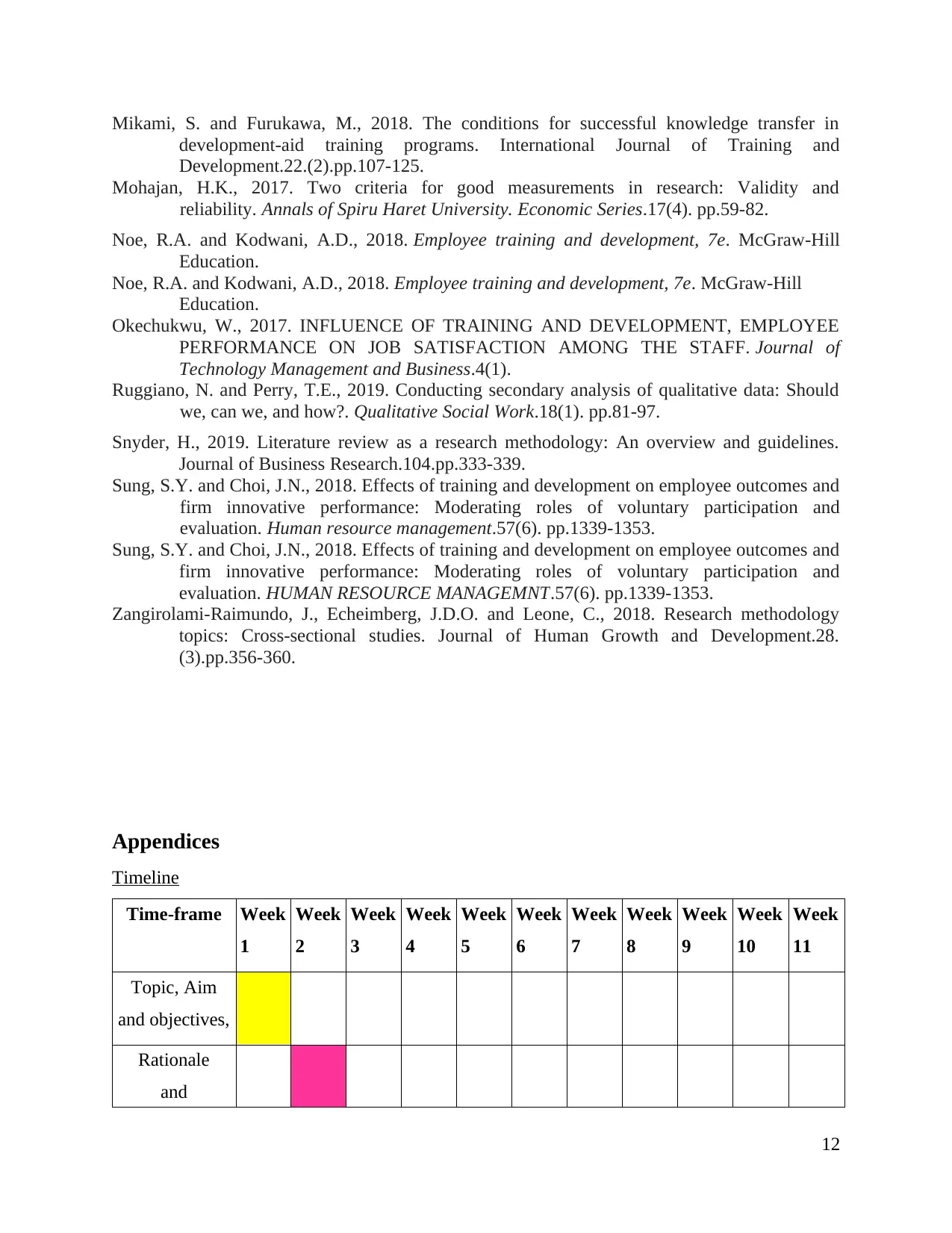
Timeline
Time-frame Week
1
Week
2
Week
3
Week
4
Week
5
Week
6
Week
7
Week
8
Week
9
Week
10
Week
11
Topic, Aim
and objectives,
Rationale
and
12
development‐aid training programs. International Journal of Training and
Development.22.(2).pp.107-125.
Mohajan, H.K., 2017. Two criteria for good measurements in research: Validity and
reliability. Annals of Spiru Haret University. Economic Series.17(4). pp.59-82.
Noe, R.A. and Kodwani, A.D., 2018. Employee training and development, 7e. McGraw-Hill
Education.
Noe, R.A. and Kodwani, A.D., 2018. Employee training and development, 7e. McGraw-Hill
Education.
Okechukwu, W., 2017. INFLUENCE OF TRAINING AND DEVELOPMENT, EMPLOYEE
PERFORMANCE ON JOB SATISFACTION AMONG THE STAFF. Journal of
Technology Management and Business.4(1).
Ruggiano, N. and Perry, T.E., 2019. Conducting secondary analysis of qualitative data: Should
we, can we, and how?. Qualitative Social Work.18(1). pp.81-97.
Snyder, H., 2019. Literature review as a research methodology: An overview and guidelines.
Journal of Business Research.104.pp.333-339.
Sung, S.Y. and Choi, J.N., 2018. Effects of training and development on employee outcomes and
firm innovative performance: Moderating roles of voluntary participation and
evaluation. Human resource management.57(6). pp.1339-1353.
Sung, S.Y. and Choi, J.N., 2018. Effects of training and development on employee outcomes and
firm innovative performance: Moderating roles of voluntary participation and
evaluation. HUMAN RESOURCE MANAGEMNT.57(6). pp.1339-1353.
Zangirolami-Raimundo, J., Echeimberg, J.D.O. and Leone, C., 2018. Research methodology
topics: Cross-sectional studies. Journal of Human Growth and Development.28.
(3).pp.356-360.
Appendices
Timeline
Time-frame Week
1
Week
2
Week
3
Week
4
Week
5
Week
6
Week
7
Week
8
Week
9
Week
10
Week
11
Topic, Aim
and objectives,
Rationale
and
12
⊘ This is a preview!⊘
Do you want full access?
Subscribe today to unlock all pages.
Trusted by 1+ million students worldwide

1 out of 14


Related Documents


Your All-in-One AI-Powered Toolkit for Academic Success.
+13062052269
info@desklib.com
Available 24*7 on WhatsApp / Email
![[object Object]](/_next/static/media/star-bottom.7253800d.svg)
Unlock your academic potential
Copyright © 2020–2026 A2Z Services. All Rights Reserved. Developed and managed by ZUCOL.