Training Sessions Database ERD Diagram Project and Business Rules

Verified

Added on  2024/07/01

|2
|316
|210
Project
AI Summary
This project provides ERD diagrams designed according to specified business rules for a training sessions database. The first business rule dictates that each player attends all 20 training sessions, which is reflected in the ERD by linking the Player and Training Session tables through a Performance table to avoid a many-to-many relationship. The second business rule requires each training session to have at least six registered players. Assumptions made include attributes in the Player table (training_sessions_attended) and Training_session table (number_of_players) to enforce these rules. The relationships between Player, Training_session, and Performance are one-to-many, with cardinalities and optionalities reflecting the ability of one player to attend many sessions and one session to include many players, with performance ratings stored in the Performance table. Desklib offers a wealth of resources for students, including past papers and solved assignments.
Document Page
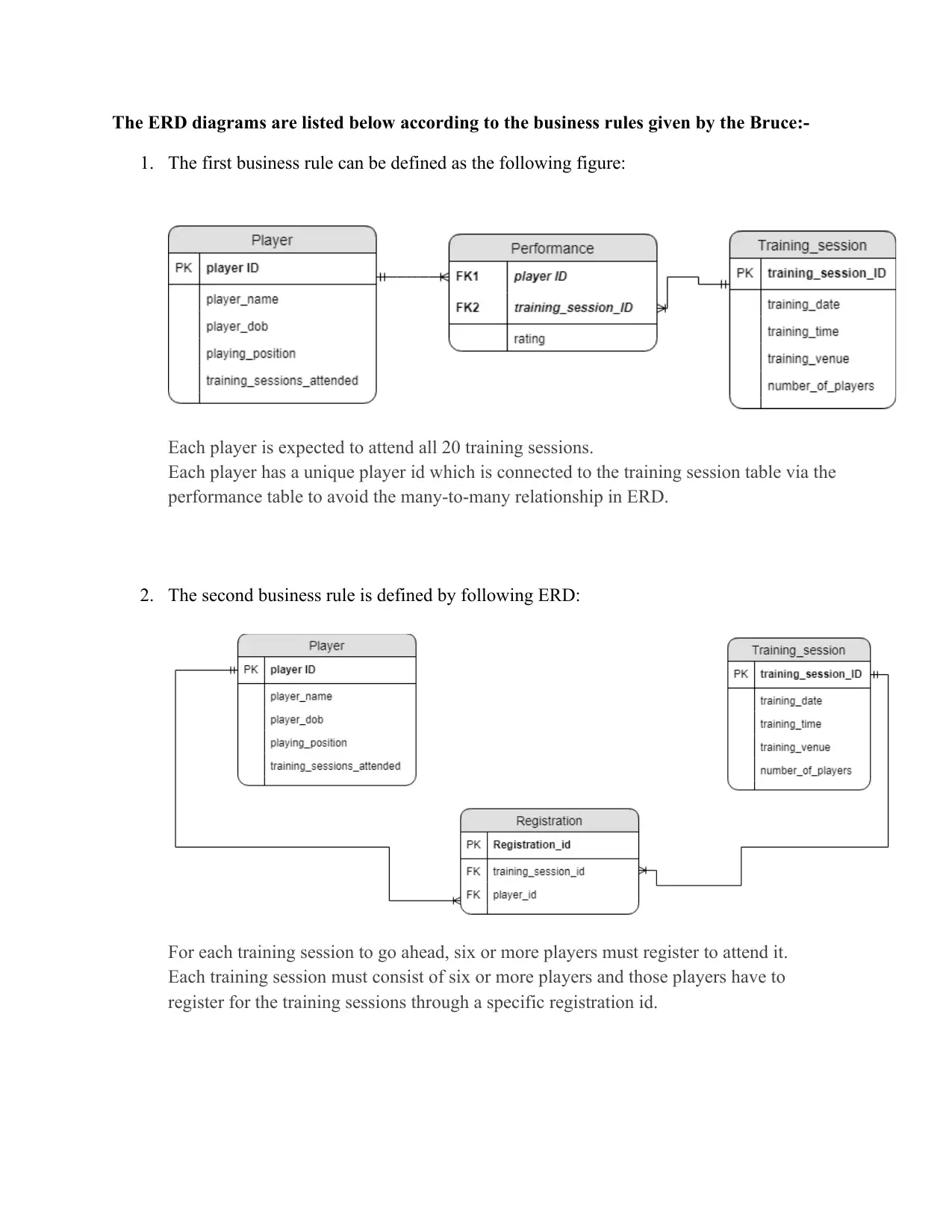
The ERD diagrams are listed below according to the business rules given by the Bruce:-
1.
The first business rule can be defined as the following figure:
Each player is expected to attend all 20 training sessions.

Each player has a unique player id which is connected to the training session table via the

performance table to avoid the many-to-many relationship in ERD.

2.
The second business rule is defined by following ERD:
For each training session to go ahead, six or more players must register to attend it.

Each training session must consist of six or more players and those players have to

register for the training sessions through a specific registration id.
tabler-icon-diamond-filled.svg

Paraphrase This Document

Need a fresh take? Get an instant paraphrase of this document with our AI Paraphraser
Document Page
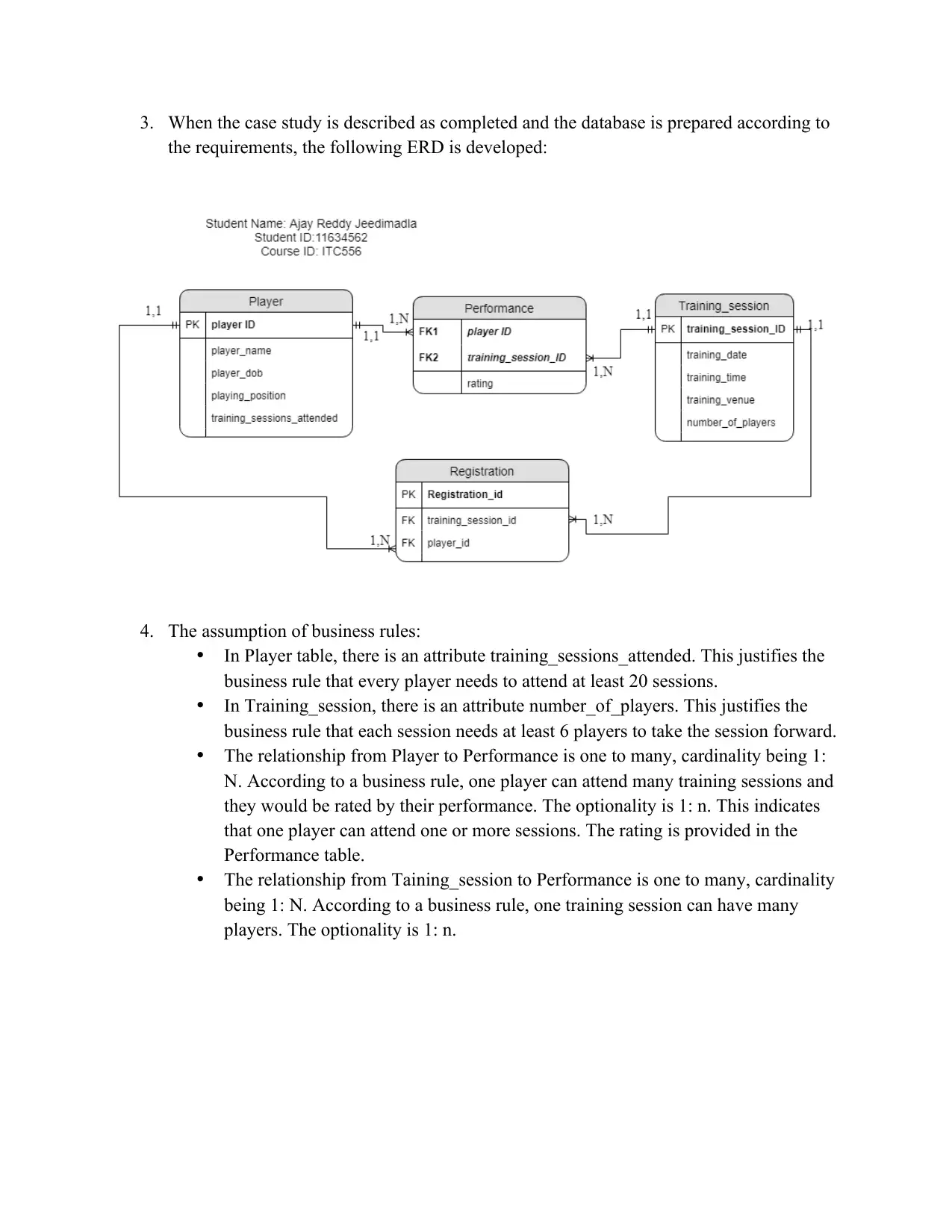
3. When the case study is described as completed and the database is prepared according to
the requirements, the following ERD is developed:

4.
The assumption of business rules:
In Player table, there is an attribute training_sessions_attended. This justifies the
business rule that every player needs to attend at least 20 sessions.

In Training_session, there is an attribute number_of_players. This justifies the
business rule that each session needs at least 6 players to take the session forward.

The relationship from Player to Performance is one to many, cardinality being 1:
N. According to a business rule, one player can attend many training sessions and

they would be rated by their performance. The optionality is 1: n. This indicates

that one player can attend one or more sessions. The rating is provided in the

Performance table.

The relationship from Taining_session to Performance is one to many, cardinality
being 1: N. According to a business rule, one training session can have many

players. The optionality is 1: n.
chevron_up_icon
1 out of 2
circle_padding
hide_on_mobile
zoom_out_icon
[object Object]