Transcultural Health Care Assignment: Communication, Ethics, and Care

Verified

Added on  2022/08/29

|4
|851
|34
Homework Assignment
AI Summary
This assignment addresses the complexities of transcultural healthcare, focusing on a patient who speaks little English and is experiencing a delay in discharge due to a fall. The solution explores alternative communication methods, such as visual aids, to overcome language barriers and ensure the patient understands their condition and discharge instructions. It emphasizes the importance of assessing patient comprehension and the impact of staff actions on patient care, highlighting ethical considerations and the need for clear communication. The assignment also stresses the importance of providing patient instructions in multiple languages and ensuring a safe environment to prevent patient harm, aligning with patient education and care policies. The solution provides insights into how healthcare providers can improve patient experiences and deliver quality care in diverse cultural settings, considering the ethical implications of their actions.
Document Page
Running head: TRANSCULTURAL HEALTH CARE 1
Transcultural Health Care
Name
Institution of Affiliation
tabler-icon-diamond-filled.svg

Paraphrase This Document

Need a fresh take? Get an instant paraphrase of this document with our AI Paraphraser
Document Page
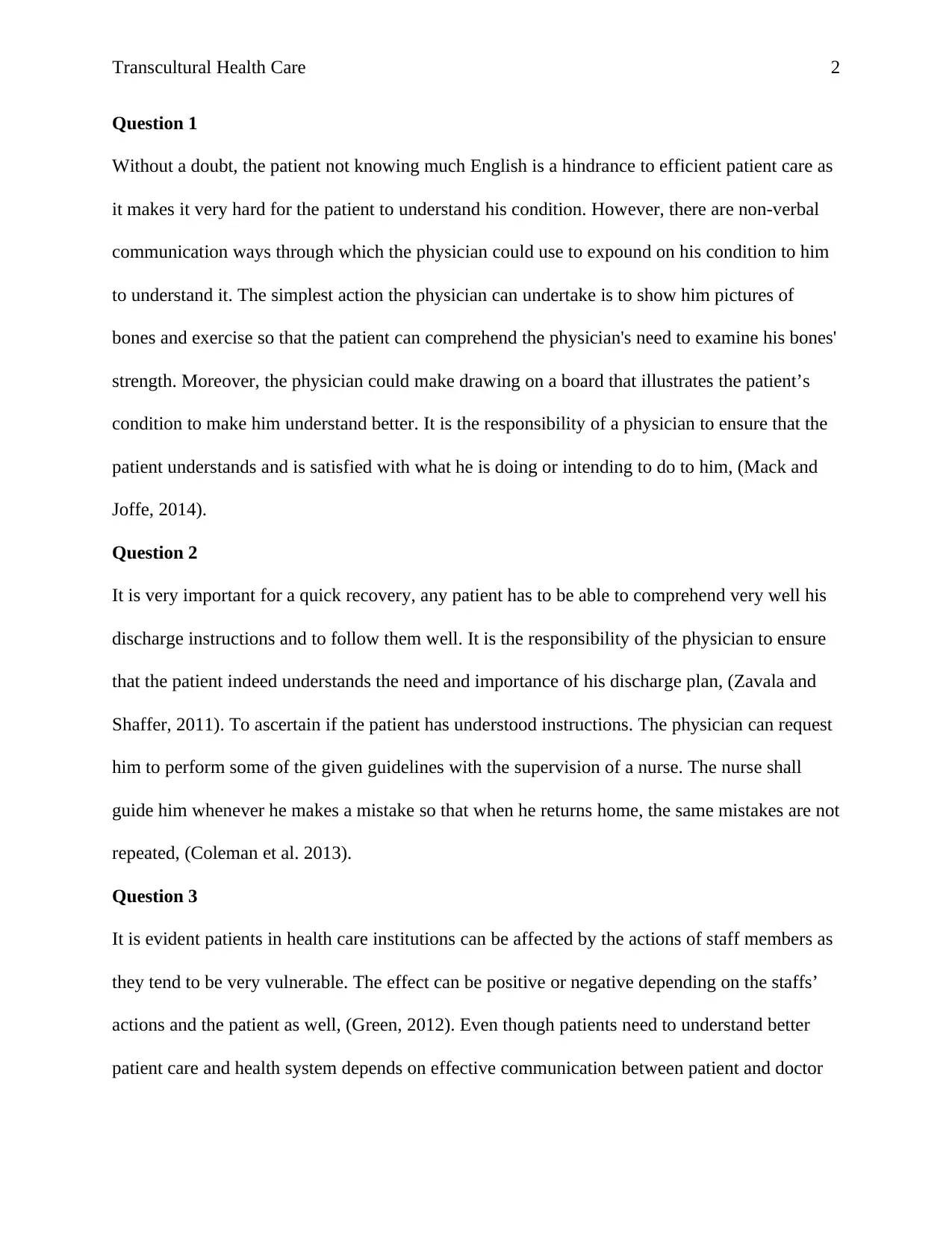
Transcultural Health Care 2
Question 1
Without a doubt, the patient not knowing much English is a hindrance to efficient patient care as
it makes it very hard for the patient to understand his condition. However, there are non-verbal
communication ways through which the physician could use to expound on his condition to him
to understand it. The simplest action the physician can undertake is to show him pictures of
bones and exercise so that the patient can comprehend the physician's need to examine his bones'
strength. Moreover, the physician could make drawing on a board that illustrates the patient’s
condition to make him understand better. It is the responsibility of a physician to ensure that the
patient understands and is satisfied with what he is doing or intending to do to him, (Mack and
Joffe, 2014).
Question 2
It is very important for a quick recovery, any patient has to be able to comprehend very well his
discharge instructions and to follow them well. It is the responsibility of the physician to ensure
that the patient indeed understands the need and importance of his discharge plan, (Zavala and
Shaffer, 2011). To ascertain if the patient has understood instructions. The physician can request
him to perform some of the given guidelines with the supervision of a nurse. The nurse shall
guide him whenever he makes a mistake so that when he returns home, the same mistakes are not
repeated, (Coleman et al. 2013).
Question 3
It is evident patients in health care institutions can be affected by the actions of staff members as
they tend to be very vulnerable. The effect can be positive or negative depending on the staffs’
actions and the patient as well, (Green, 2012). Even though patients need to understand better
patient care and health system depends on effective communication between patient and doctor
Document Page
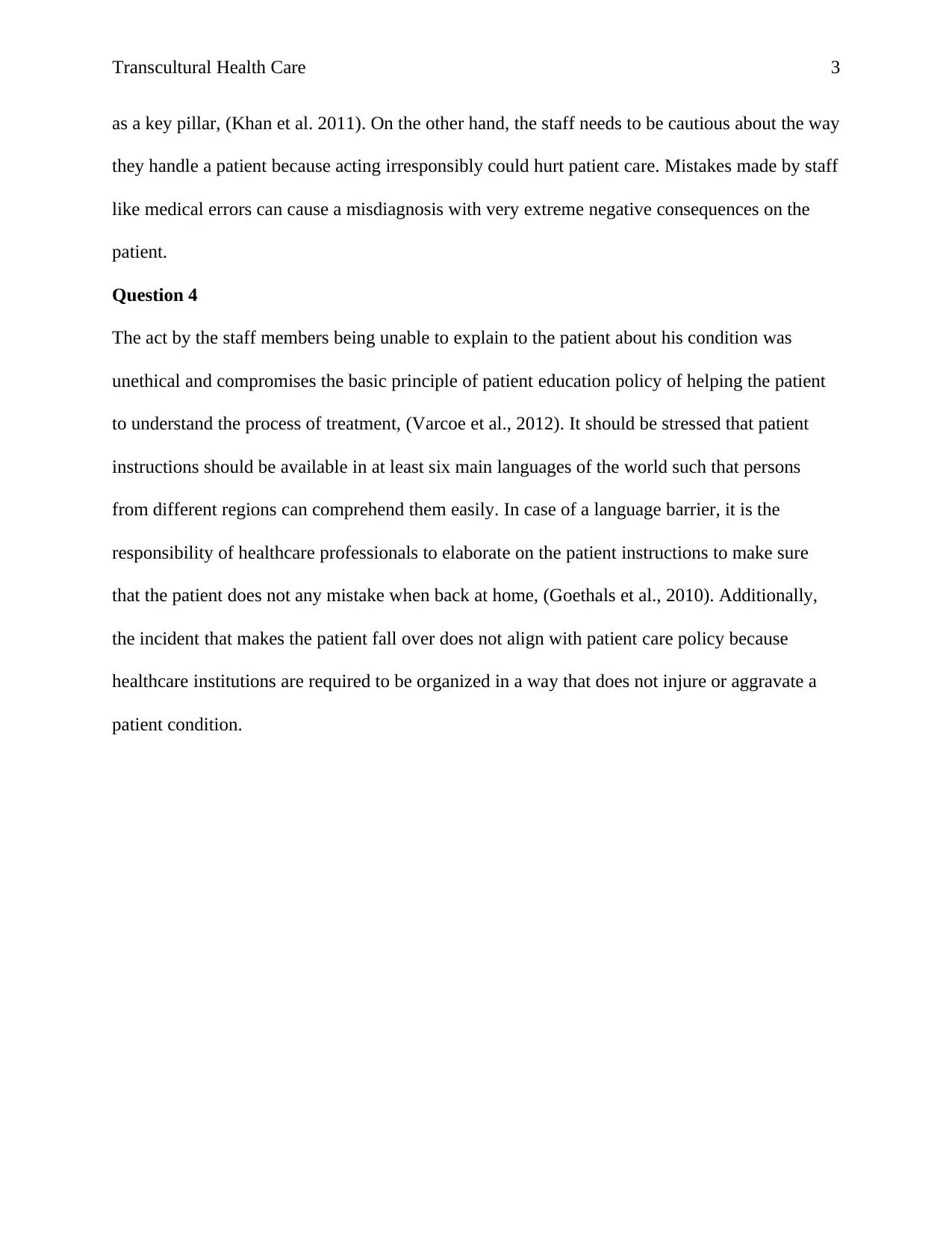
Transcultural Health Care 3
as a key pillar, (Khan et al. 2011). On the other hand, the staff needs to be cautious about the way
they handle a patient because acting irresponsibly could hurt patient care. Mistakes made by staff
like medical errors can cause a misdiagnosis with very extreme negative consequences on the
patient.
Question 4
The act by the staff members being unable to explain to the patient about his condition was
unethical and compromises the basic principle of patient education policy of helping the patient
to understand the process of treatment, (Varcoe et al., 2012). It should be stressed that patient
instructions should be available in at least six main languages of the world such that persons
from different regions can comprehend them easily. In case of a language barrier, it is the
responsibility of healthcare professionals to elaborate on the patient instructions to make sure
that the patient does not any mistake when back at home, (Goethals et al., 2010). Additionally,
the incident that makes the patient fall over does not align with patient care policy because
healthcare institutions are required to be organized in a way that does not injure or aggravate a
patient condition.
Document Page
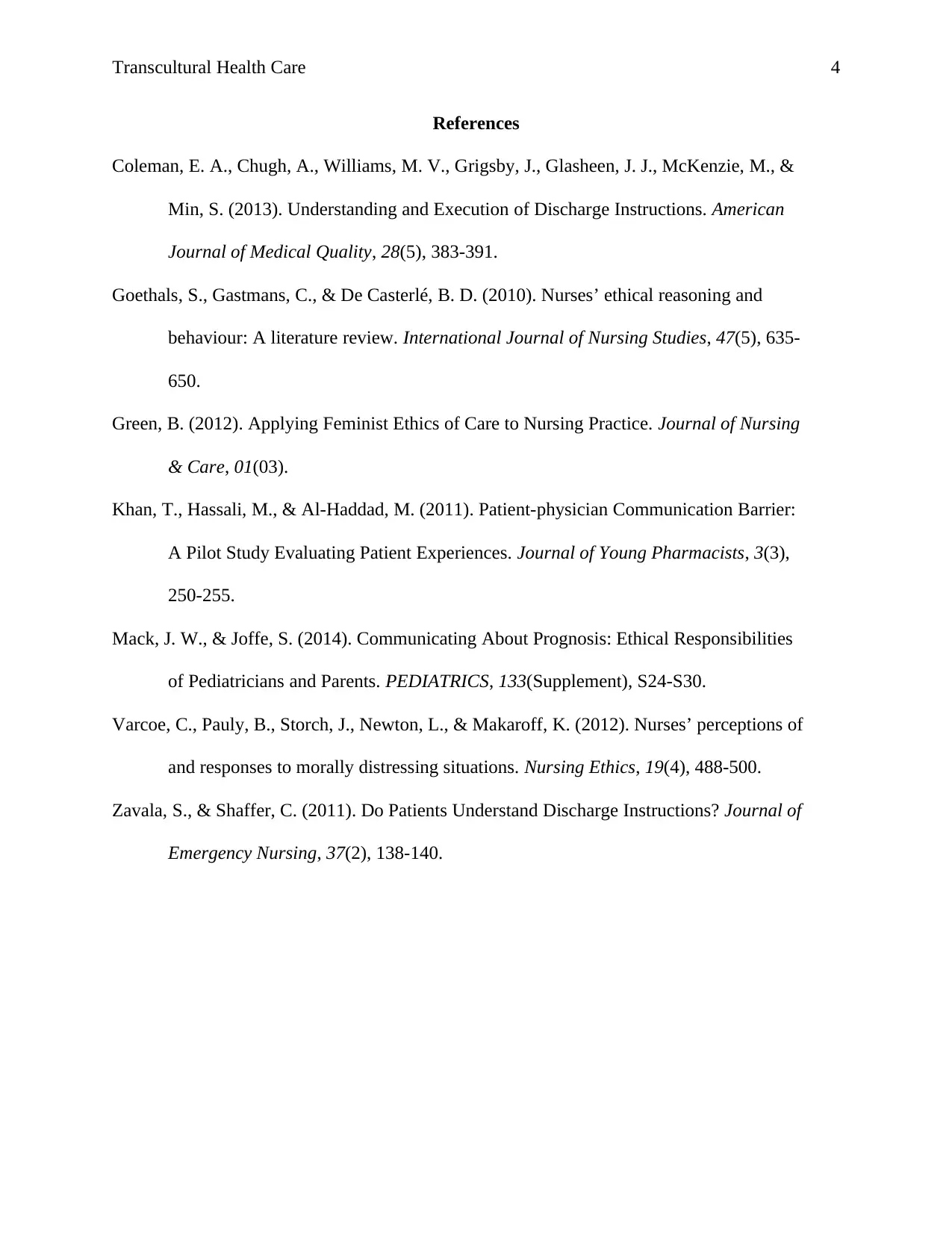
Transcultural Health Care 4
References
Coleman, E. A., Chugh, A., Williams, M. V., Grigsby, J., Glasheen, J. J., McKenzie, M., &
Min, S. (2013). Understanding and Execution of Discharge Instructions. American
Journal of Medical Quality, 28(5), 383-391.
Goethals, S., Gastmans, C., & De Casterlé, B. D. (2010). Nurses’ ethical reasoning and
behaviour: A literature review. International Journal of Nursing Studies, 47(5), 635-
650.
Green, B. (2012). Applying Feminist Ethics of Care to Nursing Practice. Journal of Nursing
& Care, 01(03).
Khan, T., Hassali, M., & Al-Haddad, M. (2011). Patient-physician Communication Barrier:
A Pilot Study Evaluating Patient Experiences. Journal of Young Pharmacists, 3(3),
250-255.
Mack, J. W., & Joffe, S. (2014). Communicating About Prognosis: Ethical Responsibilities
of Pediatricians and Parents. PEDIATRICS, 133(Supplement), S24-S30.
Varcoe, C., Pauly, B., Storch, J., Newton, L., & Makaroff, K. (2012). Nurses’ perceptions of
and responses to morally distressing situations. Nursing Ethics, 19(4), 488-500.
Zavala, S., & Shaffer, C. (2011). Do Patients Understand Discharge Instructions? Journal of
Emergency Nursing, 37(2), 138-140.
chevron_up_icon
1 out of 4
circle_padding
hide_on_mobile
zoom_out_icon
[object Object]