Special Aspects of Translating Tool Morphometric Data into Database

Verified

Added on  2022/09/27

|4
|810
|22
Project
AI Summary
This minor thesis project, undertaken by Mohan Sai Kandula, focuses on the special aspects of translating tool morphometric information into a structured database. The project addresses the challenges in roll pass design, particularly the limitations of existing software in analyzing geometrically dissimilar products. It proposes an improved technique for digitizing complex pass shapes and aims to facilitate statistical analysis of morphometric features. The project is justified by the increasing need for data-driven optimization in rolling mills and the importance of analyzing industrial records. Expected outcomes include an overview of published information, diagnosis of digitization difficulties, and the presentation of digitized roll pass examples. The project leverages morphometric studies to analyze procedures and utilize advanced software for calculations. The project also highlights the significance of Big Data and statistical models in improving the sustainability of rolling mill operations and the importance of intelligent systems for consistent product quality. The project uses references to support the research.

Document Page
Minor Thesis Project Brief
Student Name:
Mohan Sai Kandula
Student ID Number:
110260096
PROJECT DETAILS
Project Title: Special aspects of translating tool morphometric information into structured
database
Problems & Significance
A central agenda in rolling process is design of the series of passes used to form the product
gradually, starting with a cuboid and finishing with one of many shapes of long products (Caruana et
al., 2014). Bearing in mind the enormous quantity of rolled products, large counts of passes and their
repetitions used across numerous campaigns, it is broadly accepted that useful knowledge about this
technique of material processing can be extracted by means of statistical analyses of industrial
records.
In traditional approach to roll pass design, the quantitative information about morphological features
of roll passes could be combined as long as the analysed cases belonged to the family of
geometrically similar products (Wang, Song and Tang, 2016). The existing software used for
analyzing roll pass design is delimited to the above constraint, i.e. it allows for comparing only the
products of the same narrowly defined category. The new form of morphometric approach allows for
creating much broader database and thus comparing wider range of shapes which ultimately allows
for inferring new knowledge about the rolling process by virtue of statistical analyses.
Expected Outcomes
An overview of published information about pass design in long-product-rolling systems will be
presented.
Difficulties in digitizing the complex pass shapes will be diagnosed.
An improved technique for digitizing will be proposed and tested.
Current attempts to rely on statistical analyses of industrial records are curtailed by misalignments
in defining the rolling pass morphometric and kinematic concepts.
Examples of the use of digitized format of roll passes will be presented.
Justification of the project using literature
This project is considered to be viable as the landmark-based studies based on morphometric
tabler-icon-diamond-filled.svg

Paraphrase This Document

Need a fresh take? Get an instant paraphrase of this document with our AI Paraphraser
Document Page
studies help in the analysis of procedures. Digitization is a precondition for utilizing the advanced
computerized software routines such as calculation of roll working diameter, groove area,
coefficient of elongation, roll velocity etc.
In case of morphometric analysis, there is a certain set of scrutinizing the pass series based on
analysis based on statistics (Wei, Gaoshen and Qingwu, 2015)
The project will facilitate statistical analysis (such as multiple regression) of morphometric features
of rolling series.
The companies running rolling mills increasingly recognize the need to radically improve the
sustainability these complex operations. The primary driving force for such advance is in utilization
of Big Data via statistical models. There is a well-accepted general understanding about the
importance of analysing actual industrial records (Tang et al., 2015). The most valid evidence
about the interplay of all possible variables in a rolling mill and the ultimate outcome is a factual
manufacturing process. Intelligent systems that continuously learn and optimise the performance
of rolling mills are extremely valuable for the manufacture of consistent product quality. Rolling
mill operations generate huge quantities of records digitization of which is one of the
preconditions for employing statistical tools for optimizing the process (Fu et al., 2017).
Developing analytical tools to utilize the manufacturing databases would be of great benefit
to the industry.
Document Page
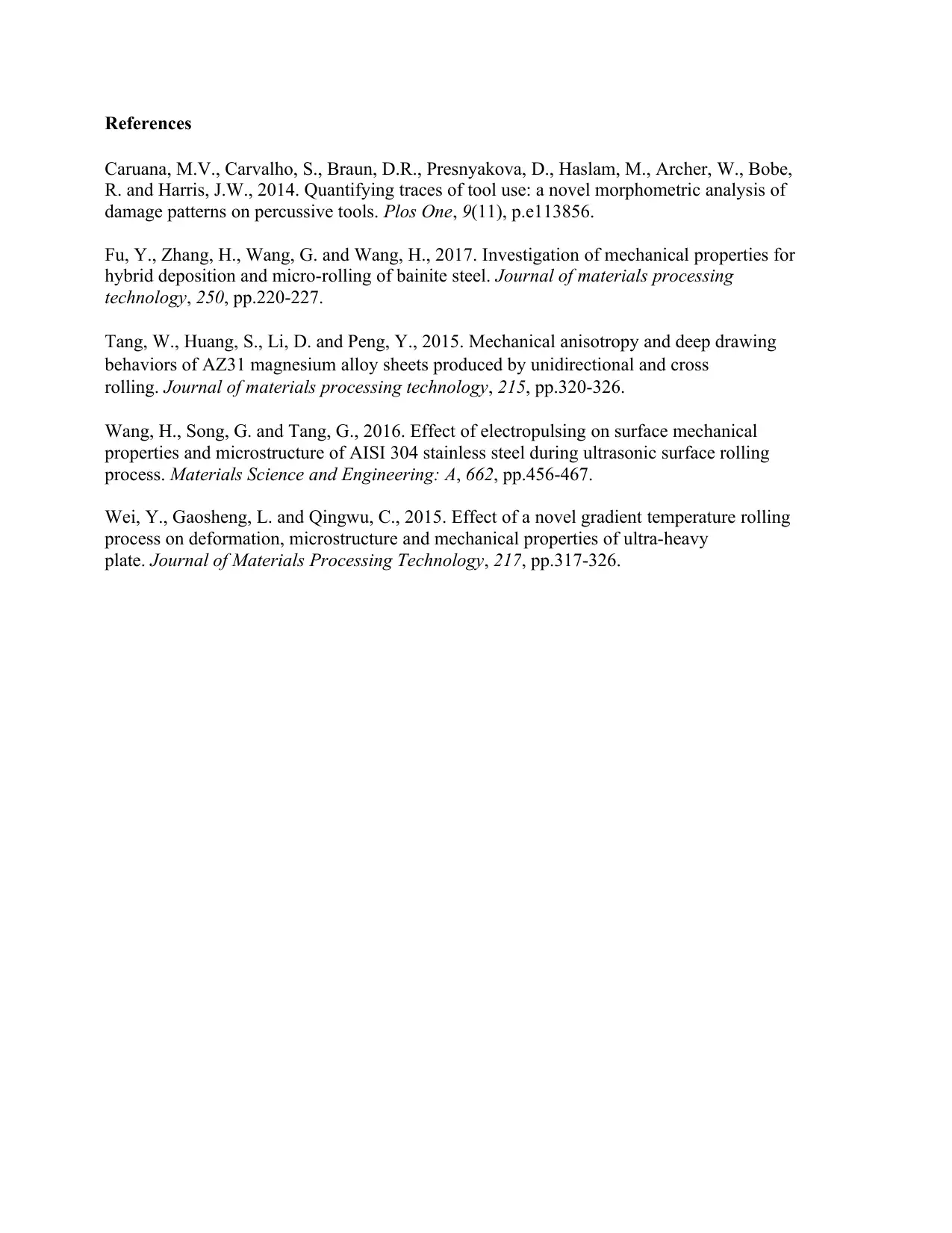
References
Caruana, M.V., Carvalho, S., Braun, D.R., Presnyakova, D., Haslam, M., Archer, W., Bobe,
R. and Harris, J.W., 2014. Quantifying traces of tool use: a novel morphometric analysis of
damage patterns on percussive tools. Plos One, 9(11), p.e113856.
Fu, Y., Zhang, H., Wang, G. and Wang, H., 2017. Investigation of mechanical properties for
hybrid deposition and micro-rolling of bainite steel. Journal of materials processing
technology, 250, pp.220-227.
Tang, W., Huang, S., Li, D. and Peng, Y., 2015. Mechanical anisotropy and deep drawing
behaviors of AZ31 magnesium alloy sheets produced by unidirectional and cross
rolling. Journal of materials processing technology, 215, pp.320-326.
Wang, H., Song, G. and Tang, G., 2016. Effect of electropulsing on surface mechanical
properties and microstructure of AISI 304 stainless steel during ultrasonic surface rolling
process. Materials Science and Engineering: A, 662, pp.456-467.
Wei, Y., Gaosheng, L. and Qingwu, C., 2015. Effect of a novel gradient temperature rolling
process on deformation, microstructure and mechanical properties of ultra-heavy
plate. Journal of Materials Processing Technology, 217, pp.317-326.
Document Page
chevron_up_icon
1 out of 4
circle_padding
hide_on_mobile
zoom_out_icon
[object Object]