NURS 725 - Evidence Table: Translation Research in Population Health

Verified

Added on  2023/06/04

|4
|1370
|455
Literature Review
AI Summary
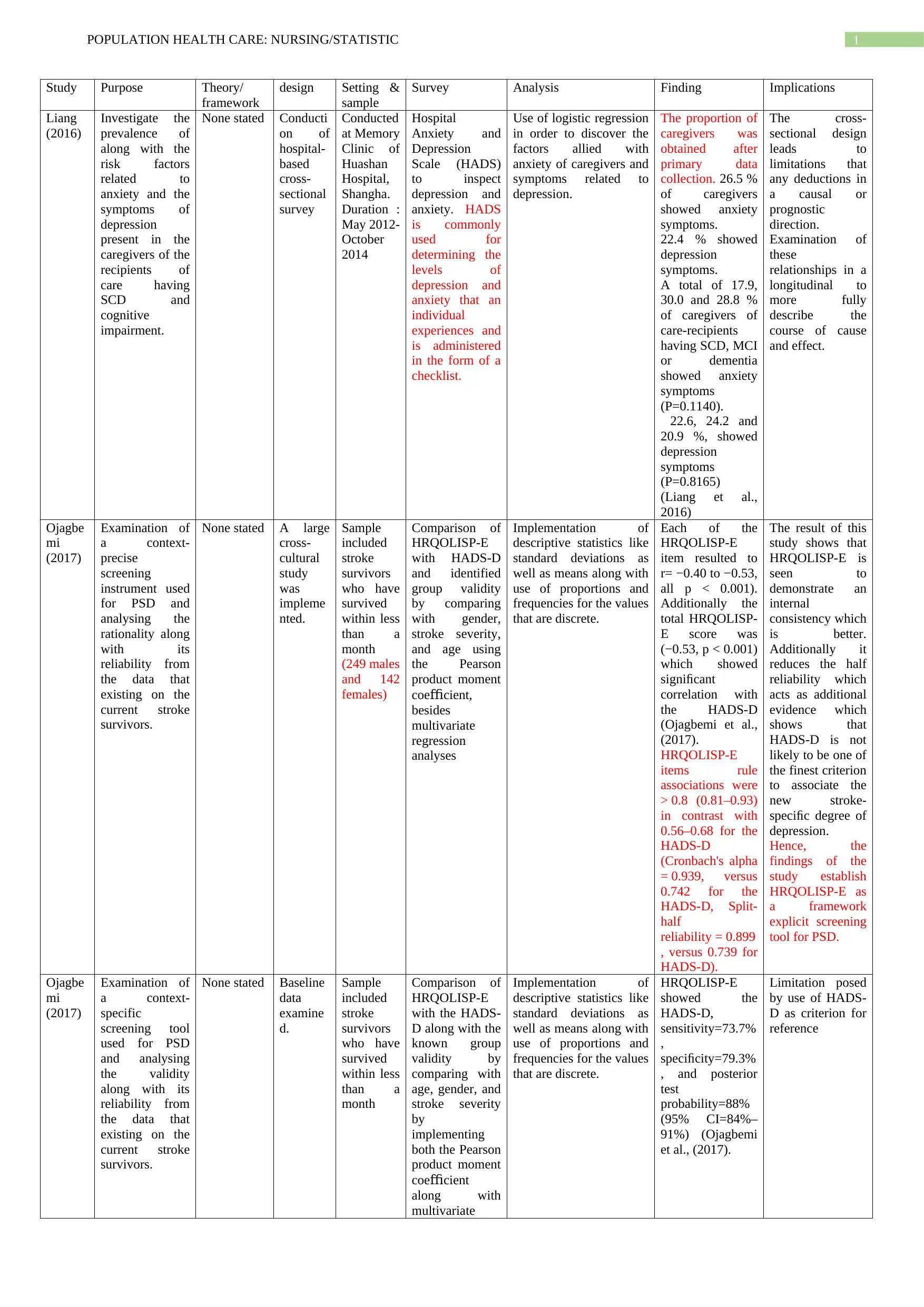
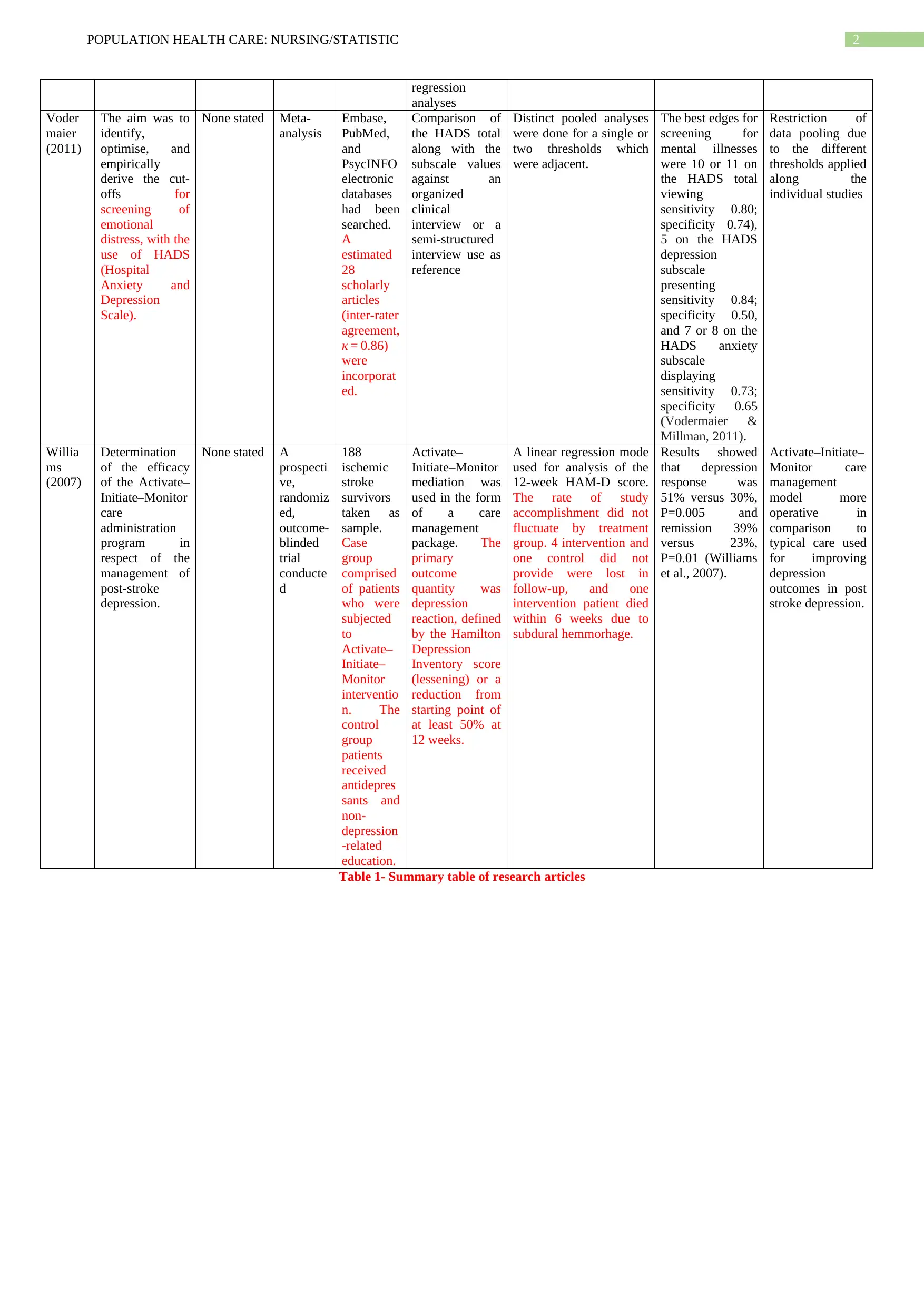
This document presents a literature review in the form of an evidence table, focusing on population health care, nursing, and statistics. It summarizes key research articles, examining study designs, settings, samples, surveys/instruments used, and findings related to topics such as anxiety and depression in caregivers of individuals with cognitive decline, screening tools for post-stroke depression, and the effectiveness of care management programs for post-stroke depression. The table includes details like study purpose, theoretical frameworks, statistical analyses, and implications for practice or limitations of the research. Studies included utilize designs such as cross-sectional surveys, meta-analyses, and randomized controlled trials to investigate various aspects of population health and mental health outcomes. The evidence table is designed to provide a concise overview of relevant research for translation research, as part of the NURS 725 course.
Document Page
Running head: POPULATION HEALTH CARE: NURSING/STATISTIC
POPULATION HEALTH CARE: NURSING/STATISTIC
Name of the Student:
Name of the University:
Author Note:
tabler-icon-diamond-filled.svg

Paraphrase This Document

Need a fresh take? Get an instant paraphrase of this document with our AI Paraphraser
Document Page
1POPULATION HEALTH CARE: NURSING/STATISTIC
Study Purpose Theory/
framework
design Setting &
sample
Survey Analysis Finding Implications
Liang
(2016)
Investigate the
prevalence of
along with the
risk factors
related to
anxiety and the
symptoms of
depression
present in the
caregivers of the
recipients of
care having
SCD and
cognitive
impairment.
None stated Conducti
on of
hospital-
based
cross-
sectional
survey
Conducted
at Memory
Clinic of
Huashan
Hospital,
Shangha.
Duration :
May 2012-
October
2014
Hospital
Anxiety and
Depression
Scale (HADS)
to inspect
depression and
anxiety. HADS
is commonly
used for
determining the
levels of
depression and
anxiety that an
individual
experiences and
is administered
in the form of a
checklist.
Use of logistic regression
in order to discover the
factors allied with
anxiety of caregivers and
symptoms related to
depression.
The proportion of
caregivers was
obtained after
primary data
collection. 26.5 %
of caregivers
showed anxiety
symptoms.
22.4 % showed
depression
symptoms.
A total of 17.9,
30.0 and 28.8 %
of caregivers of
care-recipients
having SCD, MCI
or dementia
showed anxiety
symptoms
(P=0.1140).
22.6, 24.2 and
20.9 %, showed
depression
symptoms
(P=0.8165)
(Liang et al.,
2016)
The cross-
sectional design
leads to
limitations that
any deductions in
a causal or
prognostic
direction.
Examination of
these
relationships in a
longitudinal to
more fully
describe the
course of cause
and effect.
Ojagbe
mi
(2017)
Examination of
a context-
precise
screening
instrument used
for PSD and
analysing the
rationality along
with its
reliability from
the data that
existing on the
current stroke
survivors.
None stated A large
cross-
cultural
study
was
impleme
nted.
Sample
included
stroke
survivors
who have
survived
within less
than a
month
(249 males
and 142
females)
Comparison of
HRQOLISP-E
with HADS-D
and identified
group validity
by comparing
with gender,
stroke severity,
and age using
the Pearson
product moment
coefficient,
besides
multivariate
regression
analyses
Implementation of
descriptive statistics like
standard deviations as
well as means along with
use of proportions and
frequencies for the values
that are discrete.
Each of the
HRQOLISP-E
item resulted to
r= −0.40 to −0.53,
all p < 0.001).
Additionally the
total HRQOLISP-
E score was
(−0.53, p < 0.001)
which showed
significant
correlation with
the HADS-D
(Ojagbemi et al.,
(2017).
HRQOLISP-E
items rule
associations were
> 0.8 (0.81–0.93)
in contrast with
0.56–0.68 for the
HADS-D
(Cronbach's alpha
= 0.939, versus
0.742 for the
HADS-D, Split-
half
reliability = 0.899
, versus 0.739 for
HADS-D).
The result of this
study shows that
HRQOLISP-E is
seen to
demonstrate an
internal
consistency which
is better.
Additionally it
reduces the half
reliability which
acts as additional
evidence which
shows that
HADS-D is not
likely to be one of
the finest criterion
to associate the
new stroke-
specific degree of
depression.
Hence, the
findings of the
study establish
HRQOLISP-E as
a framework
explicit screening
tool for PSD.
Ojagbe
mi
(2017)
Examination of
a context-
specific
screening tool
used for PSD
and analysing
the validity
along with its
reliability from
the data that
existing on the
current stroke
survivors.
None stated Baseline
data
examine
d.
Sample
included
stroke
survivors
who have
survived
within less
than a
month
Comparison of
HRQOLISP-E
with the HADS-
D along with the
known group
validity by
comparing with
age, gender, and
stroke severity
by
implementing
both the Pearson
product moment
coefficient
along with
multivariate
Implementation of
descriptive statistics like
standard deviations as
well as means along with
use of proportions and
frequencies for the values
that are discrete.
HRQOLISP-E
showed the
HADS-D,
sensitivity=73.7%
,
specificity=79.3%
, and posterior
test
probability=88%
(95% CI=84%–
91%) (Ojagbemi
et al., (2017).
Limitation posed
by use of HADS-
D as criterion for
reference
Document Page
2POPULATION HEALTH CARE: NURSING/STATISTIC
regression
analyses
Voder
maier
(2011)
The aim was to
identify,
optimise, and
empirically
derive the cut-
offs for
screening of
emotional
distress, with the
use of HADS
(Hospital
Anxiety and
Depression
Scale).
None stated Meta-
analysis
Embase,
PubMed,
and
PsycINFO
electronic
databases
had been
searched.
A
estimated
28
scholarly
articles
(inter-rater
agreement,
κ = 0.86)
were
incorporat
ed.
Comparison of
the HADS total
along with the
subscale values
against an
organized
clinical
interview or a
semi-structured
interview use as
reference
Distinct pooled analyses
were done for a single or
two thresholds which
were adjacent.
The best edges for
screening for
mental illnesses
were 10 or 11 on
the HADS total
viewing
sensitivity 0.80;
specificity 0.74),
5 on the HADS
depression
subscale
presenting
sensitivity 0.84;
specificity 0.50,
and 7 or 8 on the
HADS anxiety
subscale
displaying
sensitivity 0.73;
specificity 0.65
(Vodermaier &
Millman, 2011).
Restriction of
data pooling due
to the different
thresholds applied
along the
individual studies
Willia
ms
(2007)
Determination
of the efficacy
of the Activate–
Initiate–Monitor
care
administration
program in
respect of the
management of
post-stroke
depression.
None stated A
prospecti
ve,
randomiz
ed,
outcome-
blinded
trial
conducte
d
188
ischemic
stroke
survivors
taken as
sample.
Case
group
comprised
of patients
who were
subjected
to
Activate–
Initiate–
Monitor
interventio
n. The
control
group
patients
received
antidepres
sants and
non-
depression
-related
education.
Activate–
Initiate–Monitor
mediation was
used in the form
of a care
management
package. The
primary
outcome
quantity was
depression
reaction, defined
by the Hamilton
Depression
Inventory score
(lessening) or a
reduction from
starting point of
at least 50% at
12 weeks.
A linear regression mode
used for analysis of the
12-week HAM-D score.
The rate of study
accomplishment did not
fluctuate by treatment
group. 4 intervention and
one control did not
provide were lost in
follow-up, and one
intervention patient died
within 6 weeks due to
subdural hemmorhage.
Results showed
that depression
response was
51% versus 30%,
P=0.005 and
remission 39%
versus 23%,
P=0.01 (Williams
et al., 2007).
Activate–Initiate–
Monitor care
management
model more
operative in
comparison to
typical care used
for improving
depression
outcomes in post
stroke depression.
Table 1- Summary table of research articles
Document Page
3POPULATION HEALTH CARE: NURSING/STATISTIC
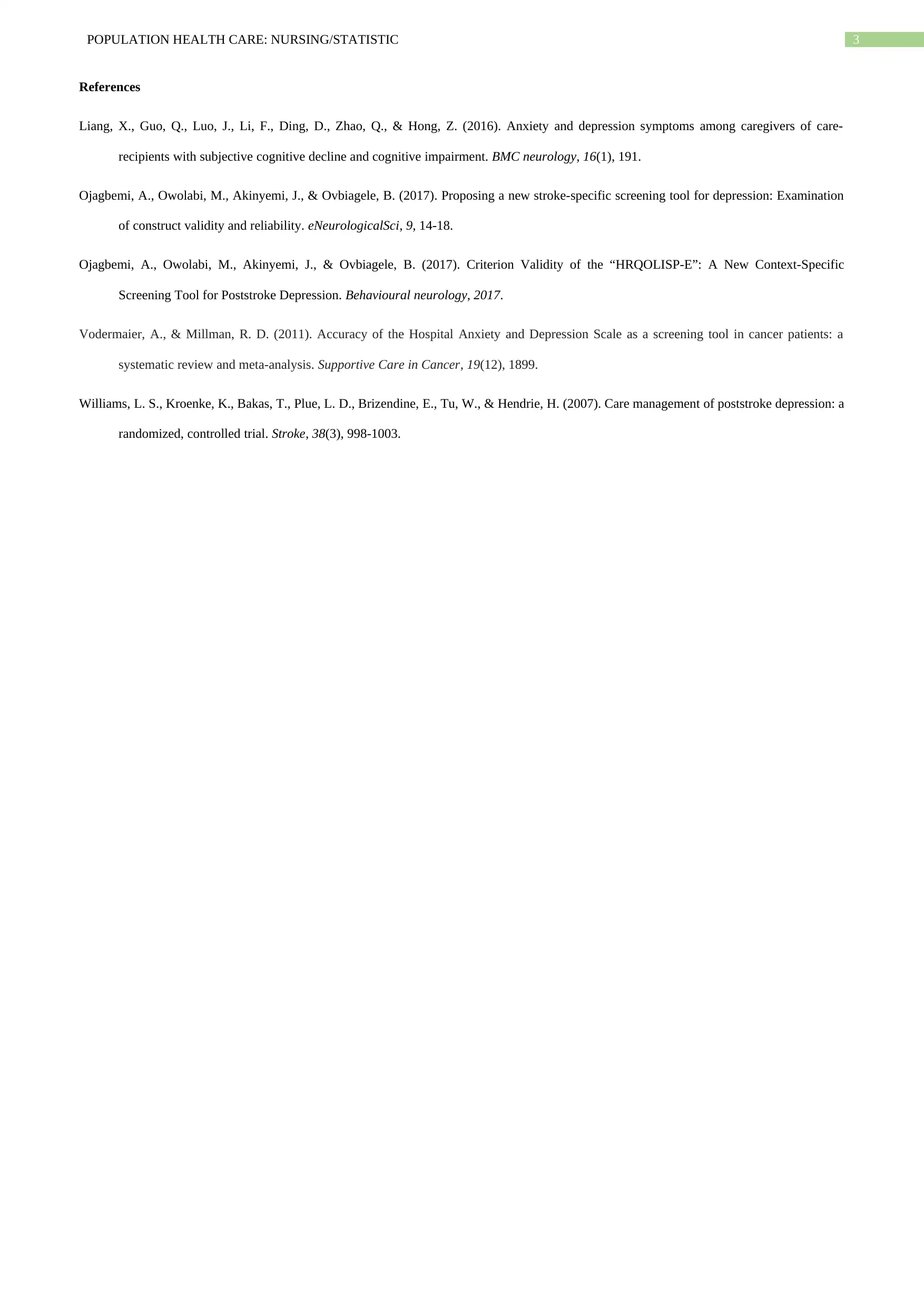
References
Liang, X., Guo, Q., Luo, J., Li, F., Ding, D., Zhao, Q., & Hong, Z. (2016). Anxiety and depression symptoms among caregivers of care-
recipients with subjective cognitive decline and cognitive impairment. BMC neurology, 16(1), 191.
Ojagbemi, A., Owolabi, M., Akinyemi, J., & Ovbiagele, B. (2017). Proposing a new stroke-specific screening tool for depression: Examination
of construct validity and reliability. eNeurologicalSci, 9, 14-18.
Ojagbemi, A., Owolabi, M., Akinyemi, J., & Ovbiagele, B. (2017). Criterion Validity of the “HRQOLISP-E”: A New Context-Specific
Screening Tool for Poststroke Depression. Behavioural neurology, 2017.
Vodermaier, A., & Millman, R. D. (2011). Accuracy of the Hospital Anxiety and Depression Scale as a screening tool in cancer patients: a
systematic review and meta-analysis. Supportive Care in Cancer, 19(12), 1899.
Williams, L. S., Kroenke, K., Bakas, T., Plue, L. D., Brizendine, E., Tu, W., & Hendrie, H. (2007). Care management of poststroke depression: a
randomized, controlled trial. Stroke, 38(3), 998-1003.
chevron_up_icon
1 out of 4
circle_padding
hide_on_mobile
zoom_out_icon
[object Object]