Analyzing Consumer Behavior in Transport Mode Choice

Verified

Added on  2020/05/08

|7
|1752
|76
AI Summary
The study delves into the application of various consumer behavior theories to understand transport mode choice decisions. It highlights how factors like symbolic stimuli, significant stimuli, and social influences shape consumers' transportation preferences. The analysis incorporates Howard’s Theory of Buyer Behavior, examining input variables such as environmental stimuli that affect purchase choices. By integrating models like Grönroos's service quality model, the paper evaluates marketing implications in improving customer interactions and service delivery in the transport sector. It also considers socio-demographic data to predict consumer behavior patterns and their impact on competitive strategies within the market. The findings underscore the importance of understanding consumer perceptions and attitudes towards different transport modes, which can guide effective marketing practices and enhance service quality.

Document Page
TITLE
NAME
INSTITUTION
tabler-icon-diamond-filled.svg

Paraphrase This Document

Need a fresh take? Get an instant paraphrase of this document with our AI Paraphraser
Document Page
LITERATURE REVIEW
Introduction
This chapter contains the empirical review, theoretical review as well as the conceptual
framework. The empirical review gives detailed information on the study, which includes,
assessing the relationship between socio-demographic data and the means of travelling to work,
evaluate the difference in travel behavior between young adults and senior adult, and examine
how level of access to transport mode influence mode share.
The theories covered in the theoretical review include the Transaction Cost Theory, Concept of
consumer behavior and the service quality theory, while the conceptual framework gives a
description of the relationship between travel behavior and customer service delivery.
Theoretical Framework
Transaction Cost Theory
This theory was propagated by Hicks and Niehans in 1983 The theory states that the existence of
companies has been thriving since they can only administer transactions of a market place within
themselves in an affordable way than they can with any other company externally. Transaction
cost occurs when working with parties from the outside of the company. These costs include
information cost, decision cost, outsourcing costs and enforcement cost. Information cost has
been greatly reduced by emergence of new information technology which has enabled managers
to pursue and carry out transactions in a resourceful way. Transaction cost can be classified into
several categories namely; tangible and intangible costs, monetary cost, intellectual and labour
costs which occur indirectly, hence they are termed as indirect costs. A firm will incur labour
costs when they get someone to do something on their behalf (Williamson, 1989). A company
structure and systems is a mojor concern in control over transaction cost and the management
should make all transactions internal to avoid non production costs, risks and drawbacks.
Document Page
Transaction overheads have a valuable influence on customer service transmittal. The goal of the
study is to check in thoroughly how customer service delivery can be made better using social
media marketing. Social media as a platform will achieve this in lowering transactions costs.
Concept of consumer behavior
Consumer behavior research is the scientific study of how human beings will seek a study of
how they use goods that satisfy their human wants. Consumer behaviors include the actions and
decisions that lead to a customer's purchase of a good or services. It is studied by marketers,
businesses and researchers to understand what influences an individual’s preference and choice
of a product of service. There are various factors that affect consumer behavior they include;
beliefs and social values, age, education, culture, economic status and personality, The findings
on consumer behavior are used to come up with strategies and products that will improve a
company’s performance and profits. Today’s research on consumer behavior is increasingly vital
for businesses because consumers are now more knowledgeable and powerful (Faison, 1977).
Characteristics of consumers will comprise four key factors where the factors are responsible for
the different sorts of behaviors portrayed by the consumers. These factors include:
Cultural: Different people will have differing cultures where they are affected through
socialization processes with family and other key organizations.
Social: consumer behavior will also be affected by the kin of friends and age mate as well as the
social class that one has.
Personal: people have differing preferences and this will trigger their customer satisfaction.
Group influence: the group in which a consumer associates with will be responsible for the
consumer preference, perception and attitude towards a product or service.
The purchasing power: consumers evaluate their ability to purchase before deciding to buy the
product or service.
Economic condition: the prevailing economic situation in the market plays a vital role in
influencing consumer behavior and their choice of products.
Advertisements; this helps to create awareness and remind the consumers about a product. This
greatly influences the consumer decisions and behavior (Sirgy, 1982).
Document Page
Service quality theory
This theory was propagated by It states that the satisfaction of a customer with the service
delivered to them depends on their first experience of the same service or product; or on the
expectations they had before in comparison with the actual performance they received. Thus, if
the customers’ recent experience is better than their preceding anticipation, then the customers’
desires, needs, taste and preferences would have been met. This concept states that the quality of
service shows the difference between the expectation of a customer from a provision and their
perception of the service they receive. It is therefore important for customers’ perceptions and
expectations to be known (Brown et al., 1993)
Business organizations can use social media marketing to find out what customers say about
their services and work on improving them. The information they get from social media sites can
enable them to design ways of offering better service (Grönroos, 1984).Through social media,
businesses get insights, ideas and thought on how to offer better customer service as well as new
services or products that they can offer their customers.
Empirical Review
How organizations utilize socio-demographic data in customer service delivery
Companies across variety of industries are exploring social demographic data to improve
customer service delivery. Socio-demographic outlets help organizations to monitor their
customers and acquire information about the customers’ preferences, taste and their opinion
towards the organizations service delivery. This data allows enterprises to champion any changes
that may arise due to customer service related and to effectively make appropriate adjustments to
strategies, products or services (Bettencourt, 1997).
The social demographic data report in 2012 showed that 83% of marketers view social
demographic data as essential to businesses. It also gave the advantages of using social
tabler-icon-diamond-filled.svg

Paraphrase This Document

Need a fresh take? Get an instant paraphrase of this document with our AI Paraphraser
Document Page
demographic data; which include better exposure. This means that through social demographic
data, businesses are more exposed to their customers. They can offer customer service by
meeting with the customers one on one and listening to their complains, suggestions and opinion
about your products and service ( Hubbert et al. 1997). Trio Digital Company Ltd is characterized
by its excellent operational online customer relations. This is due to its ability to incorporate
cultures that motives the employees to act and respond swiftly on consumer needs. The
organization carries out training and development to equip their staff with knowledge and skills
on how to relate with customers and address their complains in time, this improves customer
service delivery. Through social demographic data, the support staffs are able to answer
customer questions and solve their problems
How organizations examine level of access to transport mode influence mode share.
A theory was first developed by Howard in 1963 then developed further by Howard and Sheth in
1969 to become ‘Theory of Buyer Behavior’. The theory explains four variables that influence
consumer behavior which includes perception and learning constructs outputs, input and external
variables. Input variables refer to the environmental stimuli a consumer is exposed to. The types
of stimuli that the advertiser may provide are symbolic stimuli; which refers to an iconic
presentation of a product that affects the buyer indirectly. significant stimuli which are actual
elements of products that the consumer acts on and social stimuli which includes family, social
class (Buehler, (2011). Perceptual or Learning Constructs refers to physiological variables such as
motives, perceptions and attitudes that impact on consumer’s decision process. Outputs: the
purchase choice is the output; when a consumer uses a product and is satisfied with it, this will
build up a positive attitude and increase purchase intent of the product or brand. Exogenous
Variable: These are external variables that greatly impact consumer decisions. They include
social class, culture, organization, financial status and personality.
This theory attempts to show rationality of brand choice behavior by buyers under conditions of
incomplete information and reduced processing ability. This model is based on the assumption
that customers behave rationally when purchasing a product.
Document Page
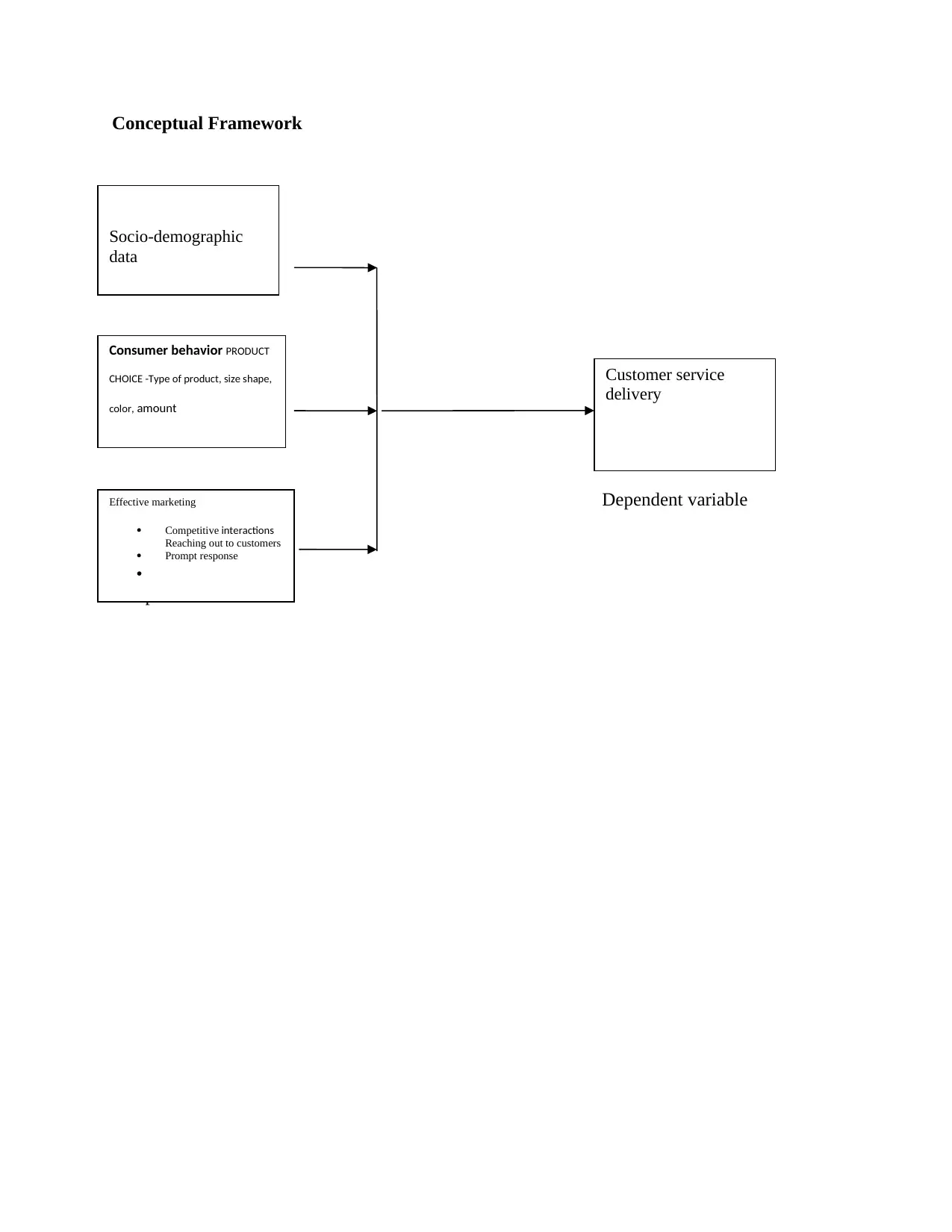
Conceptual Framework
Dependent variable
Independent variables
Socio-demographic
data
Consumer behavior PRODUCT
CHOICE -Type of product, size shape,
color, amount
Effective marketing
Competitive interactions
Reaching out to customers
Prompt response

Customer service
delivery
Document Page
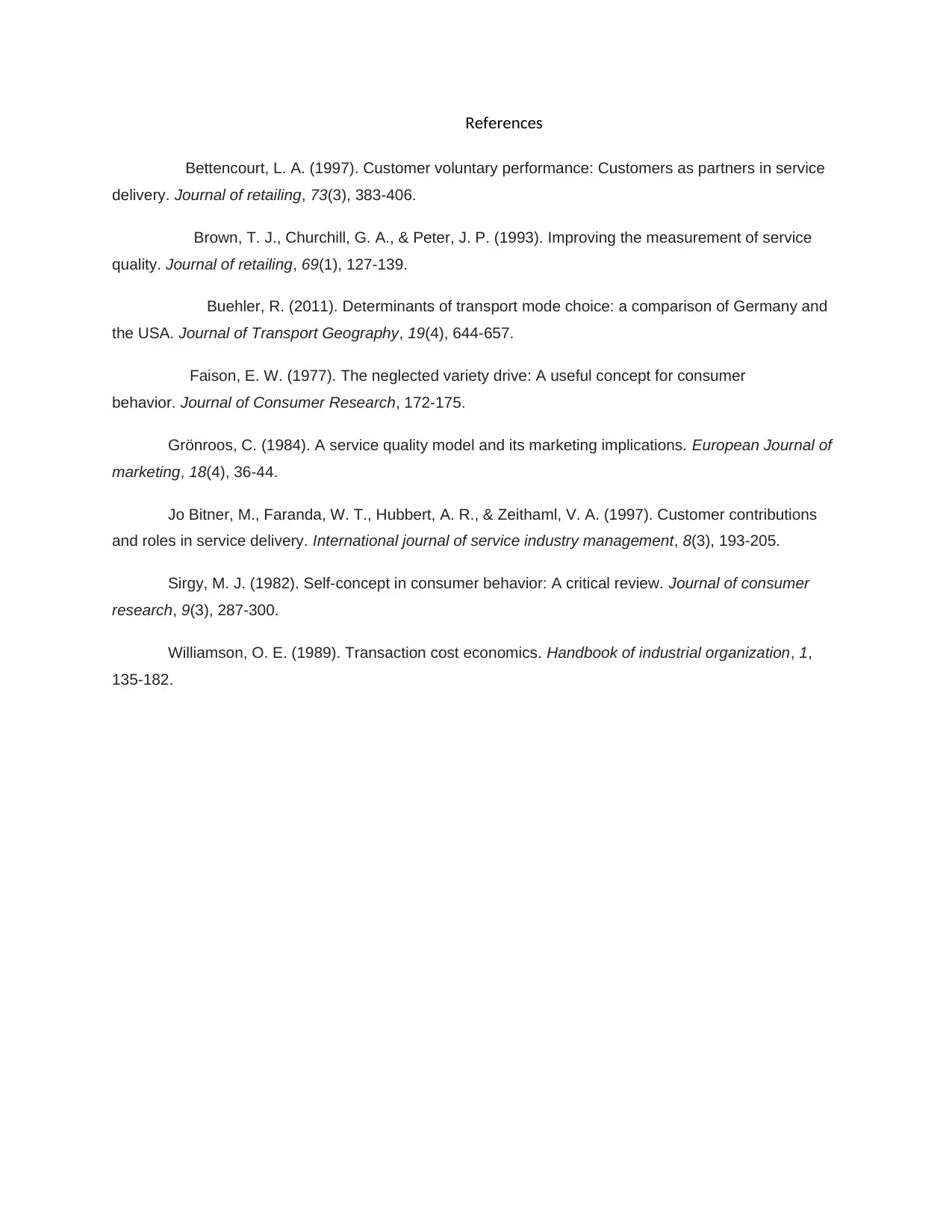
References
Bettencourt, L. A. (1997). Customer voluntary performance: Customers as partners in service
delivery. Journal of retailing, 73(3), 383-406.
Brown, T. J., Churchill, G. A., & Peter, J. P. (1993). Improving the measurement of service
quality. Journal of retailing, 69(1), 127-139.
Buehler, R. (2011). Determinants of transport mode choice: a comparison of Germany and
the USA. Journal of Transport Geography, 19(4), 644-657.
Faison, E. W. (1977). The neglected variety drive: A useful concept for consumer
behavior. Journal of Consumer Research, 172-175.
Grönroos, C. (1984). A service quality model and its marketing implications. European Journal of
marketing, 18(4), 36-44.
Jo Bitner, M., Faranda, W. T., Hubbert, A. R., & Zeithaml, V. A. (1997). Customer contributions
and roles in service delivery. International journal of service industry management, 8(3), 193-205.
Sirgy, M. J. (1982). Self-concept in consumer behavior: A critical review. Journal of consumer
research, 9(3), 287-300.
Williamson, O. E. (1989). Transaction cost economics. Handbook of industrial organization, 1,
135-182.
chevron_up_icon
1 out of 7
circle_padding
hide_on_mobile
zoom_out_icon
[object Object]