Transtheoretical Model of Change Application Report for Health

Verified

Added on  2022/10/02

|4
|890
|19
Report
AI Summary
This report applies the Transtheoretical Model of Change (TMC) to address heart disease in Kansas City. It outlines the five stages of the model: Precontemplation, Contemplation, Preparation, Action, and Maintenance, and analyzes the current health status of the city's population, highlighting the contemplation stage. The report discusses the decrease in heart disease deaths, smoking, and obesity rates, while also mentioning the need for further action. It emphasizes the role of health educators in guiding individuals through the stages of change, providing strategies to promote healthy behaviors like physical activity, diet modification, and smoking cessation. The report references several studies and articles to support the application of the TMC in public health interventions.
Document Page
Running head: TRANSTHEORETICAL MODEL OF CHANGE
TRANSTHEORETICAL MODEL OF CHANGE
Name of Student:
Name of University:
Author’s Note:
tabler-icon-diamond-filled.svg

Paraphrase This Document

Need a fresh take? Get an instant paraphrase of this document with our AI Paraphraser
Document Page
1TRANSTHEORETICAL MODEL OF CHANGE
Introduction
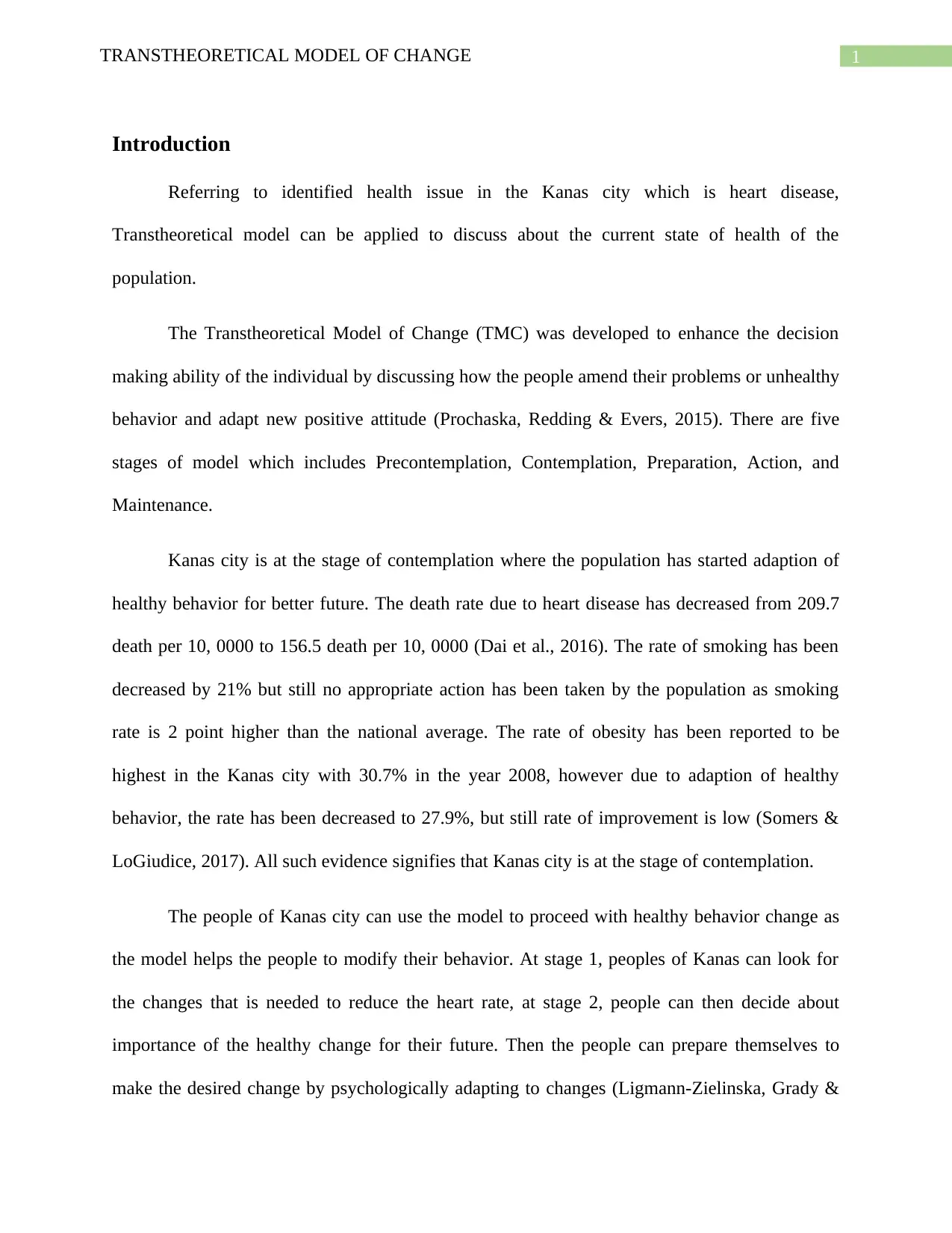
Referring to identified health issue in the Kanas city which is heart disease,
Transtheoretical model can be applied to discuss about the current state of health of the
population.
The Transtheoretical Model of Change (TMC) was developed to enhance the decision
making ability of the individual by discussing how the people amend their problems or unhealthy
behavior and adapt new positive attitude (Prochaska, Redding & Evers, 2015). There are five
stages of model which includes Precontemplation, Contemplation, Preparation, Action, and
Maintenance.
Kanas city is at the stage of contemplation where the population has started adaption of
healthy behavior for better future. The death rate due to heart disease has decreased from 209.7
death per 10, 0000 to 156.5 death per 10, 0000 (Dai et al., 2016). The rate of smoking has been
decreased by 21% but still no appropriate action has been taken by the population as smoking
rate is 2 point higher than the national average. The rate of obesity has been reported to be
highest in the Kanas city with 30.7% in the year 2008, however due to adaption of healthy
behavior, the rate has been decreased to 27.9%, but still rate of improvement is low (Somers &
LoGiudice, 2017). All such evidence signifies that Kanas city is at the stage of contemplation.
The people of Kanas city can use the model to proceed with healthy behavior change as
the model helps the people to modify their behavior. At stage 1, peoples of Kanas can look for
the changes that is needed to reduce the heart rate, at stage 2, people can then decide about
importance of the healthy change for their future. Then the people can prepare themselves to
make the desired change by psychologically adapting to changes (Ligmann-Zielinska, Grady &
Document Page
2TRANSTHEORETICAL MODEL OF CHANGE
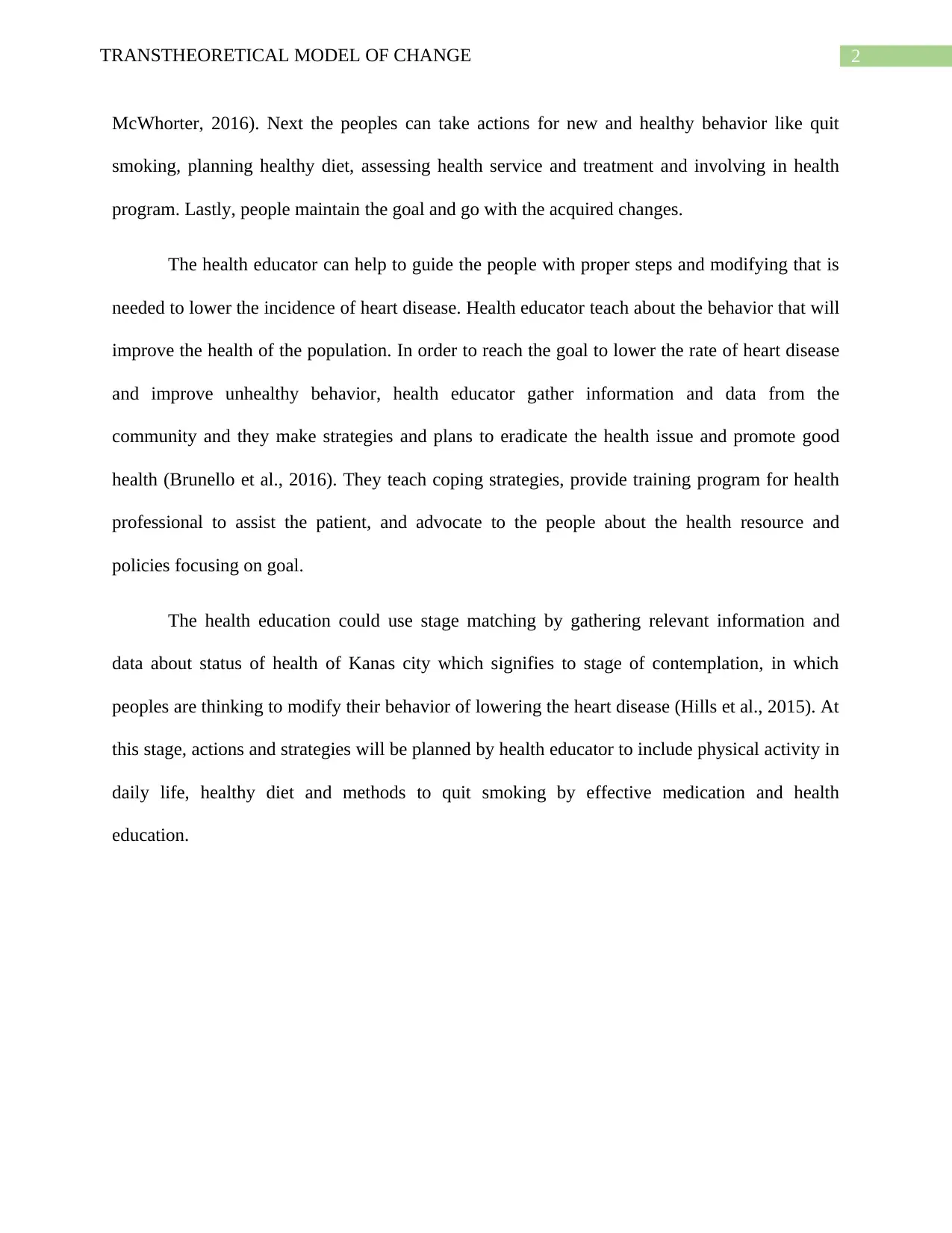
McWhorter, 2016). Next the peoples can take actions for new and healthy behavior like quit
smoking, planning healthy diet, assessing health service and treatment and involving in health
program. Lastly, people maintain the goal and go with the acquired changes.
The health educator can help to guide the people with proper steps and modifying that is
needed to lower the incidence of heart disease. Health educator teach about the behavior that will
improve the health of the population. In order to reach the goal to lower the rate of heart disease
and improve unhealthy behavior, health educator gather information and data from the
community and they make strategies and plans to eradicate the health issue and promote good
health (Brunello et al., 2016). They teach coping strategies, provide training program for health
professional to assist the patient, and advocate to the people about the health resource and
policies focusing on goal.
The health education could use stage matching by gathering relevant information and
data about status of health of Kanas city which signifies to stage of contemplation, in which
peoples are thinking to modify their behavior of lowering the heart disease (Hills et al., 2015). At
this stage, actions and strategies will be planned by health educator to include physical activity in
daily life, healthy diet and methods to quit smoking by effective medication and health
education.
Document Page
3TRANSTHEORETICAL MODEL OF CHANGE
Reference
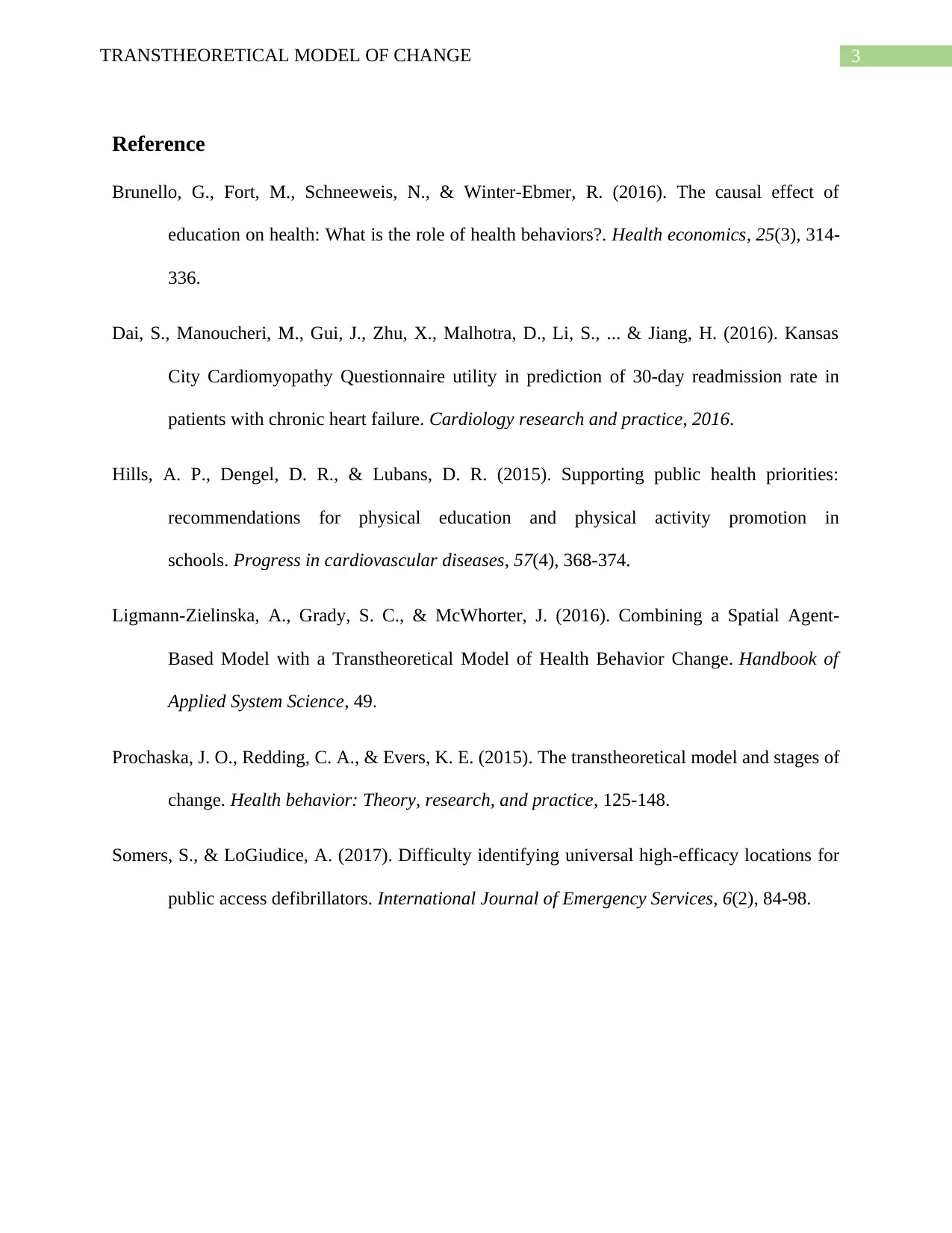
Brunello, G., Fort, M., Schneeweis, N., & Winter‐Ebmer, R. (2016). The causal effect of
education on health: What is the role of health behaviors?. Health economics, 25(3), 314-
336.
Dai, S., Manoucheri, M., Gui, J., Zhu, X., Malhotra, D., Li, S., ... & Jiang, H. (2016). Kansas
City Cardiomyopathy Questionnaire utility in prediction of 30-day readmission rate in
patients with chronic heart failure. Cardiology research and practice, 2016.
Hills, A. P., Dengel, D. R., & Lubans, D. R. (2015). Supporting public health priorities:
recommendations for physical education and physical activity promotion in
schools. Progress in cardiovascular diseases, 57(4), 368-374.
Ligmann-Zielinska, A., Grady, S. C., & McWhorter, J. (2016). Combining a Spatial Agent-
Based Model with a Transtheoretical Model of Health Behavior Change. Handbook of
Applied System Science, 49.
Prochaska, J. O., Redding, C. A., & Evers, K. E. (2015). The transtheoretical model and stages of
change. Health behavior: Theory, research, and practice, 125-148.
Somers, S., & LoGiudice, A. (2017). Difficulty identifying universal high-efficacy locations for
public access defibrillators. International Journal of Emergency Services, 6(2), 84-98.
chevron_up_icon
1 out of 4
circle_padding
hide_on_mobile
zoom_out_icon
[object Object]