Strategic Responses to Change: Travel & Tourism Contemporary Issues
VerifiedAdded on 2024/04/25
|21
|5156
|271
Report
AI Summary
This report provides a comprehensive analysis of contemporary issues and trends in the travel and tourism sector. It identifies key drivers of change, including the rise of millennials and mobile technology, the impact of Brexit and political unrest, and the increase in bogus holiday illness claims. The report evaluates current trends such as adventure tourism, rural tourism, and dark tourism, and analyzes how travel and tourism businesses can respond to these changes. It includes a PEST analysis of Whitfield PLC, examining the political, economic, social, and technological factors affecting the company. Furthermore, the report discusses the potential consequences of businesses failing to adapt to market changes and emphasizes the importance of effective risk management and strategic planning. The aim is to offer insights into the challenges and opportunities facing the travel and tourism industry and to provide actionable strategies for businesses to thrive in a dynamic environment. Desklib provides access to similar solved assignments and study resources for students.
Contemporary issues in Travel & Tourism

Paraphrase This Document
Need a fresh take? Get an instant paraphrase of this document with our AI Paraphraser
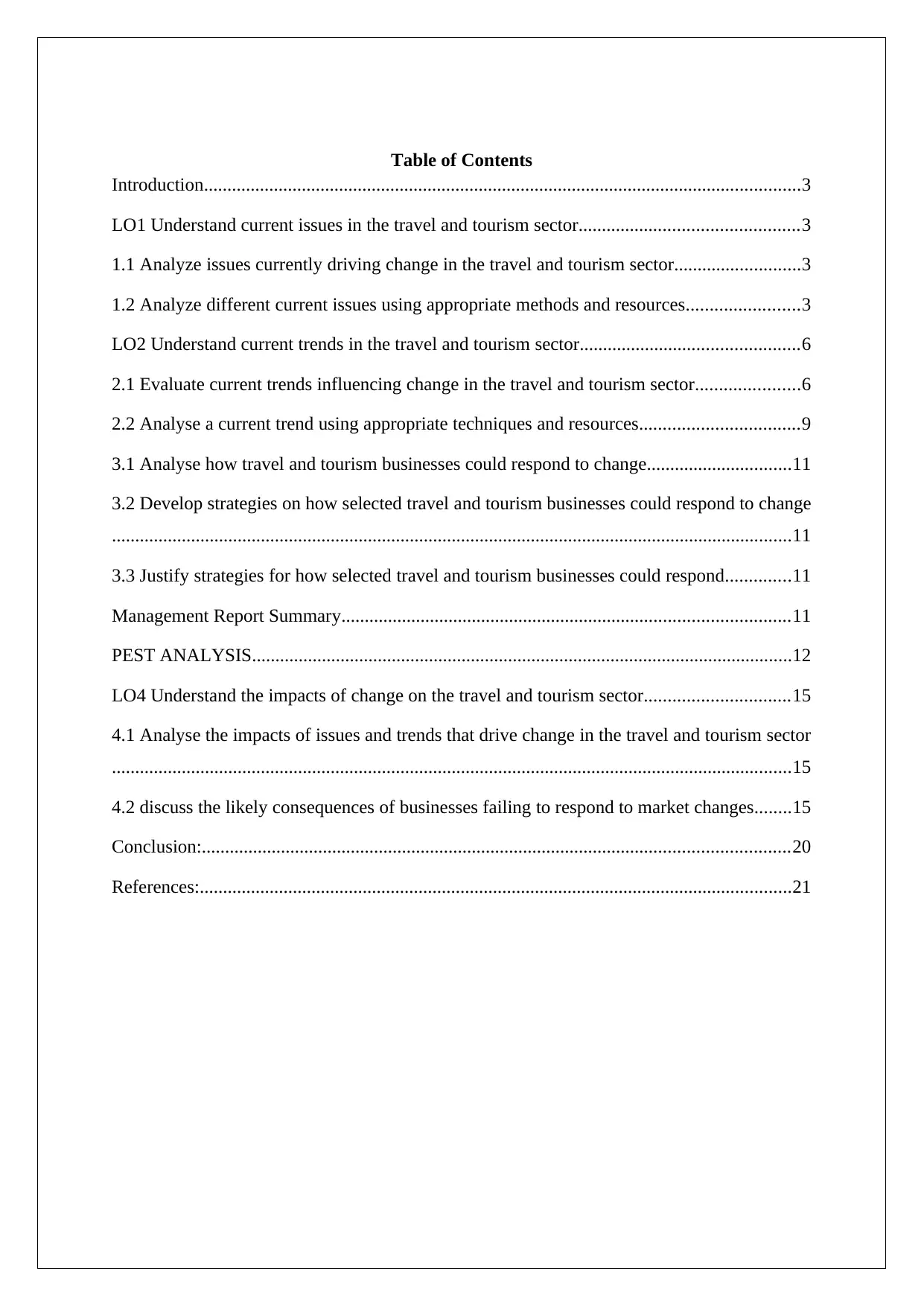
Table of Contents
Introduction................................................................................................................................3
LO1 Understand current issues in the travel and tourism sector...............................................3
1.1 Analyze issues currently driving change in the travel and tourism sector...........................3
1.2 Analyze different current issues using appropriate methods and resources........................3
LO2 Understand current trends in the travel and tourism sector...............................................6
2.1 Evaluate current trends influencing change in the travel and tourism sector......................6
2.2 Analyse a current trend using appropriate techniques and resources..................................9
3.1 Analyse how travel and tourism businesses could respond to change...............................11
3.2 Develop strategies on how selected travel and tourism businesses could respond to change
..................................................................................................................................................11
3.3 Justify strategies for how selected travel and tourism businesses could respond..............11
Management Report Summary................................................................................................11
PEST ANALYSIS....................................................................................................................12
LO4 Understand the impacts of change on the travel and tourism sector...............................15
4.1 Analyse the impacts of issues and trends that drive change in the travel and tourism sector
..................................................................................................................................................15
4.2 discuss the likely consequences of businesses failing to respond to market changes........15
Conclusion:..............................................................................................................................20
References:...............................................................................................................................21
Introduction................................................................................................................................3
LO1 Understand current issues in the travel and tourism sector...............................................3
1.1 Analyze issues currently driving change in the travel and tourism sector...........................3
1.2 Analyze different current issues using appropriate methods and resources........................3
LO2 Understand current trends in the travel and tourism sector...............................................6
2.1 Evaluate current trends influencing change in the travel and tourism sector......................6
2.2 Analyse a current trend using appropriate techniques and resources..................................9
3.1 Analyse how travel and tourism businesses could respond to change...............................11
3.2 Develop strategies on how selected travel and tourism businesses could respond to change
..................................................................................................................................................11
3.3 Justify strategies for how selected travel and tourism businesses could respond..............11
Management Report Summary................................................................................................11
PEST ANALYSIS....................................................................................................................12
LO4 Understand the impacts of change on the travel and tourism sector...............................15
4.1 Analyse the impacts of issues and trends that drive change in the travel and tourism sector
..................................................................................................................................................15
4.2 discuss the likely consequences of businesses failing to respond to market changes........15
Conclusion:..............................................................................................................................20
References:...............................................................................................................................21
Introduction
The key theme of this assignment is to understand the current issues that are found in the travel
and tourism industry. Importance has also been levied upon the seven primary issues that have
become major problems in this industry. Also, the international issues pertaining to the political
disturbances in Middle East and North Africa and Brexit that has substantially led to a decline in
the tourism business in UK. The further subsection deals with the situational analysis of
Whitfield PLC which includes Pest Analysis, SWOT analysis, Marketing Strategy and
Marketing Mix. These analyses have been enabled the report to develop clearly an
understanding of the marketing strategy of the company and how can the strategy be enhanced
in order to maximize profit.
LO1 Understand current issues in the travel and tourism sector
1.1 Analyze issues currently driving change in the travel and tourism sector
1.2 Analyze different current issues using appropriate methods and resources
Information Pack
Currently Driving Change and Current Issues in the Travel and Tourism Sector
Contents
Introduction
The millennials and the continued advancement of mobile technology
Bogus holiday illness claims
Effect of Brexit on tourism industry in UK
Effect of Political unrest in Middle East and North Africa
Introduction
The primary issues found in the British travel, tourism industry is manifold, and the following
reasons contribute heavily towards the same. With the technological advancement, the internet has
The key theme of this assignment is to understand the current issues that are found in the travel
and tourism industry. Importance has also been levied upon the seven primary issues that have
become major problems in this industry. Also, the international issues pertaining to the political
disturbances in Middle East and North Africa and Brexit that has substantially led to a decline in
the tourism business in UK. The further subsection deals with the situational analysis of
Whitfield PLC which includes Pest Analysis, SWOT analysis, Marketing Strategy and
Marketing Mix. These analyses have been enabled the report to develop clearly an
understanding of the marketing strategy of the company and how can the strategy be enhanced
in order to maximize profit.
LO1 Understand current issues in the travel and tourism sector
1.1 Analyze issues currently driving change in the travel and tourism sector
1.2 Analyze different current issues using appropriate methods and resources
Information Pack
Currently Driving Change and Current Issues in the Travel and Tourism Sector
Contents
Introduction
The millennials and the continued advancement of mobile technology
Bogus holiday illness claims
Effect of Brexit on tourism industry in UK
Effect of Political unrest in Middle East and North Africa
Introduction
The primary issues found in the British travel, tourism industry is manifold, and the following
reasons contribute heavily towards the same. With the technological advancement, the internet has
⊘ This is a preview!⊘
Do you want full access?
Subscribe today to unlock all pages.

Trusted by 1+ million students worldwide
successfully flummoxed the world like a quagmire and made it possible to plan, tailor and book a
holiday for the travellers with a single click from their smart phones. In turn, this facility has
popularised the role of critical and attractive content quite indispensible for business and to what
extent travel providers are capable in fulfilling the customised holiday preferences of the clients is
a major reason as to why the tourism sector is facing a decrease in their respective demand. The
tourism sector is also exposed to the Post Brexit challenges but at the same time, it is too early to
comment on the effects of the Brexit challenges that the UK tourism sector would face. Brexit is
found to have long-term effects on input costs such as flight costs, employee retention costs and
other leasing costs. A fall in purchasing power has also affected consumer confidence. This,
coupled with the altered employee and immigration laws has affected the working conditions and
the working directives. Foreign exchange rates have also been affected due to Britain’s possible
exist from the European Union (Risteskia et al., 2012). Besides, an increase in shifting of traveller
priorities has been seen in the recent years. With an expected increase in demand for exclusive
facilities, which includes accommodation facilities as well as other offers the industry, must take
into consideration the demands currency conscious and tech savvy customers.
The uncertainties caused due to Brexit have not led to a significant delay in planning. Over the last
six months, customer complaints have significantly increased, which has proved to be a key issues
that the travel and tourism sector must effectively prevent. Effective risk management plans will
ensure that businesses can handle the larger load of claims levied against them.
Because of the sensitive data handled by tour operators in the industry, (i.e. customer details and
supplier information) 2017 became a crucial year to ensure that changes had far reaching
implications across the industry as a whole (Holden, 2016).
The millennials and the continued advancement of mobile technology
The world has observed the rise of the millennials and continued advances in mobile technology.
Moreover, the millennium has found how providers would look to gain customer loyalty via
advancing their technology solutions. At the mid-way point of the year appraising use of Customer
Relationship Management platforms that can ensure GDPR compliance, platform agility, social
media, apps and other forms of digital touch points with customers, appear to be a focus for many
businesses. (Carlisle, et al., 2013). There has been a range of events in the sector that focus on
connecting with the millennial generation. It is clear the impact of digital disrupters remains a
holiday for the travellers with a single click from their smart phones. In turn, this facility has
popularised the role of critical and attractive content quite indispensible for business and to what
extent travel providers are capable in fulfilling the customised holiday preferences of the clients is
a major reason as to why the tourism sector is facing a decrease in their respective demand. The
tourism sector is also exposed to the Post Brexit challenges but at the same time, it is too early to
comment on the effects of the Brexit challenges that the UK tourism sector would face. Brexit is
found to have long-term effects on input costs such as flight costs, employee retention costs and
other leasing costs. A fall in purchasing power has also affected consumer confidence. This,
coupled with the altered employee and immigration laws has affected the working conditions and
the working directives. Foreign exchange rates have also been affected due to Britain’s possible
exist from the European Union (Risteskia et al., 2012). Besides, an increase in shifting of traveller
priorities has been seen in the recent years. With an expected increase in demand for exclusive
facilities, which includes accommodation facilities as well as other offers the industry, must take
into consideration the demands currency conscious and tech savvy customers.
The uncertainties caused due to Brexit have not led to a significant delay in planning. Over the last
six months, customer complaints have significantly increased, which has proved to be a key issues
that the travel and tourism sector must effectively prevent. Effective risk management plans will
ensure that businesses can handle the larger load of claims levied against them.
Because of the sensitive data handled by tour operators in the industry, (i.e. customer details and
supplier information) 2017 became a crucial year to ensure that changes had far reaching
implications across the industry as a whole (Holden, 2016).
The millennials and the continued advancement of mobile technology
The world has observed the rise of the millennials and continued advances in mobile technology.
Moreover, the millennium has found how providers would look to gain customer loyalty via
advancing their technology solutions. At the mid-way point of the year appraising use of Customer
Relationship Management platforms that can ensure GDPR compliance, platform agility, social
media, apps and other forms of digital touch points with customers, appear to be a focus for many
businesses. (Carlisle, et al., 2013). There has been a range of events in the sector that focus on
connecting with the millennial generation. It is clear the impact of digital disrupters remains a
Paraphrase This Document
Need a fresh take? Get an instant paraphrase of this document with our AI Paraphraser
concern for both the industry and the regulators – the focus for many remains investing in
technology to build the customer relationship. However, a recent RSM survey of the middle
market stated that – just 37 per cent of those surveyed have a clear digital strategy in place. As the
business invests and recognises the importance of R&D, it is recommended that the advisors are
consulted early in respect of R&D tax credit claims. Businesses are mindful of the need to attract
talent and new entrants to the sector with a wealth of social media and technology skills (Hall,et
al., 2014). Ensuring an engaging and effective recruitment process is paramount in the process.
Cyber security and data privacy
The rules and laws of the data protection governing body are continuously changing. The
organisations must be significantly prepared for the General Data Protection Regulation. 2017 was
an essential year for these organisations as they held troves of sensitive data. Data protection rules
needed wide spread implications and those flouting the rules would have to strictly reprimanded.
Whilst the media attention has inevitably focused on the NHS’s and ABTA’s of this world, cyber
criminals do not stress upon large organisations. Middle market businesses are at high risk too.
Several breaches have been reported in the sector and, with another significant global ransom ware
attack in recent days, this issue is set to continue.
Bogus holiday illness claims
Over the last six months of the year, 2017, there has been a significant increase in customer
complaints and claims. Over the last six months of 2016, the industry saw huge rise in bogus
holiday illness claims being lodged by consumers. This has continued into 2017 and
‘Jet2Holidays’ issued the most public response to the trend of increased holiday illness claims, by
sending private detectives out to resorts to verify claims of management companies. After reports
of CMCs were published in Portugal in May, the FCO have also warned consumers that if false or
fraudulent claims are made, legal proceedings may follow (Smith, and Puczkó, 2012). Insurance
firms have also been warned that the likely consequence of this trend continuing would not only
lead to a price increase from travel firms to claw-back pay-outs but also a hike in holiday
insurance premiums. Both ABTA and one of the trade publications launched campaigns in recent
weeks lobbying government. It is likely that the industry is in for more pain over the summer
months but perhaps the second half of the year will see a positive result with the government
responding and closing the current loophole in UK Law (McLachlan, and Binns, 2014).
technology to build the customer relationship. However, a recent RSM survey of the middle
market stated that – just 37 per cent of those surveyed have a clear digital strategy in place. As the
business invests and recognises the importance of R&D, it is recommended that the advisors are
consulted early in respect of R&D tax credit claims. Businesses are mindful of the need to attract
talent and new entrants to the sector with a wealth of social media and technology skills (Hall,et
al., 2014). Ensuring an engaging and effective recruitment process is paramount in the process.
Cyber security and data privacy
The rules and laws of the data protection governing body are continuously changing. The
organisations must be significantly prepared for the General Data Protection Regulation. 2017 was
an essential year for these organisations as they held troves of sensitive data. Data protection rules
needed wide spread implications and those flouting the rules would have to strictly reprimanded.
Whilst the media attention has inevitably focused on the NHS’s and ABTA’s of this world, cyber
criminals do not stress upon large organisations. Middle market businesses are at high risk too.
Several breaches have been reported in the sector and, with another significant global ransom ware
attack in recent days, this issue is set to continue.
Bogus holiday illness claims
Over the last six months of the year, 2017, there has been a significant increase in customer
complaints and claims. Over the last six months of 2016, the industry saw huge rise in bogus
holiday illness claims being lodged by consumers. This has continued into 2017 and
‘Jet2Holidays’ issued the most public response to the trend of increased holiday illness claims, by
sending private detectives out to resorts to verify claims of management companies. After reports
of CMCs were published in Portugal in May, the FCO have also warned consumers that if false or
fraudulent claims are made, legal proceedings may follow (Smith, and Puczkó, 2012). Insurance
firms have also been warned that the likely consequence of this trend continuing would not only
lead to a price increase from travel firms to claw-back pay-outs but also a hike in holiday
insurance premiums. Both ABTA and one of the trade publications launched campaigns in recent
weeks lobbying government. It is likely that the industry is in for more pain over the summer
months but perhaps the second half of the year will see a positive result with the government
responding and closing the current loophole in UK Law (McLachlan, and Binns, 2014).
Effect of Political unrest in Middle East and North Africa
According to a latest report furnished by Euromonitor International it has been predicted that the
tourism department of Middle East and North Africa are prone to be heavily affected as oil prices
soar and there is a huge possibility of double-dip recession. Even as Egyptian and Tunisian
authorities strive to placate the customers and reassure them of a return to normalcy, it can be
found that the political crisis has not dissipated, while customers are still worried about such
developments ( Kang, et al., 2012). Political unrest in will countries such as Libya and Algeria has
also an adverse impact on tourism flows. The last five years has seen a significant amount of
investment into the tourism infrastructure of these countries, albeit the amount is not a substantial
one. Unfortunately, with recent development, the development of the tourism industry has been
indefinitely postponed.
Effect of Brexit on tourism industry in UK
In a recent report, “Travel Trends Report,” (2017) it was found that by ABTA that the number of
domestic holidays in the United Kingdom have increased to 71 % as of 2016. This, when
compared to the figure, 64 % in 2015 is an increase. Brexit was a key contributing factor to the
increased demands for domestic holidays. Destination Report has also shed light on the fact that
people prefer to avail a holiday in UK because it is more affordable than any other holiday spot in
the world and since the time UK decided to leave the European Union, the tourism business is
witnessing an increasing demand ( Mason, 2015).
LO2 Understand current trends in the travel and tourism sector
2.1 Evaluate current trends influencing change in the travel and tourism sector
Information Pack
Current Trends Influencing Changes in Travel and Tourism Industries
According to a latest report furnished by Euromonitor International it has been predicted that the
tourism department of Middle East and North Africa are prone to be heavily affected as oil prices
soar and there is a huge possibility of double-dip recession. Even as Egyptian and Tunisian
authorities strive to placate the customers and reassure them of a return to normalcy, it can be
found that the political crisis has not dissipated, while customers are still worried about such
developments ( Kang, et al., 2012). Political unrest in will countries such as Libya and Algeria has
also an adverse impact on tourism flows. The last five years has seen a significant amount of
investment into the tourism infrastructure of these countries, albeit the amount is not a substantial
one. Unfortunately, with recent development, the development of the tourism industry has been
indefinitely postponed.
Effect of Brexit on tourism industry in UK
In a recent report, “Travel Trends Report,” (2017) it was found that by ABTA that the number of
domestic holidays in the United Kingdom have increased to 71 % as of 2016. This, when
compared to the figure, 64 % in 2015 is an increase. Brexit was a key contributing factor to the
increased demands for domestic holidays. Destination Report has also shed light on the fact that
people prefer to avail a holiday in UK because it is more affordable than any other holiday spot in
the world and since the time UK decided to leave the European Union, the tourism business is
witnessing an increasing demand ( Mason, 2015).
LO2 Understand current trends in the travel and tourism sector
2.1 Evaluate current trends influencing change in the travel and tourism sector
Information Pack
Current Trends Influencing Changes in Travel and Tourism Industries
⊘ This is a preview!⊘
Do you want full access?
Subscribe today to unlock all pages.
Trusted by 1+ million students worldwide
Content:
Introduction
Adventure tourism
Extreme/sports tourism
Rural/agro tourism
Gastro tourism
Dark tourism
Medical tourism
Green tourism
Grey tourism
Faith tourism
Reasons of growth:
Introduction:
Travel and tourism industry can be considered as one of the most dynamic sector of United
Kingdom. Business organizations deal with travel industry of United Kingdom should follow
the recent trends of the same. Tour operators of United Kingdom works on two different types
of tourism activities; one is inbound and domestic tourism and the other one is outbound one.
Inbound and domestic tourism refers to the tourism activities and initiatives inside the country or
specific community. Respective country preserves their tourist’s spots and makes strategies to
attract the attention of the travel lovers of the concerned community (Cohen, and Cohen, 2015).
In case of outbound tourism facilities, community people prefer to go outside the country to
explore the tourist attractions of different countries or communities. There are different kinds of
tourism facilities available in the industry; significant ones are adventure tourism, agro based
tourism and green tourism, just to name a few. Tour operators should understand the travel
desires and preferences of the community they are serving.
Travel desires and preferences of concerned community people are changing day by day. People
are becoming much more subjective to their choices of travelling. Different types of tour
Introduction
Adventure tourism
Extreme/sports tourism
Rural/agro tourism
Gastro tourism
Dark tourism
Medical tourism
Green tourism
Grey tourism
Faith tourism
Reasons of growth:
Introduction:
Travel and tourism industry can be considered as one of the most dynamic sector of United
Kingdom. Business organizations deal with travel industry of United Kingdom should follow
the recent trends of the same. Tour operators of United Kingdom works on two different types
of tourism activities; one is inbound and domestic tourism and the other one is outbound one.
Inbound and domestic tourism refers to the tourism activities and initiatives inside the country or
specific community. Respective country preserves their tourist’s spots and makes strategies to
attract the attention of the travel lovers of the concerned community (Cohen, and Cohen, 2015).
In case of outbound tourism facilities, community people prefer to go outside the country to
explore the tourist attractions of different countries or communities. There are different kinds of
tourism facilities available in the industry; significant ones are adventure tourism, agro based
tourism and green tourism, just to name a few. Tour operators should understand the travel
desires and preferences of the community they are serving.
Travel desires and preferences of concerned community people are changing day by day. People
are becoming much more subjective to their choices of travelling. Different types of tour
Paraphrase This Document
Need a fresh take? Get an instant paraphrase of this document with our AI Paraphraser
opportunities are coming out in the market to meet the preferences of community people. To
understand the different current trends on travel preferences of the community, individual
should have prolific knowledge on different type’s tourism initiatives.
Adventure tourism:
This type of tourism packages offer travellers the excitement experiences through their
packages. Tour operator focuses on the risk and adventurous nature of the travellers both in case
of inbound and outbound tourism aspects (Ingram, 2011).
Extreme/sports tourism:
Extreme or sports tourism involves travelling or exploring to dangerous tourists spots, like,
mountains, caves, deserts etc. Travellers have to deal with several kinds of risks to attend this
kind of tourism packages. Tour operator should consider the very importance of risk
management in this package.
Rural/agro tourism:
Rural or agro tourism works differently in different countries. Generally, this kind of travel and
tourism packages arranges visits to the farms or agro land in distant countrysides or villages.
Gastro tourism:
Gastro tourism packages attract travellers who desire to explore different cultures, foods of
different communities. Gastro tourists give value to different kinds of food practices in the
different places of the country or all over the world.
Dark tourism:
Dark tourism packages helps the travellers or explorers to visit places associated with death or
tragedy. It can be an old and significant cemetery or a museum with dark background.
Medical tourism:
Medical tourism is mainly developed on the need of the individuals who want to obtain medical
facilities or treatments of other countries than own. People with critical health conditions travel
to get better medical facilities and services.
Green tourism:
understand the different current trends on travel preferences of the community, individual
should have prolific knowledge on different type’s tourism initiatives.
Adventure tourism:
This type of tourism packages offer travellers the excitement experiences through their
packages. Tour operator focuses on the risk and adventurous nature of the travellers both in case
of inbound and outbound tourism aspects (Ingram, 2011).
Extreme/sports tourism:
Extreme or sports tourism involves travelling or exploring to dangerous tourists spots, like,
mountains, caves, deserts etc. Travellers have to deal with several kinds of risks to attend this
kind of tourism packages. Tour operator should consider the very importance of risk
management in this package.
Rural/agro tourism:
Rural or agro tourism works differently in different countries. Generally, this kind of travel and
tourism packages arranges visits to the farms or agro land in distant countrysides or villages.
Gastro tourism:
Gastro tourism packages attract travellers who desire to explore different cultures, foods of
different communities. Gastro tourists give value to different kinds of food practices in the
different places of the country or all over the world.
Dark tourism:
Dark tourism packages helps the travellers or explorers to visit places associated with death or
tragedy. It can be an old and significant cemetery or a museum with dark background.
Medical tourism:
Medical tourism is mainly developed on the need of the individuals who want to obtain medical
facilities or treatments of other countries than own. People with critical health conditions travel
to get better medical facilities and services.
Green tourism:
Green Tourism is a quite different concept of tourism other than those mentioned above. Green
tourism refers to the overall sustainability of the tourism industry. It works and follows recent
trends and practices. It involves all types of tourism trends of the available in the community as
well as in the industry.
Grey tourism:
Grey tourism packages focus on the travelling desires and preferences of the elderly people in
the community concerned. These packages consider the needs and requirements of elderly
people with added medical assurance and facilities.
Faith tourism:
Faith tourism packages are based on the travelling experiences with religious places. Religion is
one of the most important aspects of our society and religious people of different community
often prefer to visit religious places.
Reasons of growth:
Reasons behind growth of different kinds of tourism perspectives lead to the different travel
preferences of different people in the community concerned. Reasons behind the travelling
desires determined the content of the packages (Hall and Page, 2014). Needs and preferences of
the tourists are becoming much more specific in these days, which had led to the categorization
of the travel and tourism industry. From the different categories of tourism packages, it is clear
that audience preferences are the most important factor to be considered in this sector.
2.2 Analyse a current trend using appropriate techniques and resources
Poster
tourism refers to the overall sustainability of the tourism industry. It works and follows recent
trends and practices. It involves all types of tourism trends of the available in the community as
well as in the industry.
Grey tourism:
Grey tourism packages focus on the travelling desires and preferences of the elderly people in
the community concerned. These packages consider the needs and requirements of elderly
people with added medical assurance and facilities.
Faith tourism:
Faith tourism packages are based on the travelling experiences with religious places. Religion is
one of the most important aspects of our society and religious people of different community
often prefer to visit religious places.
Reasons of growth:
Reasons behind growth of different kinds of tourism perspectives lead to the different travel
preferences of different people in the community concerned. Reasons behind the travelling
desires determined the content of the packages (Hall and Page, 2014). Needs and preferences of
the tourists are becoming much more specific in these days, which had led to the categorization
of the travel and tourism industry. From the different categories of tourism packages, it is clear
that audience preferences are the most important factor to be considered in this sector.
2.2 Analyse a current trend using appropriate techniques and resources
Poster
⊘ This is a preview!⊘
Do you want full access?
Subscribe today to unlock all pages.
Trusted by 1+ million students worldwide
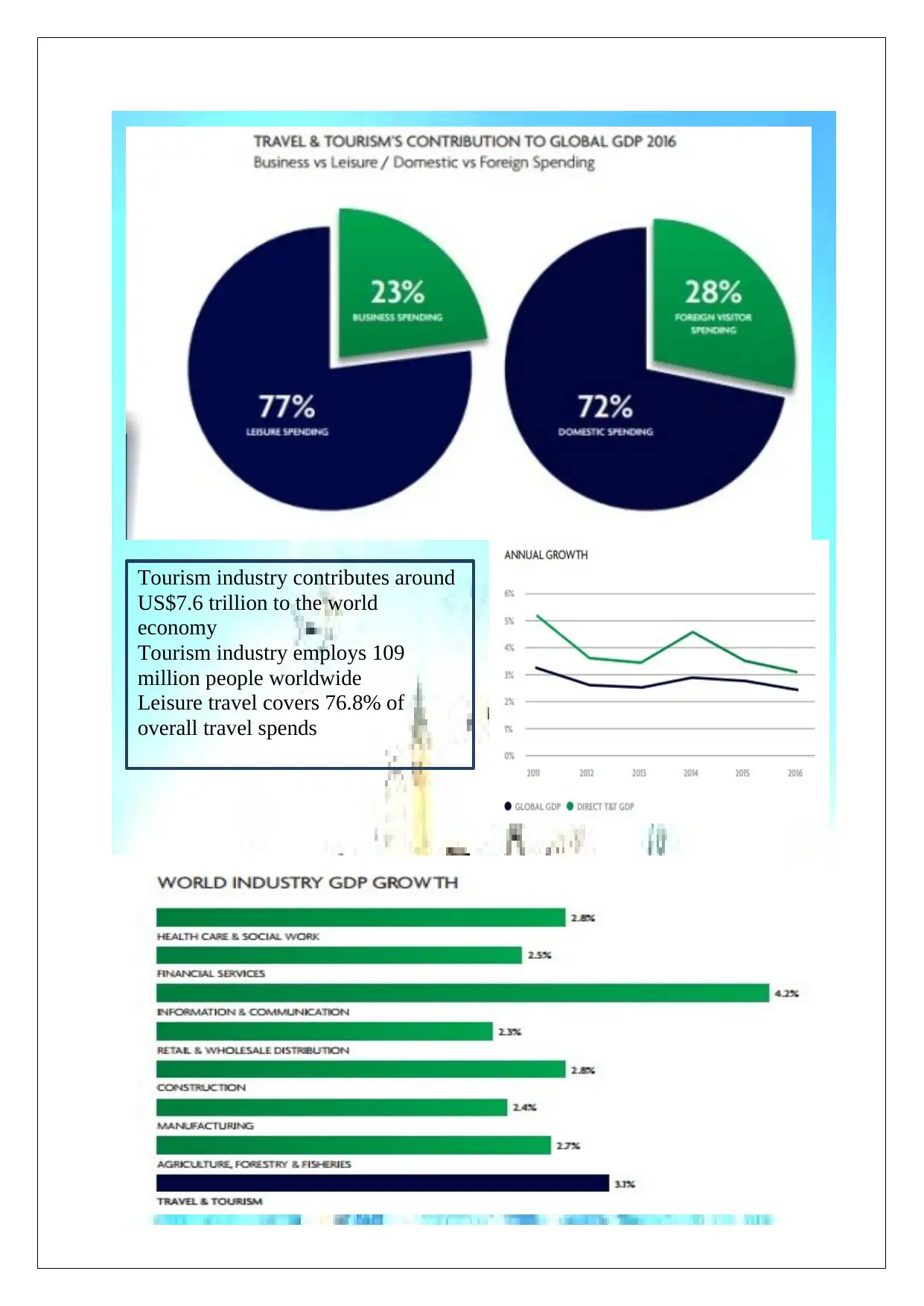
Tourism industry contributes around
US$7.6 trillion to the world
economy
Tourism industry employs 109
million people worldwide
Leisure travel covers 76.8% of
overall travel spends
US$7.6 trillion to the world
economy
Tourism industry employs 109
million people worldwide
Leisure travel covers 76.8% of
overall travel spends
Paraphrase This Document
Need a fresh take? Get an instant paraphrase of this document with our AI Paraphraser
Notes on Poster
World Travel and Tourism Council used to apply effective tools and techniques to mobilize
resources and analyse use if resources in the travel and tourism industry. Techniques utilized by
the council are appropriate enough to extract both qualitative and quantitative data gathered to
understand the recent trends and nature of the travel and tourism industry. According to the data
gathered and analysed by this council, it has been observed that travel and tourism industry
contributes around US$7.6 trillion to the world economy. This industry employs 109 million
people worldwide and directly contributes around US$2.3 trillion. People in these days travel
purposively both for work and entertainment. Leisure travel covers 76.8% of overall travel
spends all over the world. Domestic and outbound travel both makes significant contributions in
revenue generations of the respective countries of the world. Respective countries are using their
resources skilfully to generate maximum growth in the travel and tourism industry (Sacco et al.,
2014). Travel and tourism organizations are giving more importance of the resources of their
own countries and communities and trying to mobilize those resources in the development of the
community as well.
LO3 Understand how the travel and tourism sector responds to change
3.1 Analyse how travel and tourism businesses could respond to change
3.2 Develop strategies on how selected travel and tourism businesses could respond to
change
3.3 Justify strategies for how selected travel and tourism businesses could respond
Management Report Summary
In order to clearly develop the marketing and business strategy of Whitfield PLC, PEST
analysis, SWOT analysis, Marketing strategy and Marketing Mix (4 Ps) were analyzed and
studies which are discussed in the following tables.
World Travel and Tourism Council used to apply effective tools and techniques to mobilize
resources and analyse use if resources in the travel and tourism industry. Techniques utilized by
the council are appropriate enough to extract both qualitative and quantitative data gathered to
understand the recent trends and nature of the travel and tourism industry. According to the data
gathered and analysed by this council, it has been observed that travel and tourism industry
contributes around US$7.6 trillion to the world economy. This industry employs 109 million
people worldwide and directly contributes around US$2.3 trillion. People in these days travel
purposively both for work and entertainment. Leisure travel covers 76.8% of overall travel
spends all over the world. Domestic and outbound travel both makes significant contributions in
revenue generations of the respective countries of the world. Respective countries are using their
resources skilfully to generate maximum growth in the travel and tourism industry (Sacco et al.,
2014). Travel and tourism organizations are giving more importance of the resources of their
own countries and communities and trying to mobilize those resources in the development of the
community as well.
LO3 Understand how the travel and tourism sector responds to change
3.1 Analyse how travel and tourism businesses could respond to change
3.2 Develop strategies on how selected travel and tourism businesses could respond to
change
3.3 Justify strategies for how selected travel and tourism businesses could respond
Management Report Summary
In order to clearly develop the marketing and business strategy of Whitfield PLC, PEST
analysis, SWOT analysis, Marketing strategy and Marketing Mix (4 Ps) were analyzed and
studies which are discussed in the following tables.
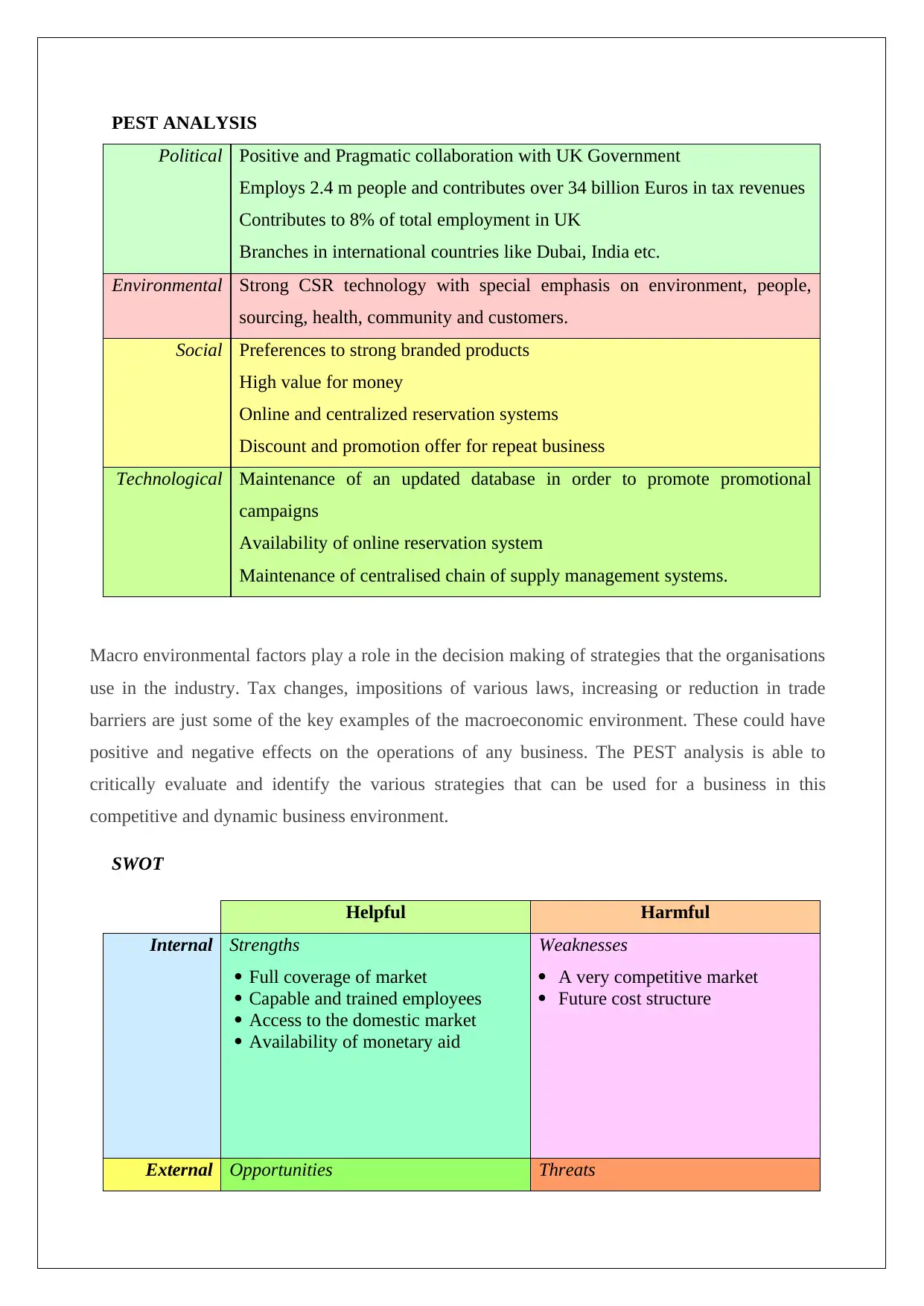
PEST ANALYSIS
Political Positive and Pragmatic collaboration with UK Government
Employs 2.4 m people and contributes over 34 billion Euros in tax revenues
Contributes to 8% of total employment in UK
Branches in international countries like Dubai, India etc.
Environmental Strong CSR technology with special emphasis on environment, people,
sourcing, health, community and customers.
Social Preferences to strong branded products
High value for money
Online and centralized reservation systems
Discount and promotion offer for repeat business
Technological Maintenance of an updated database in order to promote promotional
campaigns
Availability of online reservation system
Maintenance of centralised chain of supply management systems.
Macro environmental factors play a role in the decision making of strategies that the organisations
use in the industry. Tax changes, impositions of various laws, increasing or reduction in trade
barriers are just some of the key examples of the macroeconomic environment. These could have
positive and negative effects on the operations of any business. The PEST analysis is able to
critically evaluate and identify the various strategies that can be used for a business in this
competitive and dynamic business environment.
SWOT
Helpful Harmful
Internal Strengths
Full coverage of market
Capable and trained employees
Access to the domestic market
Availability of monetary aid
Weaknesses
A very competitive market
Future cost structure
External Opportunities Threats
Political Positive and Pragmatic collaboration with UK Government
Employs 2.4 m people and contributes over 34 billion Euros in tax revenues
Contributes to 8% of total employment in UK
Branches in international countries like Dubai, India etc.
Environmental Strong CSR technology with special emphasis on environment, people,
sourcing, health, community and customers.
Social Preferences to strong branded products
High value for money
Online and centralized reservation systems
Discount and promotion offer for repeat business
Technological Maintenance of an updated database in order to promote promotional
campaigns
Availability of online reservation system
Maintenance of centralised chain of supply management systems.
Macro environmental factors play a role in the decision making of strategies that the organisations
use in the industry. Tax changes, impositions of various laws, increasing or reduction in trade
barriers are just some of the key examples of the macroeconomic environment. These could have
positive and negative effects on the operations of any business. The PEST analysis is able to
critically evaluate and identify the various strategies that can be used for a business in this
competitive and dynamic business environment.
SWOT
Helpful Harmful
Internal Strengths
Full coverage of market
Capable and trained employees
Access to the domestic market
Availability of monetary aid
Weaknesses
A very competitive market
Future cost structure
External Opportunities Threats
⊘ This is a preview!⊘
Do you want full access?
Subscribe today to unlock all pages.
Trusted by 1+ million students worldwide

1 out of 21


Related Documents


Your All-in-One AI-Powered Toolkit for Academic Success.
+13062052269
info@desklib.com
Available 24*7 on WhatsApp / Email
![[object Object]](/_next/static/media/star-bottom.7253800d.svg)
Unlock your academic potential
Copyright © 2020–2026 A2Z Services. All Rights Reserved. Developed and managed by ZUCOL.