Travel and Tourism Sector: Analyzing Government Influence and Impacts
VerifiedAdded on 2024/06/04
|20
|5660
|385
Report
AI Summary
This report provides a comprehensive analysis of the travel and tourism sector, beginning with its historical development, tracing its evolution from ancient times through industrial revolution to modern tourism trends, including the rise of mass tourism and the influence of technology. It details the structure of the UK travel and tourism sector, highlighting the roles of both public and private organizations, including transportation, accommodation, travel agents, and attractions. The report examines the influence of local, national, and international government agencies, focusing on their roles in policy creation, infrastructure development, and political stability, particularly in the context of Southall Travel's expansion into Africa. Furthermore, it explores the interplay of supply and demand, analyzing factors affecting tourism demand and how supply has adapted to meet these demands. Finally, the report evaluates the economic, environmental, and social impacts of tourism, particularly in Africa, and suggests strategies to minimize negative impacts while maximizing positive outcomes. The report also mentions that Desklib provides past papers and solved assignments for students.
THE TRAVEL AND TOURISM SECTOR
1
1

Paraphrase This Document
Need a fresh take? Get an instant paraphrase of this document with our AI Paraphraser
Table of Contents
Introduction......................................................................................................................................3
LO1 Understand the history and structure of the travel and tourism..............................................4
1. You are required to create a leaflet explaining the key historical developments in the travel
and tourism sector as well as the structure of the same. (AC1.1 & 1.2& M3)................................4
LO2 Understand the influence of local and national governments and international agencies on
the travel and tourism sector............................................................................................................8
2. You are required to analyze the function of government, government sponsored bodies
international agencies and interrelationships with governments in travel and tourism (2.1)..........8
3. As part of your research you should also explain how local national economic policy
influences the success of the travel and tourism sector as well as discuss the implications of
political change on the travel and tourism sector in different countries (AC 2.2 and 2.3)............10
LO 3 Understand the effects of supply and demand on the travel and tourism.............................12
4. An explanation of factors affecting tourism demand (AC 3.1& D3)........................................12
5. An explanation of how supply has changed to meet the effects of demand (AC 3.2& D3)......13
LO4 Understand the impacts of tourism........................................................................................14
6. Make an evaluation of the main positive and negative economic, Environmental and social
impacts of tourism in Africa (AC 4.1)...........................................................................................14
7. Explain strategies that can be used to minimize the negative impacts while maximizing the
positive impacts (AC 4.2)..............................................................................................................14
Conclusion.....................................................................................................................................15
Reference List................................................................................................................................16
2
Introduction......................................................................................................................................3
LO1 Understand the history and structure of the travel and tourism..............................................4
1. You are required to create a leaflet explaining the key historical developments in the travel
and tourism sector as well as the structure of the same. (AC1.1 & 1.2& M3)................................4
LO2 Understand the influence of local and national governments and international agencies on
the travel and tourism sector............................................................................................................8
2. You are required to analyze the function of government, government sponsored bodies
international agencies and interrelationships with governments in travel and tourism (2.1)..........8
3. As part of your research you should also explain how local national economic policy
influences the success of the travel and tourism sector as well as discuss the implications of
political change on the travel and tourism sector in different countries (AC 2.2 and 2.3)............10
LO 3 Understand the effects of supply and demand on the travel and tourism.............................12
4. An explanation of factors affecting tourism demand (AC 3.1& D3)........................................12
5. An explanation of how supply has changed to meet the effects of demand (AC 3.2& D3)......13
LO4 Understand the impacts of tourism........................................................................................14
6. Make an evaluation of the main positive and negative economic, Environmental and social
impacts of tourism in Africa (AC 4.1)...........................................................................................14
7. Explain strategies that can be used to minimize the negative impacts while maximizing the
positive impacts (AC 4.2)..............................................................................................................14
Conclusion.....................................................................................................................................15
Reference List................................................................................................................................16
2
Introduction
Travel and tourism sector is one of the rapidly growing industries throughout the world. In this
context, it is noteworthy that this sector is contributing highly in the national GDP, thereby
shaping the country’s economy as well as infrastructure. Several factors are influencing the
growth of the industry. On the other hand, it is also noteworthy that several factors are also
hindering the maximum effectiveness of the travel and tourism sector related activities. Since
development of the industry, this sector has been seen to be flourished with time, along with
historical developments. The key purpose of travel and tourism sector is to offer entertainment
and leisure related services to the customers as well as to keep all the valuable historical artifacts
secured (Becker, 2016). In this context, the UK travel and tourism sector is world’s one of the
fastest growing sector, attracting global population. In this context, it is noteworthy that the
national, local as well as international government and government related agencies are playing
significant roles in determining the success of this sector. Considering all these factors, the travel
consultant of Southall Travel would conduct an analysis of the factors having impact on the
travel and tourism sector as well as the other above mentioned aspects.
3
Travel and tourism sector is one of the rapidly growing industries throughout the world. In this
context, it is noteworthy that this sector is contributing highly in the national GDP, thereby
shaping the country’s economy as well as infrastructure. Several factors are influencing the
growth of the industry. On the other hand, it is also noteworthy that several factors are also
hindering the maximum effectiveness of the travel and tourism sector related activities. Since
development of the industry, this sector has been seen to be flourished with time, along with
historical developments. The key purpose of travel and tourism sector is to offer entertainment
and leisure related services to the customers as well as to keep all the valuable historical artifacts
secured (Becker, 2016). In this context, the UK travel and tourism sector is world’s one of the
fastest growing sector, attracting global population. In this context, it is noteworthy that the
national, local as well as international government and government related agencies are playing
significant roles in determining the success of this sector. Considering all these factors, the travel
consultant of Southall Travel would conduct an analysis of the factors having impact on the
travel and tourism sector as well as the other above mentioned aspects.
3
⊘ This is a preview!⊘
Do you want full access?
Subscribe today to unlock all pages.

Trusted by 1+ million students worldwide
LO1 Understand the history and structure of the travel and tourism
1. You are required to create a leaflet explaining the key historical developments in the
travel and tourism sector as well as the structure of the same. (AC1.1 & 1.2& M3)
Historical developments UK in travel and tourism sector
The rapid growth of the travel and tourism sector dated back to the ancient era. In the 3d century
BC, the Greeks visited sites to heal gods. The first Olympic held in Greece in 776 BC and the
international travel concept rose with the Roman Empire and the VFR movements. Romans
introduced guidebooks for listing hostels in order to identify quality of services. Through 17th
and 18th centuries, the concept of grand tour developed, followed by “spa tourism, seaside resort
development, alpine resort development, mass tourism, cultural tourism and long-haul tourism”
related activities (Beneki et al., 2012). Government has possessed significant interest in the
development of this sector, which has been highlighted since Lord Thomas developed the
tourism company named Thomas Holidays.
Through passing years, the preferences and demands of visitors has been changed for different
tourism destinations and based on these, the tourism companies also had been changing their
strategies and activities to meet customers’ expectations and give them unique experiences. For
instance, the preferences changed from visiting coastal areas and zoological parks in 1840s to
pilgrimages during the medieval period. Further, since 1945, travelers in UK started to spend a
considerable part of their income in travelling, which has been embedded in their lifestyle slowly
(Blanke and Chiesa, 2013).
The industrial revolution in UK influenced the travel and tourism sector to be developed, which
further influenced international travelling across the geographical boundaries. In the following
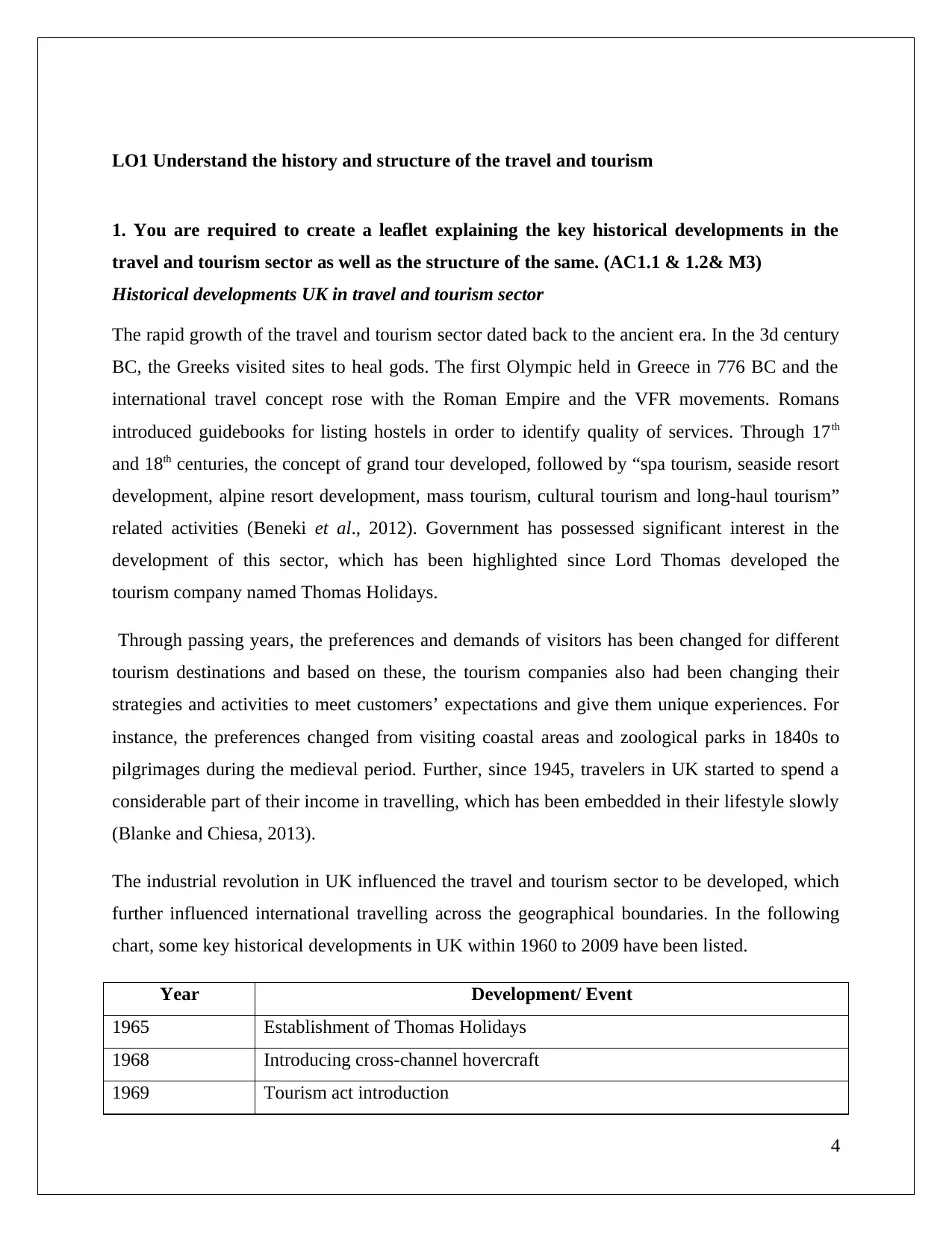
chart, some key historical developments in UK within 1960 to 2009 have been listed.
Year Development/ Event
1965 Establishment of Thomas Holidays
1968 Introducing cross-channel hovercraft
1969 Tourism act introduction
4
1. You are required to create a leaflet explaining the key historical developments in the
travel and tourism sector as well as the structure of the same. (AC1.1 & 1.2& M3)
Historical developments UK in travel and tourism sector
The rapid growth of the travel and tourism sector dated back to the ancient era. In the 3d century
BC, the Greeks visited sites to heal gods. The first Olympic held in Greece in 776 BC and the
international travel concept rose with the Roman Empire and the VFR movements. Romans
introduced guidebooks for listing hostels in order to identify quality of services. Through 17th
and 18th centuries, the concept of grand tour developed, followed by “spa tourism, seaside resort
development, alpine resort development, mass tourism, cultural tourism and long-haul tourism”
related activities (Beneki et al., 2012). Government has possessed significant interest in the
development of this sector, which has been highlighted since Lord Thomas developed the
tourism company named Thomas Holidays.
Through passing years, the preferences and demands of visitors has been changed for different
tourism destinations and based on these, the tourism companies also had been changing their
strategies and activities to meet customers’ expectations and give them unique experiences. For
instance, the preferences changed from visiting coastal areas and zoological parks in 1840s to
pilgrimages during the medieval period. Further, since 1945, travelers in UK started to spend a
considerable part of their income in travelling, which has been embedded in their lifestyle slowly
(Blanke and Chiesa, 2013).
The industrial revolution in UK influenced the travel and tourism sector to be developed, which
further influenced international travelling across the geographical boundaries. In the following
chart, some key historical developments in UK within 1960 to 2009 have been listed.
Year Development/ Event
1965 Establishment of Thomas Holidays
1968 Introducing cross-channel hovercraft
1969 Tourism act introduction
4
Paraphrase This Document
Need a fresh take? Get an instant paraphrase of this document with our AI Paraphraser
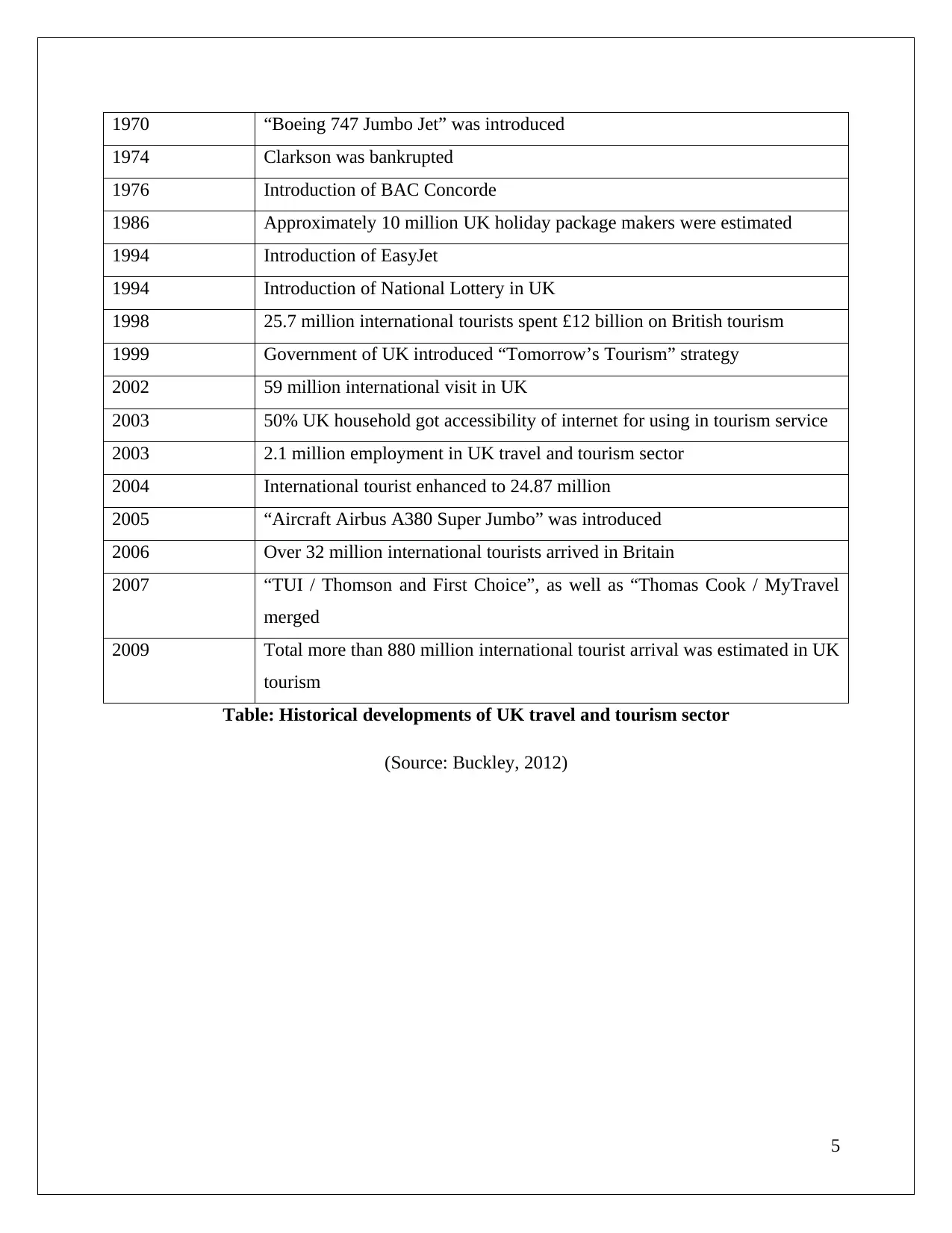
1970 “Boeing 747 Jumbo Jet” was introduced
1974 Clarkson was bankrupted
1976 Introduction of BAC Concorde
1986 Approximately 10 million UK holiday package makers were estimated
1994 Introduction of EasyJet
1994 Introduction of National Lottery in UK
1998 25.7 million international tourists spent £12 billion on British tourism
1999 Government of UK introduced “Tomorrow’s Tourism” strategy
2002 59 million international visit in UK
2003 50% UK household got accessibility of internet for using in tourism service
2003 2.1 million employment in UK travel and tourism sector
2004 International tourist enhanced to 24.87 million
2005 “Aircraft Airbus A380 Super Jumbo” was introduced
2006 Over 32 million international tourists arrived in Britain
2007 “TUI / Thomson and First Choice”, as well as “Thomas Cook / MyTravel
merged
2009 Total more than 880 million international tourist arrival was estimated in UK
tourism
Table: Historical developments of UK travel and tourism sector
(Source: Buckley, 2012)
5
1974 Clarkson was bankrupted
1976 Introduction of BAC Concorde
1986 Approximately 10 million UK holiday package makers were estimated
1994 Introduction of EasyJet
1994 Introduction of National Lottery in UK
1998 25.7 million international tourists spent £12 billion on British tourism
1999 Government of UK introduced “Tomorrow’s Tourism” strategy
2002 59 million international visit in UK
2003 50% UK household got accessibility of internet for using in tourism service
2003 2.1 million employment in UK travel and tourism sector
2004 International tourist enhanced to 24.87 million
2005 “Aircraft Airbus A380 Super Jumbo” was introduced
2006 Over 32 million international tourists arrived in Britain
2007 “TUI / Thomson and First Choice”, as well as “Thomas Cook / MyTravel
merged
2009 Total more than 880 million international tourist arrival was estimated in UK
tourism
Table: Historical developments of UK travel and tourism sector
(Source: Buckley, 2012)
5
The rapid growth of the travel and tourism sector dated
back to the ancient era. In the 3d century BC, the
Greeks visited sites to heal gods. The first Olympic held
in Greece in 776 BC and the international travel
concept rose with the Roman Empire and the VFR
movements. Romans introduced guidebooks for listing
hostels in order to identify quality of services. Through
17th and 18th centuries, the concept of grand tour
developed, followed by “spa tourism, seaside resort
development, alpine resort development, mass tourism,
cultural tourism and long-haul tourism” related
activities (Beneki et al., 2012). Government has
possessed significant interest in the development of this
sector, which has been highlighted since Lord Thomas
developed the tourism company named Thomas
Holidays. Through passing years, the preferences and
demands of visitors has been changed for different
tourism destinations and based on these, the tourism
companies also had been changing their strategies and
activities to meet customers’ expectations and give
them unique experiences. For instance, the preferences
changed from visiting coastal areas and zoological
parks in 1840s to pilgrimages during the medieval
period. Further, since 1945, travelers in UK started to
spend a considerable part of their income in travelling,
which has been embedded in their lifestyle slowly
(Blanke and Chiesa, 2013).
The industrial revolution in UK influenced the travel
and tourism sector to be developed, which further
influenced international travelling across the
geographical boundaries.
Historical developments in travel and tourism sector in UK
6
back to the ancient era. In the 3d century BC, the
Greeks visited sites to heal gods. The first Olympic held
in Greece in 776 BC and the international travel
concept rose with the Roman Empire and the VFR
movements. Romans introduced guidebooks for listing
hostels in order to identify quality of services. Through
17th and 18th centuries, the concept of grand tour
developed, followed by “spa tourism, seaside resort
development, alpine resort development, mass tourism,
cultural tourism and long-haul tourism” related
activities (Beneki et al., 2012). Government has
possessed significant interest in the development of this
sector, which has been highlighted since Lord Thomas
developed the tourism company named Thomas
Holidays. Through passing years, the preferences and
demands of visitors has been changed for different
tourism destinations and based on these, the tourism
companies also had been changing their strategies and
activities to meet customers’ expectations and give
them unique experiences. For instance, the preferences
changed from visiting coastal areas and zoological
parks in 1840s to pilgrimages during the medieval
period. Further, since 1945, travelers in UK started to
spend a considerable part of their income in travelling,
which has been embedded in their lifestyle slowly
(Blanke and Chiesa, 2013).
The industrial revolution in UK influenced the travel
and tourism sector to be developed, which further
influenced international travelling across the
geographical boundaries.
Historical developments in travel and tourism sector in UK
6
⊘ This is a preview!⊘
Do you want full access?
Subscribe today to unlock all pages.
Trusted by 1+ million students worldwide
Structure of UK travel and tourism sector
In order to analyze the factors affecting the
growth and developments of travel and
tourism sector as well as the downturn of
Southal Travels’ sales, Southall Travels
need to understand the structure of the
industry and its key players. The increased
revenue of the sector is contributing in
developing the infrastructure of the sector,
which will further help in maximizing
revenue.
The key players in the tourism industry
structure include:
Public and Private organizations
The structure of UK travel and tourism
sector includes both public and private
organizations. The privately owned tourism
organizations are categorized under private
tourism sector; whereas, mainly the
government and government-sponsored
agencies responsible for promoting and
developing tourism in the country are
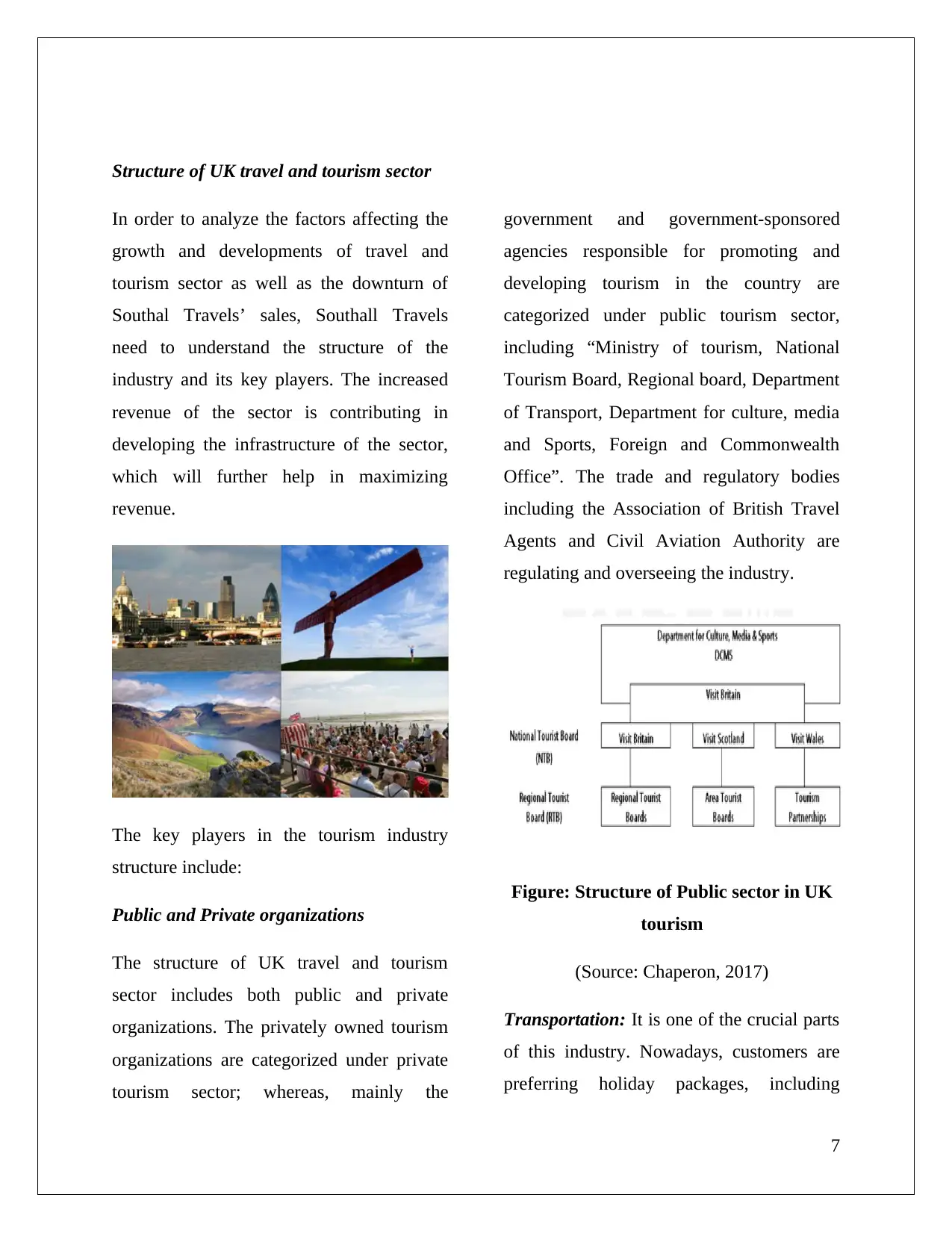
categorized under public tourism sector,
including “Ministry of tourism, National
Tourism Board, Regional board, Department
of Transport, Department for culture, media
and Sports, Foreign and Commonwealth
Office”. The trade and regulatory bodies
including the Association of British Travel
Agents and Civil Aviation Authority are
regulating and overseeing the industry.
Figure: Structure of Public sector in UK
tourism
(Source: Chaperon, 2017)
Transportation: It is one of the crucial parts
of this industry. Nowadays, customers are
preferring holiday packages, including
7
In order to analyze the factors affecting the
growth and developments of travel and
tourism sector as well as the downturn of
Southal Travels’ sales, Southall Travels
need to understand the structure of the
industry and its key players. The increased
revenue of the sector is contributing in
developing the infrastructure of the sector,
which will further help in maximizing
revenue.
The key players in the tourism industry
structure include:
Public and Private organizations
The structure of UK travel and tourism
sector includes both public and private
organizations. The privately owned tourism
organizations are categorized under private
tourism sector; whereas, mainly the
government and government-sponsored
agencies responsible for promoting and
developing tourism in the country are
categorized under public tourism sector,
including “Ministry of tourism, National
Tourism Board, Regional board, Department
of Transport, Department for culture, media
and Sports, Foreign and Commonwealth
Office”. The trade and regulatory bodies
including the Association of British Travel
Agents and Civil Aviation Authority are
regulating and overseeing the industry.
Figure: Structure of Public sector in UK
tourism
(Source: Chaperon, 2017)
Transportation: It is one of the crucial parts
of this industry. Nowadays, customers are
preferring holiday packages, including
7
Paraphrase This Document
Need a fresh take? Get an instant paraphrase of this document with our AI Paraphraser
transport facilities. Thus, the tour operators
or agencies need to take significant
consideration for transport facilities and
collaborate with transport facilities.
Industrial revolution played significant role
in this context. Further, launching “Boeing
747 'Jumbo Jet’ and Aircraft Airbus A380
Super Jumbo” influenced tourism
development.
Accommodation: Mostly the
accommodation is served by the private
sector organizations. Different types of
accommodation is offered, including world
class hotels, guest houses, hostel, campus
accommodation, camp sites, Bed and
breakfast, farm house, accommodation in
trains and aircraft, cruise liners and ferries.
For instance, TUI group is offering
accommodation in 300 hotels (Giaoutzi,
2017).
Attraction: These can be controlled and
managed by private or public organization
or government. UK consist a diverse range
of tourist attractions including natural sites,
historical artifacts, cultural heritage places,
mountain, biodiversity hotspot, seaside etc.
Further, several tourism agencies are
offering facilities for supporting education,
business meetings as well as leisure.
Information and Coordination: Offering
information to the customers regarding
safety, their responsibility, healthcare as
well as any emergency situations is crucial,
which is mainly served by the social as well
as print media. Southall Travels is
developing the online presence and using
ICT tools for informing customers as well
coordinating with the agencies with which it
is working.
Travel agents and tour operators: There are
multinational chain, maniple as well as
independent travel agencies in UK tourism
sector, offering a range of facilities. The
independent tour operators including large
transnational tour operators or independent
specialized tour operators are emphasizing
upon offering unique service to UK tourists
(Grenier, 2017). In this context, Southall
Travels is a privately owned travel agency
offering a range of tourism facilities.
8
or agencies need to take significant
consideration for transport facilities and
collaborate with transport facilities.
Industrial revolution played significant role
in this context. Further, launching “Boeing
747 'Jumbo Jet’ and Aircraft Airbus A380
Super Jumbo” influenced tourism
development.
Accommodation: Mostly the
accommodation is served by the private
sector organizations. Different types of
accommodation is offered, including world
class hotels, guest houses, hostel, campus
accommodation, camp sites, Bed and
breakfast, farm house, accommodation in
trains and aircraft, cruise liners and ferries.
For instance, TUI group is offering
accommodation in 300 hotels (Giaoutzi,
2017).
Attraction: These can be controlled and
managed by private or public organization
or government. UK consist a diverse range
of tourist attractions including natural sites,
historical artifacts, cultural heritage places,
mountain, biodiversity hotspot, seaside etc.
Further, several tourism agencies are
offering facilities for supporting education,
business meetings as well as leisure.
Information and Coordination: Offering
information to the customers regarding
safety, their responsibility, healthcare as
well as any emergency situations is crucial,
which is mainly served by the social as well
as print media. Southall Travels is
developing the online presence and using
ICT tools for informing customers as well
coordinating with the agencies with which it
is working.
Travel agents and tour operators: There are
multinational chain, maniple as well as
independent travel agencies in UK tourism
sector, offering a range of facilities. The
independent tour operators including large
transnational tour operators or independent
specialized tour operators are emphasizing
upon offering unique service to UK tourists
(Grenier, 2017). In this context, Southall
Travels is a privately owned travel agency
offering a range of tourism facilities.
8

9
⊘ This is a preview!⊘
Do you want full access?
Subscribe today to unlock all pages.
Trusted by 1+ million students worldwide
LO2 Understand the influence of local and national governments and international
agencies on the travel and tourism sector
2. You are required to analyze the function of government, government sponsored bodies
international agencies and interrelationships with governments in travel and tourism (2.1)
The UK government is playing a significant role in promoting the travel and tourism business.
As this sector is contributing with a high amount to the country’s GDP, the government and
government sponsored bodies are attempting to preserve the interest of these industry players, for
enhancing their profit margin. Further, in the current scenario, it has been revealed that in order
to resolve the issue of 15% sales decrease of Southall Travels, it is planning to expand the
business in Africa, concentrating upon leisure and business tourism. Thus, it is also crucial to
understand the role of African government in tourism sector.
Role of local, regional and central government
The southern African states are creating right policy, building infrastructure and fighting with
corruption for developing tourism, through economic development and encouraging inclusive
and sustainable growth. The central government is helping the tourism sector to build good road
and communications’ infrastructure, in restricting corruption and developing political stability,
thereby making the country potential to visit. Although the global crisis hit the continent badly,
the prudent macroeconomic policies introduced by the government as well as financial support
from multilateral agencies are making the tourism sector attractive for investment from US,
Europe, China and India (Fang et al., 2016). In this context, Southall Travels’ expansion is
feasible. The local and central government’s political support at the highest level is crucial for
tourism development. Government of Africa is playing a crucial role in coordinating the role of
public sector agencies, private profit and non-profit entities as well as local communities. Local
government is also supplying the basic infrastructure, while helping in promoting country’s
tourism for marketing and investment. In case of the critical constraints faced by the travel
agencies are mostly dependent on the action of central government, based on which the
government undertakes actions, which are related to air transport, tour operators as well as
accommodation.
10
agencies on the travel and tourism sector
2. You are required to analyze the function of government, government sponsored bodies
international agencies and interrelationships with governments in travel and tourism (2.1)
The UK government is playing a significant role in promoting the travel and tourism business.
As this sector is contributing with a high amount to the country’s GDP, the government and
government sponsored bodies are attempting to preserve the interest of these industry players, for
enhancing their profit margin. Further, in the current scenario, it has been revealed that in order
to resolve the issue of 15% sales decrease of Southall Travels, it is planning to expand the
business in Africa, concentrating upon leisure and business tourism. Thus, it is also crucial to
understand the role of African government in tourism sector.
Role of local, regional and central government
The southern African states are creating right policy, building infrastructure and fighting with
corruption for developing tourism, through economic development and encouraging inclusive
and sustainable growth. The central government is helping the tourism sector to build good road
and communications’ infrastructure, in restricting corruption and developing political stability,
thereby making the country potential to visit. Although the global crisis hit the continent badly,
the prudent macroeconomic policies introduced by the government as well as financial support
from multilateral agencies are making the tourism sector attractive for investment from US,
Europe, China and India (Fang et al., 2016). In this context, Southall Travels’ expansion is
feasible. The local and central government’s political support at the highest level is crucial for
tourism development. Government of Africa is playing a crucial role in coordinating the role of
public sector agencies, private profit and non-profit entities as well as local communities. Local
government is also supplying the basic infrastructure, while helping in promoting country’s
tourism for marketing and investment. In case of the critical constraints faced by the travel
agencies are mostly dependent on the action of central government, based on which the
government undertakes actions, which are related to air transport, tour operators as well as
accommodation.
10
Paraphrase This Document
Need a fresh take? Get an instant paraphrase of this document with our AI Paraphraser
In this context, it is noteworthy that for promoting tourism development in Africa, the
government needs to make strategies decisions regarding key issues, including “the scale of
tourism development, the sustainability of the sector and financing of tourism and economic
rents”, upon consulting with all the stakeholders at national and regional level, as well as
government needs to decide the scale of development. Further, sound government policies in
Africa are helping to extract the maximum tourism related economic benefits. However, “high
cost of regulation, preservation and monitoring cost” main hinder sustainability (Mowforth and
Munt, 2015). The ignored government funding resource can act as the economic rents generated
by tourism. African government is creating an enabling environment for investment from foreign
businesses, while providing supporting infrastructure for those investments, which would make
the business expansion practice by Southall Travels feasible.
Further, as Southall is UK based country, thus the national government and government
sponsored bodies like VisitBritain, UK regional tourist boards including “Visit London, South
West Tourism” as well as local authority (LA) work in partnership for promoting leisure and
business tourism expansion of Southall Travels in Africa. Local government would als play a
crucial role in marketing the area to potential visitors as well as take responsibility of the
operations of the Tourist information centers (Mowforth and Munt, 2015).
Role of international agencies
UNWTO and World Tourism Organization are the key international agencies, which are
introducing policies and regulations for ensuring the ethical practice and coordination among
tourism sectors of different nations. In addition, the World Travel and Tourism Council is putting
significant effort in terms of sustainability of the tourism business, including waste minimization,
water resource, energy efficiency conservation and management. Further, the International Air
Transport Association is “international industry trade group of airlines”, which regulates the air
travel, shipping of dangerous goods etc. Therefore, these agencies would be responsible for the
activities by Southall Travels related to tourism business expansion in Africa (Mowforth and
Munt, 2015).
11
government needs to make strategies decisions regarding key issues, including “the scale of
tourism development, the sustainability of the sector and financing of tourism and economic
rents”, upon consulting with all the stakeholders at national and regional level, as well as
government needs to decide the scale of development. Further, sound government policies in
Africa are helping to extract the maximum tourism related economic benefits. However, “high
cost of regulation, preservation and monitoring cost” main hinder sustainability (Mowforth and
Munt, 2015). The ignored government funding resource can act as the economic rents generated
by tourism. African government is creating an enabling environment for investment from foreign
businesses, while providing supporting infrastructure for those investments, which would make
the business expansion practice by Southall Travels feasible.
Further, as Southall is UK based country, thus the national government and government
sponsored bodies like VisitBritain, UK regional tourist boards including “Visit London, South
West Tourism” as well as local authority (LA) work in partnership for promoting leisure and
business tourism expansion of Southall Travels in Africa. Local government would als play a
crucial role in marketing the area to potential visitors as well as take responsibility of the
operations of the Tourist information centers (Mowforth and Munt, 2015).
Role of international agencies
UNWTO and World Tourism Organization are the key international agencies, which are
introducing policies and regulations for ensuring the ethical practice and coordination among
tourism sectors of different nations. In addition, the World Travel and Tourism Council is putting
significant effort in terms of sustainability of the tourism business, including waste minimization,
water resource, energy efficiency conservation and management. Further, the International Air
Transport Association is “international industry trade group of airlines”, which regulates the air
travel, shipping of dangerous goods etc. Therefore, these agencies would be responsible for the
activities by Southall Travels related to tourism business expansion in Africa (Mowforth and
Munt, 2015).
11
3. As part of your research you should also explain how local national economic policy
influences the success of the travel and tourism sector as well as discuss the implications of
political change on the travel and tourism sector in different countries (AC 2.2 and 2.3)
The local as well as national economic policies have significant influence upon the success of the
travel and tourism organizations. In this context, it is noteworthy for Southall Travels that as it is
UK based organization and attempting to expand its business in Africa, the economic policy and
political situation of both the countries would have an impact upon tourism business. The stable
economy of UK is promoting investment in promoting tourism infrastructure, through which
efficient transport; roads along with cultural and architectural heritages are attracting more
customers (Mason, 2015). National tax and regulatory payments are controlling national and
international trade in regards to tourism development.
In this context, the key objective of government’s economic policy in both the nations are to
“control unemployment, control inflation, create and maintain a favorable balance of payments,
enhance national income, standard of living of population as well as support less developed
countries”. The stable socio-economic condition of local community reflects high educational
level, good access to technology, which would help to inform people. On the other hand, it has
been revealed that as most of the African countries are experiencing difficulties to exploit the
potential of tourism facilities in business and economic development. Thus, the economic
diversification can reduce drawbacks in tourism development (Boniface et al., 2016). Further,
the economic policies of African nations are enhancing the job opportunities for unemployed
youth by influencing tourism development. The intraregional tourism in Africa is enhancing the
opportunities for economic diversification. As a result, the access to tourism destinations is
facilitated, boosting the competitiveness of tourism destinations.
Implications of political change
Brexit imposed a significant effect on UK’s political environment, by decreasing the value of
Great Britain Pound, as a result the international tourists visit has been enhanced, thereby
enhancing profit margin of this sector. The UK government has implemented Visa provision
policy for Chinese tourists, which enhanced the number or tourist from China, thereby enhancing
revenue of the sector. However, it is crucial for the tourism company to have a clear idea
regarding the socio-economic as well as political condition of China as well as other countries. In
12
influences the success of the travel and tourism sector as well as discuss the implications of
political change on the travel and tourism sector in different countries (AC 2.2 and 2.3)
The local as well as national economic policies have significant influence upon the success of the
travel and tourism organizations. In this context, it is noteworthy for Southall Travels that as it is
UK based organization and attempting to expand its business in Africa, the economic policy and
political situation of both the countries would have an impact upon tourism business. The stable
economy of UK is promoting investment in promoting tourism infrastructure, through which
efficient transport; roads along with cultural and architectural heritages are attracting more
customers (Mason, 2015). National tax and regulatory payments are controlling national and
international trade in regards to tourism development.
In this context, the key objective of government’s economic policy in both the nations are to
“control unemployment, control inflation, create and maintain a favorable balance of payments,
enhance national income, standard of living of population as well as support less developed
countries”. The stable socio-economic condition of local community reflects high educational
level, good access to technology, which would help to inform people. On the other hand, it has
been revealed that as most of the African countries are experiencing difficulties to exploit the
potential of tourism facilities in business and economic development. Thus, the economic
diversification can reduce drawbacks in tourism development (Boniface et al., 2016). Further,
the economic policies of African nations are enhancing the job opportunities for unemployed
youth by influencing tourism development. The intraregional tourism in Africa is enhancing the
opportunities for economic diversification. As a result, the access to tourism destinations is
facilitated, boosting the competitiveness of tourism destinations.
Implications of political change
Brexit imposed a significant effect on UK’s political environment, by decreasing the value of
Great Britain Pound, as a result the international tourists visit has been enhanced, thereby
enhancing profit margin of this sector. The UK government has implemented Visa provision
policy for Chinese tourists, which enhanced the number or tourist from China, thereby enhancing
revenue of the sector. However, it is crucial for the tourism company to have a clear idea
regarding the socio-economic as well as political condition of China as well as other countries. In
12
⊘ This is a preview!⊘
Do you want full access?
Subscribe today to unlock all pages.
Trusted by 1+ million students worldwide

1 out of 20


Related Documents


Your All-in-One AI-Powered Toolkit for Academic Success.
+13062052269
info@desklib.com
Available 24*7 on WhatsApp / Email
![[object Object]](/_next/static/media/star-bottom.7253800d.svg)
Unlock your academic potential
Copyright © 2020–2026 A2Z Services. All Rights Reserved. Developed and managed by ZUCOL.