Legislation, Ethics, and CSR in the Travel and Tourism Sector
VerifiedAdded on 2020/01/23
|22
|7382
|136
Report
AI Summary
This report delves into the legal and ethical frameworks governing the travel and tourism sector, with a specific focus on the context of England and Wales. It explores the legal and regulatory landscape, including consumer protection, health and safety, and licensing. The report analyzes the impact of legislation related to health, safety, and security, as well as equality. Contract and consumer protection legislation are examined in relation to travel and tourism customers. The report also addresses ethical dilemmas faced by businesses in the sector, with a case study of British Airways' corporate social responsibility policy. The analysis covers surface, sea, and air transport laws within the UK's legal and regulatory framework. The report highlights the importance of adhering to legal and ethical standards for the sustainable development and success of the tourism industry, and the protection of both consumers and employees.
Legislation and Ethics in
Travel and Tourism Sector
Travel and Tourism Sector

Paraphrase This Document
Need a fresh take? Get an instant paraphrase of this document with our AI Paraphraser
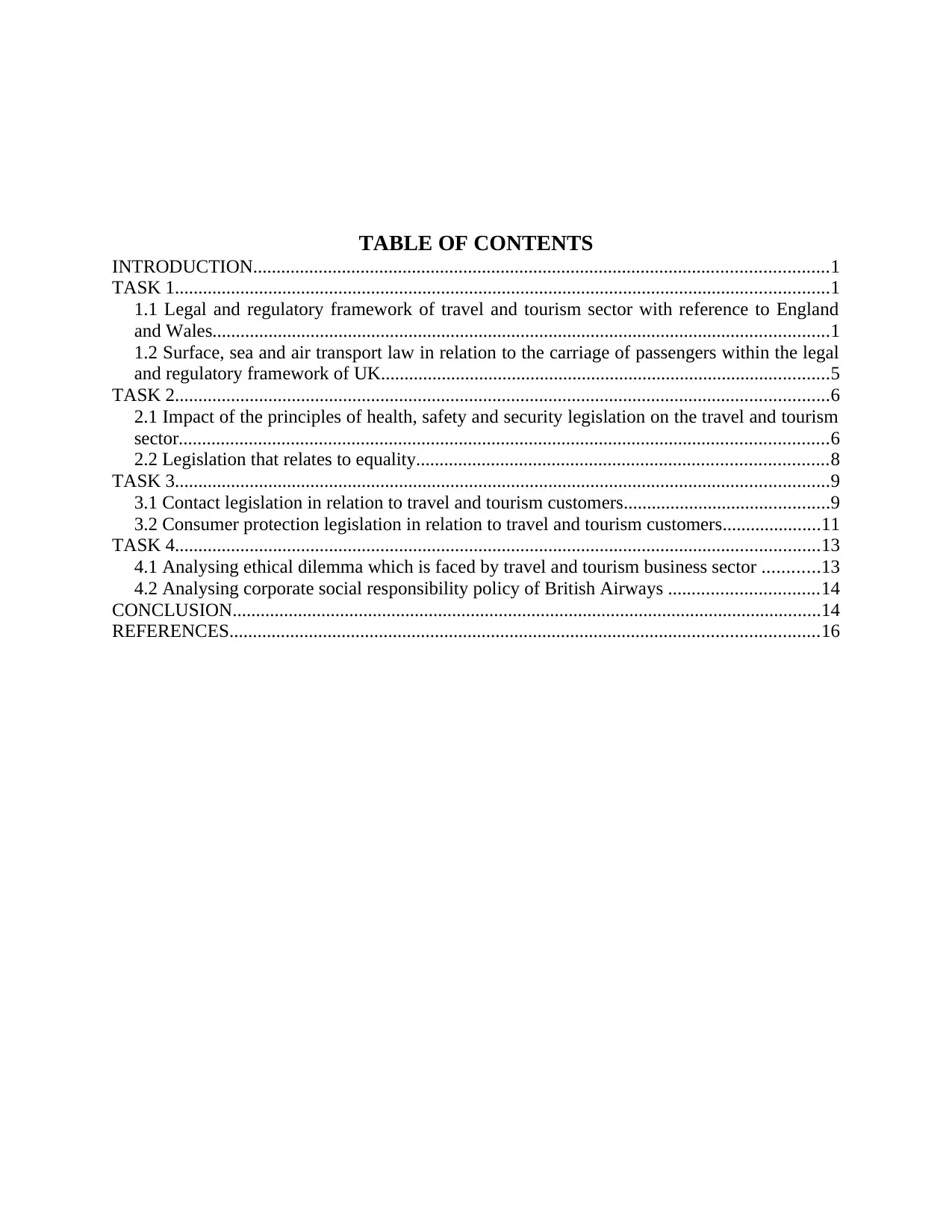
TABLE OF CONTENTS
INTRODUCTION...........................................................................................................................1
TASK 1............................................................................................................................................1
1.1 Legal and regulatory framework of travel and tourism sector with reference to England
and Wales....................................................................................................................................1
1.2 Surface, sea and air transport law in relation to the carriage of passengers within the legal
and regulatory framework of UK................................................................................................5
TASK 2............................................................................................................................................6
2.1 Impact of the principles of health, safety and security legislation on the travel and tourism
sector...........................................................................................................................................6
2.2 Legislation that relates to equality........................................................................................8
TASK 3............................................................................................................................................9
3.1 Contact legislation in relation to travel and tourism customers............................................9
3.2 Consumer protection legislation in relation to travel and tourism customers.....................11
TASK 4..........................................................................................................................................13
4.1 Analysing ethical dilemma which is faced by travel and tourism business sector ............13
4.2 Analysing corporate social responsibility policy of British Airways ................................14
CONCLUSION..............................................................................................................................14
REFERENCES..............................................................................................................................16
INTRODUCTION...........................................................................................................................1
TASK 1............................................................................................................................................1
1.1 Legal and regulatory framework of travel and tourism sector with reference to England
and Wales....................................................................................................................................1
1.2 Surface, sea and air transport law in relation to the carriage of passengers within the legal
and regulatory framework of UK................................................................................................5
TASK 2............................................................................................................................................6
2.1 Impact of the principles of health, safety and security legislation on the travel and tourism
sector...........................................................................................................................................6
2.2 Legislation that relates to equality........................................................................................8
TASK 3............................................................................................................................................9
3.1 Contact legislation in relation to travel and tourism customers............................................9
3.2 Consumer protection legislation in relation to travel and tourism customers.....................11
TASK 4..........................................................................................................................................13
4.1 Analysing ethical dilemma which is faced by travel and tourism business sector ............13
4.2 Analysing corporate social responsibility policy of British Airways ................................14
CONCLUSION..............................................................................................................................14
REFERENCES..............................................................................................................................16
INTRODUCTION
In this current era of globalisation, international sector of touristy market havehas gained
enormous attention of the public bodies. Due to this, they have become one of the most emerging
businesses that has earned high revenue by raising the national GDP rate. The rising boundaries
of tourism sector has together identified numerous destinations over varied locations at a
worldwide level (Bowie, 2013). This increment has fetched a liable interest of many corporates
and business personnel to invest their capital income in touristy market and generate higher
profits. However, government and other affiliated parties have enforced various strategic policies
and procedures with a structured legislation of ethics. This is mainly in order to maintain a
qualitative performance of tourism sector and other related corporations like hotel
accommodations, restaurants, airline industries and tour operators (Breen, 2013).
Similar to this, report is substantially based upon related information on tourism which
mainly covers a significant structuring of certain requisite strategies. This is basically to benefit
the business operations of tourism with some amended services and amenities to the upcoming
users (Banerjee, 2007). Leading purpose of such implication is to maintain the satisfaction level
of service users and provisioning of qualitative functions rendered by the tourism sectors.
TASK 1
1.1 Legal and regulatory framework of travel and tourism sector with reference to England and
Wales
Current structuring of travel and tourism sector is purely based upon certain legitimate
considerations to be followed by the affiliated bodies of touring operations. It is however with a
wider role of appointed governmental bodies in countries which are directly accountable for
framing such validated policies in their respective nations (Carroll, 2014). This is yet again with
a considerable thought of maintaining a regularised and systematised culture where upcoming
tourists will be welcomed in a grateful surrounding. Such legal frameworks in travel and tourism
are nowadays referred as an essential cogitation where it has rapidly converted into a broad
spectrum of economic sector.
These judicial policies however differsdiffer from one another according to the
distinctive nature of several countries at a global level. The legalised procedures are specifically
defined as a fine association of varied industry specific laws that are also governed by foreign
1
In this current era of globalisation, international sector of touristy market havehas gained
enormous attention of the public bodies. Due to this, they have become one of the most emerging
businesses that has earned high revenue by raising the national GDP rate. The rising boundaries
of tourism sector has together identified numerous destinations over varied locations at a
worldwide level (Bowie, 2013). This increment has fetched a liable interest of many corporates
and business personnel to invest their capital income in touristy market and generate higher
profits. However, government and other affiliated parties have enforced various strategic policies
and procedures with a structured legislation of ethics. This is mainly in order to maintain a
qualitative performance of tourism sector and other related corporations like hotel
accommodations, restaurants, airline industries and tour operators (Breen, 2013).
Similar to this, report is substantially based upon related information on tourism which
mainly covers a significant structuring of certain requisite strategies. This is basically to benefit
the business operations of tourism with some amended services and amenities to the upcoming
users (Banerjee, 2007). Leading purpose of such implication is to maintain the satisfaction level
of service users and provisioning of qualitative functions rendered by the tourism sectors.
TASK 1
1.1 Legal and regulatory framework of travel and tourism sector with reference to England and
Wales
Current structuring of travel and tourism sector is purely based upon certain legitimate
considerations to be followed by the affiliated bodies of touring operations. It is however with a
wider role of appointed governmental bodies in countries which are directly accountable for
framing such validated policies in their respective nations (Carroll, 2014). This is yet again with
a considerable thought of maintaining a regularised and systematised culture where upcoming
tourists will be welcomed in a grateful surrounding. Such legal frameworks in travel and tourism
are nowadays referred as an essential cogitation where it has rapidly converted into a broad
spectrum of economic sector.
These judicial policies however differsdiffer from one another according to the
distinctive nature of several countries at a global level. The legalised procedures are specifically
defined as a fine association of varied industry specific laws that are also governed by foreign
1
⊘ This is a preview!⊘
Do you want full access?
Subscribe today to unlock all pages.

Trusted by 1+ million students worldwide
modulations. It is thus with reference to state about the legal and regulatory framework of travel
and tourism sector in England and Wales where it is mainly governed by a crucial enactment of
Development of Tourism Act 1969 (Cooper, 2012). It has laid down almost all requisite
regulatory policies of tourism industry in UK. It has together constituted the British authority
boards of touristy for Scotland, England and Wales.
This is mainly to define a correspondent relationship between law and tourism where
they both are referred to be a complex disclosure of their distinct cogitations that is yet again
with an interconnected prospect. It is where the law definedefines about some vital perceptions
of protecting environment by together considering the health and safety perspective of
approaching individuals in country (Crozier and Martin, 2012). This together defines the law of
companies and their contractual aspects in terms of IPC and CRPC. However, tourism exists
with a slightly differentiated agenda of defining rules and regulations of tourism firms that is
essentially to protect the basic rights of tourers who are travelling by any mode of transportation.
These rules also differ from country to country with a similar objective of enhancing recent
proceedings in a more impelling manner.
Below delineated constituents are referred to varied diversified laws that constantly
influences the travel industry which are mentioned as- Consumer protection from unfair trading regulation 2008- This is the foremost cogitation
of regimental bodies of England and Wales (Ferrell, 2014). It is with a significant
concern of protecting consumers from any misleading activities of biased commercialised
practices in the nation (Paterson and Brody, 2015). Health and safety legislation- This is to define the workplace consideration of employees
and employers of tour operator firms to protect the consumers from an associative risk of
security (MA, Q.M., 2016). Licensing act 2003- It is yet again defined to be another vital imposition of working into
a legitimated culture where the banned activities should be entirely restricted by
organisational parties (Ko and et.al., 2014). It can be hereby related to the sale of
alcoholic content in the premises that should be done with a prior and proper licensing by
its solicitous bodies (Laing, 2016).
Sexual Offence- It is with reference to depict the prohibited activities of running a sex
racket, assaultive practices and child abusive measures, etc. This is with a prime
2
and tourism sector in England and Wales where it is mainly governed by a crucial enactment of
Development of Tourism Act 1969 (Cooper, 2012). It has laid down almost all requisite
regulatory policies of tourism industry in UK. It has together constituted the British authority
boards of touristy for Scotland, England and Wales.
This is mainly to define a correspondent relationship between law and tourism where
they both are referred to be a complex disclosure of their distinct cogitations that is yet again
with an interconnected prospect. It is where the law definedefines about some vital perceptions
of protecting environment by together considering the health and safety perspective of
approaching individuals in country (Crozier and Martin, 2012). This together defines the law of
companies and their contractual aspects in terms of IPC and CRPC. However, tourism exists
with a slightly differentiated agenda of defining rules and regulations of tourism firms that is
essentially to protect the basic rights of tourers who are travelling by any mode of transportation.
These rules also differ from country to country with a similar objective of enhancing recent
proceedings in a more impelling manner.
Below delineated constituents are referred to varied diversified laws that constantly
influences the travel industry which are mentioned as- Consumer protection from unfair trading regulation 2008- This is the foremost cogitation
of regimental bodies of England and Wales (Ferrell, 2014). It is with a significant
concern of protecting consumers from any misleading activities of biased commercialised
practices in the nation (Paterson and Brody, 2015). Health and safety legislation- This is to define the workplace consideration of employees
and employers of tour operator firms to protect the consumers from an associative risk of
security (MA, Q.M., 2016). Licensing act 2003- It is yet again defined to be another vital imposition of working into
a legitimated culture where the banned activities should be entirely restricted by
organisational parties (Ko and et.al., 2014). It can be hereby related to the sale of
alcoholic content in the premises that should be done with a prior and proper licensing by
its solicitous bodies (Laing, 2016).
Sexual Offence- It is with reference to depict the prohibited activities of running a sex
racket, assaultive practices and child abusive measures, etc. This is with a prime
2
Paraphrase This Document
Need a fresh take? Get an instant paraphrase of this document with our AI Paraphraser
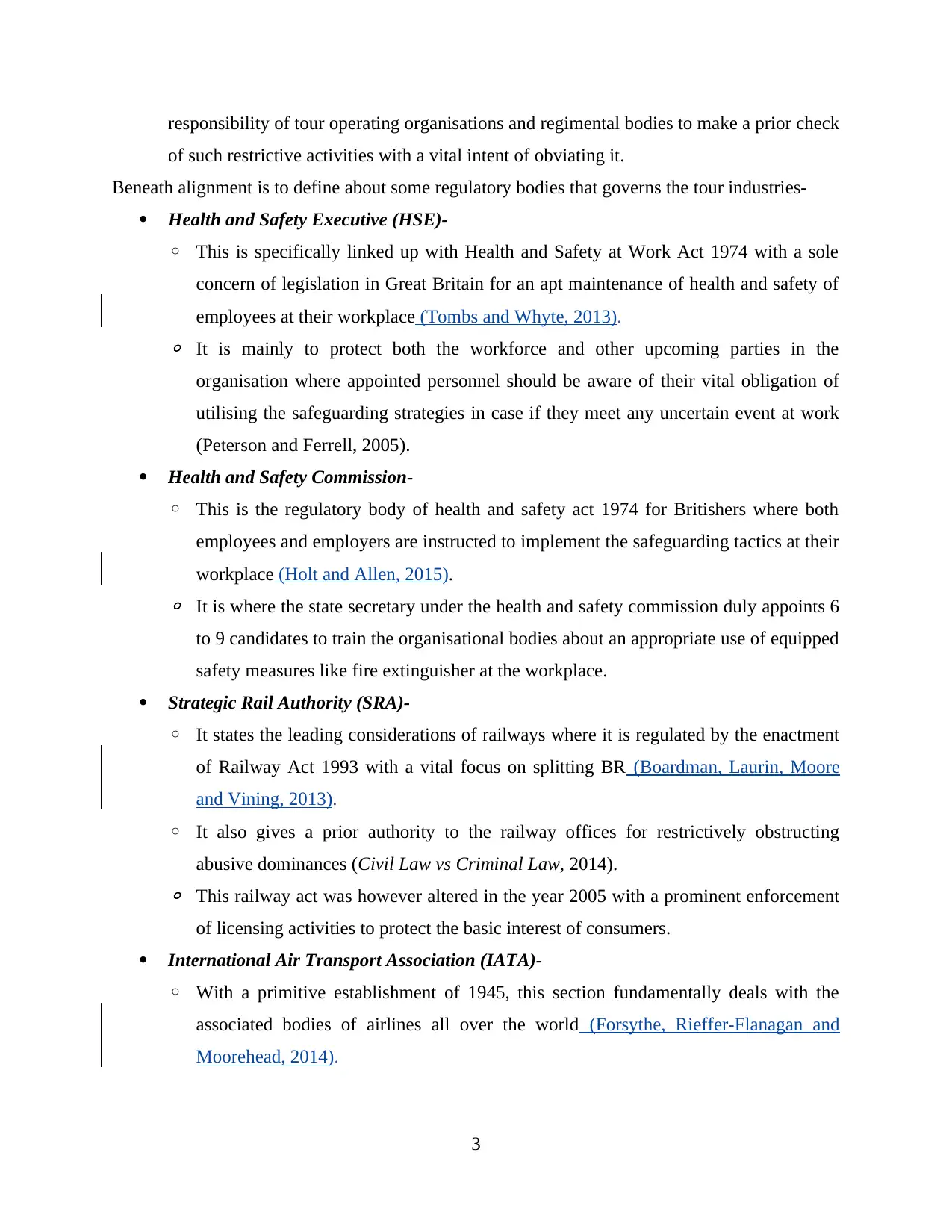
responsibility of tour operating organisations and regimental bodies to make a prior check
of such restrictive activities with a vital intent of obviating it.
Beneath alignment is to define about some regulatory bodies that governs the tour industries-
Health and Safety Executive (HSE)-
◦ This is specifically linked up with Health and Safety at Work Act 1974 with a sole
concern of legislation in Great Britain for an apt maintenance of health and safety of
employees at their workplace (Tombs and Whyte, 2013).
◦ It is mainly to protect both the workforce and other upcoming parties in the
organisation where appointed personnel should be aware of their vital obligation of
utilising the safeguarding strategies in case if they meet any uncertain event at work
(Peterson and Ferrell, 2005).
Health and Safety Commission-
◦ This is the regulatory body of health and safety act 1974 for Britishers where both
employees and employers are instructed to implement the safeguarding tactics at their
workplace (Holt and Allen, 2015).
◦ It is where the state secretary under the health and safety commission duly appoints 6
to 9 candidates to train the organisational bodies about an appropriate use of equipped
safety measures like fire extinguisher at the workplace.
Strategic Rail Authority (SRA)-
◦ It states the leading considerations of railways where it is regulated by the enactment
of Railway Act 1993 with a vital focus on splitting BR (Boardman, Laurin, Moore
and Vining, 2013).
◦ It also gives a prior authority to the railway offices for restrictively obstructing
abusive dominances (Civil Law vs Criminal Law, 2014).
◦ This railway act was however altered in the year 2005 with a prominent enforcement
of licensing activities to protect the basic interest of consumers.
International Air Transport Association (IATA)-
◦ With a primitive establishment of 1945, this section fundamentally deals with the
associated bodies of airlines all over the world (Forsythe, Rieffer-Flanagan and
Moorehead, 2014).
3
of such restrictive activities with a vital intent of obviating it.
Beneath alignment is to define about some regulatory bodies that governs the tour industries-
Health and Safety Executive (HSE)-
◦ This is specifically linked up with Health and Safety at Work Act 1974 with a sole
concern of legislation in Great Britain for an apt maintenance of health and safety of
employees at their workplace (Tombs and Whyte, 2013).
◦ It is mainly to protect both the workforce and other upcoming parties in the
organisation where appointed personnel should be aware of their vital obligation of
utilising the safeguarding strategies in case if they meet any uncertain event at work
(Peterson and Ferrell, 2005).
Health and Safety Commission-
◦ This is the regulatory body of health and safety act 1974 for Britishers where both
employees and employers are instructed to implement the safeguarding tactics at their
workplace (Holt and Allen, 2015).
◦ It is where the state secretary under the health and safety commission duly appoints 6
to 9 candidates to train the organisational bodies about an appropriate use of equipped
safety measures like fire extinguisher at the workplace.
Strategic Rail Authority (SRA)-
◦ It states the leading considerations of railways where it is regulated by the enactment
of Railway Act 1993 with a vital focus on splitting BR (Boardman, Laurin, Moore
and Vining, 2013).
◦ It also gives a prior authority to the railway offices for restrictively obstructing
abusive dominances (Civil Law vs Criminal Law, 2014).
◦ This railway act was however altered in the year 2005 with a prominent enforcement
of licensing activities to protect the basic interest of consumers.
International Air Transport Association (IATA)-
◦ With a primitive establishment of 1945, this section fundamentally deals with the
associated bodies of airlines all over the world (Forsythe, Rieffer-Flanagan and
Moorehead, 2014).
3
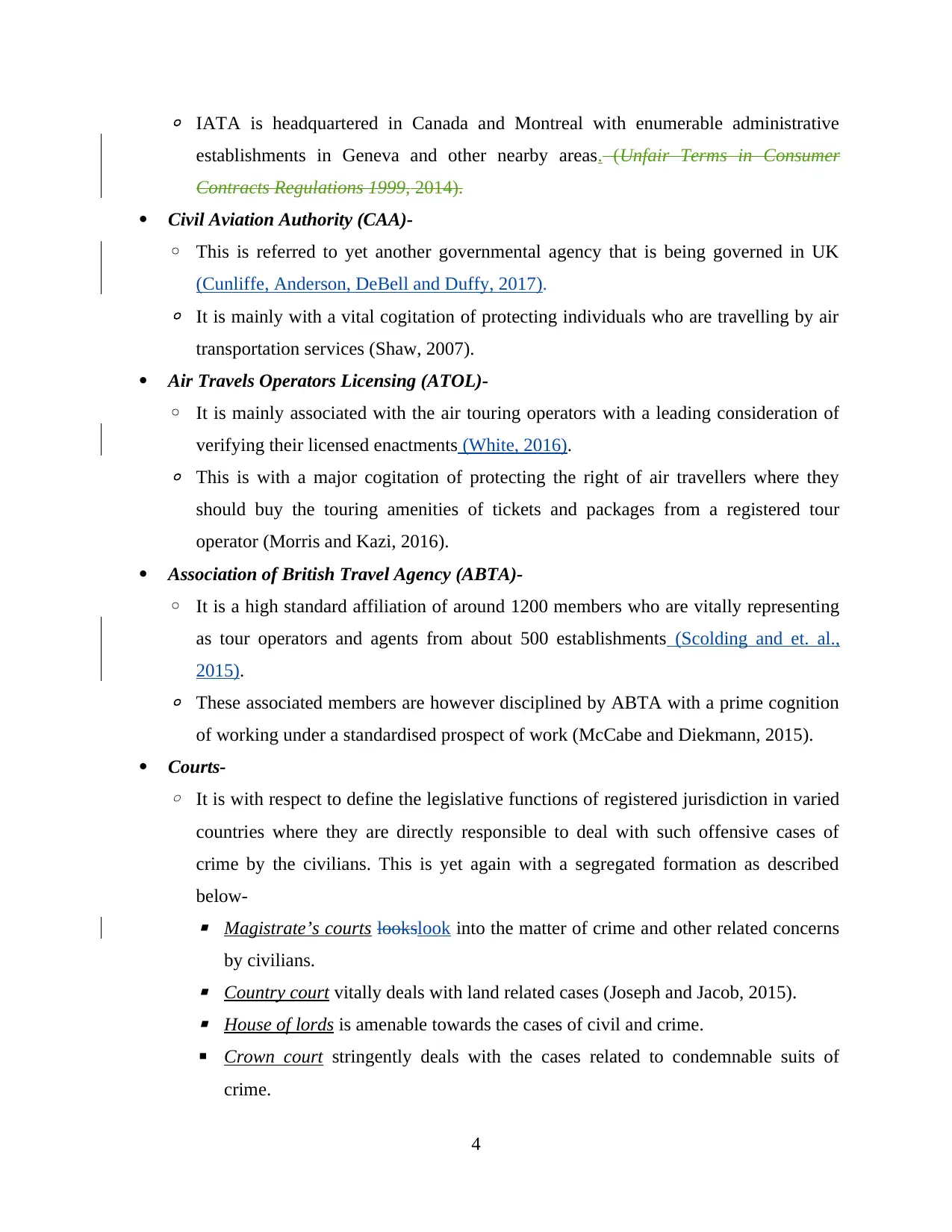
◦ IATA is headquartered in Canada and Montreal with enumerable administrative
establishments in Geneva and other nearby areas. (Unfair Terms in Consumer
Contracts Regulations 1999, 2014).
Civil Aviation Authority (CAA)-
◦ This is referred to yet another governmental agency that is being governed in UK
(Cunliffe, Anderson, DeBell and Duffy, 2017).
◦ It is mainly with a vital cogitation of protecting individuals who are travelling by air
transportation services (Shaw, 2007).
Air Travels Operators Licensing (ATOL)-
◦ It is mainly associated with the air touring operators with a leading consideration of
verifying their licensed enactments (White, 2016).
◦ This is with a major cogitation of protecting the right of air travellers where they
should buy the touring amenities of tickets and packages from a registered tour
operator (Morris and Kazi, 2016).
Association of British Travel Agency (ABTA)-
◦ It is a high standard affiliation of around 1200 members who are vitally representing
as tour operators and agents from about 500 establishments (Scolding and et. al.,
2015).
◦ These associated members are however disciplined by ABTA with a prime cognition
of working under a standardised prospect of work (McCabe and Diekmann, 2015).
Courts-
◦ It is with respect to define the legislative functions of registered jurisdiction in varied
countries where they are directly responsible to deal with such offensive cases of
crime by the civilians. This is yet again with a segregated formation as described
below-
▪ Magistrate’s courts lookslook into the matter of crime and other related concerns
by civilians.
▪ Country court vitally deals with land related cases (Joseph and Jacob, 2015).
▪ House of lords is amenable towards the cases of civil and crime.
▪ Crown court stringently deals with the cases related to condemnable suits of
crime.
4
establishments in Geneva and other nearby areas. (Unfair Terms in Consumer
Contracts Regulations 1999, 2014).
Civil Aviation Authority (CAA)-
◦ This is referred to yet another governmental agency that is being governed in UK
(Cunliffe, Anderson, DeBell and Duffy, 2017).
◦ It is mainly with a vital cogitation of protecting individuals who are travelling by air
transportation services (Shaw, 2007).
Air Travels Operators Licensing (ATOL)-
◦ It is mainly associated with the air touring operators with a leading consideration of
verifying their licensed enactments (White, 2016).
◦ This is with a major cogitation of protecting the right of air travellers where they
should buy the touring amenities of tickets and packages from a registered tour
operator (Morris and Kazi, 2016).
Association of British Travel Agency (ABTA)-
◦ It is a high standard affiliation of around 1200 members who are vitally representing
as tour operators and agents from about 500 establishments (Scolding and et. al.,
2015).
◦ These associated members are however disciplined by ABTA with a prime cognition
of working under a standardised prospect of work (McCabe and Diekmann, 2015).
Courts-
◦ It is with respect to define the legislative functions of registered jurisdiction in varied
countries where they are directly responsible to deal with such offensive cases of
crime by the civilians. This is yet again with a segregated formation as described
below-
▪ Magistrate’s courts lookslook into the matter of crime and other related concerns
by civilians.
▪ Country court vitally deals with land related cases (Joseph and Jacob, 2015).
▪ House of lords is amenable towards the cases of civil and crime.
▪ Crown court stringently deals with the cases related to condemnable suits of
crime.
4
⊘ This is a preview!⊘
Do you want full access?
Subscribe today to unlock all pages.
Trusted by 1+ million students worldwide
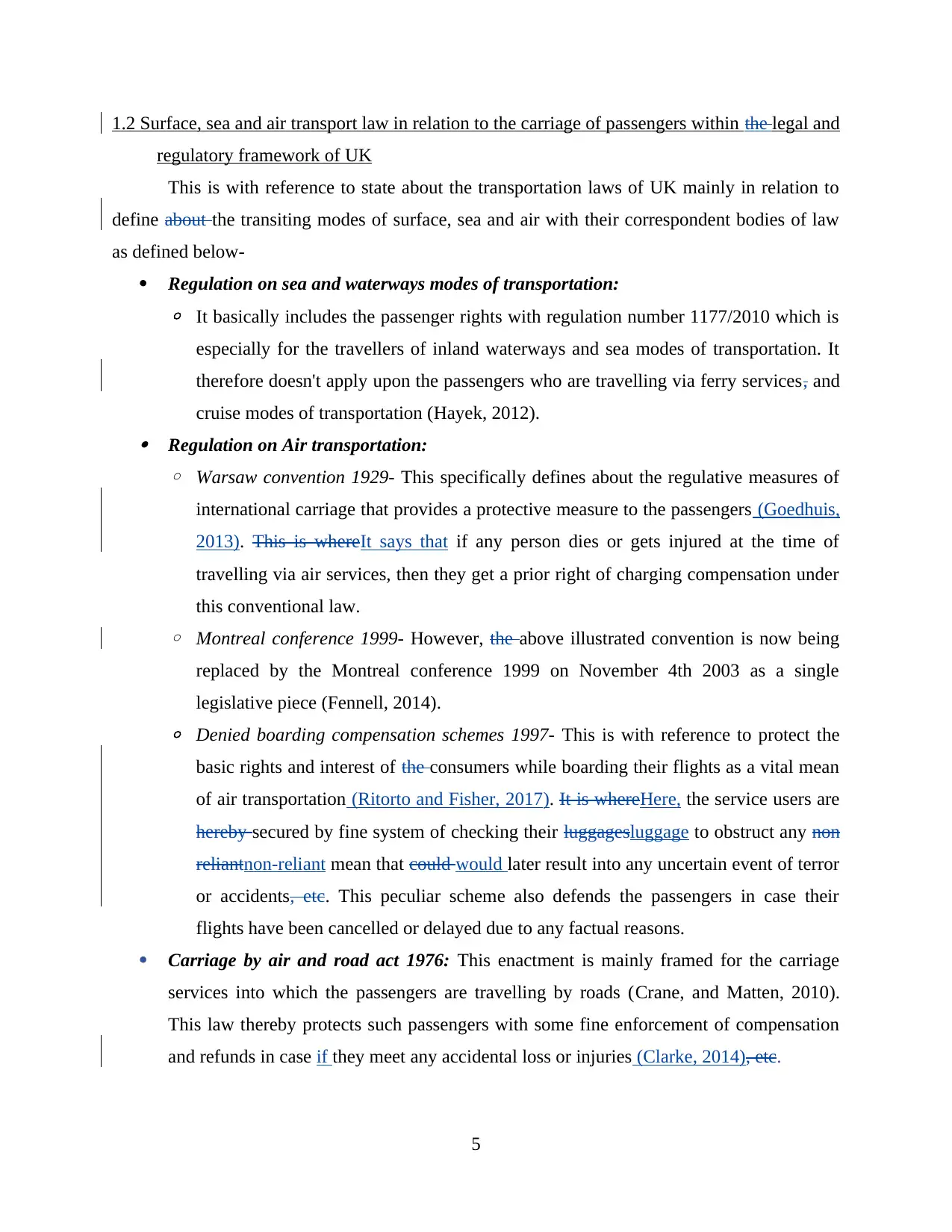
1.2 Surface, sea and air transport law in relation to the carriage of passengers within the legal and
regulatory framework of UK
This is with reference to state about the transportation laws of UK mainly in relation to
define about the transiting modes of surface, sea and air with their correspondent bodies of law
as defined below-
Regulation on sea and waterways modes of transportation:
◦ It basically includes the passenger rights with regulation number 1177/2010 which is
especially for the travellers of inland waterways and sea modes of transportation. It
therefore doesn't apply upon the passengers who are travelling via ferry services, and
cruise modes of transportation (Hayek, 2012). Regulation on Air transportation:
◦ Warsaw convention 1929- This specifically defines about the regulative measures of
international carriage that provides a protective measure to the passengers (Goedhuis,
2013). This is whereIt says that if any person dies or gets injured at the time of
travelling via air services, then they get a prior right of charging compensation under
this conventional law.
◦ Montreal conference 1999- However, the above illustrated convention is now being
replaced by the Montreal conference 1999 on November 4th 2003 as a single
legislative piece (Fennell, 2014).
◦ Denied boarding compensation schemes 1997- This is with reference to protect the
basic rights and interest of the consumers while boarding their flights as a vital mean
of air transportation (Ritorto and Fisher, 2017). It is whereHere, the service users are
hereby secured by fine system of checking their luggagesluggage to obstruct any non
reliantnon-reliant mean that could would later result into any uncertain event of terror
or accidents, etc. This peculiar scheme also defends the passengers in case their
flights have been cancelled or delayed due to any factual reasons.
Carriage by air and road act 1976: This enactment is mainly framed for the carriage
services into which the passengers are travelling by roads (Crane, and Matten, 2010).
This law thereby protects such passengers with some fine enforcement of compensation
and refunds in case if they meet any accidental loss or injuries (Clarke, 2014), etc.
5
regulatory framework of UK
This is with reference to state about the transportation laws of UK mainly in relation to
define about the transiting modes of surface, sea and air with their correspondent bodies of law
as defined below-
Regulation on sea and waterways modes of transportation:
◦ It basically includes the passenger rights with regulation number 1177/2010 which is
especially for the travellers of inland waterways and sea modes of transportation. It
therefore doesn't apply upon the passengers who are travelling via ferry services, and
cruise modes of transportation (Hayek, 2012). Regulation on Air transportation:
◦ Warsaw convention 1929- This specifically defines about the regulative measures of
international carriage that provides a protective measure to the passengers (Goedhuis,
2013). This is whereIt says that if any person dies or gets injured at the time of
travelling via air services, then they get a prior right of charging compensation under
this conventional law.
◦ Montreal conference 1999- However, the above illustrated convention is now being
replaced by the Montreal conference 1999 on November 4th 2003 as a single
legislative piece (Fennell, 2014).
◦ Denied boarding compensation schemes 1997- This is with reference to protect the
basic rights and interest of the consumers while boarding their flights as a vital mean
of air transportation (Ritorto and Fisher, 2017). It is whereHere, the service users are
hereby secured by fine system of checking their luggagesluggage to obstruct any non
reliantnon-reliant mean that could would later result into any uncertain event of terror
or accidents, etc. This peculiar scheme also defends the passengers in case their
flights have been cancelled or delayed due to any factual reasons.
Carriage by air and road act 1976: This enactment is mainly framed for the carriage
services into which the passengers are travelling by roads (Crane, and Matten, 2010).
This law thereby protects such passengers with some fine enforcement of compensation
and refunds in case if they meet any accidental loss or injuries (Clarke, 2014), etc.
5
Paraphrase This Document
Need a fresh take? Get an instant paraphrase of this document with our AI Paraphraser
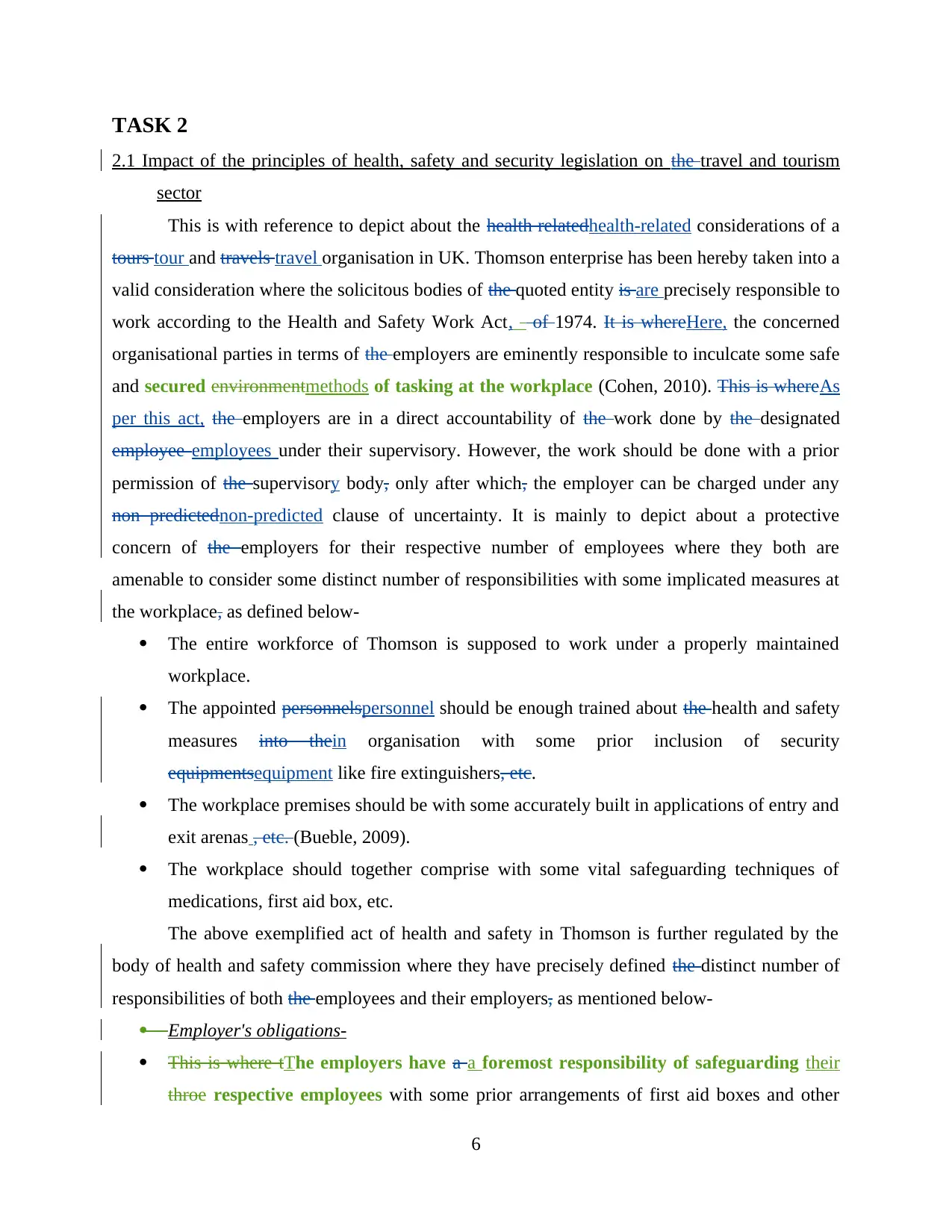
TASK 2
2.1 Impact of the principles of health, safety and security legislation on the travel and tourism
sector
This is with reference to depict about the health relatedhealth-related considerations of a
tours tour and travels travel organisation in UK. Thomson enterprise has been hereby taken into a
valid consideration where the solicitous bodies of the quoted entity is are precisely responsible to
work according to the Health and Safety Work Act, of 1974. It is whereHere, the concerned
organisational parties in terms of the employers are eminently responsible to inculcate some safe
and secured environmentmethods of tasking at the workplace (Cohen, 2010). This is whereAs
per this act, the employers are in a direct accountability of the work done by the designated
employee employees under their supervisory. However, the work should be done with a prior
permission of the supervisory body, only after which, the employer can be charged under any
non predictednon-predicted clause of uncertainty. It is mainly to depict about a protective
concern of the employers for their respective number of employees where they both are
amenable to consider some distinct number of responsibilities with some implicated measures at
the workplace, as defined below-
The entire workforce of Thomson is supposed to work under a properly maintained
workplace.
The appointed personnelspersonnel should be enough trained about the health and safety
measures into thein organisation with some prior inclusion of security
equipmentsequipment like fire extinguishers, etc.
The workplace premises should be with some accurately built in applications of entry and
exit arenas , etc. (Bueble, 2009).
The workplace should together comprise with some vital safeguarding techniques of
medications, first aid box, etc.
The above exemplified act of health and safety in Thomson is further regulated by the
body of health and safety commission where they have precisely defined the distinct number of
responsibilities of both the employees and their employers, as mentioned below-
Employer's obligations-
This is where tThe employers have a a foremost responsibility of safeguarding their
throe respective employees with some prior arrangements of first aid boxes and other
6
2.1 Impact of the principles of health, safety and security legislation on the travel and tourism
sector
This is with reference to depict about the health relatedhealth-related considerations of a
tours tour and travels travel organisation in UK. Thomson enterprise has been hereby taken into a
valid consideration where the solicitous bodies of the quoted entity is are precisely responsible to
work according to the Health and Safety Work Act, of 1974. It is whereHere, the concerned
organisational parties in terms of the employers are eminently responsible to inculcate some safe
and secured environmentmethods of tasking at the workplace (Cohen, 2010). This is whereAs
per this act, the employers are in a direct accountability of the work done by the designated
employee employees under their supervisory. However, the work should be done with a prior
permission of the supervisory body, only after which, the employer can be charged under any
non predictednon-predicted clause of uncertainty. It is mainly to depict about a protective
concern of the employers for their respective number of employees where they both are
amenable to consider some distinct number of responsibilities with some implicated measures at
the workplace, as defined below-
The entire workforce of Thomson is supposed to work under a properly maintained
workplace.
The appointed personnelspersonnel should be enough trained about the health and safety
measures into thein organisation with some prior inclusion of security
equipmentsequipment like fire extinguishers, etc.
The workplace premises should be with some accurately built in applications of entry and
exit arenas , etc. (Bueble, 2009).
The workplace should together comprise with some vital safeguarding techniques of
medications, first aid box, etc.
The above exemplified act of health and safety in Thomson is further regulated by the
body of health and safety commission where they have precisely defined the distinct number of
responsibilities of both the employees and their employers, as mentioned below-
Employer's obligations-
This is where tThe employers have a a foremost responsibility of safeguarding their
throe respective employees with some prior arrangements of first aid boxes and other
6
related amenities for timely treatment of any bruised employee who have has met with
any accident at the time of working.
◦ The employers are also responsible to provide timely sessions of training to their
employees regarding an appropriate use of the implemented safeguarding policies and
procedures into thein organisation (Bredeson, 2010).
◦ A proper arrangement of lighting facilities to perform the work is also referred
to be yar another major consideration of the employers.
Employees obligations-
This is with relation to define aboutIt is related with some vital responsibilities of the
employees where they are also required to make a proper use of the accessible
safeguarding techniques at their workplace. The employeesEmployees should also use a protective tactic of clothing and other related
facets to protect themselves from any uncertain occurrences where they should also know
about an accurate enforcement of the available safety equipmentsequipment at their
workplace.
Duty of care and vicarious liability:
This is mainly to depict about a relative consent of employee and employer where the
employers are always responsible for any abnormal act of their employees. This defines a vital
existence of vicarious liability into in an organisation that always occurs between the related
bodies of the enterprise (Botterill, Pennings and Mainil, 2013). It is hereby affiliated to the
employee- employer relationship in Thomson where the superior bodies will be significantly
responsible for a vicarious act of their subordinates at the workplace that should also exists exist
at their stipulated hours of working.
Duty of care is however referred to as a distinct conclusion of statutory bodies of UK
where the manufacturer is always held responsible for the goods produced by them. This is
where it precisely shows the relationship between the makers and their consumers in case if they
suffer from the acquired goods and services by the respective traders and dealers.
Data Protection Act 1988:
This act is basically framed to protect the individualistic individual rights of people in
terms of protecting their confidentiality. It is where Thomson with reference to this particular act
is required to properly consider the privacy concern of their upcoming guests and service users.
7
any accident at the time of working.
◦ The employers are also responsible to provide timely sessions of training to their
employees regarding an appropriate use of the implemented safeguarding policies and
procedures into thein organisation (Bredeson, 2010).
◦ A proper arrangement of lighting facilities to perform the work is also referred
to be yar another major consideration of the employers.
Employees obligations-
This is with relation to define aboutIt is related with some vital responsibilities of the
employees where they are also required to make a proper use of the accessible
safeguarding techniques at their workplace. The employeesEmployees should also use a protective tactic of clothing and other related
facets to protect themselves from any uncertain occurrences where they should also know
about an accurate enforcement of the available safety equipmentsequipment at their
workplace.
Duty of care and vicarious liability:
This is mainly to depict about a relative consent of employee and employer where the
employers are always responsible for any abnormal act of their employees. This defines a vital
existence of vicarious liability into in an organisation that always occurs between the related
bodies of the enterprise (Botterill, Pennings and Mainil, 2013). It is hereby affiliated to the
employee- employer relationship in Thomson where the superior bodies will be significantly
responsible for a vicarious act of their subordinates at the workplace that should also exists exist
at their stipulated hours of working.
Duty of care is however referred to as a distinct conclusion of statutory bodies of UK
where the manufacturer is always held responsible for the goods produced by them. This is
where it precisely shows the relationship between the makers and their consumers in case if they
suffer from the acquired goods and services by the respective traders and dealers.
Data Protection Act 1988:
This act is basically framed to protect the individualistic individual rights of people in
terms of protecting their confidentiality. It is where Thomson with reference to this particular act
is required to properly consider the privacy concern of their upcoming guests and service users.
7
⊘ This is a preview!⊘
Do you want full access?
Subscribe today to unlock all pages.
Trusted by 1+ million students worldwide
The entire workforce of the cited entity is also required to implement the same with prominent
methods of training them about the same (Unfair Contract Terms Act 1977, 2014). Along with
that, This is where the contact details, address, payment and banking details should be eminently
preserved by Thomas in order to adhere by the eight leading principles of this enactment.
2.2 Legislation that relates to equality
This is with relation to depictIt depicts about an equal consideration of work in Thomson
where the solicitous bodies of the enterprise should work into in an equalised culture of tasking
with a strict elimination of any unequalised methods. Such unequalised measures are however
known as discriminationas discrimination where it is entirely prohibited under law. The below
described enactments are thus referringthus refer about some related acts that are significantly
framed by the regimental bodies of UK in order to destruct any discriminative mean of tasking at
the workplace. Thomson is also referred toalso refers to implement a similar strategy by
proceeding with some below defined measures- Racial Discrimination Act 1956- This is referred to theIt is referred as an act which is
precisely made for eliminating any discriminative formulation by the of the employers
towards their employees. It is where the workers are they generally biased on the basis
of their distinct colour, nationality and religion of their employees (Banerjee, 2007). It is
however referred to be a banned activity which is strictly prohibited with the inclusion of
this peculiar act into thein organisations. This act however provides protection to such
discriminated candidates in the form of housing and other related facilities of education
and employment (Simpson and Yinger, 2013), etc. Disability Act- This is referred to theIt refers to the discrimination that is generally made
on the basis of any disabled characteristics characteristic of an individual. It is where the
disabled candidates into the in organisation are often proposed with less number of
opportunities to perform into in a succeeding manner (kumari Gupta, 2017). However,
such inculcation of acts in Thomson strictly restricts the employers to discriminate their
employees on the basis of any of their disabled condition and instead providing them
equal number of opportunities to work. Sex Discrimination Act 1975- It is where the workers Workers are often discriminated on
the basis of their gender (Terjesen, Aguilera and Lorenz, 2015). This is where the male
Male employees are often rendered with more number of chances to perform in
8
methods of training them about the same (Unfair Contract Terms Act 1977, 2014). Along with
that, This is where the contact details, address, payment and banking details should be eminently
preserved by Thomas in order to adhere by the eight leading principles of this enactment.
2.2 Legislation that relates to equality
This is with relation to depictIt depicts about an equal consideration of work in Thomson
where the solicitous bodies of the enterprise should work into in an equalised culture of tasking
with a strict elimination of any unequalised methods. Such unequalised measures are however
known as discriminationas discrimination where it is entirely prohibited under law. The below
described enactments are thus referringthus refer about some related acts that are significantly
framed by the regimental bodies of UK in order to destruct any discriminative mean of tasking at
the workplace. Thomson is also referred toalso refers to implement a similar strategy by
proceeding with some below defined measures- Racial Discrimination Act 1956- This is referred to theIt is referred as an act which is
precisely made for eliminating any discriminative formulation by the of the employers
towards their employees. It is where the workers are they generally biased on the basis
of their distinct colour, nationality and religion of their employees (Banerjee, 2007). It is
however referred to be a banned activity which is strictly prohibited with the inclusion of
this peculiar act into thein organisations. This act however provides protection to such
discriminated candidates in the form of housing and other related facilities of education
and employment (Simpson and Yinger, 2013), etc. Disability Act- This is referred to theIt refers to the discrimination that is generally made
on the basis of any disabled characteristics characteristic of an individual. It is where the
disabled candidates into the in organisation are often proposed with less number of
opportunities to perform into in a succeeding manner (kumari Gupta, 2017). However,
such inculcation of acts in Thomson strictly restricts the employers to discriminate their
employees on the basis of any of their disabled condition and instead providing them
equal number of opportunities to work. Sex Discrimination Act 1975- It is where the workers Workers are often discriminated on
the basis of their gender (Terjesen, Aguilera and Lorenz, 2015). This is where the male
Male employees are often rendered with more number of chances to perform in
8
Paraphrase This Document
Need a fresh take? Get an instant paraphrase of this document with our AI Paraphraser
comparison to the female personnelspersonnel. As a resultresult, to which,this, the male
employees are together been offered with higher level profiles into in the organisation in
comparison to the female candidates (Carroll, 2014).
Employment Protection Act 1998- This is with relation to defineIt states about certain
protective consideration of employees that are working in Thomson. It is where their
employersEmployers are hereby referred to be the responsible bodies to render a safe and
secured circumstances environment of working to their subordinates (Emir, 2016) into a
healthy environment. This also defines some other affiliated clauses of health benefits to
the workers by together enumerating a considerable amount of leaves into it. Maternity
leaves are also a vital part of this particular act to benefit the female employees with 6
weeks of paid leaves to support them at the time of their motherhood.
TASK 3
3.1 Contact legislation in relation to travel and tourism customers
To: Travel Assistant
Subject: Statement of Contract Legislation
This is with respect to defineIt defines about some vital deliberations of a legitimately
framed contract with its all its related principles and leading importance into in the lives of its
affiliated participants. A contract is basically referred to as a mutual agreement among two or
more parties where they are together considered to frameing its laid down principles with a
judicial imposition on it. Such validated agreements also defines define some essential rules
to be considered by both the tour and travel agencies and their approaching service users, as
stated below-
This is whereHere, the passengers and their referring companies should cognitively know about a
legitimate foundation among one another where they are legally connected to each other.
Under whichIn this, the refereed referred company have is having a prior right of charging the
client for their rendered services., onOn the contrary to which, the customercustomers also have
an associated right of claiming refund or compensation in case if the enterprise have has not
fulfilled their commitments (Fennell, 2014).
9
employees are together been offered with higher level profiles into in the organisation in
comparison to the female candidates (Carroll, 2014).
Employment Protection Act 1998- This is with relation to defineIt states about certain
protective consideration of employees that are working in Thomson. It is where their
employersEmployers are hereby referred to be the responsible bodies to render a safe and
secured circumstances environment of working to their subordinates (Emir, 2016) into a
healthy environment. This also defines some other affiliated clauses of health benefits to
the workers by together enumerating a considerable amount of leaves into it. Maternity
leaves are also a vital part of this particular act to benefit the female employees with 6
weeks of paid leaves to support them at the time of their motherhood.
TASK 3
3.1 Contact legislation in relation to travel and tourism customers
To: Travel Assistant
Subject: Statement of Contract Legislation
This is with respect to defineIt defines about some vital deliberations of a legitimately
framed contract with its all its related principles and leading importance into in the lives of its
affiliated participants. A contract is basically referred to as a mutual agreement among two or
more parties where they are together considered to frameing its laid down principles with a
judicial imposition on it. Such validated agreements also defines define some essential rules
to be considered by both the tour and travel agencies and their approaching service users, as
stated below-
This is whereHere, the passengers and their referring companies should cognitively know about a
legitimate foundation among one another where they are legally connected to each other.
Under whichIn this, the refereed referred company have is having a prior right of charging the
client for their rendered services., onOn the contrary to which, the customercustomers also have
an associated right of claiming refund or compensation in case if the enterprise have has not
fulfilled their commitments (Fennell, 2014).
9
1. However, it is a primary cogitation of the tour and travel organisation to inform the active
existence of agreement with in the upcoming users through clear communication with
them about all its stipulated clauses.
For whichthis purpose, it is together important to comprehend the vital elements of such
contracts that are as described as below- Offer and acceptance- These are referred to the two most vital points for associating into
a contractual term. This is whereIn this, a considerable offer will be proposed by the tour
organisation that will be further accepted by an interested party. This will lead to a vital
formation of contracts among them. Consideration- It is the next legitimate factor of a valid contract into which consideration
is mainly defined to the overall payment of the tour package that should be consigned
into the proposed offer and should be deliberately accepted by the acceptance body
(Hayek, 2012). Capacity- It is whereHere, both the offer and accepting party should be enough
competent enough to get into a contractual term. This is whereHere, minors cannot make
an easycasual entrantentrance into such legal agreements with tours and travel
organisations.
Certainty- This is with relation to define about the certainty clause of an agreement where
the framed contract should possess a genuine and transparent prospect to eventually give
it a validated formation (Ko and et.al., 2014). It is whereHere, the built inbuilt-in contract
among the involved parties should have a definite form into which the accepting parties
are together referred to submit their requisite documentations to the tours tour and travel
organisations with some other related details of their total number of stay, etc.
The toursTour and travel organisation is however associated with certain form of
contracts, as mentioned below-
1. Contract for supply of goods and provision of services- This is according to the stated
clause of supply of goods and services act of 1988 as peron the basis of which the
consumer is legally entitled to render offer an amenable supply of products from the
associated suppliers. It is mainly referred to as a good sound state of hotel for
accommodation purpose with good provisioning of food, etc.
10
existence of agreement with in the upcoming users through clear communication with
them about all its stipulated clauses.
For whichthis purpose, it is together important to comprehend the vital elements of such
contracts that are as described as below- Offer and acceptance- These are referred to the two most vital points for associating into
a contractual term. This is whereIn this, a considerable offer will be proposed by the tour
organisation that will be further accepted by an interested party. This will lead to a vital
formation of contracts among them. Consideration- It is the next legitimate factor of a valid contract into which consideration
is mainly defined to the overall payment of the tour package that should be consigned
into the proposed offer and should be deliberately accepted by the acceptance body
(Hayek, 2012). Capacity- It is whereHere, both the offer and accepting party should be enough
competent enough to get into a contractual term. This is whereHere, minors cannot make
an easycasual entrantentrance into such legal agreements with tours and travel
organisations.
Certainty- This is with relation to define about the certainty clause of an agreement where
the framed contract should possess a genuine and transparent prospect to eventually give
it a validated formation (Ko and et.al., 2014). It is whereHere, the built inbuilt-in contract
among the involved parties should have a definite form into which the accepting parties
are together referred to submit their requisite documentations to the tours tour and travel
organisations with some other related details of their total number of stay, etc.
The toursTour and travel organisation is however associated with certain form of
contracts, as mentioned below-
1. Contract for supply of goods and provision of services- This is according to the stated
clause of supply of goods and services act of 1988 as peron the basis of which the
consumer is legally entitled to render offer an amenable supply of products from the
associated suppliers. It is mainly referred to as a good sound state of hotel for
accommodation purpose with good provisioning of food, etc.
10
⊘ This is a preview!⊘
Do you want full access?
Subscribe today to unlock all pages.
Trusted by 1+ million students worldwide

1 out of 22


Related Documents


Your All-in-One AI-Powered Toolkit for Academic Success.
+13062052269
info@desklib.com
Available 24*7 on WhatsApp / Email
![[object Object]](/_next/static/media/star-bottom.7253800d.svg)
Unlock your academic potential
Copyright © 2020–2026 A2Z Services. All Rights Reserved. Developed and managed by ZUCOL.