Analysing Travelodge's Business Organisation & Environment Factors
VerifiedAdded on 2023/06/04
|8
|1849
|313
Report
AI Summary
This report provides an analysis of Travelodge's business organisation, focusing on its structure and the internal and external factors influencing its operations. The report begins with an overview of Travelodge's organisational structure, highlighting its divisional approach to managing various functions such as cooking, housekeeping, and finance. It then delves into a business environment analysis, employing SWOT and PESTLE frameworks to assess Travelodge's strengths, weaknesses, opportunities, threats, and the impact of political, economic, social, technological, legal, and environmental factors. The SWOT analysis identifies Travelodge's strengths in its extensive global presence and effective advertising, weaknesses in increased competition, opportunities in leveraging digital marketing post-COVID-19, and threats from the ongoing pandemic. The PESTLE analysis examines the influence of Brexit, economic fluctuations, social adaptations to hygiene standards, technological advancements, legal compliance, and environmental sustainability efforts. The report concludes that effective business management, strategic adaptation, and embracing innovation are crucial for Travelodge to maintain its market position and ensure continued growth.
Understanding
Business Organisation
Contents
Business Organisation
Contents
Paraphrase This Document
Need a fresh take? Get an instant paraphrase of this document with our AI Paraphraser

INTRODUCTION...........................................................................................................................3
TASK...............................................................................................................................................3
Organisational Structure..................................................................................................................3
Business Environment Analysis......................................................................................................4
SWOT Analysis...............................................................................................................................4
PESTLE Analysis............................................................................................................................5
CONCLUSION................................................................................................................................7
REFERENCES................................................................................................................................8
TASK...............................................................................................................................................3
Organisational Structure..................................................................................................................3
Business Environment Analysis......................................................................................................4
SWOT Analysis...............................................................................................................................4
PESTLE Analysis............................................................................................................................5
CONCLUSION................................................................................................................................7
REFERENCES................................................................................................................................8

INTRODUCTION
The organized structure of a business is known as a business organization. It helps the
country maintain and generate revenue, and it also encourages the way of development and
productivity in the future. Offering employment and maintaining the individual's standard of
living are the primary objectives of all management. As in the modern era, it has also been
observed that the hospitality industry is expanding, generating a larger volume of revenue and
turnover for the nation, and maintaining control over the economic conditions. The management
considers in this report is Travelodge (Beynon-Davies, 2021). It refers to several hotel chains
everywhere in the world. The Travelodge organisation was started and united in Southern
California in the year of 1939. The following report covers the discussion about internal and
external sections with all suitable variations that arise with a pandemic situation of COVID – 19.
It also evaluates all macro-environmental factors and their effective aspects.
TASK
Organisational Structure
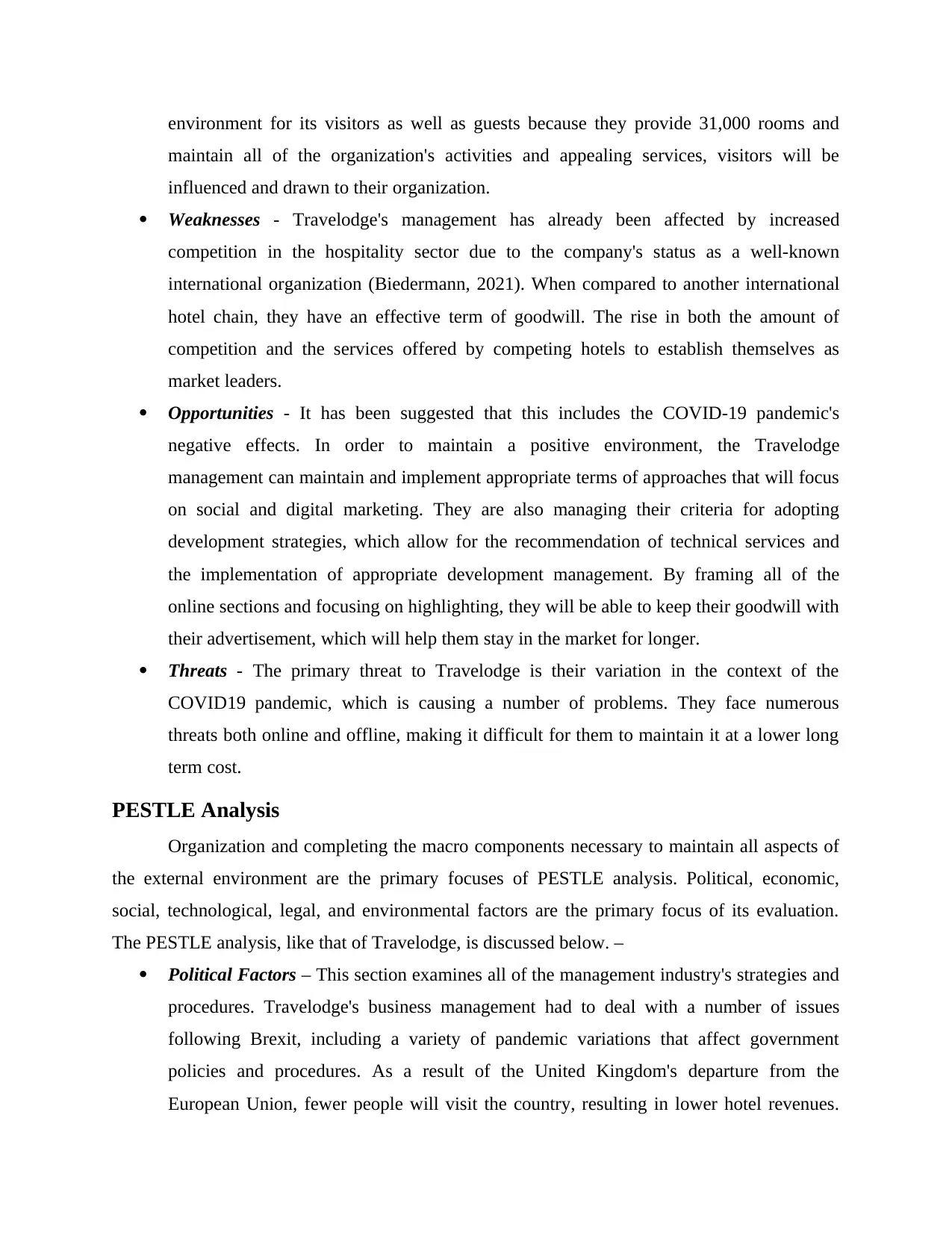
When a company or organization is formed, the management simply decides how the
organization will be run. It can be seen that each management has a unique point of view and
method of working with multiple aspects. Additionally, it includes a number of combined
sections with Travelodge, each of which is organized divisionally. The primary objective of this
structure is to attempt to maintain and separate different terms of the section in which an
organization will attempt to maintain separate terms of the aspect in order to divide the
management's responsibilities. Using appropriate criteria, the cooking, housekeeping, and
finance divisions maintain all of the sections necessary to complete the task. Travelodge follows
to this structure in order to keep the employees employed and provide them with every task in
which they will be proficient and seamless. They obey to and uphold all of the criteria that are
being developed among them. In addition, management is able to carry out the hierarchical
organizational structure, which is typically utilized in this framework in the hospitality sector, in
an efficient and effective manner (Ahmad, and Murray, 2019). It also covers the flow of sources
from top to bottom, with managers and the department head carrying out all decision-making
procedures with good management and overseeing and controlling all tasks assigned.
The organized structure of a business is known as a business organization. It helps the
country maintain and generate revenue, and it also encourages the way of development and
productivity in the future. Offering employment and maintaining the individual's standard of
living are the primary objectives of all management. As in the modern era, it has also been
observed that the hospitality industry is expanding, generating a larger volume of revenue and
turnover for the nation, and maintaining control over the economic conditions. The management
considers in this report is Travelodge (Beynon-Davies, 2021). It refers to several hotel chains
everywhere in the world. The Travelodge organisation was started and united in Southern
California in the year of 1939. The following report covers the discussion about internal and
external sections with all suitable variations that arise with a pandemic situation of COVID – 19.
It also evaluates all macro-environmental factors and their effective aspects.
TASK
Organisational Structure
When a company or organization is formed, the management simply decides how the
organization will be run. It can be seen that each management has a unique point of view and
method of working with multiple aspects. Additionally, it includes a number of combined
sections with Travelodge, each of which is organized divisionally. The primary objective of this
structure is to attempt to maintain and separate different terms of the section in which an
organization will attempt to maintain separate terms of the aspect in order to divide the
management's responsibilities. Using appropriate criteria, the cooking, housekeeping, and
finance divisions maintain all of the sections necessary to complete the task. Travelodge follows
to this structure in order to keep the employees employed and provide them with every task in
which they will be proficient and seamless. They obey to and uphold all of the criteria that are
being developed among them. In addition, management is able to carry out the hierarchical
organizational structure, which is typically utilized in this framework in the hospitality sector, in
an efficient and effective manner (Ahmad, and Murray, 2019). It also covers the flow of sources
from top to bottom, with managers and the department head carrying out all decision-making
procedures with good management and overseeing and controlling all tasks assigned.
⊘ This is a preview!⊘
Do you want full access?
Subscribe today to unlock all pages.

Trusted by 1+ million students worldwide

Illustration 1: Organisational structure for Travelodge, 2022
Business Environment Analysis
It has been determined that, in order to keep the organizational processes going,
management should try to keep and change the right strategies so that the hospitality industry can
keep doing its job in an effective and efficient way. In addition to it SWOT analyses are being
used to evaluate the micro factors. In contrast, PESTLE analysis will be framed in each
microenvironmental section to manage the appropriate task level.
SWOT Analysis
Because it is an essential analysis that lends support to managing all of the internal
criteria by which the foundation of management can determine their opportunities, threats,
strengths, and weaknesses. It manages the responsibility of organizing the company's workings
and criteria, which need to be improved (Ward, and Shortt, 2020). The following is a description
of the various Travelodge management specific SWOT analyses: -
Strength - Travelodge maintains approximately 435 properties with 31,000 rooms around
the world. They also manage and promote their effective time of action, which ensures
that the development and promotion will continue, and they follow their advertising team,
which focuses on providing the effective term of goodwill for the hotel chain in the
market. It has also carried out its responsibilities by creating a welcoming and secure
Business Environment Analysis
It has been determined that, in order to keep the organizational processes going,
management should try to keep and change the right strategies so that the hospitality industry can
keep doing its job in an effective and efficient way. In addition to it SWOT analyses are being
used to evaluate the micro factors. In contrast, PESTLE analysis will be framed in each
microenvironmental section to manage the appropriate task level.
SWOT Analysis
Because it is an essential analysis that lends support to managing all of the internal
criteria by which the foundation of management can determine their opportunities, threats,
strengths, and weaknesses. It manages the responsibility of organizing the company's workings
and criteria, which need to be improved (Ward, and Shortt, 2020). The following is a description
of the various Travelodge management specific SWOT analyses: -
Strength - Travelodge maintains approximately 435 properties with 31,000 rooms around
the world. They also manage and promote their effective time of action, which ensures
that the development and promotion will continue, and they follow their advertising team,
which focuses on providing the effective term of goodwill for the hotel chain in the
market. It has also carried out its responsibilities by creating a welcoming and secure
Paraphrase This Document
Need a fresh take? Get an instant paraphrase of this document with our AI Paraphraser

environment for its visitors as well as guests because they provide 31,000 rooms and
maintain all of the organization's activities and appealing services, visitors will be
influenced and drawn to their organization.
Weaknesses - Travelodge's management has already been affected by increased
competition in the hospitality sector due to the company's status as a well-known
international organization (Biedermann, 2021). When compared to another international
hotel chain, they have an effective term of goodwill. The rise in both the amount of
competition and the services offered by competing hotels to establish themselves as
market leaders.
Opportunities - It has been suggested that this includes the COVID-19 pandemic's
negative effects. In order to maintain a positive environment, the Travelodge
management can maintain and implement appropriate terms of approaches that will focus
on social and digital marketing. They are also managing their criteria for adopting
development strategies, which allow for the recommendation of technical services and
the implementation of appropriate development management. By framing all of the
online sections and focusing on highlighting, they will be able to keep their goodwill with
their advertisement, which will help them stay in the market for longer.
Threats - The primary threat to Travelodge is their variation in the context of the
COVID19 pandemic, which is causing a number of problems. They face numerous
threats both online and offline, making it difficult for them to maintain it at a lower long
term cost.
PESTLE Analysis
Organization and completing the macro components necessary to maintain all aspects of
the external environment are the primary focuses of PESTLE analysis. Political, economic,
social, technological, legal, and environmental factors are the primary focus of its evaluation.
The PESTLE analysis, like that of Travelodge, is discussed below. –
Political Factors – This section examines all of the management industry's strategies and
procedures. Travelodge's business management had to deal with a number of issues
following Brexit, including a variety of pandemic variations that affect government
policies and procedures. As a result of the United Kingdom's departure from the
European Union, fewer people will visit the country, resulting in lower hotel revenues.
maintain all of the organization's activities and appealing services, visitors will be
influenced and drawn to their organization.
Weaknesses - Travelodge's management has already been affected by increased
competition in the hospitality sector due to the company's status as a well-known
international organization (Biedermann, 2021). When compared to another international
hotel chain, they have an effective term of goodwill. The rise in both the amount of
competition and the services offered by competing hotels to establish themselves as
market leaders.
Opportunities - It has been suggested that this includes the COVID-19 pandemic's
negative effects. In order to maintain a positive environment, the Travelodge
management can maintain and implement appropriate terms of approaches that will focus
on social and digital marketing. They are also managing their criteria for adopting
development strategies, which allow for the recommendation of technical services and
the implementation of appropriate development management. By framing all of the
online sections and focusing on highlighting, they will be able to keep their goodwill with
their advertisement, which will help them stay in the market for longer.
Threats - The primary threat to Travelodge is their variation in the context of the
COVID19 pandemic, which is causing a number of problems. They face numerous
threats both online and offline, making it difficult for them to maintain it at a lower long
term cost.
PESTLE Analysis
Organization and completing the macro components necessary to maintain all aspects of
the external environment are the primary focuses of PESTLE analysis. Political, economic,
social, technological, legal, and environmental factors are the primary focus of its evaluation.
The PESTLE analysis, like that of Travelodge, is discussed below. –
Political Factors – This section examines all of the management industry's strategies and
procedures. Travelodge's business management had to deal with a number of issues
following Brexit, including a variety of pandemic variations that affect government
policies and procedures. As a result of the United Kingdom's departure from the
European Union, fewer people will visit the country, resulting in lower hotel revenues.

Additionally, the hostel's operations and profitability will be affected by the ongoing
trade war between various nations. Additionally, the hotel industry is currently in a very
difficult phase as a result of lockdowns imposed by various nations. However, a growing
number of nations are gradually easing their lockdowns, which will support the hotel
industry's expansion and revenue growth.
Economic Factors – The manner in which the business of management maintains interest
rates, inflation, recession, and other capital are included in this category. The Travelodge
management evaluates all of the sections and maintains their funding in an effort to
increase profitability (Kolachina, and Raj, 2022). However, in the event of a pandemic,
their will be affected and will have to deal with a loss in the economy.
Social Factors – The hospitality industry uses a variety of demographic and
organizational factors to influence customer’s observations of its hotel chain and
facilities. Travelodge's management has implemented a number of adaptable strategies
during the COVID-19 pandemic, which has resulted in an increase in tourism because of
the hotel's hygienic and safe environment as well as its luxury services.
Technological Factors – The management oversees all technological matters pertaining
to the organization's development and utilization. It also promoted a number of aspects,
including the digitalization of room facilities, check-in, and check-out processes via
digital means, so that innovation and progress can be easily maintained..
Legal Factors – The rules and regulations that each management follows to ensure the
continued growth of their management business Because Travelodge has multiple
locations around the world, it is essential to draft legal policies in accordance with these
locations. The management team at Travelodge has developed a suitable set of strategies
by which they consider maintaining governmental protocols.
Environmental Factors – It will focus on ensuring environmental safety and adaptability
to changing global conditions (Katagiri, 2020). The respective management of
Travelodge is also maintaining all of their energy saving programs, thereby maintaining
their business's reduction in waste and incineration.
trade war between various nations. Additionally, the hotel industry is currently in a very
difficult phase as a result of lockdowns imposed by various nations. However, a growing
number of nations are gradually easing their lockdowns, which will support the hotel
industry's expansion and revenue growth.
Economic Factors – The manner in which the business of management maintains interest
rates, inflation, recession, and other capital are included in this category. The Travelodge
management evaluates all of the sections and maintains their funding in an effort to
increase profitability (Kolachina, and Raj, 2022). However, in the event of a pandemic,
their will be affected and will have to deal with a loss in the economy.
Social Factors – The hospitality industry uses a variety of demographic and
organizational factors to influence customer’s observations of its hotel chain and
facilities. Travelodge's management has implemented a number of adaptable strategies
during the COVID-19 pandemic, which has resulted in an increase in tourism because of
the hotel's hygienic and safe environment as well as its luxury services.
Technological Factors – The management oversees all technological matters pertaining
to the organization's development and utilization. It also promoted a number of aspects,
including the digitalization of room facilities, check-in, and check-out processes via
digital means, so that innovation and progress can be easily maintained..
Legal Factors – The rules and regulations that each management follows to ensure the
continued growth of their management business Because Travelodge has multiple
locations around the world, it is essential to draft legal policies in accordance with these
locations. The management team at Travelodge has developed a suitable set of strategies
by which they consider maintaining governmental protocols.
Environmental Factors – It will focus on ensuring environmental safety and adaptability
to changing global conditions (Katagiri, 2020). The respective management of
Travelodge is also maintaining all of their energy saving programs, thereby maintaining
their business's reduction in waste and incineration.
⊘ This is a preview!⊘
Do you want full access?
Subscribe today to unlock all pages.

Trusted by 1+ million students worldwide

CONCLUSION
From the above-mentioned report, it has been concluded that Business management is an
important part of keeping the country's growth and turnover going. In addition, it provides a
method for market profitability by preserving and adapting various terminology strategies. The
overview of management's methods of operation and the framework for the strategies are
provided by the organizational structure. The method for dividing multiple terms of management
sections is provided by divisional organization structure. In contrast, it includes an internal
factor, the SWOT analysis, and it upholds and promotes all effective terms of standards that must
be upheld for the business and its fields. On the other hand, it came to the conclusion that the
PESTLE analysis is also referred to as a macro-environmental factor because it maintains or
deals with the organization or allows management to modify working criteria based on it. Last
but not least, it includes the digitalization and innovation that the company needs to keep up with
if it wants to stay in the market for a long time.
From the above-mentioned report, it has been concluded that Business management is an
important part of keeping the country's growth and turnover going. In addition, it provides a
method for market profitability by preserving and adapting various terminology strategies. The
overview of management's methods of operation and the framework for the strategies are
provided by the organizational structure. The method for dividing multiple terms of management
sections is provided by divisional organization structure. In contrast, it includes an internal
factor, the SWOT analysis, and it upholds and promotes all effective terms of standards that must
be upheld for the business and its fields. On the other hand, it came to the conclusion that the
PESTLE analysis is also referred to as a macro-environmental factor because it maintains or
deals with the organization or allows management to modify working criteria based on it. Last
but not least, it includes the digitalization and innovation that the company needs to keep up with
if it wants to stay in the market for a long time.
Paraphrase This Document
Need a fresh take? Get an instant paraphrase of this document with our AI Paraphraser

REFERENCES
Books and Journals
Beynon-Davies, P., 2021. Business analysis and design: understanding innovation in
organisation. Springer Nature.
Ahmad, M.U. and Murray, J., 2019. Understanding the connect between digitalisation,
sustainability and performance of an organisation. International Journal of Business
Excellence, 17(1), pp.83-96.
Ward, J. and Shortt, H. eds., 2020. Using arts-based research methods: Creative approaches for
researching business, organisation and humanities. Springer Nature.
Biedermann, M., 2021. The application of high reliability organisation theory in relation to high
reliable organisational practice: An air traffic case (Doctoral dissertation, University of
Gloucestershire).
Kolachina, S. and Raj, K.B., 2022. A theoretical study on managing the intangible component of
the knowledge base of an organisation. International Journal of Intelligent
Enterprise, 9(3), pp.344-356.
Katagiri, H., 2020. Conceptual organisation of customer engagement: Understanding the concept
of engagement and considering the structure of customer engagement factors. The
Marketing Review, 20(1-2), pp.109-142.
Books and Journals
Beynon-Davies, P., 2021. Business analysis and design: understanding innovation in
organisation. Springer Nature.
Ahmad, M.U. and Murray, J., 2019. Understanding the connect between digitalisation,
sustainability and performance of an organisation. International Journal of Business
Excellence, 17(1), pp.83-96.
Ward, J. and Shortt, H. eds., 2020. Using arts-based research methods: Creative approaches for
researching business, organisation and humanities. Springer Nature.
Biedermann, M., 2021. The application of high reliability organisation theory in relation to high
reliable organisational practice: An air traffic case (Doctoral dissertation, University of
Gloucestershire).
Kolachina, S. and Raj, K.B., 2022. A theoretical study on managing the intangible component of
the knowledge base of an organisation. International Journal of Intelligent
Enterprise, 9(3), pp.344-356.
Katagiri, H., 2020. Conceptual organisation of customer engagement: Understanding the concept
of engagement and considering the structure of customer engagement factors. The
Marketing Review, 20(1-2), pp.109-142.
1 out of 8
Related Documents
Your All-in-One AI-Powered Toolkit for Academic Success.
+13062052269
info@desklib.com
Available 24*7 on WhatsApp / Email
Unlock your academic potential
Copyright © 2020–2025 A2Z Services. All Rights Reserved. Developed and managed by ZUCOL.