Treatment Plan for a Patient with Obesity and Diabetes
VerifiedAdded on 2020/06/05
|6
|2156
|104
Essay
AI Summary
This essay presents a treatment strategy for a 43-year-old woman named Julie Green, who is dealing with obesity, type 2 diabetes, joint pain, and depression. The essay explores the application of psychological theories like the Schachter-Singer theory and drive reduction theory to understand Julie's emotional and behavioral responses. It analyzes the physiological and psychological factors contributing to her conditions, including the impact of obesity on diabetes and joint pain, as well as the role of motivation and emotional well-being in weight management. The treatment plan focuses on two main goals: increasing motivation, self-determination, and encouraging long-term weight control strategies through motivational interviewing and behavioral techniques; and setting emotional well-being goals to address depression and improve lifestyle changes. The essay emphasizes the importance of addressing emotional distress to facilitate weight loss and improve overall health, supported by relevant research and references.
Treatment
strategy
strategy
Paraphrase This Document
Need a fresh take? Get an instant paraphrase of this document with our AI Paraphraser

The particular essay is in reference to 43 year old women named Julie Green. She is a
married women and having three children's of age 10, 7 and 4 years. Julie is presently looking
after the family and is not involved in any employment outside the house. But before starting the
family she used to work in a company as an administrative assistant. It is also known that Julie is
170 cm tall and her weight is 120 kg. On the basis of BMI calculation it is found that Julie is
dealing with obesity. She mentioned that her husband is highly cooperative and supportive and
also described that her two eldest children's are also overweight. Julie has also recently
developed the diabetes type 2 and is walking in home with the help of cane as she is also having
joint pain. It was also found that Julie had tried many dirts pattern but none of them helped her in
loosing weight.
On the basis of recent interview with Julie it was found that she is suffering from the
feeling of depression due to her extreme weight gain and is not able to do any task. According to
the Schachter-Singer Theory of emotion, an event that happens tends to produce the
physiological arousal first, then the person identify the reason for this arousal and then only that
particular person is able experience the emotions (Psychology 101 – Motivation and Emotion,
2017). In the case of the Julie her weight keep on increasing, at initials she was not concerned as
when she goes through many complications such as obesity and diabetes then she became aware
regarding the problems and then dealing with feeling of depression.
It was also found that Julie also had the feeling of anger because her elder son is teased
by people for being overweight. Similarly, this pattern of arousal is also associated with the
theory of Schachter-Singer in which, first event occurs then person is able to experience the
emotional change. As per the views of Izard (2013), drive reduction theory states that all humans
have some biological internal needs that forces them to perform things in a certain way.
According to hull these internal needs are need to be reduced and control in order to maintain
internal calmness. For example, internal feelings of thirst and hunger that leads and motivate the
person to consume more amount of food that lead to condition of overweight. Similarly, in case
of Julie she needs to control these feeling in order to reduce the impact of obesity.
The weight of Julie was already 120 kg before she had any other complications. By the
calculation of BMI it was found that she is highly obsessed and need the immediate control on
her lifestyle. As per the views of Arnold (2013), motivation and support highly influence the
feeling of ones and promote them to perform the activities at higher level. From this it can be
married women and having three children's of age 10, 7 and 4 years. Julie is presently looking
after the family and is not involved in any employment outside the house. But before starting the
family she used to work in a company as an administrative assistant. It is also known that Julie is
170 cm tall and her weight is 120 kg. On the basis of BMI calculation it is found that Julie is
dealing with obesity. She mentioned that her husband is highly cooperative and supportive and
also described that her two eldest children's are also overweight. Julie has also recently
developed the diabetes type 2 and is walking in home with the help of cane as she is also having
joint pain. It was also found that Julie had tried many dirts pattern but none of them helped her in
loosing weight.
On the basis of recent interview with Julie it was found that she is suffering from the
feeling of depression due to her extreme weight gain and is not able to do any task. According to
the Schachter-Singer Theory of emotion, an event that happens tends to produce the
physiological arousal first, then the person identify the reason for this arousal and then only that
particular person is able experience the emotions (Psychology 101 – Motivation and Emotion,
2017). In the case of the Julie her weight keep on increasing, at initials she was not concerned as
when she goes through many complications such as obesity and diabetes then she became aware
regarding the problems and then dealing with feeling of depression.
It was also found that Julie also had the feeling of anger because her elder son is teased
by people for being overweight. Similarly, this pattern of arousal is also associated with the
theory of Schachter-Singer in which, first event occurs then person is able to experience the
emotional change. As per the views of Izard (2013), drive reduction theory states that all humans
have some biological internal needs that forces them to perform things in a certain way.
According to hull these internal needs are need to be reduced and control in order to maintain
internal calmness. For example, internal feelings of thirst and hunger that leads and motivate the
person to consume more amount of food that lead to condition of overweight. Similarly, in case
of Julie she needs to control these feeling in order to reduce the impact of obesity.
The weight of Julie was already 120 kg before she had any other complications. By the
calculation of BMI it was found that she is highly obsessed and need the immediate control on
her lifestyle. As per the views of Arnold (2013), motivation and support highly influence the
feeling of ones and promote them to perform the activities at higher level. From this it can be

inferred that Julie was always supported and motivated by her husband which in turn leads her to
continue her diet and lifestyle that further complicated her life. The main cause of diabetes type 2
in Julie is obesity as having (Body Mass Index) BMI higher than 30 leads to indicates the
presence of diabetes because of being obese. It is known that obesity lead to changes in the
process of body metabolism. Thus, these changes forces the adipose tissues also known as fat
tissues to release the molecules of fat in blood that causes the decrease in the insulin sensitivity
due to adverse effect on the insulin responsive cells. As per the views of Brown and Capozza
(2016), abdominal fats forces the fats cells to release pro-inflammatory chemicals known as
cytokines. This continuous release of cytokines disrupt the functioning of insulin responsive cells
thus decreasing the ability to response to insulin.
Thus, this condition of resistance impairs the proper functioning of the insulin to reduce
the out of glucose from liver. This is the reason that lead Julie to duffer from the type 2 diabetes.
Along with this obesity not only contributed in formation of type 2 diabetes but also resulted in
the increased joint pain in her. Due to heavy upper body weight, extreme pressure felt by knee
and hip joint. This increase in weight can put excessive stress on the joint and causes damage to
cartilages that leads to extreme joint pain. It is necessary for Julie to have control on weight as it
can lead to tear and wear in joint and can create the condition in which it becomes necessary to
replace the knees. According to Moors, Ellsworth, Scherer & Frijda (2013), in many instances
failure in any approach can demotivate the person and this can have bad impact of the
physiological functioning of the body. Similarly, in case of Julie, she tried many diets but none
of them work, this failure further pose negative impact on her physiological conditions as she
admits that she is dealing with depression. However, as per the views of Przybylski, Murayama,
DeHaan & Gladwell (2013), in obese people there is a mood disorder that leads to depression. In
many person obesity leads to poor self esteem and isolation from the social life that act as the
main contributors of depression. According to Elwyn, Dehlendorf, Epstein, Marrin, White &
Frosch (2014), on the basis of Maslows need hierarchy first need of humans is physiological
needs. This includes needs related to food, water and other vital components of the life. And in
the case of Julie she is not bale to live life happily as her needs of getting healthy is not fulfilled,
thus this hinders her to live a normal life.
There is an immediate need of a treatment plan in order to improve the normal emotional
functioning and increase the motivation in order to encourage her to lose her weight.
continue her diet and lifestyle that further complicated her life. The main cause of diabetes type 2
in Julie is obesity as having (Body Mass Index) BMI higher than 30 leads to indicates the
presence of diabetes because of being obese. It is known that obesity lead to changes in the
process of body metabolism. Thus, these changes forces the adipose tissues also known as fat
tissues to release the molecules of fat in blood that causes the decrease in the insulin sensitivity
due to adverse effect on the insulin responsive cells. As per the views of Brown and Capozza
(2016), abdominal fats forces the fats cells to release pro-inflammatory chemicals known as
cytokines. This continuous release of cytokines disrupt the functioning of insulin responsive cells
thus decreasing the ability to response to insulin.
Thus, this condition of resistance impairs the proper functioning of the insulin to reduce
the out of glucose from liver. This is the reason that lead Julie to duffer from the type 2 diabetes.
Along with this obesity not only contributed in formation of type 2 diabetes but also resulted in
the increased joint pain in her. Due to heavy upper body weight, extreme pressure felt by knee
and hip joint. This increase in weight can put excessive stress on the joint and causes damage to
cartilages that leads to extreme joint pain. It is necessary for Julie to have control on weight as it
can lead to tear and wear in joint and can create the condition in which it becomes necessary to
replace the knees. According to Moors, Ellsworth, Scherer & Frijda (2013), in many instances
failure in any approach can demotivate the person and this can have bad impact of the
physiological functioning of the body. Similarly, in case of Julie, she tried many diets but none
of them work, this failure further pose negative impact on her physiological conditions as she
admits that she is dealing with depression. However, as per the views of Przybylski, Murayama,
DeHaan & Gladwell (2013), in obese people there is a mood disorder that leads to depression. In
many person obesity leads to poor self esteem and isolation from the social life that act as the
main contributors of depression. According to Elwyn, Dehlendorf, Epstein, Marrin, White &
Frosch (2014), on the basis of Maslows need hierarchy first need of humans is physiological
needs. This includes needs related to food, water and other vital components of the life. And in
the case of Julie she is not bale to live life happily as her needs of getting healthy is not fulfilled,
thus this hinders her to live a normal life.
There is an immediate need of a treatment plan in order to improve the normal emotional
functioning and increase the motivation in order to encourage her to lose her weight.
⊘ This is a preview!⊘
Do you want full access?
Subscribe today to unlock all pages.

Trusted by 1+ million students worldwide

Goal 1: To increase the motivation, self determination and encouraging the long term weight
control strategies.
Objective: The main objective of this goal is to encourage Julie regarding the long term weight
control strategies by motivational sessions and interviews.
Reduction in motivation is an important factor that limits the weight loss interventions.
This lack of motivations can be compensated by effective motivational interviews (Helping
Patients Set Fitness Goals, 2017). In case of Julie number of behavioural techniques can be used
to achieve the goal of reducing weight which includes: self monitoring, environmental
restructuring and support through groups and individuals. Through an effective session Julie can
be motivated to increase the self monitoring techniques in order to keep a regular check on health
to reduce the impacts of obesity. According to Jiang, King & Prinyawiwatkul (2014), there is
need to set an intrinsic goal, in order to improve the personal health by reducing the weight and
to improve the appearance by gaining the fitness. Through the help of self determination theory
Julie can be encouraged to set goals regarding the weight loss.
Through the effective sessions and interviews Julie can be acknowledge regarding the
long term weight control that includes involvement of the physical activates for a fix time in a
day and regulating the diet by consulting the dieticians regarding the appropriate diet plan in
order to maintain the appropriate weight and consists of the meals that are low in sugar and fats.
Thus, diet having fewer carbohydrates and fat can help Julie in regulating the weight of herself.
In this way she can regulate her weight in order to reduce the effect of obesity effectively.
Goal 2: Setting emotional well-being goals.
Objective: The main objective this goal is to make change in the lifestyle of Julie in order to
reduce the weight.
Efforts made to increase the level of physical activities and improvement on diet plans in
some cases lead to resistance and made people frustrated if they are not able to meet the goal.
Similarly, in case of Julie there is need to set emotional well being prior to other diet related and
physical activities goals. Because by getting success in over all emotional well being Julies can
be boosted with confidence to achieve the goals related to diet and fitness.
According to Saffari, Pakpour, Mohammadi-Zeidi, Samadi & Chen (2014), there need of
permanent change in lifestyle in order to achieve the permanent weight loss. There is need for
the patients who are suffering from various emotional issues such as depression, anger, anxiety
control strategies.
Objective: The main objective of this goal is to encourage Julie regarding the long term weight
control strategies by motivational sessions and interviews.
Reduction in motivation is an important factor that limits the weight loss interventions.
This lack of motivations can be compensated by effective motivational interviews (Helping
Patients Set Fitness Goals, 2017). In case of Julie number of behavioural techniques can be used
to achieve the goal of reducing weight which includes: self monitoring, environmental
restructuring and support through groups and individuals. Through an effective session Julie can
be motivated to increase the self monitoring techniques in order to keep a regular check on health
to reduce the impacts of obesity. According to Jiang, King & Prinyawiwatkul (2014), there is
need to set an intrinsic goal, in order to improve the personal health by reducing the weight and
to improve the appearance by gaining the fitness. Through the help of self determination theory
Julie can be encouraged to set goals regarding the weight loss.
Through the effective sessions and interviews Julie can be acknowledge regarding the
long term weight control that includes involvement of the physical activates for a fix time in a
day and regulating the diet by consulting the dieticians regarding the appropriate diet plan in
order to maintain the appropriate weight and consists of the meals that are low in sugar and fats.
Thus, diet having fewer carbohydrates and fat can help Julie in regulating the weight of herself.
In this way she can regulate her weight in order to reduce the effect of obesity effectively.
Goal 2: Setting emotional well-being goals.
Objective: The main objective this goal is to make change in the lifestyle of Julie in order to
reduce the weight.
Efforts made to increase the level of physical activities and improvement on diet plans in
some cases lead to resistance and made people frustrated if they are not able to meet the goal.
Similarly, in case of Julie there is need to set emotional well being prior to other diet related and
physical activities goals. Because by getting success in over all emotional well being Julies can
be boosted with confidence to achieve the goals related to diet and fitness.
According to Saffari, Pakpour, Mohammadi-Zeidi, Samadi & Chen (2014), there need of
permanent change in lifestyle in order to achieve the permanent weight loss. There is need for
the patients who are suffering from various emotional issues such as depression, anger, anxiety
Paraphrase This Document
Need a fresh take? Get an instant paraphrase of this document with our AI Paraphraser

and stress to cop up with these problems first in order to lose weight (Motivation, self-
determination, and long-term weight control, 2012). As per the views of Izard (2013), patients
who are able to achieve victory over their emotional distress are motivated enough to come up
with problems related to over weight. Similarly, in case of Julie there is need to maker her come
up from the feeling of depression and anger first in order to make herself that much motivated
and to generate the level of confidence that will help her to achieve the goals of proper physical
exercises and appropriate diet. This change in lifestyle can help her a lot in improving her
emotional functioning and motivation to achieve the optimum weight loss.
From the above essay it can be concluded that emotional well being is an important
aspect that play major role in building confidence and motivation among persons. And it can also
be inferred appropriate motivation regarding the personal well being can effectively help in
reducing the body weight.
determination, and long-term weight control, 2012). As per the views of Izard (2013), patients
who are able to achieve victory over their emotional distress are motivated enough to come up
with problems related to over weight. Similarly, in case of Julie there is need to maker her come
up from the feeling of depression and anger first in order to make herself that much motivated
and to generate the level of confidence that will help her to achieve the goals of proper physical
exercises and appropriate diet. This change in lifestyle can help her a lot in improving her
emotional functioning and motivation to achieve the optimum weight loss.
From the above essay it can be concluded that emotional well being is an important
aspect that play major role in building confidence and motivation among persons. And it can also
be inferred appropriate motivation regarding the personal well being can effectively help in
reducing the body weight.

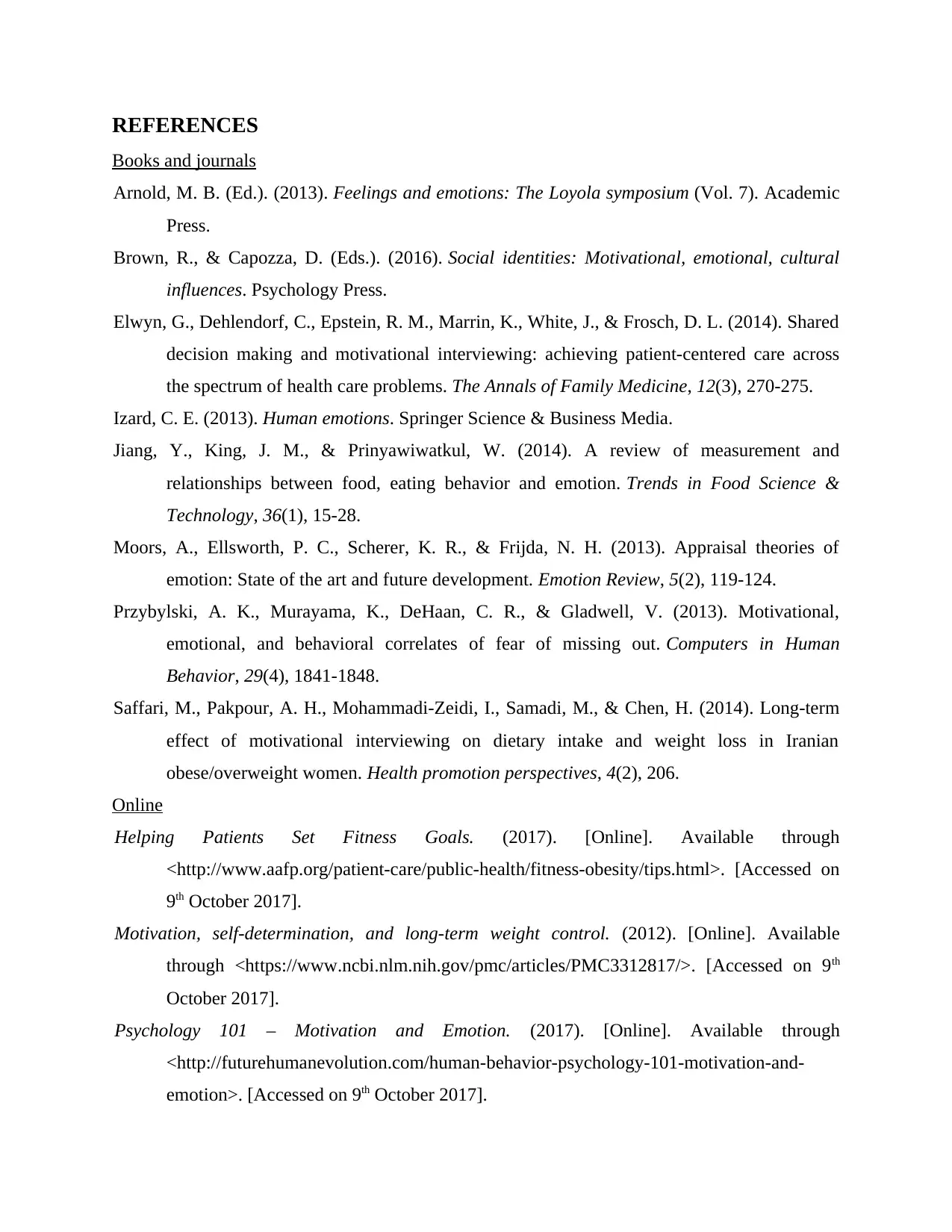
REFERENCES
Books and journals
Arnold, M. B. (Ed.). (2013). Feelings and emotions: The Loyola symposium (Vol. 7). Academic
Press.
Brown, R., & Capozza, D. (Eds.). (2016). Social identities: Motivational, emotional, cultural
influences. Psychology Press.
Elwyn, G., Dehlendorf, C., Epstein, R. M., Marrin, K., White, J., & Frosch, D. L. (2014). Shared
decision making and motivational interviewing: achieving patient-centered care across
the spectrum of health care problems. The Annals of Family Medicine, 12(3), 270-275.
Izard, C. E. (2013). Human emotions. Springer Science & Business Media.
Jiang, Y., King, J. M., & Prinyawiwatkul, W. (2014). A review of measurement and
relationships between food, eating behavior and emotion. Trends in Food Science &
Technology, 36(1), 15-28.
Moors, A., Ellsworth, P. C., Scherer, K. R., & Frijda, N. H. (2013). Appraisal theories of
emotion: State of the art and future development. Emotion Review, 5(2), 119-124.
Przybylski, A. K., Murayama, K., DeHaan, C. R., & Gladwell, V. (2013). Motivational,
emotional, and behavioral correlates of fear of missing out. Computers in Human
Behavior, 29(4), 1841-1848.
Saffari, M., Pakpour, A. H., Mohammadi-Zeidi, I., Samadi, M., & Chen, H. (2014). Long-term
effect of motivational interviewing on dietary intake and weight loss in Iranian
obese/overweight women. Health promotion perspectives, 4(2), 206.
Online
Helping Patients Set Fitness Goals. (2017). [Online]. Available through
<http://www.aafp.org/patient-care/public-health/fitness-obesity/tips.html>. [Accessed on
9th October 2017].
Motivation, self-determination, and long-term weight control. (2012). [Online]. Available
through <https://www.ncbi.nlm.nih.gov/pmc/articles/PMC3312817/>. [Accessed on 9th
October 2017].
Psychology 101 – Motivation and Emotion. (2017). [Online]. Available through
<http://futurehumanevolution.com/human-behavior-psychology-101-motivation-and-
emotion>. [Accessed on 9th October 2017].
Books and journals
Arnold, M. B. (Ed.). (2013). Feelings and emotions: The Loyola symposium (Vol. 7). Academic
Press.
Brown, R., & Capozza, D. (Eds.). (2016). Social identities: Motivational, emotional, cultural
influences. Psychology Press.
Elwyn, G., Dehlendorf, C., Epstein, R. M., Marrin, K., White, J., & Frosch, D. L. (2014). Shared
decision making and motivational interviewing: achieving patient-centered care across
the spectrum of health care problems. The Annals of Family Medicine, 12(3), 270-275.
Izard, C. E. (2013). Human emotions. Springer Science & Business Media.
Jiang, Y., King, J. M., & Prinyawiwatkul, W. (2014). A review of measurement and
relationships between food, eating behavior and emotion. Trends in Food Science &
Technology, 36(1), 15-28.
Moors, A., Ellsworth, P. C., Scherer, K. R., & Frijda, N. H. (2013). Appraisal theories of
emotion: State of the art and future development. Emotion Review, 5(2), 119-124.
Przybylski, A. K., Murayama, K., DeHaan, C. R., & Gladwell, V. (2013). Motivational,
emotional, and behavioral correlates of fear of missing out. Computers in Human
Behavior, 29(4), 1841-1848.
Saffari, M., Pakpour, A. H., Mohammadi-Zeidi, I., Samadi, M., & Chen, H. (2014). Long-term
effect of motivational interviewing on dietary intake and weight loss in Iranian
obese/overweight women. Health promotion perspectives, 4(2), 206.
Online
Helping Patients Set Fitness Goals. (2017). [Online]. Available through
<http://www.aafp.org/patient-care/public-health/fitness-obesity/tips.html>. [Accessed on
9th October 2017].
Motivation, self-determination, and long-term weight control. (2012). [Online]. Available
through <https://www.ncbi.nlm.nih.gov/pmc/articles/PMC3312817/>. [Accessed on 9th
October 2017].
Psychology 101 – Motivation and Emotion. (2017). [Online]. Available through
<http://futurehumanevolution.com/human-behavior-psychology-101-motivation-and-
emotion>. [Accessed on 9th October 2017].
⊘ This is a preview!⊘
Do you want full access?
Subscribe today to unlock all pages.

Trusted by 1+ million students worldwide
1 out of 6
Related Documents
Your All-in-One AI-Powered Toolkit for Academic Success.
+13062052269
info@desklib.com
Available 24*7 on WhatsApp / Email
Unlock your academic potential
Copyright © 2020–2025 A2Z Services. All Rights Reserved. Developed and managed by ZUCOL.