True Buch Case Study: Entrepreneurial Challenges and Growth
VerifiedAdded on 2021/05/25
|15
|3684
|222
Case Study
AI Summary
This case study examines the entrepreneurial journey of True Buch, a kombucha company, from its inception to its current market position. The analysis begins with an executive summary highlighting the company's success factors, primarily its commitment to a sustainable business model and strategic retailer selection. The report then delves into True Buch's primary success elements, including its focus on local sourcing and its ability to maintain a competitive edge in the kombucha market. It also addresses the challenges the company faces in expanding its market and client base, such as intense competition and resource limitations. Furthermore, the case study explores potential international markets for True Buch, using a pyramid principle approach to identify opportunities in North America and Asia-Pacific. The report emphasizes marketing and distribution strategies, particularly leveraging supermarkets and online platforms. The case study concludes by summarizing True Buch's strategic approach to growth, focusing on its sustainable practices and its ability to adapt to a competitive market.
True Buch Case Study 1
TRUE BUCH CASE STUDY
By (name)
Student’s Name
Professor’s Name
Course
Date
TRUE BUCH CASE STUDY
By (name)
Student’s Name
Professor’s Name
Course
Date

Paraphrase This Document
Need a fresh take? Get an instant paraphrase of this document with our AI Paraphraser
True Buch Case Study 2
Executive Summary
Generally, True Buch’s main success factor was their commitment to slow, but a purposeful
selection of retailers whose values aligned with theirs. This success element was further
influenced by the company’s awareness of its ability constraints in their local market. Despite the
stiff competition in the kombucha market, True Buch has managed to maintain a competitive
edge through its sustainable enterprise model. This model has been applied in every decision-
making level of the firm, as every marketing item must have various uses. Consequently, the
latter uses theoretical concepts of strategic control to maintain its success factor. For instance,
True Buch utilized this approach when they prioritized on producing a “handcraft made
kombucha” drink using organic ingredients that could be sourced locally. As a result, they were
able to attract and retain the local market through its locally made kombucha.
Executive Summary
Generally, True Buch’s main success factor was their commitment to slow, but a purposeful
selection of retailers whose values aligned with theirs. This success element was further
influenced by the company’s awareness of its ability constraints in their local market. Despite the
stiff competition in the kombucha market, True Buch has managed to maintain a competitive
edge through its sustainable enterprise model. This model has been applied in every decision-
making level of the firm, as every marketing item must have various uses. Consequently, the
latter uses theoretical concepts of strategic control to maintain its success factor. For instance,
True Buch utilized this approach when they prioritized on producing a “handcraft made
kombucha” drink using organic ingredients that could be sourced locally. As a result, they were
able to attract and retain the local market through its locally made kombucha.
True Buch Case Study 3
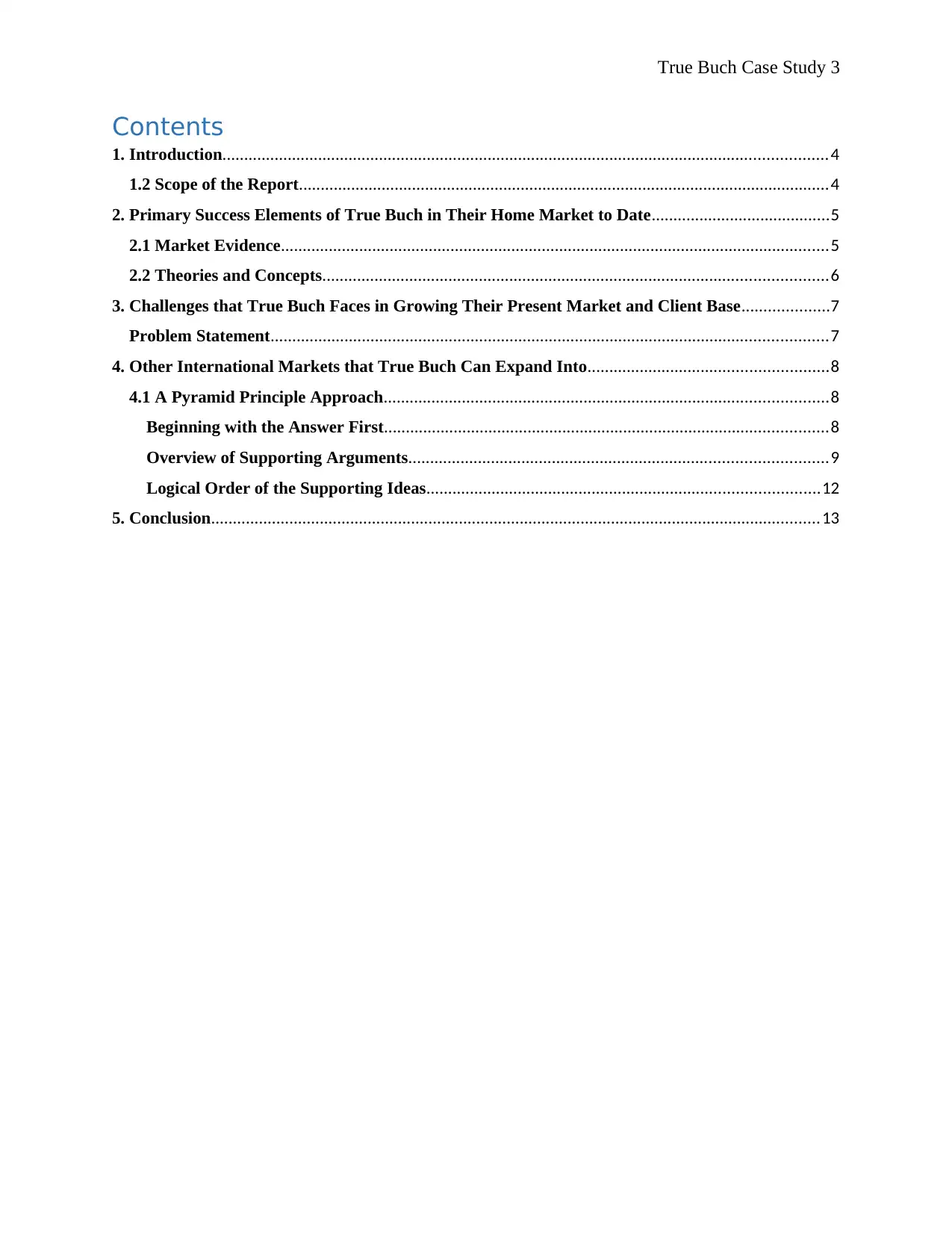
Contents
1. Introduction...........................................................................................................................................4
1.2 Scope of the Report..........................................................................................................................4
2. Primary Success Elements of True Buch in Their Home Market to Date.........................................5
2.1 Market Evidence..............................................................................................................................5
2.2 Theories and Concepts....................................................................................................................6
3. Challenges that True Buch Faces in Growing Their Present Market and Client Base....................7
Problem Statement................................................................................................................................7
4. Other International Markets that True Buch Can Expand Into.......................................................8
4.1 A Pyramid Principle Approach......................................................................................................8
Beginning with the Answer First......................................................................................................8
Overview of Supporting Arguments................................................................................................9
Logical Order of the Supporting Ideas..........................................................................................12
5. Conclusion............................................................................................................................................13
Contents
1. Introduction...........................................................................................................................................4
1.2 Scope of the Report..........................................................................................................................4
2. Primary Success Elements of True Buch in Their Home Market to Date.........................................5
2.1 Market Evidence..............................................................................................................................5
2.2 Theories and Concepts....................................................................................................................6
3. Challenges that True Buch Faces in Growing Their Present Market and Client Base....................7
Problem Statement................................................................................................................................7
4. Other International Markets that True Buch Can Expand Into.......................................................8
4.1 A Pyramid Principle Approach......................................................................................................8
Beginning with the Answer First......................................................................................................8
Overview of Supporting Arguments................................................................................................9
Logical Order of the Supporting Ideas..........................................................................................12
5. Conclusion............................................................................................................................................13
⊘ This is a preview!⊘
Do you want full access?
Subscribe today to unlock all pages.

Trusted by 1+ million students worldwide
True Buch Case Study 4
1. Introduction
Conrad and Louisa Ferrel uncovered kombucha while touring the Asian continent.
Conrad, a celiac victim, created a taste for this enflamed tea as a substitute to beer, and began
brewing it at home. According to Louisa, she developed a taste interest for kombucha due to its
enzymatic properties after she was diagnosed with an auto-immune infection. After five years,
the couple quit their jobs as chartered accountants, and began True Buch. Presently, the company
is a commercial draught kombucha firm, which brews Cochrane utilizing local suppliers and
produce like tea from “The Naked Leaf” in Kensington, where the couples reside. Shortly after
entry in the kombucha marketplace in Calgary, Alberta, the firm experienced massive growth.
This is because the company sold its beer from reusable kegs, and in single-serving bottles at
local retailers and markets. Unfortunately, with such high demand for its items, the company
struggled to keep up with the high demand. This is because the reusable kegs that were on
various sites at retailers needed maintenance and replenishing, and the all-out outcome of the
home-made bottling line was 1,000 single-serving bottles daily. Additionally, the firm’s
production space was at its maximum capacity, and the proprietors had no more left to invest.
Fortunately, when True Buch was established, the couple had a vivid vision of how they would
grow their business, and their goal was to attain one million dollars in revenue by 2020. Due to
this fact, they were ready to devote their time and effort required to get there.
1.2 Scope of the Report
The report focuses on establishing the primary success elements of True Buch in their home
market to date. Also, it focuses on the fundamental challenges facing the latter in growing their
existing client base and market. Besides, the report assesses other international markets that True
Buch can expand into.
1. Introduction
Conrad and Louisa Ferrel uncovered kombucha while touring the Asian continent.
Conrad, a celiac victim, created a taste for this enflamed tea as a substitute to beer, and began
brewing it at home. According to Louisa, she developed a taste interest for kombucha due to its
enzymatic properties after she was diagnosed with an auto-immune infection. After five years,
the couple quit their jobs as chartered accountants, and began True Buch. Presently, the company
is a commercial draught kombucha firm, which brews Cochrane utilizing local suppliers and
produce like tea from “The Naked Leaf” in Kensington, where the couples reside. Shortly after
entry in the kombucha marketplace in Calgary, Alberta, the firm experienced massive growth.
This is because the company sold its beer from reusable kegs, and in single-serving bottles at
local retailers and markets. Unfortunately, with such high demand for its items, the company
struggled to keep up with the high demand. This is because the reusable kegs that were on
various sites at retailers needed maintenance and replenishing, and the all-out outcome of the
home-made bottling line was 1,000 single-serving bottles daily. Additionally, the firm’s
production space was at its maximum capacity, and the proprietors had no more left to invest.
Fortunately, when True Buch was established, the couple had a vivid vision of how they would
grow their business, and their goal was to attain one million dollars in revenue by 2020. Due to
this fact, they were ready to devote their time and effort required to get there.
1.2 Scope of the Report
The report focuses on establishing the primary success elements of True Buch in their home
market to date. Also, it focuses on the fundamental challenges facing the latter in growing their
existing client base and market. Besides, the report assesses other international markets that True
Buch can expand into.
Paraphrase This Document
Need a fresh take? Get an instant paraphrase of this document with our AI Paraphraser
True Buch Case Study 5
2. Primary Success Elements of True Buch in Their Home Market to Date
2.1 Market Evidence
One of the significant success components of True Buch is their commitment to slowly,
but purposefully select retailers whose values align with theirs. Through this approach, the
Ferrels created partnerships with like-minded local enterprises (Ivey Business School
Foundation, 2018, p.3). In addition, they were aware of their ability constraints in their local
market, and are always focused on meeting the demands of present clients before attending to
new ones. Due to this fact, they knew that they could accelerate the growth of the firm by raising
capital through equity or debt, although the Ferrels always avoided taking debts.
Another success factor is that True Buch was formed as a force for good, which has
enabled it to operate smoothly to date. According to the company, giving back to society, and
reinvesting in initiatives were crucial in maintaining their relationship with the local community,
as they were their primary market. Contrary, the aggressive landscape for kombucha in Calgary
has grown extensively, as local rivals have put pressure on True Buch production capacity
(Hyatt, 2017). For instance, the “Wild Tea Kombucha Calgary,” “Effervescent Tea Co.
Beaverlodge,” and “Wild Child Brew Red Deer.” Notably, these competitors within the local
market that True Buch operates introduced new flavors that attracted some of the clients.
Despite the intense competition in the local Calgary market, True Buch has managed to
be successful to date through its sustainable corporate model. This approach has been
implemented in every decision-making level of the company. For instance, all the firm’s sample
cups are recyclable, they do not give out paper handouts at shows, and every marketing product
must have several uses (Bullfrog power, 2019). Thus, the company signage is not showing
specific, which enables them to utilize it for various events (Cousin, 2019). Also, the sourcing of
2. Primary Success Elements of True Buch in Their Home Market to Date
2.1 Market Evidence
One of the significant success components of True Buch is their commitment to slowly,
but purposefully select retailers whose values align with theirs. Through this approach, the
Ferrels created partnerships with like-minded local enterprises (Ivey Business School
Foundation, 2018, p.3). In addition, they were aware of their ability constraints in their local
market, and are always focused on meeting the demands of present clients before attending to
new ones. Due to this fact, they knew that they could accelerate the growth of the firm by raising
capital through equity or debt, although the Ferrels always avoided taking debts.
Another success factor is that True Buch was formed as a force for good, which has
enabled it to operate smoothly to date. According to the company, giving back to society, and
reinvesting in initiatives were crucial in maintaining their relationship with the local community,
as they were their primary market. Contrary, the aggressive landscape for kombucha in Calgary
has grown extensively, as local rivals have put pressure on True Buch production capacity
(Hyatt, 2017). For instance, the “Wild Tea Kombucha Calgary,” “Effervescent Tea Co.
Beaverlodge,” and “Wild Child Brew Red Deer.” Notably, these competitors within the local
market that True Buch operates introduced new flavors that attracted some of the clients.
Despite the intense competition in the local Calgary market, True Buch has managed to
be successful to date through its sustainable corporate model. This approach has been
implemented in every decision-making level of the company. For instance, all the firm’s sample
cups are recyclable, they do not give out paper handouts at shows, and every marketing product
must have several uses (Bullfrog power, 2019). Thus, the company signage is not showing
specific, which enables them to utilize it for various events (Cousin, 2019). Also, the sourcing of
True Buch Case Study 6
suppliers and products from the local market has allowed the True Buch to maintain its
competitive edge, and retain local clients. For instance, the latter sources all their tea from
“Naked Leaf” in Kensington, and they procure most of their ingredients locally.
2.2 Theories and Concepts
True Buch utilizes theoretical concepts of strategic management to maintain its success to
date. For instance, the conceptual approach to strategic management has helped Conrad and
Louisa to make sound decisions about kombucha production and marketing in Calgary (Omalaja
& Eruola, 2011, p.63). This is demonstrated during a purposeful growth approach, which enabled
them to slowly, but selecting local retailers whose values aligned with theirs. As a result, the
company created partnerships with only like-minded local enterprises. Alternatively, Conrad and
Louisa utilized this theoretic concept when they focused on producing a “handcraft made
kombucha” drink using organic ingredients that were most available in Calgary, and that had
minimal impact on the environment. As a consequence, True Buch was able to attract, and
maintain the local Calgary market through its locally made product.
Another concept that the firm utilized was its unique sustainability and zero waste
enterprise model, which greatly influenced its success to date. Through the zero waste concept,
True Buch was able to sell its kombucha from ecological kegs in booths at local agronomists’
markets, and in retail areas throughout Calgary. Thus, they were able to send their kombucha
kegs off to the various stores that sell their kombucha, and then gather them when they were
empty. Importantly, True Buch created their keg wash station at the brewery to wash-down, and
sanitize various kegs at once. To enhance sustainability to its corporate model, True Buch
focused on vending draught kombucha, as local people could reutilize their bottles and growlers
suppliers and products from the local market has allowed the True Buch to maintain its
competitive edge, and retain local clients. For instance, the latter sources all their tea from
“Naked Leaf” in Kensington, and they procure most of their ingredients locally.
2.2 Theories and Concepts
True Buch utilizes theoretical concepts of strategic management to maintain its success to
date. For instance, the conceptual approach to strategic management has helped Conrad and
Louisa to make sound decisions about kombucha production and marketing in Calgary (Omalaja
& Eruola, 2011, p.63). This is demonstrated during a purposeful growth approach, which enabled
them to slowly, but selecting local retailers whose values aligned with theirs. As a result, the
company created partnerships with only like-minded local enterprises. Alternatively, Conrad and
Louisa utilized this theoretic concept when they focused on producing a “handcraft made
kombucha” drink using organic ingredients that were most available in Calgary, and that had
minimal impact on the environment. As a consequence, True Buch was able to attract, and
maintain the local Calgary market through its locally made product.
Another concept that the firm utilized was its unique sustainability and zero waste
enterprise model, which greatly influenced its success to date. Through the zero waste concept,
True Buch was able to sell its kombucha from ecological kegs in booths at local agronomists’
markets, and in retail areas throughout Calgary. Thus, they were able to send their kombucha
kegs off to the various stores that sell their kombucha, and then gather them when they were
empty. Importantly, True Buch created their keg wash station at the brewery to wash-down, and
sanitize various kegs at once. To enhance sustainability to its corporate model, True Buch
focused on vending draught kombucha, as local people could reutilize their bottles and growlers
⊘ This is a preview!⊘
Do you want full access?
Subscribe today to unlock all pages.
Trusted by 1+ million students worldwide
True Buch Case Study 7
for a long time. Generally, the company is committed to sustainability through is multiple
packing tape that is distinct to their clients, who they engage with to protect the environment.
3. Challenges that True Buch Faces in Growing Their Present Market and Client Base
Problem Statement
The primary challenges that True Buch encounters in growing their existing market and
client base are stiff competition and limited human and natural resources to cater for the
increasing demand of kombucha. According to Conrad and Louisa, True Buch is currently
unable to adequately supply its client base with enough kombucha products due to high demand,
which in turn, has affected the pricing of kombucha products. Now, the enterprise has eight full-
time employees who are unable to adequately cater for all the needs of the clients, which has
limited its current client base. Despite this fact, an increase in demand means that True Buch
would struggle to obtain the necessary organic ingredients needed to produce high-quality
kombucha, with limited effect on the environment.
Technological advancement may be a crucial component in managing the high demand
that True Buch is unable to cater to. Unfortunately, opting for such promotions may lead to
environmental pollution, which may distort the marketing approach of the company. Importantly,
Conrad and Louisa began the production of kombucha as a handcrafted tea made from organic
ingredients, which attracted the majority of their local clients. Therefore, their limited human
resource has limited the company’s ability to grow its present market and consumer base.
Alternatively, regular delays have been experienced during the production of kombucha, which
has limited True Buch’s client base. This is mainly because the fermentation process takes 14-
days, and the tanks allocated in this process are not enough to ensure adequate production of the
kombucha within the limited schedule. Besides, the bottles are manually capped and ready for
for a long time. Generally, the company is committed to sustainability through is multiple
packing tape that is distinct to their clients, who they engage with to protect the environment.
3. Challenges that True Buch Faces in Growing Their Present Market and Client Base
Problem Statement
The primary challenges that True Buch encounters in growing their existing market and
client base are stiff competition and limited human and natural resources to cater for the
increasing demand of kombucha. According to Conrad and Louisa, True Buch is currently
unable to adequately supply its client base with enough kombucha products due to high demand,
which in turn, has affected the pricing of kombucha products. Now, the enterprise has eight full-
time employees who are unable to adequately cater for all the needs of the clients, which has
limited its current client base. Despite this fact, an increase in demand means that True Buch
would struggle to obtain the necessary organic ingredients needed to produce high-quality
kombucha, with limited effect on the environment.
Technological advancement may be a crucial component in managing the high demand
that True Buch is unable to cater to. Unfortunately, opting for such promotions may lead to
environmental pollution, which may distort the marketing approach of the company. Importantly,
Conrad and Louisa began the production of kombucha as a handcrafted tea made from organic
ingredients, which attracted the majority of their local clients. Therefore, their limited human
resource has limited the company’s ability to grow its present market and consumer base.
Alternatively, regular delays have been experienced during the production of kombucha, which
has limited True Buch’s client base. This is mainly because the fermentation process takes 14-
days, and the tanks allocated in this process are not enough to ensure adequate production of the
kombucha within the limited schedule. Besides, the bottles are manually capped and ready for
Paraphrase This Document
Need a fresh take? Get an instant paraphrase of this document with our AI Paraphraser
True Buch Case Study 8
delivery, which may lead to delays, as the process is tiresome due to limited human resources
present at the company. Presently, the company can manually cap and prepare 800 bottles a day,
which is not enough to cater for their high demand. As a consequence, True Buch has been
unable to grow its market share, and client base.
The aggressive landscape for kombucha in the local Calgary market has grown
exponentially, which has made it difficult for True Buch to expand its current market and client
base. Besides, these competitors have provided better flavors and combination formulas of
kombucha that the latter may not provide. For instance, True Buch mainly offers ginger and
blueberry rooibos, “mojito mint,” “root beer,” and “vanilla chai” kombucha products. In contrast,
Wild Tea Kombucha Calgary offers “strawberry daiquiri,” hard lime, and “pineapple mojito.”
Besides, “Wild Tea Kombucha Calgary” stated products act more as a playful tune on cocktails
compared to True Buch items. Such competition has limited the growth of the company, as rivals
can tap into markets that True Buch has not yet explored. The stiff competition has further
limited the growth of True Buch’s market share because other competitors have opted for better
production ways of kombucha. For instance, Happy Belly is among the few Alberta firms that
use honey rather than cane sugar in kombucha production. Also, their kombucha can be utilized
in multiple dishes.
4. Other International Markets that True Buch Can Expand Into
4.1 A Pyramid Principle Approach
Beginning with the Answer First
In 2019, the global kombucha market was worth 1.7 billion US dollars, and is predicted
to expand at a revenue-based CAGR of 20 percent during the estimated period. Presently,
growing client preference for operational drinks over carbonated ones has been ignited by the
delivery, which may lead to delays, as the process is tiresome due to limited human resources
present at the company. Presently, the company can manually cap and prepare 800 bottles a day,
which is not enough to cater for their high demand. As a consequence, True Buch has been
unable to grow its market share, and client base.
The aggressive landscape for kombucha in the local Calgary market has grown
exponentially, which has made it difficult for True Buch to expand its current market and client
base. Besides, these competitors have provided better flavors and combination formulas of
kombucha that the latter may not provide. For instance, True Buch mainly offers ginger and
blueberry rooibos, “mojito mint,” “root beer,” and “vanilla chai” kombucha products. In contrast,
Wild Tea Kombucha Calgary offers “strawberry daiquiri,” hard lime, and “pineapple mojito.”
Besides, “Wild Tea Kombucha Calgary” stated products act more as a playful tune on cocktails
compared to True Buch items. Such competition has limited the growth of the company, as rivals
can tap into markets that True Buch has not yet explored. The stiff competition has further
limited the growth of True Buch’s market share because other competitors have opted for better
production ways of kombucha. For instance, Happy Belly is among the few Alberta firms that
use honey rather than cane sugar in kombucha production. Also, their kombucha can be utilized
in multiple dishes.
4. Other International Markets that True Buch Can Expand Into
4.1 A Pyramid Principle Approach
Beginning with the Answer First
In 2019, the global kombucha market was worth 1.7 billion US dollars, and is predicted
to expand at a revenue-based CAGR of 20 percent during the estimated period. Presently,
growing client preference for operational drinks over carbonated ones has been ignited by the
True Buch Case Study 9
intrinsic nutritional benefits of kombucha products. The growing popularity of kombucha
products means that True Buch can comfortably penetrate new markets, as people have become
more aware of the health benefits of kombucha items. Some of the new global markets that True
Buch can focus on are North America (the United States and Mexico), and Asia-Pacific (Japan,
India, and China). Generally, True Buch can focus on entering the US market because it is the
largest supplier of kombucha. On the other hand, Asia provides a commercial developing
kombucha market, as kombucha is made and taken by the family (Market Watch Publishers,
2020).
Overview of Supporting Arguments
Marketing and the distribution network.
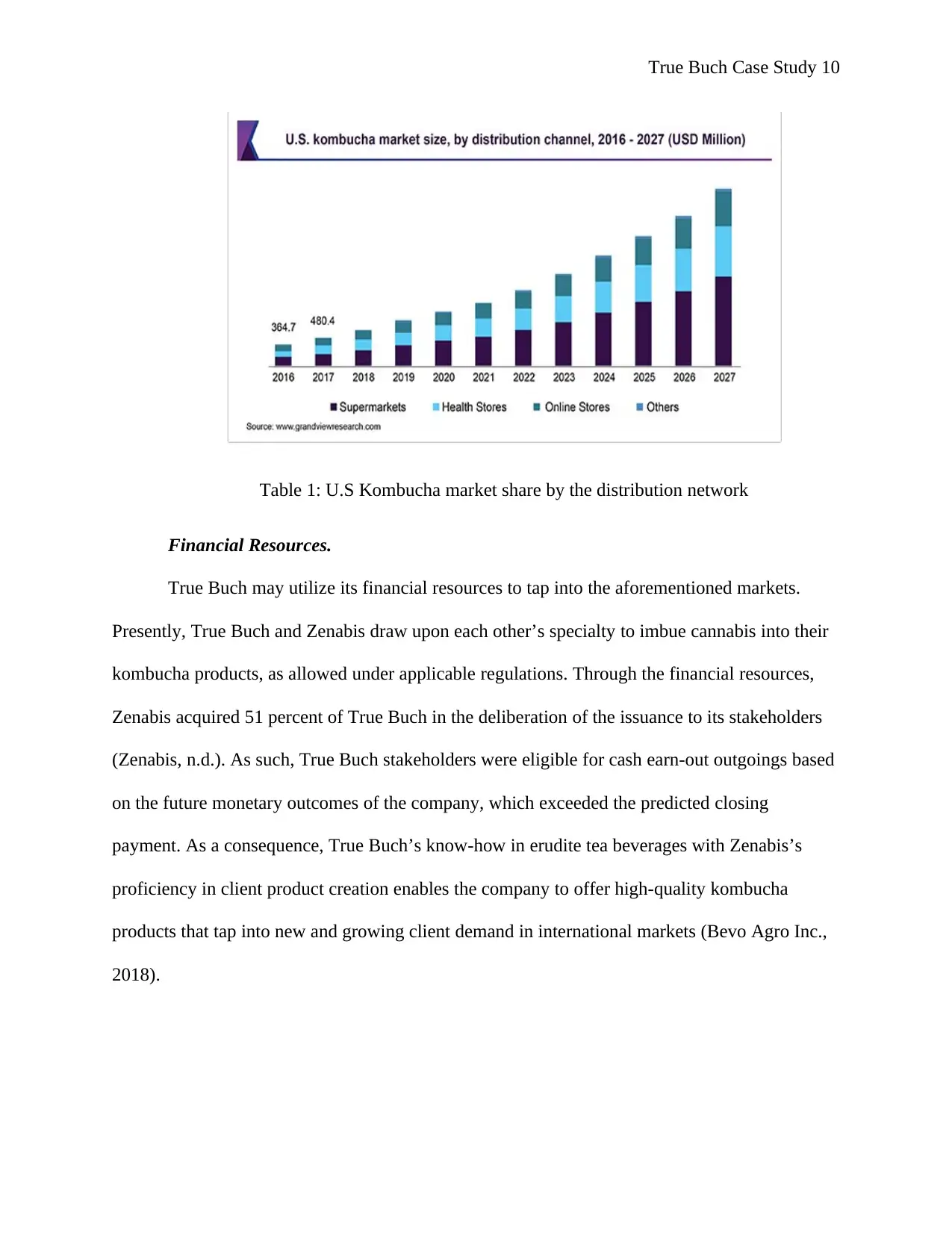
According to Table 1, it is evident that the distribution channels of kombucha products
have improved in the U.S, as supermarkets account for the highest market segment in 2019. This
is because they were easily accessible, and were crucial for concocting a sustainable market
approach (Grand View Research, 2019, p.2). Through this marketing technique, True Buch can
comfortably gain entry in new markets, as supermarkets are readily accessible in the stated
potential markets. Also, clients are more susceptible to acknowledge new items through on-shelf
retail advertising, eye-catching packaging, and publicizing events held at popular supermarkets
for client awareness. Alternatively, True Buch may utilize online shopping avenues to create
marketing promotions to entice clients from the stated international markets to try their new
kombucha items through social media influencers.
intrinsic nutritional benefits of kombucha products. The growing popularity of kombucha
products means that True Buch can comfortably penetrate new markets, as people have become
more aware of the health benefits of kombucha items. Some of the new global markets that True
Buch can focus on are North America (the United States and Mexico), and Asia-Pacific (Japan,
India, and China). Generally, True Buch can focus on entering the US market because it is the
largest supplier of kombucha. On the other hand, Asia provides a commercial developing
kombucha market, as kombucha is made and taken by the family (Market Watch Publishers,
2020).
Overview of Supporting Arguments
Marketing and the distribution network.
According to Table 1, it is evident that the distribution channels of kombucha products
have improved in the U.S, as supermarkets account for the highest market segment in 2019. This
is because they were easily accessible, and were crucial for concocting a sustainable market
approach (Grand View Research, 2019, p.2). Through this marketing technique, True Buch can
comfortably gain entry in new markets, as supermarkets are readily accessible in the stated
potential markets. Also, clients are more susceptible to acknowledge new items through on-shelf
retail advertising, eye-catching packaging, and publicizing events held at popular supermarkets
for client awareness. Alternatively, True Buch may utilize online shopping avenues to create
marketing promotions to entice clients from the stated international markets to try their new
kombucha items through social media influencers.
⊘ This is a preview!⊘
Do you want full access?
Subscribe today to unlock all pages.
Trusted by 1+ million students worldwide
True Buch Case Study 10
Table 1: U.S Kombucha market share by the distribution network
Financial Resources.
True Buch may utilize its financial resources to tap into the aforementioned markets.
Presently, True Buch and Zenabis draw upon each other’s specialty to imbue cannabis into their
kombucha products, as allowed under applicable regulations. Through the financial resources,
Zenabis acquired 51 percent of True Buch in the deliberation of the issuance to its stakeholders
(Zenabis, n.d.). As such, True Buch stakeholders were eligible for cash earn-out outgoings based
on the future monetary outcomes of the company, which exceeded the predicted closing
payment. As a consequence, True Buch’s know-how in erudite tea beverages with Zenabis’s
proficiency in client product creation enables the company to offer high-quality kombucha
products that tap into new and growing client demand in international markets (Bevo Agro Inc.,
2018).
Table 1: U.S Kombucha market share by the distribution network
Financial Resources.
True Buch may utilize its financial resources to tap into the aforementioned markets.
Presently, True Buch and Zenabis draw upon each other’s specialty to imbue cannabis into their
kombucha products, as allowed under applicable regulations. Through the financial resources,
Zenabis acquired 51 percent of True Buch in the deliberation of the issuance to its stakeholders
(Zenabis, n.d.). As such, True Buch stakeholders were eligible for cash earn-out outgoings based
on the future monetary outcomes of the company, which exceeded the predicted closing
payment. As a consequence, True Buch’s know-how in erudite tea beverages with Zenabis’s
proficiency in client product creation enables the company to offer high-quality kombucha
products that tap into new and growing client demand in international markets (Bevo Agro Inc.,
2018).
Paraphrase This Document
Need a fresh take? Get an instant paraphrase of this document with our AI Paraphraser
True Buch Case Study 11
Innovation.
To gain entry into the new global markets, True Buch’s innovation strategy may focus on
their kombucha production, packaging, and distribution (Paul & Dutta, 2019, p.262). To increase
its production such that it can cater to its potential global market, True Buch may need to
increase its capacity tanks required for the fermentation process, such that the bottling line will
be increased by at least 70 percent. During the production process, the company may also
incorporate a semi-automated complete solution comprising a labeler, rinser, filler, and capper to
reduce the need for manual capping, which is time-consuming and labor-intensive. Importantly,
the advanced production line may need at least five new employees, as well as upskilling and
training for current ones to enhance production, such that True Buch may meet the needs of its
new global markets. Therefore, the new production line may enable True Buch to meet the
elevating demand across Canadian and international markets.
To improve on their packaging, True Buch must focus on evergreen packaging that
conserves the environment, and can also be recycled. Presently, the company is using glass
bottles in packaging kombucha, which are usually fragile. Importantly, an evergreen packaging
that is sustainable gains the attention of more local and global clients, as they can reuse them for
some time. Due to this fact, True Buch may opt to use aluminum cans for its packaging lines
because they are the most ecological beverage packages. Conversely, they have a better
reutilizing ratio, and more reused content compared to glass packaging. Besides, they are
lightweight, durable, and stackable, which can enable True Buch to package and transport more
beverages utilizing fewer material. Therefore, adopting an evergreen packaging may help in
improving the image of the latter as a conservative enterprise, which can help it tap into the
global market.
Innovation.
To gain entry into the new global markets, True Buch’s innovation strategy may focus on
their kombucha production, packaging, and distribution (Paul & Dutta, 2019, p.262). To increase
its production such that it can cater to its potential global market, True Buch may need to
increase its capacity tanks required for the fermentation process, such that the bottling line will
be increased by at least 70 percent. During the production process, the company may also
incorporate a semi-automated complete solution comprising a labeler, rinser, filler, and capper to
reduce the need for manual capping, which is time-consuming and labor-intensive. Importantly,
the advanced production line may need at least five new employees, as well as upskilling and
training for current ones to enhance production, such that True Buch may meet the needs of its
new global markets. Therefore, the new production line may enable True Buch to meet the
elevating demand across Canadian and international markets.
To improve on their packaging, True Buch must focus on evergreen packaging that
conserves the environment, and can also be recycled. Presently, the company is using glass
bottles in packaging kombucha, which are usually fragile. Importantly, an evergreen packaging
that is sustainable gains the attention of more local and global clients, as they can reuse them for
some time. Due to this fact, True Buch may opt to use aluminum cans for its packaging lines
because they are the most ecological beverage packages. Conversely, they have a better
reutilizing ratio, and more reused content compared to glass packaging. Besides, they are
lightweight, durable, and stackable, which can enable True Buch to package and transport more
beverages utilizing fewer material. Therefore, adopting an evergreen packaging may help in
improving the image of the latter as a conservative enterprise, which can help it tap into the
global market.
True Buch Case Study 12
Human Resources.
HR professionals have multiple roles within a company, and they are responsible for
formulating approaches that prioritize on recruiting and retaining top skilled workers, as well as
overseeing the company’s operations. Due to this fact, Conrad and Louisa may need to
restructure their enterprise to enter into the global market. This is because, as True Buch grows
to become a global entity, they cannot always manage to keep track of the marketing,
accounting, and other managerial tasks. Therefore, they may need to further train and develop
their current staff, such that they can manage certain crucial aspects of the enterprise, while
Conrad and Louisa focus on other manageable ones. This approach will ensure that True Buch is
effectively managed even as it prepares to enter a new market because its management would be
firm and extensive. Besides, the former may need more skilled personnel, such that they can
occupy new tasks as they enter the international market. As a result, True Buch can maintain its
quality even as it taps into new markets.
Logical Order of the Supporting Ideas
Generally, the pyramid principle technique must have a rational structure that dictates the
sequence of events. In this case, True Buch first established its financial and partnership position
with Zenabis, which enable them to produce high-quality kombucha items that could attract the
international market. Second, the human resources available at True Buch would facilitate the
smooth operations of the company, as it taps into the new market. This was achieved by
retraining of the available workforce, such that they could manage more sensitive aspects of the
enterprise. Besides, the employment of new skilled personnel enabled the company to handle
new tasks as the business entered the global market. Third, the company introduced a semi-
automated production system that could increase the production capacity of the firm, such that it
Human Resources.
HR professionals have multiple roles within a company, and they are responsible for
formulating approaches that prioritize on recruiting and retaining top skilled workers, as well as
overseeing the company’s operations. Due to this fact, Conrad and Louisa may need to
restructure their enterprise to enter into the global market. This is because, as True Buch grows
to become a global entity, they cannot always manage to keep track of the marketing,
accounting, and other managerial tasks. Therefore, they may need to further train and develop
their current staff, such that they can manage certain crucial aspects of the enterprise, while
Conrad and Louisa focus on other manageable ones. This approach will ensure that True Buch is
effectively managed even as it prepares to enter a new market because its management would be
firm and extensive. Besides, the former may need more skilled personnel, such that they can
occupy new tasks as they enter the international market. As a result, True Buch can maintain its
quality even as it taps into new markets.
Logical Order of the Supporting Ideas
Generally, the pyramid principle technique must have a rational structure that dictates the
sequence of events. In this case, True Buch first established its financial and partnership position
with Zenabis, which enable them to produce high-quality kombucha items that could attract the
international market. Second, the human resources available at True Buch would facilitate the
smooth operations of the company, as it taps into the new market. This was achieved by
retraining of the available workforce, such that they could manage more sensitive aspects of the
enterprise. Besides, the employment of new skilled personnel enabled the company to handle
new tasks as the business entered the global market. Third, the company introduced a semi-
automated production system that could increase the production capacity of the firm, such that it
⊘ This is a preview!⊘
Do you want full access?
Subscribe today to unlock all pages.
Trusted by 1+ million students worldwide

1 out of 15


Your All-in-One AI-Powered Toolkit for Academic Success.
+13062052269
info@desklib.com
Available 24*7 on WhatsApp / Email
![[object Object]](/_next/static/media/star-bottom.7253800d.svg)
Unlock your academic potential
Copyright © 2020–2026 A2Z Services. All Rights Reserved. Developed and managed by ZUCOL.