Factors Influencing Project Management Structure: TWT Development

Verified

Added on  2023/04/21

|6
|753
|99
Report
AI Summary
This report delves into the factors influencing the choice of project management structure for a TPC Wearable Technology (TWT) development project. It assesses seven key factors based on Hobbs and Menard (1993): project size, strategic importance, novelty and need for innovation, need for integration, environmental complexity, budget and time constraints, and stability of resource requirements. The project involves designing a wearable medical device for a startup, incorporating various medical features. Each factor is rated (high or medium), and assumptions related to each are explicitly stated. The analysis considers the integration of medical and IT teams, budget allocation, and adherence to timelines, highlighting the strategic importance and innovative aspects of the project within the medical sector. The report concludes by referencing relevant literature on wearable medical monitoring systems and innovation in health systems.
Document Page
Running head: TPC WEARABLE TECHNOLOGY (TWT) DEVELOPMENT PROJECT
TPC Wearable Technology (TWT) Development Project
Name of the Student
Name of the University
Author’s note
tabler-icon-diamond-filled.svg

Paraphrase This Document

Need a fresh take? Get an instant paraphrase of this document with our AI Paraphraser
Document Page
1TPC WEARABLE TECHNOLOGY (TWT) DEVELOPMENT PROJECT
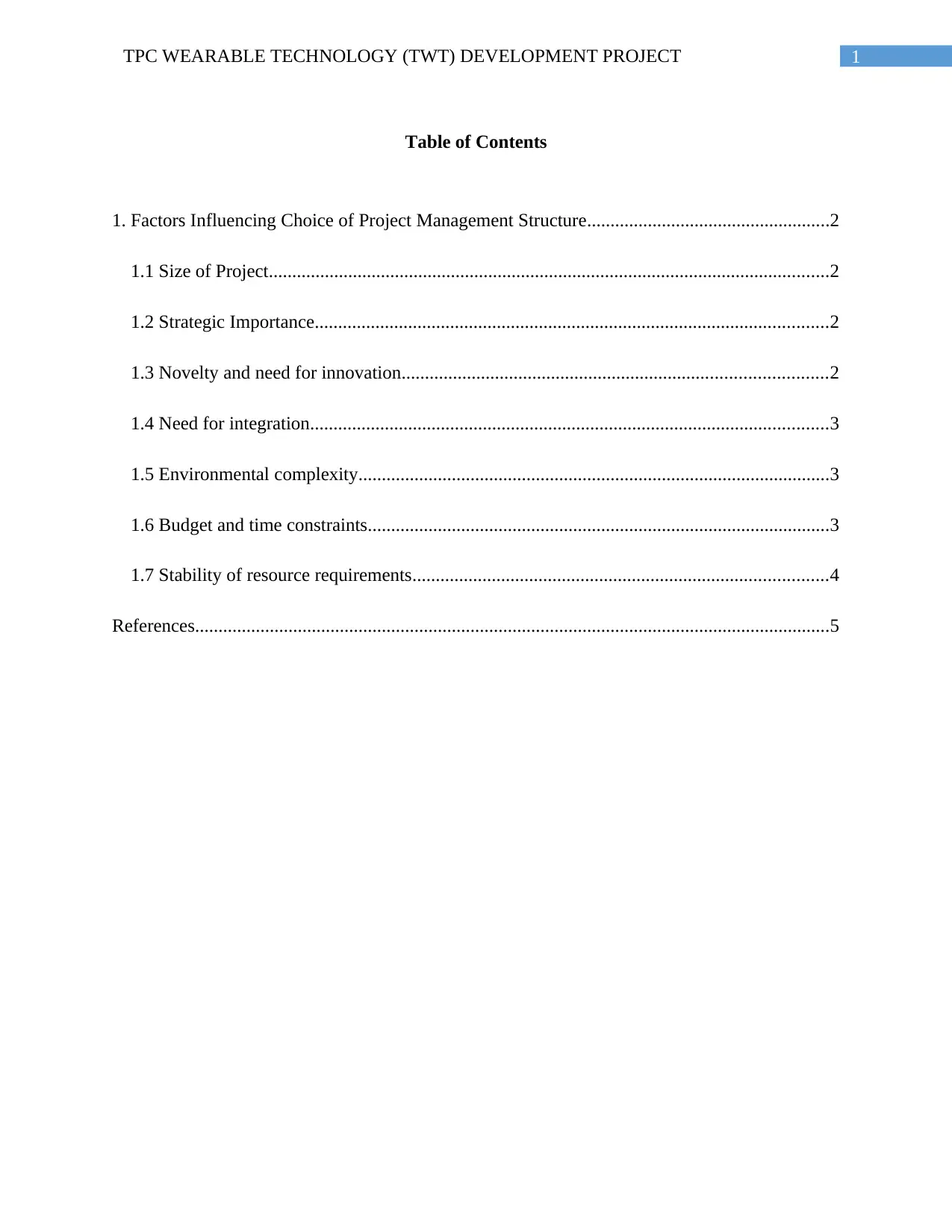
Table of Contents
1. Factors Influencing Choice of Project Management Structure....................................................2
1.1 Size of Project........................................................................................................................2
1.2 Strategic Importance..............................................................................................................2
1.3 Novelty and need for innovation...........................................................................................2
1.4 Need for integration...............................................................................................................3
1.5 Environmental complexity.....................................................................................................3
1.6 Budget and time constraints...................................................................................................3
1.7 Stability of resource requirements.........................................................................................4
References........................................................................................................................................5
Document Page
2TPC WEARABLE TECHNOLOGY (TWT) DEVELOPMENT PROJECT
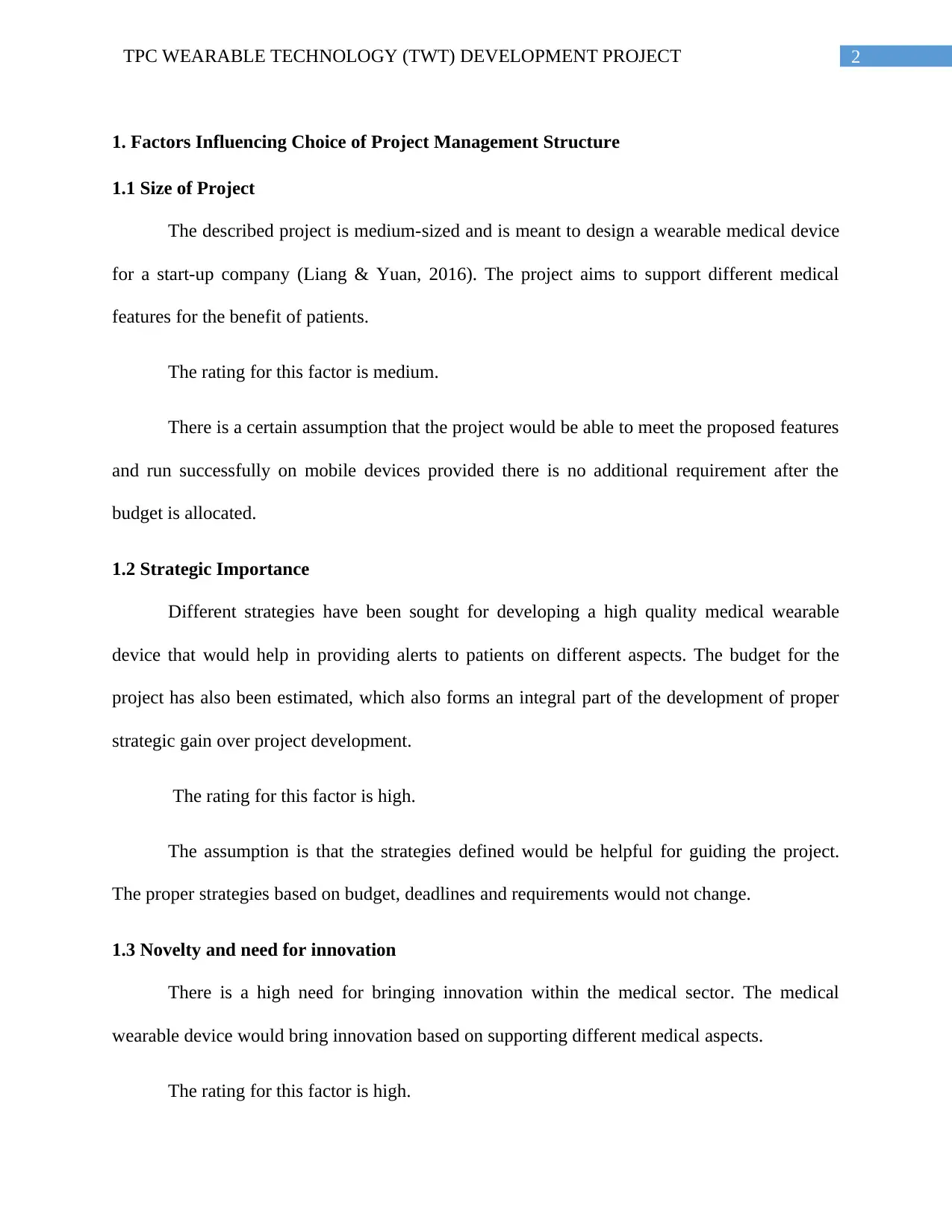
1. Factors Influencing Choice of Project Management Structure
1.1 Size of Project
The described project is medium-sized and is meant to design a wearable medical device
for a start-up company (Liang & Yuan, 2016). The project aims to support different medical
features for the benefit of patients.
The rating for this factor is medium.
There is a certain assumption that the project would be able to meet the proposed features
and run successfully on mobile devices provided there is no additional requirement after the
budget is allocated.
1.2 Strategic Importance
Different strategies have been sought for developing a high quality medical wearable
device that would help in providing alerts to patients on different aspects. The budget for the
project has also been estimated, which also forms an integral part of the development of proper
strategic gain over project development.
The rating for this factor is high.
The assumption is that the strategies defined would be helpful for guiding the project.
The proper strategies based on budget, deadlines and requirements would not change.
1.3 Novelty and need for innovation
There is a high need for bringing innovation within the medical sector. The medical
wearable device would bring innovation based on supporting different medical aspects.
The rating for this factor is high.
Document Page
3TPC WEARABLE TECHNOLOGY (TWT) DEVELOPMENT PROJECT
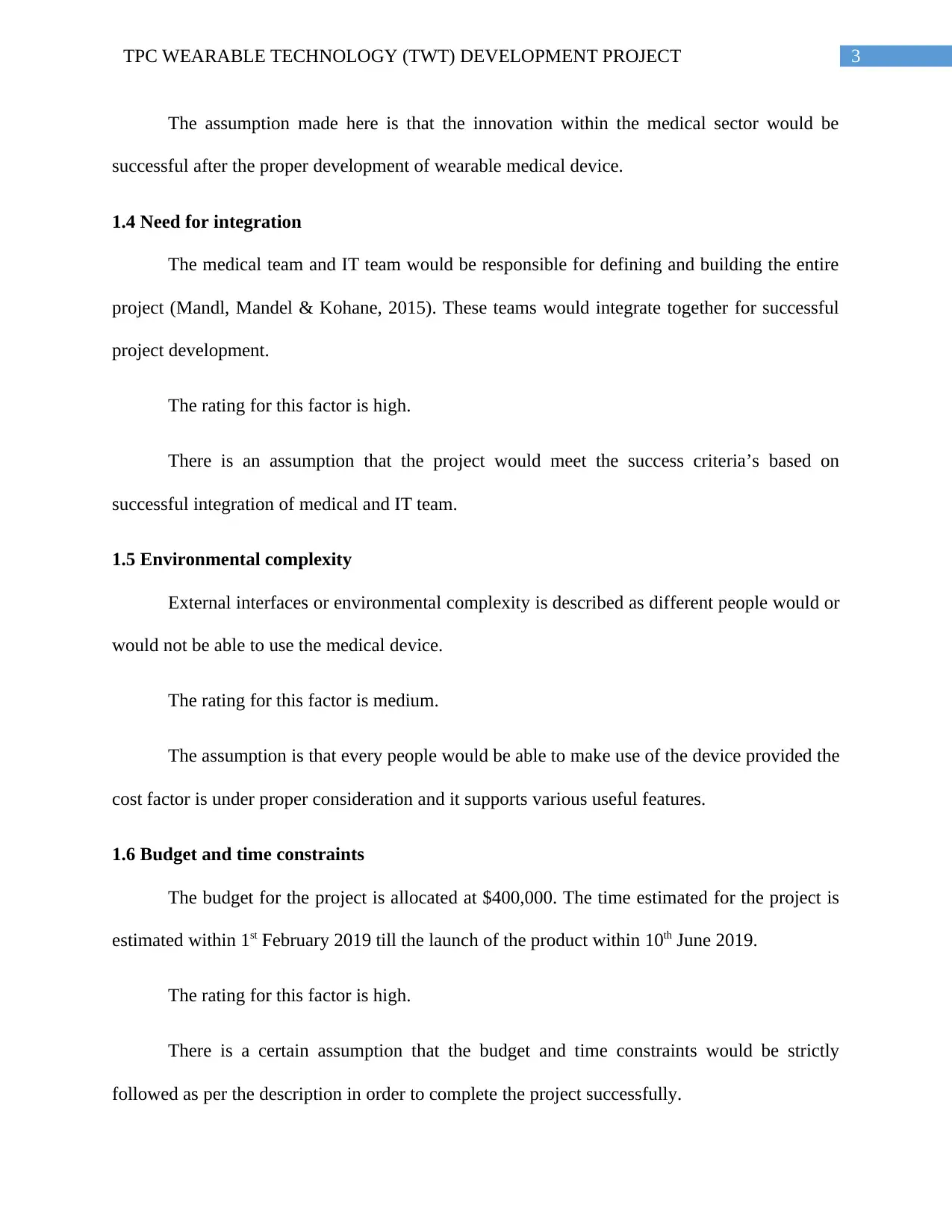
The assumption made here is that the innovation within the medical sector would be
successful after the proper development of wearable medical device.
1.4 Need for integration
The medical team and IT team would be responsible for defining and building the entire
project (Mandl, Mandel & Kohane, 2015). These teams would integrate together for successful
project development.
The rating for this factor is high.
There is an assumption that the project would meet the success criteria’s based on
successful integration of medical and IT team.
1.5 Environmental complexity
External interfaces or environmental complexity is described as different people would or
would not be able to use the medical device.
The rating for this factor is medium.
The assumption is that every people would be able to make use of the device provided the
cost factor is under proper consideration and it supports various useful features.
1.6 Budget and time constraints
The budget for the project is allocated at $400,000. The time estimated for the project is
estimated within 1st February 2019 till the launch of the product within 10th June 2019.
The rating for this factor is high.
There is a certain assumption that the budget and time constraints would be strictly
followed as per the description in order to complete the project successfully.
tabler-icon-diamond-filled.svg

Paraphrase This Document

Need a fresh take? Get an instant paraphrase of this document with our AI Paraphraser
Document Page
4TPC WEARABLE TECHNOLOGY (TWT) DEVELOPMENT PROJECT
1.7 Stability of resource requirements
Each of the resources required during the project such as medical staff, IT team, budget
and others are estimated prior to project development and would be allocated as per the
requirement at each stage of project development.
The rating for this factor is high.
Assumption made is that the project would be achieved successfully after the proper
allocation of each resources within the proper estimated time periods.
Document Page
5TPC WEARABLE TECHNOLOGY (TWT) DEVELOPMENT PROJECT
References
Liang, T., & Yuan, Y. J. (2016). Wearable medical monitoring systems based on wireless
networks: A review. IEEE Sensors Journal, 16(23), 8186-8199.
Mandl, K. D., Mandel, J. C., & Kohane, I. S. (2015). Driving innovation in health systems
through an apps-based information economy. Cell systems, 1(1), 8-13.
chevron_up_icon
1 out of 6
circle_padding
hide_on_mobile
zoom_out_icon
[object Object]