Health Promotion for Aboriginal Australians with Diabetes
VerifiedAdded on 2021/02/20
|9
|2443
|66
Report
AI Summary
This report addresses the increasing prevalence of type 2 diabetes among Indigenous Australians, attributing it to lifestyle changes and limited access to healthcare. It identifies 'Healthy Diet' as a crucial nursing intervention for managing and preventing diabetes, emphasizing its comprehensive approach to patient care. The report reviews various health promotion strategies, including education and mobile technology, while critically analyzing the effectiveness of current initiatives. The conclusion highlights the need for improved healthcare promotion, particularly in remote areas, and underscores the importance of culturally sensitive interventions to address this critical health issue within Aboriginal communities. The report stresses the need for increased awareness, access to care, and the adoption of healthier lifestyles to combat the growing diabetes epidemic.
Health promotion
issue
1
issue
1

Paraphrase This Document
Need a fresh take? Get an instant paraphrase of this document with our AI Paraphraser
Executive summary
This report is presented with the aim of identification of reasons behind rising number of
Indigenous Australians suffering from diabetes and the nursing interventions that can be adopted
in order to cure them. In this report, the reasons behind increase of spread of type 2 diabetes in
Aboriginal Australians have been discussed and out of all the available interventions, the most
suitable interventions have been identified. The importance and reason of choosing ‘Healthy
Diet’ as an apt nursing intervention for this issue is discussed and appropriate conclusions
regarding diabetic health related issues and its cure will be made.
2
This report is presented with the aim of identification of reasons behind rising number of
Indigenous Australians suffering from diabetes and the nursing interventions that can be adopted
in order to cure them. In this report, the reasons behind increase of spread of type 2 diabetes in
Aboriginal Australians have been discussed and out of all the available interventions, the most
suitable interventions have been identified. The importance and reason of choosing ‘Healthy
Diet’ as an apt nursing intervention for this issue is discussed and appropriate conclusions
regarding diabetic health related issues and its cure will be made.
2
Table of Contents
Executive summary.........................................................................................................................2
INTRODUCTION...........................................................................................................................4
MAIN BODY..................................................................................................................................4
Health promotion issue................................................................................................................4
CONCLUSION................................................................................................................................7
REFERENCES................................................................................................................................8
3
Executive summary.........................................................................................................................2
INTRODUCTION...........................................................................................................................4
MAIN BODY..................................................................................................................................4
Health promotion issue................................................................................................................4
CONCLUSION................................................................................................................................7
REFERENCES................................................................................................................................8
3
⊘ This is a preview!⊘
Do you want full access?
Subscribe today to unlock all pages.

Trusted by 1+ million students worldwide
INTRODUCTION
The increased transition pace of Aboriginal Australians from their traditional lifestyle values
to a modern one has led to increased spread of some serious health issues amongst them which
were earlier never found amongst these communities. One of these increased health issues is the
spread of Type 2 diabetes due to this lifestyle change (Lahme, Stern and Cooper, 2018). In this
report, the reason behind increased spread of this type 2 diabetes has been identified and various
health promotion issues regarding the type 2 diabetes have been discussed. Further, this report
will also identify the various nursing intervention available for cure of such diabetic problem in
the Indigenous Australians (Verra and et.al., 2019). After proper literature review, those
intervention which will help in curing this disease most effectively would be discussed along
with the correct rationale for selecting these interventions amongst other interventions (Diabetes
Mellitus, 2016). This report will also discuss various theories available under healthcare
promotion of type 2 diabetes’ interventions that can be implemented to educate the Aboriginal
Australians regarding healthcare practices which can be adopted and lastly, this report will also
include a critical analysis of different approaches adopted for promotion of healthcare services at
local, national and international level in Australia for educating such indigenous Australians has
been made (Suchert and et.al., 2018).
MAIN BODY
Health promotion issue
Diabetes is health issue in which blood glucose level increases at a very high level (Jacklin
and et.al., 2017). It mainly occurs when insulin created by pancreas stops lowering blood glucose
level or when body stopes creating sufficient insulin to lower blood glucose level. There are
mainly two type of diabetes: First is type 1 diabetes and second is type 2 diabetes. In type 1
diabetes body does not make insulin whereas in type 2 diabetes body does not make or use
sufficient insulin required by the body to lower blood glucose level. In this type 2 diabetes is
growing at much higher level as compared to type 1 diabetes (Adegbija, Hoy and Wang, 2015).
In Australia most of the people are affected by type 2 diabetes mostly and one of the most
prominent reason for this is obesity and unawareness. Type 2 diabetes is one of the fastest
growing chronic disease in Australia. In Australia as compared to general population Aboriginal
and Torres Strait Islander people are at higher risk of type 2 diabetes (Day and Helson, 2015).
Aboriginal communities who live at remote areas are at higher risk of this disease because they
4
The increased transition pace of Aboriginal Australians from their traditional lifestyle values
to a modern one has led to increased spread of some serious health issues amongst them which
were earlier never found amongst these communities. One of these increased health issues is the
spread of Type 2 diabetes due to this lifestyle change (Lahme, Stern and Cooper, 2018). In this
report, the reason behind increased spread of this type 2 diabetes has been identified and various
health promotion issues regarding the type 2 diabetes have been discussed. Further, this report
will also identify the various nursing intervention available for cure of such diabetic problem in
the Indigenous Australians (Verra and et.al., 2019). After proper literature review, those
intervention which will help in curing this disease most effectively would be discussed along
with the correct rationale for selecting these interventions amongst other interventions (Diabetes
Mellitus, 2016). This report will also discuss various theories available under healthcare
promotion of type 2 diabetes’ interventions that can be implemented to educate the Aboriginal
Australians regarding healthcare practices which can be adopted and lastly, this report will also
include a critical analysis of different approaches adopted for promotion of healthcare services at
local, national and international level in Australia for educating such indigenous Australians has
been made (Suchert and et.al., 2018).
MAIN BODY
Health promotion issue
Diabetes is health issue in which blood glucose level increases at a very high level (Jacklin
and et.al., 2017). It mainly occurs when insulin created by pancreas stops lowering blood glucose
level or when body stopes creating sufficient insulin to lower blood glucose level. There are
mainly two type of diabetes: First is type 1 diabetes and second is type 2 diabetes. In type 1
diabetes body does not make insulin whereas in type 2 diabetes body does not make or use
sufficient insulin required by the body to lower blood glucose level. In this type 2 diabetes is
growing at much higher level as compared to type 1 diabetes (Adegbija, Hoy and Wang, 2015).
In Australia most of the people are affected by type 2 diabetes mostly and one of the most
prominent reason for this is obesity and unawareness. Type 2 diabetes is one of the fastest
growing chronic disease in Australia. In Australia as compared to general population Aboriginal
and Torres Strait Islander people are at higher risk of type 2 diabetes (Day and Helson, 2015).
Aboriginal communities who live at remote areas are at higher risk of this disease because they
4
Paraphrase This Document
Need a fresh take? Get an instant paraphrase of this document with our AI Paraphraser
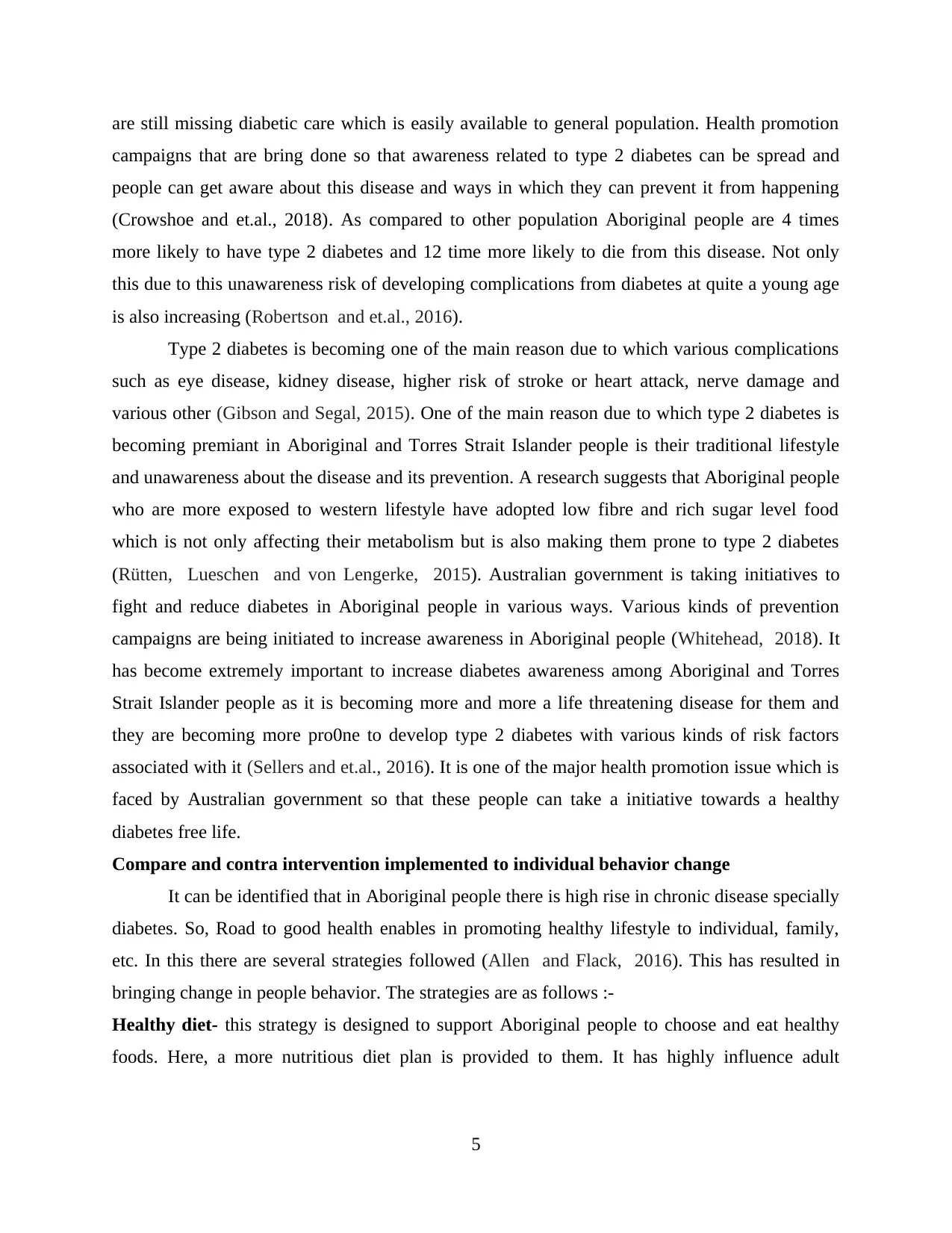
are still missing diabetic care which is easily available to general population. Health promotion
campaigns that are bring done so that awareness related to type 2 diabetes can be spread and
people can get aware about this disease and ways in which they can prevent it from happening
(Crowshoe and et.al., 2018). As compared to other population Aboriginal people are 4 times
more likely to have type 2 diabetes and 12 time more likely to die from this disease. Not only
this due to this unawareness risk of developing complications from diabetes at quite a young age
is also increasing (Robertson and et.al., 2016).
Type 2 diabetes is becoming one of the main reason due to which various complications
such as eye disease, kidney disease, higher risk of stroke or heart attack, nerve damage and
various other (Gibson and Segal, 2015). One of the main reason due to which type 2 diabetes is
becoming premiant in Aboriginal and Torres Strait Islander people is their traditional lifestyle
and unawareness about the disease and its prevention. A research suggests that Aboriginal people
who are more exposed to western lifestyle have adopted low fibre and rich sugar level food
which is not only affecting their metabolism but is also making them prone to type 2 diabetes
(Rütten, Lueschen and von Lengerke, 2015). Australian government is taking initiatives to
fight and reduce diabetes in Aboriginal people in various ways. Various kinds of prevention
campaigns are being initiated to increase awareness in Aboriginal people (Whitehead, 2018). It
has become extremely important to increase diabetes awareness among Aboriginal and Torres
Strait Islander people as it is becoming more and more a life threatening disease for them and
they are becoming more pro0ne to develop type 2 diabetes with various kinds of risk factors
associated with it (Sellers and et.al., 2016). It is one of the major health promotion issue which is
faced by Australian government so that these people can take a initiative towards a healthy
diabetes free life.
Compare and contra intervention implemented to individual behavior change
It can be identified that in Aboriginal people there is high rise in chronic disease specially
diabetes. So, Road to good health enables in promoting healthy lifestyle to individual, family,
etc. In this there are several strategies followed (Allen and Flack, 2016). This has resulted in
bringing change in people behavior. The strategies are as follows :-
Healthy diet- this strategy is designed to support Aboriginal people to choose and eat healthy
foods. Here, a more nutritious diet plan is provided to them. It has highly influence adult
5
campaigns that are bring done so that awareness related to type 2 diabetes can be spread and
people can get aware about this disease and ways in which they can prevent it from happening
(Crowshoe and et.al., 2018). As compared to other population Aboriginal people are 4 times
more likely to have type 2 diabetes and 12 time more likely to die from this disease. Not only
this due to this unawareness risk of developing complications from diabetes at quite a young age
is also increasing (Robertson and et.al., 2016).
Type 2 diabetes is becoming one of the main reason due to which various complications
such as eye disease, kidney disease, higher risk of stroke or heart attack, nerve damage and
various other (Gibson and Segal, 2015). One of the main reason due to which type 2 diabetes is
becoming premiant in Aboriginal and Torres Strait Islander people is their traditional lifestyle
and unawareness about the disease and its prevention. A research suggests that Aboriginal people
who are more exposed to western lifestyle have adopted low fibre and rich sugar level food
which is not only affecting their metabolism but is also making them prone to type 2 diabetes
(Rütten, Lueschen and von Lengerke, 2015). Australian government is taking initiatives to
fight and reduce diabetes in Aboriginal people in various ways. Various kinds of prevention
campaigns are being initiated to increase awareness in Aboriginal people (Whitehead, 2018). It
has become extremely important to increase diabetes awareness among Aboriginal and Torres
Strait Islander people as it is becoming more and more a life threatening disease for them and
they are becoming more pro0ne to develop type 2 diabetes with various kinds of risk factors
associated with it (Sellers and et.al., 2016). It is one of the major health promotion issue which is
faced by Australian government so that these people can take a initiative towards a healthy
diabetes free life.
Compare and contra intervention implemented to individual behavior change
It can be identified that in Aboriginal people there is high rise in chronic disease specially
diabetes. So, Road to good health enables in promoting healthy lifestyle to individual, family,
etc. In this there are several strategies followed (Allen and Flack, 2016). This has resulted in
bringing change in people behavior. The strategies are as follows :-
Healthy diet- this strategy is designed to support Aboriginal people to choose and eat healthy
foods. Here, a more nutritious diet plan is provided to them. It has highly influence adult
5
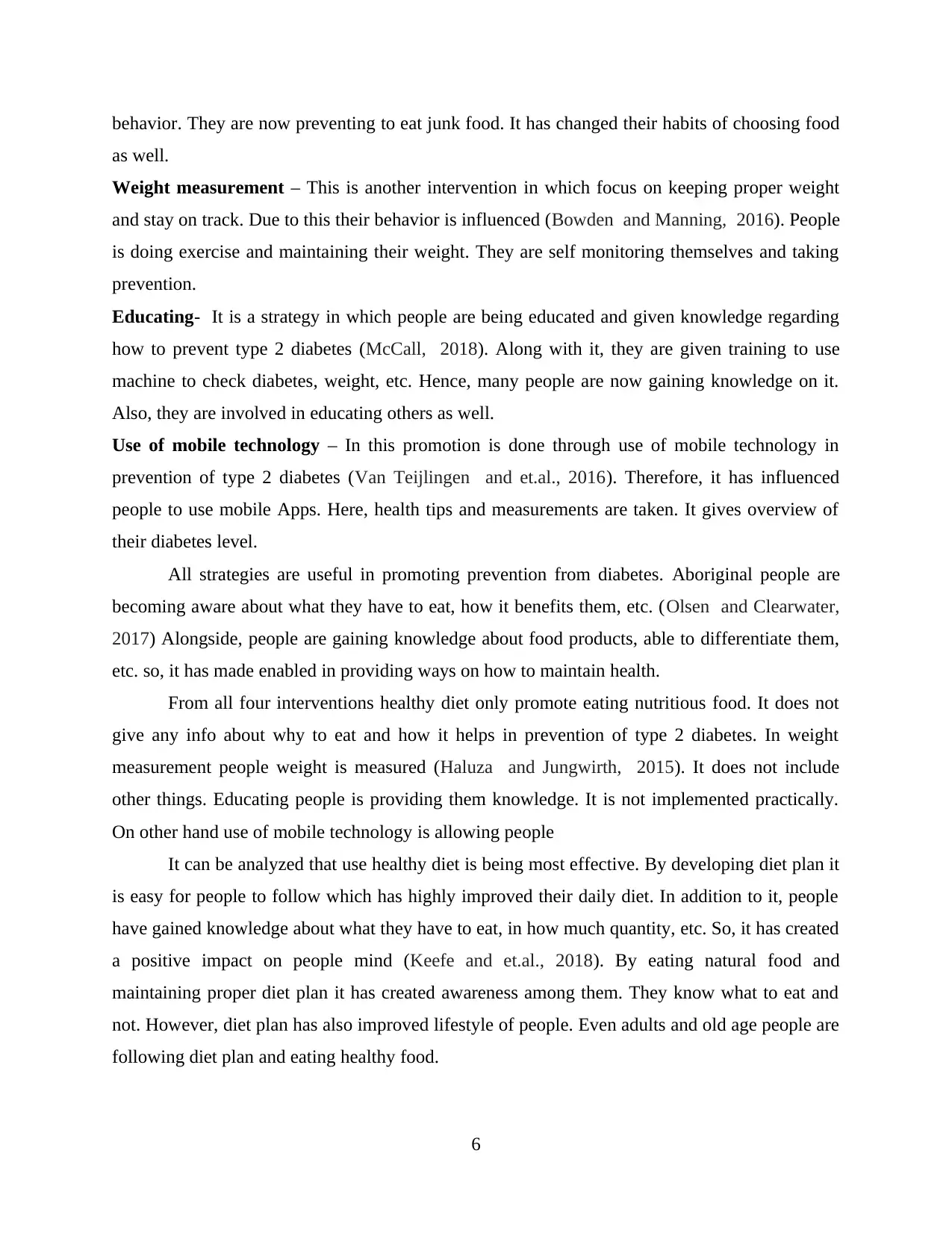
behavior. They are now preventing to eat junk food. It has changed their habits of choosing food
as well.
Weight measurement – This is another intervention in which focus on keeping proper weight
and stay on track. Due to this their behavior is influenced (Bowden and Manning, 2016). People
is doing exercise and maintaining their weight. They are self monitoring themselves and taking
prevention.
Educating- It is a strategy in which people are being educated and given knowledge regarding
how to prevent type 2 diabetes (McCall, 2018). Along with it, they are given training to use
machine to check diabetes, weight, etc. Hence, many people are now gaining knowledge on it.
Also, they are involved in educating others as well.
Use of mobile technology – In this promotion is done through use of mobile technology in
prevention of type 2 diabetes (Van Teijlingen and et.al., 2016). Therefore, it has influenced
people to use mobile Apps. Here, health tips and measurements are taken. It gives overview of
their diabetes level.
All strategies are useful in promoting prevention from diabetes. Aboriginal people are
becoming aware about what they have to eat, how it benefits them, etc. (Olsen and Clearwater,
2017) Alongside, people are gaining knowledge about food products, able to differentiate them,
etc. so, it has made enabled in providing ways on how to maintain health.
From all four interventions healthy diet only promote eating nutritious food. It does not
give any info about why to eat and how it helps in prevention of type 2 diabetes. In weight
measurement people weight is measured (Haluza and Jungwirth, 2015). It does not include
other things. Educating people is providing them knowledge. It is not implemented practically.
On other hand use of mobile technology is allowing people
It can be analyzed that use healthy diet is being most effective. By developing diet plan it
is easy for people to follow which has highly improved their daily diet. In addition to it, people
have gained knowledge about what they have to eat, in how much quantity, etc. So, it has created
a positive impact on people mind (Keefe and et.al., 2018). By eating natural food and
maintaining proper diet plan it has created awareness among them. They know what to eat and
not. However, diet plan has also improved lifestyle of people. Even adults and old age people are
following diet plan and eating healthy food.
6
as well.
Weight measurement – This is another intervention in which focus on keeping proper weight
and stay on track. Due to this their behavior is influenced (Bowden and Manning, 2016). People
is doing exercise and maintaining their weight. They are self monitoring themselves and taking
prevention.
Educating- It is a strategy in which people are being educated and given knowledge regarding
how to prevent type 2 diabetes (McCall, 2018). Along with it, they are given training to use
machine to check diabetes, weight, etc. Hence, many people are now gaining knowledge on it.
Also, they are involved in educating others as well.
Use of mobile technology – In this promotion is done through use of mobile technology in
prevention of type 2 diabetes (Van Teijlingen and et.al., 2016). Therefore, it has influenced
people to use mobile Apps. Here, health tips and measurements are taken. It gives overview of
their diabetes level.
All strategies are useful in promoting prevention from diabetes. Aboriginal people are
becoming aware about what they have to eat, how it benefits them, etc. (Olsen and Clearwater,
2017) Alongside, people are gaining knowledge about food products, able to differentiate them,
etc. so, it has made enabled in providing ways on how to maintain health.
From all four interventions healthy diet only promote eating nutritious food. It does not
give any info about why to eat and how it helps in prevention of type 2 diabetes. In weight
measurement people weight is measured (Haluza and Jungwirth, 2015). It does not include
other things. Educating people is providing them knowledge. It is not implemented practically.
On other hand use of mobile technology is allowing people
It can be analyzed that use healthy diet is being most effective. By developing diet plan it
is easy for people to follow which has highly improved their daily diet. In addition to it, people
have gained knowledge about what they have to eat, in how much quantity, etc. So, it has created
a positive impact on people mind (Keefe and et.al., 2018). By eating natural food and
maintaining proper diet plan it has created awareness among them. They know what to eat and
not. However, diet plan has also improved lifestyle of people. Even adults and old age people are
following diet plan and eating healthy food.
6
⊘ This is a preview!⊘
Do you want full access?
Subscribe today to unlock all pages.
Trusted by 1+ million students worldwide
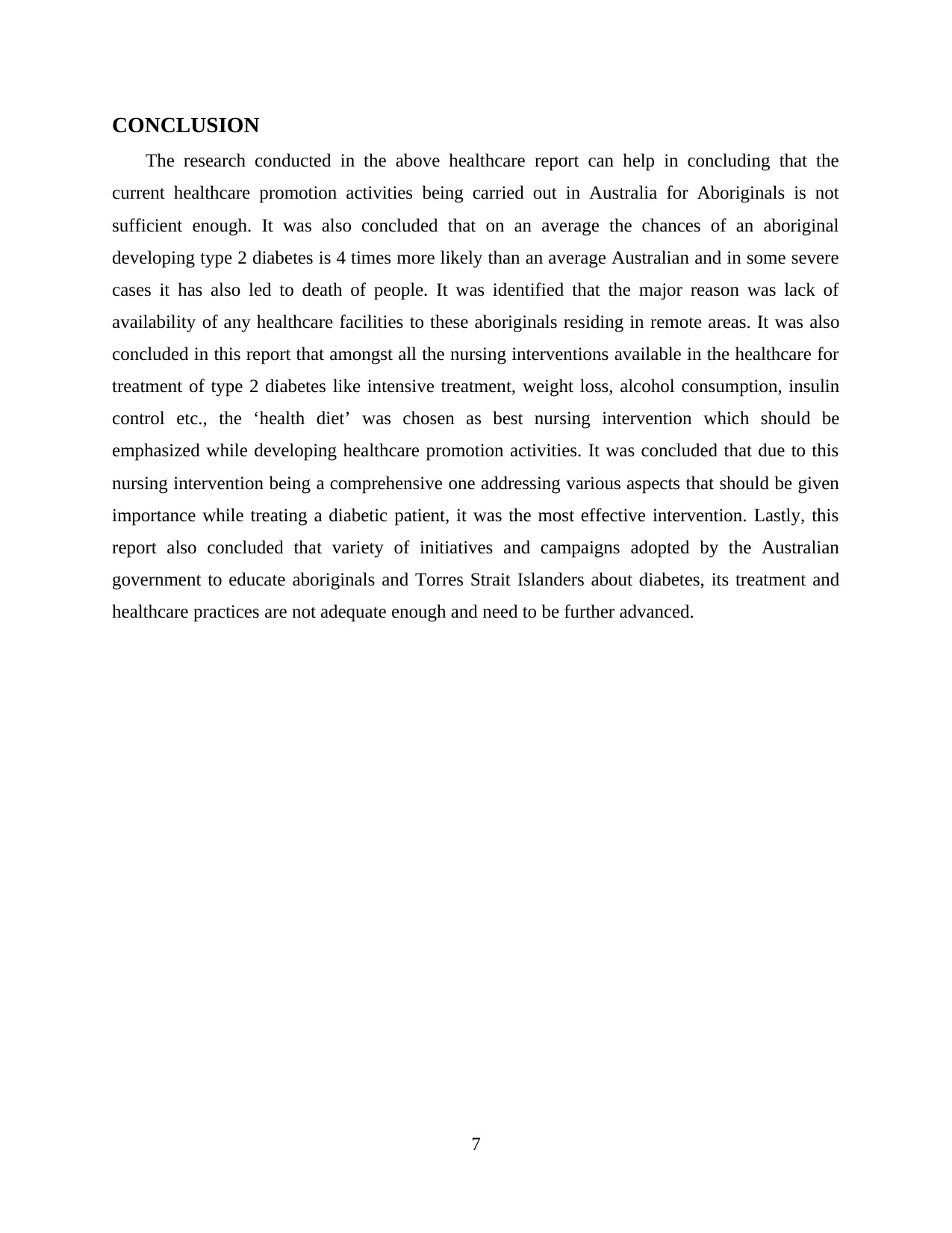
CONCLUSION
The research conducted in the above healthcare report can help in concluding that the
current healthcare promotion activities being carried out in Australia for Aboriginals is not
sufficient enough. It was also concluded that on an average the chances of an aboriginal
developing type 2 diabetes is 4 times more likely than an average Australian and in some severe
cases it has also led to death of people. It was identified that the major reason was lack of
availability of any healthcare facilities to these aboriginals residing in remote areas. It was also
concluded in this report that amongst all the nursing interventions available in the healthcare for
treatment of type 2 diabetes like intensive treatment, weight loss, alcohol consumption, insulin
control etc., the ‘health diet’ was chosen as best nursing intervention which should be
emphasized while developing healthcare promotion activities. It was concluded that due to this
nursing intervention being a comprehensive one addressing various aspects that should be given
importance while treating a diabetic patient, it was the most effective intervention. Lastly, this
report also concluded that variety of initiatives and campaigns adopted by the Australian
government to educate aboriginals and Torres Strait Islanders about diabetes, its treatment and
healthcare practices are not adequate enough and need to be further advanced.
7
The research conducted in the above healthcare report can help in concluding that the
current healthcare promotion activities being carried out in Australia for Aboriginals is not
sufficient enough. It was also concluded that on an average the chances of an aboriginal
developing type 2 diabetes is 4 times more likely than an average Australian and in some severe
cases it has also led to death of people. It was identified that the major reason was lack of
availability of any healthcare facilities to these aboriginals residing in remote areas. It was also
concluded in this report that amongst all the nursing interventions available in the healthcare for
treatment of type 2 diabetes like intensive treatment, weight loss, alcohol consumption, insulin
control etc., the ‘health diet’ was chosen as best nursing intervention which should be
emphasized while developing healthcare promotion activities. It was concluded that due to this
nursing intervention being a comprehensive one addressing various aspects that should be given
importance while treating a diabetic patient, it was the most effective intervention. Lastly, this
report also concluded that variety of initiatives and campaigns adopted by the Australian
government to educate aboriginals and Torres Strait Islanders about diabetes, its treatment and
healthcare practices are not adequate enough and need to be further advanced.
7
Paraphrase This Document
Need a fresh take? Get an instant paraphrase of this document with our AI Paraphraser
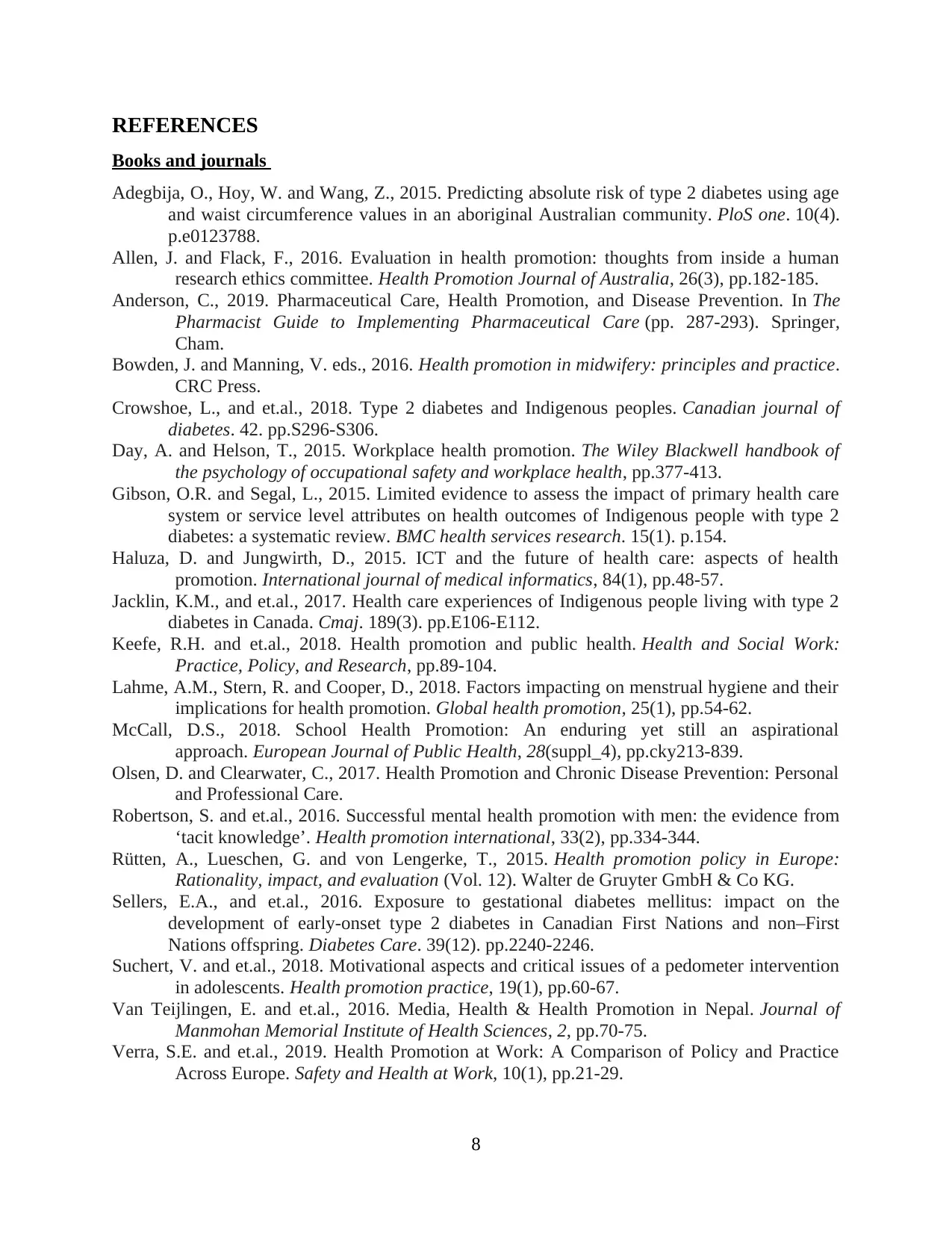
REFERENCES
Books and journals
Adegbija, O., Hoy, W. and Wang, Z., 2015. Predicting absolute risk of type 2 diabetes using age
and waist circumference values in an aboriginal Australian community. PloS one. 10(4).
p.e0123788.
Allen, J. and Flack, F., 2016. Evaluation in health promotion: thoughts from inside a human
research ethics committee. Health Promotion Journal of Australia, 26(3), pp.182-185.
Anderson, C., 2019. Pharmaceutical Care, Health Promotion, and Disease Prevention. In The
Pharmacist Guide to Implementing Pharmaceutical Care (pp. 287-293). Springer,
Cham.
Bowden, J. and Manning, V. eds., 2016. Health promotion in midwifery: principles and practice.
CRC Press.
Crowshoe, L., and et.al., 2018. Type 2 diabetes and Indigenous peoples. Canadian journal of
diabetes. 42. pp.S296-S306.
Day, A. and Helson, T., 2015. Workplace health promotion. The Wiley Blackwell handbook of
the psychology of occupational safety and workplace health, pp.377-413.
Gibson, O.R. and Segal, L., 2015. Limited evidence to assess the impact of primary health care
system or service level attributes on health outcomes of Indigenous people with type 2
diabetes: a systematic review. BMC health services research. 15(1). p.154.
Haluza, D. and Jungwirth, D., 2015. ICT and the future of health care: aspects of health
promotion. International journal of medical informatics, 84(1), pp.48-57.
Jacklin, K.M., and et.al., 2017. Health care experiences of Indigenous people living with type 2
diabetes in Canada. Cmaj. 189(3). pp.E106-E112.
Keefe, R.H. and et.al., 2018. Health promotion and public health. Health and Social Work:
Practice, Policy, and Research, pp.89-104.
Lahme, A.M., Stern, R. and Cooper, D., 2018. Factors impacting on menstrual hygiene and their
implications for health promotion. Global health promotion, 25(1), pp.54-62.
McCall, D.S., 2018. School Health Promotion: An enduring yet still an aspirational
approach. European Journal of Public Health, 28(suppl_4), pp.cky213-839.
Olsen, D. and Clearwater, C., 2017. Health Promotion and Chronic Disease Prevention: Personal
and Professional Care.
Robertson, S. and et.al., 2016. Successful mental health promotion with men: the evidence from
‘tacit knowledge’. Health promotion international, 33(2), pp.334-344.
Rütten, A., Lueschen, G. and von Lengerke, T., 2015. Health promotion policy in Europe:
Rationality, impact, and evaluation (Vol. 12). Walter de Gruyter GmbH & Co KG.
Sellers, E.A., and et.al., 2016. Exposure to gestational diabetes mellitus: impact on the
development of early-onset type 2 diabetes in Canadian First Nations and non–First
Nations offspring. Diabetes Care. 39(12). pp.2240-2246.
Suchert, V. and et.al., 2018. Motivational aspects and critical issues of a pedometer intervention
in adolescents. Health promotion practice, 19(1), pp.60-67.
Van Teijlingen, E. and et.al., 2016. Media, Health & Health Promotion in Nepal. Journal of
Manmohan Memorial Institute of Health Sciences, 2, pp.70-75.
Verra, S.E. and et.al., 2019. Health Promotion at Work: A Comparison of Policy and Practice
Across Europe. Safety and Health at Work, 10(1), pp.21-29.
8
Books and journals
Adegbija, O., Hoy, W. and Wang, Z., 2015. Predicting absolute risk of type 2 diabetes using age
and waist circumference values in an aboriginal Australian community. PloS one. 10(4).
p.e0123788.
Allen, J. and Flack, F., 2016. Evaluation in health promotion: thoughts from inside a human
research ethics committee. Health Promotion Journal of Australia, 26(3), pp.182-185.
Anderson, C., 2019. Pharmaceutical Care, Health Promotion, and Disease Prevention. In The
Pharmacist Guide to Implementing Pharmaceutical Care (pp. 287-293). Springer,
Cham.
Bowden, J. and Manning, V. eds., 2016. Health promotion in midwifery: principles and practice.
CRC Press.
Crowshoe, L., and et.al., 2018. Type 2 diabetes and Indigenous peoples. Canadian journal of
diabetes. 42. pp.S296-S306.
Day, A. and Helson, T., 2015. Workplace health promotion. The Wiley Blackwell handbook of
the psychology of occupational safety and workplace health, pp.377-413.
Gibson, O.R. and Segal, L., 2015. Limited evidence to assess the impact of primary health care
system or service level attributes on health outcomes of Indigenous people with type 2
diabetes: a systematic review. BMC health services research. 15(1). p.154.
Haluza, D. and Jungwirth, D., 2015. ICT and the future of health care: aspects of health
promotion. International journal of medical informatics, 84(1), pp.48-57.
Jacklin, K.M., and et.al., 2017. Health care experiences of Indigenous people living with type 2
diabetes in Canada. Cmaj. 189(3). pp.E106-E112.
Keefe, R.H. and et.al., 2018. Health promotion and public health. Health and Social Work:
Practice, Policy, and Research, pp.89-104.
Lahme, A.M., Stern, R. and Cooper, D., 2018. Factors impacting on menstrual hygiene and their
implications for health promotion. Global health promotion, 25(1), pp.54-62.
McCall, D.S., 2018. School Health Promotion: An enduring yet still an aspirational
approach. European Journal of Public Health, 28(suppl_4), pp.cky213-839.
Olsen, D. and Clearwater, C., 2017. Health Promotion and Chronic Disease Prevention: Personal
and Professional Care.
Robertson, S. and et.al., 2016. Successful mental health promotion with men: the evidence from
‘tacit knowledge’. Health promotion international, 33(2), pp.334-344.
Rütten, A., Lueschen, G. and von Lengerke, T., 2015. Health promotion policy in Europe:
Rationality, impact, and evaluation (Vol. 12). Walter de Gruyter GmbH & Co KG.
Sellers, E.A., and et.al., 2016. Exposure to gestational diabetes mellitus: impact on the
development of early-onset type 2 diabetes in Canadian First Nations and non–First
Nations offspring. Diabetes Care. 39(12). pp.2240-2246.
Suchert, V. and et.al., 2018. Motivational aspects and critical issues of a pedometer intervention
in adolescents. Health promotion practice, 19(1), pp.60-67.
Van Teijlingen, E. and et.al., 2016. Media, Health & Health Promotion in Nepal. Journal of
Manmohan Memorial Institute of Health Sciences, 2, pp.70-75.
Verra, S.E. and et.al., 2019. Health Promotion at Work: A Comparison of Policy and Practice
Across Europe. Safety and Health at Work, 10(1), pp.21-29.
8
Whitehead, D., 2018. Exploring health promotion and health education in nursing. Nursing
Standard, 33(8).
9
Standard, 33(8).
9
⊘ This is a preview!⊘
Do you want full access?
Subscribe today to unlock all pages.
Trusted by 1+ million students worldwide

1 out of 9


Related Documents


Your All-in-One AI-Powered Toolkit for Academic Success.
+13062052269
info@desklib.com
Available 24*7 on WhatsApp / Email
![[object Object]](/_next/static/media/star-bottom.7253800d.svg)
Unlock your academic potential
Copyright © 2020–2026 A2Z Services. All Rights Reserved. Developed and managed by ZUCOL.