Evaluating Australian Business Structures: Sole Traders to Trusts
VerifiedAdded on 2021/06/17
|8
|1974
|49
Report
AI Summary
This report provides a detailed analysis of the four primary business structures in Australia: sole traders, partnerships, companies, and trusts. It explores the unique characteristics of each structure, including ownership, liability, and legal frameworks. The report outlines the advantages and disadvantages associated with each type, such as ease of setup, access to capital, and liability exposure. Furthermore, the report delves into the tax implications of each structure, considering factors such as income tax rates and filing requirements. The paper concludes by recommending the most suitable business structure for a hypothetical scenario, considering factors like growth potential and liability protection, providing a comprehensive understanding of business structure selection for students on Desklib.
Running Head: Business Structures
Types of Business Structures
Student Name
Institutional Affiliation
Course/Number
Instructor Name
Due Date
Types of Business Structures
Student Name
Institutional Affiliation
Course/Number
Instructor Name
Due Date
Paraphrase This Document
Need a fresh take? Get an instant paraphrase of this document with our AI Paraphraser

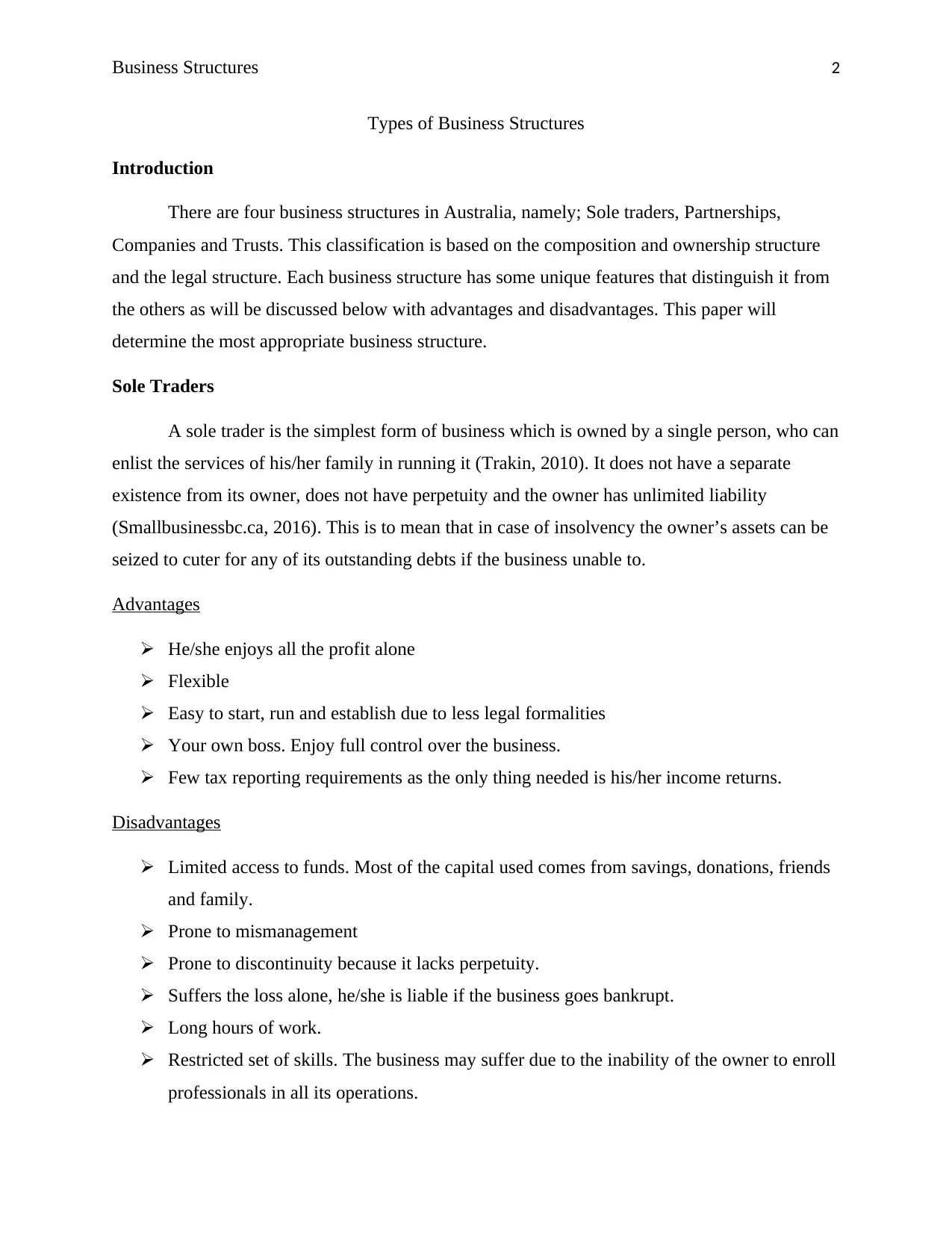
Business Structures 2
Types of Business Structures
Introduction
There are four business structures in Australia, namely; Sole traders, Partnerships,
Companies and Trusts. This classification is based on the composition and ownership structure
and the legal structure. Each business structure has some unique features that distinguish it from
the others as will be discussed below with advantages and disadvantages. This paper will
determine the most appropriate business structure.
Sole Traders
A sole trader is the simplest form of business which is owned by a single person, who can
enlist the services of his/her family in running it (Trakin, 2010). It does not have a separate
existence from its owner, does not have perpetuity and the owner has unlimited liability
(Smallbusinessbc.ca, 2016). This is to mean that in case of insolvency the owner’s assets can be
seized to cuter for any of its outstanding debts if the business unable to.
Advantages
He/she enjoys all the profit alone
Flexible
Easy to start, run and establish due to less legal formalities
Your own boss. Enjoy full control over the business.
Few tax reporting requirements as the only thing needed is his/her income returns.
Disadvantages
Limited access to funds. Most of the capital used comes from savings, donations, friends
and family.
Prone to mismanagement
Prone to discontinuity because it lacks perpetuity.
Suffers the loss alone, he/she is liable if the business goes bankrupt.
Long hours of work.
Restricted set of skills. The business may suffer due to the inability of the owner to enroll
professionals in all its operations.
Types of Business Structures
Introduction
There are four business structures in Australia, namely; Sole traders, Partnerships,
Companies and Trusts. This classification is based on the composition and ownership structure
and the legal structure. Each business structure has some unique features that distinguish it from
the others as will be discussed below with advantages and disadvantages. This paper will
determine the most appropriate business structure.
Sole Traders
A sole trader is the simplest form of business which is owned by a single person, who can
enlist the services of his/her family in running it (Trakin, 2010). It does not have a separate
existence from its owner, does not have perpetuity and the owner has unlimited liability
(Smallbusinessbc.ca, 2016). This is to mean that in case of insolvency the owner’s assets can be
seized to cuter for any of its outstanding debts if the business unable to.
Advantages
He/she enjoys all the profit alone
Flexible
Easy to start, run and establish due to less legal formalities
Your own boss. Enjoy full control over the business.
Few tax reporting requirements as the only thing needed is his/her income returns.
Disadvantages
Limited access to funds. Most of the capital used comes from savings, donations, friends
and family.
Prone to mismanagement
Prone to discontinuity because it lacks perpetuity.
Suffers the loss alone, he/she is liable if the business goes bankrupt.
Long hours of work.
Restricted set of skills. The business may suffer due to the inability of the owner to enroll
professionals in all its operations.

Business Structures 3
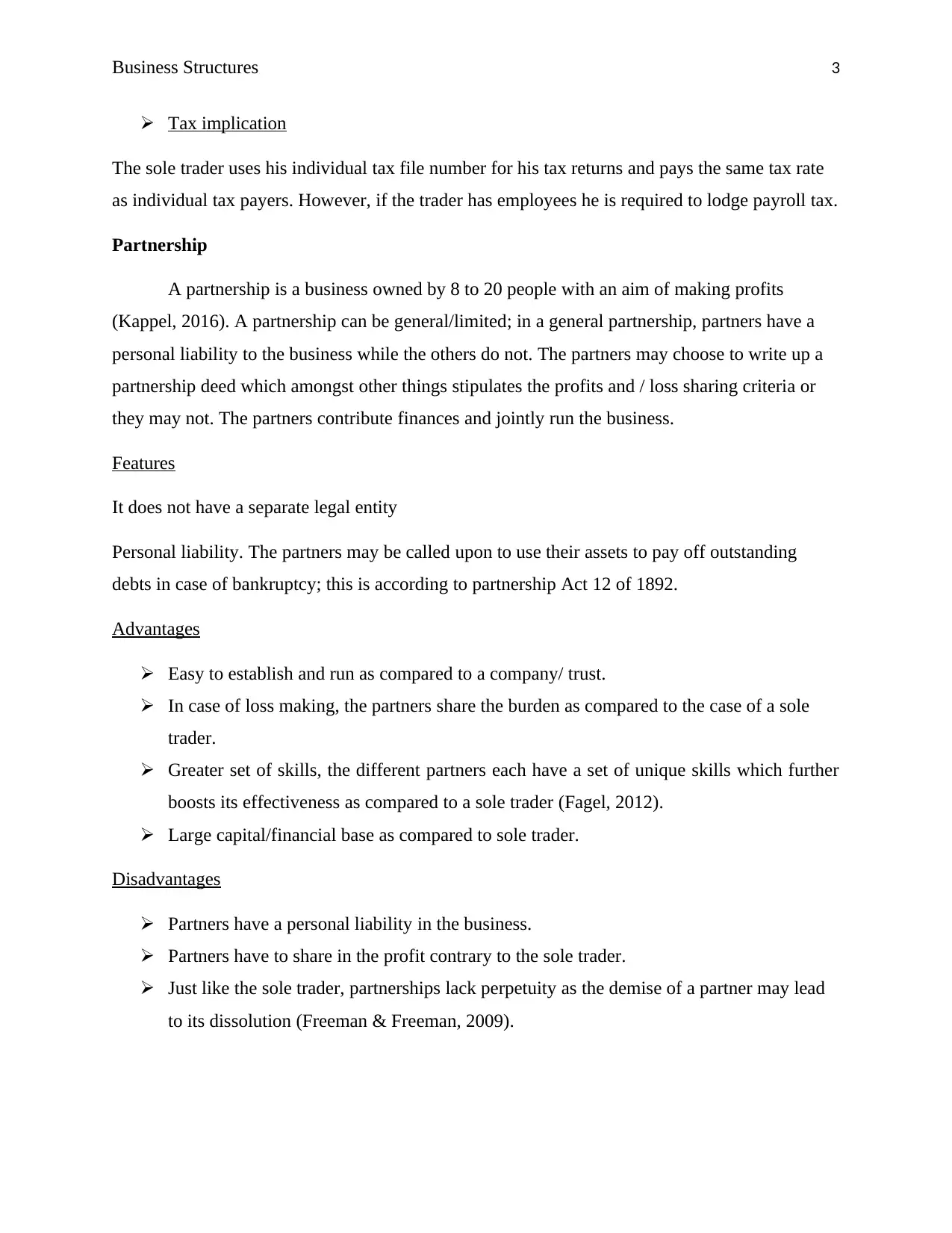
Tax implication
The sole trader uses his individual tax file number for his tax returns and pays the same tax rate
as individual tax payers. However, if the trader has employees he is required to lodge payroll tax.
Partnership
A partnership is a business owned by 8 to 20 people with an aim of making profits
(Kappel, 2016). A partnership can be general/limited; in a general partnership, partners have a
personal liability to the business while the others do not. The partners may choose to write up a
partnership deed which amongst other things stipulates the profits and / loss sharing criteria or
they may not. The partners contribute finances and jointly run the business.
Features
It does not have a separate legal entity
Personal liability. The partners may be called upon to use their assets to pay off outstanding
debts in case of bankruptcy; this is according to partnership Act 12 of 1892.
Advantages
Easy to establish and run as compared to a company/ trust.
In case of loss making, the partners share the burden as compared to the case of a sole
trader.
Greater set of skills, the different partners each have a set of unique skills which further
boosts its effectiveness as compared to a sole trader (Fagel, 2012).
Large capital/financial base as compared to sole trader.
Disadvantages
Partners have a personal liability in the business.
Partners have to share in the profit contrary to the sole trader.
Just like the sole trader, partnerships lack perpetuity as the demise of a partner may lead
to its dissolution (Freeman & Freeman, 2009).
Tax implication
The sole trader uses his individual tax file number for his tax returns and pays the same tax rate
as individual tax payers. However, if the trader has employees he is required to lodge payroll tax.
Partnership
A partnership is a business owned by 8 to 20 people with an aim of making profits
(Kappel, 2016). A partnership can be general/limited; in a general partnership, partners have a
personal liability to the business while the others do not. The partners may choose to write up a
partnership deed which amongst other things stipulates the profits and / loss sharing criteria or
they may not. The partners contribute finances and jointly run the business.
Features
It does not have a separate legal entity
Personal liability. The partners may be called upon to use their assets to pay off outstanding
debts in case of bankruptcy; this is according to partnership Act 12 of 1892.
Advantages
Easy to establish and run as compared to a company/ trust.
In case of loss making, the partners share the burden as compared to the case of a sole
trader.
Greater set of skills, the different partners each have a set of unique skills which further
boosts its effectiveness as compared to a sole trader (Fagel, 2012).
Large capital/financial base as compared to sole trader.
Disadvantages
Partners have a personal liability in the business.
Partners have to share in the profit contrary to the sole trader.
Just like the sole trader, partnerships lack perpetuity as the demise of a partner may lead
to its dissolution (Freeman & Freeman, 2009).
⊘ This is a preview!⊘
Do you want full access?
Subscribe today to unlock all pages.

Trusted by 1+ million students worldwide

Business Structures 4
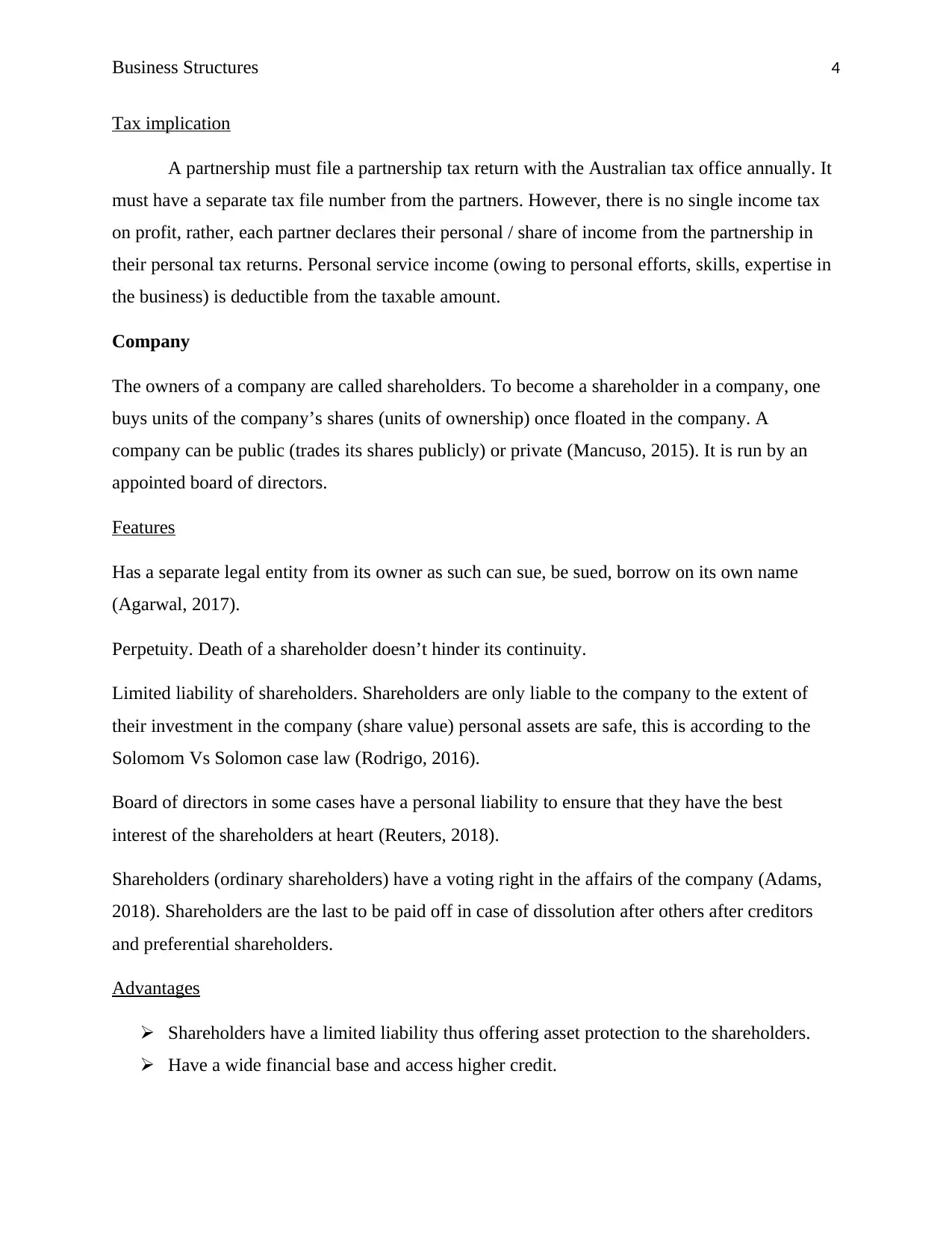
Tax implication
A partnership must file a partnership tax return with the Australian tax office annually. It
must have a separate tax file number from the partners. However, there is no single income tax
on profit, rather, each partner declares their personal / share of income from the partnership in
their personal tax returns. Personal service income (owing to personal efforts, skills, expertise in
the business) is deductible from the taxable amount.
Company
The owners of a company are called shareholders. To become a shareholder in a company, one
buys units of the company’s shares (units of ownership) once floated in the company. A
company can be public (trades its shares publicly) or private (Mancuso, 2015). It is run by an
appointed board of directors.
Features
Has a separate legal entity from its owner as such can sue, be sued, borrow on its own name
(Agarwal, 2017).
Perpetuity. Death of a shareholder doesn’t hinder its continuity.
Limited liability of shareholders. Shareholders are only liable to the company to the extent of
their investment in the company (share value) personal assets are safe, this is according to the
Solomom Vs Solomon case law (Rodrigo, 2016).
Board of directors in some cases have a personal liability to ensure that they have the best
interest of the shareholders at heart (Reuters, 2018).
Shareholders (ordinary shareholders) have a voting right in the affairs of the company (Adams,
2018). Shareholders are the last to be paid off in case of dissolution after others after creditors
and preferential shareholders.
Advantages
Shareholders have a limited liability thus offering asset protection to the shareholders.
Have a wide financial base and access higher credit.
Tax implication
A partnership must file a partnership tax return with the Australian tax office annually. It
must have a separate tax file number from the partners. However, there is no single income tax
on profit, rather, each partner declares their personal / share of income from the partnership in
their personal tax returns. Personal service income (owing to personal efforts, skills, expertise in
the business) is deductible from the taxable amount.
Company
The owners of a company are called shareholders. To become a shareholder in a company, one
buys units of the company’s shares (units of ownership) once floated in the company. A
company can be public (trades its shares publicly) or private (Mancuso, 2015). It is run by an
appointed board of directors.
Features
Has a separate legal entity from its owner as such can sue, be sued, borrow on its own name
(Agarwal, 2017).
Perpetuity. Death of a shareholder doesn’t hinder its continuity.
Limited liability of shareholders. Shareholders are only liable to the company to the extent of
their investment in the company (share value) personal assets are safe, this is according to the
Solomom Vs Solomon case law (Rodrigo, 2016).
Board of directors in some cases have a personal liability to ensure that they have the best
interest of the shareholders at heart (Reuters, 2018).
Shareholders (ordinary shareholders) have a voting right in the affairs of the company (Adams,
2018). Shareholders are the last to be paid off in case of dissolution after others after creditors
and preferential shareholders.
Advantages
Shareholders have a limited liability thus offering asset protection to the shareholders.
Have a wide financial base and access higher credit.
Paraphrase This Document
Need a fresh take? Get an instant paraphrase of this document with our AI Paraphraser

Business Structures 5
Can hire experts and professionals and as such ensure efficient management and
consequently more profits.
Capacity to contract
Can sue and be sued in its own name
Perpetual succession
Disadvantages
Slow decision making as compared to sole traders since a board meeting must be called
for before any decisions are arrived to.
More expensive to establish and run.
Shareholders have less control over the company as it is directly controlled by the
directors.
They are subject to too many legal formalities thus, are less flexible
They are subject to undue publicity
Corporate taxes; tax levied
Participation by strangers; members other than directors are actively involved in the day
to day affairs of the company.
Tax implication
Must have a tax file number which is used in submitting its annual tax returns which must be
done annually. A company usually pays its income tax by installments through the pay as you go
by stem (system where installments of expected tax liability on businesses and investments in a
financial are paid.)
The company’s income is taxed at the company’s tax rate.
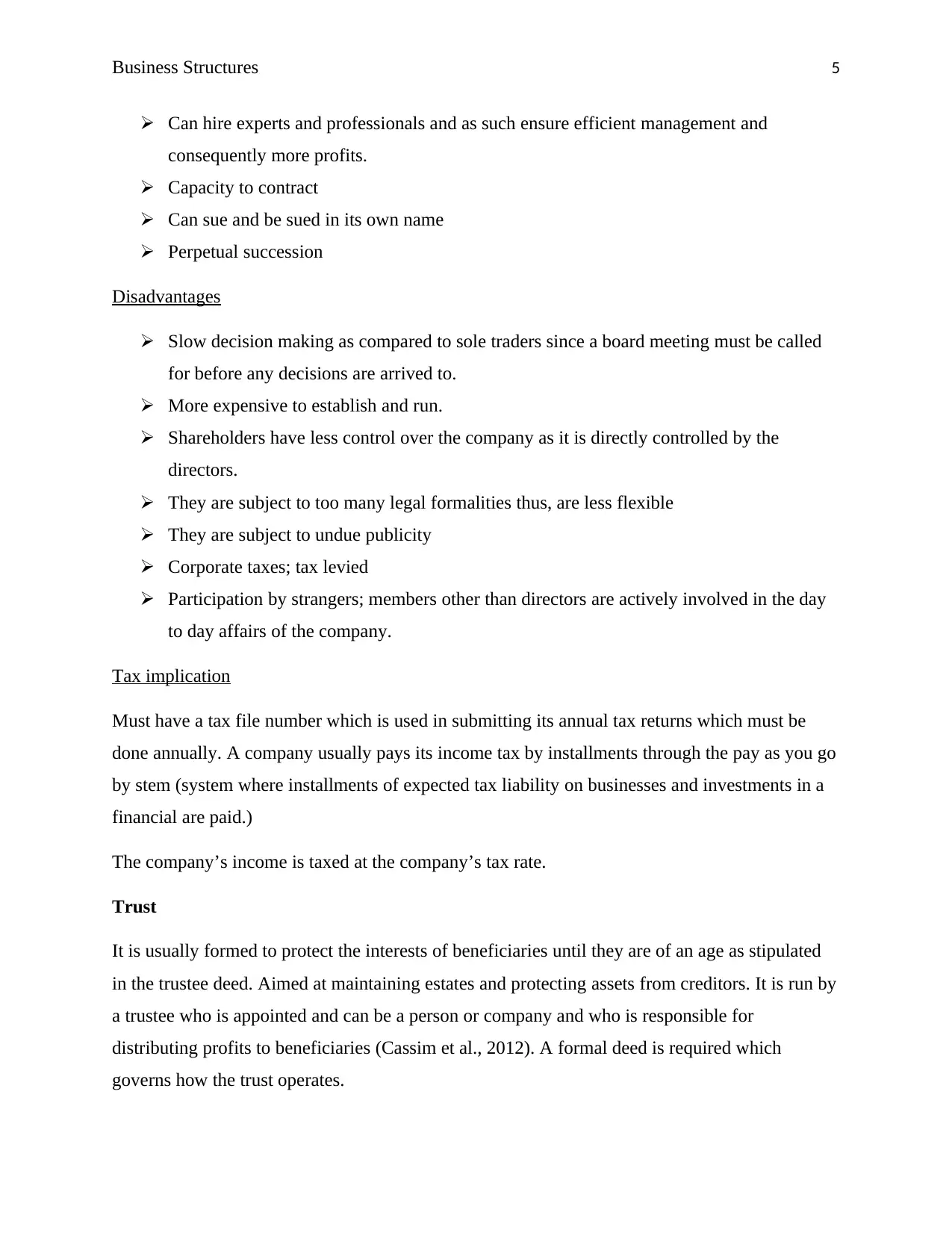
Trust
It is usually formed to protect the interests of beneficiaries until they are of an age as stipulated
in the trustee deed. Aimed at maintaining estates and protecting assets from creditors. It is run by
a trustee who is appointed and can be a person or company and who is responsible for
distributing profits to beneficiaries (Cassim et al., 2012). A formal deed is required which
governs how the trust operates.
Can hire experts and professionals and as such ensure efficient management and
consequently more profits.
Capacity to contract
Can sue and be sued in its own name
Perpetual succession
Disadvantages
Slow decision making as compared to sole traders since a board meeting must be called
for before any decisions are arrived to.
More expensive to establish and run.
Shareholders have less control over the company as it is directly controlled by the
directors.
They are subject to too many legal formalities thus, are less flexible
They are subject to undue publicity
Corporate taxes; tax levied
Participation by strangers; members other than directors are actively involved in the day
to day affairs of the company.
Tax implication
Must have a tax file number which is used in submitting its annual tax returns which must be
done annually. A company usually pays its income tax by installments through the pay as you go
by stem (system where installments of expected tax liability on businesses and investments in a
financial are paid.)
The company’s income is taxed at the company’s tax rate.
Trust
It is usually formed to protect the interests of beneficiaries until they are of an age as stipulated
in the trustee deed. Aimed at maintaining estates and protecting assets from creditors. It is run by
a trustee who is appointed and can be a person or company and who is responsible for
distributing profits to beneficiaries (Cassim et al., 2012). A formal deed is required which
governs how the trust operates.

Business Structures 6
Advantages.
Beneficiaries enjoy limited liability in the case an appointed corporate trustee acts
solvently.
Avoids the cost and delay of probate (where the validity of a will is determined)
Ensures continuity in the management of the trust should disability or death of the
founder passes through the appointed trustee (Mokosak, 2014).
The founder remains in control of the trust so long as he/she is alive and able.
Offers more privacy than a company.
Disadvantages
It is complex to establish and run.
It is an expensive form of structure.
Borrowing to expand its operations is complicated by the additional complexities of its
loan borrowing process.
The trustees’ power is limited by the trust deed making flexibility rather difficult.
Tax implication
Must have its own file for reporting annual tax returns, apply for an Australian business number.
It may be liable to pay tax depending on the deed (how the income is distributed between to the
beneficiaries).
For instance, if all income goes to adult resident beneficiaries, the trust is not liable to taxation as
the beneficiaries are bound to declare that income in their own taxable income.
However, if the beneficiaries are minors then, the trustee is assessed on behalf of the beneficiary.
In case benefits are accumulated, then the trustee is still assessed on the total income which is
charged at the highest individual tax rate.
The Best Business Structure
The best structure for Susan and Mustafa to adopt is the company reasons being; Even if
they start the business as a partnership as seems to be their stand, they intend to open it up to
broaden the horizon. If they go the company way, they will have a higher capacity for growth
owing to the fact that financially there would be plenty from the shareholders which they could
Advantages.
Beneficiaries enjoy limited liability in the case an appointed corporate trustee acts
solvently.
Avoids the cost and delay of probate (where the validity of a will is determined)
Ensures continuity in the management of the trust should disability or death of the
founder passes through the appointed trustee (Mokosak, 2014).
The founder remains in control of the trust so long as he/she is alive and able.
Offers more privacy than a company.
Disadvantages
It is complex to establish and run.
It is an expensive form of structure.
Borrowing to expand its operations is complicated by the additional complexities of its
loan borrowing process.
The trustees’ power is limited by the trust deed making flexibility rather difficult.
Tax implication
Must have its own file for reporting annual tax returns, apply for an Australian business number.
It may be liable to pay tax depending on the deed (how the income is distributed between to the
beneficiaries).
For instance, if all income goes to adult resident beneficiaries, the trust is not liable to taxation as
the beneficiaries are bound to declare that income in their own taxable income.
However, if the beneficiaries are minors then, the trustee is assessed on behalf of the beneficiary.
In case benefits are accumulated, then the trustee is still assessed on the total income which is
charged at the highest individual tax rate.
The Best Business Structure
The best structure for Susan and Mustafa to adopt is the company reasons being; Even if
they start the business as a partnership as seems to be their stand, they intend to open it up to
broaden the horizon. If they go the company way, they will have a higher capacity for growth
owing to the fact that financially there would be plenty from the shareholders which they could
⊘ This is a preview!⊘
Do you want full access?
Subscribe today to unlock all pages.

Trusted by 1+ million students worldwide

Business Structures 7
also gear up with credit from financial institutions to ensure optimum funds to pursue their goals
and objectives. This is not (or may not) be possible with the other structures. In the company
structure Susan and Mustafa and the other shareholders will be able to enjoy limited liability and
as such may be able to take on some calculated gambles that they would normally under the case
of partnership shun due to their personal liability. They will have asset protection in this
structure. Due to the availability of capital, they will be able to maximize on its resources e.g.
human resource to ensure effectiveness and efficient management and processes and
consequently profitability.
also gear up with credit from financial institutions to ensure optimum funds to pursue their goals
and objectives. This is not (or may not) be possible with the other structures. In the company
structure Susan and Mustafa and the other shareholders will be able to enjoy limited liability and
as such may be able to take on some calculated gambles that they would normally under the case
of partnership shun due to their personal liability. They will have asset protection in this
structure. Due to the availability of capital, they will be able to maximize on its resources e.g.
human resource to ensure effectiveness and efficient management and processes and
consequently profitability.
Paraphrase This Document
Need a fresh take? Get an instant paraphrase of this document with our AI Paraphraser

Business Structures 8
References
Adams, D. (2018). Five Main Characteristics of a Corporation in Accounting. Retrieved from
http://smallbusiness.chron.com/five-main-characteristics-corporation-accounting-
20579.html.
Agarwal, K. (2017). Top 10 Characteristics of a Company – Discussed! Retrieved from
http://www.yourarticlelibrary.com/accounting/company-accounts/top-10-characteristics-
of-a-company-discussed/46805.
Cassim, F., Cassim, M. F., Cassim, R., Jooste, R. D., Shev, J., & Yeats, J. (2012). The Law of
Business Structures. Claremont [South Africa]: Juta.
Fagel, M. (2012). Principles of emergency management. Boca Raton: CRC Press/Taylor &
Francis Group.
Freeman, S., & Freeman, J. (2009). Financial Accounting. Melbourne: P.Ed Australia.
Kappel, M. (2016). Types of Business Structures. Retrieved from
https://www.patriotsoftware.com/accounting/training/blog/a-guide-to-basic-business-
structures/.
Mancuso, A. (2015). Incorporate your business, [2015]: [a step-by-step guide to forming a
corporation in any state]. Berkeley, California: Nolo.
Mokosak, F. (2014). Advantages and disadvantages of trusts. Retrieved from
https://www.desmoinesregister.com/story/money/2014/03/31/advantages-disadvantages-
trusts/7141729/.
Reuters, T. (2018). Types of Business Structures. Retrieved from
https://smallbusiness.findlaw.com/incorporation-and-legal-structures/types-of-business-
structures.html.
Rodrigo. (2016). The Doctrine Of Separate Legal Entity: A Case Of Salomon Vs Salomon & Co Ltd – The
WritePass Journal. Retrieved from https://writepass.com/journal/2016/11/the-doctrine-of-
separate-legal-entity-a-case-of-salomon-vs-salomon-co-ltd/Smallbusinessbc.ca. (2016).
Choose the Right Business Structure for Your Business. Retrieved from
https://smallbusinessbc.ca/article/how-to-choose-the-right-business-structure-for-your-
small-business/.
Trakin, C. (2010). Choosing the right legal form of business: the complete guide to becoming a
sole proprietor, partnership, LLC, or corporation. Ocala, Fla, Atlantic Pub. Group.
References
Adams, D. (2018). Five Main Characteristics of a Corporation in Accounting. Retrieved from
http://smallbusiness.chron.com/five-main-characteristics-corporation-accounting-
20579.html.
Agarwal, K. (2017). Top 10 Characteristics of a Company – Discussed! Retrieved from
http://www.yourarticlelibrary.com/accounting/company-accounts/top-10-characteristics-
of-a-company-discussed/46805.
Cassim, F., Cassim, M. F., Cassim, R., Jooste, R. D., Shev, J., & Yeats, J. (2012). The Law of
Business Structures. Claremont [South Africa]: Juta.
Fagel, M. (2012). Principles of emergency management. Boca Raton: CRC Press/Taylor &
Francis Group.
Freeman, S., & Freeman, J. (2009). Financial Accounting. Melbourne: P.Ed Australia.
Kappel, M. (2016). Types of Business Structures. Retrieved from
https://www.patriotsoftware.com/accounting/training/blog/a-guide-to-basic-business-
structures/.
Mancuso, A. (2015). Incorporate your business, [2015]: [a step-by-step guide to forming a
corporation in any state]. Berkeley, California: Nolo.
Mokosak, F. (2014). Advantages and disadvantages of trusts. Retrieved from
https://www.desmoinesregister.com/story/money/2014/03/31/advantages-disadvantages-
trusts/7141729/.
Reuters, T. (2018). Types of Business Structures. Retrieved from
https://smallbusiness.findlaw.com/incorporation-and-legal-structures/types-of-business-
structures.html.
Rodrigo. (2016). The Doctrine Of Separate Legal Entity: A Case Of Salomon Vs Salomon & Co Ltd – The
WritePass Journal. Retrieved from https://writepass.com/journal/2016/11/the-doctrine-of-
separate-legal-entity-a-case-of-salomon-vs-salomon-co-ltd/Smallbusinessbc.ca. (2016).
Choose the Right Business Structure for Your Business. Retrieved from
https://smallbusinessbc.ca/article/how-to-choose-the-right-business-structure-for-your-
small-business/.
Trakin, C. (2010). Choosing the right legal form of business: the complete guide to becoming a
sole proprietor, partnership, LLC, or corporation. Ocala, Fla, Atlantic Pub. Group.
1 out of 8
Related Documents
Your All-in-One AI-Powered Toolkit for Academic Success.
+13062052269
info@desklib.com
Available 24*7 on WhatsApp / Email
Unlock your academic potential
Copyright © 2020–2025 A2Z Services. All Rights Reserved. Developed and managed by ZUCOL.