Leadership, Team Development, and Motivation Report for U Select
VerifiedAdded on 2023/04/24
|23
|5599
|491
Report
AI Summary
This report, prepared for U Select, delves into the critical aspects of team development, leadership, and employee motivation. It begins with an executive summary and introduction outlining the report's purpose: to analyze team composition, assess team roles using Belbin's model, and evaluate managerial styles through Blake and Mouton's grid. The report then examines leadership and team formation using Adair's action-centered model and Tuckman's stages of team development. Furthermore, it explores employee motivation, applying Herzberg's and Maslow's motivational tools. The analysis focuses on the customer service team within U Select, a supermarket chain, and provides recommendations for enhancing team performance, communication, and conflict resolution. The report suggests implementing monitoring systems based on the forming and norming stages of team development and emphasizes the importance of showing concern for team members to boost motivation and achieve organizational objectives.
Running head: MANAGEMENT
Management
Name of the Student
Name of the University
Author Note
Management
Name of the Student
Name of the University
Author Note

Paraphrase This Document
Need a fresh take? Get an instant paraphrase of this document with our AI Paraphraser
1
MANAGEMENT
Table of Contents
Executive Summary...................................................................................................................2
Introduction................................................................................................................................2
Team features and composition.................................................................................................3
Importance of team roles............................................................................................................3
Team role using Belbin..........................................................................................................3
Manager’s role Blake and Mouton.........................................................................................4
Leadership and team formation..................................................................................................7
Employee motivation...............................................................................................................10
Use of motivational tools......................................................................................................10
Encouragement of communication tools..............................................................................15
Conflicts between team members.........................................................................................16
Team performance monitoring and improvement plan............................................................16
Conclusion................................................................................................................................18
Bibliography.............................................................................................................................19
MANAGEMENT
Table of Contents
Executive Summary...................................................................................................................2
Introduction................................................................................................................................2
Team features and composition.................................................................................................3
Importance of team roles............................................................................................................3
Team role using Belbin..........................................................................................................3
Manager’s role Blake and Mouton.........................................................................................4
Leadership and team formation..................................................................................................7
Employee motivation...............................................................................................................10
Use of motivational tools......................................................................................................10
Encouragement of communication tools..............................................................................15
Conflicts between team members.........................................................................................16
Team performance monitoring and improvement plan............................................................16
Conclusion................................................................................................................................18
Bibliography.............................................................................................................................19
2
MANAGEMENT
Executive Summary
The report focuses on the team development and the importance motivation as well as
leadership has on U Select. An analysis is made by using models such as Belbin’s team role,
Tuckman’s theory as well as motivation models that include the application of Herzberg’s
and Maslow’s model. Recommendations for the monitoring and implementation of the plans
can be associated with the development of monitoring systems based on the analysis of the
forming stage and its development to the norming stage. At the same time, showing concerns
for the team members can be considered as an important matter of development of motivation
among employees.
Introduction
The purpose of the report is to identify the importance of the development of a team
and the manner in which proper team composition can help in the development of an
organisation. At the same time motivation and leadership within a team is also highlighted
which helps in the analysis of the importance of teams. The importance of building and
developing a successful team in an organisation is that it can help in improving the
productivity and likewise can build a sense of unity among the employees. The focus is on
the development of teams in an organisation like U Select, a leading chain of supermarket
located in Hong Kong (Uselect.com.hk 2019). China Resources Vanguard along with Tesco
jointly ventures U Select. One third of the product of the company comes from the store in
Tesco (Uselect.com.hk 2019). In total, there are about 37 stores in Hong Kong
(Uselect.com.hk 2019). The reason for the importance of team development in the
organisation is that it can help in building up coordination among one the employees. The
assignment provides an analysis of team development, leadership as well as motivation
among the employees.
MANAGEMENT
Executive Summary
The report focuses on the team development and the importance motivation as well as
leadership has on U Select. An analysis is made by using models such as Belbin’s team role,
Tuckman’s theory as well as motivation models that include the application of Herzberg’s
and Maslow’s model. Recommendations for the monitoring and implementation of the plans
can be associated with the development of monitoring systems based on the analysis of the
forming stage and its development to the norming stage. At the same time, showing concerns
for the team members can be considered as an important matter of development of motivation
among employees.
Introduction
The purpose of the report is to identify the importance of the development of a team
and the manner in which proper team composition can help in the development of an
organisation. At the same time motivation and leadership within a team is also highlighted
which helps in the analysis of the importance of teams. The importance of building and
developing a successful team in an organisation is that it can help in improving the
productivity and likewise can build a sense of unity among the employees. The focus is on
the development of teams in an organisation like U Select, a leading chain of supermarket
located in Hong Kong (Uselect.com.hk 2019). China Resources Vanguard along with Tesco
jointly ventures U Select. One third of the product of the company comes from the store in
Tesco (Uselect.com.hk 2019). In total, there are about 37 stores in Hong Kong
(Uselect.com.hk 2019). The reason for the importance of team development in the
organisation is that it can help in building up coordination among one the employees. The
assignment provides an analysis of team development, leadership as well as motivation
among the employees.
⊘ This is a preview!⊘
Do you want full access?
Subscribe today to unlock all pages.

Trusted by 1+ million students worldwide
3
MANAGEMENT
Team features and composition
The team that can be analysed within the organisation includes the customer service
team, the role of which is to assist the customers to purchase as well as identify the products.
The team composition consists of both experienced as well as young employees so that they
can guide the customers in a proper manner and enrich the quality of services that is
perceived for the organisation (Uselect.com.hk 2019). The success of the team can help in
bringing about an increase in the recognition of U Select and at the same time provide a
positive word for the development of the organisation among the customers (Uselect.com.hk
2019). It is necessary that the team helps one another and maintain coordination between one
another so that they can fulfil the requirements of the customers. Not only that working
together can bring about the attainment of organisational objectives which can help U Select
to retain its success at the Hong Kong market (Uselect.com.hk 2019). Thus, it can be said that
the team features along with the composition can bring about success as well as develop a
sense of competence among the team members. In this regard, an analysis can be made about
the importance of team roles.
Importance of team roles
Team role using Belbin
Belbin had identified 9 roles that can be used effectively to analyse the strengths and
weakness of a team composition. Each of the members of a team is provided with various
responsibilities that pertain to the characteristics of the employees. It helps in the
development of a team as a tendency to behave, contribute and interrelate with others in a
particular manner. As observed by Kearney (2018) Belbin’s model consists of three-action
orientated role, which includes the shaper, implementer and the completer. As stated by
Steers and Sánchez‐Runde (2017) it also includes three people orientated role such as team
MANAGEMENT
Team features and composition
The team that can be analysed within the organisation includes the customer service
team, the role of which is to assist the customers to purchase as well as identify the products.
The team composition consists of both experienced as well as young employees so that they
can guide the customers in a proper manner and enrich the quality of services that is
perceived for the organisation (Uselect.com.hk 2019). The success of the team can help in
bringing about an increase in the recognition of U Select and at the same time provide a
positive word for the development of the organisation among the customers (Uselect.com.hk
2019). It is necessary that the team helps one another and maintain coordination between one
another so that they can fulfil the requirements of the customers. Not only that working
together can bring about the attainment of organisational objectives which can help U Select
to retain its success at the Hong Kong market (Uselect.com.hk 2019). Thus, it can be said that
the team features along with the composition can bring about success as well as develop a
sense of competence among the team members. In this regard, an analysis can be made about
the importance of team roles.
Importance of team roles
Team role using Belbin
Belbin had identified 9 roles that can be used effectively to analyse the strengths and
weakness of a team composition. Each of the members of a team is provided with various
responsibilities that pertain to the characteristics of the employees. It helps in the
development of a team as a tendency to behave, contribute and interrelate with others in a
particular manner. As observed by Kearney (2018) Belbin’s model consists of three-action
orientated role, which includes the shaper, implementer and the completer. As stated by
Steers and Sánchez‐Runde (2017) it also includes three people orientated role such as team
Paraphrase This Document
Need a fresh take? Get an instant paraphrase of this document with our AI Paraphraser
4
MANAGEMENT
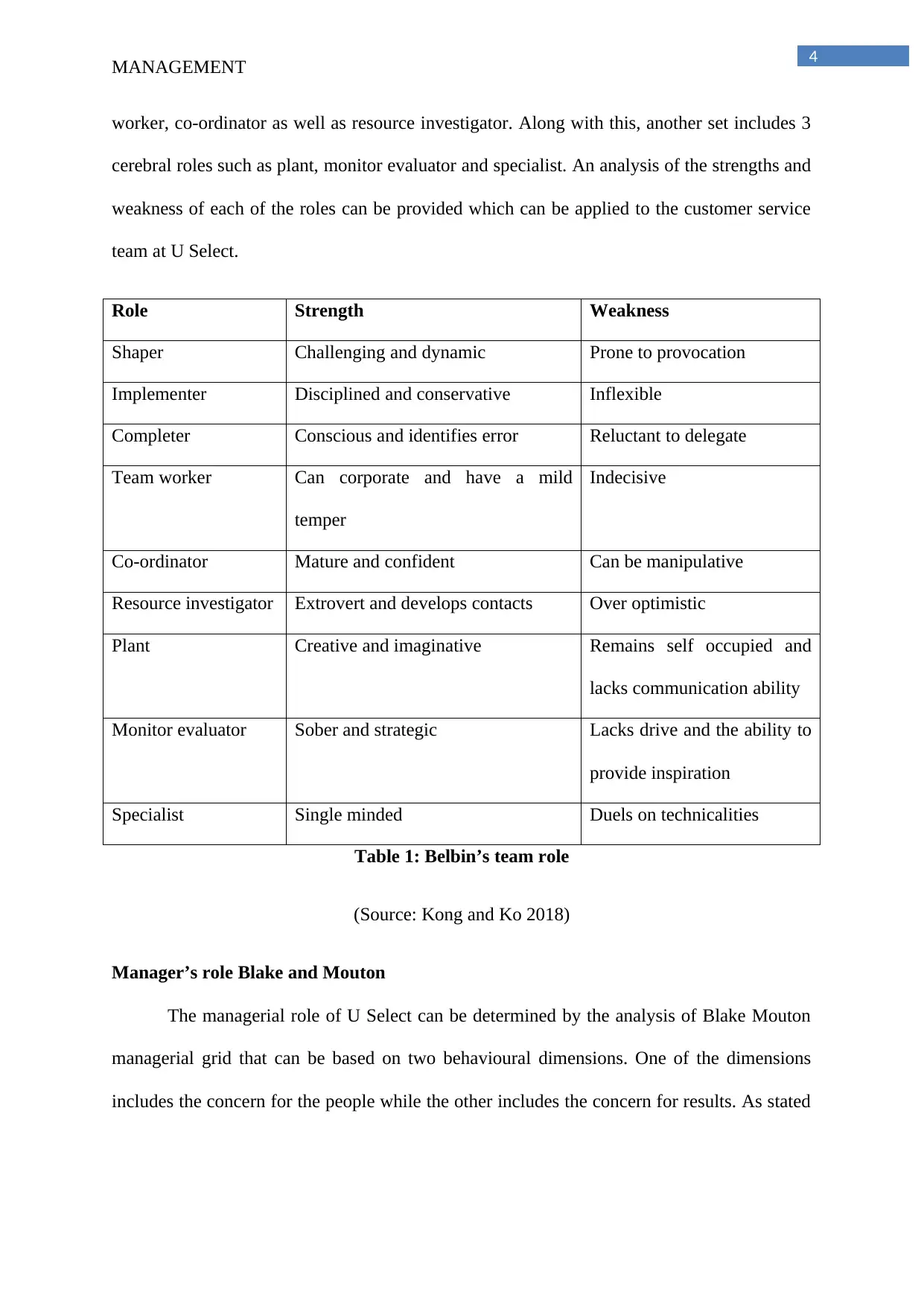
worker, co-ordinator as well as resource investigator. Along with this, another set includes 3
cerebral roles such as plant, monitor evaluator and specialist. An analysis of the strengths and
weakness of each of the roles can be provided which can be applied to the customer service
team at U Select.
Role Strength Weakness
Shaper Challenging and dynamic Prone to provocation
Implementer Disciplined and conservative Inflexible
Completer Conscious and identifies error Reluctant to delegate
Team worker Can corporate and have a mild
temper
Indecisive
Co-ordinator Mature and confident Can be manipulative
Resource investigator Extrovert and develops contacts Over optimistic
Plant Creative and imaginative Remains self occupied and
lacks communication ability
Monitor evaluator Sober and strategic Lacks drive and the ability to
provide inspiration
Specialist Single minded Duels on technicalities
Table 1: Belbin’s team role
(Source: Kong and Ko 2018)
Manager’s role Blake and Mouton
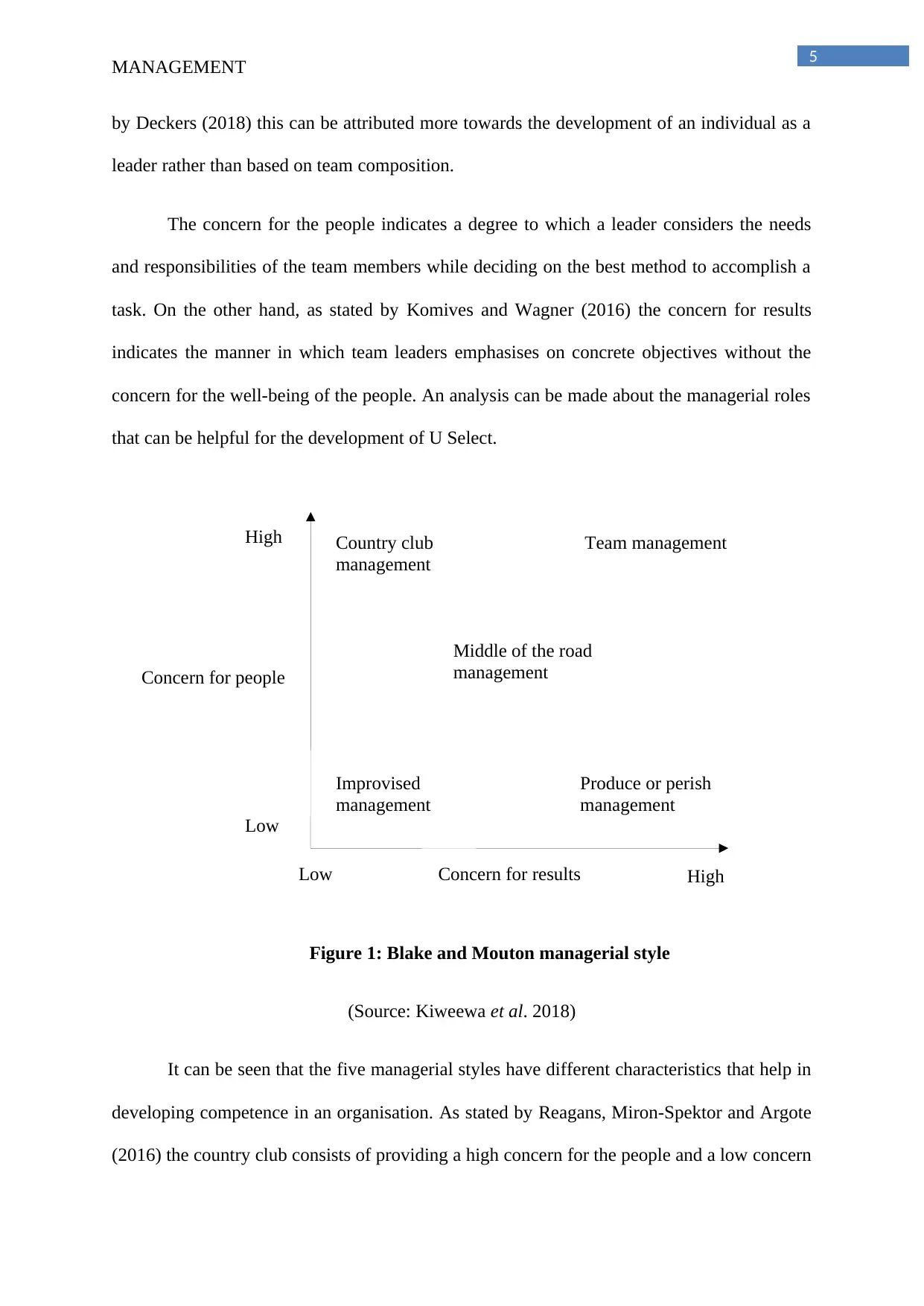
The managerial role of U Select can be determined by the analysis of Blake Mouton
managerial grid that can be based on two behavioural dimensions. One of the dimensions
includes the concern for the people while the other includes the concern for results. As stated
MANAGEMENT
worker, co-ordinator as well as resource investigator. Along with this, another set includes 3
cerebral roles such as plant, monitor evaluator and specialist. An analysis of the strengths and
weakness of each of the roles can be provided which can be applied to the customer service
team at U Select.
Role Strength Weakness
Shaper Challenging and dynamic Prone to provocation
Implementer Disciplined and conservative Inflexible
Completer Conscious and identifies error Reluctant to delegate
Team worker Can corporate and have a mild
temper
Indecisive
Co-ordinator Mature and confident Can be manipulative
Resource investigator Extrovert and develops contacts Over optimistic
Plant Creative and imaginative Remains self occupied and
lacks communication ability
Monitor evaluator Sober and strategic Lacks drive and the ability to
provide inspiration
Specialist Single minded Duels on technicalities
Table 1: Belbin’s team role
(Source: Kong and Ko 2018)
Manager’s role Blake and Mouton
The managerial role of U Select can be determined by the analysis of Blake Mouton
managerial grid that can be based on two behavioural dimensions. One of the dimensions
includes the concern for the people while the other includes the concern for results. As stated
5
High
Low
HighLow
Concern for people
Concern for results
Country club
management
Improvised
management
Team management
Produce or perish
management
Middle of the road
management
MANAGEMENT
by Deckers (2018) this can be attributed more towards the development of an individual as a
leader rather than based on team composition.
The concern for the people indicates a degree to which a leader considers the needs
and responsibilities of the team members while deciding on the best method to accomplish a
task. On the other hand, as stated by Komives and Wagner (2016) the concern for results
indicates the manner in which team leaders emphasises on concrete objectives without the
concern for the well-being of the people. An analysis can be made about the managerial roles
that can be helpful for the development of U Select.
Figure 1: Blake and Mouton managerial style
(Source: Kiweewa et al. 2018)
It can be seen that the five managerial styles have different characteristics that help in
developing competence in an organisation. As stated by Reagans, Miron-Spektor and Argote
(2016) the country club consists of providing a high concern for the people and a low concern
High
Low
HighLow
Concern for people
Concern for results
Country club
management
Improvised
management
Team management
Produce or perish
management
Middle of the road
management
MANAGEMENT
by Deckers (2018) this can be attributed more towards the development of an individual as a
leader rather than based on team composition.
The concern for the people indicates a degree to which a leader considers the needs
and responsibilities of the team members while deciding on the best method to accomplish a
task. On the other hand, as stated by Komives and Wagner (2016) the concern for results
indicates the manner in which team leaders emphasises on concrete objectives without the
concern for the well-being of the people. An analysis can be made about the managerial roles
that can be helpful for the development of U Select.
Figure 1: Blake and Mouton managerial style
(Source: Kiweewa et al. 2018)
It can be seen that the five managerial styles have different characteristics that help in
developing competence in an organisation. As stated by Reagans, Miron-Spektor and Argote
(2016) the country club consists of providing a high concern for the people and a low concern
⊘ This is a preview!⊘
Do you want full access?
Subscribe today to unlock all pages.
Trusted by 1+ million students worldwide
6
MANAGEMENT
for the results. This may result in the attainment of poor quality as well as productivity
among the organisations.
On the other hand, the team management is balanced perfectly as it provides high
concern for both the employees as well as the results. Hence, Riskin et al. (2016) stated that
this can be considered as a highly motivating managerial style and takes care of the people
keeping in mind the quality of the results that are to be adopted for the development of the
organisation.
The improvised manager has low concern for the employees as well as the results
(Gross 2016). Such organisations do not last for long due to the lack of motivation that exists
within the organisation. Such managers are more vulnerable for failing to continue with the
managerial systems required for success.
According to Soetanto and MacDonald (2017), the produce or perish management
style, has high concern for the results but not so for the people. This can be considered as
another low motivating factor that can be associated with a poor managerial concern and at
the same time lead to an excess turnover rate of the employees. The employees may feel
stressed due to excessive workload.
The middle of the road managers maintains a balance between the concern for the
people as well as the results. As stated by Raes et al. (2015) these managers need mediocre
work and ensure that employees are kept a little more than healthy so that the desired quality
can be maintained.
Based on the analysis, it can be said for U Select the best managerial role that can be
followed is the team management so that a high result and a high concern for the people can
MANAGEMENT
for the results. This may result in the attainment of poor quality as well as productivity
among the organisations.
On the other hand, the team management is balanced perfectly as it provides high
concern for both the employees as well as the results. Hence, Riskin et al. (2016) stated that
this can be considered as a highly motivating managerial style and takes care of the people
keeping in mind the quality of the results that are to be adopted for the development of the
organisation.
The improvised manager has low concern for the employees as well as the results
(Gross 2016). Such organisations do not last for long due to the lack of motivation that exists
within the organisation. Such managers are more vulnerable for failing to continue with the
managerial systems required for success.
According to Soetanto and MacDonald (2017), the produce or perish management
style, has high concern for the results but not so for the people. This can be considered as
another low motivating factor that can be associated with a poor managerial concern and at
the same time lead to an excess turnover rate of the employees. The employees may feel
stressed due to excessive workload.
The middle of the road managers maintains a balance between the concern for the
people as well as the results. As stated by Raes et al. (2015) these managers need mediocre
work and ensure that employees are kept a little more than healthy so that the desired quality
can be maintained.
Based on the analysis, it can be said for U Select the best managerial role that can be
followed is the team management so that a high result and a high concern for the people can
Paraphrase This Document
Need a fresh take? Get an instant paraphrase of this document with our AI Paraphraser
7
MANAGEMENT
be shown (Uselect.com.hk 2019). Therefore, it is necessary to understand the formation of
the teams and the leadership qualities required.
Leadership and team formation
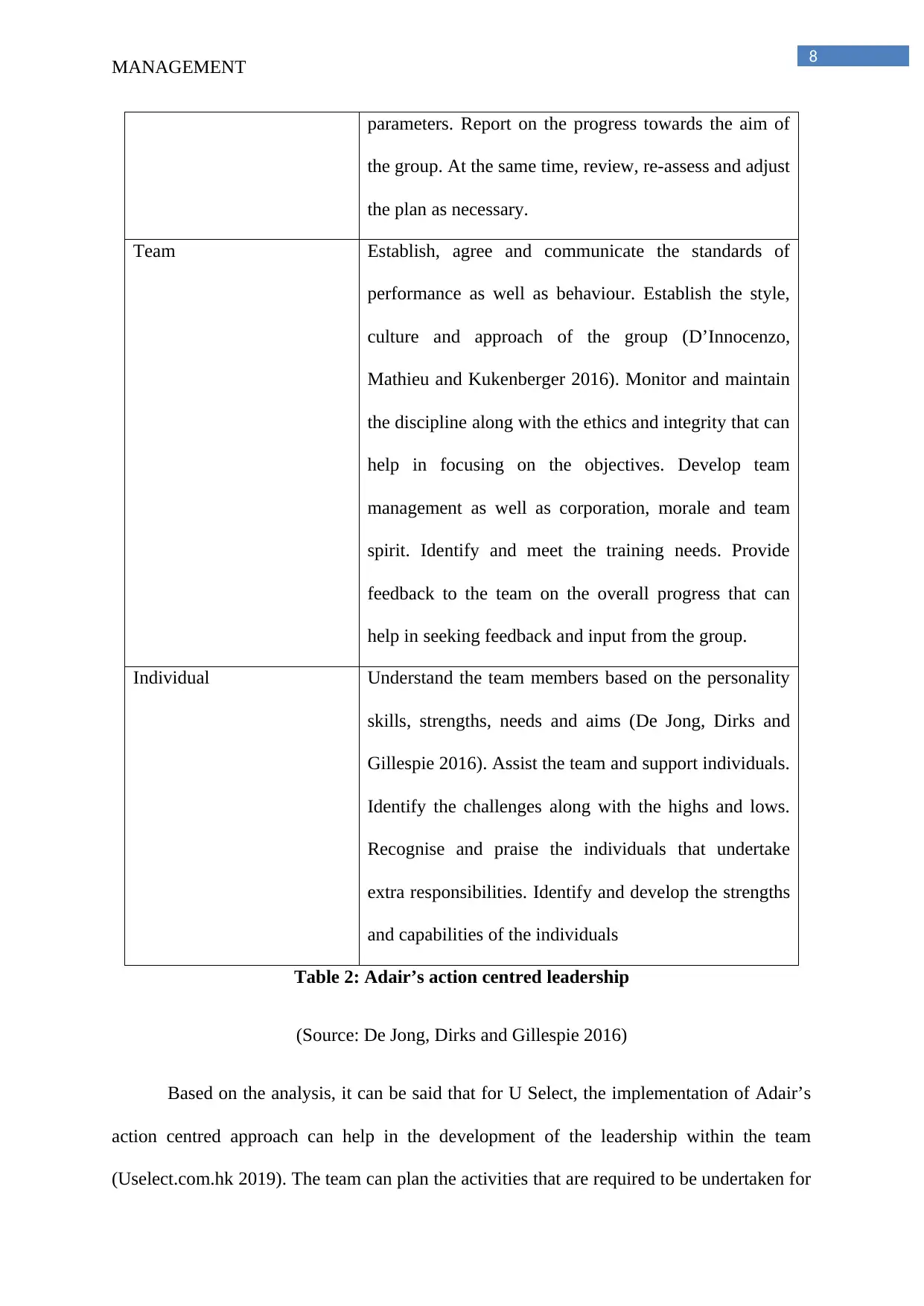
The implementation of John Adair’s action centred model on leadership and team
formation can help in understanding a simple blue print of the management and leadership
styles that need to be applied in teams. The model consists of three core management
responsibilities of Adair and consists of three circles, which includes achieving the task,
managing the team as well as managing the individuals.
Figure 2: Adair’s action centred leadership
(Source: D’Innocenzo, Mathieu and Kukenberger 2016)
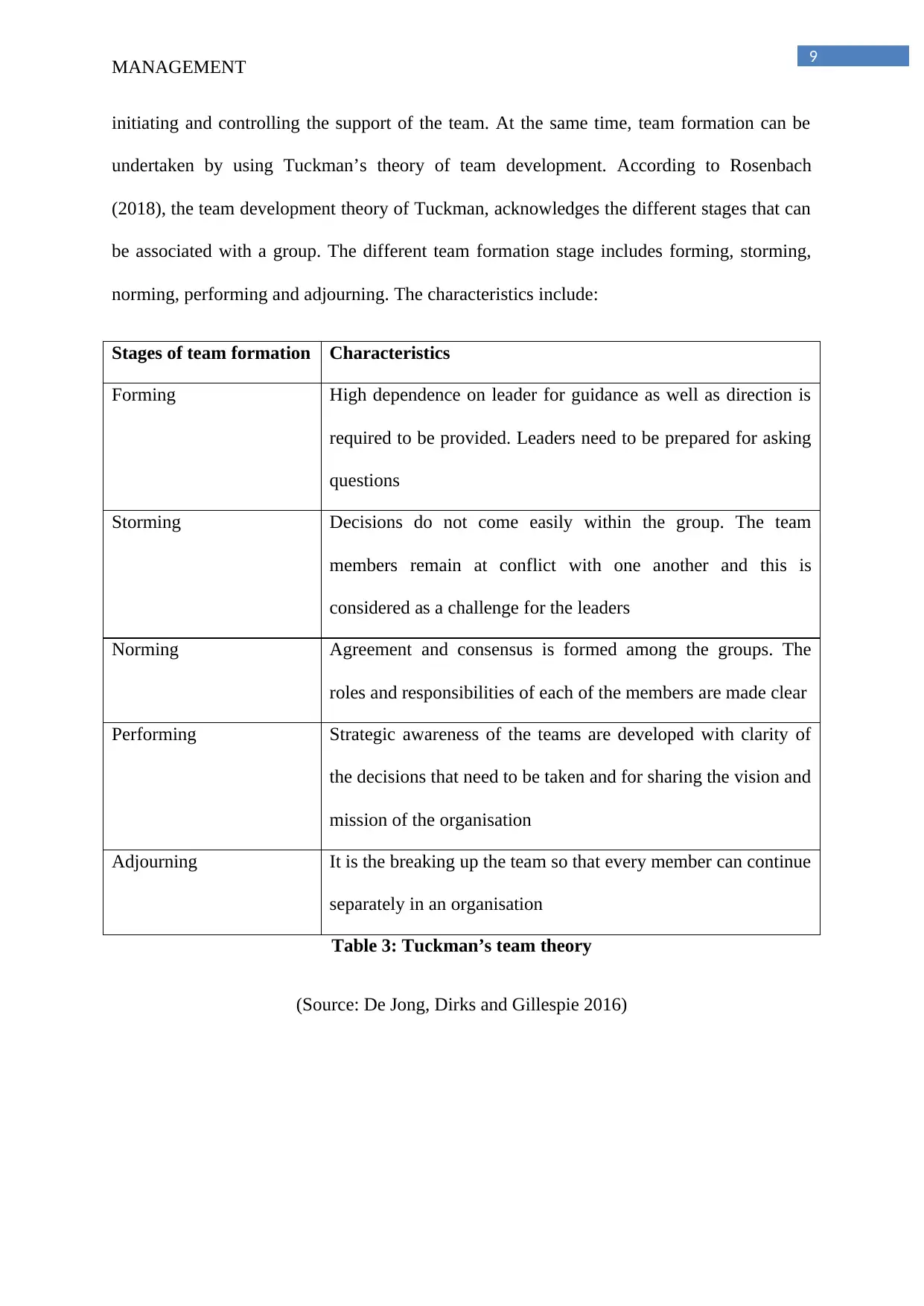
Managerial responsibilities Characteristics
Task Identify the aims and vision of the group along with the
purpose and direction. Defining the activity is
necessary. The resources can be identified as well,
which includes people, processes as well as systems and
tools. Set standards, quality, and time and reporting
TaskTeamIndividual
MANAGEMENT
be shown (Uselect.com.hk 2019). Therefore, it is necessary to understand the formation of
the teams and the leadership qualities required.
Leadership and team formation
The implementation of John Adair’s action centred model on leadership and team
formation can help in understanding a simple blue print of the management and leadership
styles that need to be applied in teams. The model consists of three core management
responsibilities of Adair and consists of three circles, which includes achieving the task,
managing the team as well as managing the individuals.
Figure 2: Adair’s action centred leadership
(Source: D’Innocenzo, Mathieu and Kukenberger 2016)
Managerial responsibilities Characteristics
Task Identify the aims and vision of the group along with the
purpose and direction. Defining the activity is
necessary. The resources can be identified as well,
which includes people, processes as well as systems and
tools. Set standards, quality, and time and reporting
TaskTeamIndividual
8
MANAGEMENT
parameters. Report on the progress towards the aim of
the group. At the same time, review, re-assess and adjust
the plan as necessary.
Team Establish, agree and communicate the standards of
performance as well as behaviour. Establish the style,
culture and approach of the group (D’Innocenzo,
Mathieu and Kukenberger 2016). Monitor and maintain
the discipline along with the ethics and integrity that can
help in focusing on the objectives. Develop team
management as well as corporation, morale and team
spirit. Identify and meet the training needs. Provide
feedback to the team on the overall progress that can
help in seeking feedback and input from the group.
Individual Understand the team members based on the personality
skills, strengths, needs and aims (De Jong, Dirks and
Gillespie 2016). Assist the team and support individuals.
Identify the challenges along with the highs and lows.
Recognise and praise the individuals that undertake
extra responsibilities. Identify and develop the strengths
and capabilities of the individuals
Table 2: Adair’s action centred leadership
(Source: De Jong, Dirks and Gillespie 2016)
Based on the analysis, it can be said that for U Select, the implementation of Adair’s
action centred approach can help in the development of the leadership within the team
(Uselect.com.hk 2019). The team can plan the activities that are required to be undertaken for
MANAGEMENT
parameters. Report on the progress towards the aim of
the group. At the same time, review, re-assess and adjust
the plan as necessary.
Team Establish, agree and communicate the standards of
performance as well as behaviour. Establish the style,
culture and approach of the group (D’Innocenzo,
Mathieu and Kukenberger 2016). Monitor and maintain
the discipline along with the ethics and integrity that can
help in focusing on the objectives. Develop team
management as well as corporation, morale and team
spirit. Identify and meet the training needs. Provide
feedback to the team on the overall progress that can
help in seeking feedback and input from the group.
Individual Understand the team members based on the personality
skills, strengths, needs and aims (De Jong, Dirks and
Gillespie 2016). Assist the team and support individuals.
Identify the challenges along with the highs and lows.
Recognise and praise the individuals that undertake
extra responsibilities. Identify and develop the strengths
and capabilities of the individuals
Table 2: Adair’s action centred leadership
(Source: De Jong, Dirks and Gillespie 2016)
Based on the analysis, it can be said that for U Select, the implementation of Adair’s
action centred approach can help in the development of the leadership within the team
(Uselect.com.hk 2019). The team can plan the activities that are required to be undertaken for
⊘ This is a preview!⊘
Do you want full access?
Subscribe today to unlock all pages.
Trusted by 1+ million students worldwide
9
MANAGEMENT
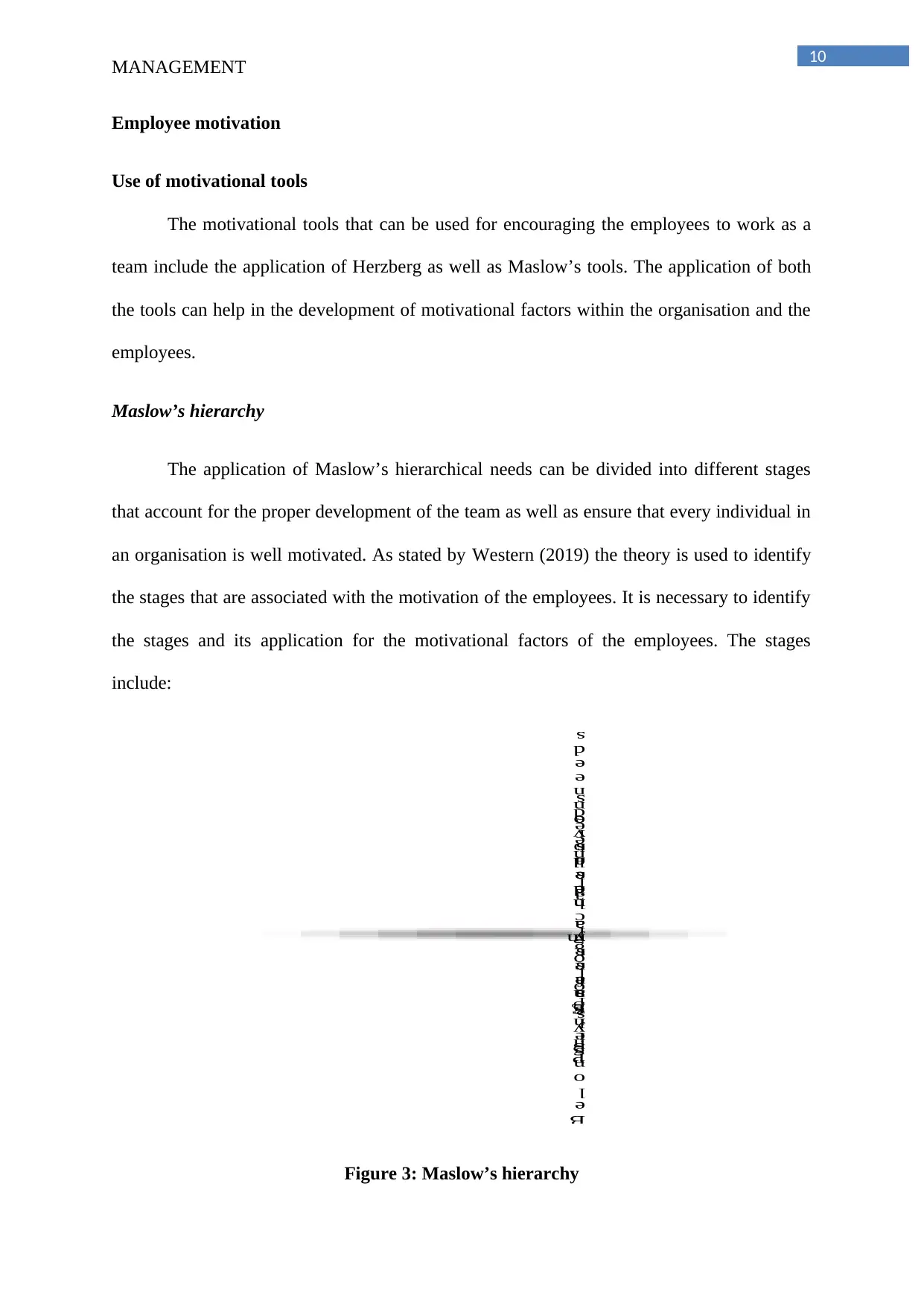
initiating and controlling the support of the team. At the same time, team formation can be
undertaken by using Tuckman’s theory of team development. According to Rosenbach
(2018), the team development theory of Tuckman, acknowledges the different stages that can
be associated with a group. The different team formation stage includes forming, storming,
norming, performing and adjourning. The characteristics include:
Stages of team formation Characteristics
Forming High dependence on leader for guidance as well as direction is
required to be provided. Leaders need to be prepared for asking
questions
Storming Decisions do not come easily within the group. The team
members remain at conflict with one another and this is
considered as a challenge for the leaders
Norming Agreement and consensus is formed among the groups. The
roles and responsibilities of each of the members are made clear
Performing Strategic awareness of the teams are developed with clarity of
the decisions that need to be taken and for sharing the vision and
mission of the organisation
Adjourning It is the breaking up the team so that every member can continue
separately in an organisation
Table 3: Tuckman’s team theory
(Source: De Jong, Dirks and Gillespie 2016)
MANAGEMENT
initiating and controlling the support of the team. At the same time, team formation can be
undertaken by using Tuckman’s theory of team development. According to Rosenbach
(2018), the team development theory of Tuckman, acknowledges the different stages that can
be associated with a group. The different team formation stage includes forming, storming,
norming, performing and adjourning. The characteristics include:
Stages of team formation Characteristics
Forming High dependence on leader for guidance as well as direction is
required to be provided. Leaders need to be prepared for asking
questions
Storming Decisions do not come easily within the group. The team
members remain at conflict with one another and this is
considered as a challenge for the leaders
Norming Agreement and consensus is formed among the groups. The
roles and responsibilities of each of the members are made clear
Performing Strategic awareness of the teams are developed with clarity of
the decisions that need to be taken and for sharing the vision and
mission of the organisation
Adjourning It is the breaking up the team so that every member can continue
separately in an organisation
Table 3: Tuckman’s team theory
(Source: De Jong, Dirks and Gillespie 2016)
Paraphrase This Document
Need a fresh take? Get an instant paraphrase of this document with our AI Paraphraser
10
MANAGEMENT
Employee motivation
Use of motivational tools
The motivational tools that can be used for encouraging the employees to work as a
team include the application of Herzberg as well as Maslow’s tools. The application of both
the tools can help in the development of motivational factors within the organisation and the
employees.
Maslow’s hierarchy
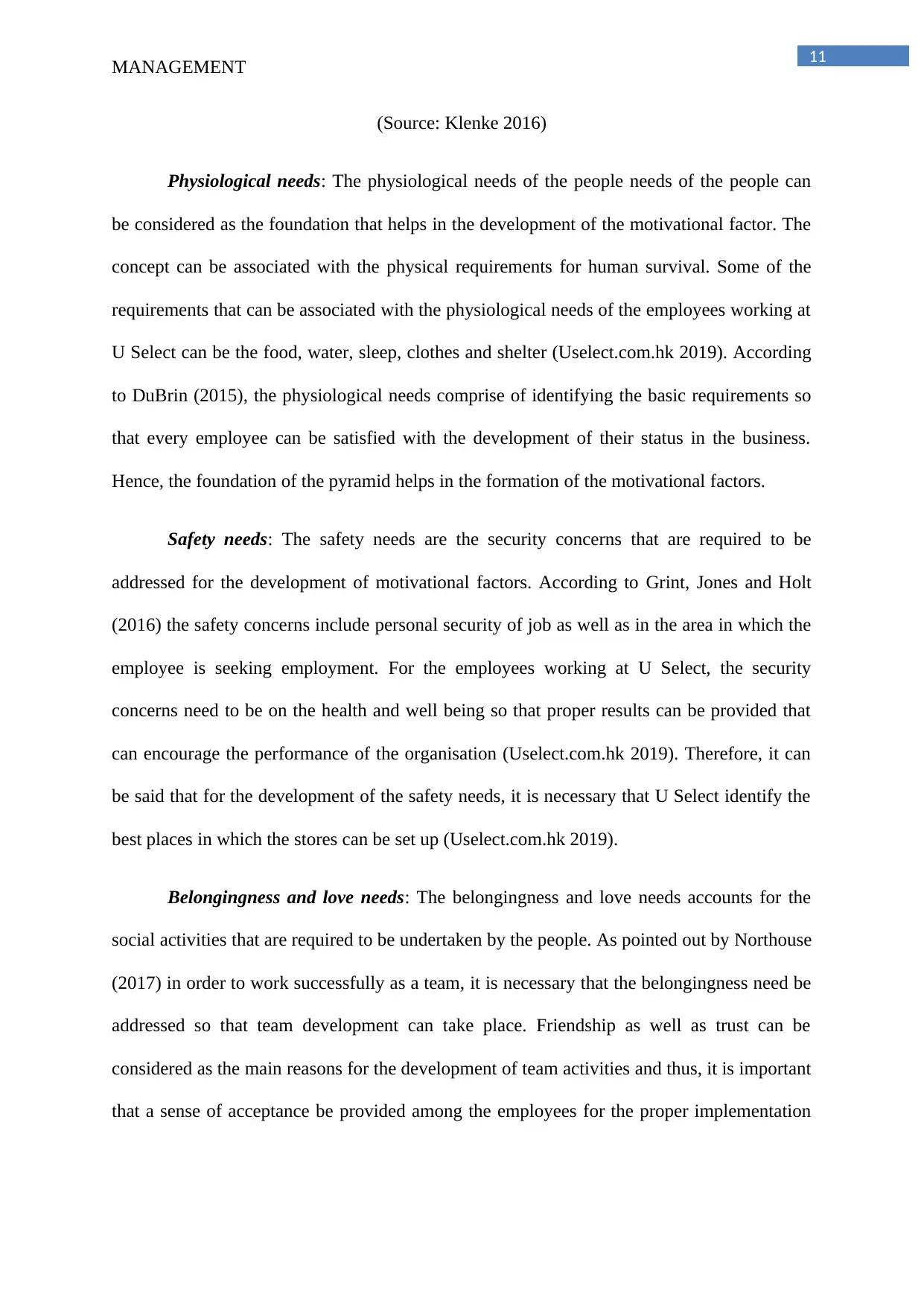
The application of Maslow’s hierarchical needs can be divided into different stages
that account for the proper development of the team as well as ensure that every individual in
an organisation is well motivated. As stated by Western (2019) the theory is used to identify
the stages that are associated with the motivation of the employees. It is necessary to identify
the stages and its application for the motivational factors of the employees. The stages
include:
Figure 3: Maslow’s hierarchy
S
e
l
f
a
c
t
u
a
l
i
s
a
t
i
o
n
E
s
t
e
e
m
n
e
e
d
s
B
e
l
o
n
g
i
n
g
n
e
s
s
a
n
d
l
o
v
e
n
e
e
d
s
S
a
f
e
t
y
n
e
e
d
s
P
h
y
s
i
o
l
o
g
i
c
a
l
n
e
e
d
s
MANAGEMENT
Employee motivation
Use of motivational tools
The motivational tools that can be used for encouraging the employees to work as a
team include the application of Herzberg as well as Maslow’s tools. The application of both
the tools can help in the development of motivational factors within the organisation and the
employees.
Maslow’s hierarchy
The application of Maslow’s hierarchical needs can be divided into different stages
that account for the proper development of the team as well as ensure that every individual in
an organisation is well motivated. As stated by Western (2019) the theory is used to identify
the stages that are associated with the motivation of the employees. It is necessary to identify
the stages and its application for the motivational factors of the employees. The stages
include:
Figure 3: Maslow’s hierarchy
S
e
l
f
a
c
t
u
a
l
i
s
a
t
i
o
n
E
s
t
e
e
m
n
e
e
d
s
B
e
l
o
n
g
i
n
g
n
e
s
s
a
n
d
l
o
v
e
n
e
e
d
s
S
a
f
e
t
y
n
e
e
d
s
P
h
y
s
i
o
l
o
g
i
c
a
l
n
e
e
d
s
11
MANAGEMENT
(Source: Klenke 2016)
Physiological needs: The physiological needs of the people needs of the people can
be considered as the foundation that helps in the development of the motivational factor. The
concept can be associated with the physical requirements for human survival. Some of the
requirements that can be associated with the physiological needs of the employees working at
U Select can be the food, water, sleep, clothes and shelter (Uselect.com.hk 2019). According
to DuBrin (2015), the physiological needs comprise of identifying the basic requirements so
that every employee can be satisfied with the development of their status in the business.
Hence, the foundation of the pyramid helps in the formation of the motivational factors.
Safety needs: The safety needs are the security concerns that are required to be
addressed for the development of motivational factors. According to Grint, Jones and Holt
(2016) the safety concerns include personal security of job as well as in the area in which the
employee is seeking employment. For the employees working at U Select, the security
concerns need to be on the health and well being so that proper results can be provided that
can encourage the performance of the organisation (Uselect.com.hk 2019). Therefore, it can
be said that for the development of the safety needs, it is necessary that U Select identify the
best places in which the stores can be set up (Uselect.com.hk 2019).
Belongingness and love needs: The belongingness and love needs accounts for the
social activities that are required to be undertaken by the people. As pointed out by Northouse
(2017) in order to work successfully as a team, it is necessary that the belongingness need be
addressed so that team development can take place. Friendship as well as trust can be
considered as the main reasons for the development of team activities and thus, it is important
that a sense of acceptance be provided among the employees for the proper implementation
MANAGEMENT
(Source: Klenke 2016)
Physiological needs: The physiological needs of the people needs of the people can
be considered as the foundation that helps in the development of the motivational factor. The
concept can be associated with the physical requirements for human survival. Some of the
requirements that can be associated with the physiological needs of the employees working at
U Select can be the food, water, sleep, clothes and shelter (Uselect.com.hk 2019). According
to DuBrin (2015), the physiological needs comprise of identifying the basic requirements so
that every employee can be satisfied with the development of their status in the business.
Hence, the foundation of the pyramid helps in the formation of the motivational factors.
Safety needs: The safety needs are the security concerns that are required to be
addressed for the development of motivational factors. According to Grint, Jones and Holt
(2016) the safety concerns include personal security of job as well as in the area in which the
employee is seeking employment. For the employees working at U Select, the security
concerns need to be on the health and well being so that proper results can be provided that
can encourage the performance of the organisation (Uselect.com.hk 2019). Therefore, it can
be said that for the development of the safety needs, it is necessary that U Select identify the
best places in which the stores can be set up (Uselect.com.hk 2019).
Belongingness and love needs: The belongingness and love needs accounts for the
social activities that are required to be undertaken by the people. As pointed out by Northouse
(2017) in order to work successfully as a team, it is necessary that the belongingness need be
addressed so that team development can take place. Friendship as well as trust can be
considered as the main reasons for the development of team activities and thus, it is important
that a sense of acceptance be provided among the employees for the proper implementation
⊘ This is a preview!⊘
Do you want full access?
Subscribe today to unlock all pages.
Trusted by 1+ million students worldwide

1 out of 23


Related Documents


Your All-in-One AI-Powered Toolkit for Academic Success.
+13062052269
info@desklib.com
Available 24*7 on WhatsApp / Email
![[object Object]](/_next/static/media/star-bottom.7253800d.svg)
Unlock your academic potential
Copyright © 2020–2026 A2Z Services. All Rights Reserved. Developed and managed by ZUCOL.