Cultural Diversity, Language Barriers & Healthcare in the UAE
VerifiedAdded on 2023/06/11
|9
|2930
|207
Report
AI Summary
This report explores the critical issues of language barriers and cultural diversity within the healthcare system of the UAE, where a multinational workforce interacts with a diverse patient population. It highlights the potential for miscommunication and adverse outcomes due to these barriers, emphasizing the necessity for cultural sensitivity and effective communication strategies. The report includes a personal reflection on an incident involving a language barrier, analyzed using Gibbs' Reflective Cycle and the Crescent of Care model. It further connects these issues to the Health Authority of Abu Dhabi's (HAAD) policies on cultural sensitivity and offers recommendations for improving cultural competence among healthcare professionals, such as implementing interpreter services, cultural awareness programs, and strategies for systemic cultural competence, to ensure high-quality, patient-centered care.
LANGUAGE BARRIERS
AND
CULTURAL DIVERSITY
AND
CULTURAL DIVERSITY

Paraphrase This Document
Need a fresh take? Get an instant paraphrase of this document with our AI Paraphraser
1
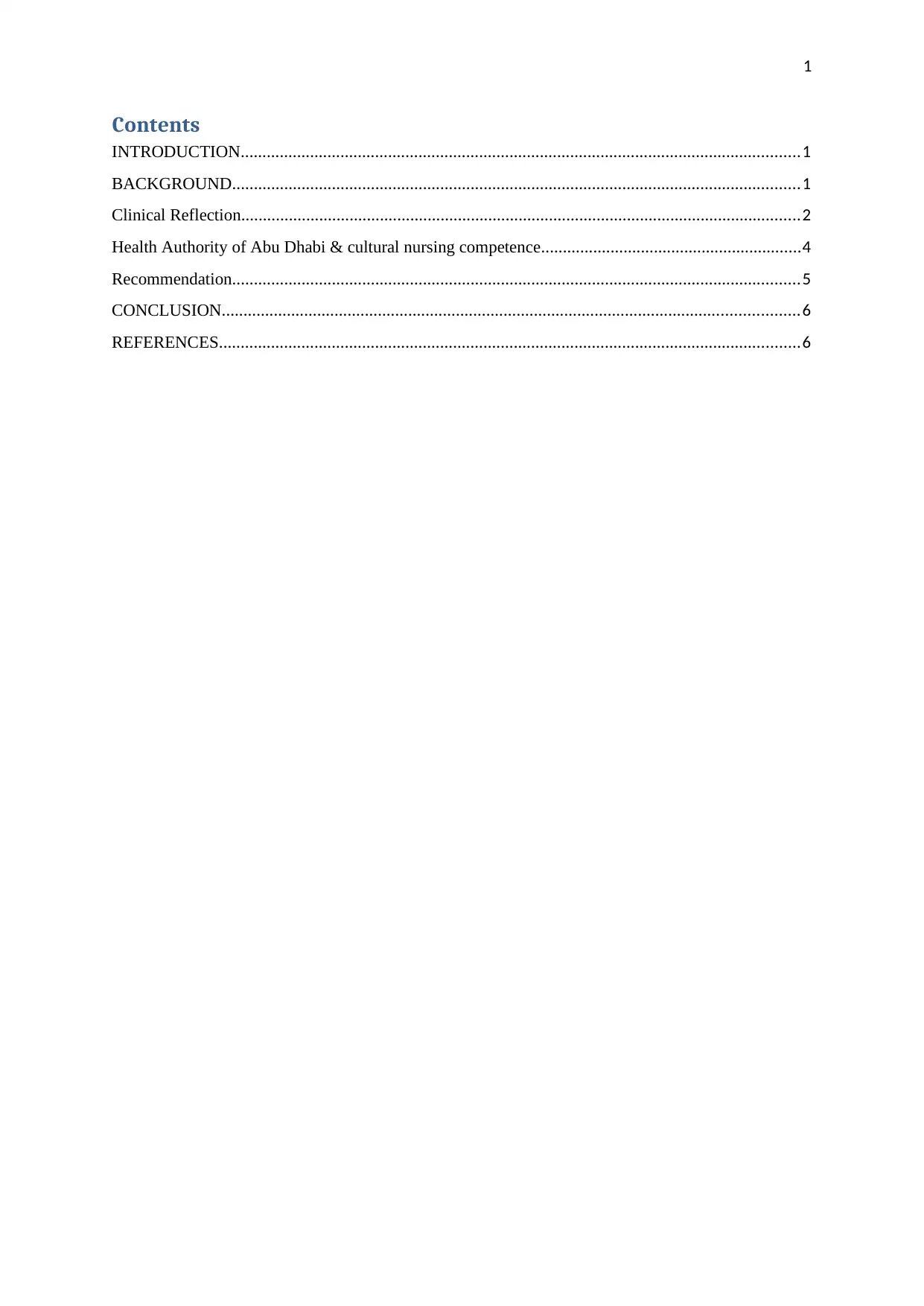
Contents
INTRODUCTION.................................................................................................................................1
BACKGROUND...................................................................................................................................1
Clinical Reflection.................................................................................................................................2
Health Authority of Abu Dhabi & cultural nursing competence............................................................4
Recommendation...................................................................................................................................5
CONCLUSION.....................................................................................................................................6
REFERENCES......................................................................................................................................6
Contents
INTRODUCTION.................................................................................................................................1
BACKGROUND...................................................................................................................................1
Clinical Reflection.................................................................................................................................2
Health Authority of Abu Dhabi & cultural nursing competence............................................................4
Recommendation...................................................................................................................................5
CONCLUSION.....................................................................................................................................6
REFERENCES......................................................................................................................................6
2
INTRODUCTION
Cultural diversity and language barrier always exist between the health care providers as well
as patients (El Ansari, Newbigging, Roth & Malik, 2009). This report somehow discusses the
necessity of recognising these two. Understanding the language and culture of the clients
coming to the patient care is highly important. This is more essential when there are huge
variances in the culture among the health care staffs and the patients. This is a sensitive topic
as miscommunication in the health sector may result in the misunderstanding which can
cause serious casualties or may cause death. Effective communication needs both language
knowledge as well as cultural awareness. Even when one is missed the whole communication
remains incomplete. The major aim of this report is to highlights the issues related to
language barrier in-between patients and multinational health care practitioners. It also
shows the UAE’s cultural diversity which is reflected through an experiences in the health
acre unit utilising Gibbs cycle. It also relates it with the crescent of care model and linking
the problem with Health Authority of Abu Dhabi.
BACKGROUND
From late 90’s it was seen that there was a considerable increase in the number of people that
are coming into UAE in the search of work (Delphin-Rittmon, Andres-Hyman, Flanagan &
Davidson, 2013). This can also be seen in the health care sector which resulted in the
requirement of skilled and experienced labour. This has enabled UAE to recruit a huge
number of people from different nations. Due to this the population of UAE has become very
diverse especially in terms of the diversity in cultural backgrounds, nationalities as well as
language that people speak. UAE’s official language is Arabic while there are many people
that spoke Hindi, English, Pashto, Persian and many more languages. With the diverse
population existing within the nation, it is always difficult to deliver a highly quality health
services (Hendson, Reis & Nicholas, 2015). This gets more difficult in the case of frontline
staffs, as they have to interact with the clients immediately. According to facts only 3% of the
registered nurses are Emirati and the rest others are expatriates. It shows that the diversity is
not only in terms of people living in the nation rather it is also present in the health care
staffs. In the next section of the report experienced incidents occurring because of language
barrier in the context of health care unit has been highlighted using Gibbs reflective cycle.
INTRODUCTION
Cultural diversity and language barrier always exist between the health care providers as well
as patients (El Ansari, Newbigging, Roth & Malik, 2009). This report somehow discusses the
necessity of recognising these two. Understanding the language and culture of the clients
coming to the patient care is highly important. This is more essential when there are huge
variances in the culture among the health care staffs and the patients. This is a sensitive topic
as miscommunication in the health sector may result in the misunderstanding which can
cause serious casualties or may cause death. Effective communication needs both language
knowledge as well as cultural awareness. Even when one is missed the whole communication
remains incomplete. The major aim of this report is to highlights the issues related to
language barrier in-between patients and multinational health care practitioners. It also
shows the UAE’s cultural diversity which is reflected through an experiences in the health
acre unit utilising Gibbs cycle. It also relates it with the crescent of care model and linking
the problem with Health Authority of Abu Dhabi.
BACKGROUND
From late 90’s it was seen that there was a considerable increase in the number of people that
are coming into UAE in the search of work (Delphin-Rittmon, Andres-Hyman, Flanagan &
Davidson, 2013). This can also be seen in the health care sector which resulted in the
requirement of skilled and experienced labour. This has enabled UAE to recruit a huge
number of people from different nations. Due to this the population of UAE has become very
diverse especially in terms of the diversity in cultural backgrounds, nationalities as well as
language that people speak. UAE’s official language is Arabic while there are many people
that spoke Hindi, English, Pashto, Persian and many more languages. With the diverse
population existing within the nation, it is always difficult to deliver a highly quality health
services (Hendson, Reis & Nicholas, 2015). This gets more difficult in the case of frontline
staffs, as they have to interact with the clients immediately. According to facts only 3% of the
registered nurses are Emirati and the rest others are expatriates. It shows that the diversity is
not only in terms of people living in the nation rather it is also present in the health care
staffs. In the next section of the report experienced incidents occurring because of language
barrier in the context of health care unit has been highlighted using Gibbs reflective cycle.
⊘ This is a preview!⊘
Do you want full access?
Subscribe today to unlock all pages.

Trusted by 1+ million students worldwide
3
Clinical Reflection
Here, I have taken use of Gibbs reflective cycle for reflecting on things that I have observed
in the practice at health care unit like the cultural nursing practice and language barrier. Gibbs
reflective cycle is also understood to be as the model of reflection (Johnson, 2015). Gibbs
reflective cycle comprises of six steps namely description, feeling, evaluation, analysis,
conclusion and action plan. The crescent of care model will be used to further explain the
analysis step.
Description
Beginning with the description stage and I will share the issue that occurred at Almafraq
hospital for a clinical placements in a medical room. At the time of my shift, an Indian patient
rang the bell and hence I reached his room and asked him what he needs. The person replied
in Urdu where he asked me to remove the intravenous fluid as he needed to loo. I was unable
to understand his requirements as he spoke in Urdu which I didn’t knew. I interpreted it like
if he wanted to discontinue the IV fluids and hence asking for removing it. When I asked
whether he knows English or Arabic, he replied a no. I even tried that IV is important and
will remove it when it’s not necessary. The patient become frustrated and said no need to
remove it. I immediately moved out and asked my preceptor who is luckily an Indian to
check the patient and understand what he is demanding for. When she arrived she was able to
understand the request and hence removed the IV fluid immediately.
Feelings
I was bit confused when the patient was talking in Urdu. It was slightly difficult for me to
understand what he demanded for even when I was trying very hard. This made me bit
nervous as well as upset especially when he looked angry. Anyway when my perception
arrived, I was relaxed and it resolved my tension as she understood the demand of his to go to
loo. Along with this I was little embarrassed because of the misunderstanding that took place.
This made me realise so as to why learning of various language is necessary for making the
communication effective at the same time prevent from any kind of misconceptions
(McCarthy, Cassidy, Graham & Tuohy, 2013).
Evaluation
The worst thing regarding the situation is that even when I was unable to understand URDU,
I did not call anyone for help in the start only. This led me to an embarrassing situation and
Clinical Reflection
Here, I have taken use of Gibbs reflective cycle for reflecting on things that I have observed
in the practice at health care unit like the cultural nursing practice and language barrier. Gibbs
reflective cycle is also understood to be as the model of reflection (Johnson, 2015). Gibbs
reflective cycle comprises of six steps namely description, feeling, evaluation, analysis,
conclusion and action plan. The crescent of care model will be used to further explain the
analysis step.
Description
Beginning with the description stage and I will share the issue that occurred at Almafraq
hospital for a clinical placements in a medical room. At the time of my shift, an Indian patient
rang the bell and hence I reached his room and asked him what he needs. The person replied
in Urdu where he asked me to remove the intravenous fluid as he needed to loo. I was unable
to understand his requirements as he spoke in Urdu which I didn’t knew. I interpreted it like
if he wanted to discontinue the IV fluids and hence asking for removing it. When I asked
whether he knows English or Arabic, he replied a no. I even tried that IV is important and
will remove it when it’s not necessary. The patient become frustrated and said no need to
remove it. I immediately moved out and asked my preceptor who is luckily an Indian to
check the patient and understand what he is demanding for. When she arrived she was able to
understand the request and hence removed the IV fluid immediately.
Feelings
I was bit confused when the patient was talking in Urdu. It was slightly difficult for me to
understand what he demanded for even when I was trying very hard. This made me bit
nervous as well as upset especially when he looked angry. Anyway when my perception
arrived, I was relaxed and it resolved my tension as she understood the demand of his to go to
loo. Along with this I was little embarrassed because of the misunderstanding that took place.
This made me realise so as to why learning of various language is necessary for making the
communication effective at the same time prevent from any kind of misconceptions
(McCarthy, Cassidy, Graham & Tuohy, 2013).
Evaluation
The worst thing regarding the situation is that even when I was unable to understand URDU,
I did not call anyone for help in the start only. This led me to an embarrassing situation and
Paraphrase This Document
Need a fresh take? Get an instant paraphrase of this document with our AI Paraphraser
4
also it was also frustrating for the patients as understood the condition in some other manner.
The positive about the incident was that I understood how bad can be language barrier in
understanding the situation and way it affects the quality of the services related with health
care services (Policy on Cultural Sensitivity and Awareness in Healthcare Facilities, 2012).
Analysis
The condition could have degraded further if I would not have called my preceptor. It was
possible that patient gets angrier over the situation and due to anxiety he would have pulled
the cannula for going to the washroom. Language barriers are always frustrating and results
in communicational errors along with psychological stress for the patients that already
anxious. Furthermore, having knowledge regarding the different languages is very crucial in
the health care setting especially for eliminating the problems related with misunderstanding
when the hospital staffs and the clients spoke different languages (Wollin & Fairweather,
2012). It is also evident that even when the patient has insufficient knowledge regarding any
language such communicational gap occurs. Whenever there is lag in the information
transfer, it may lead to uncertainty and health risks.
The person is not an Arabic person but still a Muslim and hence crescent of care model may
be implemented on him. This model is a guide which suggests the nurses to meet the
interpersonal, spiritual, clinical, cultural and psychosocial requirements of the patients. In this
family is placed at the centre of the care. As this is the issue related to the language barrier
hence I will be concentrating on the interpersonal care that is having the focus on the
communicational patterns. In Islam, the communication among the Muslim is affected by the
gender (Yeok, 2007). In this religion, we as a person have to respect others whom we are
talking with irrespective of the language, colour or religion they are from.
Conclusion
While analysing the situation I concluded that in future I would be many things in a slightly
different manner. Firstly, I would ask whether the person speaks English or Arabic. If he
replies no, I would ask a help from someone else who has a better understanding of the same
language. According to the conversations I have had with non-Arabic nurses in the hospital
having the experience of more than 4 years, this solution was widely prevalent among the
nurses in order to overcome the language barriers. If there is no one who could help me with
the same language in the same shift, I would ask the help from the translation service or I
also it was also frustrating for the patients as understood the condition in some other manner.
The positive about the incident was that I understood how bad can be language barrier in
understanding the situation and way it affects the quality of the services related with health
care services (Policy on Cultural Sensitivity and Awareness in Healthcare Facilities, 2012).
Analysis
The condition could have degraded further if I would not have called my preceptor. It was
possible that patient gets angrier over the situation and due to anxiety he would have pulled
the cannula for going to the washroom. Language barriers are always frustrating and results
in communicational errors along with psychological stress for the patients that already
anxious. Furthermore, having knowledge regarding the different languages is very crucial in
the health care setting especially for eliminating the problems related with misunderstanding
when the hospital staffs and the clients spoke different languages (Wollin & Fairweather,
2012). It is also evident that even when the patient has insufficient knowledge regarding any
language such communicational gap occurs. Whenever there is lag in the information
transfer, it may lead to uncertainty and health risks.
The person is not an Arabic person but still a Muslim and hence crescent of care model may
be implemented on him. This model is a guide which suggests the nurses to meet the
interpersonal, spiritual, clinical, cultural and psychosocial requirements of the patients. In this
family is placed at the centre of the care. As this is the issue related to the language barrier
hence I will be concentrating on the interpersonal care that is having the focus on the
communicational patterns. In Islam, the communication among the Muslim is affected by the
gender (Yeok, 2007). In this religion, we as a person have to respect others whom we are
talking with irrespective of the language, colour or religion they are from.
Conclusion
While analysing the situation I concluded that in future I would be many things in a slightly
different manner. Firstly, I would ask whether the person speaks English or Arabic. If he
replies no, I would ask a help from someone else who has a better understanding of the same
language. According to the conversations I have had with non-Arabic nurses in the hospital
having the experience of more than 4 years, this solution was widely prevalent among the
nurses in order to overcome the language barriers. If there is no one who could help me with
the same language in the same shift, I would ask the help from the translation service or I
5
would ask the help from the nurse from other ward who is from the same culture as of
patient’s culture. I have understood that we need to give care to the patients that are
congruent to their culture and are competent enough to meet the needs of the hospital. I also
realised that I need to study the familiar culture in the United Arab Emirates especially to
study reading the significant and simple words to help the communication (El-Amouri and
O’Neill, 2011). The nurse whom I have interviewed in the start said that I did not have any
knowledge regarding the Arabic language. For the help she just learnt some of the words that
would help her in her day to day service like toilet, motivation, drinking, eating, medication,
pain etc.
Action plan
In the coming time, I must ensure that I will be giving care that is culturally competent
especially in terms of communication so as to avoid mistakes at the hospital where patients
come from multiple nations here in UAE. If there is no body available from the translation
services, I would seek help from the nurses from other ward having the same nationality.
Adding to this, for becoming culturally sensitive and competent, I would be attending an
orientation program which finds the religious beliefs and the cultural diversity of the patients
from different nations in the health care organisations (Loney et. al., 2013).
Cultural nursing competence & Health Authority of Abu Dhabi
HAAD or Health Authority of Abu Dhabi had been conducted a policy on the cultural
sensitivity as well as alertness in the facilities of hospital. This is implemented to all the
health care facilities and the professionals that are licensed through HAAD. The goal of these
policies are to make sure that all the hospital staffs mainly nurses who are working at
hospitals have a knowledge regarding different cultures and the way the in which language
barriers impact on their services as well as the patients responds to the health care services.
This policy suggests that being competent and culturally sensitive is essential in providing
high quality services and hence taking out the positive health results. It is also to be
understood that being cultural attributes does not only mean being from different nationality
or race rather it also involves religion, language, socio-economic status and gender.
Therefore, HAAD needs to have an interpretation service which must be available with the
patients and their families for interpreting their language and removing such barriers. Further,
HAAD needs to look at the efficiency of translation services is linked with clinical practices
would ask the help from the nurse from other ward who is from the same culture as of
patient’s culture. I have understood that we need to give care to the patients that are
congruent to their culture and are competent enough to meet the needs of the hospital. I also
realised that I need to study the familiar culture in the United Arab Emirates especially to
study reading the significant and simple words to help the communication (El-Amouri and
O’Neill, 2011). The nurse whom I have interviewed in the start said that I did not have any
knowledge regarding the Arabic language. For the help she just learnt some of the words that
would help her in her day to day service like toilet, motivation, drinking, eating, medication,
pain etc.
Action plan
In the coming time, I must ensure that I will be giving care that is culturally competent
especially in terms of communication so as to avoid mistakes at the hospital where patients
come from multiple nations here in UAE. If there is no body available from the translation
services, I would seek help from the nurses from other ward having the same nationality.
Adding to this, for becoming culturally sensitive and competent, I would be attending an
orientation program which finds the religious beliefs and the cultural diversity of the patients
from different nations in the health care organisations (Loney et. al., 2013).
Cultural nursing competence & Health Authority of Abu Dhabi
HAAD or Health Authority of Abu Dhabi had been conducted a policy on the cultural
sensitivity as well as alertness in the facilities of hospital. This is implemented to all the
health care facilities and the professionals that are licensed through HAAD. The goal of these
policies are to make sure that all the hospital staffs mainly nurses who are working at
hospitals have a knowledge regarding different cultures and the way the in which language
barriers impact on their services as well as the patients responds to the health care services.
This policy suggests that being competent and culturally sensitive is essential in providing
high quality services and hence taking out the positive health results. It is also to be
understood that being cultural attributes does not only mean being from different nationality
or race rather it also involves religion, language, socio-economic status and gender.
Therefore, HAAD needs to have an interpretation service which must be available with the
patients and their families for interpreting their language and removing such barriers. Further,
HAAD needs to look at the efficiency of translation services is linked with clinical practices
⊘ This is a preview!⊘
Do you want full access?
Subscribe today to unlock all pages.
Trusted by 1+ million students worldwide
6
(Mathew et. al., 2013). Health Authority of Abu Dhabi also finds few of the needs of
professional and personal development of the nurses for enhancing their capability of
delivering the culturally matching care to the people as well as to help the communication.
For instance, Health Authority of Abu Dhabi promotes the hospital workers to find the
diversity related to culture along with the language differences for making sure that all the
patients are treated with sensitivity, respect and dignity. Adding to this, HAAD commands
the new staff to attend the orientation process regarding the language in UAE and the
acceptable cultural norms and believes in UAE. However an annual progress report shall be
made by the health settings to document the development of the alertness among the staffs
especially regarding the language and culture of the community of United Arab Emirates.
Recommendation
For ensuring the culture based health care service various strategies to encourage and sustains
systemic cultural competence must be used. At first, it is recommended to distribute the
guidelines and standards of the cultural competence all across the health care systems.
Further, to ensure multicultural change, it is beneficial to use accountability strategies.
Another point is to accomplish assessment of culture which also involves patient’s
satisfaction assessment. Adding to this interpretation service should not only assist in Arabic
or English rather it must be able to sort out the problems related to all the multinational
people living in UAE (El Amouri & O’Neill, 2014). The translation must also be in terms of
clinical practices not only the general translations so that problems of the patients can be
addressed. It is not possible for the staffs to learn so many languages hence they could learn
some of the words that are important in care services. Taking use of the visual aids like signs,
symbols, written cards, pictures, translation books or videos can be highly beneficial in this
regards. Written prescriptions should also be available in different languages so that patients
can also understand the medication requirements.
CONCLUSION
From the above paper it can be concluded that cultural difference and language barriers
makes the health care services poor. Misunderstanding or miscommunication can be threat to
life. UAE has citizen from different cultural backgrounds hence the hospital also needs to
provide cultural health care services. Use of translation can be very effective along with the
training of the staffs.
(Mathew et. al., 2013). Health Authority of Abu Dhabi also finds few of the needs of
professional and personal development of the nurses for enhancing their capability of
delivering the culturally matching care to the people as well as to help the communication.
For instance, Health Authority of Abu Dhabi promotes the hospital workers to find the
diversity related to culture along with the language differences for making sure that all the
patients are treated with sensitivity, respect and dignity. Adding to this, HAAD commands
the new staff to attend the orientation process regarding the language in UAE and the
acceptable cultural norms and believes in UAE. However an annual progress report shall be
made by the health settings to document the development of the alertness among the staffs
especially regarding the language and culture of the community of United Arab Emirates.
Recommendation
For ensuring the culture based health care service various strategies to encourage and sustains
systemic cultural competence must be used. At first, it is recommended to distribute the
guidelines and standards of the cultural competence all across the health care systems.
Further, to ensure multicultural change, it is beneficial to use accountability strategies.
Another point is to accomplish assessment of culture which also involves patient’s
satisfaction assessment. Adding to this interpretation service should not only assist in Arabic
or English rather it must be able to sort out the problems related to all the multinational
people living in UAE (El Amouri & O’Neill, 2014). The translation must also be in terms of
clinical practices not only the general translations so that problems of the patients can be
addressed. It is not possible for the staffs to learn so many languages hence they could learn
some of the words that are important in care services. Taking use of the visual aids like signs,
symbols, written cards, pictures, translation books or videos can be highly beneficial in this
regards. Written prescriptions should also be available in different languages so that patients
can also understand the medication requirements.
CONCLUSION
From the above paper it can be concluded that cultural difference and language barriers
makes the health care services poor. Misunderstanding or miscommunication can be threat to
life. UAE has citizen from different cultural backgrounds hence the hospital also needs to
provide cultural health care services. Use of translation can be very effective along with the
training of the staffs.
Paraphrase This Document
Need a fresh take? Get an instant paraphrase of this document with our AI Paraphraser
7
REFERENCES
Delphin-Rittmon, M. E., Andres-Hyman, R., Flanagan, E. H., & Davidson, L. (2013). Seven
essential strategies for promoting and sustaining systemic cultural competence. The
Psychiatric Quarterly, 84(1), 53-64. doi:10.1007/s11126-012-9226-2
El Amouri, S. & O’Neill, S., (2014) Leadership style and culturally competent care: Nurse
leaders’ views of their practice in the multicultural care settings of the United Arab
Emirates. Contemporary nurse, 48(2), pp.135-149.
El Ansari, W., Newbigging, K., Roth, C., & Malik, F. (2009) The role of advocacy and
interpretation services in the delivery of quality healthcare to diverse minority
communities in London, United Kingdom. Health & Social Care In The Community,
17(6), 636-646 11p. doi:10.1111/j.1365-2524.2009.00867.x
El-Amouri, S. & O’Neill, S., (2011). Supporting cross-cultural communication and culturally
competent care in the linguistically and culturally diverse hospital settings of
UAE. Contemporary Nurse, 39(2), pp.240-255.
Hendson, L., Reis, M. D., & Nicholas, D. B. (2015). Health Care Providers' Perspectives of
Providing Culturally Competent Care in the NICU. JOGNN: Journal Of Obstetric,
Gynecologic & Neonatal Nursing, 44(1), 17-27 11p. doi:10.1111/1552-6909.12524
Johnson, R. M. (2015). The changing face of patient care: delivering patient-centered and
culturally competent care in an evolving world. Delaware Medical Journal, 87(3), 85-
87.
Loney, T., Aw, T.C., Handysides, D.G., Ali, R., Blair, I., Grivna, M., Shah, S.M., Sheek-
Hussein, M., El-Sadig, M., Sharif, A.A., …El-Obaid, Y. (2013). An analysis of the
health status of the United Arab Emirates: the ‘Big 4’public health issues. Global
health action, 6(1), p.20100.
Mathew, E., Muttappallymyalil, J., Sreedharan, J., John, L.J., John, J., Mehboob, M., …
Mathew, A. (2013). Self-reported use of complementary and alternative medicine
among the health care consumers at a tertiary care center in Ajman, United Arab
Emirates. Annals of medical and health sciences research, 3(2), p.215.
REFERENCES
Delphin-Rittmon, M. E., Andres-Hyman, R., Flanagan, E. H., & Davidson, L. (2013). Seven
essential strategies for promoting and sustaining systemic cultural competence. The
Psychiatric Quarterly, 84(1), 53-64. doi:10.1007/s11126-012-9226-2
El Amouri, S. & O’Neill, S., (2014) Leadership style and culturally competent care: Nurse
leaders’ views of their practice in the multicultural care settings of the United Arab
Emirates. Contemporary nurse, 48(2), pp.135-149.
El Ansari, W., Newbigging, K., Roth, C., & Malik, F. (2009) The role of advocacy and
interpretation services in the delivery of quality healthcare to diverse minority
communities in London, United Kingdom. Health & Social Care In The Community,
17(6), 636-646 11p. doi:10.1111/j.1365-2524.2009.00867.x
El-Amouri, S. & O’Neill, S., (2011). Supporting cross-cultural communication and culturally
competent care in the linguistically and culturally diverse hospital settings of
UAE. Contemporary Nurse, 39(2), pp.240-255.
Hendson, L., Reis, M. D., & Nicholas, D. B. (2015). Health Care Providers' Perspectives of
Providing Culturally Competent Care in the NICU. JOGNN: Journal Of Obstetric,
Gynecologic & Neonatal Nursing, 44(1), 17-27 11p. doi:10.1111/1552-6909.12524
Johnson, R. M. (2015). The changing face of patient care: delivering patient-centered and
culturally competent care in an evolving world. Delaware Medical Journal, 87(3), 85-
87.
Loney, T., Aw, T.C., Handysides, D.G., Ali, R., Blair, I., Grivna, M., Shah, S.M., Sheek-
Hussein, M., El-Sadig, M., Sharif, A.A., …El-Obaid, Y. (2013). An analysis of the
health status of the United Arab Emirates: the ‘Big 4’public health issues. Global
health action, 6(1), p.20100.
Mathew, E., Muttappallymyalil, J., Sreedharan, J., John, L.J., John, J., Mehboob, M., …
Mathew, A. (2013). Self-reported use of complementary and alternative medicine
among the health care consumers at a tertiary care center in Ajman, United Arab
Emirates. Annals of medical and health sciences research, 3(2), p.215.
8
McCarthy, J., Cassidy, I., Graham, M. M., & Tuohy, D. (2013) Conversations through
barriers of language and interpretation. British Journal Of Nursing, 22(6), 335-339
5p.
Policy on Cultural Sensitivity and Awareness in Healthcare Facilities. (2012, June).
Retrieved January 29, 2016, from Health Authority of Abu Dhabi:
http://www.haad.ae/haad/tabid/37/Default.aspx?Search=cultural+competent+care
Wollin, J. A., & Fairweather, C. T. (2012). Nursing education: a case study of a Bachelor of
Science Nursing programme in Abu Dhabi, United Arab Emirates. Journal Of
Nursing Management, 20(1), 20-27 8p. doi:10.1111/j.1365-2834.2011.01298.x
Yeok, K. (2007). Case study: Gibbs' reflective cycle on the ventilator care bundle. Singapore
Nursing Journal, 34(3), 63-72 10p.
McCarthy, J., Cassidy, I., Graham, M. M., & Tuohy, D. (2013) Conversations through
barriers of language and interpretation. British Journal Of Nursing, 22(6), 335-339
5p.
Policy on Cultural Sensitivity and Awareness in Healthcare Facilities. (2012, June).
Retrieved January 29, 2016, from Health Authority of Abu Dhabi:
http://www.haad.ae/haad/tabid/37/Default.aspx?Search=cultural+competent+care
Wollin, J. A., & Fairweather, C. T. (2012). Nursing education: a case study of a Bachelor of
Science Nursing programme in Abu Dhabi, United Arab Emirates. Journal Of
Nursing Management, 20(1), 20-27 8p. doi:10.1111/j.1365-2834.2011.01298.x
Yeok, K. (2007). Case study: Gibbs' reflective cycle on the ventilator care bundle. Singapore
Nursing Journal, 34(3), 63-72 10p.
⊘ This is a preview!⊘
Do you want full access?
Subscribe today to unlock all pages.
Trusted by 1+ million students worldwide

1 out of 9


Related Documents


Your All-in-One AI-Powered Toolkit for Academic Success.
+13062052269
info@desklib.com
Available 24*7 on WhatsApp / Email
![[object Object]](/_next/static/media/star-bottom.7253800d.svg)
Unlock your academic potential
Copyright © 2020–2025 A2Z Services. All Rights Reserved. Developed and managed by ZUCOL.